
Instructor Resource
Rowe, Cases in Leadership 5e
SAGE Publications, Inc., 2019
Case Notes
Case 1.2: House, Hearth and Home: Managing Leadership Change
Karen MacMillan and Meredith Woodwark wrote this teaching note as an aid to instructors in
the classroom use of the case House, Hearth and Home: Managing Leadership Change, No.
9B12C048. This teaching note should not be used in any way that would prejudice the future use
of the case.
Richard Ivey School of Business Foundation prohibits any form of reproduction, storage or
transmission without its written permission. Reproduction of this material is not covered under
authorization by any reproduction rights organization. To order copies or request permission to
reproduce materials, contact Ivey Publishing, Richard Ivey School of Business Foundation, The
Teaching Note
Synopsis
The owner and general manager of a large retail establishment faced a dilemma about whether
his long-time yard manager was still the right person for the job. The business increasingly
depended on providing superior customer service in order to compete in the market. Recently,
the owner had placed a personal friend as assistant yard manager, and he had shown a real talent
for developing employees and driving performance improvements. As a result, customer service
feedback had drastically improved. The owner realized that the assistant had become the real
leader of the yard. He wondered how to keep the momentum of the changes going while still
showing due respect to a loyal employee.
The case could be used effectively in both undergraduate and graduate courses/modules on
leadership, strategic human resources, change management, services management, employee
motivation and performance management and managerial decision making.
Learning Objectives
This case will help students improve their understanding of several important aspects of
leadership theory and practice, including leadership versus management, leadership styles,
strategic human resource (HR) strategy, conflict management approaches, the challenges of
workplace friendships and successfully implementing contentious decisions.
• A business’s competitive strategy influences its HR management strategy. House, Hearth
and Home is a retailer offering products that are undifferentiated from those offered by its
big box store competition. Because the large-scale organizations can offer greater
selection at a lower cost, House, Hearth and Home must set itself apart by providing
exceptional customer value through relationship building and high service levels. This
case highlights how the store’s HR management strategy must be aligned with its
business strategy in order to be successful at delivering exceptional customer service.
Instructor Resource
Rowe, Cases in Leadership 5e
SAGE Publications, Inc., 2019
• Another way of looking at the key decision in the case is through the lens of leadership
employee influences the managerial decision and how it should be handled.
• Challenging business decisions need to be considered in terms of their potential
consequences. In addition to the factors above, this decision also requires a consideration
of organizational justice, future employee motivation and morale, potential psychological
Useful associated readings include:
1. Heskett, J. L., & Schlesinger, L. (1994). Putting the service-profit chain to work. Harvard
Business Review, 72(2), 164–174.
2. Kotter, J. P. (2001). What leaders really do. Harvard Business Review, 79(11), 25–33.
3. Heifetz, R. A., & Laurie, D. L. (2001). The work of leadership. Harvard Business
Review, 79(11), 35–47.
4. Rooke, D., & Torbert, W. R. (2005). Seven transformations of leadership. Harvard
Business Review, 83(4), 66–76.
5. Treacy, M., & Wiersema, F. (1993). Customer intimacy and other value disciplines.
Harvard Business Review, 71, 84–93.
Research Methods
This case was developed from field research. Interviews and site visits were conducted over a
period of several weeks. The names of the retail store, the owner and the employees have been
changed. However, none of the relevant facts of the case were altered.
Assignment Questions and Answers
1. Describe House, Hearth and Home’s competitive business strategy. How does it
differentiate itself from its competitors? What are the HR implications of this competitive
position? Provide examples from the case.
2. a) Contrast the different approaches Dan Boyd and Wesley Simpson take with low
performing employees. Which do you think is more effective?
b) Do you think there is a difference between being a manager and being a leader? Why
or why not? If so, how are they different?
3. How has Boyd been able to accomplish so much in such a little time? Why has Simpson
not been able to?
1. Describe House, Hearth and Home’s competitive business strategy. How does it
differentiate itself from its competitors? What are the HR implications of this competitive
position? Provide examples from the case.
House, Hearth and Home is a retailer offering products that are undifferentiated from those
offered by its big box store competition. Because the competition often offers greater selection at
a lower cost, House, Hearth and Home must provide customer value by stressing its customer
Instructor Resource
Rowe, Cases in Leadership 5e
SAGE Publications, Inc., 2019
Instructor Resource
Rowe, Cases in Leadership 5e
SAGE Publications, Inc., 2019
2. (a) Contrast the different approaches Boyd and Simpson take with low performing
employees. Which do you think is more effective?
84–84.
5 Ahearne, M., Mathieu, J., & Rapp, A. (2005). To empower or not to empower your sales force? An empirical
164–174.
Instructor Resource
Rowe, Cases in Leadership 5e
SAGE Publications, Inc., 2019
The case clearly indicates that Simpson’s tendency is to avoid confrontations with low
performing employees, preferring to accommodate or avoid employees rather than correcting
their behavior. Simpson only confronts employees when instructed to do so by Coglin.
Instructor Resource
Rowe, Cases in Leadership 5e
SAGE Publications, Inc., 2019
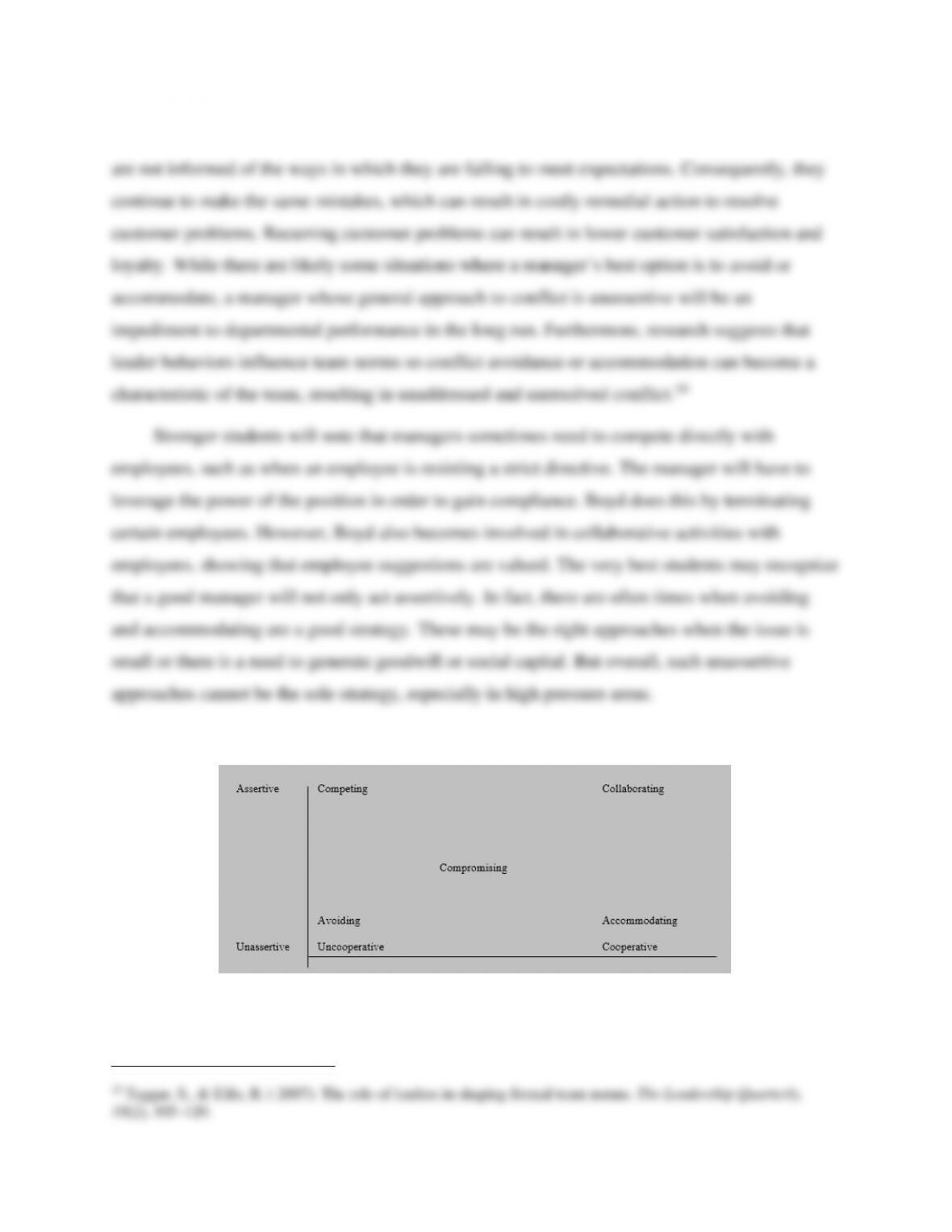
Figure 1: Dual Concerns Model
2. (b) Do you think there is a difference between being a manager and being a leader? Why
or why not?
Instructor Resource
Rowe, Cases in Leadership 5e
SAGE Publications, Inc., 2019
Management and Leadership Distinct
From this point of view, the case portrays Simpson as a manager but not a leader. According to
Kotter, the role of managers is to promote stability and predictability in an organization as a
11 Zaleznik, A. (1977, May-June). Managers and leaders: Are they different? Harvard Business Review, 55, 67–78.
Instructor Resource
Rowe, Cases in Leadership 5e
SAGE Publications, Inc., 2019
Management and Leadership Continuum
Rather than making a strong division between management and leadership, some theorists
propose that there is a development continuum along which people move from less developed
levels of leadership (akin to the descriptions of management) to more developed levels.16 Rooke
and Torbert propose a seven level model of leadership:
Instructor Resource
Rowe, Cases in Leadership 5e
SAGE Publications, Inc., 2019
3. How has Boyd been able to accomplish so much in such a little time?
Boyd has a transformational leadership style. This is characterized by individualized
consideration (showing concern for the needs of each employee, coaching towards personal
goals); idealized influence, also known as charisma (appealing to emotions, role modeling the
Instructor Resource
Rowe, Cases in Leadership 5e
SAGE Publications, Inc., 2019