MANAGEMENT, 13TH EDITION
BY STEPHEN ROBBINS & MARY COULTER
INSTRUCTOR MANUAL
PREPARED BY:
JEFFREY ANDERSON
SENIOR LECTURER, MANAGEMENT
OHIO UNIVERSITY
PREFACE
As instructors, we know that teaching tomorrow’s managers can be a daunting task.
With all of the information available from authors, publishers, the Internet, and our own
studies, it can be difficult to sort through everything to deliver a good product to our
students. To help, we have provided instructors with a clear and concise manual for
teaching with the thirteenth edition of Management, by Stephen Robbins and Mary
Coulter.
The instructor manual provides chapter specific resources that address the learning
KEY CHANGES TO THE 13TH EDITION
Here are some of the main changes made in the 13th edition:
• A Future Vision feature is found in each chapter, giving a sneak peak at what the
work world may look like for your students.
• A Personal Inventory Assessment (PIA) has been included in each chapter.
• The decision-making chapter has been moved to the introductory Part 1 because
everything a manager does involves decision-making.
• Part 2 has been expanded to include chapters dealing with the basics of
managing in today’s workplace—environment/culture (Chapter 3), global scope
(Chapter 4), diversity (Chapter 5), social responsibility/ethics (Chapter 6), and
MYMANAGEMENTLAB SUGGESTED ACTIVITIES
For the 13th edition, Pearson’s MyManagementLab has been integrated fully into the
text. These new features are outlined below. Making assessment activities available
Watch It
Recommends a video clip that can be assigned to students for outside classroom
Try It
Recommends a mini simulation that can be assigned to students as an outside
classroom activity or be done in the classroom. As the students watch the simulation,
they will be asked to make choices based on the scenario presented in the simulation. At
Talk About It
These are discussion-type questions that can be assigned as an activity within the
classroom.
Personal Inventory Assessments
Students learn better when they can connect what they are learning to their personal
experience. PIA (Personal Inventory Assessments) is a collection of online exercises
designed to promote self-reflection and engagement in students, enhancing their ability
to connect with concepts taught in principles of management, organizational behavior,
Assisted-Graded Writing Questions
These are short essay questions that the students can complete as an assignment and
submit to you, the professor, for grading.
SAMPLE COURSE SYLLABUS
COURSE TITLE: PRINCIPLES OF MANAGEMENT
————————————————————————————————————
Class Times & Location:
Course Web Site:
Instructor Information:
Office & Office Hours:
————————————————————————————————————
COURSE DESCRIPTION:
This course serves as an introduction to the discipline of management. It is designed to
integrate the accepted theories in the area with real world applications to provide
students with the basic knowledge and skills needed for managing others. This course
begins with a discussion of the current issues in management and then proceeds to
COURSE OBJECTIVES
By the end of the course, students should be able to identify the principals of managing
formal organizations, recognize the various challenges faced by today’s managers, and
give examples of organizations engaging in the management functions of planning,
organizing, leading, and controlling.
RESOURCES
TEXTBOOK: Management, 13th Edition by S. Robbins and M. Coulter, published
by Pearson Education.
necessary.
COURSE COMPONENTS
EXAMS: A designated number of exams and a final exam will test students’
understanding of the materials discussed in class and in the assigned readings.
ONLINE ASSIGNMENTS: These assignments consist of assisted writing problems
and personal inventory assessments through MyManagementLab.
iv
exercises. For these exercises, students will be required to be actively involved
to receive credit – i.e. making substantive comments, answering questions, and
GRADING
Percentage Points
Online Assignments (10 at 10 points each) 20% 100
NOTE:
• Class attendance and participation in class discussion is expected and
absences will affect your final grade.
• The due dates for assignments are non-negotiable and late work will be
COURSE POLICIES
CLASSROOM BEHAVIOR: Classroom behavior that interferes with either the instructor’s
ability to conduct the class or the ability of students to benefit from the instruction is not
ACADEMIC HONESTY AND APPEALS: Students are expected to maintain the highest
standards of academic integrity. Behavior that violates these standards is not
acceptable. Examples are the use of unauthorized material, communication with fellow
v
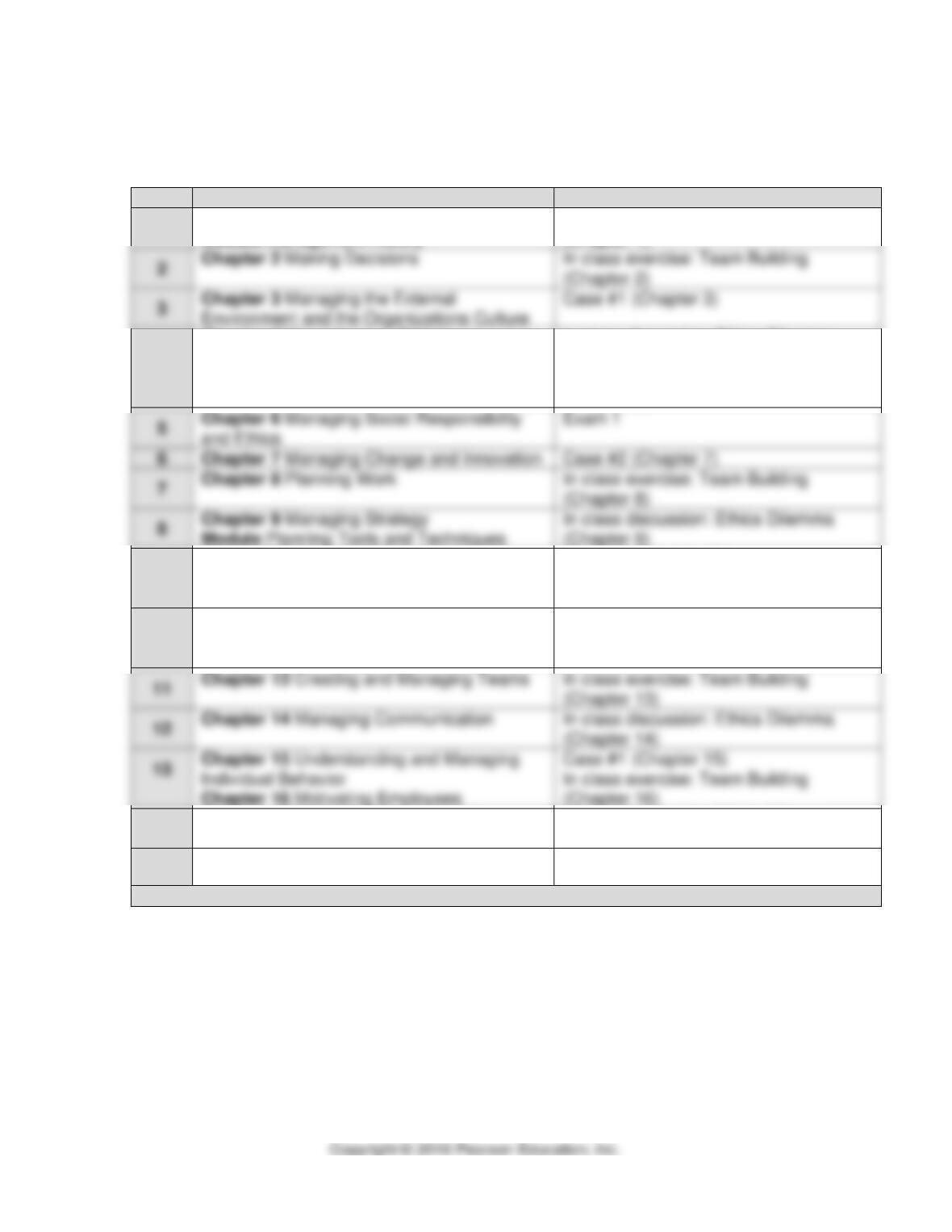
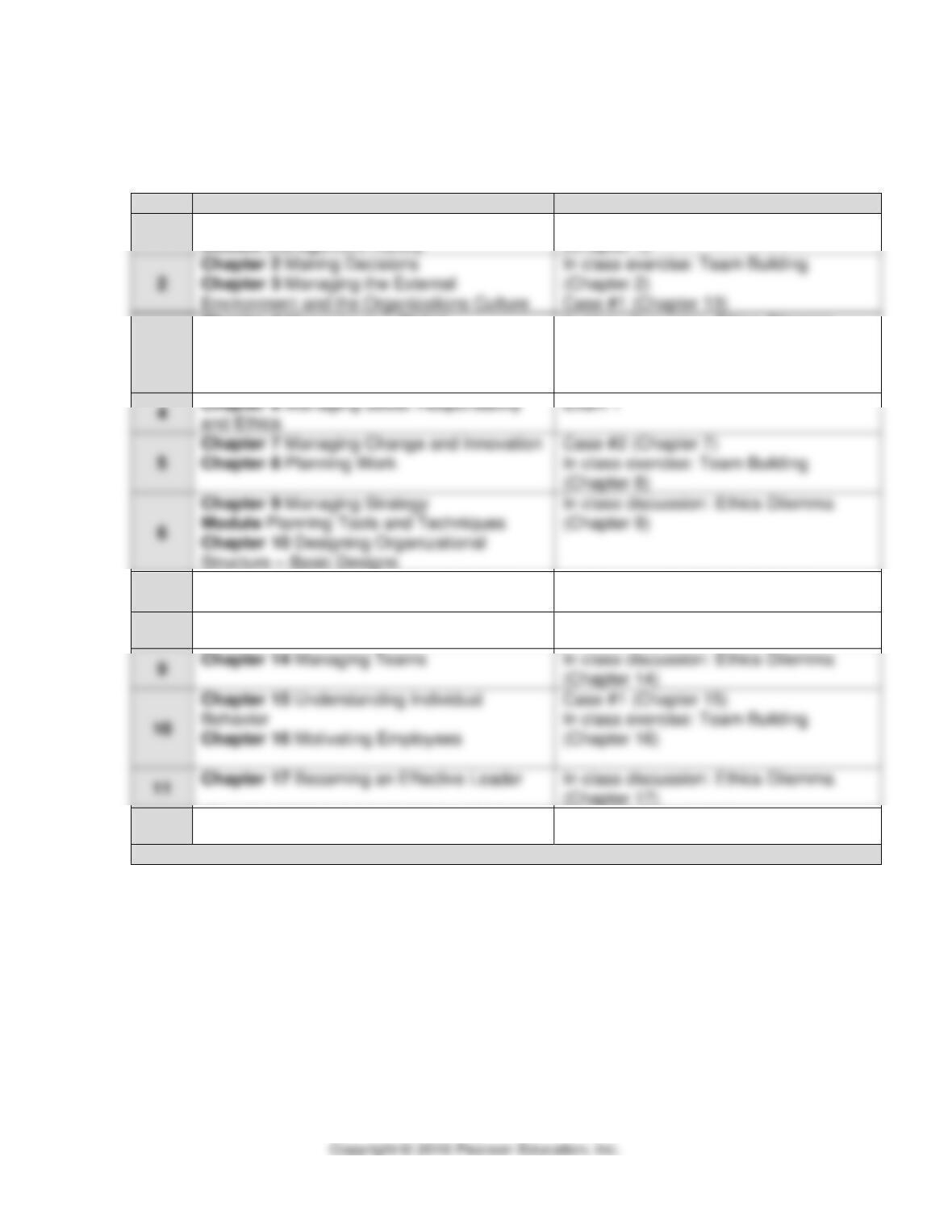
COURSE OUTLINE 16-WEEK COURSE: SEMESTER
Week
Assigned Reading
Deliverable
1
Chapter 1 Managers in the Workplace
Module Management History
In class discussion: Ethics Dilemma
(Chapter 1)
2
Chapter 2 Making Decisions
In class exercise: Team Building
(Chapter 2)
3
Chapter 3 Managing the External
Environment and the Organizations Culture
Case #1 (Chapter 3)
4
Chapter 4 Managing in a Global
Environment
Chapter 5 Managing Diversity
In class discussion: Ethics Dilemma
(Chapter 4)
In class exercise: Team Building
(Chapter 5)
5
Chapter 6 Managing Social Responsibility
and Ethics
Exam 1
Chapter 8 Planning Work
In class exercise: Team Building
Chapter 9 Managing Strategy
In class discussion: Ethics Dilemma
9
Chapter 10 Designing Organizational
Structure – Basic Designs
Case #1 (Chapter 10)
10
Chapter 11 Designing Organizational
Structure – Adaptive Designs
Chapter 12 Managing Human Resources
Exam 2
Chapter 13 Creating and Managing Teams
In class exercise: Team Building
(Chapter 13)
Chapter 14 Managing Communication
In class discussion: Ethics Dilemma
(Chapter 14)
14
Chapter 17 Being an Effective Leader
In class discussion: Ethics Dilemma
(Chapter 17)
15
Chapter 18 Monitoring and Controlling
Case #2 (Chapter 18)
Final Exam
vi
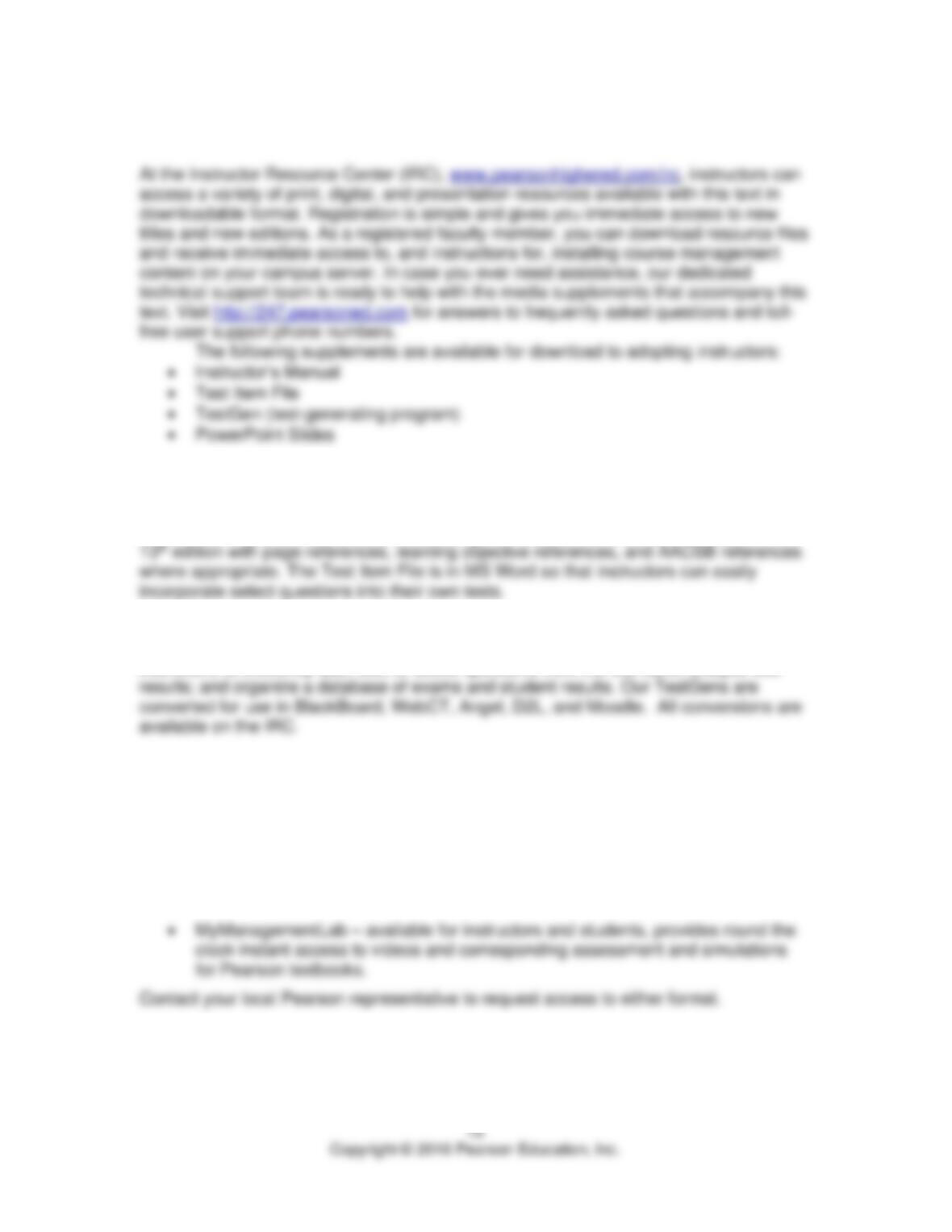
COURSE OUTLINE 12-WEEK COURSE: SEMESTER
Week
Assigned Reading
Deliverable
1
Chapter 1 Managers in the Workplace
Module Management History
In class discussion: Ethics Dilemma
(Chapter 1)
Chapter 3 Managing the External
Environment and the Organizations Culture
(Chapter 2)
Case #1 (Chapter 13)
3
Chapter 4 Managing in a Global
Environment
Chapter 5 Managing Diversity
In class discussion: Ethics Dilemma
(Chapter 4)
In class exercise: Team Building
(Chapter 5)
4
Chapter 6 Managing Social Responsibility
and Ethics
Exam 1
Chapter 8 Planning Work
In class exercise: Team Building
Chapter 10 Designing Organizational
Structure – Basic Designs
7
Chapter 11 Basic Organizational Design
Chapter 12 Adaptive Organizational Design
In class exercise: Team Building
(Chapter 12)
8
Chapter 13 Managing Human Resources
Exam 2
Chapter 14 Managing Teams
In class discussion: Ethics Dilemma
Chapter 16 Motivating Employees
(Chapter 16)
Chapter 17 Becoming an Effective Leader
In class discussion: Ethics Dilemma
(Chapter 17)
12
Chapter 18 Monitoring and Controlling
Case #2 (Chapter 18)
Final Exam
OTHER MATERIALS AVAILABLE WITH MANAGEMENT, 13TH EDITION
TEST ITEM FILE
Each chapter of the text has an extensive test bank of multiple-choice, true/false, and
short answer questions to test understanding. The Test Item File is specifically for the
TESTGEN
The test bank is also available on TestGen, a test-generating program that allows
instructors to efficiently add, edit, or delete questions from the test bank; analyze test
POWERPOINT PRESENTATIONS
A set of PowerPoint slides is available for each chapter and module in the text.
VIDEO LIBRARY
Videos illustrating the most important subject topics are available in two formats:
• DVD – available for in classroom use by instructors, includes videos mapped to
Pearson textbooks.

viii
COURSESMART
CourseSmart eTextbooks were developed for students looking to save on required or
recommended textbooks. Students simply select their eText by title or author and