Solutions for Appendix A: CFA Questions and Problems
0.75(15) 0.25(5)
12.5 percent
=+
=
4. Use the expression
22
1ρ
σ σ ρ
pn
−
=+
5. Find portfolio variance using the following expression
22
2
1ρ
σ σ ρ
σ 625[(1 0.3) / 24 0.3] 205.73
p
p
n
−
=+
= − + =
Chapter 7
Level I
1. B is correct. The required rate of return for McGettrick is 12.8 percent using the CAPM: 4% + (1.1 × 8%) =
12.8%. This is the same as the estimated rate of return and McGettrick is properly valued. If Jimma has a higher
covariance with the market portfolio than McGettrick, it also has a higher beta and a higher required rate of return.
Solutions for Appendix A: CFA Questions and Problems
2. A is correct. The beta for the stock is computed by dividing the covariance of the stock with the market by
the variance of the market. In this case, the covariance and variance are equal, so the beta is 1.0. The required rate of
return for the stock is the same as the return expected for the market. The estimated return for the stock exceeds its
required return, so the stock is undervalued.
3.
i i M
() β ( )
E R RFR R RFR= + −
4. C is correct. A portfolio that is on the CML to the left of the market portfolio is a lending portfolio with
part of the investor’s wealth invested in the risk-free asset (loaned at the risk-free rate).
Level II
5. The surprise in a factor equals actual value minus expected value. For the (interest rate factor, the surprise
Chapter 8
Level II
Solution to 3 taken from Solutions Manual to accompany Investment Analysis and Portfolio Management, Eighth
Edition, by Frank K. Reilly, CFA and Keith C. Brown, CFA. Copyright © 2005 by Thomson South-Western.
Solutions for Appendix A: CFA Questions and Problems
1. In an efficient market, all available information is already incorporated in current stock prices. The fact that
economic growth is currently higher in Country A than in Country B implies that current stock prices are already
2. It is clear by looking at the table that in each of the three size categories, the low price–to-book value stock
(P/BV) outperforms the high P/BV stock. Thus, there seems to be a value effect, as the value firms seem to
outperform the growth firms. That is, the value factor seems to be significant.
To clearly see the size effect, we rearrange the stocks in the two P/BV categories, as follows:
Stock
Size
P/BV
Return (%)
A
Huge
High
4
C
Medium
High
9
B
Huge
Low
6
D
Medium
F
Small
Low
3. Applying the-Gordon growth model with the assumed 5.9 percent dividend growth rate results in an
Chapter 9
Level I
1. To compute the compound growth rate, we only need the beginning and ending EPS values of $4.00 and
$7.00 respectively, and use the following equation:
Equity Asset Valuation, Second Edition, by Gerald Pinto, CFA, Elaine Henry, CFA Thomas Robinson, CFA, and
Solutions for Appendix A: CFA Questions and Problems
2. A is correct. Using the general time value of money formula, for sales, solve for r in the equation 2 = 1 × (1
3. B is correct. Free cash flow to the firm can be computed as operating cash flows plus after-tax interest
expense less capital expenditures.
4. C is correct. The required rate of return for the company is 6% + 1.2(11% − 6%) = 12%. Dividends are
expected to grow at a supernormal rate for two years:
Level II
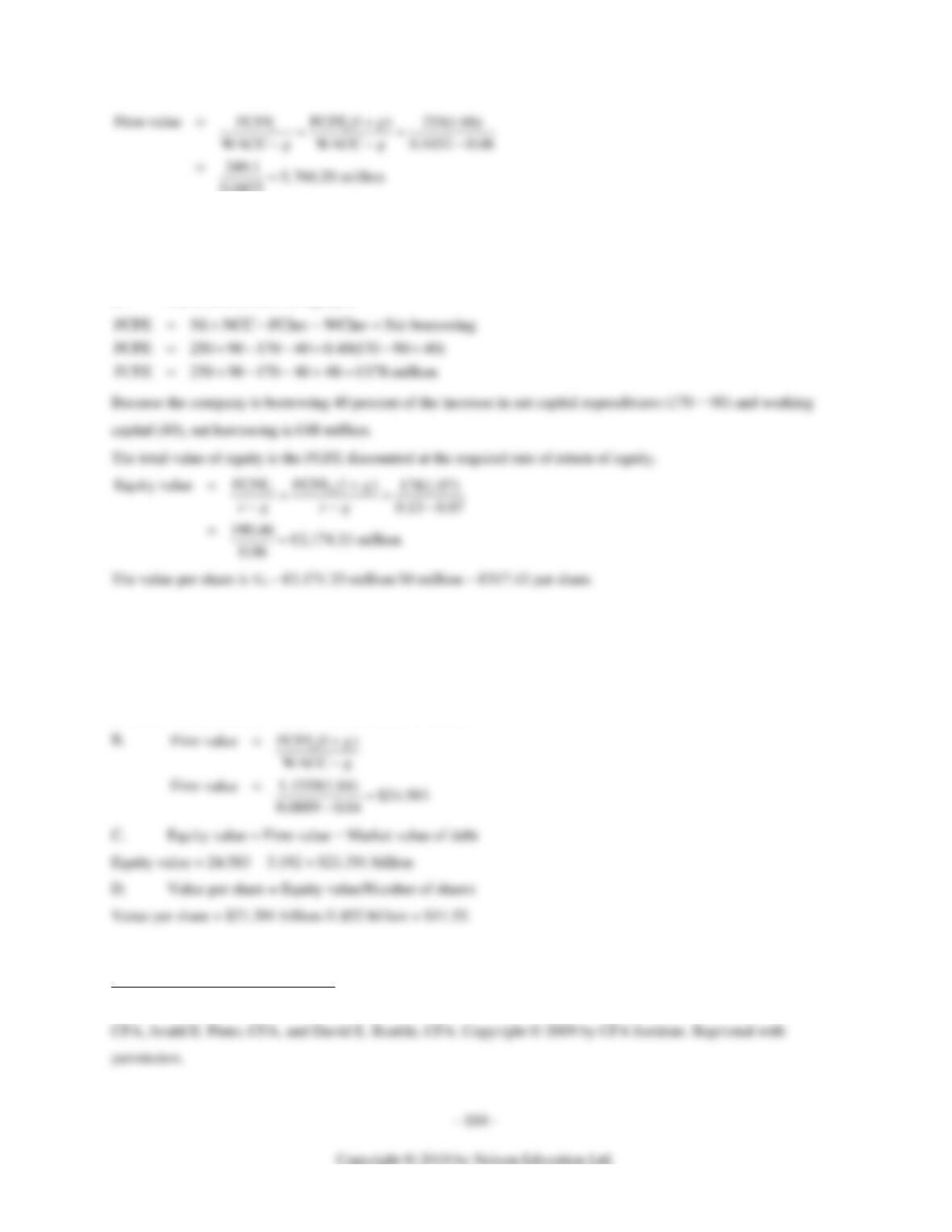
6. A. The FCFF is (in euros)
FCFF NI NCC Int(1 Tax rate) FCInv WCInv
FCFF 250 90 150(1 0.30) 170 40
= + + − − −
= + + − − −
Solutions for Appendix A: CFA Questions and Problems
0.0432
The total value of equity is the total firm value minus the value of debt, Equity = €5,766.20 million − €1,800 million
= €3,966.20 million. Dividing by the number of shares gives the per share estimate of V0 = €3,966.20 million/10
million = €396.62 per share.
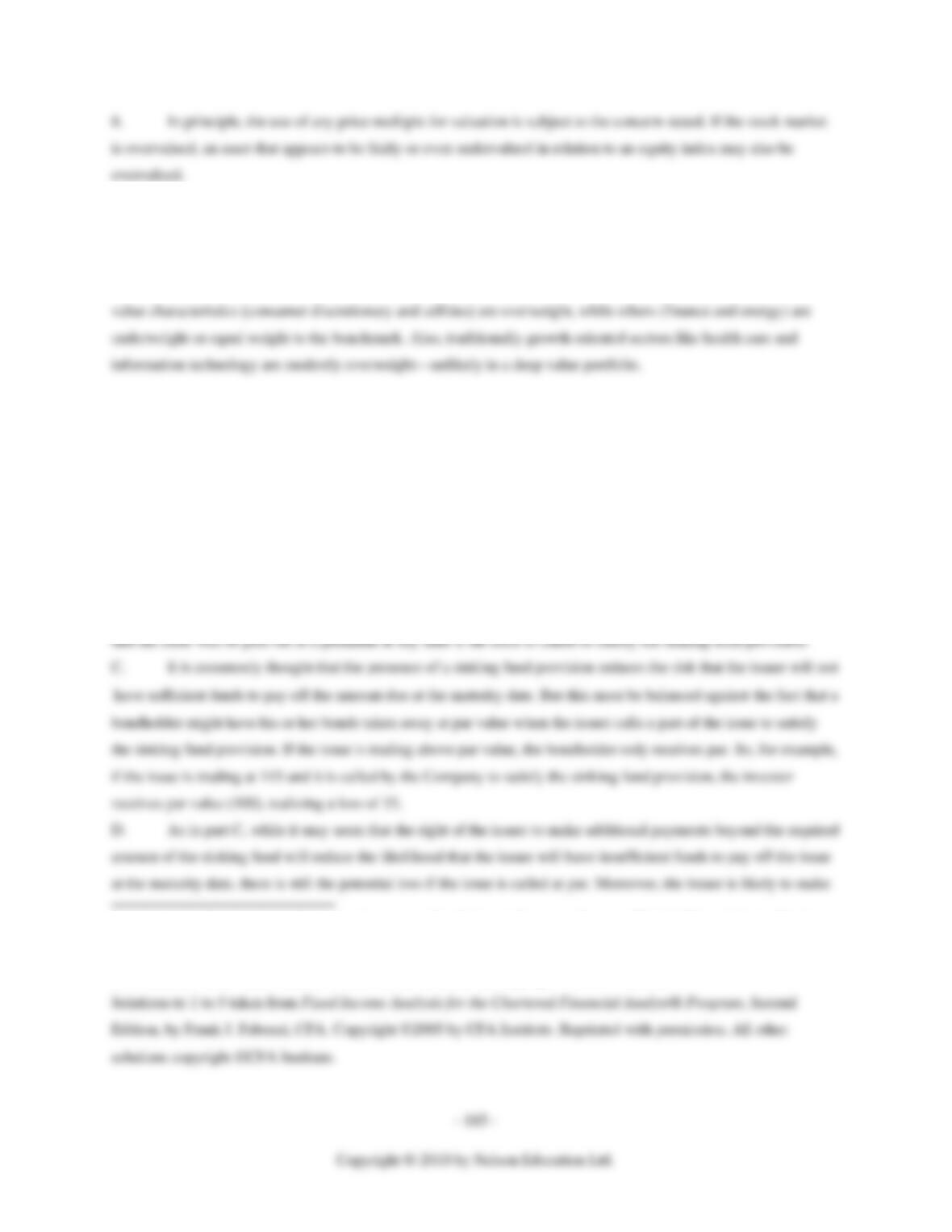
B. The free cash flow to equity is
7. A. The required return on equity is
r = E(Ri) = RF + βi[E(RM) − RF] = 5.5% + 0.90(5.5%) = 10.45%
The weighted-average cost of capital is
WACC = 0.25(7.0%) (1 − 0.40) + 0.75(10.45%) = 8.89%
Quantitative Methods for Investment Analysis, Second Edition, by Richard DeFusco, CFA, Dennis W. McLeavey,
Solutions for Appendix A: CFA Questions and Problems
Level III
9. The fund has a modest value orientation. Dividend yield, P/E, P/B, and EPS growth are all slightly lower
than the market benchmark. The sector weights are a bit more mixed. Some sectors that typically contain stocks with
Chapter 11
Level I
1. A. While it may be true that the Company can call the issue if rates decline, there is a nonrefunding
restriction prior to January 1, 2006. The Company may not refund the issue with a source of funds that costs less
than 7.75% until after that date.
B. This is only true if the issuer redeems the issue as permitted by the call schedule. In that case the premium
is paid. However, there is a sinking fund provision. If the issuer calls in the particular certificates of the issue held by
the investor in order to satisfy the sinking fund provision, the issue is called at par value. So, there is no guarantee
Solution to 9–10 taken from Managing Investment Portfolios: A Dynamic Process, Third Edition, John L. Maginn,
CFA, Donald I. Tuttle, CFA, Jerald E. Pinto, CFA, and Dennis W. McLeavey, CFA , editors. Copyright © 2007 by
CFA Institute. Reprinted with permission. All other solutions copyright © CFA Institute.
Solutions for Appendix A: CFA Questions and Problems
– 186 –
additional payments permitted to retire the issue via the sinking fund special call price of 100 when the bond is
trading at a premium, because that is when interest rates in the market are less than the coupon rate on the issue.
2. The borrowers whose loans are included in the pool can at lower interest rates refinance their loans if
interest rates decline below the rate on their loans. Consequently, the security holder cannot rely on the schedule of
principal and interest payments of the pool of loans to determine with certainty future cash flow.
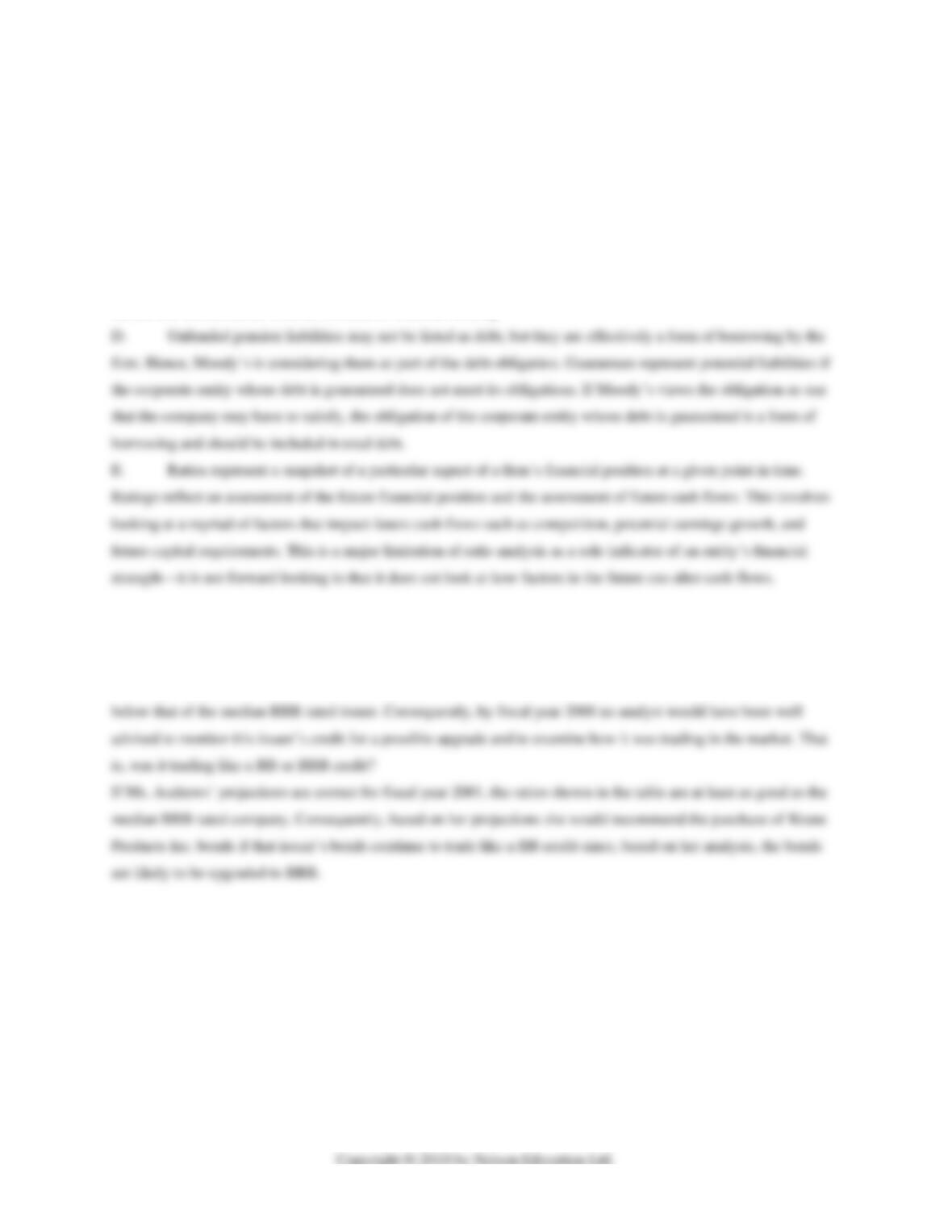
3. A. Since the inflation rate (as measured by the CPI-U) is 3.6%, the semiannual inflation rate for
adjusting the principal is 1.8%.
i. The inflation adjustment to the principal is
$1,000,000 × 0.018% = $18,000
Level II
4. A. With high-yield issuers there tends to be more bank loans in the debt structure and the loans tend
to be short term. Also, the loans tend to be floating rate rather than fixed. As a result, the analyst must look at the
Solutions for Appendix A: CFA Questions and Problems
– 187 –
B. At any given point in time, the cushion (as measured by coverage ratios) may be high. However, the
concern is with future cash flows to satisfy obligations. If the coverage ratio is adequate and is predicted to change
little in the future and the degree of confidence in the prediction is high, that situation would give greater comfort to
a bondholder than one where the coverage ratio is extremely high but can fluctuate substantially in the future.
Because of this variability it is difficult to assign a high degree of confidence to coverage ratios that are projected,
and there must be recognition that the coverage ratio may fall well below acceptable levels.
C. Financial flexibility means the ability to sustain operations should there be a down turn in business and to
sustain current dividends without reliance on external funding.
5. All the financial ratios—actual and projected for 2001—clearly indicate that the credit-worthiness of Krane
Products is improving. Using as benchmarks the S&P median ratios, the coverage ratios were already by fiscal year
2000 approaching that of the median BBB rated issuer. The capitalization ratios, while improving, were still well
Solutions for Appendix A: CFA Questions and Problems
Level III
6. Two factors that affect the yields available on inflation-indexed bonds (IIBs) are as follows:
► Overall economic growth and its corresponding impact on real interest rates bear a direct impact on IIB
7. First, let us compute the amount in each of the three tranches in the CDO. The senior tranche is 70 percent
of $250 million = $175 million. The junior tranche is 20 percent of $250 million = $50 million. The rest is the equity
tranche = $250 million − $175 million − $50 million = $25 million.
Chapter 12
Level I
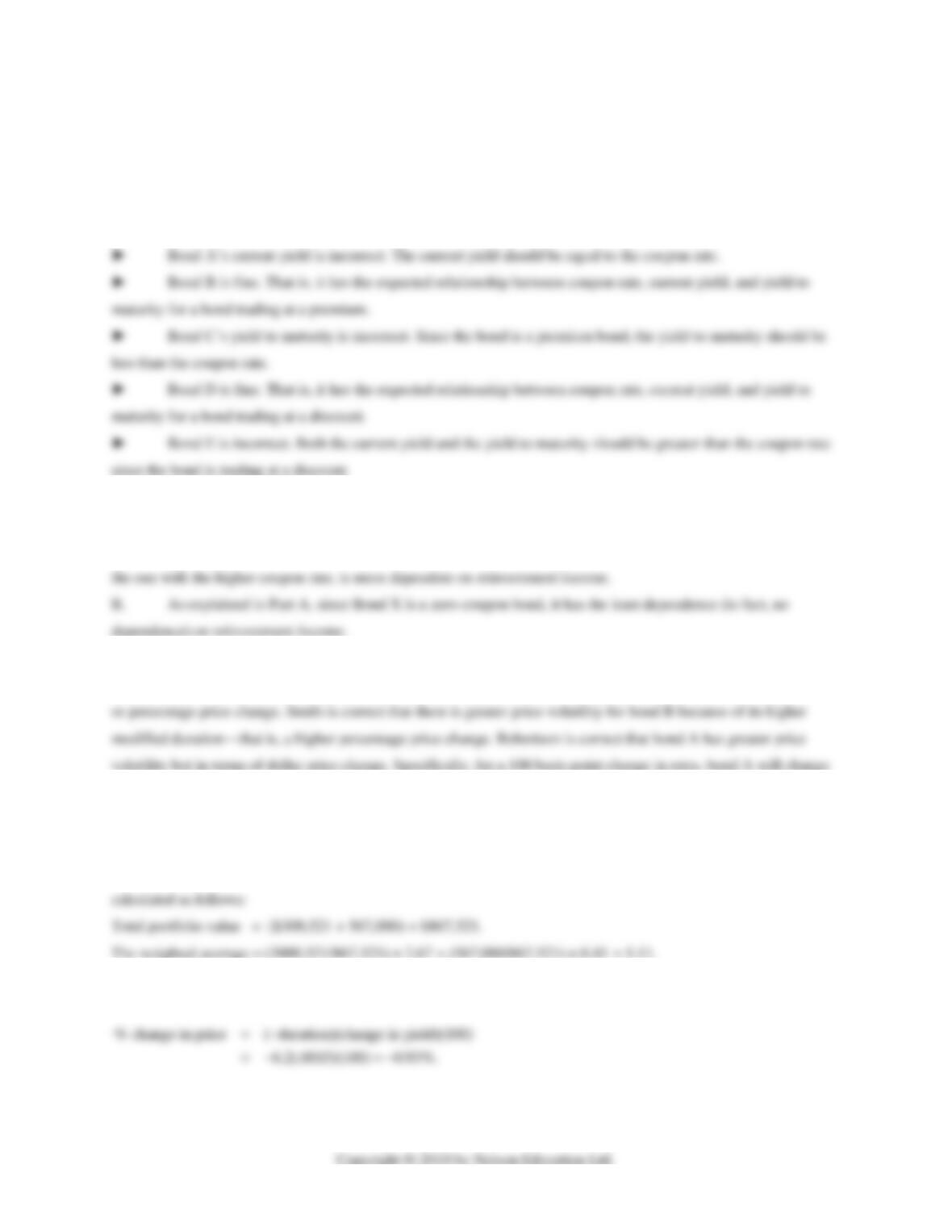
1. The present value of the cash flows of a 6.5% 20-year semiannual-pay bond using the three discount rates
is shown below:
Discount Rate (Annual BEY)
Semiannual Rate (Half Annual Rate)
Present Value of Cash
Flows
7.2%
3.6%
92.64
Solutions for Appendix A: CFA Questions and Problems
– 189 –
maturity. Doubling that rate gives a 7.4% yield to maturity on a bond-equivalent basis.
2. This question requires no calculations. (Note that the maturity of each bond is intentionally omitted.) The
question tests for an understanding of the relationship between coupon rate, current yield, and yield to maturity for a
bond trading at par, a discount, and a premium.
3. A. Bond X has no dependence on reinvestment income since it is a zero-coupon bond. So it is either
Bond Y or Bond Z. The two bonds have the same maturity. Since they are both selling at the same yield, Bond Z,
4. The problem here is in the definition of price volatility. It can be measured in terms of dollar price change
by $3.60 (4% times 90); for bond B the dollar price change will be $3 (6% times 50) for a 100 basis point rate
change.
5. B is correct. The portfolio duration is the weighted-average of the individual bonds in the portfolio and is
6. A is correct. The formula is:
Solutions for Appendix A: CFA Questions and Problems
– 190 –
Copyright © 2010 by Nelson Education Ltd.
Level II
7. A. Proponents of the pure expectations theory would assert that an upward-sloping yield curve is a
market’s forecast of a rise in interest rates. If that is correct, an expected rise in interest rates would mean that the
manager should shorten or reduce the duration (i.e., interest rate risk) of the portfolio. However, the pure
expectations theory has serious pitfalls and the forward rates are not good predictors of future interest rates.
B. The preferred habitat form of the biased expectations theory is consistent with the shape of the spot rate
curve observed. The preferred habitat theory asserts that if there is an imbalance between the supply and demand for
Chapter 13
Level I
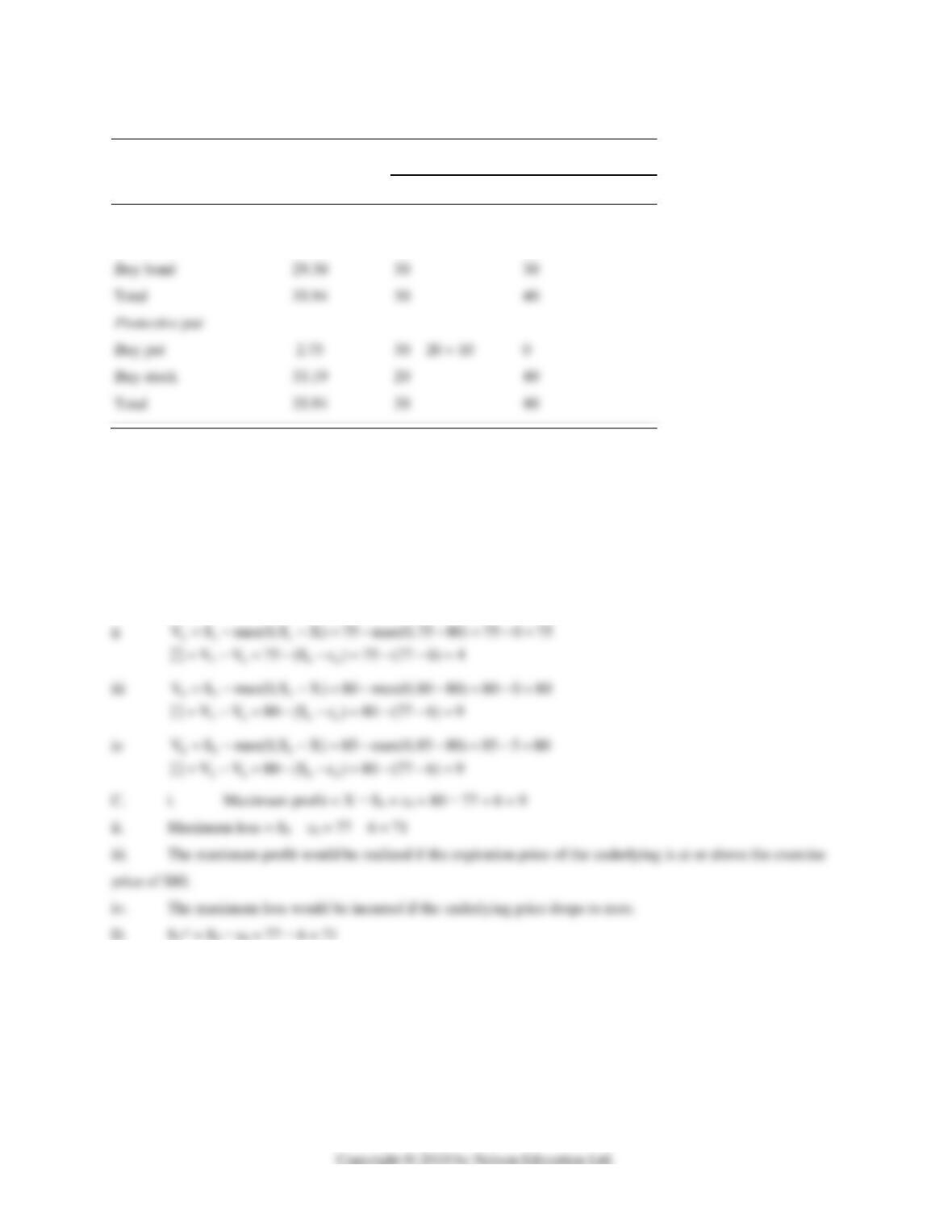
1. We can illustrate put–call parity by showing that for the fiduciary call and the protective put, the current
values and values at expiration are the same.
Call price, c0 = $6.64
Put price, p0 = $2.75
Exercise price, X = $30
Solutions for Appendix A: CFA Questions and Problems
– 191 –
Bond price, X/(l + r)T = 30/(1 + 0.04)0.6 = $29.30
Value at Expiration
Transaction
Current Value
ST = 20
ST = 40
Fiduciary call
Buy call
6.64
0
40 − 30 = 10
Buy put
2.75
30 − 20 = 10
0
The values in the table show that the current values and values at expiration for the fiduciary call and the protective
put are the same. That is, c0 + X/(1 + r)T = p0 + S0.
2. A. This position is commonly called a covered call.
B. i.
T T T
T 0 0 0
V S max(0,S X) 70 max(0, 70 80) 70 0 70
V V 70 (S c ) 70 (77 6) 70 71 1
= − − = − − = − =
= − = − − = − − = − = −
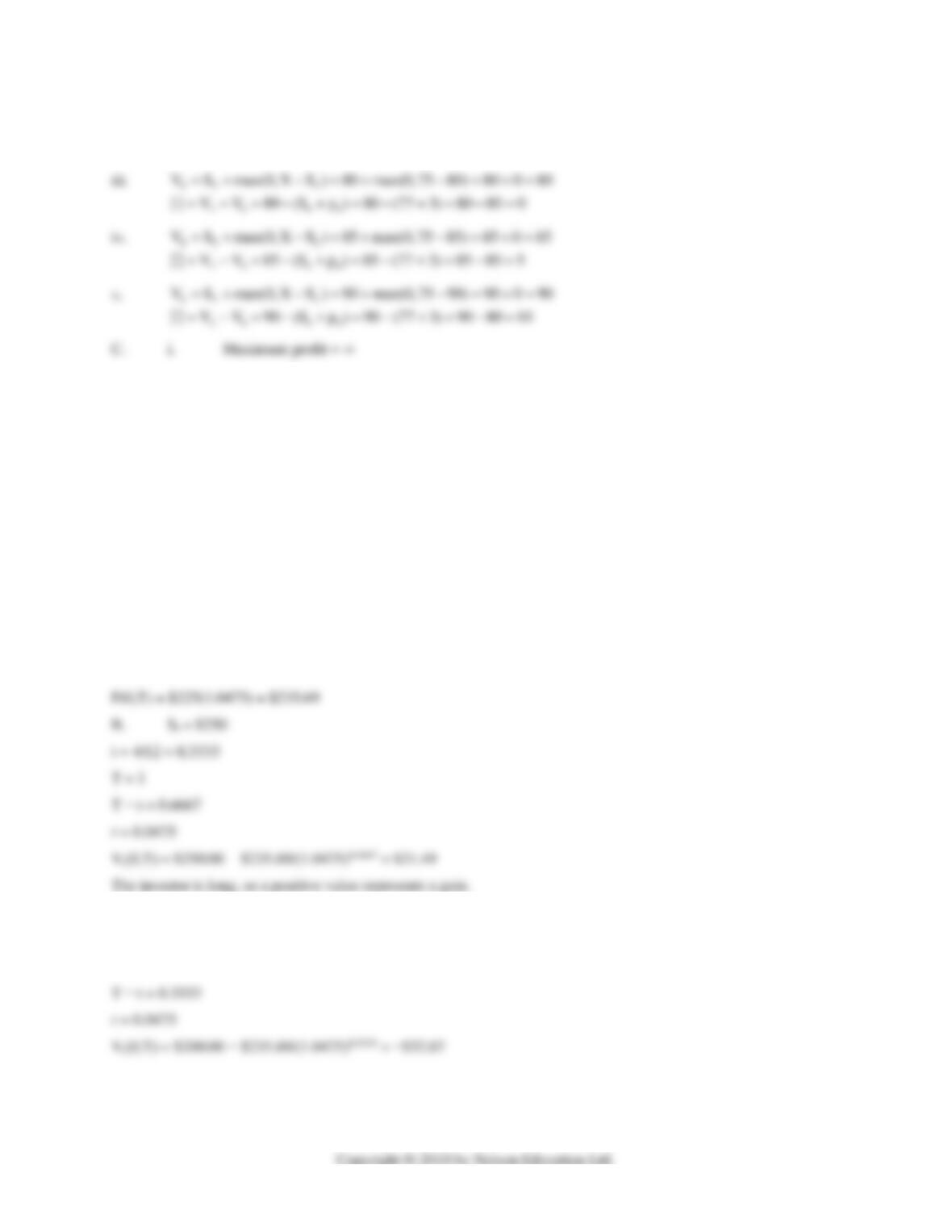
3. A. This position is commonly called a protective put.
B. i.
T T T
T 0 0 0
V S max(0, X S ) 70 max(0,75 70) 70 5 75
V V 75 (S p ) 75 (77 3) 75 80 5
= + − = + − = + =
= − = − + = − + = − = −
Solutions for Appendix A: CFA Questions and Problems
– 192 –
ii.
T T T
T 0 0 0
V S max(0,X S ) 75 max(0,75 75) 75 0 75
V V 75 (S p ) 75 (77 3) 75 80 5
= + − = + − = + =
= − = − + = − + = − = −
T T T
ii. Maximum loss = − (X − S0 − p0) = − (75 − 77 − 3) = 5
iii. The maximum loss would be incurred if the expiration price of the underlying were at or below the exercise
price of $75.
D. ST* = S0 + p0 = 77 + 3 = 80
4. B is correct. Buying the stock at $50 and delivering it against the $50 strike call generates a payoff of zero.
The premium is retained by the writer. The net profit is $6.00 per share × 100 shares or $600.
Level II
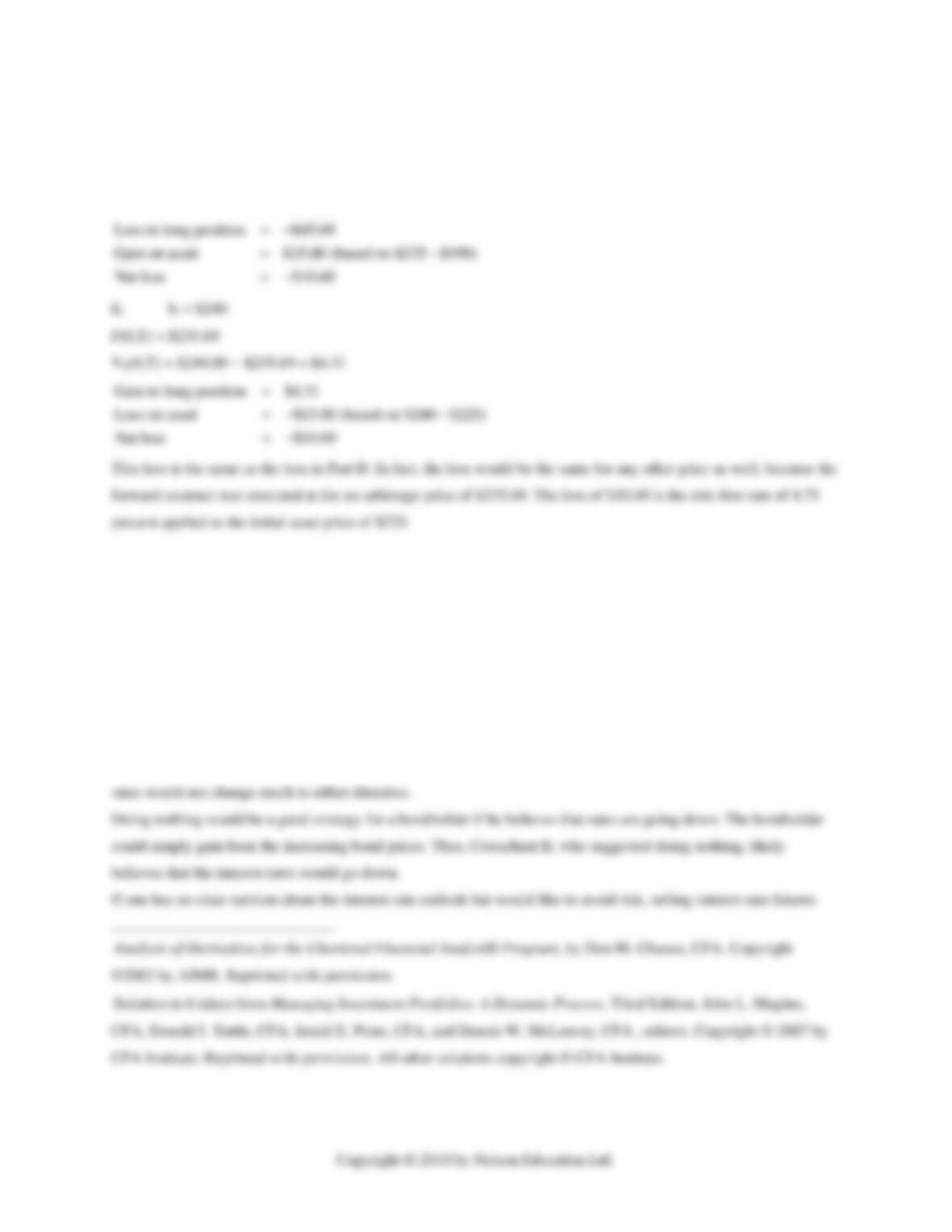
5. A. S0 = $225
T= 1
r = 0.0475
C. St = $200
t = 8/12 = 0.6667
T = 1
Solutions for Appendix A: CFA Questions and Problems
– 193 –
The investor is long, so this represents a loss to the long position.
D. St = $190
F(0,T) = $235.69
VT(0,T) = $190.00 − $235.69 = −$45.69
Level III
6. Covered call writing is a good strategy if the rates are not going to change much from their present level.
The sale of the calls brings in premium income that provides partial protection in case rates increase. The additional
income from writing calls can be used to offset declining prices. If rates fall, portfolio appreciation is limited
because the short call position is a liability for the seller, and this liability increases as rates go down. Consequently,
there is limited upside potential for the covered call writer. Overall, this drawback does not have negative
consequences if rates do not change because the added income from the sale of calls would be obtained without
sacrificing any gains. Thus, Consultant A, who suggested selling covered calls, probably believes that the interest
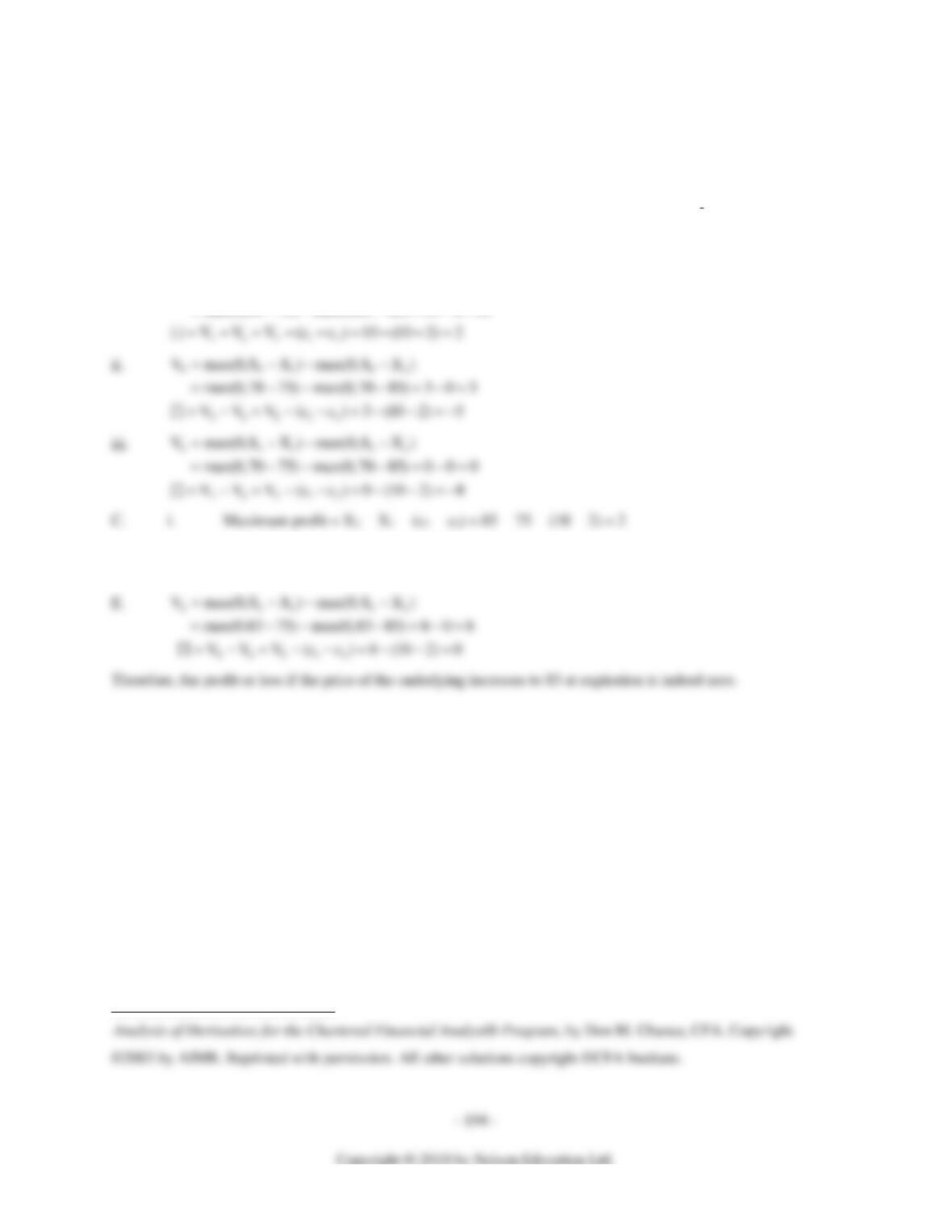
Solutions for Appendix A: CFA Questions and Problems
would be a good strategy. If interest rates were to increase, the loss in value of bonds would be offset by the gains
from futures. Thus, Consultant C, who suggested selling interest rate futures, is likely the one who has no opinion.
Paying the premium for buying the puts would not be a bad idea if a bondholder believes that interest rates are going
to increase. Thus, Consultant D is likely the one who believes that the interest rates are headed upward.
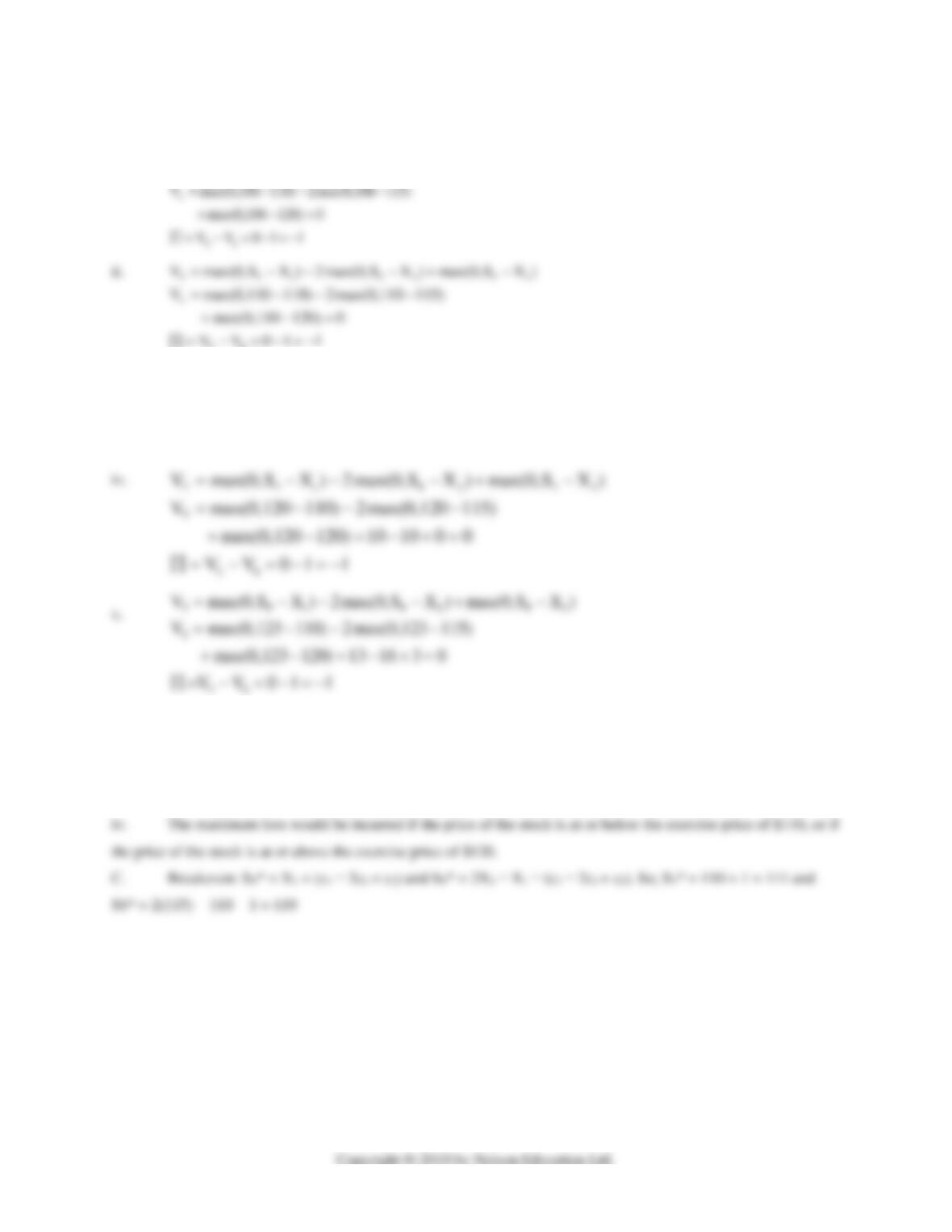
7. A. This position is commonly called a bull spread.
B. Let X1 be the lower of the two strike prices and X2 be the higher of the two strike prices.
i.
T T 1 T 2
V max(0,S X ) max(0,S X )
max(0,89 75) max(0,89 85) 14 4 10
= − − −
= − − − = − =
ii. Maximum loss = c1 − c2 = 10 − 2 = 8
D. ST* = X1 + (c1 − c2) = 75 + (10 − 2) = 83
Solutions for Appendix A: CFA Questions and Problems
– 195 –
8. A. Let X1 be 110, X2 be 115, and X3 be 120.
V0 = c1 − 2c2 + c3 = 8 − 2(5) + 3 = 1
i.
T T 1 T 2 T 3
T
V max(0,S X ) 2 max(0,S X ) max(0,S X )
max(0,110 120) 0
= − − − + −
= − − −
+ − =
T T 1 T 2 T 3
V max(0,S X ) 2 max(0,S X ) max(0,S X )
= − − − + −
T0
iii.
T T 1 T 2 T 3
T
T0
V max(0,S X ) 2 max(0,S X ) max(0,S X )
V max(0,115 110) 2 max(0,115 115)
max(0,115 120) 5
=V V 5 1 4
= − − − + −
= − − −
+ − =
− = − =
B. i. Maximum profit = X2 − X1 − (c1 − 2c2 + c3) = 115 − 110 − 1 = 4
ii. Maximum loss = c1 − 2c2 + c3 = 1
iii. The maximum profit would be realized if the price of the stock at expiration of the options is at the exercise
price of $115.
Solutions for Appendix A: CFA Questions and Problems
– 196 –
Chapter 14
Level II
1. A. A convertible bond grants the investor the option to call the common stock of the issuer. Thus, a
convertible bond has an embedded call option on the common stock. However, most convertible bonds are callable.
That is, there is a second embedded call option granting the issuer the right to retire the bond.
3. Her gain caused by the increase in the price of Dow Jones industrial Average futures is $10(9,086 − 9,020)
= $660. Because Craft had a short position in S&P Midcap 400 futures, her loss caused by the increase in the price
of S&P Midcap 400 futures is $500(370.20 − 369.40) = $400. Craft’s net gain is $660 − $400 = $260.
4. A. T = 90/365 = 0.2466. The futures price is
T
00
0.2466
0
f (T) S (1 r)
f (0.2466) 300(1.06) $304.34 per ounce
=+
==
B. Do the following:
► Enter a short futures position—that is, sell the futures at $306.
Solutions for Appendix A: CFA Questions and Problems
– 197 –
► Sell short the gold at $300.
► At expiration, take the delivery of an ounce of gold and pay $303.
This amount paid is $1.34 less than $304.34, which is the sum of the funds received from the short sale of the asset
rate.
5. Call price, c0 = $4.50
Put price, p0 = $6.80
Exercise price, X = $70
Risk-free rate, r = 5 percent
B.
Instrument
Actual Price ($)
Synthetic Price ($)
Mispricing/Profit ($)
Call
4.50
5.41
0.91
Put
6.80
5.89
0.91
69.62
0.91
66.41
0.91
C. The actual call is cheaper than the synthetic call. Therefore, an arbitrage transaction where you buy the call
(underpriced) and sell the synthetic call (overpriced) will yield a risk-free profit of $5.41 − $4.50 = $0.91.
As shown below, at expiration no cash will be received or paid out.
Value at Expiration
Solutions for Appendix A: CFA Questions and Problems
– 198 –
Short put
−(70 − ST)
0
D. The actual put is more expensive than the synthetic put. Therefore, an arbitrage transaction in which you
buy the synthetic put (underpriced) and sell the put (overpriced) will yield a risk-free profit of $6.80 − $5.89 =
$0.91. As shown below, at expiration no cash will be received or paid out.
Value at Expiration
Transaction
ST < 70
ST > 70
Sell put
−(70 − ST)
6. Current stock price, S = $100
Up move, u = 1.1
Down move, d = 0.85
Exercise price, X = $90
Risk-free rate, r = 6.5 percent