Solutions for Appendix A: CFA Questions and Problems
APPENDIX A
CFA SOLUTIONS
Chapter 1
Level I
1. A. Investment 2 is identical to Investment 1 except that Investment 2 has low liquidity. The
difference between the interest rate on Investment 2 and Investment 1 is 0.5 percentage point. This amount
represents the liquidity premium, which represents compensation for the risk of loss relative to an investment’s fair
C. Investment 3 has liquidity risk and default risk comparable to Investment 2, but with its longer time to
maturity, Investment 3 should have a higher maturity premium. The interest rate on Investment 3, r3, should thus be
above 2.5 percent (the interest rate on Investment 2). If the liquidity of Investment 3 were high, Investment 3 would
match Investment 4 except for investment 3’s shorter maturity. We would then conclude that Investment 3’s interest
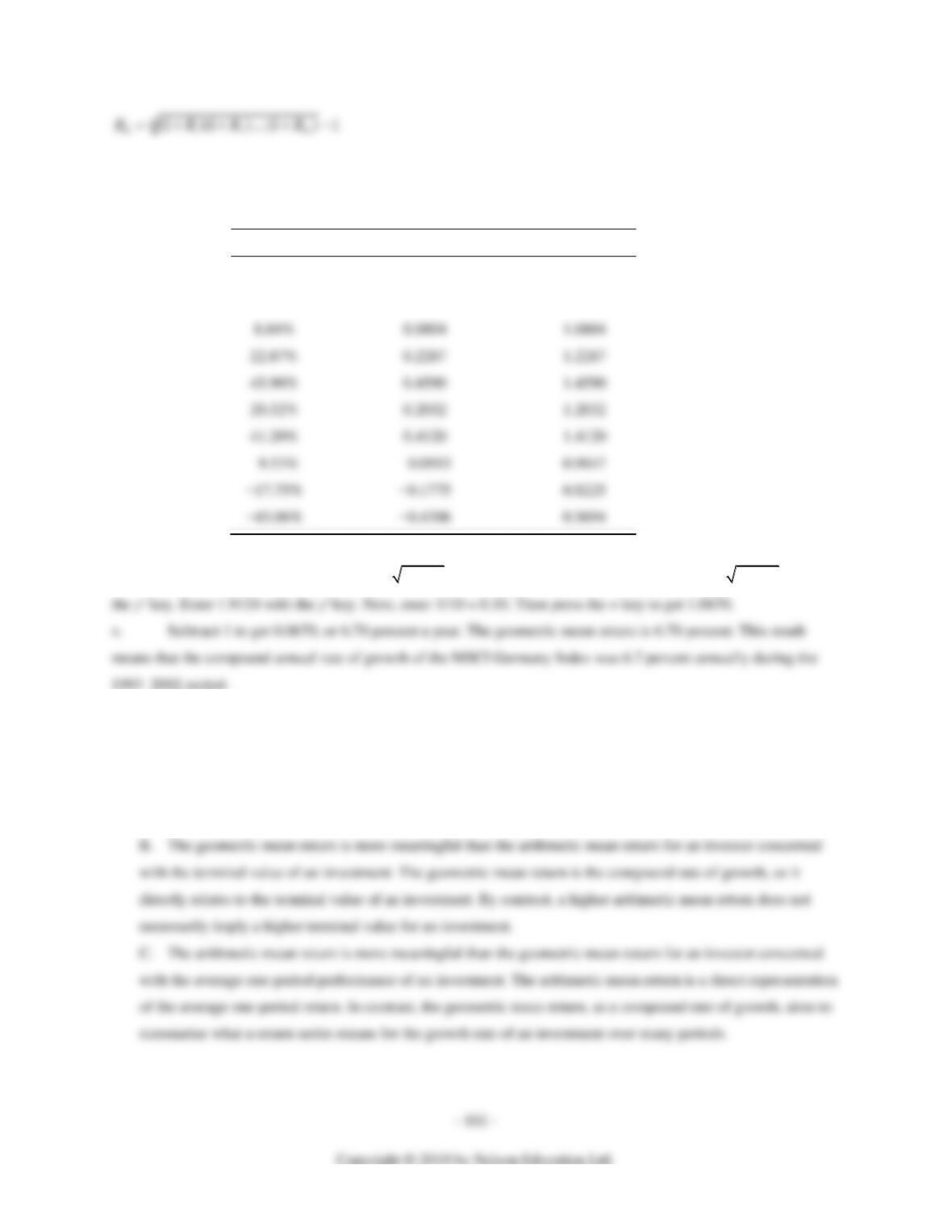
2. The geometric mean requires that all the numbers be greater than or equal to 0. To ensure that the returns satisfy
this requirement, after converting the returns to decimal form we add 1 to each return. For the geometric mean
return, RG:
Solutions for Appendix A: CFA Questions and Problems
To find the geometric mean in this example, we take the following five steps:
i. Divide each figure in the table by 100 to put the returns into decimal representation.
ii. Add 1 to each return to obtain the terms 1 + Rt.
Return
Return in Decimal Form
1 + Return
46.21%
0.4621
1.4621
−6.18%
−0.0618
0.9382
1.2287
1.2032
1.4120
−9.53%
−0.0953
0.9047
−0.4306
0.5694
iii. Multiply together all the numbers in the third column to get 1.9124.
iv. Take the 10th root of 1.9124 to get
10 1.9124 1.0670=
. On most calculators, we evaluate
10 1.9124
using
3. A. So long as a return series has any variability, the geometric mean return must be less than the arithmetic
mean return. In the solution to Problem 2, we computed the geometric mean annual return as 6.7 percent. In
general, the difference between the geometric and arithmetic means increases with the variability of the period–
by-period observations.

Solutions for Appendix A: CFA Questions and Problems
4. A. Security Market Line
i. Fair-value plot. The following template shows, using the CAPM, the expected return, ER, of Stock A and
Stock B on the SML. The points are consistent with the following equations:
ii. Analyst estimate plot. Using the analyst’s estimates, Stock A plots below the SML and Stock B, above the
SML.
B. Over versus Undervalue
Stock A is overvalued because it should provide a 16.5% return according to the CAPM whereas the analyst
Level III
5. A.
Real risk-free
rate (%)
+
Expected
inflation
(%)
+
Spreads or
premiums
(%)
=
Expected annual
fixed-income
return (%)
1-year U.S.
1.2
+
2.6
+
0
=
3.8

Solutions for Appendix A: CFA Questions and Problems
– 163 –
10-0year
MBS
1.2
+
2.6
+
0.95
=
4.75
Note: We assign the 10-year corporate a 1% maturity premium based on the 10-year over 1-
year government spread.
6. A. For Swennson, the annualized rate of return is:
B. Mattsson’s annualized rate of return of 3.27% was higher than Swennson’s at −2.09%.
Solutions for Appendix A: CFA Questions and Problems
– 164 –
Chapter 1 Appendix
Level I
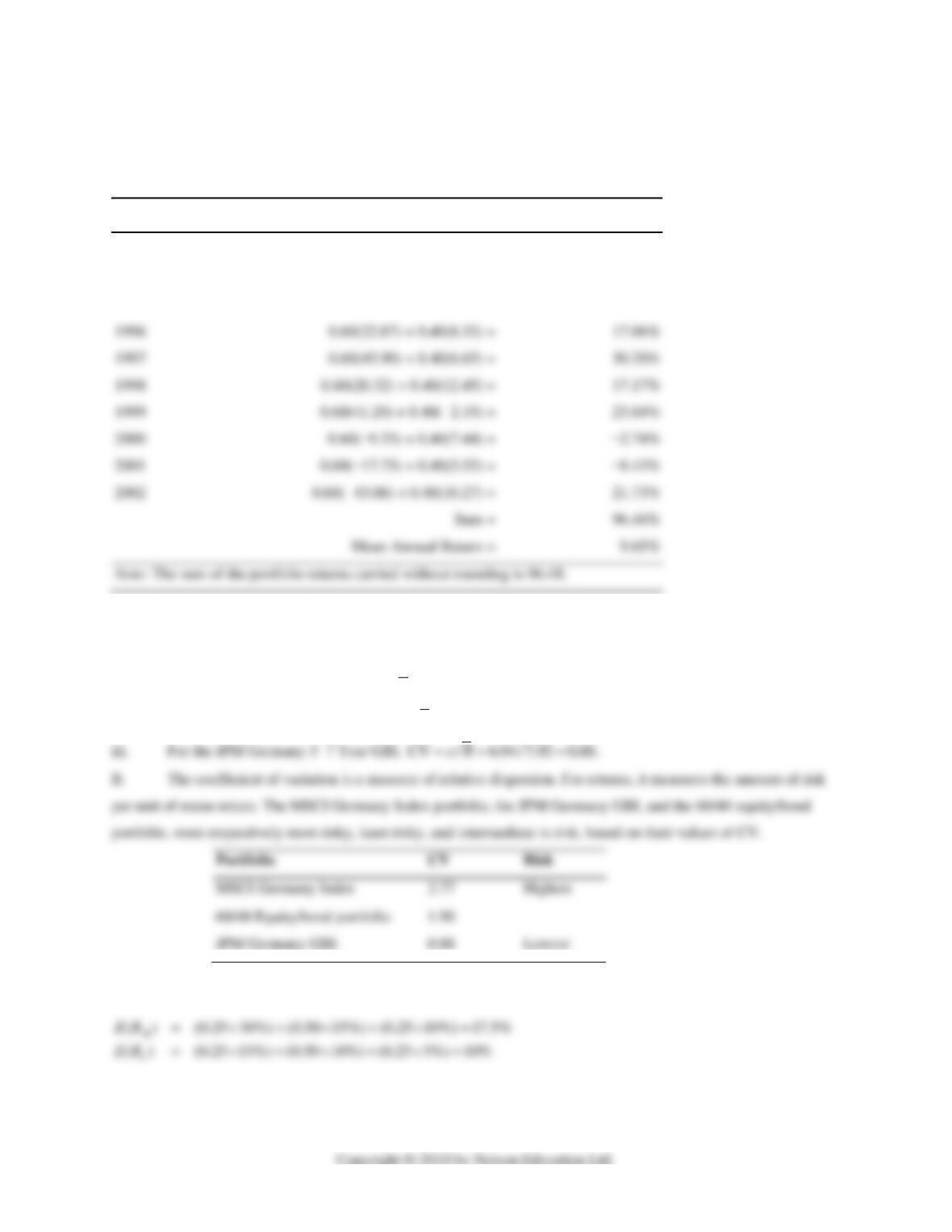
A1. The following table shows the calculation of the portfolio’s annual returns, and the mean annual return.
Year
Weighted Mean Calculation
Portfolio Return
1993
0.60(46.21) + 0.40(15.74) =
34.02%
1994
0.60(−6.18) + 0.40(−3,40) =
−5.07%
1995
0.60(8.04) + 0.40(18.30) =
12.14%
1996
0.60(22.87) + 0.40(8.35) =
17.06%
1997
0.60(45.90) + 0.40(6.65) =
30.20%
1999
23.84%
2000
2002
96.46%
A2. A. i. For the 60/40 equity/bond portfolio, the mean return (as computed in Problem 1) was
9.65 percent. We can compute the sample standard deviation of returns as s = 18.31 percent The coefficient of
variation for the 60/40 portfolio was
CV / 18.31/9.65 1.90sR= = =
.
ii. For the MSCI Germany Index,
CV / 29.95/10.80 2.77sR= = =
.
A3. The covariance is 25, computed as follows. First, we calculate expected values:

Solutions for Appendix A: CFA Questions and Problems
Then we find the covariance as follows:
BZ
Cov ( , ) (30,15) [(30 17.5) (15 10)] (15,10)
R R P P
= − − +
Level II
A4. For AOL Time Warner, the required return is
β[ ( ) ] 4.35% 2.50(8.04%) 4.35%
20.10% 24.45%
F M F
r R E R R= + − = + =
+=
β[ ( ) ] 4.35% 0.80(8.04%) 4.35%
6.43% 10.78%
F M F
r R E R R= + − = + =
Level III
A5. A. If the correlation between bond market returns and exchange rate movements were equal to zero,
the dollar volatility of the German bond market would be
A6. The best diversification vehicle is an asset whose value gets significantly higher when the rest of the
portfolio’s value is low, and thereby partially offsets the loss of other assets. The best vehicle is an asset with a

Solutions for Appendix A: CFA Questions and Problems
Chapter 2
Level II
1. C is correct. The comments about investment policy statements made by Stephenson’s patients are
incorrect. The IPS should identify pertinent investment objectives and constraints for a particular investor. Clearly
2. B is correct. An investor’s ability to take risk puts an upper limit on a reasonable return objective.
3. C is correct. Even though Stephenson describes his risk tolerance as “average,” his present investment
4. B is correct. Stephenson has adequate income to cover his living expenses and has no major outlays for
5. C is correct. Stephenson’s time horizon is long—he is currently only 55 years old. The time horizon
6. C is correct.
Risk: Stephenson has an above-average risk tolerance based on both his ability and willingness to assume risk. His
large asset base, long time horizon, ample income to cover expenses, and lack of need for liquidity or cash flow
Solutions for Appendix A: CFA Questions and Problems
– 167 –
reasonably expect from the financial markets over long periods of time and to define an achievable return objective.
Level III
7. A. i. The Maclins’ overall risk objective must consider both willingness and ability to take
risk:
Willingness. The Maclins have a below-average willingness to take risk, based on their unhappiness with the
ii. The Maclins’ return objective is to grow the portfolio to meet their educational and retirement needs as well
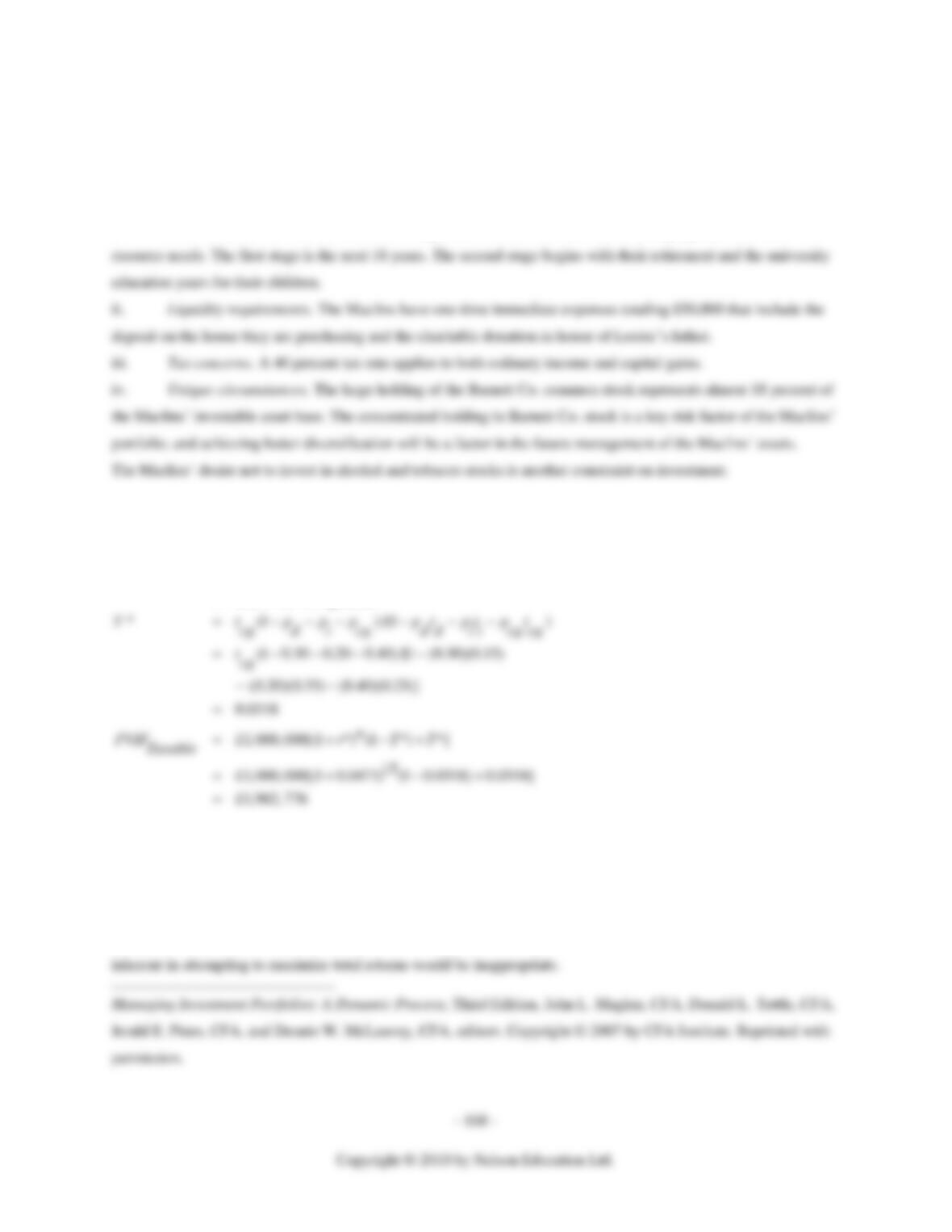
as to provide for ongoing net expenses. The Maclins will require annual after-tax cash flows of £26,000 (calculated
below) to cover ongoing net expenses and will need £2 million in 18 years to fund their children’s education and
their retirement. To meet this objective, the Maclins’ pretax required return is 7.38 percent, which is determined
below.
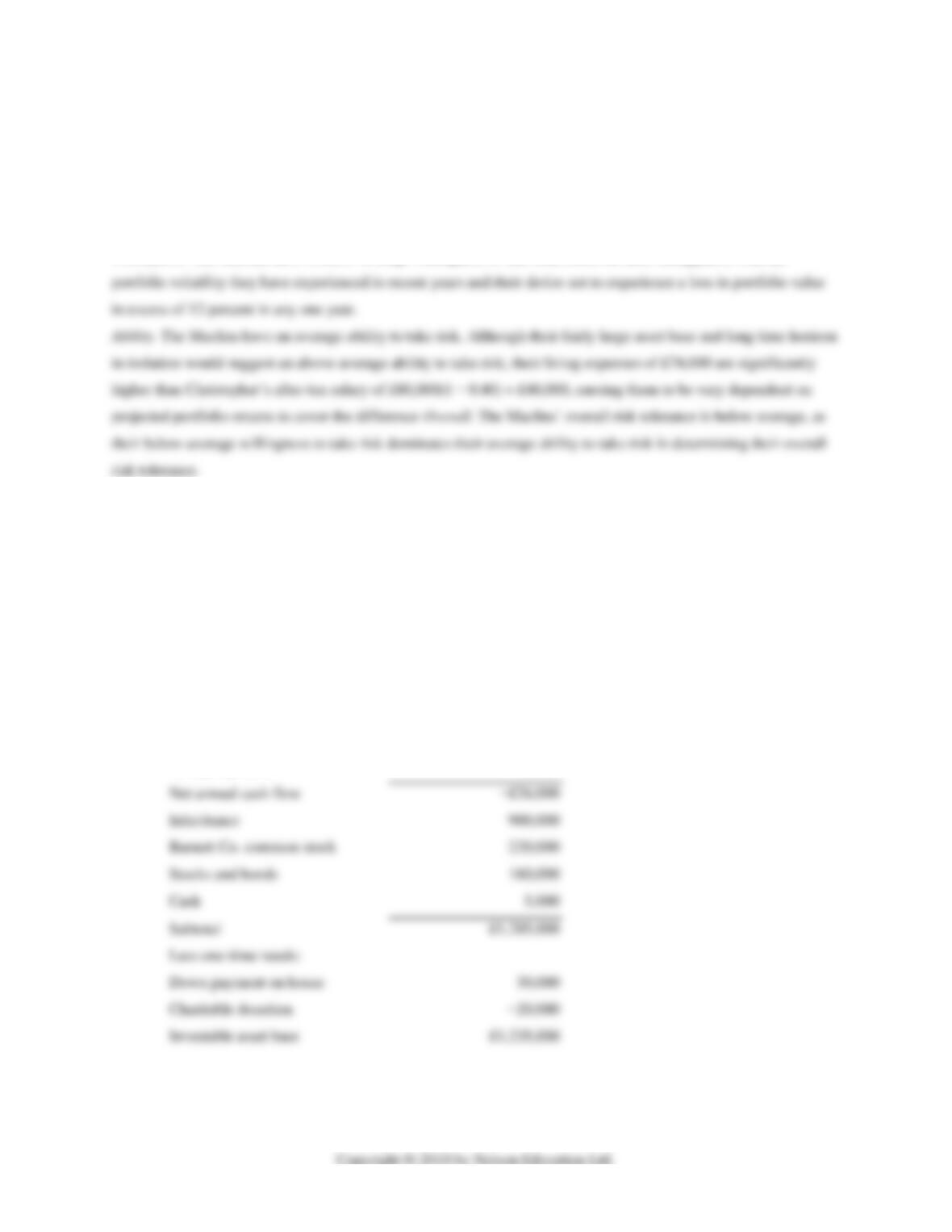
The after-tax return required to accumulate £2 million in 18 years beginning with an investable asset base of
£1,235,000 (calculated below) and with annual outflows of £26,000 is 4.427 percent, which when adjusted for the
40 percent tax rate, results in a 7.38 percent pretax return [4.427% / (1 − 0.40) = 7.38%].
Christopher’s annual salary
£80,000
Less: Taxes (40%)
−32,000
Living expenses
−74,000
Net annual cash flow
Inheritance
900,000
Barnett Co. common stock
220,000
Stocks and bonds
160,000
Subtotal
Less one-time needs:
Down payment on house
−30,000
Charitable donation
−20,000
Investable asset base
Solutions for Appendix A: CFA Questions and Problems
Note: No inflation adjustment is required in the return
calculation because increases in living expenses will be offset
by increases in Christopher’s salary.
B. The Maclins’ investment policy statement should include the following constraints:
i. Time horizon. The Maclins have a two-stage time horizon, because of their changing cash flow and
8. B is correct.
* (1 )
0.06*[1 (0.30)(0.15) (0.20)(0.35) (0.40)(0.25)]
0.0471 or 4.71 percent
r r p t p t p t
d d i i cg cg
= − − −
= − − −
=
9. Worden Technology, Inc.
IPS Y and IPS X offer different components that are appropriate for Worden Technology’s pension plan:
i. Return requirement. IPS Y has the appropriate return requirement for Worden’s pension plan. Because the
plan is currently underfunded, the manager’s primary objective should be to make it financially stronger. The risk

Solutions for Appendix A: CFA Questions and Problems
ii. Risk tolerance. IPS Y has the appropriate risk tolerance for Worden’s plan. Because of its underfunded status, the
10. A. Long-term bond holdings are important for life insurers because of their ALM (Asset Liability
Management) emphasis and the long-term nature of their liabilities. In contrast, individual investors do not have
ALM concerns to the same degree, in general. As discussed in the reading as well, because of the importance of
human capital in relation to financial capital during youth, for many young investors equity investments will be very
11. A. Accumulating funds for the child’s education is a new investment goal. Prior to the adoption, the
couple’s time horizon was two-stage (preretirement and postretirement). In their late 40s, they will have a period in
which they need to pay for the cost of the child’s education; this will involve substantial costs for which they must
plan. The couple’s multistage time horizon now includes the period up to the child’s entering college, the child’s

Solutions for Appendix A: CFA Questions and Problems
B. Given the investor’s circumstances, the decision to buy a house in one year’s time makes the addition of a
shortfall risk objective appropriate. He needs to earn at least 2 percent if he is to have sufficient funds to buy the
12. The first action (“Revise the investment policy statement of the pension scheme to take into account a
change in the forecast for inflation in the U.K.”) is incorrect. The Investment Policy Statement depends on the
client’s particular circumstances, including risk tolerance, time horizon, liquidity and legal constraints, and unique
needs. Therefore, a change in economic forecast would not affect the Investment Policy Statement. The Investment
Policy Statement also considers a client’s return requirement. This return requirement may change over the long
The third action (“Initiate a program to protect the financial strength of the pension scheme from the effects of U.K.
inflation by indexing benefits paid by the scheme”) is incorrect. The implementation of an inflation index
adjustment program would protect the plan participants, not the plan itself, from the effects of higher U.K. inflation.
With an inflation index adjustment program, Summit’s costs of funding the defined benefit scheme would actually
increase (thereby weakening the plan’s financial position) as U.K. inflation increases.
13. In practice, an acceptable benchmark is one that both the investment manager and the plan sponsor agree
represents the manager’s investment process. However, in order to function effectively in performance evaluation, a
Solutions for Appendix A: CFA Questions and Problems
– 171 –
► Investable. The benchmark should be available as a passive option.
► Measurable. It should be possible to calculate the benchmark’s return on a timely basis, for various time
periods (e.g., monthly, quarterly, annually).
14. Kim Lee Ltd.’s benchmark is not valid. The chief criticism of this type of benchmark is that it is not, and
cannot be, specified in advance.
Furthermore, since no one knows who the top-quartile managers will be at the beginning of an evaluation period, the
Chapter 3
Level II
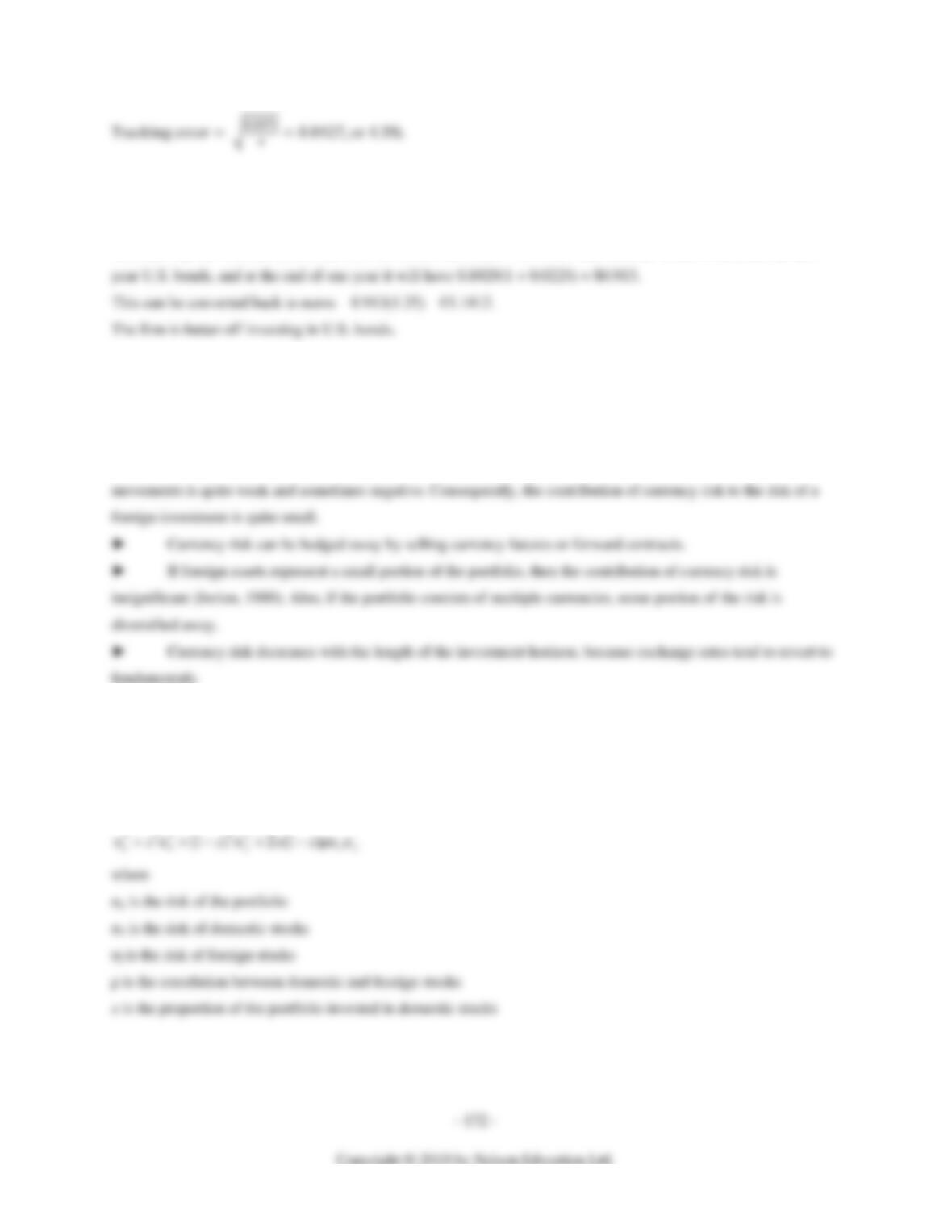
1.
Year
Portfolio Return
Benchmark Return
Excess Return
Squared Deviation
2008
12%
14%
-2.0%
0.18%
2009
14%
10%
4.0%
0.03%
2010
20%
12%
8.0%
0.34%
2011
14%
16%
-2.0%
0.18%
Solutions for Appendix A: CFA Questions and Problems
2. If the German firm invests funds (say, €1) in one-year euro bonds, at the end of one year it will have 1(1 +
0.0335) = €1,0335.
Alternatively the German firm could convert €1 into $(1/1.12) = $0.8929. This amount would be invested in one–
Level III
3. Currency fluctuations have an impact on the total return and volatility of foreign currency–denominated
investments. However, there are at least four reasons why currency risk is not a barrier to international investment:
► Market and currency risks are not additive. This is because the correlation between currency and market
4. Yes. The risk that counts is the contribution of the foreign assets to the total risk of the global portfolio. In
the proposed example, foreign stocks have a larger standard deviation (20%) than U.S. stocks (15%). However, let’s
calculate the standard deviation of the diversified portfolio made up of 90 percent domestic stocks and 10 percent
foreign stocks. We have

Solutions for Appendix A: CFA Questions and Problems
Here, we will take ρ = −0.10, because the U.S. portfolio is very strongly correlated with the U.S. stock index.
Chapter 4
Level I
1. B is correct. The division of tax between buyers and sellers depends in part on the elasticity of demand and
3. Profit on a short sale = Begin, value − Ending value − Dividends − Trans. costs − Interest
Beginning value of investment = $56.00 × 100 shares = $5,600 (sold under a short sale arrangement)
Your investment = Margin requirement Commission
= (.45 $5, 600) $155
$2,520 $155
$2,675
+
+
=+
=
Solutions for Appendix A: CFA Questions and Problems
Profit = $5,600 $4,500 $250 $300
= $550.00
− − −
The rate of return on your investment of $2,675 is:
$550.00/$2,675 = 20.56%
4. C is correct.
The total market value of the position is equal to:
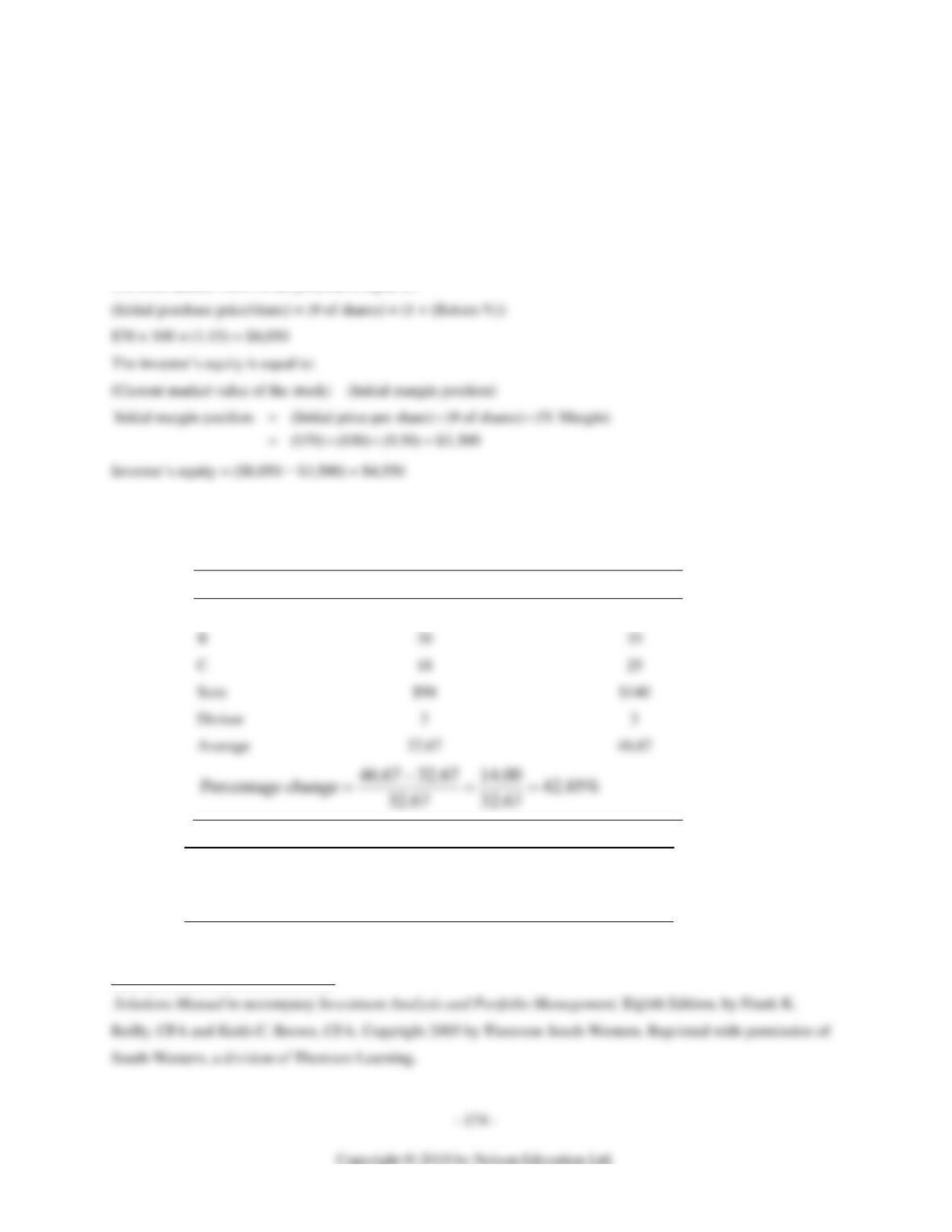
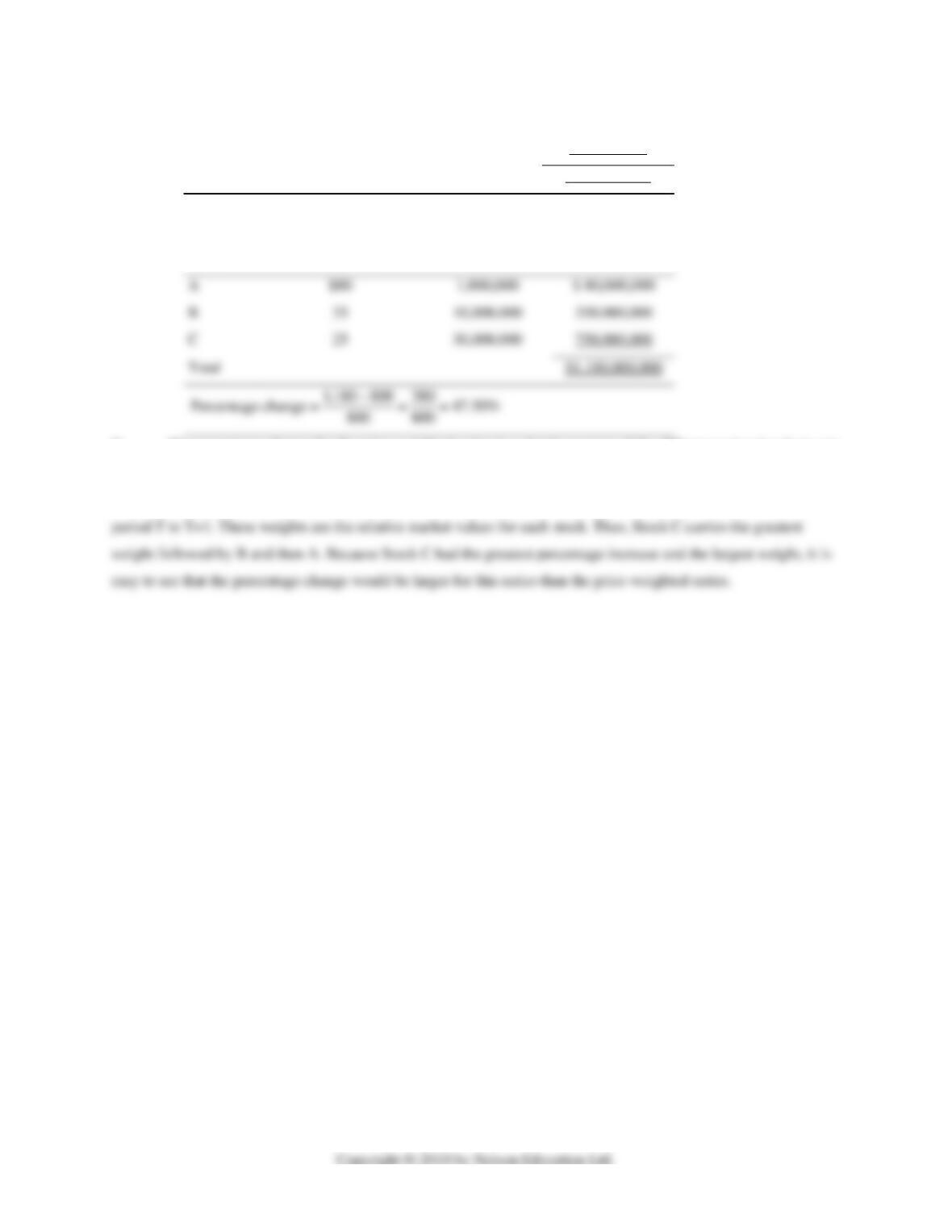
5. A. Given a three security series and a price change from period T to T+1, the percentage change in
the series would be 42.85 percent.
Period T
Period T+1
A
$60
$ 80
B.
Period T
Stock
Price/Share
# of Shares
Market Value
A
$60
1,000,000
$ 60,000,000
Solutions for Appendix A: CFA Questions and Problems
– 175 –
B
20
10,000,000
200,000,000
C
18
30,000,000
540,000,000
Total
$800,000,000
Period T+1
Stock
Price/Share
# of Shares
Market Value
C
Total
C. The percentage change for the price-weighted series is a simple average of the differences in price from one
period to the next. Equal weights are applied to each price change.
The percentage change for the value-weighted series is a weighted average of the differences in price from one
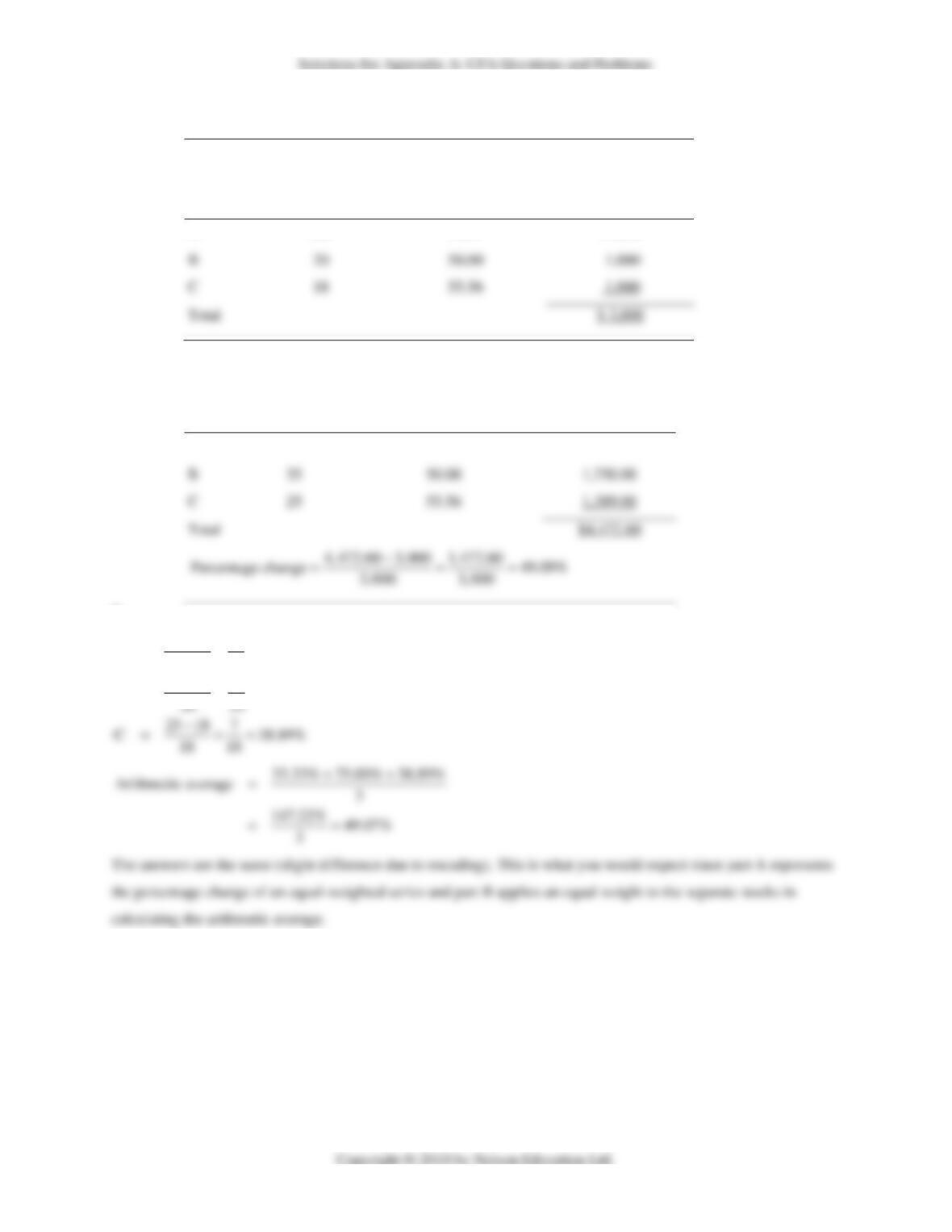
– 176 –
6. A.
Period T
Stock
Price/Share
# of Shares
Market Value
A
$60
16.67
$1,000
Period T+1
Stock
Price/Share
# of Shares
Market Value
A
$80
16.67
$ 1,333.60
B.
80 60 20
A 33.33%
60 60
35 20 15
B = 75.00%
−
= = =
−==
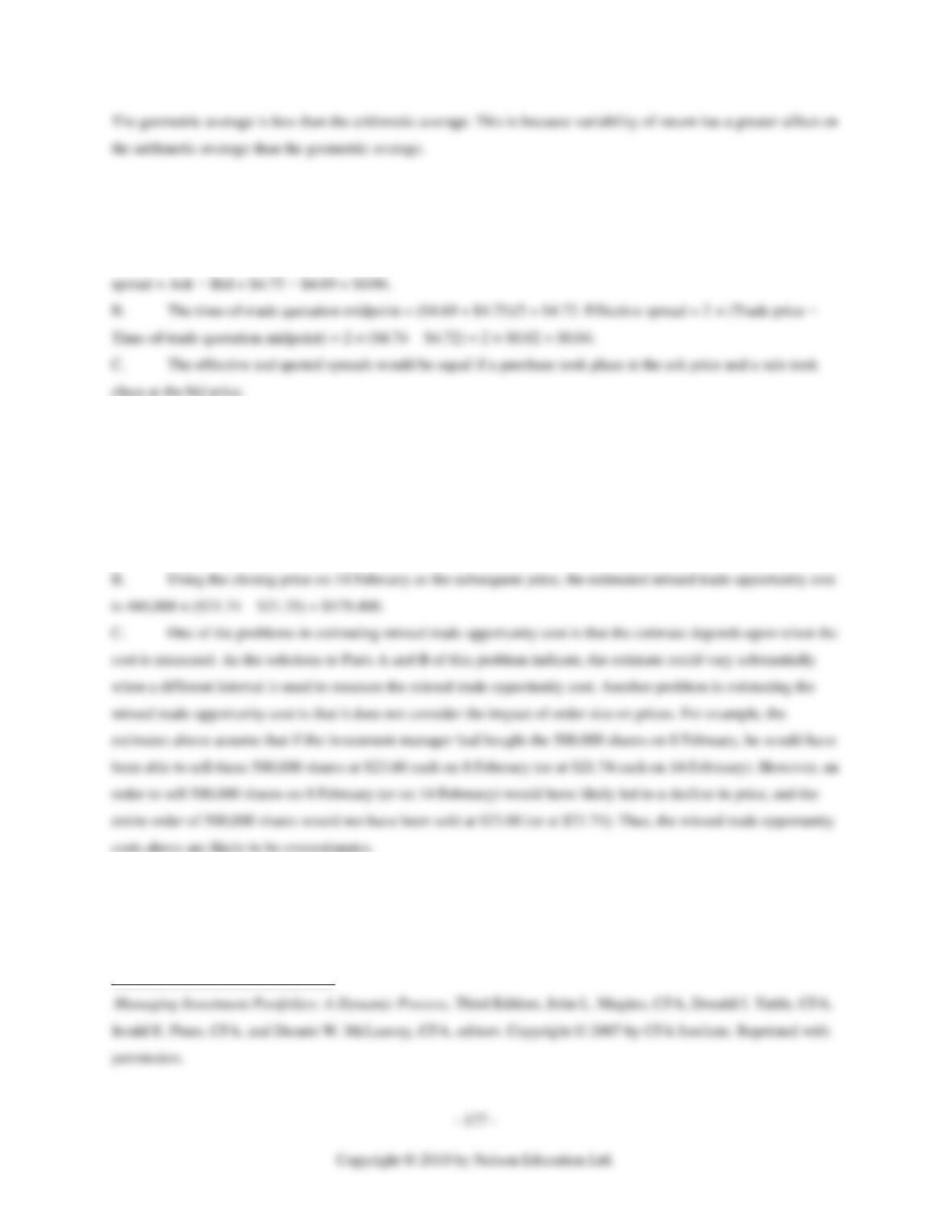
C. Geometric average is the nth root of the product of n items.
1/ 3
1/ 3
Geometric average [(1.3333)(1.75)(1.3889)]1
[3.2407] 1
1.4798 1
.4798 or 47.98%
=−
=−
=−
=
Solutions for Appendix A: CFA Questions and Problems
Level III
7. A. Quoted spread is the difference between the ask and bid prices in the quote prevailing at the time
the trade is entered. The prevailing quote is the one at 10:50:06, with a bid of $4.69 and an ask of $4.75. So, Quoted
8. A. Missed trade opportunity cost is the unfilled size times the difference between the subsequent
price and the benchmark price for buys (or times the difference between the benchmark price and the subsequent
price for sells). So, using the closing price on 8 February as the subsequent price, the estimated missed trade
opportunity cost is 460,000 × ($23.60 − $21.35) = $1,035,000.
9. The average execution cost for a purchase of securities is 75 basis points, or 0.75 percent, and the average
execution cost for a sale of securities is also 0.75 percent. So, the average execution for a round-trip trade is 2 ×
0.75%, or 1.5%. Since the portfolio is expected to be turned over twice, expected execution costs are 1.5% × 2 =

Solutions for Appendix A: CFA Questions and Problems
Chapter 5
Level III
1. A is correct. The economist’s forecast assumed the Fed would keep rates low, but instead the Fed raised
rates. This argument is the “if only” excuse.
4. C is correct. Myopic loss aversion is behavior associated with investors who focus on short time horizons.
They tend to look at one-year returns rather than the longer time horizons appropriate for pension fund investing.
7. A. Overall, the domestic equities asset class has performed well relative to the benchmark (4.54% vs.
4.04%). However, only one of the two domestic equities managers has outperformed his respective benchmark.
Equity manager A has outperformed by 15 basis points, while equity manager B has underperformed by 18 basis
points.
The international equity asset class as a whole has outperformed its benchmark. In addition, both international
equity managers have also outperformed their respective benchmarks.

Solutions for Appendix A: CFA Questions and Problems
B. Overall, the total fund has outperformed its benchmark by 11 basis points. Nevertheless, the fund may be
able to improve its relative performance by considering some changes to the manager lineup.
8. The average performance should be that of the market index minus costs (transaction costs, management
fees).
If international investors, as a group, beat some national index, it tells us that local investors, as a group, probably
Chapter 6
Level I
1. A is correct. The current portfolio has an equal amount invested in each of the four securities. The expected
2. B is correct. Replacing a security with a 14 percent return with a security having only a 13 percent return
will lower the expected return of the portfolio. The expected return on a portfolio is simply a weighted average of
the expected returns for each of the individual securities in the portfolio.
Level II
3. The expected return is 0.75E(return on stocks) + 0.25E(return on bonds)