1
Solutions To Problems of Chapter 10
10.1. Show that the step, in a greedy algorithm, that selects the column of
the sensing matrix, so that to maximize the correlation between the
column and the currently available error vector e(i−1), is equivalent
with selecting the column that reduces the l2norm of the error vector.
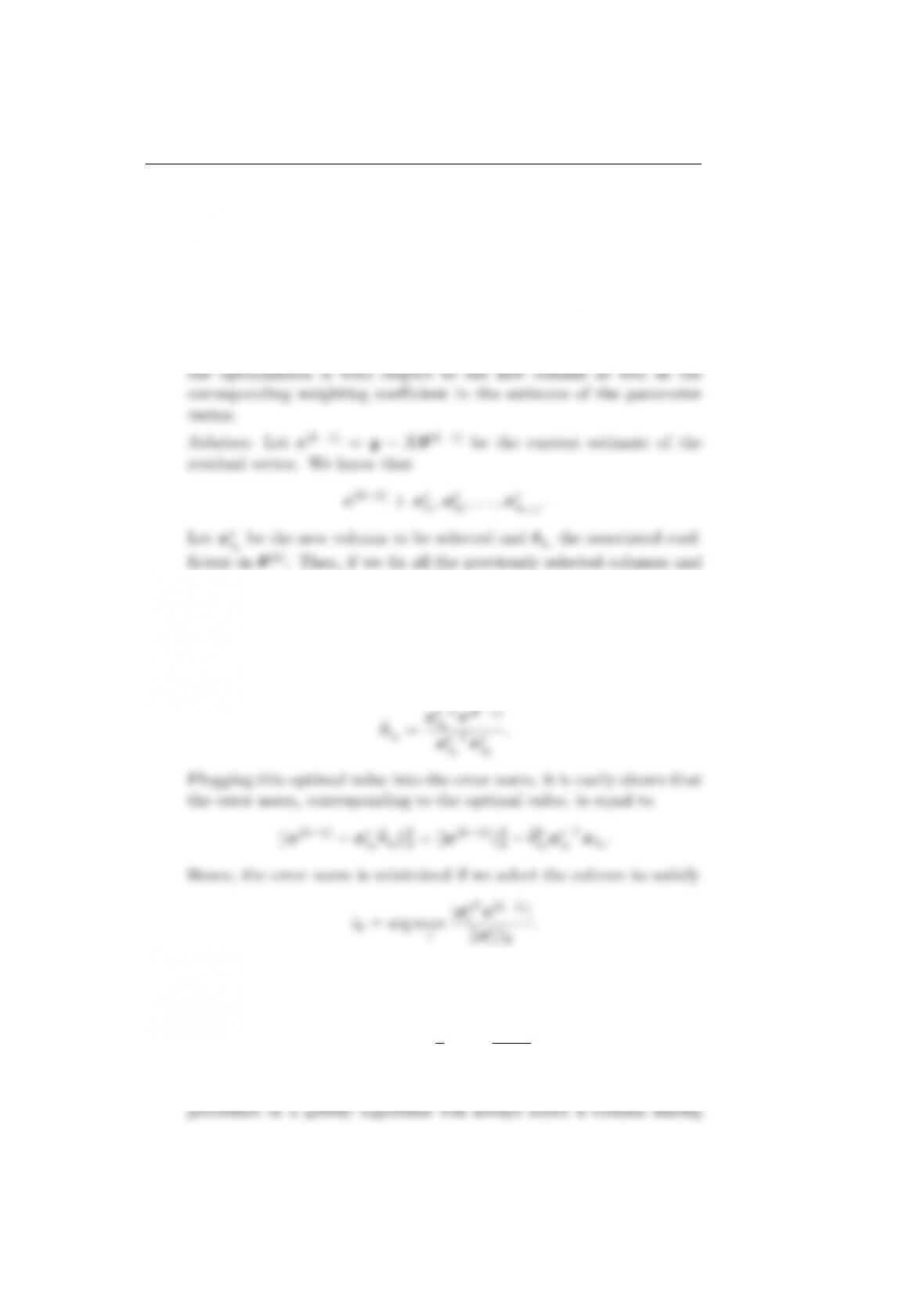
Hint: All the parameters obtained in previous steps are fixed, and
their associated coefficients in θ(k), the square `2norm of the error
becomes
||y−Xθ(k−1) −xc
ikθik||2
2=||e(k−1) −xc
ikθik||2
2.
Minimizing the previous norm w.r. to θik, we easily obtain that
ik
Te(k−1)
i
||xc
i||2
10.2. Prove the proposition stating that if there is a sparse solution to the
linear system y=Xθsuch that
k0=||θ||0<1
21 + 1
µ(X),
where µ(X) is the mutual coherence of X, then the column selection
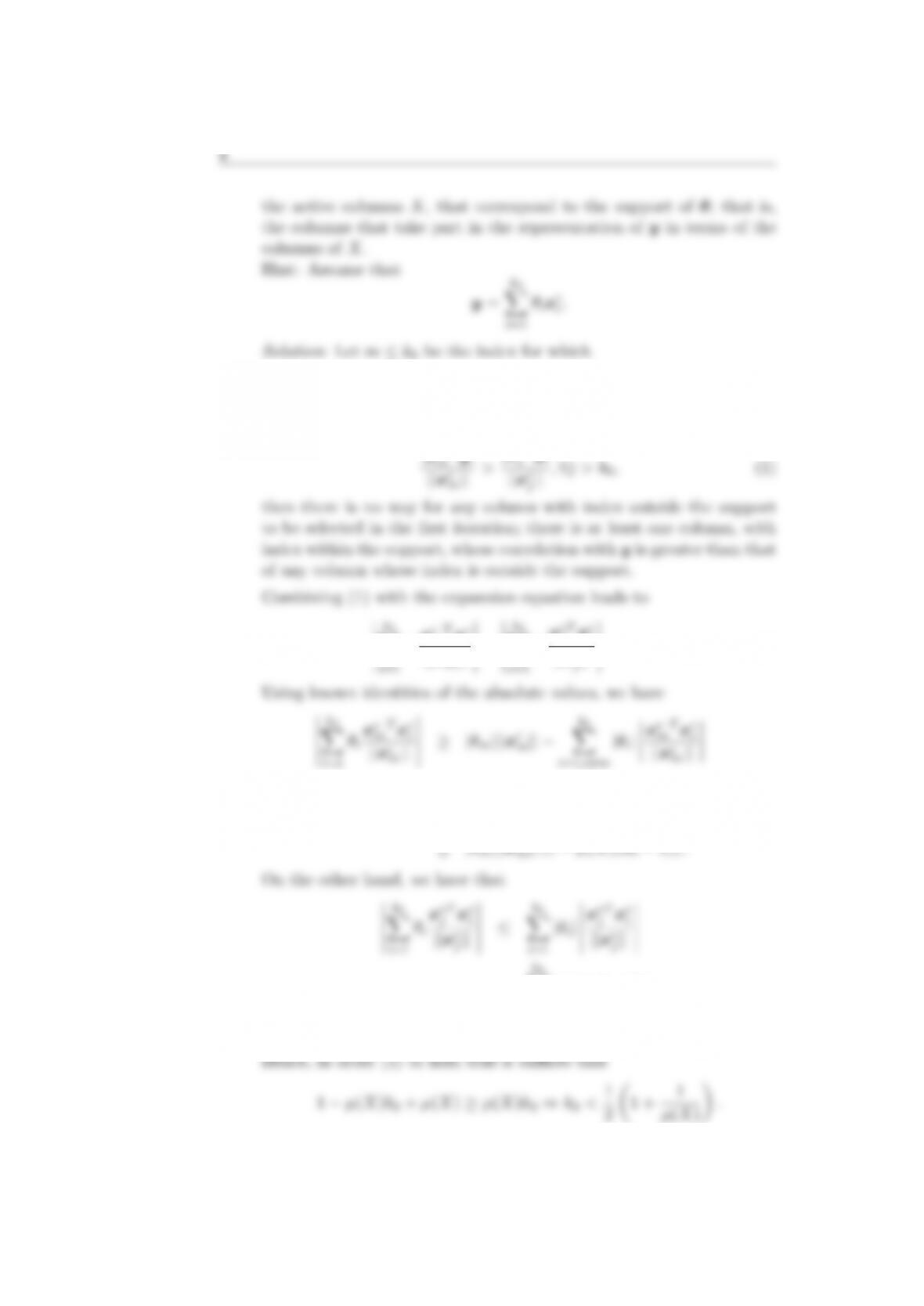
|θm|||xc
m|| ≥ |θi|||xc
i||, i 6=m, i ≤k0,
where the vector norms are assumed to be the `2norms. Then if we
show that
|xc
X
θi
xc
mTxc
i
||xc
>
X
θi
xc
jTxc
i
||xc
, j > k0.(2)
i=1
i=1,i6=m
≥ |θm|||xc
m|| −
k0
X
i=1,i6=m
|θm|||xc
m||µ(X)
≥ |θm|||xc
≤
X
i=1
|θi|||xc
i||µ(X)
≤ |θm|||xc
m||µ(X)k0.
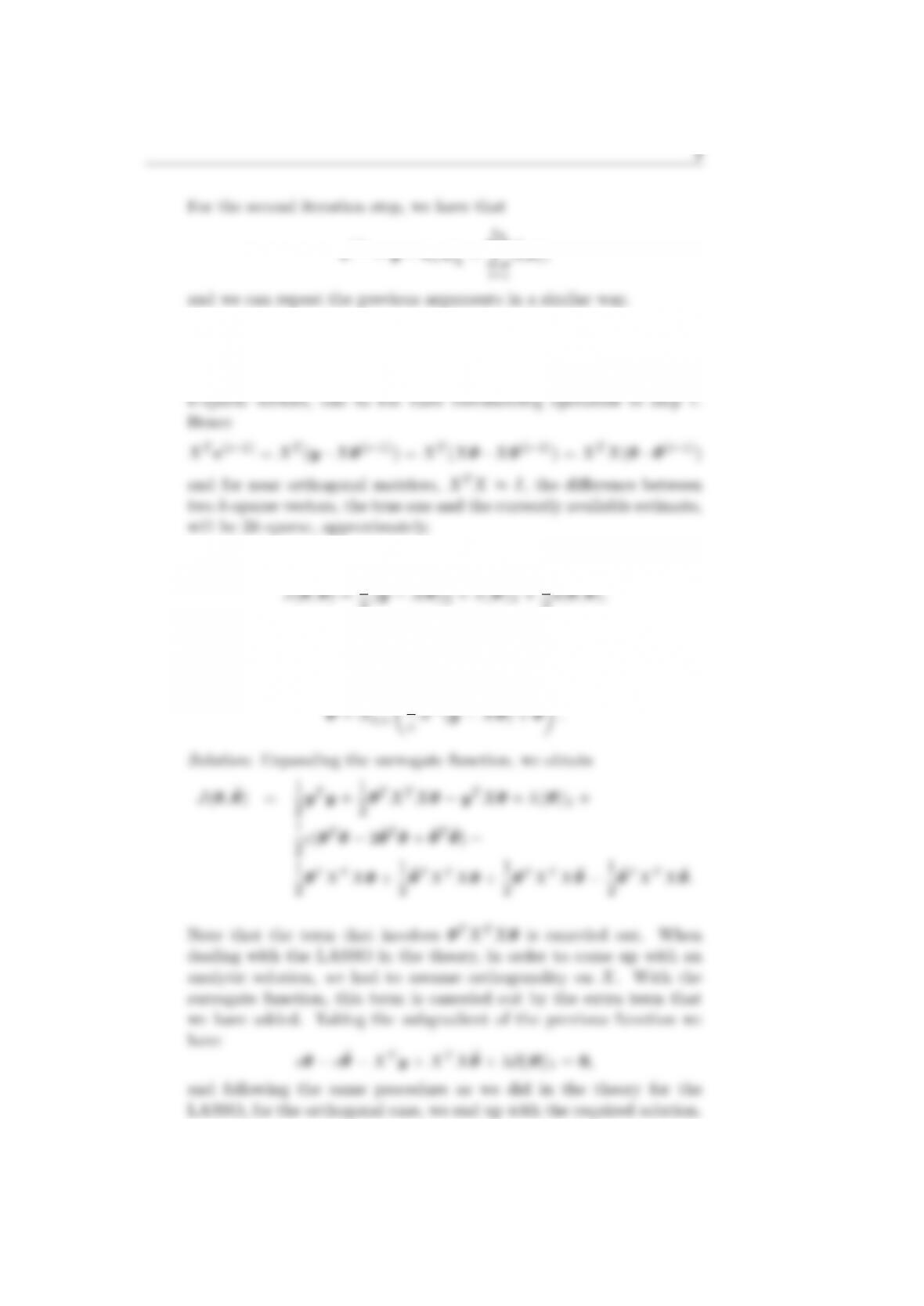
e(1) =y−θi1xc
k0
X
˜
θixc
10.3. Give an explanation to justify why in step 4 of the CoSaMP algorithm
the value of tis taken to be equal to 2k
Solution: The estimates, θ(i), obtained at each iteration are always
10.4. Show that if
2||y−Xθ||2
2d(θ,˜
where
d(θ,˜
θ) := c||θ−˜
θ||2
2− ||Xθ−X˜
θ||2
2,
then minimization results to
ˆ
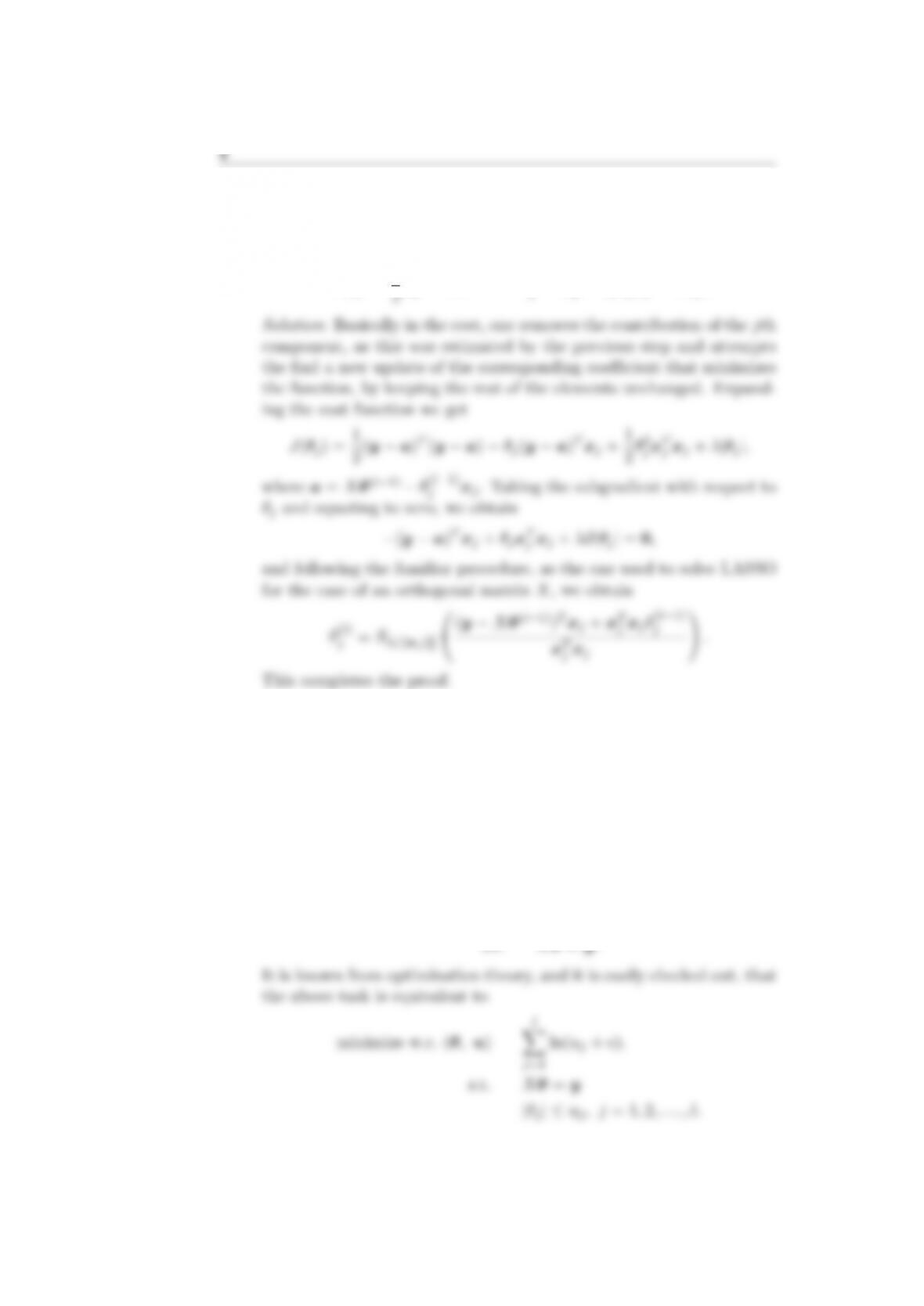
10.5. Prove the basic recursion of the parallel coordinate descent algorithm.
Hint: Assume that at the ith iteration, it is the turn of the jth com-
ponent to be updated, so that the following is minimized
J(θj) = 1
jxj−θjxj||2
2+λ|θj|.
10.6. Derive the iterative scheme to minimize the weighted `1ball, using
a majorization-minimization procedure to minimize Pl
i=1 ln(|θi|+),
subject to the measurements set, y=Xθ.
Hint: Use the linearization of the logarithmic function to bound it
from above, since it is a concave function and its graph is located be-
low its tangent.
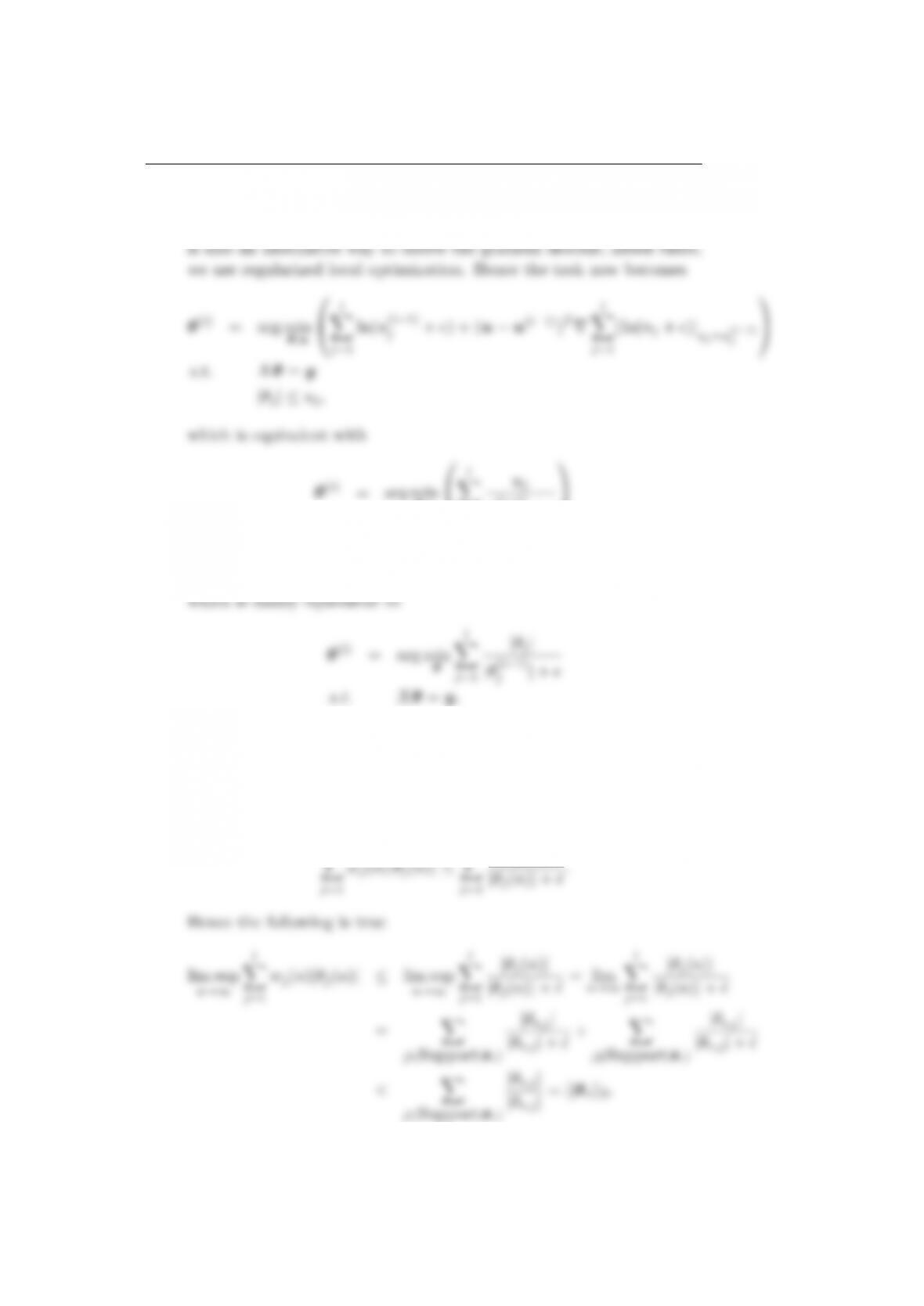
Solution: Our task is
minimize w.r. θ
l
X
j=1
ln(|θj|+),
s.t. Xθ=y.
5
Instead, at each iteration step, we will try to minimize the linearization
of the function, around its previous estimate. We have seen that this
θ,u
j=1
u(i−1)
j+
s.t. Xθ=y
|θj| ≤ uj,
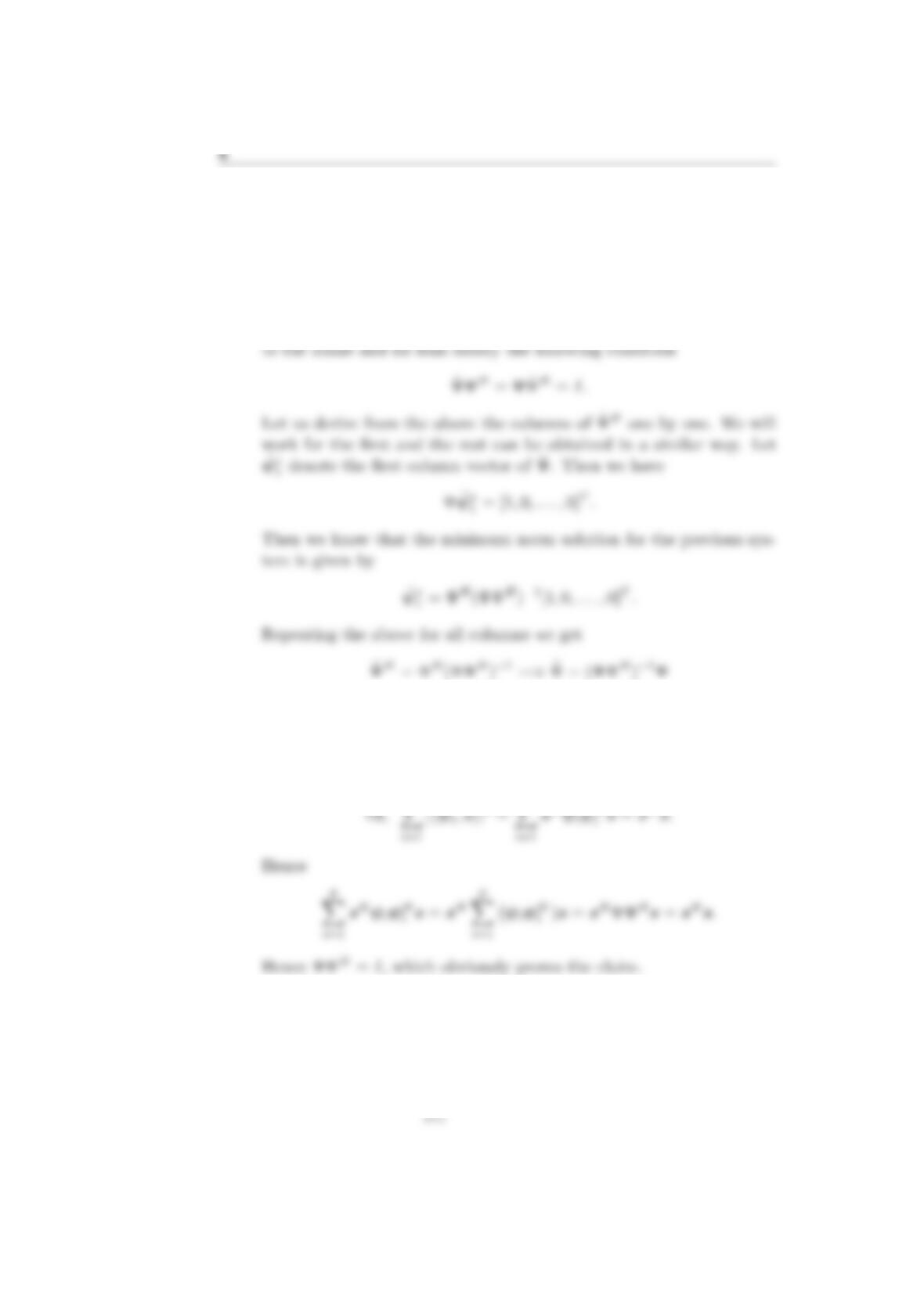
10.7. Show that the weighted `1ball, used in SpAPSM, is upper bounded
by the `0norm of the target vector.
Solution: Assume that θ(n) converges to the true vector. Moreover
assume that ´n≥´ > 0. Then
l
X
wj(n)|θj(n)| ≤
l
X
|θj(n)|
j∈Support(θ∗)
10.8. Show that the canonical dual frame minimizes the total `2norm of the
dual frame, i.e.,
X
i∈I
˜
ψi
2
2.
Hint: Use the result of Problem 9.10.
Solution: We know from the theory that the matrices corresponding
10.9. Show that Parseval’s tight frames are self dual.
Solution: Let the dimensionality of the frame’s matrix Ψ be N×p.
From the definition of the Parseval tight frame (PTFP) we have that
p
X
p
X
is=sHs.
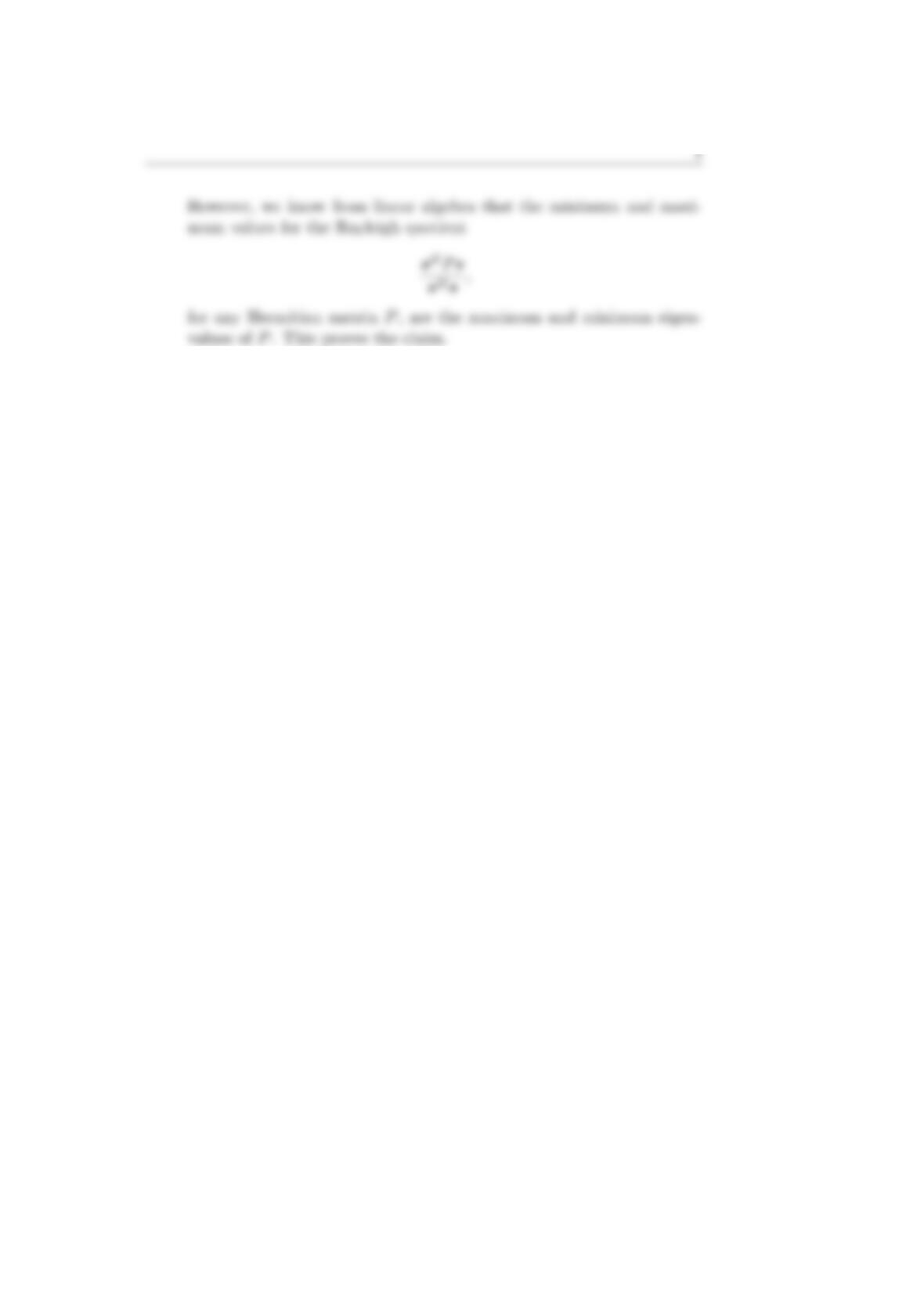
10.10. Prove that the bounds A, B of a frame coincide with the maximum
and minimum eigenvalues of the matrix product ΨΨH.
Solution: From the definition of a frame we have
Aksk2
2≤
p
X
|hψi,si|2=sHΨΨHs≤Bksk2
2.

Bibliography
[Horn 85] Horn R.A., Johnson C.R. Matrix Analysis, Cambridge University
Press, New York 1985.
[Golu 83] Golub G.H., Van Loan C.F. Matrix Computations, The John Hop-
kins University Press, Baltimore, 1983.
9