Review, Practice, and Explore – Chapter 8 • 71
Review, Practice, and Explore – Chapter 8
8.1 Syntactic Ambiguity: Drawing Trees
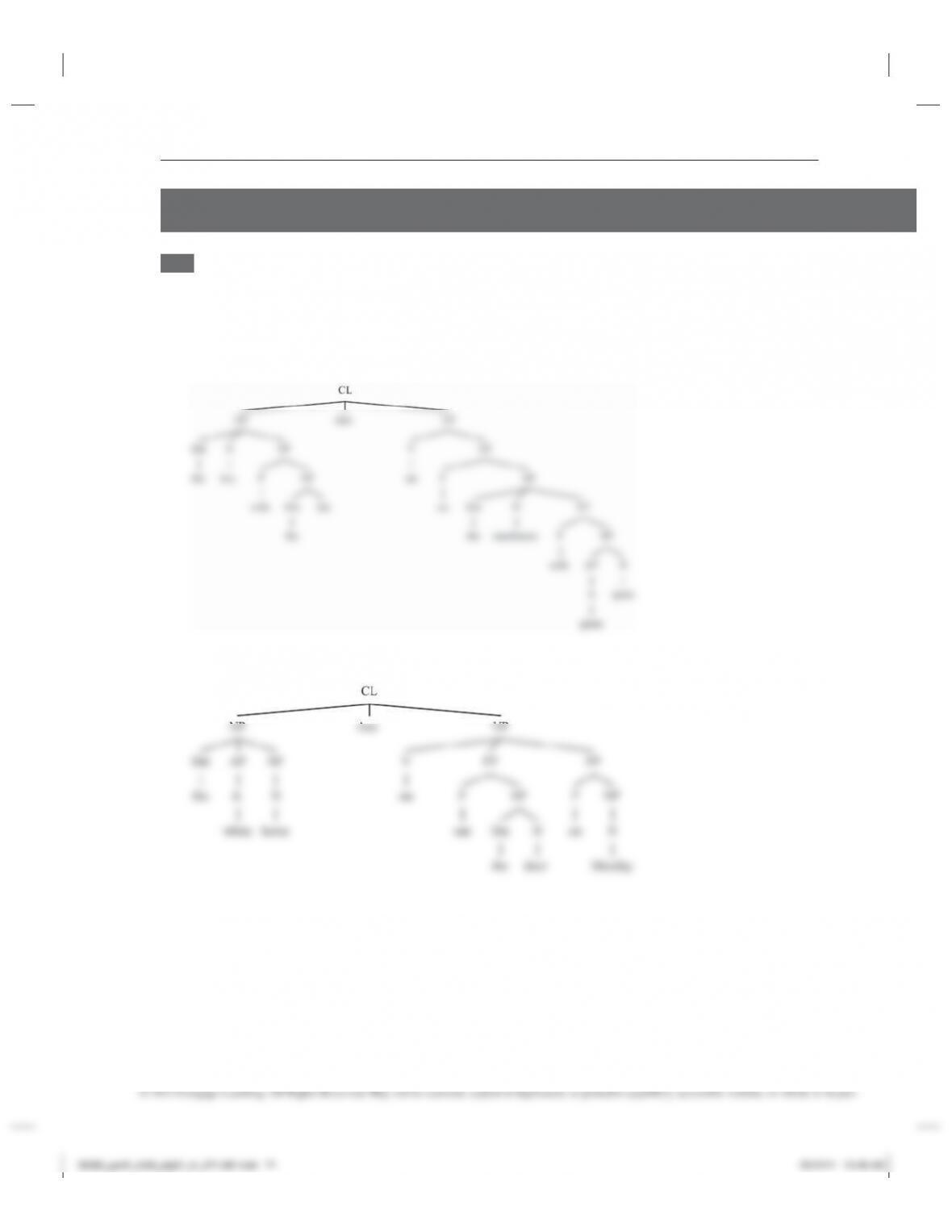
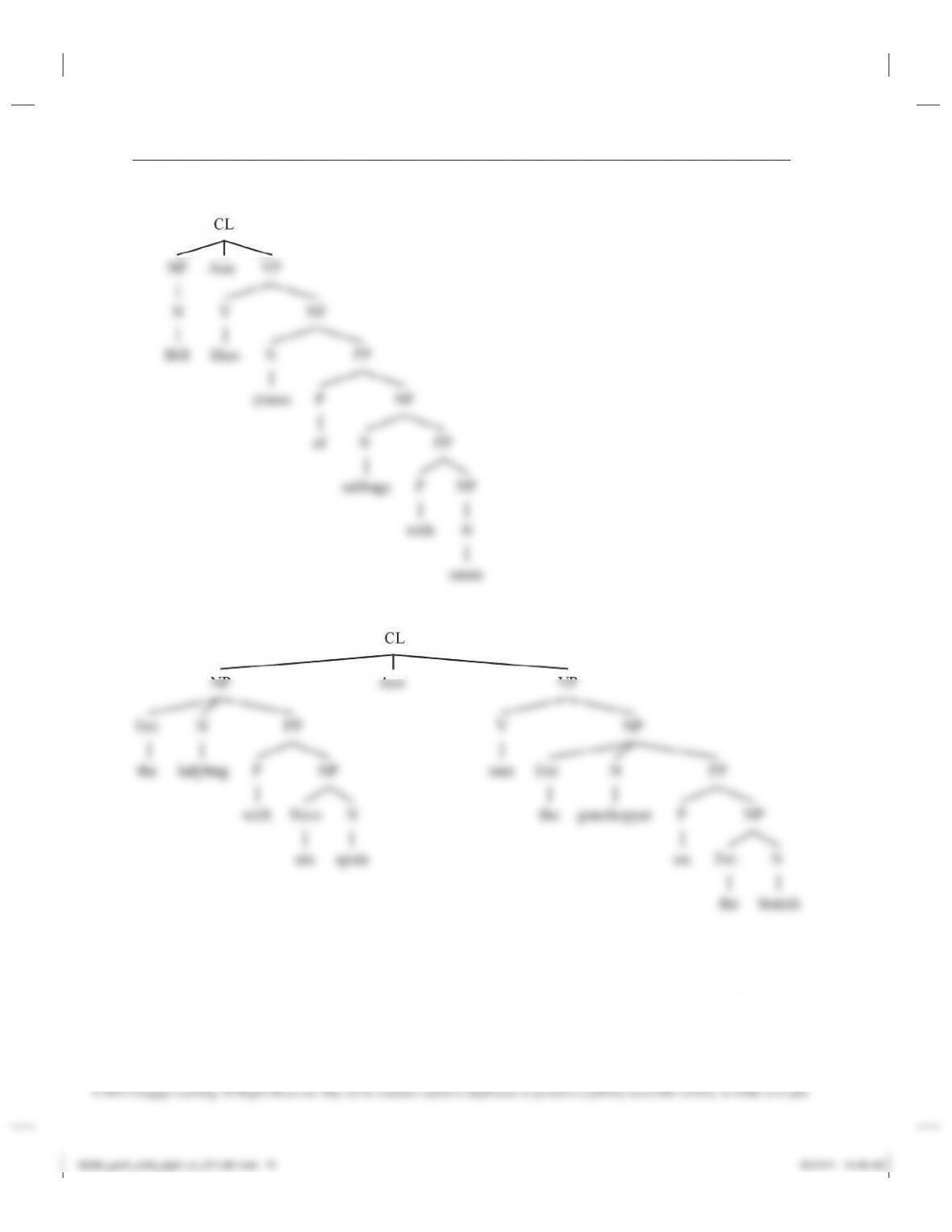
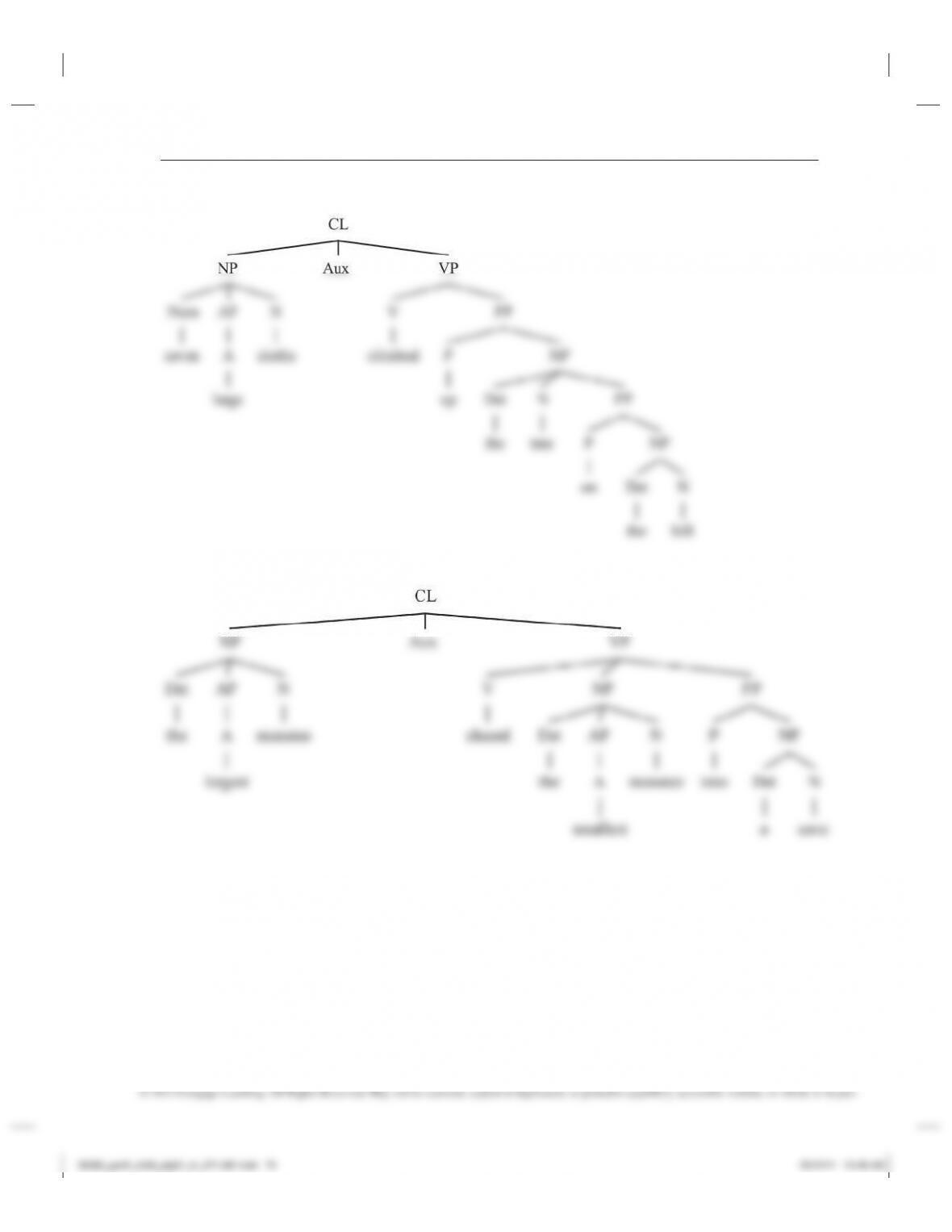
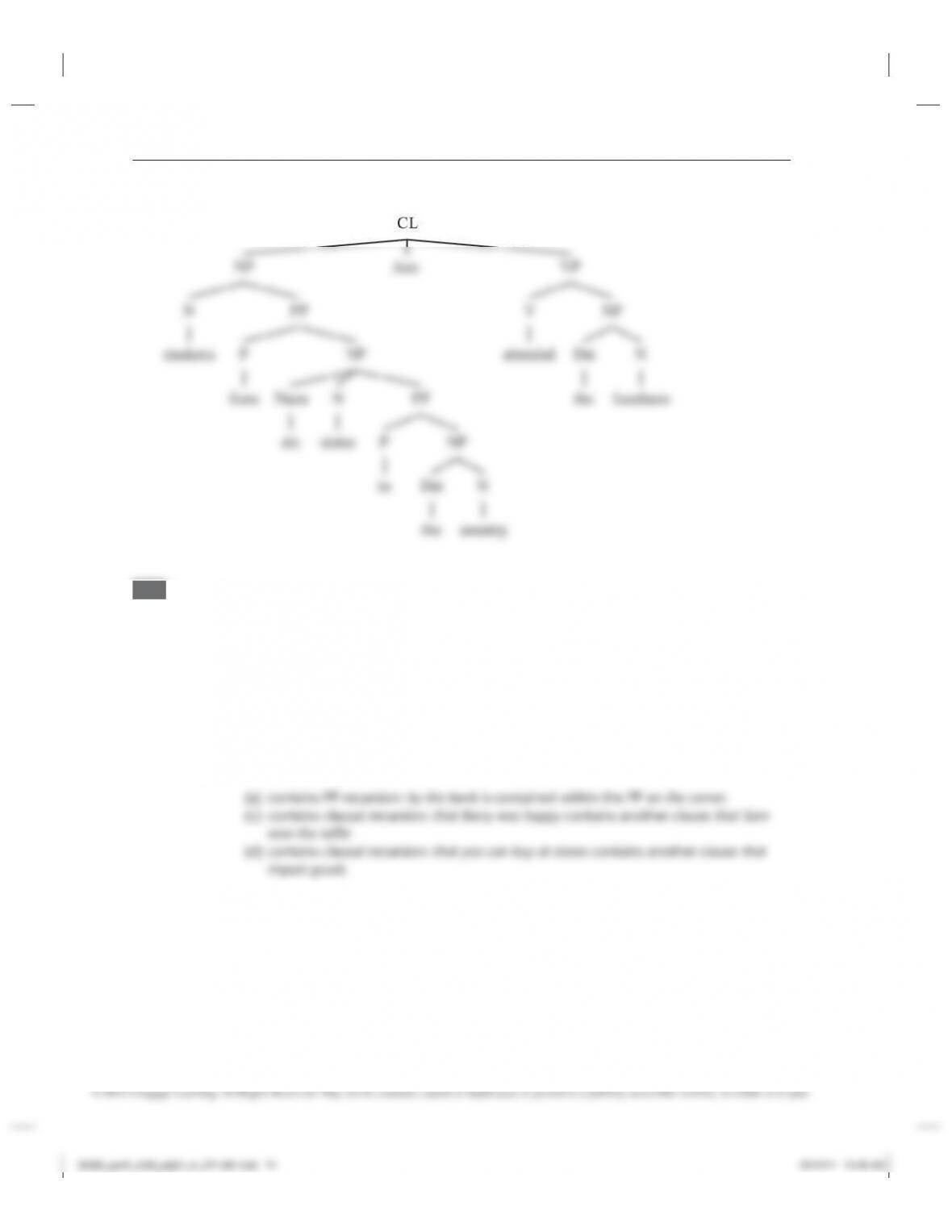
Draw tree diagrams for the following sentences, paying special attention to where each PP is at-
tached. Some (but not all!) of the sentences are ambiguous. If there is ambiguity, draw two trees to
represent the two meanings; be sure to indicate the meaning of each tree in this case.
a. The boy with the hat sat on a mushroom with green spots.
b. The white horse ran out the door on Monday.
72 • PART 2 Answer Key
c. Bill likes pieces of cabbage with sauce.
d. The ladybug with six spots sees the grasshopper on the branch.
Review, Practice, and Explore – Chapter 8 • 73
e. Seven large sloths climbed up the tree on the hill.
f. The largest manatee chased the smallest manatee into a cave.
74 • PART 2 Answer Key
g. Students from six states in the country attended the luncheon.
8.2 Recursion
Some of the following sentences include phrases that are recursive. Can you identify the category of
the recursive phrase(s) (PP, NP, CL, etc.)?
a. The house on the corner by the bank is for sale.
b. A few people came to the party, and everyone left early.
c. I don’t think that Barry was happy that Sam won the rafe.
d. Cheese that you can buy at stores that import goods from overseas is usually pretty
expensive.
e. I jumped up and ran home.
In a text of your choice, find at least three examples of recursion (of any category you choose, but
common examples include NP, PP, and clause recursion). Label the recursive categories.
Answers will vary.
Review, Practice, and Explore – Chapter 8 • 75
8.3 Silent Syntax
Each of the following sentences or exchanges includes a silent phrase, which is marked with Δ.
What syntactic material is missing in each sentence?
a. I just bought three new textbooks, and Avery bought six Δ [textbooks]!
b. You might want to go to the party, but I don’t Δ [want to go to the party].
8.4 Nouns, Noun Phrases, and Pronoun Substitution
Find all the noun phrases in the following sentences. (Some include only a head noun; others are
much larger.) Then, show how the pronoun substitution test provides evidence that those phrases are
in fact noun phrases, even if they consist of only one word. Are any of the sentences ambiguous?
How can pronoun substitution help you explain the two meanings?
Example: Dogs on leashes are allowed in this park.
a. Dogs are free to run and jump and play with the toys at the park.
They are free to run and jump and play with them at it.
b. My neighbor brings seven dogs to the park every day.
c. The schnauzer and the cocker spaniel bark a lot.
d. The schnauzer, the cocker spaniel, and the border collie like to play together.
e. People who have dogs and like to take them out for exercise use the park often.
g. Mary loves the park.

Review, Practice, and Explore – Chapter 8 • 77
B. Which of the following examples violate parallelism? Why or why not? Is it accurate
to say that parallelism always requires the coordination of the same syntactic category?
Under what circumstances can this requirement be relaxed?
1. Artichokes are in season and very delicious. PP and AP
3. I’ve never seen a unicorn talk or a hippogriff sing. clauses
5. Maurice saw the bus and that his son got on it. NP and clause
6. Lucy was grumpy and in a funk. AP and PP
Some of these violate parallelism by coordinating dissimiliar categories if they are
semantically similar (grumpy and in a funk are AP and PP respectively, but PP here
describes a state). Some students may nd the ones that coordinate dissimilar
categories to be unacceptable. Deletion may be involved so that there actually is
coordination of like categories, but not all of the phrase is spoken; for example,
8.8 Conjunction and Subordination
We’ve seen that coordination involves linking constituents in various ways. Subordination, on the
other hand, involves embedding one constituent in another.
Here, the clause he loves it is subordinate and introduced by because, a member of a large set of sub-
ordinating conjunctions (also called subordinating prepositions), words that introduce subordinate
clauses. Others in this class include although, even though, since, while, when, before, and after.
Make up a pair of clauses. First, coordinate them with one of the coordinating conjunctions (for,
and, nor, but, or, yet, so). Then try to use the same clauses, but this time subordinate one of the
clauses to the other using a subordinating conjunction. How does subordination affect the meaning
of the sentence?
Example
Answers will vary.
Review, Practice, and Explore – Chapter 8 • 79
Write down three sentences with particles (use different examples from those given here). Show
how they undergo particle shift. Also, write down three sentences with prepositions, and show how
these do not undergo particle shift.
Answers will vary. Some examples of other particles are the following:
8.11 Deep and Surface Structure
In the following sentences, one or more of these rules may have applied: SAI, passive, and
wh-movement. Write out the deep structure for each sentence, list the rules that have applied, and
write out the surface structure. In some cases, more than one rule might apply, so list them both.
Example:
Will it rain? deep structure It will rain.
Application of rules SAI
surface structure Will it rain?
a. Is The Lord of the Rings your favorite movie series?
b. The window was broken by the baseball.
c. Which letter did the secretary mail?
d. Should we go home?
80 • PART 2 Answer Key
e. A letter was mailed by the secretary.
f. Was your stolen jewelry ever recovered by the police?
8.12 A Cross-Linguistic Look at Wh-Movement
Wh-Questions in Chinese
We have seen that English has wh-movement:
a. Jack can see the rabbit. = basic word order
b. What can Jack see? = question word order
Some languages have no wh-movement. The basic word order is the same in declaratives and in
questions. Chinese is an example:
Ta yao xiaobing (basic word order)
she/he want bread
‘She/he wants some bread.’
Ta yao shenme (question word order)
she/he want what
‘What does she/he want?’
In English, the movement of the wh-phrase to the front of the clause marks the clause as a question.
How do you think Chinese speakers know that a question is being asked?
Wh-Questions in Aleut
Aleut is a language spoken on the Aleutian Islands off the coast of Alaska. Look at the follow-
ing pairs of sentences in Aleut and their translations, and determine whether or not Aleut has
wh-movement.
a. Piitrax Ivaanax ilagulix.

Review, Practice, and Explore – Chapter 8 • 81
b. Piitrax kiin ilagulix?
Peter who help
‘Who is Peter helping?’
a. Tayagux qax qalix.
man fish eat
‘The man is eating a fish.’
b. Tayagux alqutax qalix?
man what eat
‘What is the man eating?’
8.13 Another Constraint on Wh-Movement in English
Here are some more sentences in which wh-movement in English appears to be blocked.
a. Whose book did you read __?
b. *Whose did you read __ book?
Why is (b) ungrammatical?
Here are some similar examples in which wh-movement is grammatical. Can you make up the
ungrammatical sentences patterned in the same way as (b) from these examples? Can you state
(informally) the constraint on wh-movement that blocks the ungrammatical sentences from being
generated?
a. Which person did you meet yesterday?
*Which did you meet person yesterday?
b. What class does John have in the morning?
*What does John have class in the morning?
c. Whose dog are you taking care of?
*Whose are you take caring of dog?
Wh-movement appears to operate on whole phrases/phrasal constituents, not just on
the wh-word.