120
Support: Values
KEY TERMS
stated values, p. 121
implied values, p. 121
positive values, p. 122
negative values, p. 122
terminal values, p. 122
instrumental values, p. 122
abstract values, p. 124
concrete values, p. 124
value systems, p. 124
value hierarchy, p. 126
ethics, p. 127
changing values, p. 131
attacking value, p. 131
decision makers’ value systems, p. 132
implied values, p. 133
sphere dependence of values, p. 134
Communication technology has made enormous strides in the past 50 years, espe-
cially in the past 20. Television satellites, cable, computers, fax machines, smart
phones, iPads, iPods, iMacs, camera phones, Twitter, Facebook, and other elec-
tronics have increased by geometric ratios the availability of information to people while
increasing their ability to communicate with one another. Many feel this has been a mixed
blessing, particularly when the influence on children is measured.
Children can find sex and violence on media sites and communicate it to others.
Most people believe this is a problem, but can it be solved? And how? Should media be
censored? Should the government impose the restrictions on cable that are imposed on
8
CHAPTER
M08_RIEK0596_08_SE_C08.indd Page 120 1/18/12 9:52 AM user-f501M08_RIEK0596_08_SE_C08.indd Page 120 1/18/12 9:52 AM user-f501 F-401F-401
Not all argumentation is so obviously based on values. But all argumentation has val-
ues in its development. Some would argue that values are the defining central factor of all
argumentation (Sillars). One series of studies of unplanned reasoning by children and adults
in various cultures indicates that values-based reasoning is pervasive (Willbrand and Rieke,
“Reason giving in . . . ,” 343). In this chapter, we will examine values as they serve as sup-
port for claims at the same time that we remember that claims themselves may be values.
In Chapter 1 , we observed that there are three kinds of claims: fact, value, and policy.
Value claims are those that directly involve values, and policy claims require value claims
to support them. Only a factual claim, which asserts that certain conditions exist in the
material world and can be observed, would seem to be value free, but it is not. Even the
scientist’s careful statement about laboratory observations implies the values of rationality
and knowledge. Thus, values are important even to choose one factual claim over another.
Values obviously relate directly to claims of value, and they are vital to policy and
factual claims as well. Values, together with source credibility and evidence, are the
CHARACTERISTICS OF VALUES
Values, then, are concepts of what is desirable that arguers use and decision makers under-
stand. Arguers use them with credibility and evidence to justify claims. But values have a
variety of characteristics and fit together in various ways. We will examine those characteris-
tics now so that you can better understand what goes into a value system in argumentation.
Stated and Implied Values
Some statements of value concepts are direct; these are called stated values . People some-
times say that freedom, health , or wealth is important. These words state directly the
value concepts they hold. Some value concepts may be identified by several different
words, as is the case with liberty, freedom , or independence . Furthermore, there can be
variations of a single word as in freedom, free , or freely depending on the nature of the
sentence in which they appear.
Value concepts are not always explicitly stated, however. Frequently, they are implied .
Values are general concepts that define what arguers and decision makers believe are desira-
ble, but many values are implied in what we call belief statements . Milton Rokeach defines a
CHAPTER 8 Support: Values 121
M08_RIEK0596_08_SE_C08.indd Page 121 1/18/12 9:52 AM user-f501M08_RIEK0596_08_SE_C08.indd Page 121 1/18/12 9:52 AM user-f501 F-401F-401
122 PART 2 Tools
Science
Stated: DNA research is a scientific triumph.
Implied: DNA research is virtually unquestionable.
Self-Respect
Stated: Every child’s well-being is based on self-respect .
Implied: Children need to learn to like themselves.
When you directly and frequently state value concepts, you are more intensive in your
use of values than if you imply values only through indirect statement. The closing argu-
ment of a trial frequently is more value intensive than is the examination of witnesses. In
the legal sphere, there is an attempt to be value free during the collecting of evidence.
Positive and Negative Values
Our definition of a value as “a conception of the desirable” puts a clearly positive cast on
value concepts. However, for every positive concept, there is at least one antithesis. So, a
statement of a value can be either positive or negative. Earning opposes stealing, freedom
opposes restraint, thrift opposes waste, knowledge opposes ignorance, and pleasure op-
poses pain. Depending on the strategy devised, if you argue against a specific proposal,
you may do so by identifying positive values that oppose it or negative values that you
associate with it. As a critic of argument, you will want to note the extent to which an
arguer focuses on either negative or positive values.
On the Saturday before Easter 2011, Pope Benedict XVI used the vigil marking Jesus’
transition from death to rebirth to speak out on evolution. He said:
If man were merely a random product of evolution in some place at the margins
of the universe, then his life would make no sense or might even be a chance of
nature. But no, reason is there at the beginning, creative divine reason. (Winfield)
Note how he uses negative values to set up the argument for powerful positive values.
Negative values: “random,” “at the margins of the universe,” “no sense,” “chance
of nature.”
Positive values: “Reason,” Creative,” “Divine” (God).
Terminal and Instrumental Values
Values will reflect the ends a person admires (wealth, health, happiness, security) or
the means to attain the ends (hard work, faith, helpfulness, responsibility). Milton
Rokeach called these “terminal and instrumental values” ( Beliefs 160). He also
found the terminal values to be the most central to an individual’s value system
( Nature 215).
M08_RIEK0596_08_SE_C08.indd Page 122 1/18/12 9:52 AM user-f501M08_RIEK0596_08_SE_C08.indd Page 122 1/18/12 9:52 AM user-f501 F-401F-401
CHAPTER 8 Support: Values 123
A caution is necessary on that point, however. People frequently make a terminal out
of an instrumental value. For instance, they recognize that they must work hard (means)
to achieve economic security (end), but for many people, hard work becomes an end in
itself. Retired people with secure financial situations frequently work hard at whatever
they do because work has become a terminal value for them. For the scientist, a carefully
FIGURE 8.1
Rokeach’s “Terminal” Values
Note : He found these 18 values most central in an individual’s value system.
Source : Rokeach, Milton. The Nature of Human Values . San Francisco: Free Press, 1972. Page 28.
TERMINAL VALUES
1 . A comfortable life 10 . Inner harmony
2 . An exciting life 11 . Mature love
3 . A sense of accomplishment 12 . National security
4 . A world at peace 13 . Pleasure
FIGURE 8.2
Rokeach’s “Instrumental” Values
Note : The instrumental values in this list have been adapted from Rokeach’s original list to make them all nouns like his terminal
values.
Source : Rokeach, Milton. The Nature of Human Values . San Francisco: Free Press, 1972. Page 28.
INSTRUMENTAL VALUES
1 . Ambition 10 . Imagination
2 . Broad-mindedness 11 . Independence
3 . Capability 12 . Intellect
4 . Cheerfulness 13 . Logic
Rokeach also identified 18 instrumental values (Figure 8.2 ):
M08_RIEK0596_08_SE_C08.indd Page 123 1/18/12 9:52 AM user-f501M08_RIEK0596_08_SE_C08.indd Page 123 1/18/12 9:52 AM user-f501 F-401F-401
124 PART 2 Tools
His lists are not exhaustive, but they illustrate terminal and instrumental value con-
cepts that you are likely to find in your argumentation and that of others. More important
here, they illustrate the difference between terminal and instrumental values.
Abstract and Concrete Values
A value is a conception, so it would seem that values are abstract. Words such as freedom,
justice , and truth represent abstract value concepts in society. However, there are also
times when particular people, groups, institutions, or objects serve as values. These are
called concrete values (Perelman and Olbrechts-Tyteca 77). The flag, the family, the pope,
the Star of David, and the Constitution are all concrete, yet they are value concepts. The
Constitution is a good illustration. It is an actual document, but in an argument, it has all
the power of an abstract value.
In recent years, the First Amendment to the Constitution that says, “Congress shall
make no law respecting the establishment of religion, or prohibiting the free exercise
thereof,” has been interpreted, through the Fourteenth Amendment applying the princi-
ples of the Constitution to the states to mean that the Establishment Clause applies to the
states as well as the national government. This has led to a series of decisions by the
VALUES APPEAR IN SYSTEMS
Values do not appear alone in argumentation. They appear in value systems , that is, as a
set of linked claims. Clyde Kluckhohn calls these “value orientations . . . generalized and
organized conceptions . . . of the desirable and non-desirable” (“Values” 411). We hear
people argue for better treatment of Native Americans, not on the basis of a single value
of justice or equality but on the basis of a series of values like justice, freedom, family se-
curity, happiness, and self-respect that link together and reflect a unified system in which
each value will be perceived as compatible with every other.
Indeed, one of our major disagreements in argumentation is over perceived inconsist-
ency. When values are not compatible in a system, they are used to weaken a claim. People
are charged with inconsistency if they argue for their own freedom and discriminate against
M08_RIEK0596_08_SE_C08.indd Page 124 1/18/12 9:52 AM user-f501M08_RIEK0596_08_SE_C08.indd Page 124 1/18/12 9:52 AM user-f501 F-401F-401
CHAPTER 8 Support: Values 125
minorities. We know of people who wonder how someone can object to marijuana (health)
and still drink alcohol. Some people consider it inconsistent to argue for morality and deny
a belief in God. Others find it inconsistent to support capital punishment but oppose abor-
tion, and vice versa.
These are examples of arguments about the consistency of values in a given system.
They come about because values do not stand alone. They work in integrated systems.
In an extensive study of the value systems across cultures, Charles Morris found a
dominant pattern of American value systems, although it was different from the value
systems in other cultures (44). Shalom H. Schwartz of the Hebrew University of Jerusalem
has found a core set of 10 values that his research shows are present in all cultures: Self-
direction, Stimulation, Hedonism, Achievement, Power, Security, Conformity, Tradition,
Benevolence, Universalism. However, he notes, the pursuit of achievement values may be
in conflict with benevolence values. So, a person’s own attempt to succeed might obstruct
his or her interest in the welfare of others. Then again, the actions of successful and
wealthy business leaders like Bill Gates, Mark Zuckerberg, and Steve Jobs would seem to
make these values compatible. So, the question of inconsistency must be argued on a case-
by-case basis.
A frequently cited cultural difference is between Japanese and American values in
their emphasis on collectivism versus individualism. Three researchers examined the
role of “commitment” in both cultures. In short, how do American and Japanese work-
ers and family members perceive the commitment they have to the agencies of the soci-
ety? What values characterize the Japanese and American value systems beyond the
accepted collectivism/individualism? The values [they called them themes ] found
Traditional Value Systems
There are several acknowledged U.S. value systems that scholars from a wide variety of
fields identify (Kluckhohn, Mirror 228–261; Morris 185; Ruesch 94–134; Steele and
Redding 83–91; Weaver 211–232). To illustrate, we will examine one value system that is
probably the dominant value system in U.S. politics and government, the enlightenment
value system.
The United States became a nation in the period of the Enlightenment, a new intel-
lectual era based on the writings of scientists such as Sir Isaac Newton and philosophers
such as John Locke. The Declaration of Independence is the epitome of an Enlightenment
document. In many ways, the United States is an enlightenment nation, and if enlighten-
ment is not the predominant value system, it surely is first among equals.
M08_RIEK0596_08_SE_C08.indd Page 125 1/18/12 9:52 AM user-f501M08_RIEK0596_08_SE_C08.indd Page 125 1/18/12 9:52 AM user-f501 F-401F-401
126 PART 2 Tools
The Enlightenment position stems from the belief that there is an ordered world
where all activity is governed by laws similar to the laws of physics. These “natural laws”
may or may not come from God, depending on the particular orientation of the person
examining them, but Enlightenment thinkers theorized that people could discover these
laws by themselves. Thus, people may worship God for God’s greatness, even acknowl-
edge that God created the universe and natural laws, but they find out about the universe
because they have the powers of observation and reason. The laws of nature are harmoni-
ous, and one can use reason to discover them all. They also can provide for a better life.
Positive: freedom, science, nature, rationality, democracy, fact, liberty, individual-
ism, knowledge, intelligence, reason, natural rights, natural laws, progress, in-
formation
Negative: ignorance, superstition, inattention, thoughtlessness, error, indecision, ir-
rationality, dictatorship, book burning, falsehood, regression
People use the enlightenment value system in a wide variety of spheres and situations.
They make judgments about the desirable in science, in politics, and in everyday life. All
value systems, like the enlightenment system, are a set of linked claims about desirable
ends and means. But the values in a system are more than linked to one another. A value
hierarchy defines their relationship to one another. In a particular argumentative situa-
tion, the values in a system are graded.
Values Are Graded in Systems
A particular set of decision makers is defined by the value system to which it adheres.
Many residents of the United States follow what we will call a personal success value sys-
tem. For many people, family, career, health, self-respect, satisfaction, freedom of choice,
accomplishment, material possessions, friendship, and similar values are most important
(Gallup and Newport). The personal success value system represents U.S. citizens as suc-
cess oriented in an individual way that may not be found in other cultures (e.g., the
Japanese culture).
However, as natural as such a value system is in the United States, it cannot be used
in a particular argumentative situation until it has some kind of order to it. Any two val-
ues potentially contradict one another. A person may value both family and career as a
part of personal success. Yet, an argument can be made that career can interfere with fam-
ily. In such a case, the two values are not simply part of a value system; they have to be
M08_RIEK0596_08_SE_C08.indd Page 126 1/18/12 9:52 AM user-f501M08_RIEK0596_08_SE_C08.indd Page 126 1/18/12 9:52 AM user-f501 F-401F-401
CHAPTER 8 Support: Values 127
question of their hierarchy, which solves the conflicts between them” (81–82; Walker
and Sillars 141–145). Therefore, a claim that two parents should cut back on their
work schedules to spend more time with their children is a matter of emphasizing fam-
ily over career without denying the legitimacy of either value. Such an argument may
also mean a lower rank in the hierarchy of other personal success values, such as mate-
rial possessions.
VALUES DEFINE ETHICS
Societies, spheres, and professional groups have ethical rules by which they judge their
own and other’s behavior. For the arguer, in our society, ethics is the theory of the good
and the right. Ethics define how one should behave toward others. Decision makers
should be protected from unethical arguers. Therefore, responsible arguers will point out
those arguers and arguments that are unethical. The standards by which arguers are
judged to be ethical or unethical are rooted in values.
For instance, in western society, it is generally considered unethical to deny some-
one’s freedom of expression, to tell people things that you know not to be true, to be un-
fair to an opponent, or to shirk your responsibility to provide a reasonable story. These
are only examples. There are more, but the point to be noted here is that these are all de-
The Society of Professional Journalists has a Code of Ethics for journalists. Notice
some of the wording they use. “Seek truth and report it.” “Test the accuracy from all
sources and exercise care to avoid inadvertent error.” “Diligently seek out subjects of
news stories and give them the opportunity to respond to allegations of wrongdoing.”
“Ethical journalists treat sources, subjects, and colleagues as human beings deserving re-
spect.” It is clear that this code, like the Code of Legal Justice, is rooted in the enlighten-
ment value system but is specific to journalism.
In 2006, the Duke University lacrosse team (all white men) had a party and hired two
African-American women to perform a striptease at the party. Afterward, one of the women
claimed that she had been raped. Subsequently, three of the players were arrested and charged
by Durham, North Carolina, District Attorney (DA), Mike Nifong. A recent analysis of the
case charges that the Duke faculty, the media, and the DA each violated their Code of ethics,
M08_RIEK0596_08_SE_C08.indd Page 127 1/18/12 9:52 AM user-f501M08_RIEK0596_08_SE_C08.indd Page 127 1/18/12 9:52 AM user-f501 F-401F-401
128 PART 2 Tools
lawyers. “One would wonder,” he said publicly, “why one needs an attorney if one is not
charged and has not done anything wrong.” These and other statements, the Bar Association
charged, broke the ethics rule against any comments “that have a substantial likelihood of
heightening public condemnation of the accused.” Subsequently, DA Nifong was charged
GENERAL PRINCIPLES FOR THE USE OF VALUES
Because they are so basic to argumentation, values are essential both for criticizing the
arguments of others and developing your own arguments. In this section, we will examine
seven principles for using values in argumentation. The first three apply most directly to
criticizing the arguments of others. The last four are principles that will aid you in devel-
oping your own arguments.
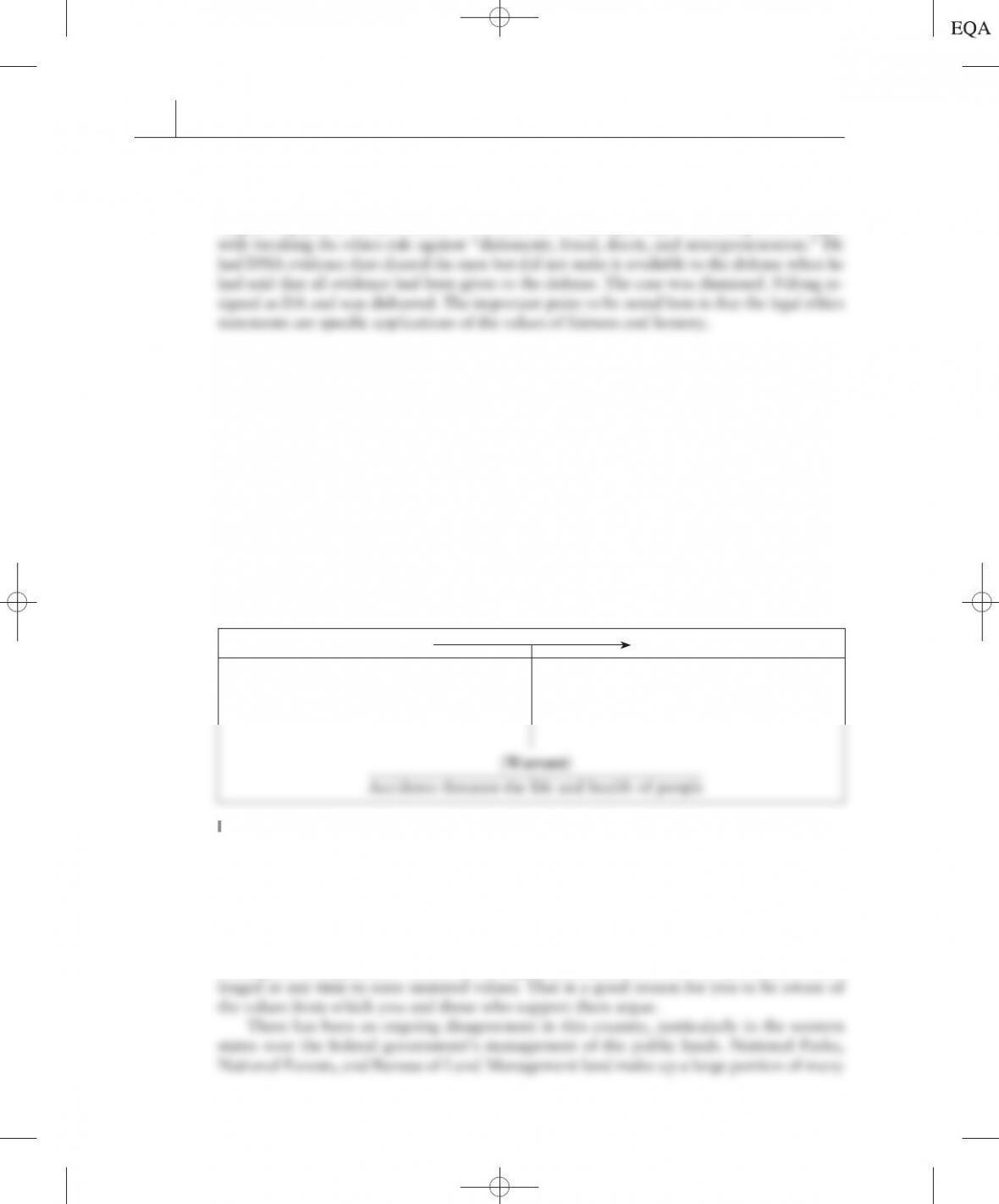
Values May Be Found Anywhere in an Argument
We have already observed that there are no value-free arguments. Any part of an argu-
ment can state values. Arguments can be made where all parts openly state values. In this
example, all the parts of the argument contain direct, positive values.
Such a value-intensive argument is possible though not likely. In most arguments,
many values will be implied, not stated, and in some arguments, one or two (warrants,
grounds, or claims) will not be stated. Yet, to function as a critic of arguments (your own
or others), you will need to be aware that values may be found anywhere. You need to
understand where an argument fits in a value system. You can do that only by actively
looking for an argument’s values. As an arguer, you must be aware that you may be chal-
(Grounds) (Claim)
Texting while driving causes accidents Texting while driving is dangerous to the
health and life of you and others
FIGURE 8.3
M08_RIEK0596_08_SE_C08.indd Page 128 1/18/12 9:52 AM user-f501M08_RIEK0596_08_SE_C08.indd Page 128 1/18/12 9:52 AM user-f501 F-401F-401
CHAPTER 8 Support: Values 129
western states. Local and state leaders in the western states who want the land to be avail-
able for development frequently clash with environmentalists who want development to
be restricted. In 2009, the U.S. House of Representatives Sub-committee on National
Parks, Forests, and Public Lands considered the Red Rock Wilderness Act that would
protect millions of acres of Southern Utah as wilderness.
Robert Redford writing in the Huffington Post made this argument for protecting the
public lands from development:
An article, by Scott Streater, posted on Utah Congressman Rob Bishop’s web site
states the opposing view:
The ‘American’s Red Rock Wilderness Act’ which preserves 9.4 million acres
of pristine land across eastern Utah, isn’t supported by a single member of
You can see from these two brief excerpts the values on each side of the debate:
Beauty, Family, protection of nature, and ancient culture are opposed by: popularity,
development, employment, and prosperity.
Recognize Values in Warrants
Warrants are the most likely place to find values. Their role in an argument is to justify
the reasoned movement from the grounds to the claim. Justification is clearly a value-us-
ing procedure.
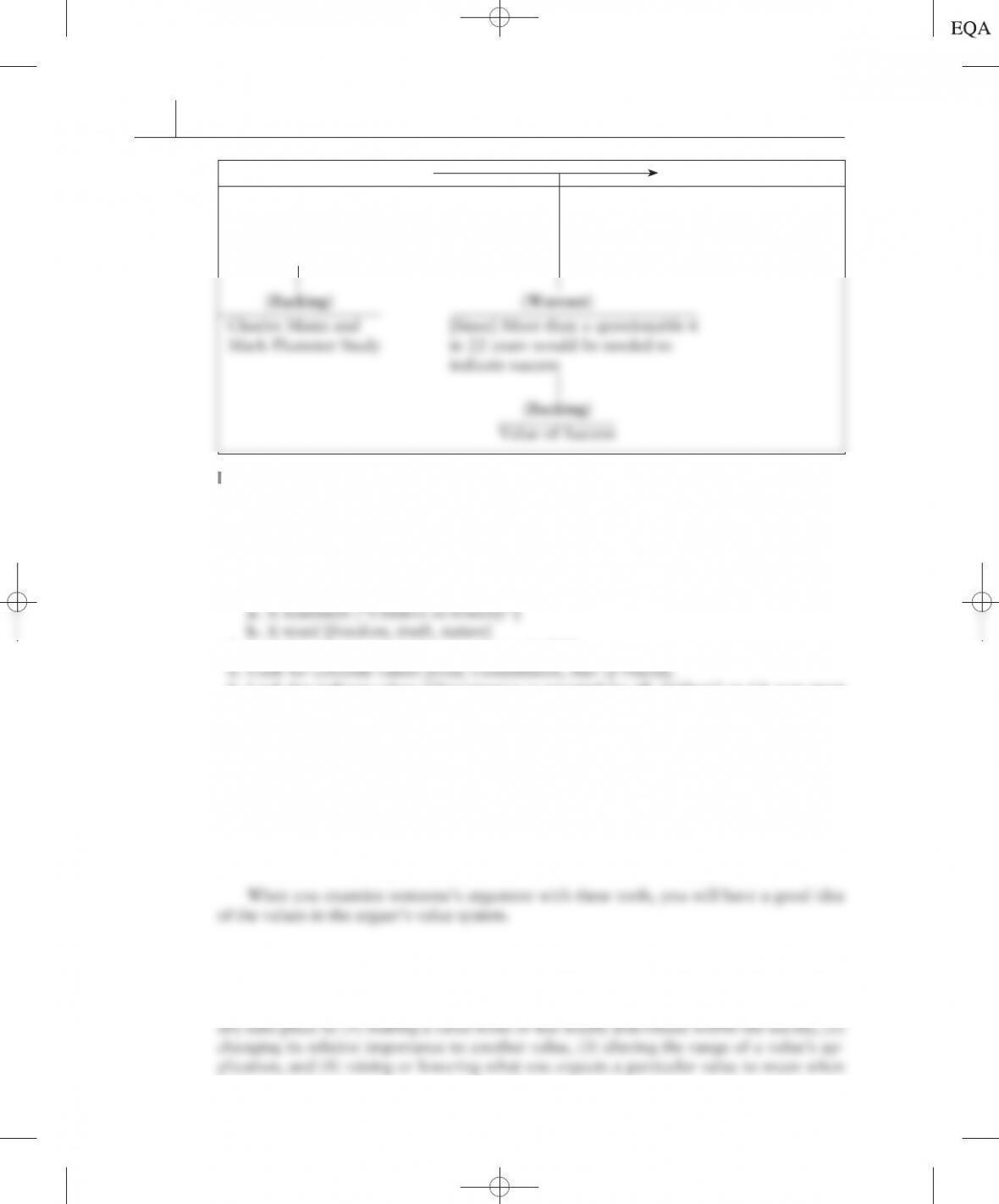
The debate over the protection of wildlife has centered on the Endangered Species
Act (ESA). Those who oppose the act claim that the ESA violates private property, hurts
the economy, and wastes tax money. A strong argument is also made that it doesn’t
work. This claim is supported by a study by Charles Mann and Mark Plummer in their
M08_RIEK0596_08_SE_C08.indd Page 129 1/18/12 9:52 AM user-f501M08_RIEK0596_08_SE_C08.indd Page 129 1/18/12 9:52 AM user-f501 F-401F-401
130 PART 2 Tools
Find the Values in the Arguments of Others
Before you can decide whether to accept or refute arguments of others, you need to find
the values they use. Here is a specific list of tools.
1. Look for specific language that directly states values.
2. Look for negative terms [ waste, immoral, filth ].
4. Look for indirect values [“Vaccination is essential for all children” or “A cure must
be found for Alzheimer’s disease” (health)].
5. Look for absent values that you might expect to find [“The purpose of government is to
protect life and property”]. (Why have liberty and the pursuit of happiness been left out
and property added to the traditional values found in the Declaration of Independence?)
6. Look for other factors that indicate values.
a. Statistical evidence (science)
b. Testimony of authorities who represent values [the Pope, Marx, Jefferson]
c. Heroes and villains of stories
d. Stylistic evidence [biblical, African-American, or scientific style]
Recognize the Limits of Value Change
Before you develop a case, you must think seriously about exactly what value changes you
wish decision makers to make. Nicholas Rescher has pointed out that value changes usu-
(Grounds) (Claim)
In 22 years only 6 species have been The Endangered Species Act is a
removed from the endangered category. failure
Some of these can attributed to reasons
other than the Endangered Species Act
FIGURE 8.4
M08_RIEK0596_08_SE_C08.indd Page 130 1/18/12 9:52 AM user-f501M08_RIEK0596_08_SE_C08.indd Page 130 1/18/12 9:52 AM user-f501 F-401F-401