
102
Support: Evidence
KEY TERMS
evidence, p. 103
example, p. 103
hypothetical example, p. 105
statistics, p. 105
raw numbers, p. 105
central tendency, p. 106
probability, p. 106
trend, p. 107
testimony of fact, p. 108
testimony of opinion, p. 108
sphere dependence, p. 115
hearsay evidence, p. 115
ordinary testimony, p. 115
expert testimony, p. 115
reluctant evidence, p. 116
negative evidence, p. 117
documented evidence, p. 117
assertion, p. 118
Studying the nature of arguments in Chapter 4 should have led you to understand
that arguments do their work by putting information into widely recognized and
respected ways of making sense. Throughout your life, you have learned that people
make sense through formats such as logical deductions, generalization, cause, sign, anal-
ogy, authority, and definition. In Chapter 4 , you also learned from the Toulmin model
that the primary relationship in argumentation is between the claim and the grounds
advanced in its support. Grounds include material that the decision makers are expected
CHAPTER
7
M07_RIEK0596_08_SE_C07.indd Page 102 17/01/12 1:41 PM user-f396M07_RIEK0596_08_SE_C07.indd Page 102 17/01/12 1:41 PM user-f396 F-396F-396

Evidence , as we will use the term in this chapter, is the support for a claim that the
arguer discovers from experience or outside authority. It usually takes the form of exam-
ples, statistics, and testimony. As we stated in Chapter 1 , different spheres have different
FORMS OF EVIDENCE
Evidence (examples, statistics, and testimony) supports a claim in such a way as to cause
the decision maker to give adherence to that claim. Evidence need not be a part of the
spoken or written argument in order to contribute to adherence, however. The simplest
form of an argument is the statement of a claim: an assertion. Assertions are not usually
considered good arguments, but they can gain adherence when decision makers already
know the evidence.
Carol’s assertion receives instant adherence from Don because of previous experi-
ences with Sam’s tardiness. If called on, Carol could provide examples such as the time
they were late for the barbecue because of Sam. In this example, the decision maker al-
ready knows the specific examples, and thus, stated evidence is unnecessary.
In addition, decision makers sometimes are in possession of evidence that runs coun-
Example
Examples may refer to undeveloped instances used in an argument by generalization .
Such examples may be short. Bruce Luecke argues that the U.S. space program has pro-
duced “30,000 spin-off products and technologies since its inception in 1958.”
He uses five short examples to illustrate the large number that he claims exist.
An extended example, or illustration , usually means an extended instance that illus-
trates a general principle (Perelman and Olbrechts-Tyteca 357). David Grann begins his
CHAPTER 7 Support: Evidence 103
M07_RIEK0596_08_SE_C07.indd Page 103 17/01/12 1:41 PM user-f396M07_RIEK0596_08_SE_C07.indd Page 103 17/01/12 1:41 PM user-f396 F-396F-396

104 PART 2 Tools
students who continue working, chanting rhymes about reading, going “back to basics,”
and getting high success rates on academic tests (24). That extended example is used to
support the claim that this is “a public school that works.”
Let’s go backpacking this summer. We had such a great time last year on the Kern
Plateau and in the Wind Rivers.
Don’t buy beets. I’ve never had beets cooked a way I like them.
Let’s go see the new Colin Firth movie. He was awesome in The King’s Speech .
Even in a public argument, it is common for a speaker to use examples taken from the
experiences of decision makers.
On August 21, 2007, Wal-Mart announced that its online music store would start sell-
ing songs free of copy-protection technology for 94 cents per tune. The Associated Press (AP)
explained that, “songs from the Rolling Stones, Coldplay and Maroon 5, among others,
will play on most portable media devices, including Apple Inc.’s iPod.” The article then pro-
ceeded to tell the story of the awkward relationship between the contemporary music indus-
try and music consumers. This story was offered as justification for Walmart’s new policy.
The article explains that, although independent musicians have long allowed those
who purchase their music to share the tunes in whatever manner they choose, large music
companies have maintained strict controls over music they sell, even after people have
purchased it. Although the story mentions that the music industry has a potentially com-
Anyone familiar with the contemporary music business will recognize the examples
given in this story and will understand how they support the claim that Digital Rights
Management has caused consumer frustration and how the new practices in music retail
activities, such as Walmart’s new policy, will reduce the frustration.
In Chapter 3 , we described how good stories function in argumentation. All exam-
ples, and particularly extended examples, need the characteristics of good stories. The
story should ring true for the decision makers. The illustration must have characters, ac-
tion, motives, and outcomes that make sense to them. In the case of a possible classroom
argument about a change in the course registration system students must use, you might
ask students to create their own stories. The scenarios of long lines, faulty telephone and
computer instruction, failure to get classes, preferences for others, and payments that
must be made just before payday, is a “story” that rings true to them.
M07_RIEK0596_08_SE_C07.indd Page 104 17/01/12 1:41 PM user-f396M07_RIEK0596_08_SE_C07.indd Page 104 17/01/12 1:41 PM user-f396 F-396F-396

CHAPTER 7 Support: Evidence 105
specific details and the citing credible sources promote the idea that the instances are real
because they can be verified by the decision makers.
A special kind of specific instance, called the hypothetical example , is used where real
examples are not available or when the available real examples are far removed from the
decision makers’ experience. It is important that a hypothetical example be perceived as
equivalent to a real example. That is, it must have the detail and credibility to give it the
characteristics of a real example.
Here is a hypothetical example that you might use to illustrate the problems of auto
repair rip-offs:
Here’s a not-very-far-fetched description of what you might be involved with. You take your
Ford Escort in for repairs; there’s something wrong in the engine or transmission. It’s mak-
Statistics
Statistics are numerical summaries of examples. Statistics provide a means for talking
about a large number of examples without citing every one. This means of summarizing
examples is found in various forms in argumentation. The most common are raw num-
bers, central tendencies, probabilities, and trends.
Raw Numbers. Some statistical references are clearly intended to emphasize significant
numbers of examples. For example, the UN AIDS-fighting agency reported on November
20, 2007, that it had overestimated the size of the epidemic and that new infections with
the deadly virus have been dropping each year since they peaked in the late 1990s. Donald
G. McNeil, Jr., writing in the New York Times of that date, says that the estimated number
infected would be reduced from 39.5 million to a more realistic figure of 32.2 million.
M07_RIEK0596_08_SE_C07.indd Page 105 17/01/12 1:41 PM user-f396M07_RIEK0596_08_SE_C07.indd Page 105 17/01/12 1:41 PM user-f396 F-396F-396

106 PART 2 Tools
understand without damaging their accuracy: The UN AIDS-fighting agency said that
there are 32.2 million people infected. These are not exact but rounded numbers. That is
undoubtedly true of the 30,000 spin-offs. Second, the raw numbers are compared with
Central Tendency. Some statistics go beyond raw numbers to provide an indication of
what is normal in a larger population. Central tendencies are frequently called averages .
In 2007, research from the Washington, DC, nonprofit Excelencia in Education re-
vealed that although Latinos constitute the fastest-growing segment of the U.S. population
and will be one-fifth of the U.S. workforce by 2025, only 12% of Latinos aged 25 years
and older have earned college degrees, compared with more than 30% of other adults.
Moreover, in the next 15 years, two-thirds of all jobs in the United States will be filled by
Statistical Probability. In Chapter 2 , we talked about various meanings of the word
probability , and statistics can represent one of them. Hilary Waldman used statistical
probability to explain why doctors spent years misdiagnosing and prescribing wrong
medications to Sofi Pagan, a young girl who was finally diagnosed with Batten, a genetic
disease with 100% fatality, in November 2000. The gene for Batten disease is extremely
rare, and a child must inherit one gene for the disease from each parent. The chance that
two people who carry that gene “will marry and have children is about one in 25,000.
Even if two carriers do find each other, their chance of having a sick child is one in four.
It’s so rare, in fact, that only 300 children in the United States have Batten disease” (83).
The story went on to explain that Sofi’s little brother, who was born before the Pagan
family had any suspicion that Sofi was ill, also had Batten disease.
The statistics are an expression of the frequency with which events occur by pure
chance, or the likelihood that something exceeds pure chance. That is, pure chance would
predict that 30% of the population will get cancer by the time they are 70 years old, but
if they smoke, their likelihood exceeds pure chance by a significant factor.
In the breast cancer study, pure chance would predict that the women treated with
letrozole and those assigned to the placebo group would have the same rate of cancer
M07_RIEK0596_08_SE_C07.indd Page 106 17/01/12 1:41 PM user-f396M07_RIEK0596_08_SE_C07.indd Page 106 17/01/12 1:41 PM user-f396 F-396F-396

CHAPTER 7 Support: Evidence 107
recurrences, and changes from that seem to be related to use of letrozole. Forty-three
percent is a significant movement beyond pure chance.
group, with “61 births per 1,000” in 2002, and “67 per 1,000 in 1990.” During the
same years, the “birth rate for women 15 to 19 rose from 40 per 1,000 to 56 per 1,000”
(A11). Because women aged 15–19 are unlikely to have extensive college or other profes-
sional training, this apparent aberration supports Armas’s interpretation that the larger
trend among women from 15 to 44 is explained by the availability of increased profes-
sional options.
Combining Forms of Evidence
Few arguments rely on only one form of evidence. Instead, successful arguments dem-
onstrate careful use of several different forms. Las Vegas showman Roy Horn (of the
duo Siegfried and Roy) was mauled by a tiger while performing at the Mirage hotel in
October 2003. The attack led to a spate of news coverage about private ownership of
tigers. Michael D. Lemonick argued that private ownership of tigers was widespread,
cruel, and dangerous. He used several forms of evidence to make his point. He began by
telling the story of a tiger kept in a Harlem apartment house until police rappelled down
the outside of the building, tranquilized the tiger, and relocated it to an animal sanctu-
ary. Lemonick followed with additional examples, then with statistics. He offered raw
M07_RIEK0596_08_SE_C07.indd Page 107 17/01/12 1:41 PM user-f396M07_RIEK0596_08_SE_C07.indd Page 107 17/01/12 1:41 PM user-f396 F-396F-396

108 PART 2 Tools
So, statistics are summaries of examples that sometimes appear as raw numbers, are
sometimes averaged, frequently rounded off, and usually compared if they are to have
maximum force for decision makers. From the point of view of evidence, however, you
Testimony
Testimony is the statement of another person or agency that is used to support a claim.
It may be used with examples or statistics as backing for the grounds of an argument. It
may also serve, as we noted in Chapter 4 , by itself as the grounds for an argument from
authority. Testimony adds the credibility of its source to the grounds or warrant of an
argument.
Traditionally, testimony has been divided into two types: testimony of fact and testi-
mony of opinion . Obviously, all testimony represents the opinion of the person or agency
cited. However, testimony about facts that provide examples or statistics is seen by many
as stronger than testimony that only expresses the opinion of the source. Indeed, there is
a general view among the researchers in this area that example and statistical evidence are
more powerful than opinion evidence (Reinard 38–40). This is in line with the common-
1. More than half of the roads in the United States are “substandard.”
3. Passenger travel doubled between 1970 and 1995 and will increase nearly two-thirds
4. Thirty-one percent of bridges are structurally deficient.
6. Full repair of the nation’s roads and bridges would require $437,000,000,000.
These are not “his” facts, moreover; he presents them as the testimony of the Federal
Highway Administration and the American Society of Civil Engineers (10–11).
Turner makes a similar analysis of each of the areas of the infrastructure, and in each
case, he identifies an authority for the facts (e.g., U.S. Department of Transportation,
American Association of State Highway and Transportation Officials, Federal Aviation
Administration, Environmental Protection Agency, Association of State Dam Safety
Officials). These are not simply “facts” but testimony of fact. The power of the evidence
rests in the detail of amounts and percentages but depends on the authority, not of the
arguer, but of the sources of the testimony.

CHAPTER 7 Support: Evidence 109
In truth, all these pieces of testimony represent opinion, although it is expert opinion.
And there still is potential for bias, which is discussed later in this chapter. The crucial
question for you as you use testimony is whether it will be perceived as fact and not
“simply opinion.” That judgment will depend on the credibility of the source and the
specificity with which that source develops the information.
GENERAL PRINCIPLES FOR THE USE OF EVIDENCE
It is difficult to prescribe how evidence should be used to support an argument because
the believability of any argument is heavily influenced by who the decision makers are
and the experience they bring to the situation. However, some principles have evolved
Use Representative Instances
By using representative instances, you choose the best examples available to prove a gen-
eralization. Remember the use of examples by Bruce Luecke on page 103? He argues
that the U.S. space program has produced 30,000 spin-off products that are useful to
the general population. He supports this with five examples. All seem important, having
to do with improved health and safety and running shoes. Are they representative of the
30,000? That is difficult to tell. His argument would be stronger, perhaps, if each of his
Use a Sufficient Number of Instances
To form a satisfactory generalization, enough examples must be provided to convince
others that the argument is believable. There is no magic number for the amount of evi-
dence needed, but there is a long-standing “rule of three.” Where a claim is in contention,
use at least three examples. It is clear that some evidence is useful even when the decision
makers already agree to the claim. It is also clear that the argument is seen as more power-
ful when more high quality evidence from multiple sources is added.
M07_RIEK0596_08_SE_C07.indd Page 109 17/01/12 1:41 PM user-f396M07_RIEK0596_08_SE_C07.indd Page 109 17/01/12 1:41 PM user-f396 F-396F-396

110 PART 2 Tools
Use Only Relevant Instances
Large amounts of evidence that is perceived as of low quality weakens an argument (Reinard
40). One of the most obvious examples of low quality evidence is information that is irrel-
evant to the argument. In fact, in some spheres, it can completely invalidate an argument. For
example, in 2011, the Supreme Court of Georgia reversed the murder conviction of a teenage
girl because the state had introduced irrelevant evidence about the defendant’s Goth lifestyle
(Boring v. State). The evidence included photographs of the appellant with dyed black hair
Account for Negative Instances
Particularly with knowledgeable decision makers, you make a mistake if you fail to ac-
count for instances that do not support the claim. The study we cited earlier that identified
the trend among U.S. women to remain childless deals carefully with negative instances.
In fact, it reported and explained negative instances. Recall it reported that the birthrate
among women aged 15–19 actually rose between 1990 and 2002. This was explained by
the presumption that such young women were unlikely to have extensive professional op-
tions. Armas also responded to the negative instance of an increase among never-married
women in professional positions who chose to have a child. She pointed out that these
women are economically capable of rearing a child without a partner and suffer much less
State the Value Characteristics of Instances
It is important to let decision makers know what value judgments apply to the example.
The following instances all provide a value clarifier (shown here in italics, though the
words probably were not emphasized that way originally).
The best example of the increase in violence against minorities is the shooting at a
Jewish day care center in Granada Hills, California.
That 54 percent of all high school seniors have smoked marijuana is a good example
M07_RIEK0596_08_SE_C07.indd Page 110 17/01/12 1:41 PM user-f396M07_RIEK0596_08_SE_C07.indd Page 110 17/01/12 1:41 PM user-f396 F-396F-396

CHAPTER 7 Support: Evidence 111
Make Instances Seem Real with Details
As we noted earlier, people give greater adherence to more specific examples (Kline 412).
Even hypothetical examples should be given the characteristics of real examples. Suppose
you were to argue for new traffic regulations and develop a hypothetical example to ex-
plain how traffic congestion can be a serious imposition that needs new regulations. That
hypothetical example might be stated like this: “Suppose you start home tomorrow night
and find yourself in a massive traffic jam that delays you, and you miss an important
Use Decision Makers’ Experience
Although you should provide enough examples to support your claim with decision mak-
ers, the other side of that coin is also important. The tedious repetition of examples for
Use Current Examples and Statistics
Clearly, the most up-to-date information is superior to less current information in as-
sessing the present situation. Even for historical study, current information should be
more useful because historical evidence is frequently cumulative. That is, every new
piece of information makes the previous idea clearer. Also, more recent statistics may
be more useful in historical argument because more sophisticated statistical measures
have been employed.
Use Credible Sources
Avoid the bias of the source. This is important not only because of the danger of drawing
a less accurate generalization but also because such bias, when recognized, will damage
the argument. Even though it is sometimes possible to win adherence through the use of
biased sources that some decision makers do not recognize as biased, it is not wise to do
so. Evidence from such sources can only be successful in seeking short-term adherence.
M07_RIEK0596_08_SE_C07.indd Page 111 17/01/12 1:41 PM user-f396M07_RIEK0596_08_SE_C07.indd Page 111 17/01/12 1:41 PM user-f396 F-396F-396
112 PART 2 Tools
For each example or statistical study that you take from someone else, ask yourself
the extent to which that source is biased and the extent to which it may appear biased to
others. Federal government agencies such as the Bureau of Labor Statistics are generally
regarded as unbiased. But the claim cited earlier that there are 30,000 spin-offs from the
space program is made by NASA and that agency may be trying to boost its image to get
new funds. Regardless of whether sources are biased, the crucial issue is whether decision
makers think they are or suspect that they may be.
Carefully Consider Statistical Measures
For our purpose, statistical measures basically answer the question: How typical are the
examples? Darrell Huff, in the book How to Lie with Statistics , presents many of the
problems of statistical argument in everyday language.
One could spend a lifetime of study and become an expert in statistical argument and
its errors. For the moment, however, the following are a few of the mistakes to avoid.
“The Sample with the Built-in Bias.” If you asked your classmates what they thought
about the federal ban on private possession of handguns and they approved it by a vote of
15 to 5, that would be impressive, but if 10 others had refused to answer your question,
you might have a built-in bias for which you were not accounting. Thus, the potential
actual split was 15 to 15 or 25 to 5. The real proportions could be as great as 5 to 1 or as
little as dead even. Also, suppose some of the people who opposed the ban did so because
they thought it was not strong enough. That would give you another built-in bias.
450,000
400,000
350,000
300,000
Population
Emergency operations
Activated
Not activated
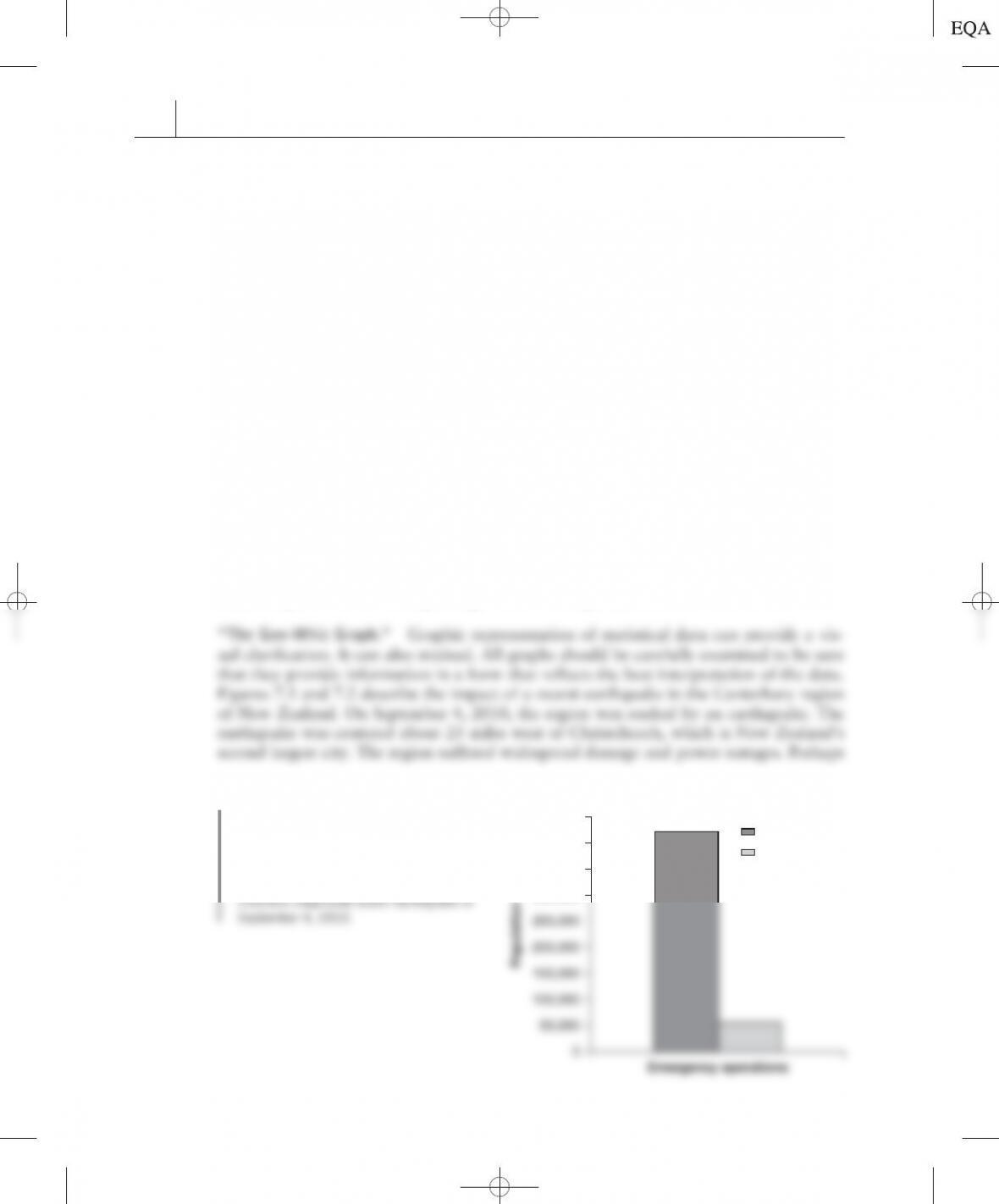
FIGURE 7.1
Number of people living in districts within
the Canterbury region of New Zealand
where the emergency operations were
activated in response to the magnitude 7.0
M07_RIEK0596_08_SE_C07.indd Page 112 17/01/12 1:41 PM user-f396M07_RIEK0596_08_SE_C07.indd Page 112 17/01/12 1:41 PM user-f396 F-396F-396
because it occurred at night, and in a rural area where most construction is intended to
withstand such quakes, no deaths were verified as being caused by the September 2010
earthquake. In the aftermath of the earthquake, some coverage described the region as a
disaster, while other coverage focused on how minimal the damage had been (both in terms
of economic loss and human causalities). People who wanted to emphasize the severity of
the situation, perhaps for the purpose of ensuring that their audience realized the region’s
need for assistance, might construct Figure 7.1 . Other groups, perhaps wanting to encour-
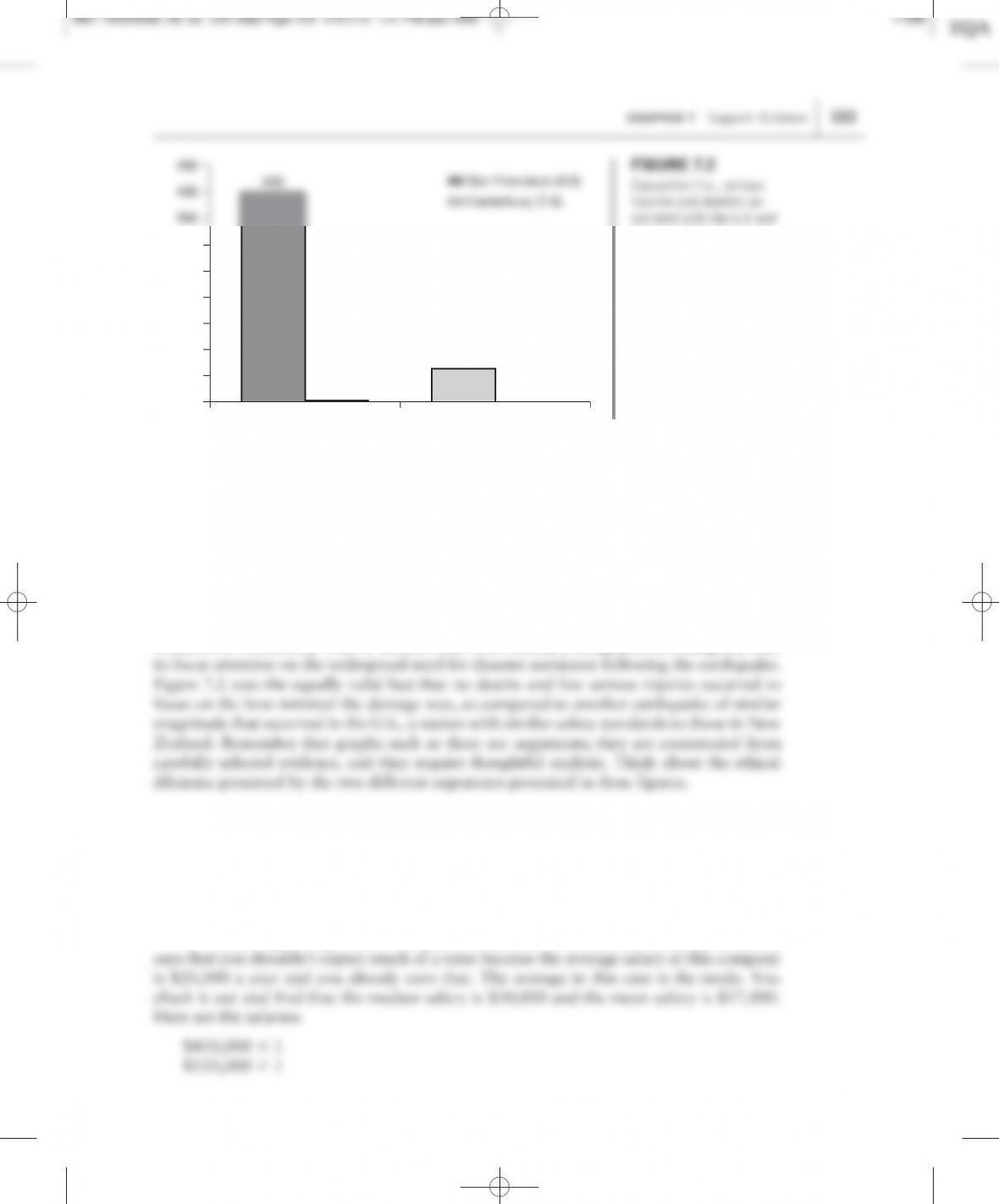
age tourism and convention business, might construct Figure 7.2 . Both figures use real
information, but they make very different arguments. Figure 7.1 uses the fact that most
residents of Canterbury lived in districts that were officially designated as emergency sites
“The Well-Chosen Average.” Average is a popular term standing for some measure of
central tendency in data, but there are several ways of measuring it. One such measure is
the median , the point above and below which 50% of the items fall. A second measure is
the mode , the value that appears most frequently among the data. The third measure is
the mean , an arithmetic average and the term most correctly applied to the term average .
The mean is found by dividing the number of items in a series into the sum of all the items.
It’s salary negotiating time at the place where you work, and the company president
says that you shouldn’t expect much of a raise because the average salary at this company
is $20,000 a year and you already earn that. The average in this case is the mode. You
check it out and find that the median salary is $30,000 and the mean salary is $57,000.
Here are the salaries:
$450,000 3 1
$150,000 3 1
300
250
Casualties
Serious injuries
200
150
100
50
0
Deaths
2
63
0
7.0 magnitude (moment
magnitude scale) earth-
quakes that occurred on
October 17, 1989, in the
San Francisco Bay Area
(USA) and September 4,
2010, in the Canterbury
region of New Zealand,
respectively; both loca-
tions employed modern,
earthquake resistant
building codes.

114 PART 2 Tools
$100,000 3 2
$57,000 3 1 Mean
$50,000 3 3
$37,000 3 4
Has your employer chosen the measure of central tendency well?
“Much Ado about Practically Nothing.” There are groups in higher education who un-
dertake the task of determining the quality of graduate programs in various disciplines.
One hears the statement, “We are one of the top five communication [or psychology
or political science] departments in the country.” Statistical reports are published show-
ing the relative ranking of all graduate programs by specialty. They make an impressive
display, and people use them in arguments. The problem is that the data are gathered by
sending questionnaires to people in the discipline who may have only limited knowledge
of work in all the institutions to be considered. The results do not control the bias in favor
Use Comparison to Clarify Statistics
We noted earlier in the discussion of statistics that they can be more useful if compared.
If you lived in Albuquerque, New Mexico, you could argue that your state and local tax
burden is low for a family of four with a $50,000 a year income. It averages only $6,900,
according to the Statistical Abstract of the United States . But $6,900 sounds like a lot
of money, almost 14% of income, to some people. It would be best to compare it with
other cities such as Des Moines, Iowa, $8,200; New York City, $13,200; Philadelphia,
$15,200; or Bridgeport, Connecticut, $18,800 to show that the Albuquerque tax burden
is the lowest surveyed in the Bureau of Census figures (“State and Local Taxes” 310).
If you wanted to argue that government projections for the fastest-growing occupa-
tions in the country show that those occupations are in the health care area, you might
cite these examples by the Bureau of the Census: The number of home health aides is
Base Testimony on Credibility Measures
The purpose of testimony is to provide credibility to a claim by adding a second person or
agency to its support. The trustworthiness and competence of the source of the testimony
is essential to its effectiveness. We discuss credibility in greater detail in Chapter 9 . We
will make only a few comments here.
M07_RIEK0596_08_SE_C07.indd Page 114 17/01/12 1:41 PM user-f396M07_RIEK0596_08_SE_C07.indd Page 114 17/01/12 1:41 PM user-f396 F-396F-396

CHAPTER 7 Support: Evidence 115
Before you accept testimony, ask yourself if the person was in a position to know, either
as an observer or with the expertise to make an intelligent observation. Ask if the source of
the testimony has anything personal to gain by the acceptance of the facts testified to. Ask if
this is firsthand knowledge or only a testimony about someone else’s testimony.
A more specific source will add greater force than a vague one. Reports in the press
are often attributed to unnamed or unknown sources, and readers have trouble assessing
credibility. It is important for you to let decision makers know the source of any testimony.
Of course, that will influence the argument you make because some sources will not be
credible to decision makers and will need to be dropped. For instance, LaVarr Webb and
SPHERE DEPENDENCE OF EVIDENCE
Evidence may be evaluated differently depending on the sphere in which the argumenta-
tion occurs. The evidence necessary to provide grounds or backing for a claim may well
change as the sphere of argument changes. Sphere dependence in evidence does not merely
Hearsay Evidence
Legal practice does not lend credibility to hearsay evidence , that is, testimony a person
might give about a statement made by another person. It is usually not admissible. Only
what a witness directly observes is admissible. The law makes this provision because only
statements from witnesses who can be held responsible are accepted. But in politics, the
reverse is frequently the case. When reporters say that the president of the United States
(or even a “usually reliable source”) told them something, it has a potential for developing
a greater adherence to their arguments than if they claimed they observed it themselves.
Ordinary and Expert Evidence
A similar situation exists in the difference between ordinary testimony and expert testi-
mony . In most professional spheres, the expert is preferred. In humanistic scholarship, a
philosopher, such as Plato, John Locke, or Karl Marx, is preferred over the observations
of ordinary people. In literary criticism, Jane Tompkins, Catherine Belsey, or Thomas
M07_RIEK0596_08_SE_C07.indd Page 115 17/01/12 1:41 PM user-f396M07_RIEK0596_08_SE_C07.indd Page 115 17/01/12 1:41 PM user-f396 F-396F-396

116 PART 2 Tools
Expert evidence for the behavioral social scientists is not a matter of differences in testi-
mony. They frequently survey ordinary people, so the testimony is ordinary, but the means
to draw conclusions from it is not. Behavioral social scientists draw their conclusions about
human behavior through an elaborate system of statistical calculations. So, the evidence
becomes not simply a collection of instances but a complex expert statistical demonstration.
Reluctant Evidence
Reluctant evidence , from those who are antagonistic to one’s purpose, has long been
considered the best evidence in public debates. In a court of law, witnesses are under oath
and required to testify against their own interests. In a public argument, a person’s own
argument may be quoted by an opponent to attack the claim and make the person seem
to have extreme views. In a political argument, an advocate may use the claims of persons
who have been supporters of a particular policy to point out the errors of that policy.
During the months following the September 11, 2001, attack on the World Trade
Center, Congress cooperated with the Bush administration to pass numerous pieces of
legislation intended to protect the United States from further terrorist attacks. The USA
Patriot Act, a centerpiece of that legislation, passed overwhelmingly, with only three
Republicans and 62 Democrats in opposition. Two years later, Michael Tomasky used
the testimony of conservative Republicans to argue that the Patriot Act had gone too far
in its assault on American freedom.
Although the USA Patriot Act was heavily supported by Republican members of
Congress and was a highlight of the Bush administration, by September 25, 2007, some
parts of the law had become so widely criticized that amendments were introduced into
Congress to restrict executive action under the act. Important from the concept of re-
luctant testimony is the fact that bills to reduce executive powers were cosponsored by
Democrats and Republicans. For example, the National Security Letter Reform Act of
2007 was introduced by Senators Russ Feingold, a Democrat from Wisconsin, and John
Sununu, a Republican from New Hampshire. A similar act was introduced in the House
of Representatives by Jerrold Nadler, a Democrat from New York, and Jeff Flake, a

CHAPTER 7 Support: Evidence 117
Negative Evidence
Negative evidence , or the absence of evidence, is used in all spheres of argument, but it is
used differently in different spheres. It is frequently used in historical scholarship. A his-
torian who finds no evidence of women doctors, lawyers, or professors in early America
will claim from this negative evidence that the professions were male dominated.
Scientists use negative evidence in the form of the null hypothesis. They try to prove
that the data may be attributable to sampling error. When they cannot prove this null
hypothesis, they believe the reverse—the hypothesis is true. So, a researcher who cannot
prove that children do not grow more violent from seeing violence on TV (the null
hypothesis) believes that they do (hypothesis).
Almost 800,000 prescriptions for Zetia and Vytorin, cholesterol-lowering drugs,
are written each week according to Alex Berenson. Two years after the drugs’ makers
Merck and Schering-Plough completed a clinical trial, no findings have been released.
Cardiologists complain that they need evidence on the effectiveness of the drugs and any
possible side effects, such as heart disease, so that they can decide whether to continue
prescribing the drugs or switch to others. The drug makers say they may release some,
but not all, of the evidence within a few months. And, even if the entire clinical findings
were made public, not all the questions will be answered one way or the other. Another
bigger study, reported in 2010, failed to answer the most important questions, and now,
lawsuits are underway. It is one thing to make decisions in the presence of uncertainty—
Documented Evidence
In law and in most scholarly fields of humanistic inquiry (e.g., literature, philosophy,
history, theology), there is a clear bias for documented evidence over undocumented evi-
dence, perhaps because written or recorded evidence seems more permanent.
Traditional historical scholarship provides a reasonable example of this emphasis.
There is such a bias toward documents that elaborate methods have been defined by
students of historiography to determine which documents are best and how they should
be interpreted. For historians, for instance, there is a strong preference for “primary
sources”—original documentary evidence. At the same time, there is a strong reservation
M07_RIEK0596_08_SE_C07.indd Page 117 17/01/12 1:41 PM user-f396M07_RIEK0596_08_SE_C07.indd Page 117 17/01/12 1:41 PM user-f396 F-396F-396

118 PART 2 Tools
Assertion and Evidence
Testimony as evidence means, as we indicated earlier, the testimony of someone other
than the person making the argument. However, studies of arguments in conversational
discourse reveal that people do use their own authority as grounds for claims (Willbrand
and Rieke, “Strategies” 419–423).
You may be an unquestioned authority on some things when you talk with your
friends or you might be an expert in an area that others don’t know about, in which case
you will need to let them know of your expertise. Most likely, you will want to provide
evidence and not trust your argumentation to assertion.
Former Senator Mark Hatfield of Oregon presents us with an example of one who,
because he is a Republican senator and conservative Christian, may not need evidence
when he argues against legalizing public prayer in the schools.
I must say very frankly that I oppose all prescriptive prayer of any kind in public schools. Does
that mean that I am against prayer? No. It does not mean that at all. I am very strong in my
M07_RIEK0596_08_SE_C07.indd Page 118 17/01/12 1:41 PM user-f396M07_RIEK0596_08_SE_C07.indd Page 118 17/01/12 1:41 PM user-f396 F-396F-396

CHAPTER 7 Support: Evidence 119
CONCLUSION
Arguments may be supported to gain decision makers’ adherence using evidence, values,
and credibility. Evidence—the traditional term for examples, statistics, and testimony—is
the subject of this chapter.
Examples may be used to develop a generalization or illustrate a general principle. They
can be real instances or hypothetical ones. Statistics provide a means for compacting examples,
for talking about a large number of specific instances at one time. Statistical measures provide
the basis for averaging and comparisons. Such measures can be simple or highly sophisticated.
Testimony about fact or about opinion is a means of adding credibility to a message.
A number of general principles guide you in using examples, statistics, and testimony.
All are based on the inclination of the decision makers, but the principles provide general
guidelines:
1. Examples should be representative.
3. Negative instances should be accounted for.
5. Detail should be given to make examples seem real.
7. Examples and statistics should be current.
9. Statistical measures should be carefully considered.
a. Avoid the “sample with the built-in bias.”
11. Testimony should be based on credibility measures.
Some forms of evidence are sphere dependent, that is, they have different values de-
pending on the sphere in which they are used. Hearsay evidence is suspect in a court of
law but quite acceptable in political argumentation. Many fields regard the expert witness
as superior to the ordinary witness, but this is not true for social scientists interested in
EXERCISES/PROJECTS
1. Deliver a short argumentative speech in which you state a single claim and support it with
specific examples, statistics, and testimony.
2. Along with all class members, bring another claim with supporting evidence to class. One by
one, present the arguments and then as a class talk about the evidence: how does it do the job
of supporting the claim? How could the claim have been supported better?
3. Participate in a debate in class. Prepare your arguments with the best evidence you can find,
M07_RIEK0596_08_SE_C07.indd Page 119 17/01/12 1:41 PM user-f396M07_RIEK0596_08_SE_C07.indd Page 119 17/01/12 1:41 PM user-f396 F-396F-396