Review, Practice, and Explore – Chapter 7 • 61
Review, Practice, and Explore – Chapter 7
7.1
Nouns and Noun Phrases
Find all the nouns in the following excerpt. Identify any members of the category Det (as we’ve de-
fined it here, to include determiners, numerals, and quantifiers) that introduce each noun. There may
be other words that precede the noun too. See if you can tell what they are, if they are not members
of the category Det.
Answer: Determiners are underlined, nouns are bolded
Can you identify four NPs in this excerpt? List them and underline the head noun of each.
Answer: Examples of noun phrases are the darkening hall, the three great tables, oak
7.2
Verbs and Verb Phrases
Write out the following sentences, and circle all the main verbs in each. Underline auxiliary verbs
and modals.
Answer: Main verbs are bolded, auxiliary verbs and modals are underlined.
Review, Practice, and Explore – Chapter 7 • 63
• Are have and be in these sentences main or auxiliary verbs? Why?
B. Now consider the following sentences.
Lucinda has had a ferret.
Lorenzo is being obnoxious.
• What is the main verb in each of these sentences? What is the auxiliary verb?
C. Finally, consider the following sentences.
Baa, baa, black sheep, have you any wool?
Has Mary a new car?
• These sentences probably sound odd to speakers of U.S. English, but they are natural for
speakers of contemporary British English and some varieties of Canadian English. Can you
explain how this use of have differs from U.S. English have, based on these data?
7.5
Which Do Is It? Main Verb or Auxiliary?
Each of the following sentences includes some form of the verb do. Using the tools of analysis in
the chapter, identify each form of do as pleonastic (“dummy”) auxiliary do or as main verb do.
(Note: Some sentences may have both, so be careful!) Explain why you label each do the way you
do, and give any relevant examples (of SAI, tag question formation, and negation) to support your
hypotheses.
Main verb do is underlined. Auxiliary do is bolded.
a. I never could do yoga!
b. Did you get a new puppy?
c. I didn’t do it!
d. You ate my dessert!
I did not!
e. You ate my dessert.
Yes, I did eat your dessert.
f. I don’t do dessert.
g. Just do the job, will you?
66 • PART 2 Answer Key
d. Horatio was playing the drums when the hurricane hit.
e. Loud playing of drums disturbs the neighbors.
f. Those annoying drums should be off limits to people like Horatio.
g. We should videotape Horatio playing the drums.
h. We could get a lot of money on eBay for that videotape.
7.11 Jabberwocky Syntax
Following are a few stanzas from the nonsense poem “Jabberwocky” by Lewis Carroll.
a. Choose six nonsense words in the poem, and label them N, V, P, A or Adv. Explain why
you labeled them as you did and what syntactic (and other) evidence you used.
b. Find six function words in the poem. How do they contribute to the meaning of the poem
and help you make sense of it?
c. What clues, other than grammatical ones, help you derive meaning from the poem? Can
you tell what’s going on? On what do you base your interpretation?
“Beware the Jabberwock, my son!
And, as in uffish thought he stood,
The Jabberwock, with eyes of ame,
Came whifing through the tulgey wood,
Answers will vary.
68 • PART 2 Answer Key
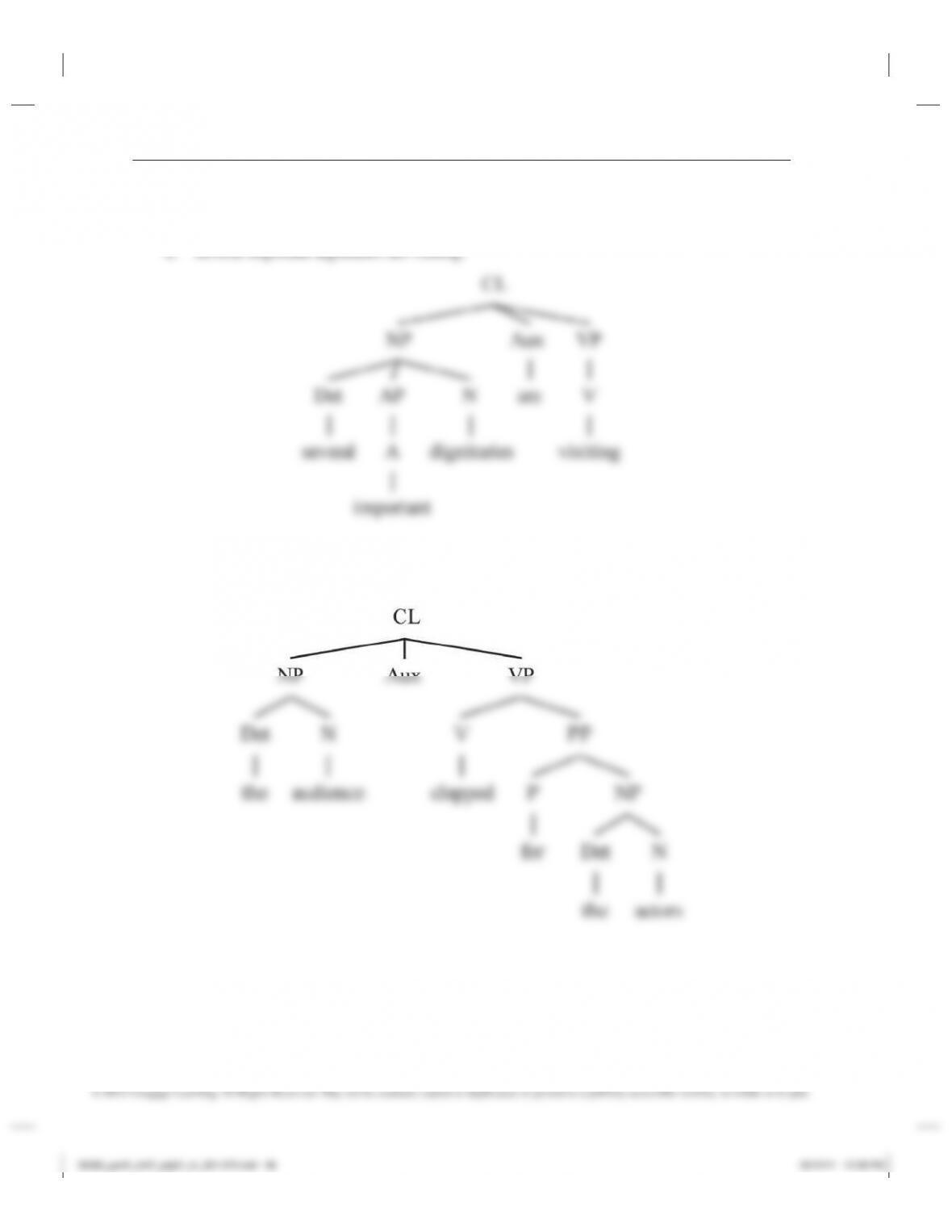
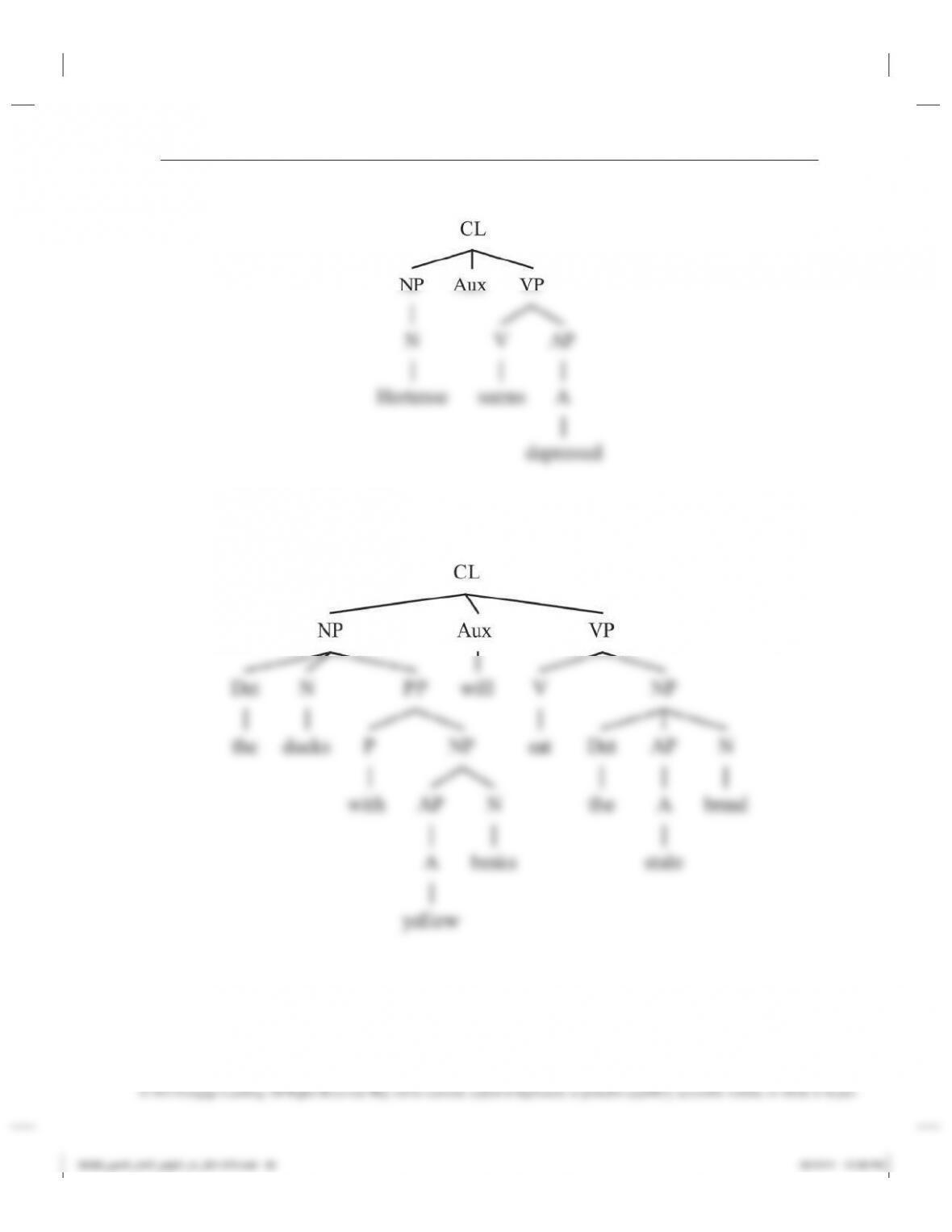
B. Diagram the following clauses for practice.
Answers:
c. Several important dignitaries are visiting.
d. The audience clapped for the actors.
Review, Practice, and Explore – Chapter 7 • 69
e. Hortense seems depressed.
f. The ducks with yellow beaks will eat the stale bread.