
Review, Practice, and Explore – Chapter 5 • 43
Review, Practice, and Explore – Chapter 5
5.1 OK, Break It Up!
Divide the following words into morphemes. If there are any you are not sure about—that you be-
lieve could be divided in more than one way—describe what is problematic and/or discuss any other
issues that arise.
treehouses equipment massage
cabinets freakishness communism
shipment turnip nevertheless
gracious begs heated
Are any of these words monomorphemic? Give an example of how one of these words illustrates the
difference between morphemes and syllables.
Answers:
Words can be divided in different ways, depending on students’ knowledge of
etymology, as well as on instructor’s goals and focus.

5.2 Finding Function Words
Find at least six (different) function words in the following text excerpt. Label each word’s syntactic
category. Also list and label at least six different content words. What kind of information is lost
when function words are omitted?
Answers: Function words are in boldface; others are content words.
Bilbo was very rich and very peculiar, and had been the wonder of the Shire for sixty years,
5.3 What’s Missing?
Find an example of a text that omits function words (the classified advertising section of any newspa-
per is a good place to look, and newspaper and magazine headlines provide good examples). Identify
the syntactic category of each content word in your example, and list the function words that are
missing. What effect does the lack of function words have on your understanding of the piece overall?
Answers will vary.
5.4 Free and Bound Morphemes
Divide the following words into morphemes. Which morphemes are affixes? Which morphemes are
free morphemes, and which are bound?
legalize prescription distaste sportsmanship serenity ridden misinformation
Answers:
affixes = -al, -ize, pre-, -ion, dis-, -s, -ship, -ity, -en, mis-, in-

5.5 A Wieldy Task
Analyze the morphology of the following text excerpt, in which the author plays with morphological
rules for comic effect. Using the terminology and concepts discussed in the chapter, explain each ex-
ample of wordplay as explicitly as you can. Do you find any “cranberry” (bound root) morphemes?
It had been a rough day, so when I walked into the party I was very chalant, despite my efforts
to appear gruntled and consolate. I was furling my wieldy umbrella for the coat check when I
saw her standing alone in a corner. She was a descript person, a woman in a state of total ar–
ray. Her hair was kempt, her clothing shevelled, and she moved in a gainly way. I wanted des-
perately to meet her, but I knew I’d have to make bones about it since I was travelling cognito.
Beknownst to me, the hostess, whom I could see both hide and hair of, was very proper, so it
would be skin off my nose if anything bad happened. And even though I had only swerving
loyalty to her, my manners couldn’t be peccable. Only toward and heard-of behavior would
do. (From “How I Met My Wife” by Jack Winter, The New Yorker, July 25, 1994.)
Answers: Missing affixes and words are in parentheses.
It had been a rough day, so when I walked into the party I was very (non)chalant,
despite my efforts to appear (dis)gruntled and (dis)consolate. I was (un)furling my
5.6 Derivational Affixation
See if you can come up with at least two other words for each of the following suffixes. Label the syn-
tactic category of the words or roots to which each suffix attaches, and label the category of the word
created by affixation. (Ignore spelling differences—they don’t affect the outcome.) Here’s an example:
Word root/word + suffix = word
serenity: serene + ity = serenity
adjective + ity = noun
Do the same for the following; find words to which the following affixes are attached, and determine
how affixation changes the syntactic category (the part of speech) of the word:
– ence/-ance (as in avoidance)
– en (as in weaken)
– ify (as in simplify)
– ness (as in senseless)
Answers:
Word root/word + suffix = word

© 2013 Cengage Learning. All Rights Reserved. May not be scanned, copied or duplicated, or posted to a publicly accessible website, in whole or in part.
5.7 It’s Greek (or Latin?) to Me!
Recall that many words in English have Greek and Latin roots and affixes and that we use these
parts of words productively to form new words. For example, the prefix neo– ‘new’ can be affixed to
conservative to derive neoconservative. Some words with Latin and Greek affixes are the following:
Latinate suffixes
excite-ment, pens-ive, ecst-atic, appear-ance, peer-age, pleas-ure, leg-al, real-ize, read-able,
seren-ity
A. Using these examples as well as a good dictionary, list at least five words (not on this list) cur-
rently used in English that have Greek or Latin affixes. Choose examples of words that are prob-
ably recent additions to the language (like neoconservative).
Answers will vary.
B. Create five words using Latin and Greek morphemes. Give each word a meaning consistent with
its affix (if you choose neo-, for example, your words would include the meaning ‘new’, as in
neolingologist).
Answers will vary.
Review, Practice, and Explore – Chapter 5 • 49
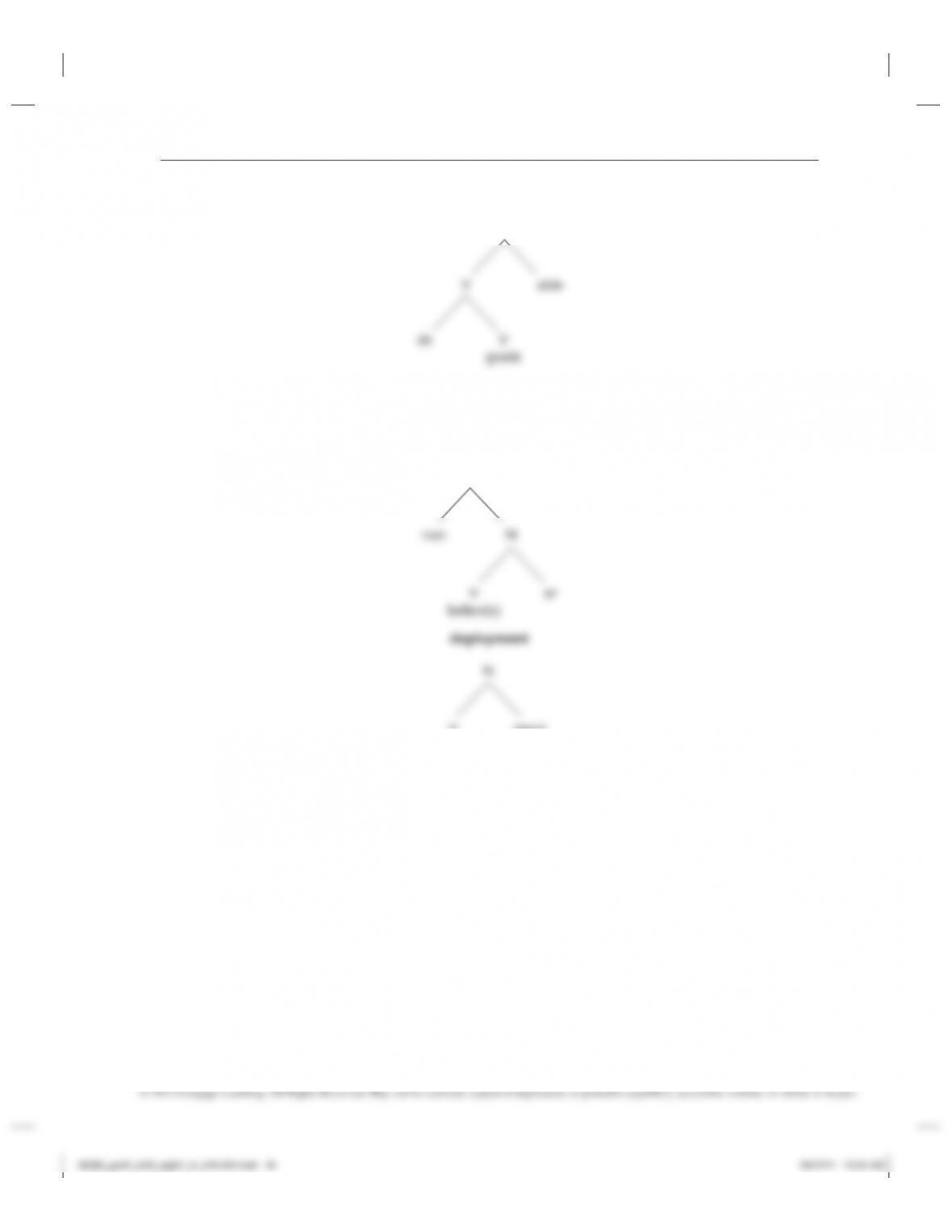
degradable
de V
grade
A
Though gradeable is a word and it might appear like –able could attach first, de– does
not productively attach to adjectives: *dehappy, *degreen.
nonbeliever
N
V
deploy
ment
Perhaps de– attaches to –ploy, though this is not a very productive process.
Review, Practice, and Explore – Chapter 5 • 51
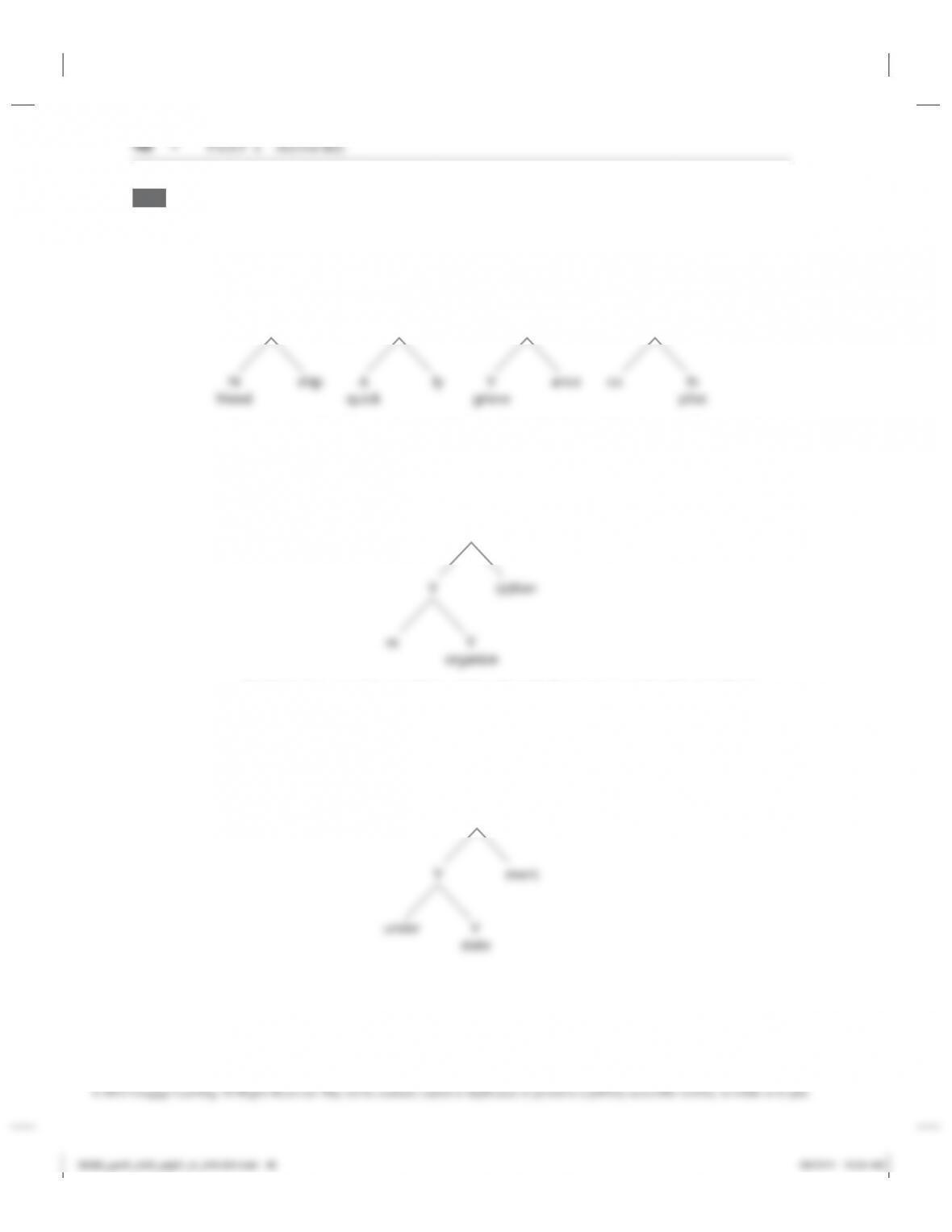
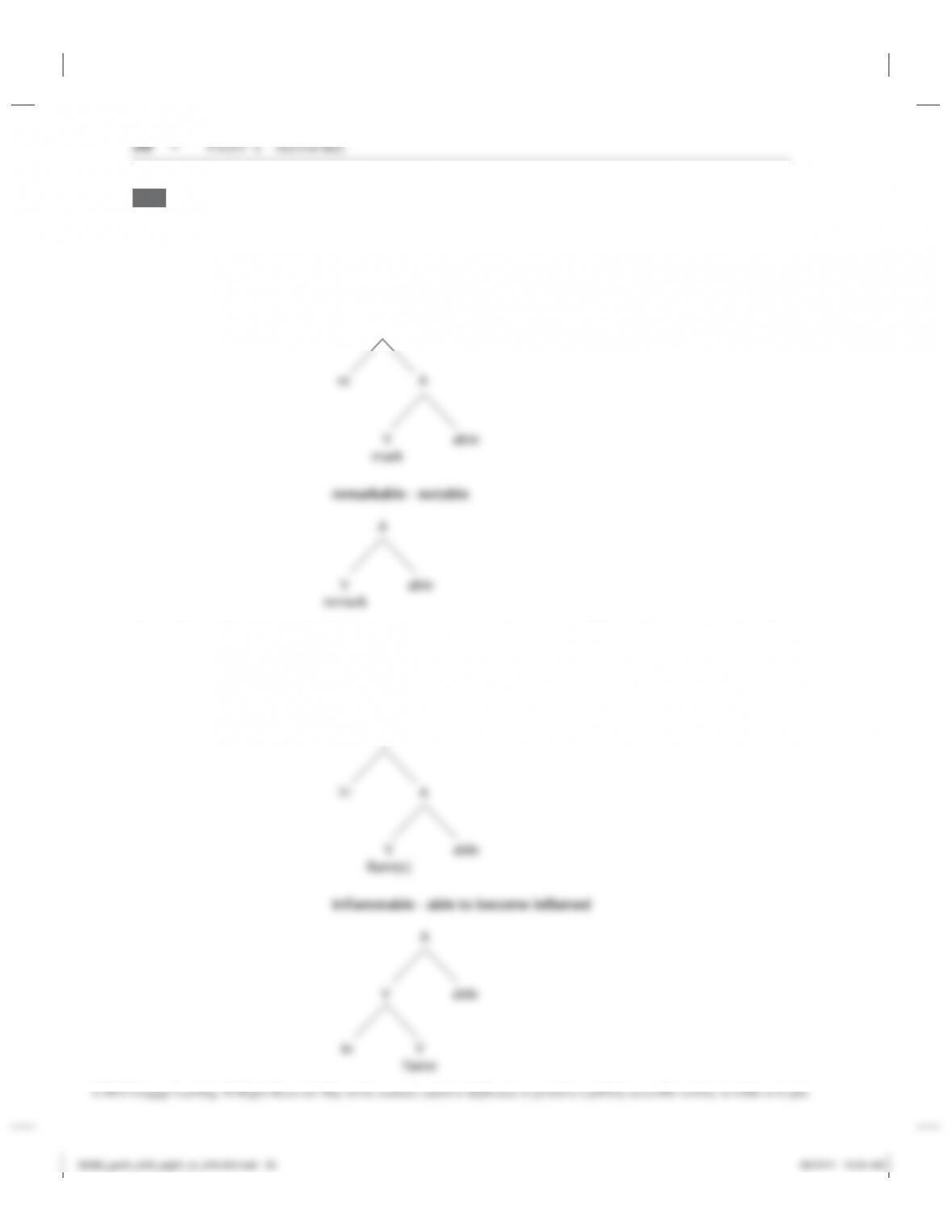
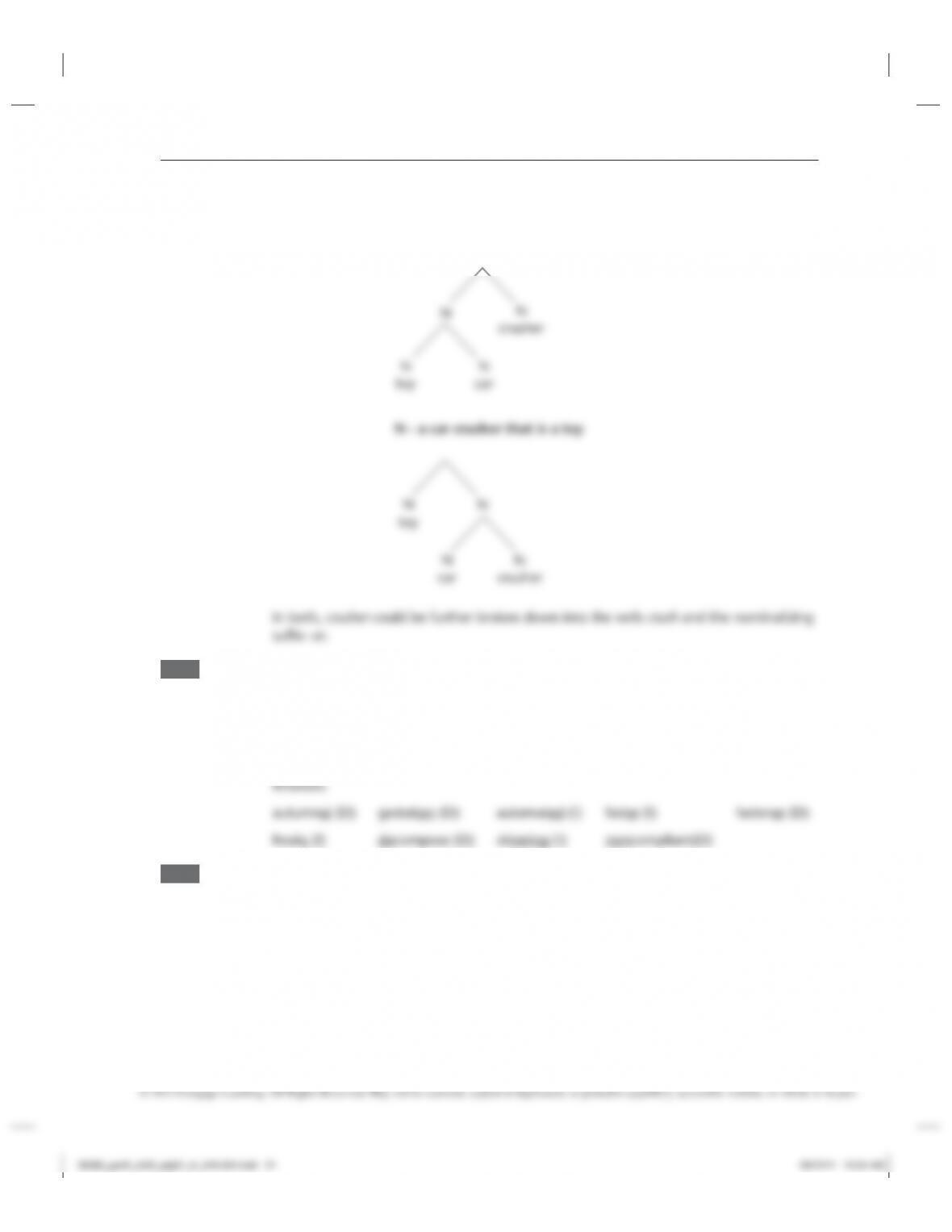
C. Draw the two word trees that represent the two distinct meanings of the noun phrase toy car
crusher. Label each with an appropriate paraphrase of the meaning.
N – crusher of toy cars
NN
crusher
5.10
Derivation or Inection?
Label the following prefixes and suffixes as derivational or inectional.
autumnal gestation automated faster fastener
freaks decompose skipping noncompliant
5.11
Derivation and Inection in Latin
Does the following data from Latin with rough English translations show that Latin marks case and
number on its nouns? Are these examples of inection or derivation?
vir man vir-i men
vir-i of man vir-orum of men
vir-o to man vis-is to men

52 • PART 2 Answer Key
Answers:
vir man
vir-i men -i = plural
5.12
Mine, Yours, and Thine
Possessive pronouns—mine, yours—vary among dialects of English and have been in ux for hun-
dreds of years. The standard pattern is given in (a).
a. mine ours
yours yours
his/hers/its theirs
Some dialects, especially in Appalachian English and some Southern dialects, have the following
pattern.
b. mine ourn
yourn yourn
hisn/hern/its theirn
Describe the pattern that the pronouns take in this dialect and why. Also consider the archaic form
thine. Where does it fit into the paradigm?
Answers:
Appalachian English and other dialects mark possessive case on pronouns with the suffix
5.13
Masculine, Feminine, Neuter?
Conduct some research on Spanish, Welsh, Arabic, Tuvalu, and Russian, all of which mark
grammatical gender in some ways. Show examples of gender marking in each language, and briey

Review, Practice, and Explore – Chapter 5 • 53
explain how gender is indicated and how it contrasts among the different forms (masculine, femi-
nine, and/or neuter).
Answers will vary.
5.14
Where Have All the Strong Verbs Gone?
The following list of words used to be strong verbs and are now weak verbs. Look them up in the Oxford
English Dictionary or another good etymological dictionary and give the older, strong form of each verb.
Do any of these verbs have different forms in different dialects? Are strong forms maintained?
bow, brew, burn, climb, help, mourn, row, step, walk
Answers: Older strong forms of (now) weak verbs (past participles are used here but
5.15
Been There. Done That.
A. Table 5.5 shows the five forms of an English verb. Using that table as a guide, label the form of
each boldface verb in the following sentences. Another helpful resource is Table 5.6, which lists
the different forms of the verb be.
1. Ferdinand has been eating dandelions.
3. Have you seen the movie?
4. Lee loves chocolate.
6. She hopes to see the movie tomorrow.
8. They have been planning a trip.
10. Ferdinand has been stung by a bee.

54 • PART 2 Answer Key
B. Construct seven sentences that include (at least) one verb in the form specified for each sen-
tence. Label the verb forms.
1. infinitive
3. present participle
5. present tense
7. past tense, present participle
A. Answers:
Ferdinand has been eating dandelions. (present participle)
Bees are buzzing around the owers. (present tense)
Have you seen the movie? (past participle)
5.16
Be in Other Languages
Look up the word for be in at least two languages, and provide the verb’s complete present-tense
conjugation—all the forms of the verb for each person and number. Do these forms follow a regular
pattern, or are they irregular compared to the way that other verbs are conjugated in the language? If
they are irregular, discuss why you think this might be.
Answers will vary.
5.17
Be in Spanish
If you have studied or are a speaker of Spanish, you are aware that there are two forms of the verb
be in Spanish – and if you are not a speaker of Spanish, you can learn about these two verbs now! In
Spanish, a different verb is used to express to be, depending on whether the speaker is addressing a
condition or an essential quality, illustrated, for example, as follows.
Answers will vary.