14 Syntax
Chapter 4: Syntax
Chapter Overview and Objectives
This chapter introduces students to concepts related to the study of syntax, especially from
perspective of generative grammar: categories, left-to-right ordering, hierarchical (constituent)
structure, transformations, and constraints. After completing this chapter, students should be
able to
٪ Apply tests to argue that particular words belong to different categories.
٪ Use terms such as dominate, directly dominate, sister, and daughter to identify the
relationships among various nodes in a tree.
٪ Use PS rules to construct tree diagrams for simple phrases or structures.
Key Terms and Concepts
lexical categories
phrasal categories
phrase structure (PS) rules
tree diagram
active sentence
passive sentence
subcategorization
restriction
wh-Movement
underlying structure
surface structure
NP-Movement
Commentary on Chapter 4
When starting Chapter 4, it is worth pointing out that whereas pragmatics and semantics deal
with meaning, syntax deals with structure: that is, the items that can appear in a sentence and
how they can be ordered and combined. You may find yourself having to remind students of
some basic terminology, depending on their background (e.g., adjective, auxiliary verb,
preposition, etc.).
Syntax 15
Speakers of English can readily label (1-2) as different sentences. That is, (1) is not the same
sentence as (2); it has some of the same words, but they appear in a different order. On the
other hand, speakers of English can also readily agree that (1-2) are the “same” sentence at a
Suggested Answers to Exercises
Exercise A, p. 49
1. †
2. An NP can contain no more than one determiner; some and those must both be analyzed
Exercise B, p. 51
Exercise C, p. 52
1. a. V1 and PP2 are sisters.
16 Syntax
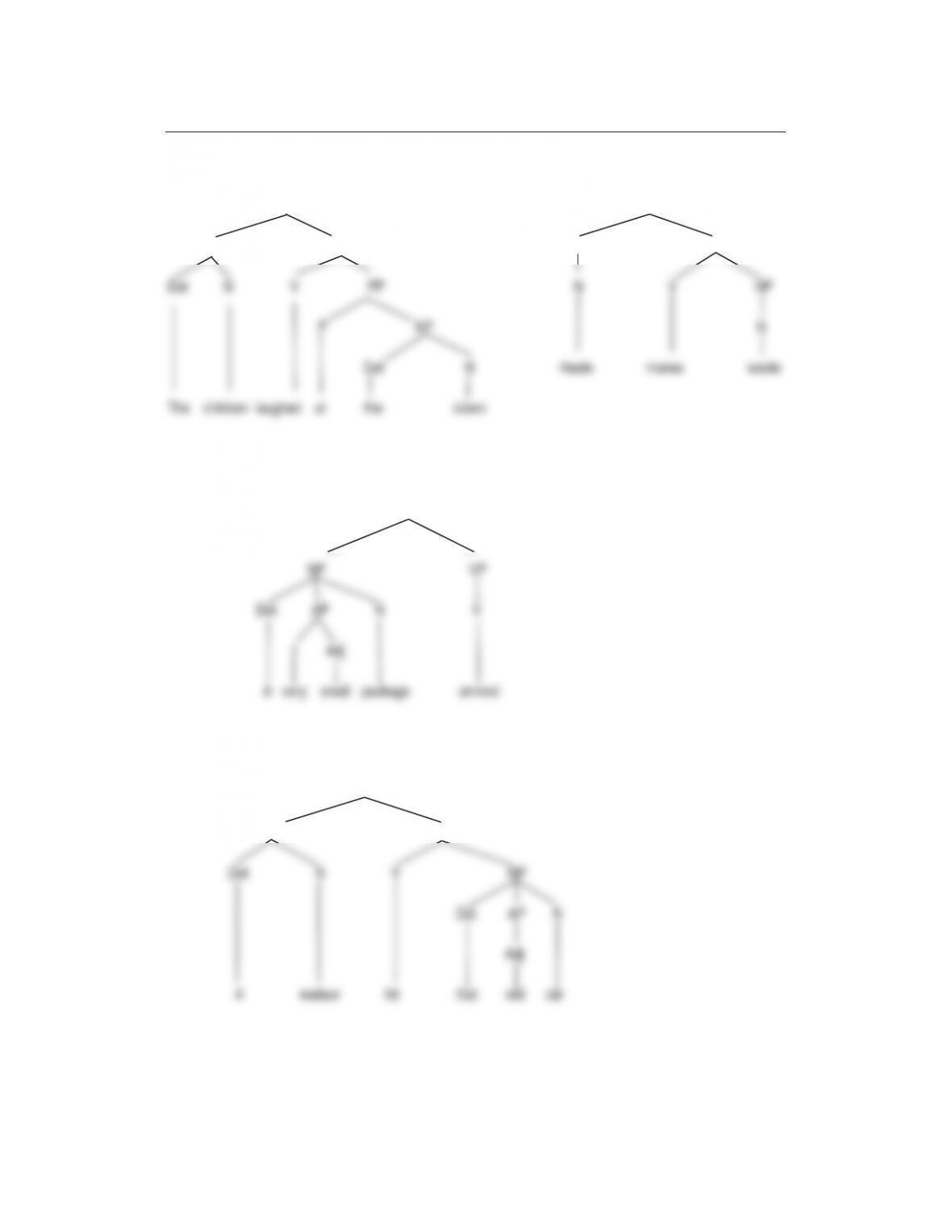
2. a. The children laughed at the clown. b. Haste makes waste.
S S
NP VP NP VP
c. A very small package arrived.
S
d. A meteor hit that red car.
S
NP VP
Syntax 17
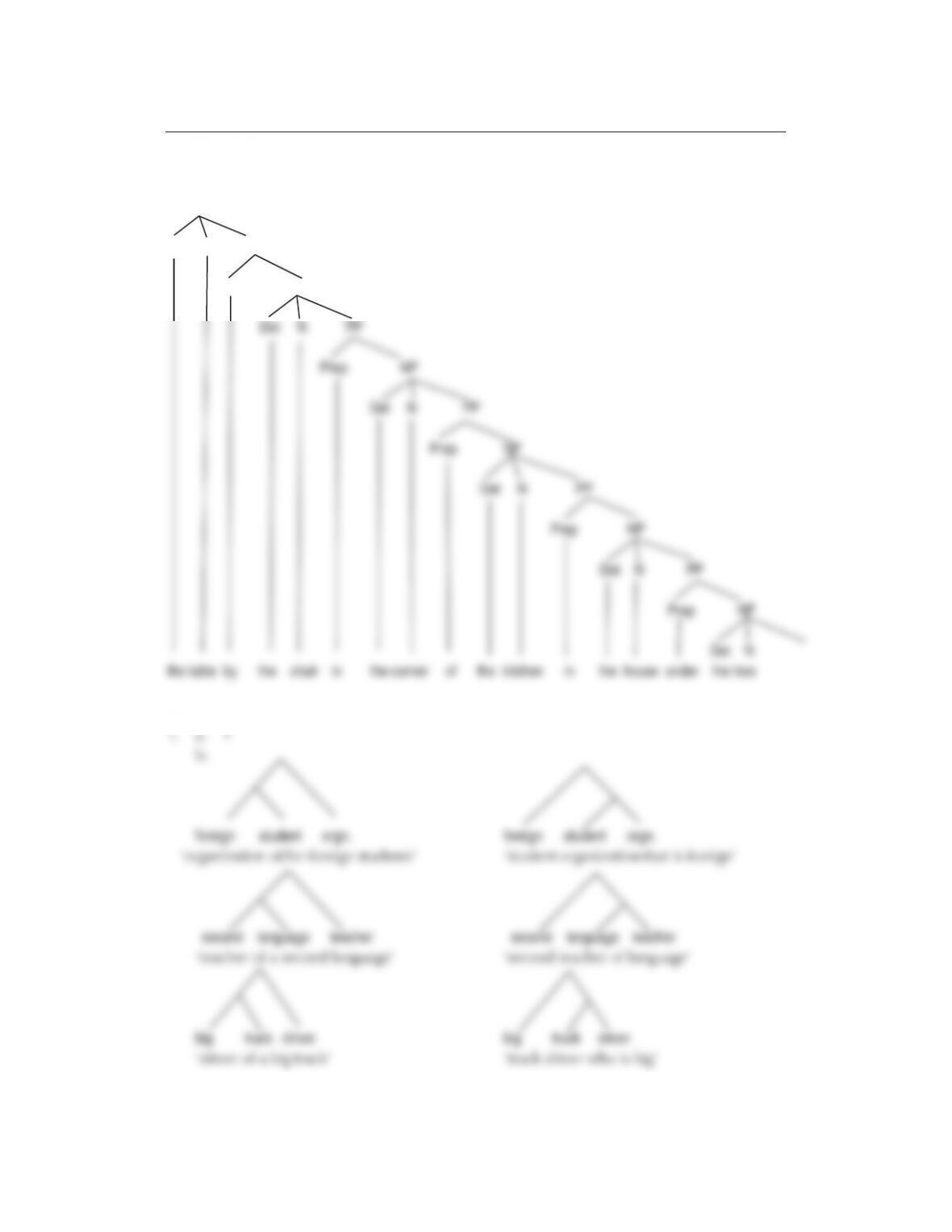
Exercise D, p. 53
NP
Det N PP
Prep NP
Exercise E, p. 55
18 Syntax
2. a. not structurally ambiguous (bank is lexically ambiguous)
Exercise F, pp. 56–58
1. Passive versions differ in their grammaticality if the PP is moved to subject position:
A
1: * The note on the door was put by Ralph.
Exercise G, p. 59–60
1. kill requires a [+living] object.
2. †
Exercise H, p. 63
1. c. ‘the professors of English from France.’ X-bar syntax states that complements occur
Exercise I, p. 67
Syntax 19
Exercise J, p. 68
1. Reflexive pronouns (e.g., himself) require an antecedent within the same clause as the
Exercise K, p. 69
1. †
Exercise L, pp. 71–72
c. Unit Movement
Structure
Supplementary Exercises, pp. 72–78
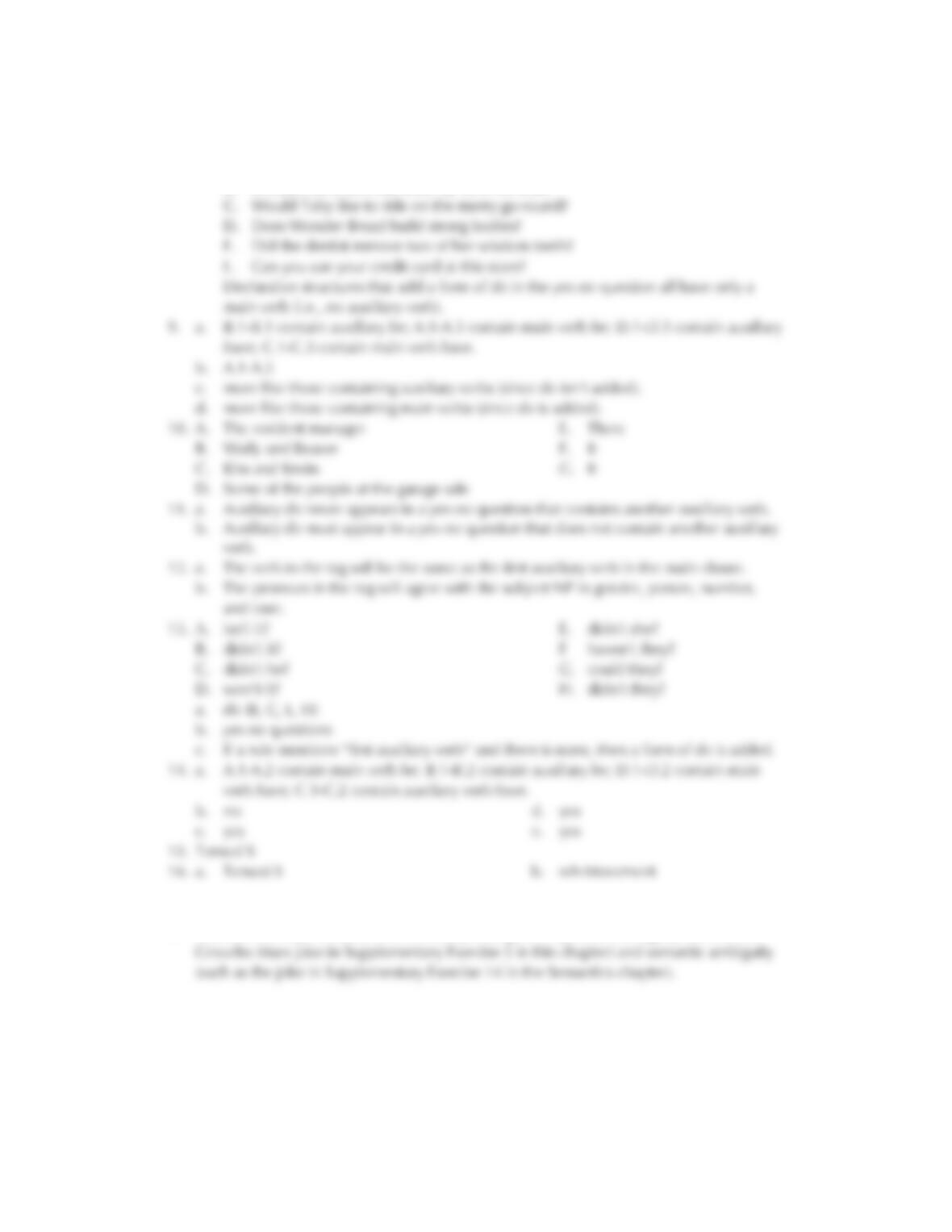
1. Structural ambiguity:
20 Syntax
d. A. Did Ralph park the car next to a fire hydrant?
B. Should I have sent this letter by certified mail?
Exploratory Exercise, p. 78
1. Answers will vary. Students will find many examples of syntactic ambiguity (such as the