
52
The Nature
of Arguments
4
CHAPTER
KEY TERMS
claim, p. 53
grounds, p. 53
warrant, p. 54
backing, p. 54
qualifier, p. 55
force, p. 55
rebuttal, p. 55
reservation, p. 55
reasoning processes, p. 56
logic, p. 57
deduction, p. 57
syllogism, p. 57
enthymeme, p. 57
informal logic, p. 58
pragma dialectical discussion rules, p. 59
argument by generalization, p. 59
sample, p. 59
agreement, p. 60
difference, p. 60
correlation, p. 60
residues, p. 60
argument by cause to effect, p. 60
argument by effect to cause, p. 60
argument by sign, p. 62
argument by analogy, p. 63
argument from authority, p. 64
wisdom of crowds, p. 64
narrative, p. 64
argument by definition, p. 65
On the playground, a little girl and boy are in an argument:
M04_RIEK0596_08_SE_C04.indd Page 52 17/01/12 2:01 PM user-f396M04_RIEK0596_08_SE_C04.indd Page 52 17/01/12 2:01 PM user-f396 F-396F-396
CHAPTER 4 The Nature of Arguments 53
What do people mean when they say, “Good point” or “That makes sense” or “That’s
reasonable” or “That’s logical?” In the case of the little girl, the boy invoked a familiar
refrain, “liar, liar, pants on fire,” which many children learn. He connected his claim with
knowledge already possessed by the girl so that she perceived it as a good point. Adults
smile at the exchange because they have learned more complex and effective ways of tell-
THE MODEL OF AN ARGUMENT
We start by introducing you to a modification of a model developed by Stephen Toulmin
(1963, iii) to help you understand the parts of an argument and their interrelationships.
In the past half-century, Toulmin’s layout of argument has become the standard pattern
for examining arguments and his terminology of claim, grounds, warrant, backing, quali-
fier, and rebuttal/reservation has become widely adopted (Hitchcock and Verheis). The
model we are using is useful to analyze an argument, but be aware that you will put an
Claim
A claim states the idea or action for which you are seeking adherence—it is the end goal
of the argument, and it is the place you begin:
Grounds
Grounds provide the primary source of support in answer to the question: “Why should
I agree with your claim?” “What have you got to back it up?” “What facts do you use
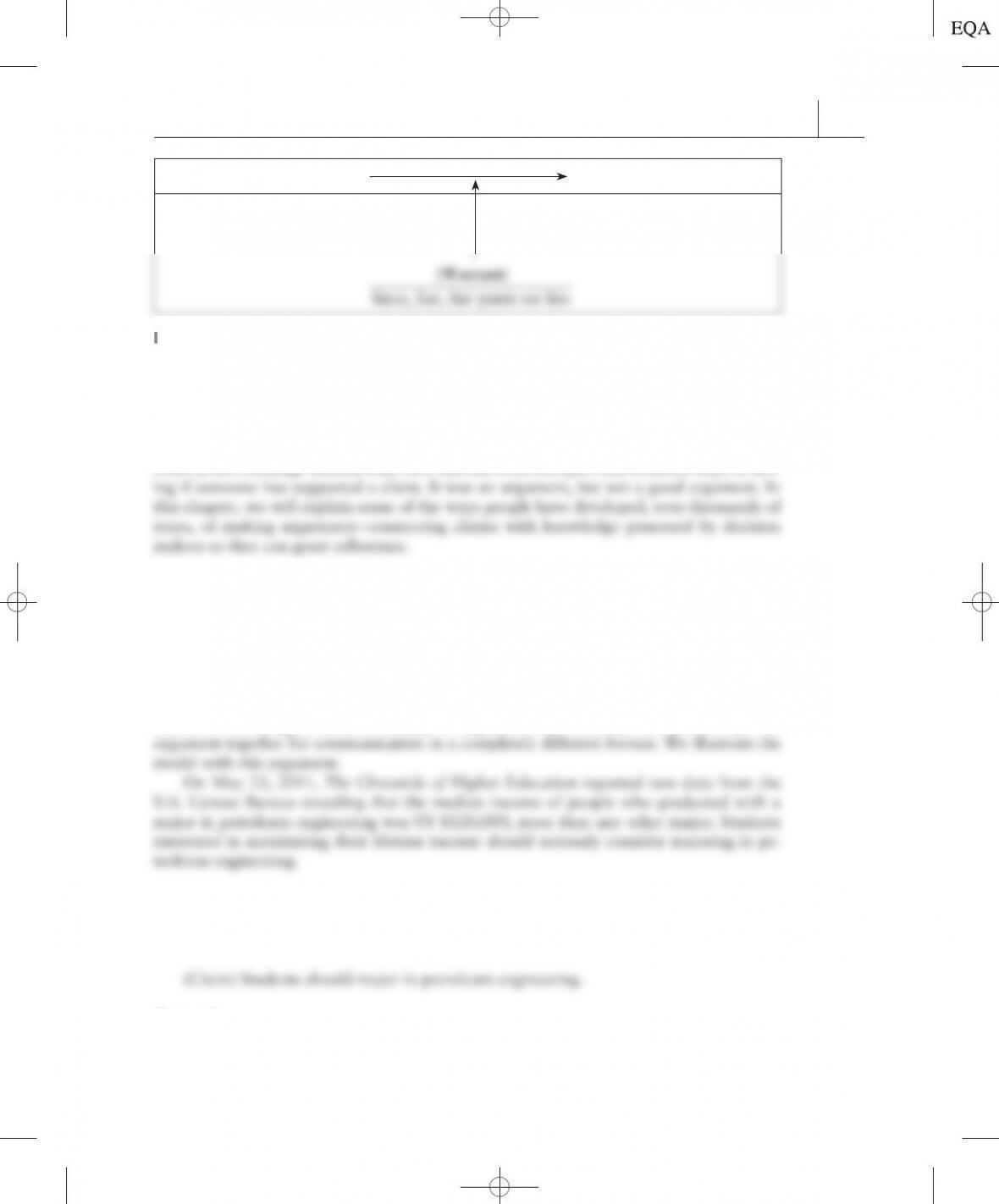
( Grounds ) ( Claim )
My pants are not on fire. I am not a liar.
FIGURE 4.1
M04_RIEK0596_08_SE_C04.indd Page 53 17/01/12 2:01 PM user-f396M04_RIEK0596_08_SE_C04.indd Page 53 17/01/12 2:01 PM user-f396 F-396F-396
54 PART 1 Principles
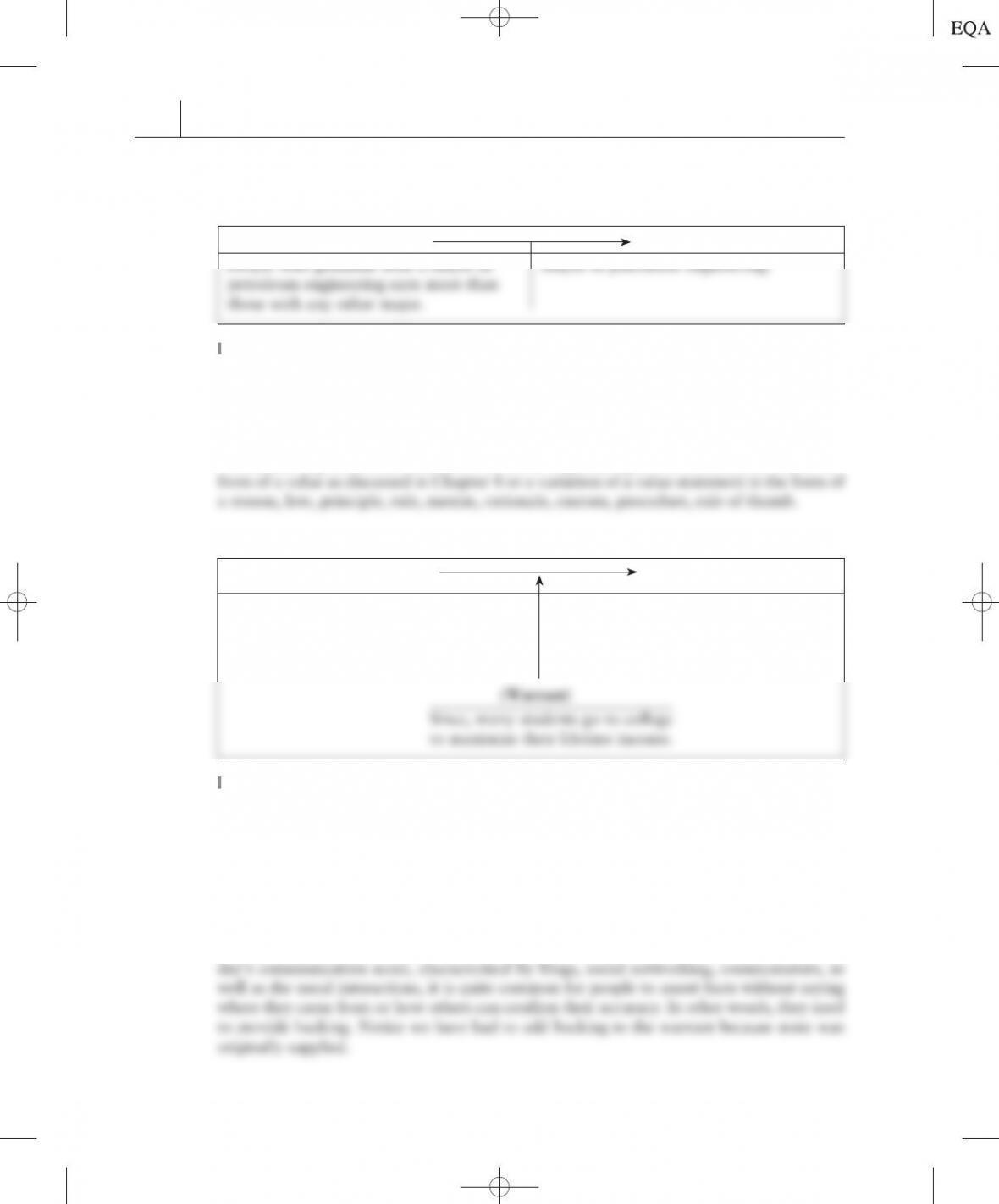
Warrant
Rarely, do the grounds alone allow the decision maker to grant adherence to the claim.
Usually, an argument includes, either stated or implied, a general statement mostly in the
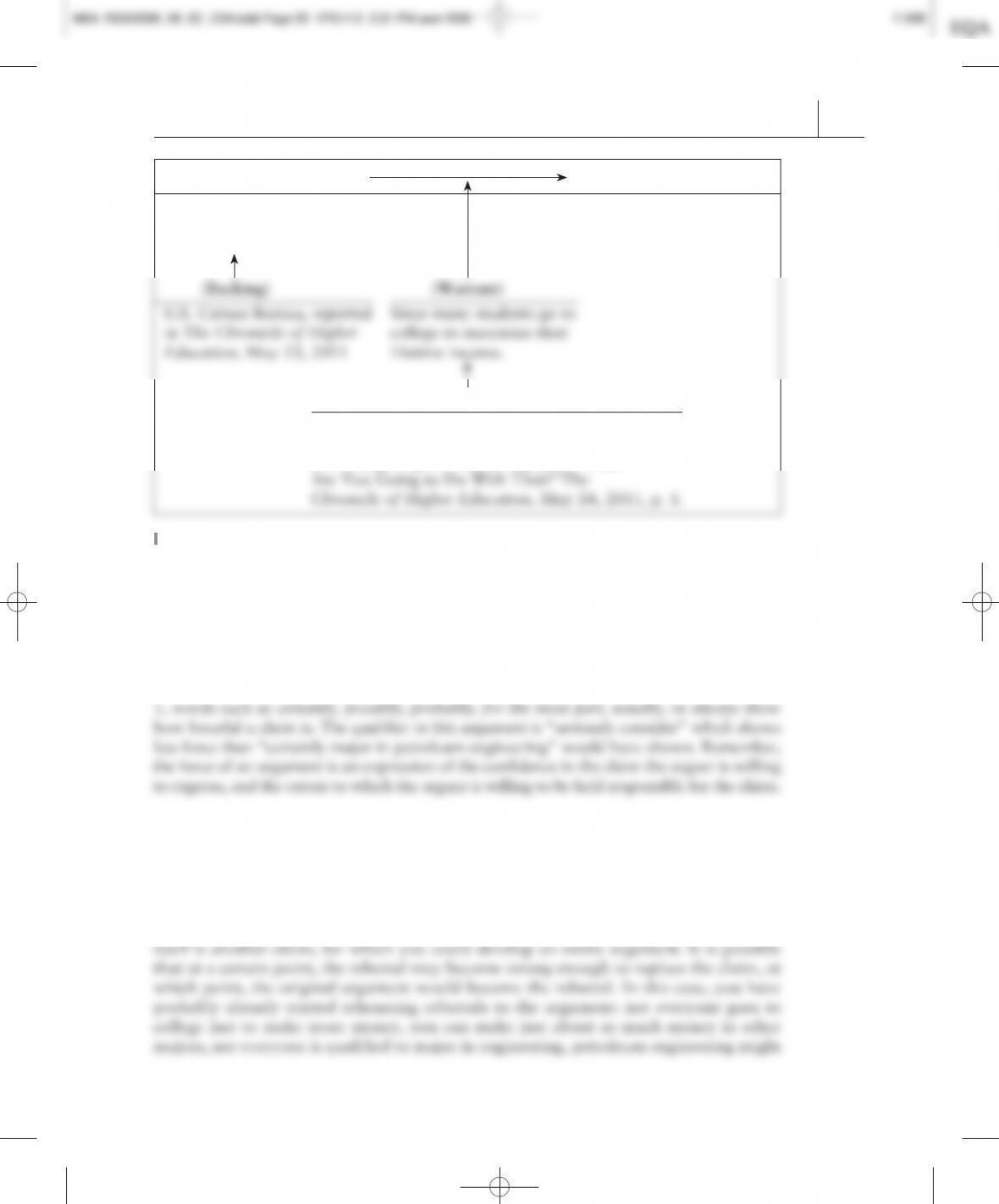
Backing
For some people, “claims, grounds, and warrant” are all an argument would need. They
would accept the reasoning and find the claim acceptable. Others, however, particularly
on controversial questions, would want more. They would require backing for either the
grounds or the warrant. Backing is any support (specific instances, statistics, testimony,
values, or credibility) that provides more specific data for the grounds or warrant. In to-
to get there?” Grounds consist mostly of evidence as discussed in Chapter 7 , as well as
values discussed in Chapter 8 and credibility discussed in Chapter 9 .
FIGURE 4.2
( Grounds ) ( Claim )
People who graduate with a major in Major in petroleum engineering.
petroleum engineering earn more than
those with any with any other major.
FIGURE 4.3
(Grounds) (Claim)
People who graduate with a major in Major in petroleum engineering.
M04_RIEK0596_08_SE_C04.indd Page 54 17/01/12 2:01 PM user-f396M04_RIEK0596_08_SE_C04.indd Page 54 17/01/12 2:01 PM user-f396 F-396F-396
CHAPTER 4 The Nature of Arguments 55
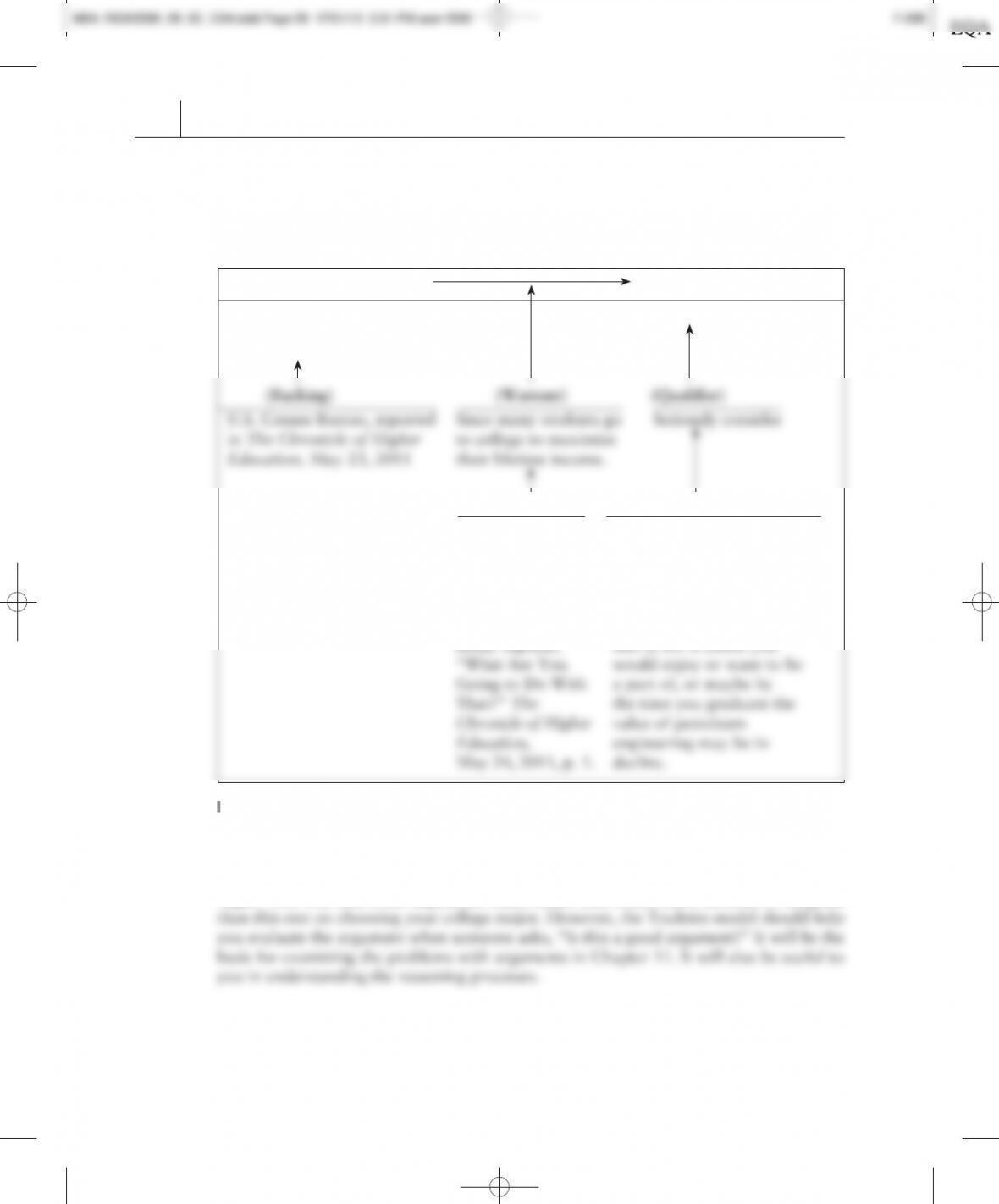
Qualifier
To be reasonable, an argument must have a claim and grounds for that claim, and the link
between the two must be justified by a warrant. The grounds or warrant may need backing,
depending on the level of questioning by decision makers. Sometimes, you have to look very
carefully at the claim to see how much is being claimed. Some claims will have a qualifier , a
statement that indicates the force of the argument. As we noted in greater detail in Chapter
Rebuttal/Reservation
The actual strength of this argument has to be judged as well by possible rebuttal/
reservation , the basis on which the claim could be questioned by decision makers and
the limits the arguer puts on the claim. The rebuttal reflects the arguments that detract
from the claim, and the reservation explains the qualifier. It says “seriously consider,”
but with the reservation that only select students will do so. The rebuttal/reservation
(Grounds) (Claim)
People who graduate with a major in Major in petroleum engineering.
petroleum engineering earn more than
those with any with any other major.
(Backing)
“Tuition is rising, the job market is weak,
and everyone seems to be debating the value
of a college degree.” Becky Supiano, “What
FIGURE 4.4
56 PART 1 Principles
not be a career you would enjoy, petroleum engineers usually have to work in places
where oil is being pumped such as Saudi Arabia or Nigeria, which may not be where
you want to live. You might have reservations about working in the petroleum industry
because it has been charged with damaging the environment or because the importance
of petroleum will decline in the future as alternative sources of energy are developed.
Not all arguments are the same. Some will be found reasonable without backing.
Some parts will not be stated. Some will be carefully developed. Some claims will be sub-
ject to significant rebuttal, others to little. Some warrants will be specific, others will be
vague. You will find some arguments much easier and others more difficult to diagram
REASONING PROCESSES
In Chapter 2 , we identified the commonplaces of arguments: those principles that are used
to generate starting points of argumentation. Among the commonplaces were certain rea-
soning processes : logic or deduction , generalization , cause , sign , analogy , and authority .
(Grounds) (Claim)
People who graduate with a major in Major in petroleum engineering.
petroleum engineering earn more than
those with any with any other major.
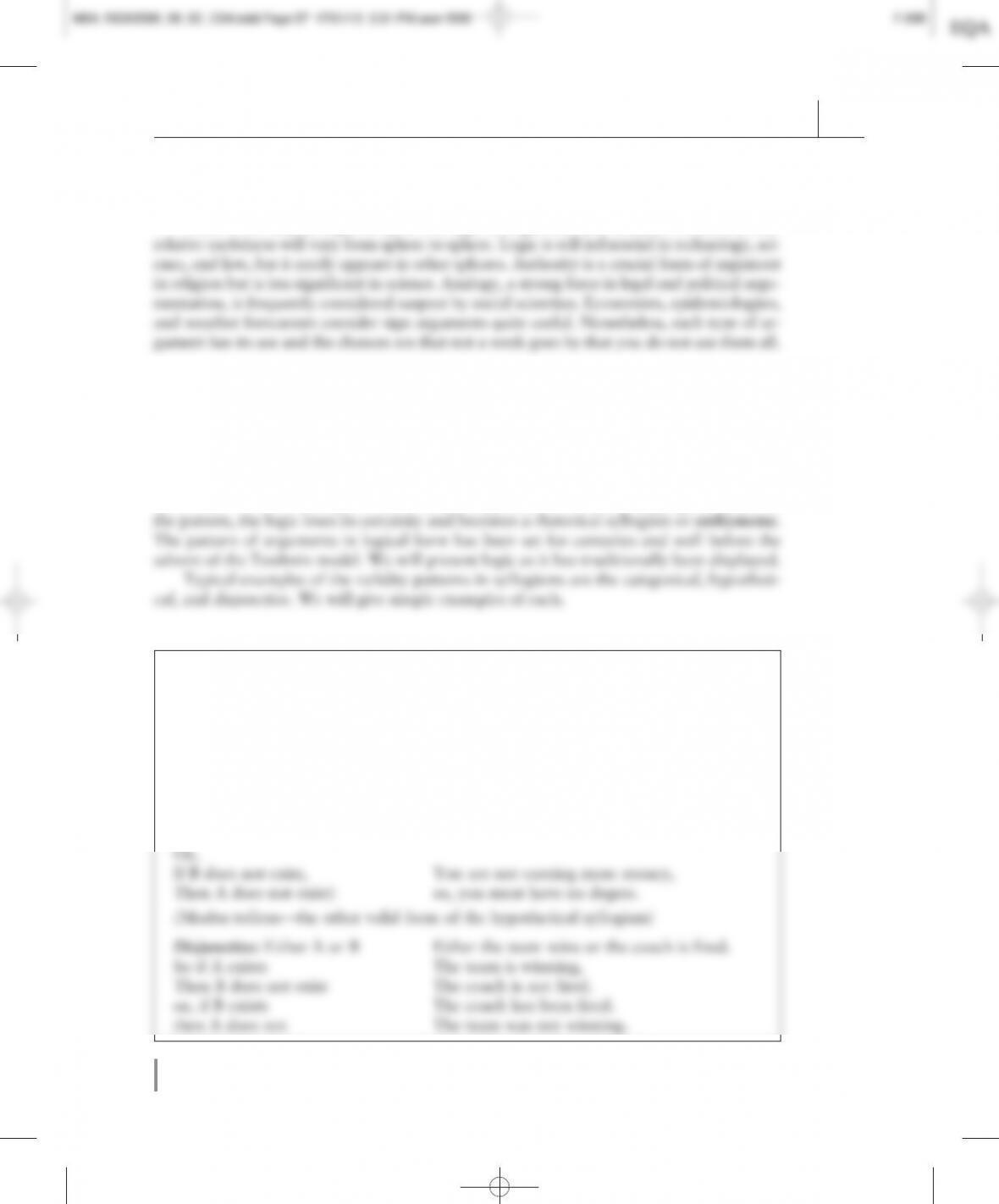
(Backing) (Rebuttal/Reservation)
“Tuition is rising, Unless money is not so
the job market is important to you, or you can
weak, and everyone make enough money in
seems to be debating another major, or you
the value of a are not qualified to major in
college degree.” petroleum engineering, or
Becky Supiano, that is not a career you
FIGURE 4.5
CHAPTER 4 The Nature of Arguments 57
These constitute the basis for most arguments. The purpose of this section is to look at
those principles more carefully to see how they are applied in all but the most specialized
situations and how they differ in the nature of their grounds, claims, and warrants.
There is no natural superiority of one type of argument over another. However, their
Argument by Logic/Deduction/Syllogism/Enthymeme
Aristotle set out a pattern of formal relations by which arguments could be tested for
validity. That is to say, if you begin with true premises, this logic can dictate the ways
in which they can be combined to yield true conclusions. The pattern is called syllogism
( deduction ) and is taught, with the modifications that have been made over the years, as
formal logic. We explain below, however, that logic works only with abstract terms such
as A’s and B’s or P’s and Q’s. When practical arguments in ordinary language are put into
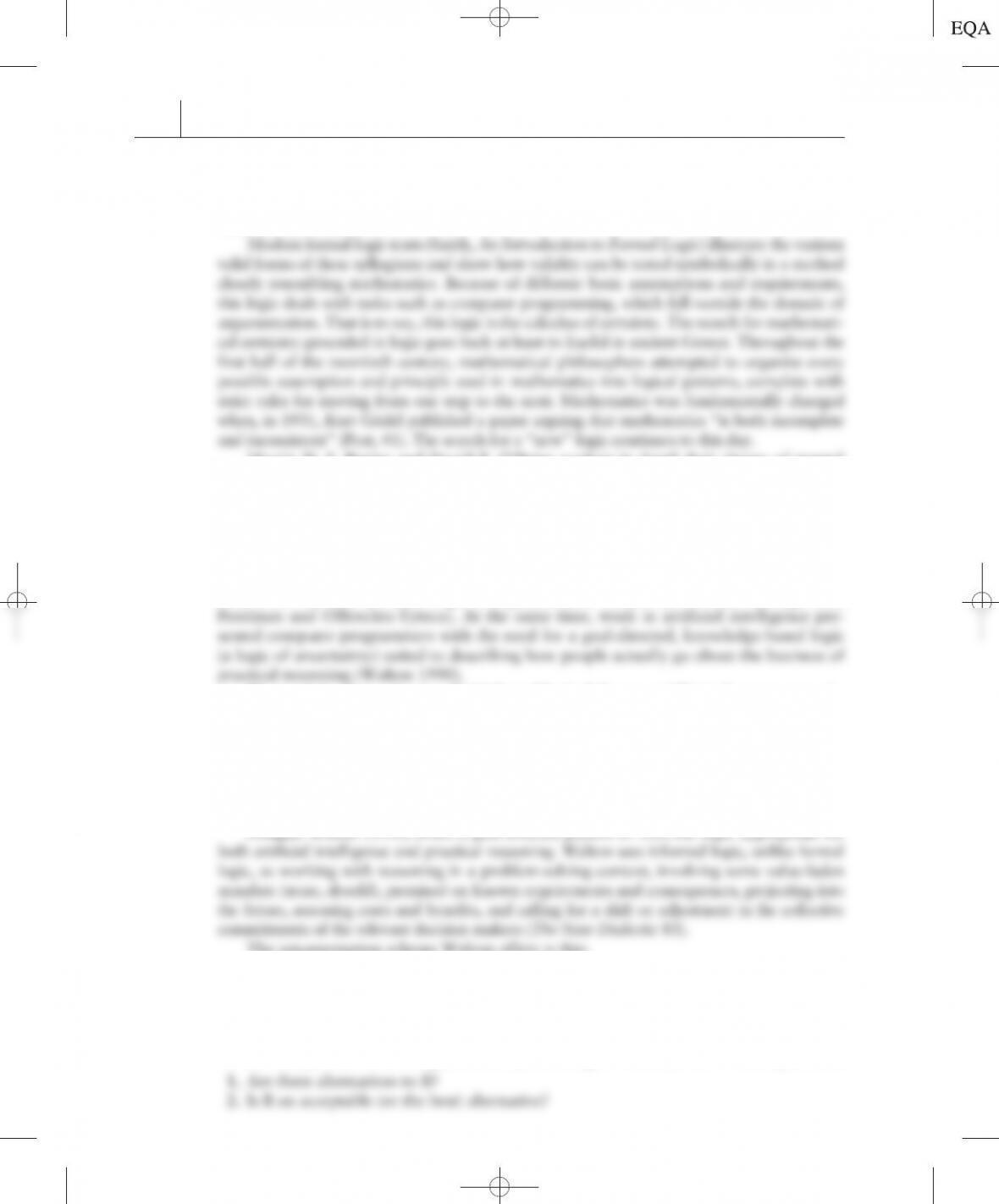
FIGURE 4.6
Valid Forms of Syllogisms/Enthymemes
Categorical : If all A is B, If good students are good drivers,
And if all C is A, and if good drivers have fewer accidents,
Then all C is B then, good students have fewer accidents.
(There are many other valid forms of categorical syllogisms.)
Hypothetical : If A, then B If you have a degree, you will earn more money.
So if A exists You do have a degree,
Then B exists so, you will earn more money.
(Modus ponens—one of two valid forms of hypothetical syllogisms)
Or,
If B does not exist, You are not earning more money,
Then A does not exist) so, you must have no degree.
(Modus tollens—the other valid form of the hypothetical syllogism)
Disjunctive: Either A or B Either the team wins or the coach is fired.
So if A exists The team is winning,
Then B does not exist The coach is not fired.
or, if B exists The coach has been fired.
then A does not The team was not winning.
M04_RIEK0596_08_SE_C04.indd Page 57 17/01/12 2:01 PM user-f396M04_RIEK0596_08_SE_C04.indd Page 57 17/01/12 2:01 PM user-f396 F-396F-396
58 PART 1 Principles
You should see at once that when we put ordinary language in the place of abstract
symbols, the arguments require grounds, backing, and qualifiers. Validity means only that
there is no internal contradiction in the logic. It does not assure the conclusions can be
held with confidence.
Martin D. S. Braine and David P. O’Brien explain in detail their theory of mental
logic consisting of “a set of inference schemas. For example, when one knows that two
propositions of the form p or q and not p are true, one can assert q ” (3). They provide
an extensive list of such schemas, although it does not claim to be exhaustive. Although
we disagree with their contention that the human mind naturally employs such logic, we
agree that people are quite capable of learning and using it.
During the last half of the twentieth century, there was much philosophical discus-
sion of the viability of formal logic in argumentation (Toulmin, The Uses of Argument ;
The result has been what is called informal logic (Johnson and Blair). In many ways, its
contribution is directed toward the discussion of fallacies, as we explain in Chapter 11 . In
its more conservative form, informal logic employs the patterns of deductive logic to criti-
cize arguments within the realm of argumentation. Thus, the concept of validity is retained,
but the force of conclusions does not reach the certainty of formal logic. Perelman and
Olbrechts-Tyteca speak of quasi-logic , meaning the use of syllogistic forms in presenting
arguments to benefit from the widespread respect given to logic by many decision makers.
Douglas Walton (1990) offers a goal-directed pattern of informal logic appropriate for
The argumentation scheme Walton offers is this:
A is the goal.
B is necessary to bring about A.
Therefore, B is necessary.
This is used, says Walton, to convince someone to take whatever action is entailed in
B. Critical appraisal of such argumentation, according to Walton, follows these questions:
M04_RIEK0596_08_SE_C04.indd Page 58 17/01/12 2:01 PM user-f396M04_RIEK0596_08_SE_C04.indd Page 58 17/01/12 2:01 PM user-f396 F-396F-396
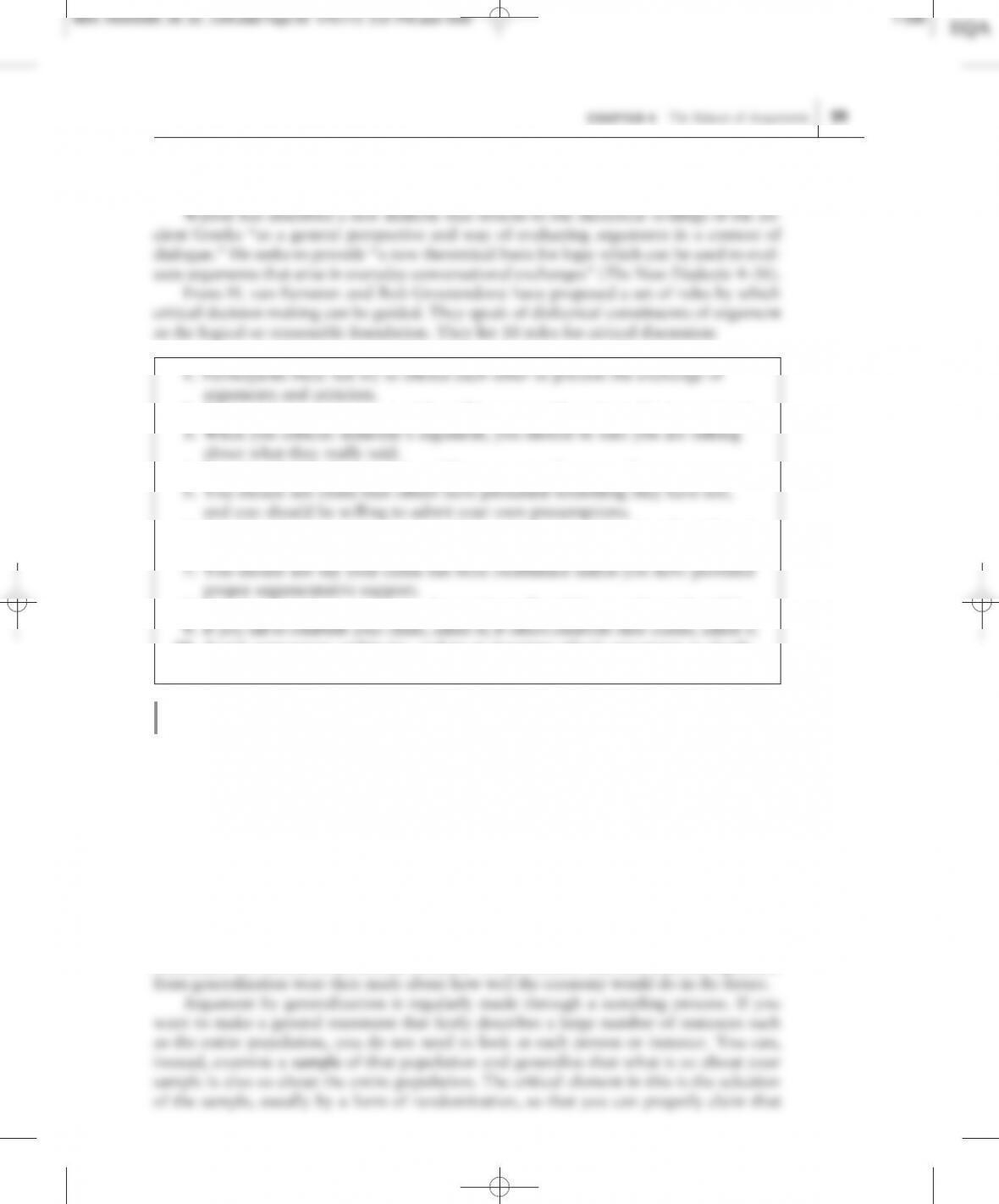
3. Is it possible to bring about B?
4. Does B have bad side effects? (85)
Argument by Generalization
Generalization, or rhetorical induction, is an argument in which individual instances are
assembled to allow the assertion of a general principle. At its most basic, a generalization is
formed by looking at individual elements so that a general statement can be made that fairly
reflects the individual data. For example, the U.S. Federal Reserve divides the country into
12 districts. Economic activity in each district is examined regularly and a general statement
on the nation’s economic health is announced. Information collected on May 27, 2011 was
published on June 9, 2011. According to The New York Times of that date, the nation’s
economy continued to grow but was held down by high food and energy prices and an
earthquake and tsunami in Japan. Some districts performed better than others, but the gen-
eralization was faithful to the central tendency. On the basis of that information, arguments
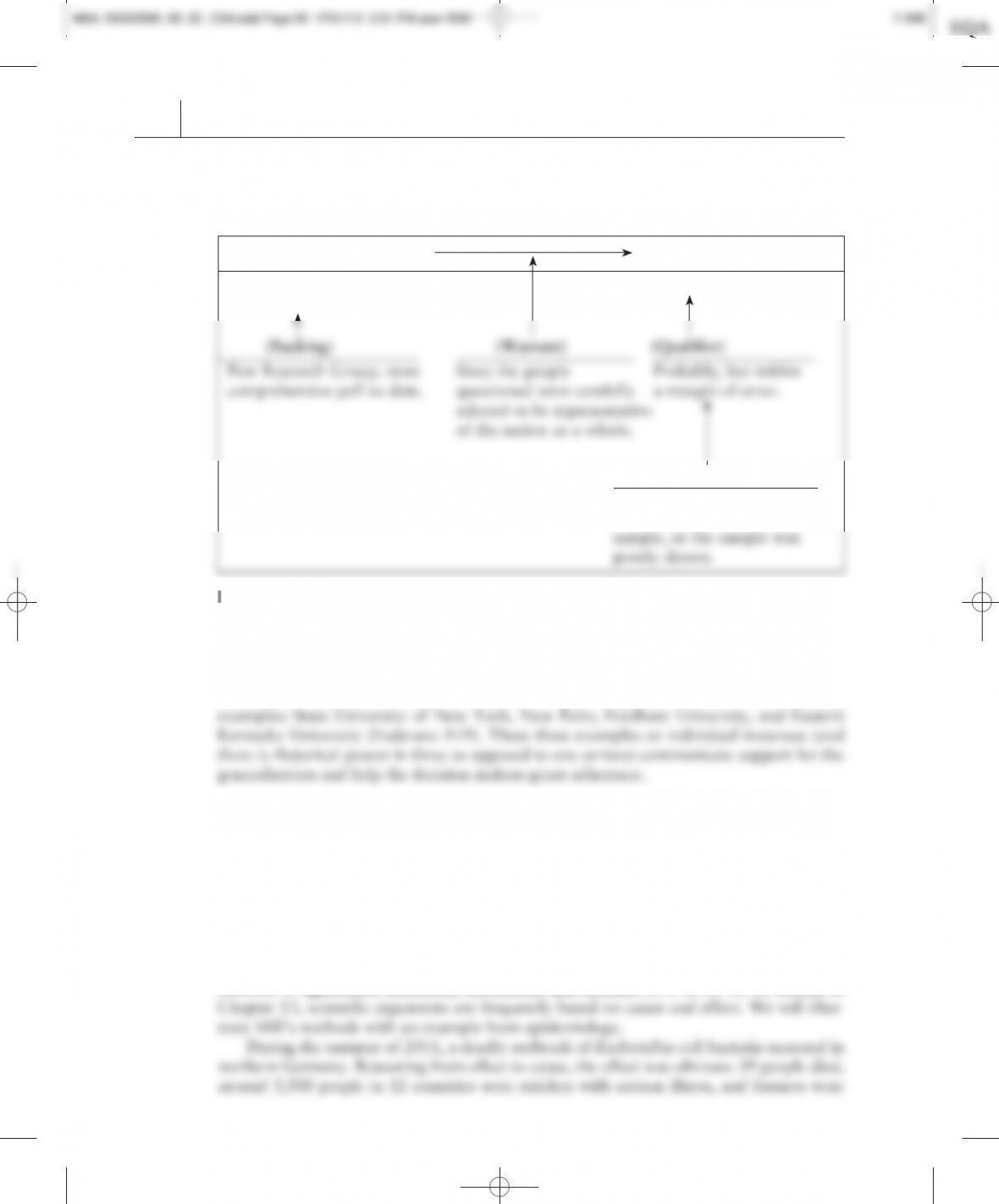
FIGURE 4.7
Pragma-Dialectical Discussion Rules
2. If you make a claim, you must be willing to provide support if it is requested.
4. You should defend your claims with arguments relevant to them.
6. You should not try to start argumentation with a starting point others do not
accept, and you should not deny a genuine starting point.
8. You should stick to arguments that are logically valid or can be made valid.
10. Avoid unnecessary ambiguity, and try to interpret other’s arguments as clearly
as possible.
60 PART 1 Principles
Examples , discussed in Chapter 7 , are also part of reasoning by generalization.
Aristotle called examples rhetorical induction (40). You might advance a general claim,
“The number of emergency-management programs in higher education has increased dra-
matically from 2001 to today.” Then, you can provide grounds for the claim by citing
Argument by Cause
Since well before Thomas Aquinas argued the existence of God by saying, “Things do
not change unless some agent changes them,” as we discuss in Chapter 14 , people have
acted on the presumption that effects have causes. Only God, claimed Aquinas, could be
the unmoved mover. Captain Von Trapp, in the film The Sound of Music , sings “Nothing
comes from nothing, nothing ever could.” An argument by cause can reason from cause
to effect or from effect to cause.
John Stuart Mill suggested that causal arguments can be developed by using the
methods of agreement, difference, correlation, and residues (278–291). As we discuss in
all members of the total population had an equal chance of being included in the sample.
When the Pew Research group said that only 32% of Americans believe that life has
evolved over time, they only questioned 2,001 people (Fox, popsci.com).
(Grounds) (Claim)
32% of the 2,001 people questioned 32% of Americans believe life has
believe life has evolved over time. evolved over time.
(Rebuttal/Reservation)
Unless the questions were
poorly phrased to mislead the
FIGURE 4.8
CHAPTER 4 The Nature of Arguments 61
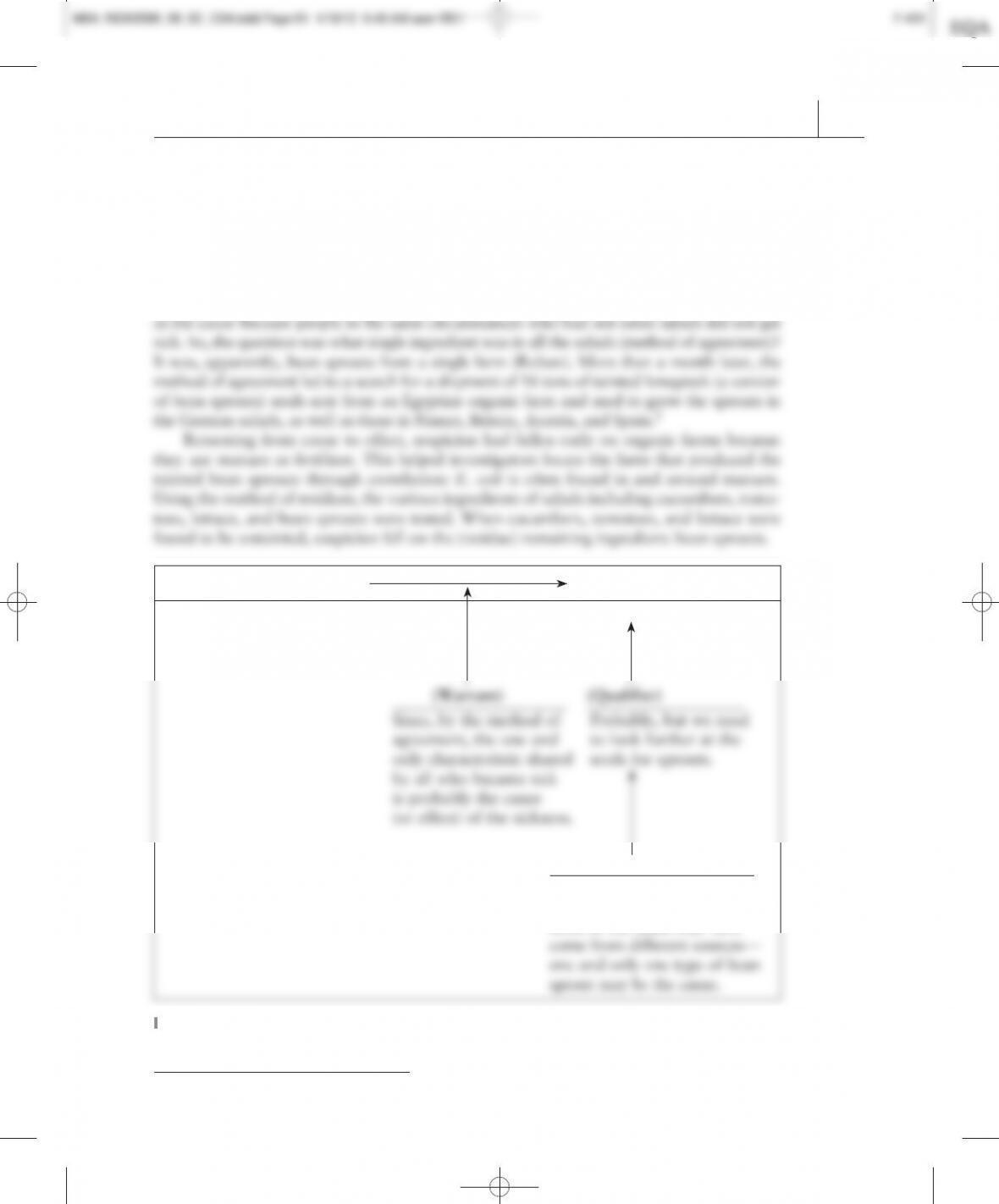
hurt when people stopped eating vegetables they thought might be carrying the bacteria. The
question was: What actually is the cause? Using the method of agreement, authorities asked,
“What is the one and only thing common to all the people who have suffered?” If they could
find, for example, that all had eaten the same food, it would probably be the cause. In fact,
it was quickly found that people had probably come in contact with the bacteria after eating
salads, but salads contain a variety of ingredients—which one was the culprit? At first, the
suspect was Spanish cucumbers, but it was found that some people had eaten salads without
cucumbers and still became sick. The method of difference was used to zoom in on salads
1 William Neuman, “A Search Is Under Way For Tainted Sprout Seeds,” The New York Times , July 6, 2011, B3.
(Grounds) (Claim)
Effect: E. coli bacterial infections. Organic bean sprouts are the cause of
Agreement: every sick person had the infections.
eaten salad with bean sprouts.
(Rebuttal/Reservation)
There were different types of
bean sprouts being used, and
some of the seeds may have
FIGURE 4.9
62 PART 1 Principles
Specialists in business and finance make regular use of argument by sign. The
Composite Index of Leading Indicators is an example. “The index is made up of 10
economic components, whose changes tend to precede changes in the overall economy”
(Investopedia). The components, such as average weekly hours worked by manufactur-
ing workers, the amount of new building permits, consumer sentiment, and the S&P 500
Argument by Sign
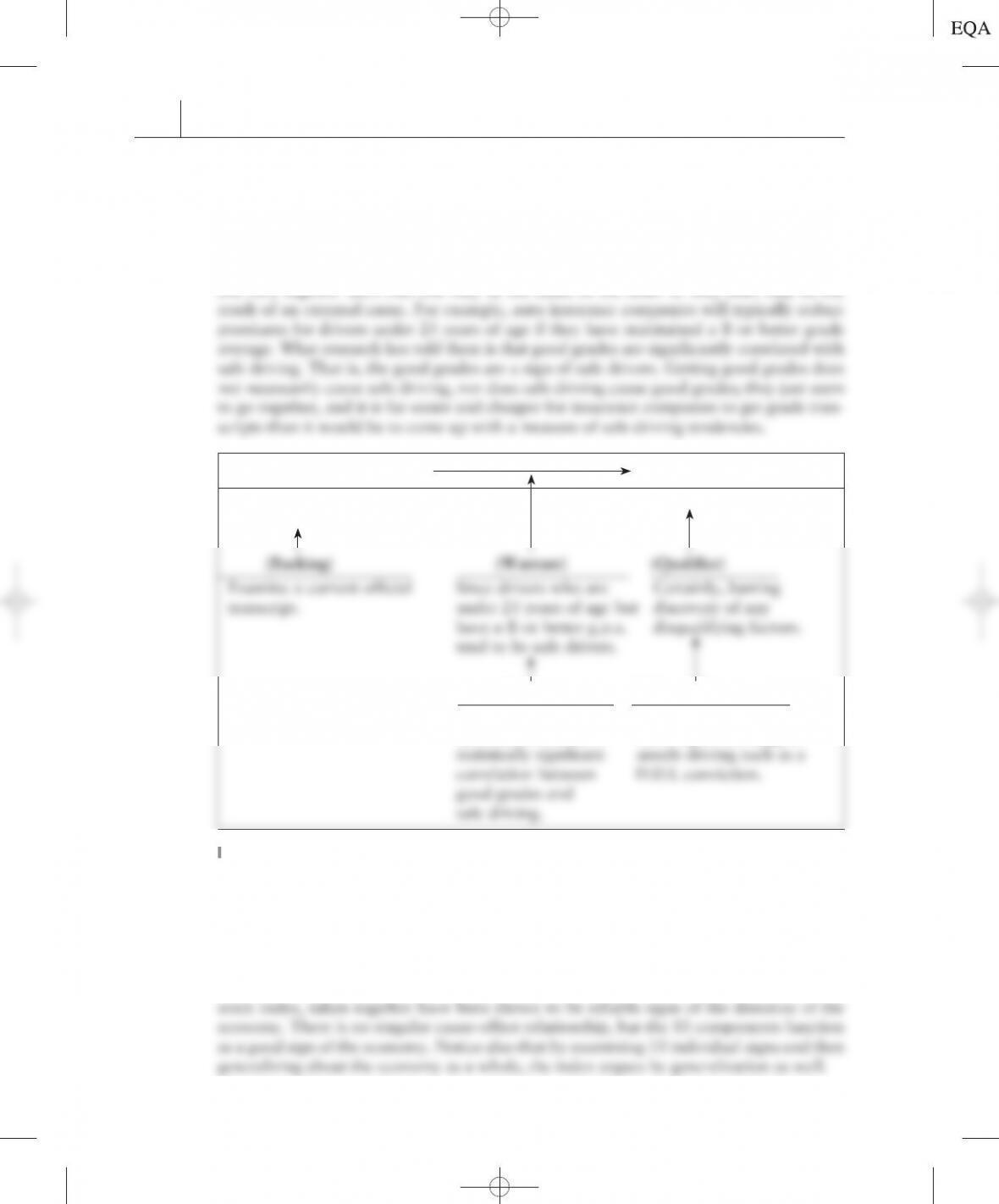
Argument by sign is closely related to causal argument but is different. A sign argument
is based on a warrant that most things, conditions, or ideas have characteristics that will
signal their presence. The sign is closely associated, but is not necessarily the cause or ef-
fect, of the thing signaled. We have just mentioned correlation as involved in cause–effect
reasoning, but it is also part of argument by sign. A correlation says that two phenom-
ena vary together such that one may be the cause of the other or they both may be the
(Grounds) (Claim)
The driver is under 25 years of age, The driver gets a discount.
but has a high g.p.a.
(Backing) (Rebuttal/Reservation)
Many years of research Unless the driver has
have demonstrated a other signs that suggest
FIGURE 4.10
M04_RIEK0596_08_SE_C04.indd Page 62 17/01/12 2:01 PM user-f396M04_RIEK0596_08_SE_C04.indd Page 62 17/01/12 2:01 PM user-f396 F-396F-396
CHAPTER 4 The Nature of Arguments 63
Argument by Analogy
In argument by analogy , you compare two situations that you believe have the same es-
sential characteristics and reason that a specific characteristic found in one situation also
exists in the analogous situation.
It has been traditional to differentiate between literal and figurative analogies. The literal
analogy is presumed to be based on factual comparisons of situations, and the figurative anal-
ogy is based on more fanciful relations. No two situations can literally be identical. However,
some comparisons are more material than others. For example, when a prize winning jour-
From the perspective of reasoning, materially similar comparisons are more signifi-
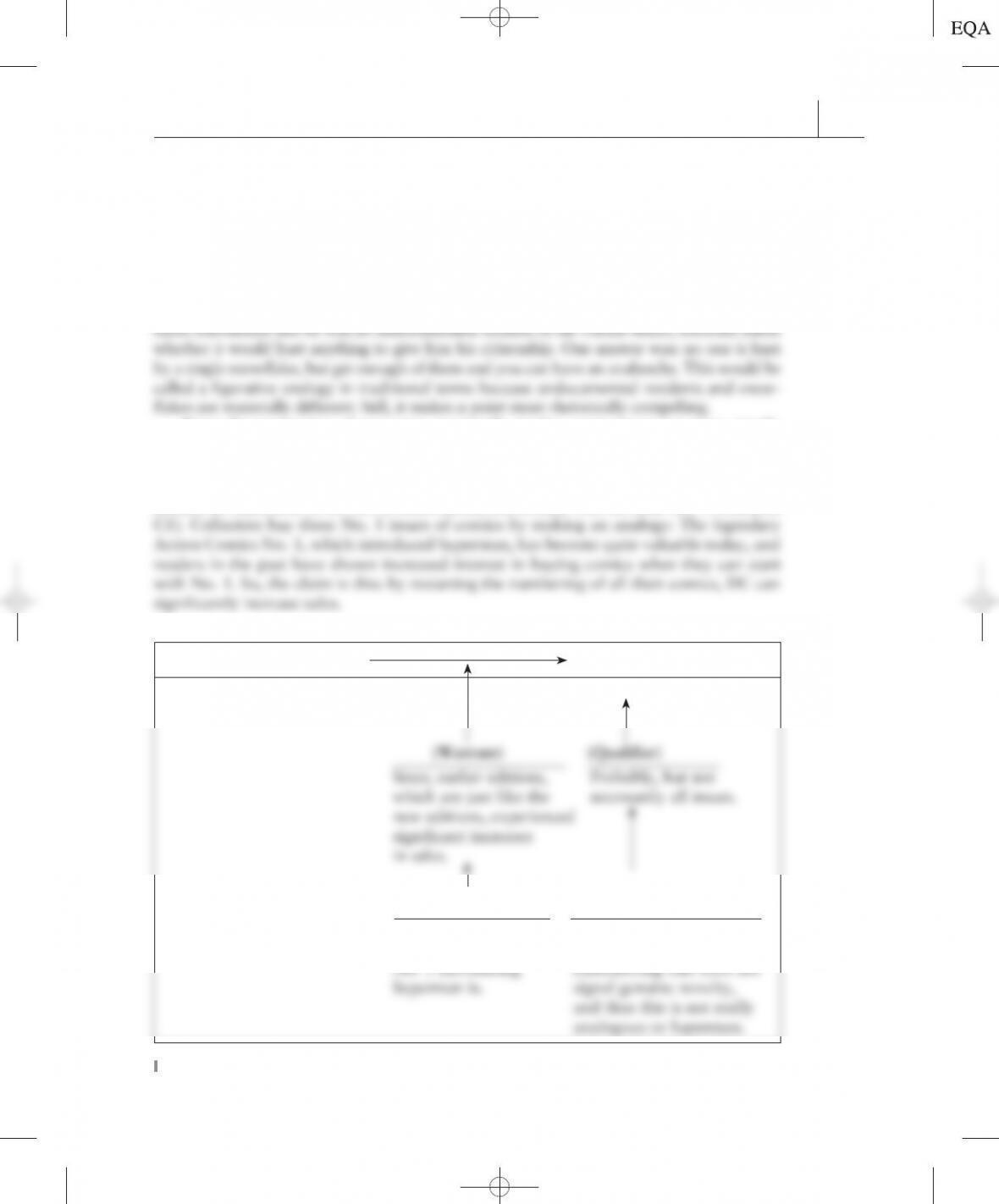
cant because decision makers tend to take them more seriously. A claim reasons that what
is so about one point of comparison is arguably so about another, or can be used to argue
a point based on comparison. DC Comics has renumbered its entire DC Universe line of
comics. In September of 2011, 52 series started anew, each with an issue No. 1 (Gustines
(Grounds) (Claim)
In the past, readers and collectors have DC Comics’ sales will increase.
been eager to buy No. 1 issues of comics.
(Backing) (Rebuttal/Reservation)
Look at how valuable Unless collectors recognize
Action Comics that this is an artificial
No. 1 introducing renumbering that does not
FIGURE 4.11
M04_RIEK0596_08_SE_C04.indd Page 63 17/01/12 2:01 PM user-f396M04_RIEK0596_08_SE_C04.indd Page 63 17/01/12 2:01 PM user-f396 F-396F-396
64 PART 1 Principles
Argument from Authority
In Chapter 9 , we will discuss how your credibility can support the adherence decision
makers give to your argument. Even persons of high credibility, however, frequently use
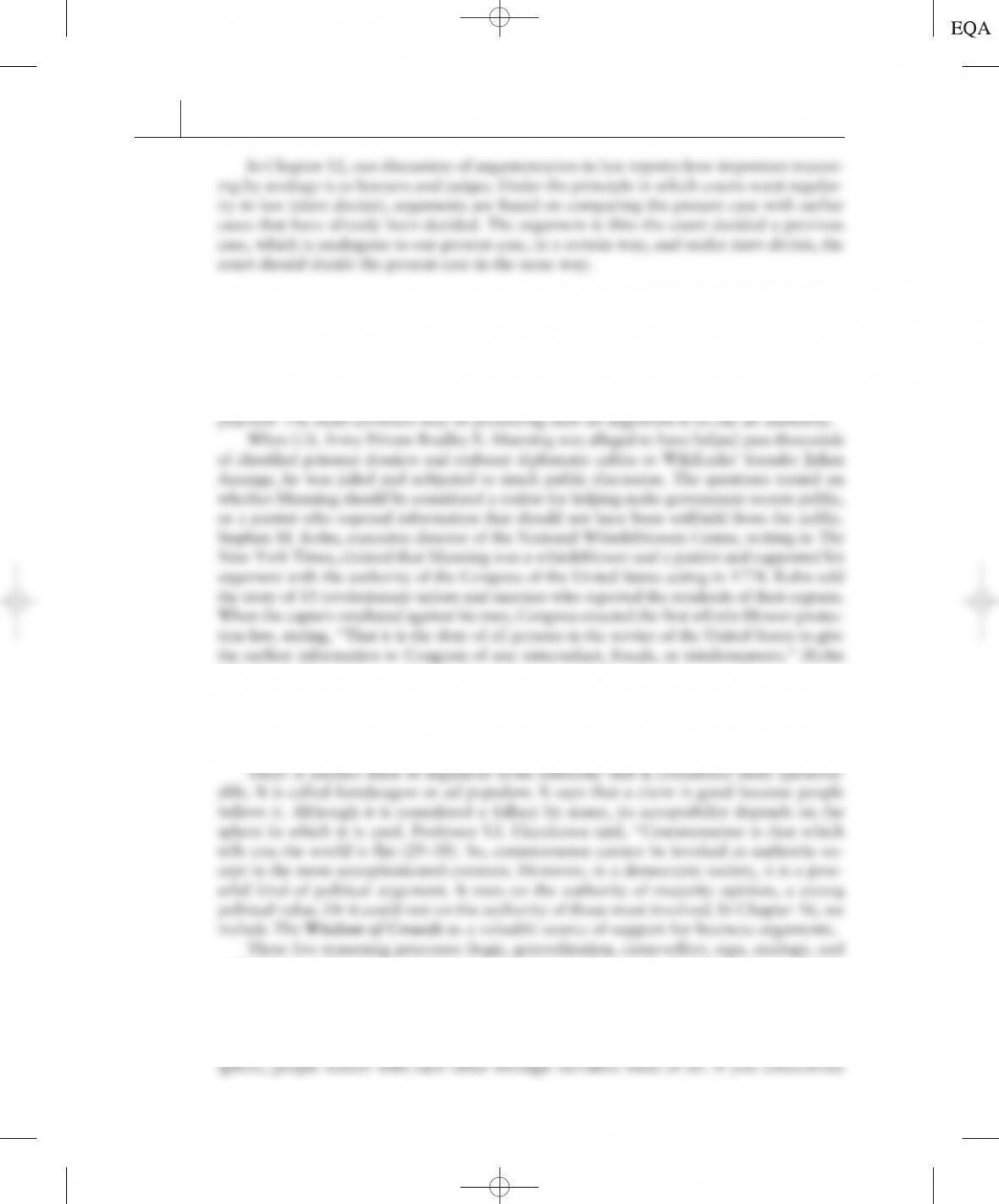
the credibility of others to argue a claim. In argument from authority , you argue that a
claim is justified because it is held by a credible person, ordinarily someone other than
A21). In the United States, the U.S. Congress is recognized as the ultimate authority concern-
ing the military, and the first Congress, sitting in 1778, consisted of the founding fathers and
other patriots who are regularly cited as the ultimate authorities on what it means to be a
patriot. Congress even directed Sam Adams to ensure that the lawyers who represented the
sailors and marines in the case were paid for their legal services (US$1,418).
authority) constitute the arguments you are most likely to find in your own argumen-
tation and that of most others, although there are special variations on these in some
spheres. For example, narratives or stories carry a heavy burden of communicating rea-
soning in many instances. In Chapter 12 , we discuss at length how legal argumentation
appears in narrative form at many points in the decision making process. In the personal
M04_RIEK0596_08_SE_C04.indd Page 64 17/01/12 2:01 PM user-f396M04_RIEK0596_08_SE_C04.indd Page 64 17/01/12 2:01 PM user-f396 F-396F-396
CHAPTER 4 The Nature of Arguments 65
on reasoning processes, diagram them to see their parts and the reasoning that holds them
DEFINITIONS AS ARGUMENT
In argument by definition , definitions serve to identify exactly what is being argued. Even
in situations of strong disagreement, disputants should try to agree on the subject of the
disagreement. Definitions are claims that must be supported by effective argumentation
because meanings are based on consensus. Value-laden terms such as love , knowledge ,
justice , or God clearly have no single precise definition. Neither do such apparently
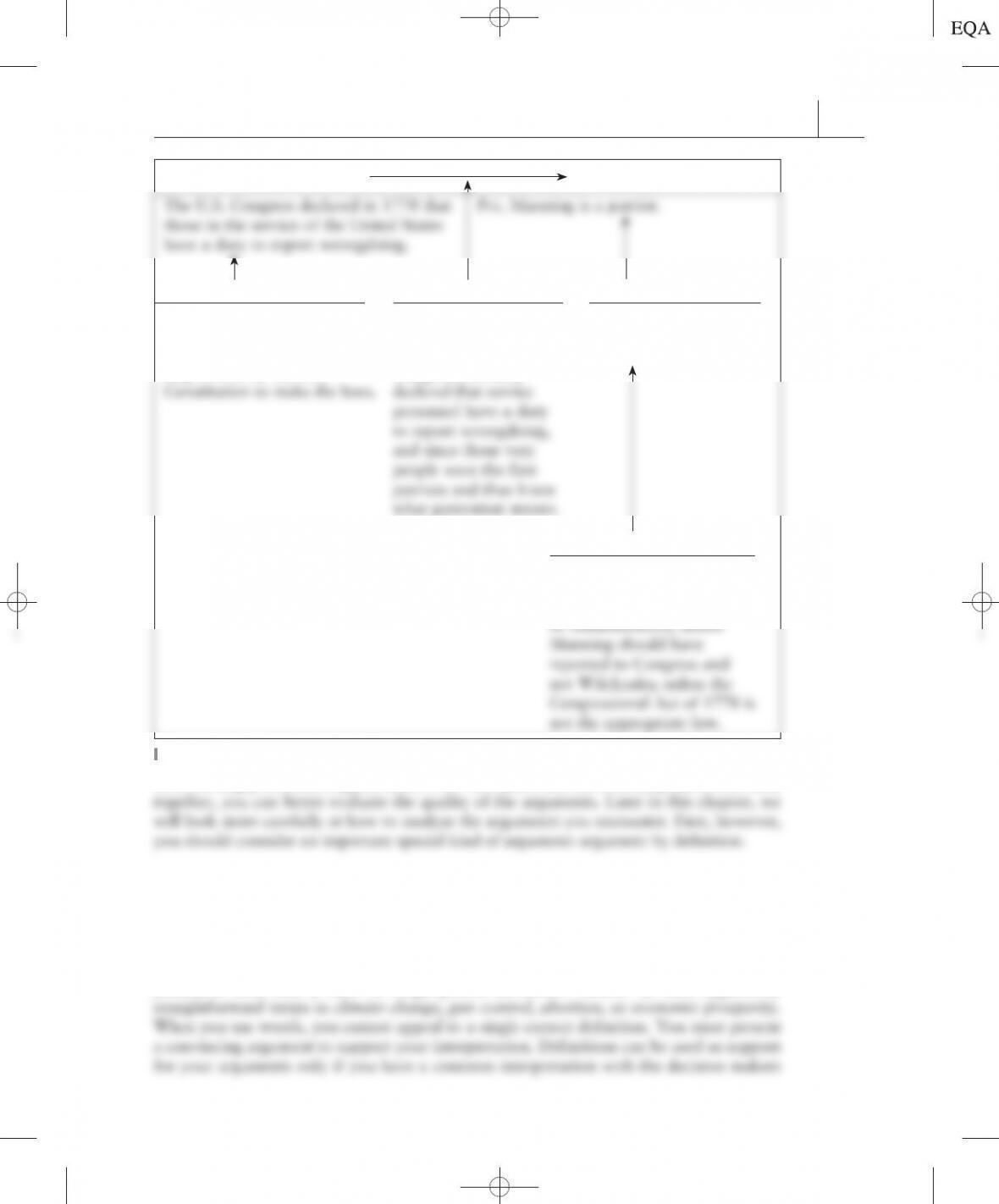
(Grounds) (Claim)
(Backing) (Warrant) (Qualifier)
The first Congress consisted Since the patriots of the Arguably, to the extent
of patriots of the American American Revolution, that the revolutionary
Revolution; Congress is acting as members of precedent applies.
empowered by the U.S. Congress, formally
(Rebuttal/Reservation)
Unless, the material given
to Wikileaks did not
concern misconduct, frauds,
FIGURE 4.12
M04_RIEK0596_08_SE_C04.indd Page 65 17/01/12 2:01 PM user-f396M04_RIEK0596_08_SE_C04.indd Page 65 17/01/12 2:01 PM user-f396 F-396F-396
66 PART 1 Principles
and hopefully with opponents as well. There are several common ways to build an argu-
ment in support of your definition, and we will discuss some of them.
Formal Definition
A formal definition involves the development of an enthymeme or a deductive logic-based
argument where a term is located within a general class for which there is a high probabil-
ity of a common audience interpretation, and then differentiating it from other aspects of
the class. The formal definition is usually the first one given in a dictionary.
Definition by Example
Just as examples (see Chapter 7 ) can serve to support an argument and are essential to ar-
gument by generalization, they can define an unknown idea. In definition by example, you
identify examples that decision makers are likely to know, and relate your concept to them.
Functional Definition
Sometimes a good way to make a convincing definition is to illustrate how a concept
functions.
Definition by Analogy
You can establish a clear meaning for a concept by using argument by analogy to show
how a term is like or unlike other familiar concepts. Remember, arguments by analogy
work by placing a concept under study alongside one on which there is agreement. If they
can be shown to have significant similarities, the unknown concept can take on meaning
from that which is already agreed on.
M04_RIEK0596_08_SE_C04.indd Page 66 17/01/12 2:01 PM user-f396M04_RIEK0596_08_SE_C04.indd Page 66 17/01/12 2:01 PM user-f396 F-396F-396
CHAPTER 4 The Nature of Arguments 67
Definitions by analogy resemble formal definitions, but they are subtly different. In
formal definitions, concepts are identified logically as part of a class. In definition by
analogy, concepts are explained by their similarity to a more familiar concept.
Definition by Authority
Arguments based on authority are common in definition. The most obvious authority is a
dictionary, which for many situations is all the authority you need. Resist being entrapped,
however, by a veneration of authority leading you to believe that the dictionary is the final or
only authority on word meanings. Often, it is the worst because dictionaries cannot possibly
be updated fast enough to keep up with the dynamics of language. However, they will give
you a general guide to three factors that will strengthen your argument in many situations.
Usage identifies how a word commonly appears in our communication, what people
particles quarks. Academics, adolescents, gangs, ethnic groups, musical groups, artists,
and others commonly create new words and can serve as the authorities on definitions.
Earlier, we used “democracy” to illustrate a formal definition. Now, we can point
to a current political debate over whether the United States is a democracy or a repub-
THE ANALYSIS OF ARGUMENTS
You can see from the examples we have discussed in explaining the types of arguments
that people do not organize their arguments exactly according to our model or any other
model. That is because arguments are aimed at decision makers who know things about
the subject, share values and credibility assumptions that the arguer need not mention,
and respond to language structures that change the order of the model in actual use.
68 PART 1 Principles
Characteristics of Arguments
Arguments are difficult to analyze, but if you recognize why that is the case, it will help
you to use the model more effectively. They are difficult because they usually have parts
missing, the order of the parts may vary, and they may overlap with one another.
Sometimes even claims are not stated. This is particularly true of argumentation that fol-
lows a strategy of telling stories. You could tell stories about people who defended themselves
from assault by having a weapon in their possession without ever stating the claim that people
should carry a weapon for self-protection. The claim is not stated but the decision maker
nical spheres typically prescribe the organizational structure of arguments.
Overlapping Arguments. Frequently, two or more arguments are developed in the same
paragraph because the arguer sees them as linked. An argument, reported in The New
York Times , claims that high school students use tranquilizers or prescription drugs for
recreational use more than heroin and cocaine combined. It then adds another claim that
M04_RIEK0596_08_SE_C04.indd Page 68 17/01/12 2:01 PM user-f396M04_RIEK0596_08_SE_C04.indd Page 68 17/01/12 2:01 PM user-f396 F-396F-396
CONCLUSION
Arguments appear in a wide variety of situations, and they differ in their nature from one
of one condition as a sign of another. Arguments may claim that one condition is analo-
gous to another, and they may be warranted by the credibility of an authority.
It is frequently necessary to develop an effective argument in support of a definitional
claim before using it as part of the larger argumentation. Definitions can be formal or
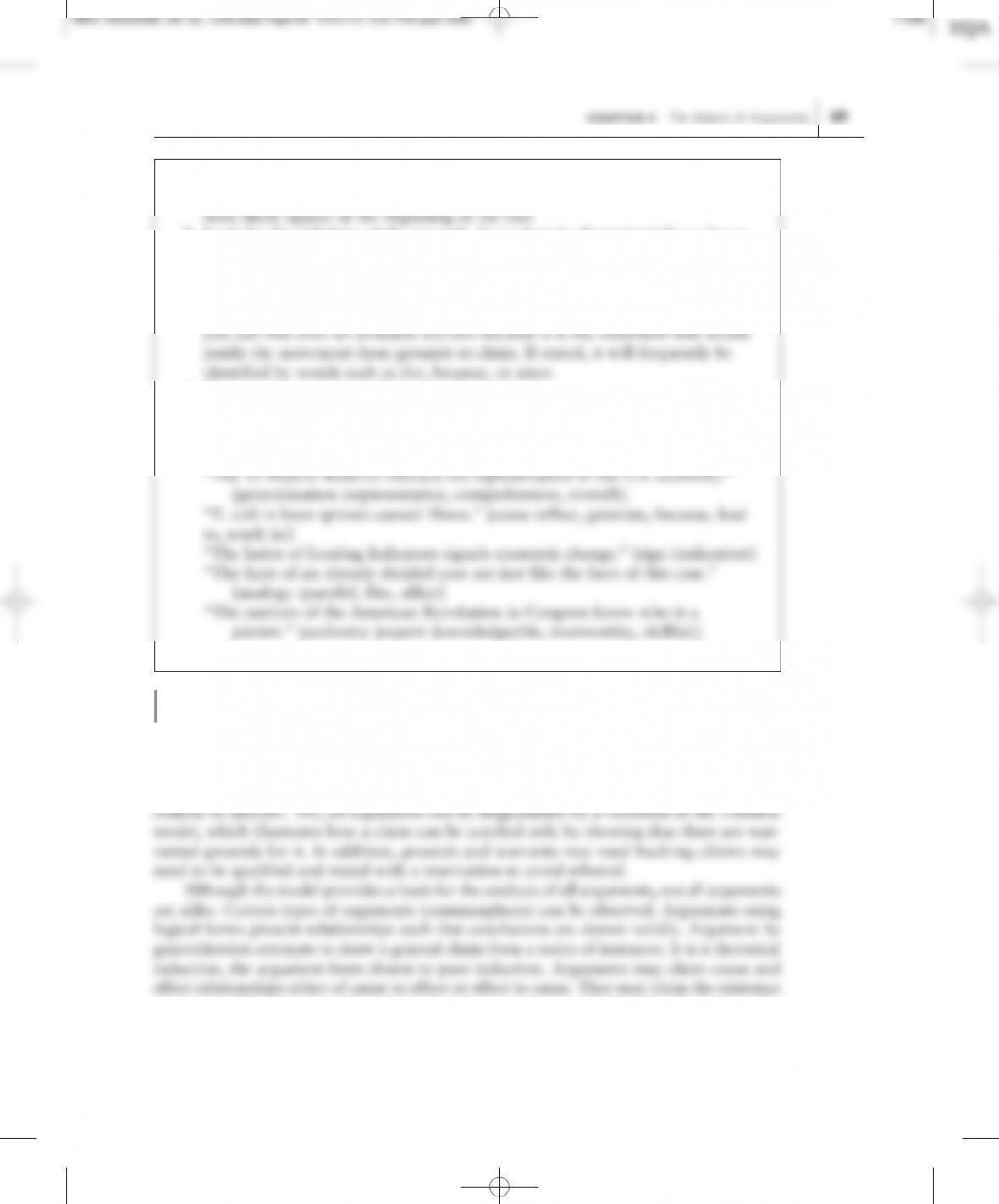
FIGURE 4.13
Guidelines for Analyzing Arguments
1. Discover and state the claim or claims. What is it the arguer wants you to
believe, value, or do? Claims may appear anywhere in the argument but they
2. Look for the subclaim of the grounds. It can best be determined if you know
the claim first and then ask yourself “On what basis am I supposed to give
adherence to the claim?”
3. Look for the warrant. Because it most frequently will be the part omitted, it
will be the most difficult to find. But if you know the claim and the grounds
4. Examine the warrant to determine the kind of argument you are analyzing.
Look back over the examples we have used and you will see it is the warrant
that identifies the kind of argument by identifying the commonplace (or
principle) behind it. Here are a few of the warrants we have used:
5. Look for backing (evidence, values, credibility).
70 PART 1 Principles
functional, by example, analogy, or authority. Definitions should be agreed to by decision
makers and, if possible, by opponents.
The Toulmin model is an analytical tool. People do not organize their arguments ac-
EXERCISES/PROJECTS
1. Bring to class one example of each of the types of arguments. Look for these in contemporary
2. Select an argument supporting a claim that you already agree with . Do an analysis of the argu-
M04_RIEK0596_08_SE_C04.indd Page 70 17/01/12 2:01 PM user-f396M04_RIEK0596_08_SE_C04.indd Page 70 17/01/12 2:01 PM user-f396 F-396F-396