
222
Argumentation
in Religion
14
CHAPTER
KEY TERMS
God, p. 223
revealed theology, p. 224
natural theology, p. 224
human beings, p. 225
moral behavior, p. 226
evil, p. 226
sin, p. 226
suffering, p. 227
salvation, p. 227
church, p. 228
sacred documents, p. 229
tradition, p. 232
experience, p. 232
revelation, p. 233
culture, p. 233
argument from authority, p. 234
argument by analogy, p. 236
narratives, p. 237
argument by sign, p. 238
paradox, p. 238
Religious argumentation is probably as old as human history, surely at least since
4000 BCE in the form of Chinese religions. Hinduism dates back to 2500 BCE
and Judaism to 2000 BCE (Patheos). Today, religious groups constitute a bewil-
dering variety of faiths that can be grouped into major religious categories.
tional religions (including Confucianism) have something under 400 million. Buddhism is
slightly under that number. The third largest group of the world’s peoples is the nonreli-
gious (secular/nonreligious/agnostic/atheist) something over 1.1 billion persons (Patheos).
M14_RIEK0596_08_SE_C14.indd Page 222 1/18/12 8:36 AM user-f501M14_RIEK0596_08_SE_C14.indd Page 222 1/18/12 8:36 AM user-f501 F-401F-401

CHAPTER 14 Argumentation in Religion 223
Each religion has a “unified system of beliefs and practices relative to sacred things . . .
which unify into one single moral community,” in the words of Emil Durkheim, and as
such leads to many subcategories of each major religious tradition. These in turn lead to
claims and counterclaims that one or another is not a religion but a vague philosophy of
life, is or is not Christian, or Muslim, or what have you. It also leads to a wide variety of
argumentative practices that make religion a unique sphere of argumentation.
Because we write primarily for people in western society, this chapter will be con-
cerned primarily with the religions in the Judeo-Christian-Islamic tradition. They consti-
tute something over 50% of the world’s population. These religions, George Kennedy has
observed, are all highly verbal religions (120). As such, they all have the primary ingre-
John Macquarrie has observed that religious language can include praying, bless-
ing, testimony, and nonverbal symbols such as crucifixes, paintings, music, and the
like. With the modern technological innovations, this can include all kinds of printed
and electronic messages: cartoons, movies, blogs, email, etc. To examine all of this for
religious information, one must be concerned about what Macquarrie calls “theological
language.” It is narrower; it “arises out of religious language as a whole, and it does so
when a religious faith becomes reflective and tries to give an account of itself in verbal
statements” (19).
Many discussions conducted in religious situations do not seem much different from
other public argumentation. Politicians speak at churches; Church leaders lead cam-
paigns for social justice or aid to the poor, but they are not speaking to theological is-
sues. In this chapter, we will investigate how religious argumentation is used to resolve
theological issues.
MAJOR QUESTIONS IN RELIGIOUS ARGUMENTATION
The existence of a wide variety of religious groups holding different interpretations is
evidence enough that religious questions abound. We will briefly identify seven questions
adapted from two lists (one developed by Harry Emerson Fosdick, another by Peter C.
Hodgson and Robert H. King) that constitute a fair summary of what has to be explained
for a system of theology to be complete. Not all religious argumentation will cover all
seven questions and other questions may arise, but these seven reasonably define religious
argumentation: (1) what is the nature of God ? (2) What is the nature of human beings?
(3) What is moral behavior, the religious life? (4) What are sin, evil, and the meaning of
suffering? (5) What is the human’s relationship to God? (6) What is the nature of salva-
tion? And (7) what is the role of the church?
M14_RIEK0596_08_SE_C14.indd Page 223 1/18/12 8:36 AM user-f501M14_RIEK0596_08_SE_C14.indd Page 223 1/18/12 8:36 AM user-f501 F-401F-401
224 PART 3 Applications
What Is the Nature of God?
2. Patterns of cause and effect are observed in the world; it is not possible to conceive of
a series of causes and effects without an initiating cause.
3. All things in the natural world are contingent on other things; nothing can be ob-
5. Since the natural world exhibits order and cause, there is design. A universe that ex-
hibits design must have a designer: God (Anderson, Natural Theology , 25–66).
These arguments are based on what Aquinas believed are universal natural principles;
(158). Probably those who engage in religious argumentation easily accept the existence
of God and the more difficult part of the question is the nature of God.
Many of the major religious traditions are based on polytheism, the existence of sev-
eral Gods; even gods who war with one another. Others, like Confucianism, have no
deities. The Hindu tradition sees a unity of all nature including humans with no special
creator God (Patheos). The religions of the Judeo-Christian-Islamic tradition, on the other
hand, are all monotheistic religions. They believe in one God. All accept the concept of
monotheism, but it still constitutes an area of argumentation.
In Islam, the defining claim is “There is no God but Allah and Muhammad is his mes-
senger.” The inscription on the Dome of the Rock in Jerusalem, from the Qur’an, says,
“Praise to God, who begets no son, and has no partner. He is God, one, eternal. He does
M14_RIEK0596_08_SE_C14.indd Page 224 1/18/12 8:36 AM user-f501M14_RIEK0596_08_SE_C14.indd Page 224 1/18/12 8:36 AM user-f501 F-401F-401
CHAPTER 14 Argumentation in Religion 225
but God is found in three persons. Other issues also come under the theme of the nature
of God. Does God intervene in human activity? Is God jealous, revengeful, or loving? Is
God a person, a spirit, a world force? Is Jesus God? Does God still reveal himself to hu-
mans? Is God found in nature?
What Is the Nature of Human Beings?
Some religious traditions, like Hinduism, have animals as equal to humans in the unity of
all nature. Among most arguers in the Judeo-Christian-Islamic tradition, there is a general
agreement that human beings are more than other animals, as is argued in the Holy Bible
Genesis 1:28: 1
Such a view has led some to argue that certain religions believe humans should exploit
other living things, whereas others argue that it means that humans are called on to ex-
ercise stewardship. However, it is interpreted, there is no doubt that human beings are
above all others, having been made in the image of God and given dominion (Genesis 1:26).
But do humans get this status from God? From nature? From the ability to reason? From
the possession of a soul? Thus, a persistent question in religious argumentation is about
the basic nature of the human being.
After the tragic crash of Egypt Air Flight 990 in November of 1999 in the waters off
Nantucket, relatives gathered at an interfaith memorial service for the 217 passengers who
had died. Ahmed El Hattab of the Islamic Society of North America asked the mourners
to submit to God’s will. “Lo, we belong to God,” he said, “and lo, we are returning. Let
us remember it is God who grants life, and it is he who takes us back” (Chivers).
Many members of other religions hold similar views. Some resolve the seeming incon-
sistency between free will and determinism by arguing that one has free will to accept the
religion but after that, one’s destiny is in the hands of God. Others argue that even the
decision to choose the religion was somehow predetermined. Still others believe God gives
people control over some parts of their lives but not over others.
The question about the nature of human beings also involves an issue of the ex-
tent to which humans are basically good or evil. “In Adam’s fall we sinned us all,” says
the Puritan New England Primer , thus expressing the concept of original sin, which sees
human beings as basically evil and unable to “save” themselves. In such a view, humans
can only be “saved” by God’s grace. Other people will reject such a view and see human
beings as basically good; capable of making moral choices; and sometimes led astray
M14_RIEK0596_08_SE_C14.indd Page 225 1/18/12 8:36 AM user-f501M14_RIEK0596_08_SE_C14.indd Page 225 1/18/12 8:36 AM user-f501 F-401F-401
226 PART 3 Applications
by evil forces (such as the Devil) but capable, with the support of God, of being good.
Obviously, many different modifications of these positions may be argued.
What Is Moral Behavior, the Religious Life?
Knowing what is right and wrong is related to a perception of the nature of human be-
ings. This question deals with such issues as how a person can know what is right. It may
even be asked; can a person know right and wrong?
283–284)
Others would argue that determining morality from a religious perspective is more com-
plicated and more tentative than this statement implies.
There are also specific issues of interpretation. An important example is in the inter-
pretation of the basic law, “You shall not kill” (Exodus 20:13). Is such a law an absolute
injunction against any form of killing? Animals? Fetuses? Criminals? Enemies in war?
What Are Sin, Evil, and the Meaning of Suffering?
One of the most complicated and perplexing questions in religious argumentation is the
nature of evil and the role of sin in the production of evil. Protestant theologian John
Hicks has argued that “the enigma of evil presents so massive and direct a threat to our
faith that we are bound to seek within the resources of Christian thought for ways, if not
of resolving it, at least rendering it bearable by the Christian conscience” (ix). Hicks calls
For many religions, evil is an expression of sin , which is a “disorientation at the very
center” of the human self (Hicks 300). Ryszard Kapuscinski notes that most African abo-
riginal religions have no concept of sin or evil. There are only evil actions that become evil
only when recognized and identified (294). Zen has no sense of suffering or evil (Patheos).
But for those in the Judeo-Christian-Islamic tradition, the question must be answered,
why has an infinitely good and loving God created sin in people and, therefore, evil in
the world? The various answers provided to this question take one into many other ques-
tions. Does God grant the individual free will, and, if so, to what extent? What is a sin?

CHAPTER 14 Argumentation in Religion 227
For instance, is homosexuality a sin or a natural representation of human diversity? This
is a growing question in the religious community today.
Suffering means different things to different people. For Buddhists, suffering is a nor-
mal part of life, so there is no problem of evil. In the Judeo-Christian-Islamic tradition,
some find the meaning of suffering in the claim that God punishes individuals or socie-
ties for their transgressions against divine laws. Certainly, that view can be seen in the
sermons and writings of New England Puritan leaders. By their view, sin is inherent in
human beings (“In Adam’s fall we sinned us all”). Or suffering may be a test that God
provides to strengthen one’s faith. Certainly, that is one meaning of the story of Job’s
What Is the Human’s Relationship to God?
“The meaning attributed to prayer,” said Harry Emerson Fosdick, “is one of the most reli-
able tests of any religion” (201). For some people, God is unapproachable. A person’s rela-
tion to God is simply that of giving praise and homage. One acknowledges God, attempts
to find out as much as possible about, and stands in awe of, the deity. For others, God is
very personal, and through prayer and other sacraments, a person can communicate with
God. Some claim they actually talk directly with a divine being as if they were carrying on
a conversation. For many people, such communication is an illusion. For others, such com-
munication marks a human being as a special person: a prophet, for instance.
Dietrich Bonhoeffer was a German Protestant theologian. While he was in a Nazi
prison in 1943, he wrote to his parents of a more socially oriented idea of the fellowship
of God and humans:
However, one looks at it, this relationship of human to God is a very special and impor-
tant relationship in any system of religious argumentation.
What Is the Nature of Salvation?
There are great differences of view about the question of immortality in the Judeo-
Christian-Islamic tradition. For some, it is the most important question in theology be-
cause salvation is the most important benefit one receives from belief, and its absence
may be the most horrible punishment. Others view this issue as less important or even
nonexistent. Like the followers of Confucius, they concentrate on the personal and so-
cial benefits of living a moral life on earth. In Hinduism, life is governed by the principle
of Samsara, or rebirth. An individual is reborn to a new life. He or she grasps for an
M14_RIEK0596_08_SE_C14.indd Page 227 1/18/12 8:36 AM user-f501M14_RIEK0596_08_SE_C14.indd Page 227 1/18/12 8:36 AM user-f501 F-401F-401
228 PART 3 Applications
understanding of self. When one stops grasping, individuals are absorbed into the ulti-
mate, what believers in Zen call Nirvana (Patheos).
Immortality can be seen as social, that is, the preservation of society. In such a view,
individuals live on in what they contribute to others or through their children. Reformed
What Is the Role of the Church?
In Islam, there is no church hierarchy. Religious leaders come from the people, and they
get their status from their ability to gain the adherence of others. Jews and most Protestant
Christians hold a similar view. Rabbis and ministers are chosen and dismissed by the con-
gregation. The church , when it can be called such, is either an individual congregation or
a loose confederation of individual congregations. The American Baptist Convention, for
instance, is such a confederation that takes theological positions, but they are not neces-
sarily binding on individual congregations. Individuals or congregations that disagree
may drop out and be unaffiliated or join another confederation such as the Southern
Baptist Convention or the General Association of Regular Baptists. A similar relationship
exists between an individual and a congregation.
Other churches have varying degrees of control over the religious claims their mem-
bers may hold and still be regarded as members. The stricter the church control, the more
likely it may be subjected to the rebuttal that it denies the fellowship of humans with God.
The more individualistic the theology, the more it is subject to the rebuttal that it has no
Values and Themes
The themes of religious argumentation are contained in the answers to the questions
posed at the beginning of this section. Each person or group develops a series of linked
CHAPTER 14 Argumentation in Religion 229
themes that define their theology. Embedded in these themes are the values that warrant
the theological claims. Every arguer does not use all of these values. We have already
noted, for instance, that Islam has a restricted concept of a church hierarchy, that some
Christians reject the idea of a sinful human, and that Judaism has a restricted concept of
immortality. Furthermore, the values that warrant a religion are not limited to the values
contained in this limited discussion of themes. Yet, our discussion has revealed a signifi-
EVIDENCE IN RELIGIOUS ARGUMENTATION
At least in the religions of the Judeo-Christian-Islamic tradition, religious claims usually
are grounded in a text, the Torah, the Bible, and the Qur’an being the most obvious ex-
amples. But the interpretation of these texts is based on interpreting them in the light of
Text as Evidence
Robert Grant observes of Christian theology, “the interpretation of scripture is the prin-
cipal bond between the ongoing life and thought of the Church and the documents which
contain its earliest traditions” (9). This explains the desire among religious writers to find
the most accurate, trustworthy, and best interpreted texts.
Accuracy. The importance of sacred documents as evidence accounts for the significant
arguments over the accuracy of translation. When the Revised Standard Version of the
Bible was first published, it produced considerable controversy. Some argued that it de-
stroyed the essential beauty of the King James Version. More important for our purposes
here, its translation of certain passages involved changes in wording with far-reaching
implications for Christianity. For instance, in Isaiah 7:14, which many Christians con-
sider a prophecy of Jesus’ birth, the King James version says “a virgin shall conceive,” the
Revised Standard version says “a young woman.” The New English Bible, unlike either
the Revised Standard Edition of the Bible or the King James version, even uses the term
girl for virgin in Luke 1:27 in describing Mary, the mother of Jesus. These differences
among three versions clearly lead to sharp differences in religious argumentation about
the miracle of virgin birth.
In recent years, an organization of Catholic and Protestant biblical scholars known
as the Jesus Seminar has undertaken to provide a new translation of the synoptic gospels
(Matthew, Mark, and Luke) and to determine the relative legitimacy of words attributed
to Jesus. In this translation, they employed “colloquialisms in English for colloquialisms
M14_RIEK0596_08_SE_C14.indd Page 229 1/18/12 8:36 AM user-f501M14_RIEK0596_08_SE_C14.indd Page 229 1/18/12 8:36 AM user-f501 F-401F-401

230 PART 3 Applications
in Greek. When the leper comes up to Jesus and says, ‘If you want to you can make me
clean,’ Jesus replies, ‘Okay—you’re clean!’” instead of “I will; be clean” (Mark 1:40–41).
Needless to say, this use of colloquialisms is only one practice that makes their work con-
troversial (Funk et al. xiii).
Trustworthiness. Even when wording is agreed on, there can still be argumentation
about texts. It has to do with the issue, what is the “canon”? What part of the text is ac-
ceptable as “sacred” evidence? Certain books are left out by some scholars and councils
and included by others. Even some books that are included in the canon are regarded as
less reliable. Books of doubtful authorship or authenticity are excluded from both the
However, for most Christians, statements have more authority if they are actually
identified as the word of God. In the fourth chapter of Joshua, there is a “narration of
what God has done in Jewish history, put in the mouth of God himself and therefore
given heightened authority.” God’s words are followed by Joshua’s charge to the people,
which is of less authority because it is an interpretation of the meaning of God’s words
(Kennedy 124).
In Islam, a similar distinction is made between the Qur’an, which is the revelation
given to Muhammad by Allah, and the Hadith (Sayings). The Hadith reports the actions
and utterances of the Prophet and, therefore, has less authority than the revealed text
(Lewis, Islam and . . . 25). To add to the importance of the text of the Qur’an, it is un-
translatable from the Arabic according to most of Islam.
Interpretation. After one knows, even in a general way, what texts are most accurate
and which parts are to be taken more seriously, there is a further problem of interpreta-
tion. How does one know what interpretation is justified?
The first deliberate attempt to systematize a method of interpretation was probably
the seven rules of the Rabbi Hillel at about the time of the birth of Jesus (Farrar 18). From
the earliest times of the Christian church, this problem of interpretation was important.
Paul argued from texts in his letter to the Galatians (4:21–23):
Tell me now, you who desire to be under law, do you not hear the law? For it is written that
Abraham had two sons, one by a slave and the other by a free woman. But the son of the slave
was born according to the flesh, the son of the free-woman’s through promise. Now this is an
allegory: These women are two covenants. (Galatians 4:21–23)
The Jewish scholar Philo of Alexandria observed in the first century ce that there were
different ways to explain the meaning of a text. A century later, Clement of Alexandria
was probably the first Christian to attempt to systematically explain the method of arguing
M14_RIEK0596_08_SE_C14.indd Page 230 1/18/12 8:36 AM user-f501M14_RIEK0596_08_SE_C14.indd Page 230 1/18/12 8:36 AM user-f501 F-401F-401
1. Historical meaning: One uses a biblical story to inform oneself about history.
3. Prophetic meaning: Specific prophesies are made, as when Daniel prophesied, “the
God of Heaven will set up a kingdom which shall never be destroyed” (Daniel 2:44).
4. Philosophical meaning: Specific events or things are interpreted as symbolizing a
5. Mystical meaning: Specific events or things are taken to mean something quite dif-
ferent from what they would literally mean to the novice. In this way, Lot’s wife is
seen to symbolize an attachment to earthly things that causes blindness to God’s truth
(Grant 80).
These textual meanings are arranged in an order from the most literal to the most
metaphorical. For some scholars, as religious argumentation moves down the list from the
most to the least literal, it becomes more questionable as evidence. A theology grounded
in historical and doctrinal meanings is the easiest to defend. Yet, such a theology would
face the refutation that it weakens the authority of the text by ignoring its most meaning-
ful interpretation.
John Leith has argued that interpretation can only be made in terms of some organizing
principle. “When a theologian seeks to work out his [or her] theology under the canon of
scripture, he [or she] agrees to find warrant for theological assertion in the broad base of
This repetition establishes a pattern to give more force to the evidence that Peter denied
Jesus. In addition, a new piece of evidence is introduced that creates a tension and a fuller
meaning:
And immediately the cock crowed a second time. And Peter remembered how Jesus had said
to him, “Before the cock crows twice you will deny me three times.” And he broke down
and wept.
It is in the identification of patterns and tensions and the interaction among them that a
particular text can be seen as a unified piece of evidence. Thus, whatever the emphasis of
the theologian on each of the five kinds of meaning, that emphasis will be governed by
some organizing principle.
M14_RIEK0596_08_SE_C14.indd Page 231 1/18/12 8:36 AM user-f501M14_RIEK0596_08_SE_C14.indd Page 231 1/18/12 8:36 AM user-f501 F-401F-401

232 PART 3 Applications
Text, then, is the most important source of evidence in religious argumentation. Its
accuracy, trustworthiness, and method of interpretation can be issues. In addition, text
is subject to adaptation, increasingly so in modern times by tradition, experience, revela-
tion, and culture.
Tradition as Evidence
In long-standing religious organizations—the Roman Catholic Church, for instance—
tradition is an important source of evidence. Over the centuries, certain interpretations
have been accepted and others rejected. A body of interpretations constitutes a tradition
by which new interpretations must be judged. Some Protestant theologians have argued
against interpreting by tradition. Each argument, they say, must return to original texts.
Even the Christian theologian who rejects this argument because the Bible was in-
spired by God and is, therefore, a literal statement of the Christian faith has to meet
another argument: that theologians are a product of their environment. Even when they
attempt to go back to the original text, they are unable to erase all traditional knowl-
edge from their minds. The Hindu tradition admits that its many sacred writings, like the
Veda, Upanishad, and Bhagavad-Gita epics, are an evolving tradition that has changed
and adapted other views over the years.
All of these arguments about tradition point to a general issue. Most theologians
agree that tradition plays some part in argumentative evidence. The issue among them is,
how much?
Experience as Evidence
A principle of interpretation closely related to tradition is experience. It is also a source
of considerable controversy. The argument for experience is that because the text does
not speak to one generation but to every generation, it must be interpreted by succeeding
generations on the basis of experience. In finding the meanings of texts for contemporary
times, one asks not what they meant historically but what they mean today.
Thus, the religious experiences of the individual, such as answered or unanswered
prayer, or the spiritual understanding in a congregation or community, or even secu-
lar knowledge, may become evidence in a religious argument. Experience is the basis on
M14_RIEK0596_08_SE_C14.indd Page 232 1/18/12 8:36 AM user-f501M14_RIEK0596_08_SE_C14.indd Page 232 1/18/12 8:36 AM user-f501 F-401F-401

CHAPTER 14 Argumentation in Religion 233
If religion is applicable to people’s lives, as believers contend, then its principles ought
to be observable there. Many are quite suspicious of experience, however, because of the
danger that one may respond to secular experience that leads away from religious inter-
pretation.
Revelation as Evidence
Revelation involves a special kind of experience when the individual is presumed to have
faith to aid in understanding a text. Augustine argued, and many Christians agree with
him, that God deliberately made the meaning of scripture obscure so that it could be
understood only by someone who had faith (Kennedy 132). Others do not go so far, but
all religious argumentation contains in it the idea that one who has faith is a better inter-
preter of the text than one who does not. The idea is expressed for Christians in Hebrews
10:1 and 11:1:
Some religious groups, such as the Roman Catholic Church and the Church of Jesus
Christ of Latter Day Saints, are led by individuals believed by their followers to have a
special ability to produce revelations not necessarily connected to scripture. Many re-
ligious people believe that even ordinary individuals have revelations by faith. In most
cases, faith clarifies text. A major thesis of the reform tradition in Protestant theology is
that the Holy Spirit enables one to make a correct interpretation.
Culture as Evidence
Judaism and Christianity reflect a historical culture in the sense that they see the entire
cosmic process as the temporal unfolding of a divine plan with a beginning, a series of
crucial events, and an end. Judaism, however, is the more historical religion. And Islam is
a more legalistic religion in which the law is defined by the Qur’an, which was written at
one time by one person. It is less historical, though it is related to the Arab culture from
which it comes.
Although Christianity has a history both before and after the life of Jesus, it is so
dominated by that life that it has an ahistorical character to it. But even a person such as
Martin Luther, who believed that “Christ is the point in the circle from which the whole
circle is drawn,” said that historical understanding is most important in giving meaning to
Chapter 11 of the Letter to the Hebrews, quoted previously, argues for faith but does
so by linking it to a long series of events in Jewish history.
234 PART 3 Applications
The Letter to the Hebrews is an argument probably aimed at anyone who might drop by
the wayside, but it uses the Old Testament to amplify its argument from ancient text, and
these ancient texts refer to events in Jewish history. That is why it came later to be called
Islam provided rules for the proper treatment of slaves, women, Jews, Christians, and
others of lesser social rank. As such, these rules were a liberalization of previous practices.
However, those rules still accepted slavery, plural marriage, concubinage, and second-class
citizenship for nonbelievers. Similar situations have existed in Judaism and Christianity.
Christian acceptance of slavery, even in the original Constitution of the United States, is
Thus, evidence in religious argumentation is traditionally from texts. But it is neces-
sary to discover which texts are most accurate, and of the accurate texts, which are most
trustworthy. Those texts must be interpreted for meaning and they must be defined as evi-
dence by some organizing principle. Such texts are influenced by evidence from tradition,
experience, revelation, and culture. In some cases, particularly in modern times, these four
in combination or alone may function as evidence without text.
PREFERRED ARGUMENT FORMS
The evidence developed from texts, traditions, experience, revelation, and culture form
the grounds and warrants from which one makes arguments for a claim. At this point,
Argument from Authority
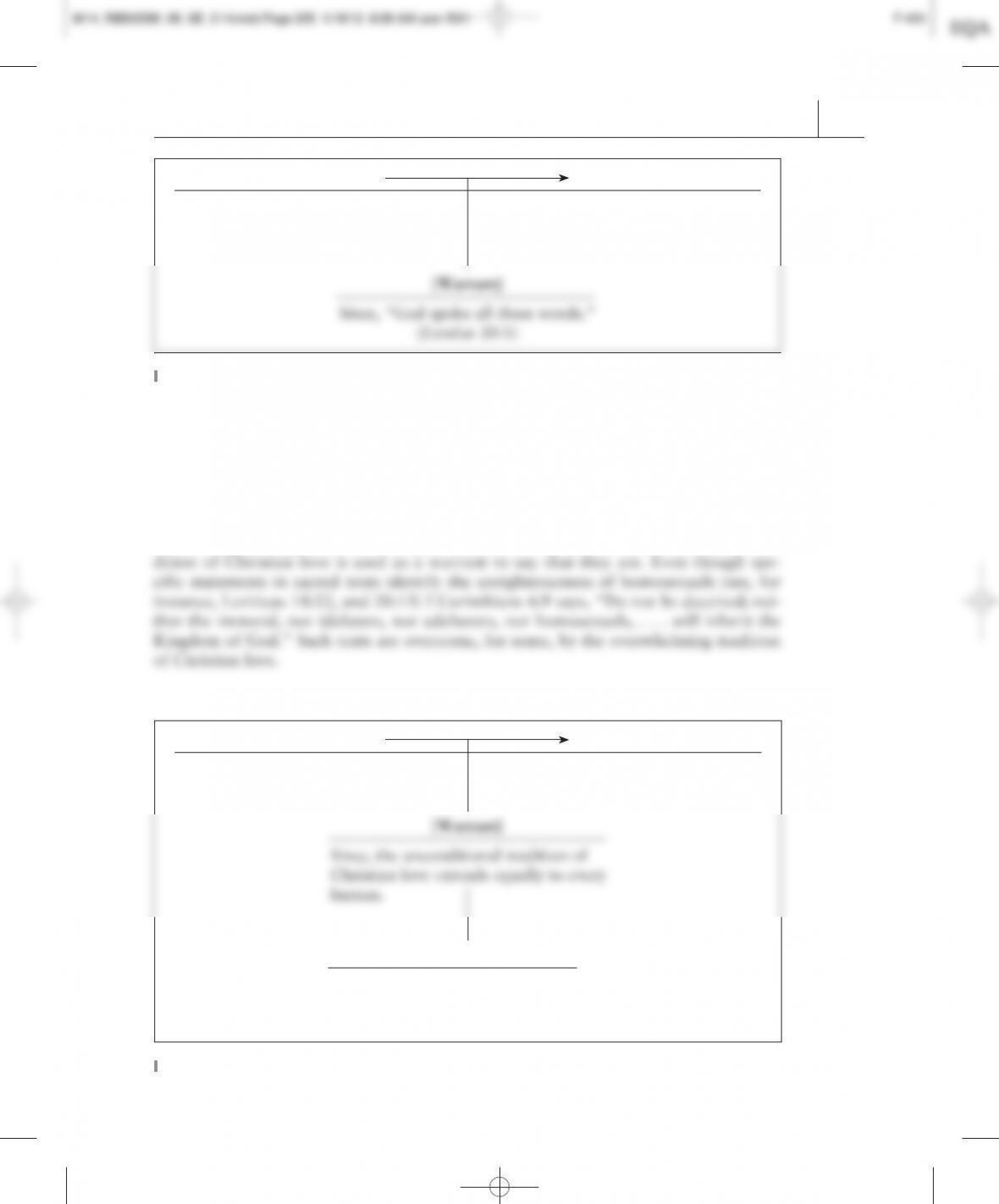
Traditionally, the primary form in which religious arguments are found is argument from
authority . God, texts, and special humans serve as a universal principle, authority, that
warrants the argument and justifies the claim:
M14_RIEK0596_08_SE_C14.indd Page 234 1/18/12 8:36 AM user-f501M14_RIEK0596_08_SE_C14.indd Page 234 1/18/12 8:36 AM user-f501 F-401F-401
CHAPTER 14 Argumentation in Religion 235
This argument from the Ten Commandments is particularly powerful because
it is warranted directly by God. Similar arguments, that are not direct statements of
God’s words, are warranted by the authority of the text itself, an apostle, or a prophet.
Tradition, experience, revelation, and culture can also warrant an argument from au-
thority. For instance, in the current debate over whether LGBT (Lesbian, Gay, Bisexual,
and Transgender) persons can be equal members, or leaders, in Christianity, the tra-
FIGURE 14.1
[Grounds] [Claim]
“You shall not steal.” Therefore, I shouldn’t steal.
(Exodus 20:15)
FIGURE 14.2
[Grounds] (Claim)
LGBT individuals are human beings. LGBT persons are equal.
[Backing]
The life and teachings of Jesus
(See, for instance, Matthew 5:1-12
Matthew 25:41
236 PART 3 Applications
These are simple illustrations of argument from authority, a form that is used over
and over again in varying complexities of potential rebuttal and qualification. It is the
argumentation form that reflects most closely the purely logical form of the formal syl-
logism discussed in Chapter 4 .
Where the text is taken as authoritative, there is little need for verification.
Consequently, generalization from sense evidence, in order to prove the value of the
grounds or warrant, is less necessary than in some other kinds of argumentation. As we
have seen, interpretation is not a simple process but is influenced by tradition, experi-
Argument by Analogy
Throughout the Bible, there are indications of the importance of the parable, the analogy.
The Psalmist says, “I will open my mouth in a parable” (Psalms 78:1). Mark says that Jesus
spoke to the scribes and “said to them in a parable. . . .” Even the staunchest literalists do not
argue that there is no metaphor in the Bible. Although they argue for a literal interpretation
of the Bible, they do not argue, for instance, that when Jesus said, “You are the salt of the
earth” (Matthew 5:13) he meant that his disciples were literally made of salt, nor that the
parable of the prodigal son must be taken merely as a literal historical event. The very recog-
nition that it is a parable means that it reveals a principle that can tell a person how to behave
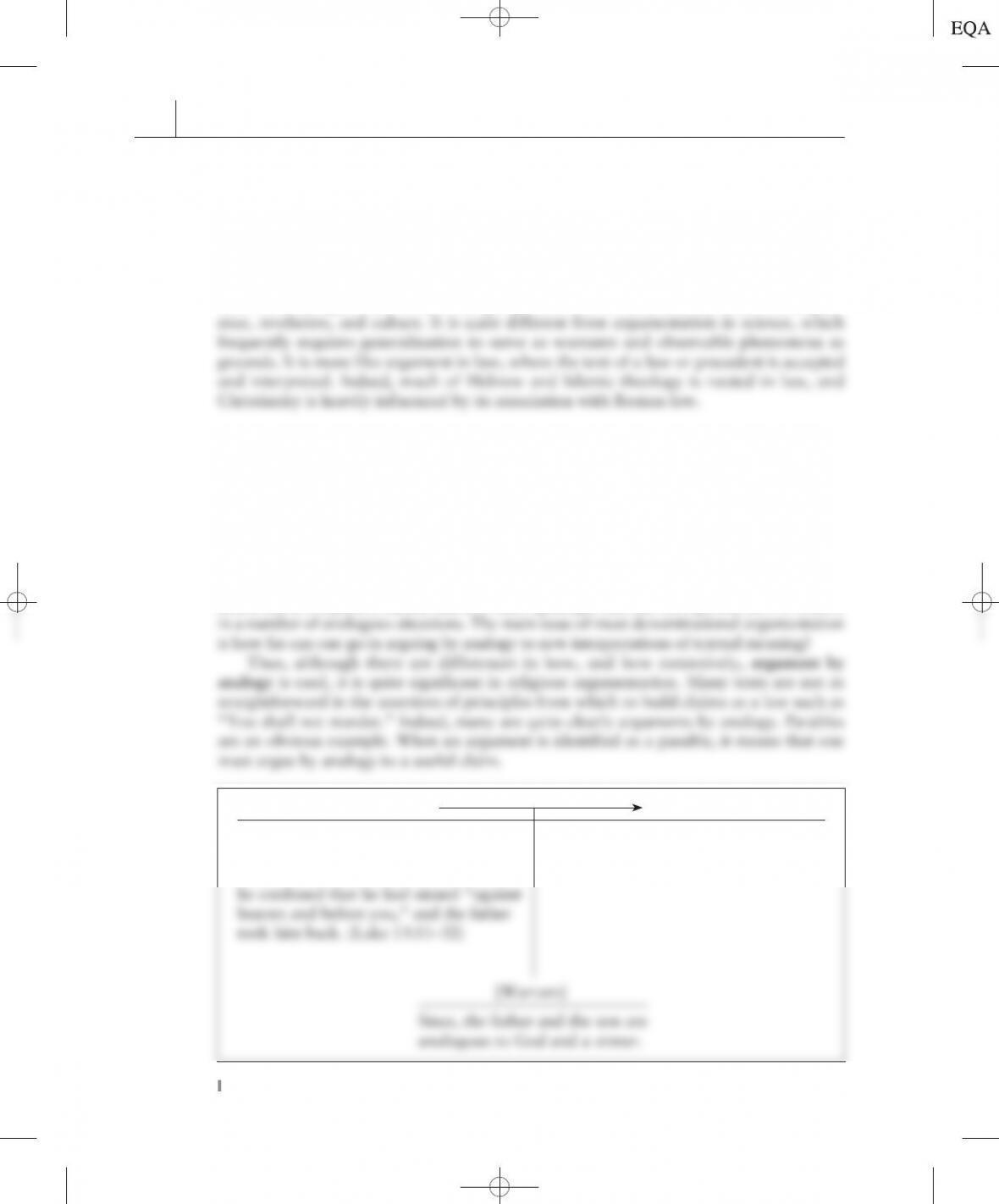
FIGURE 14.3
[Grounds] [Claim]
The Prodigal Son took his inheritance God will forgive a repentant sinner no
and squandered it in a foreign land. matter what the transgression.
When he returned to his father’s house
M14_RIEK0596_08_SE_C14.indd Page 236 1/18/12 8:36 AM user-f501M14_RIEK0596_08_SE_C14.indd Page 236 1/18/12 8:36 AM user-f501 F-401F-401
CHAPTER 14 Argumentation in Religion 237
The prodigal son analogy is supported by many specific references in the Bible to God
as Father. But in religious argumentation, many uses of analogy will reach far beyond
such an obvious example. It is here that disagreements about analogy will take place.
John Macquarrie puts the problem very well:
One solution is to return to the literal interpretation of texts. The early church father
Tertullian as well as Augustine and Aquinas argued that analogy functions appropriately
only when it has a final basis in the literal statements of text (Ayers 6). This relates to a
point made earlier that the text must be taken as a unified statement. That is, an analogy
is justified when it reflects a general understanding of meaning. The example given previ-
ously of the extensive use of “Father” for God in the text makes it easier for the prodigal
son analogy to gain adherence.
However a theologian feels about a particular argument by analogy, no theologian
would deny that analogy is a primary means of argumentation in religion. Paul’s statement
in 2 Corinthians 3:6, “The letter kills, but the spirit makes alive,” has been used to justify all
Argument by Narrative
In Judaism and Christianity, much of the sacred literature is in the form of stories. The
creation story, the story of Abraham, or the story of the Exodus from Egypt, when the
grounding principles of both Judaism and Christianity were established, comes to mind.
The story of Abraham is fundamental for Judaism, Christianity, and Islam. In the Qur’an,
God says, “Salam (peace) be upon Abraham” (37:09) He is an ancestor to Muhammad,
and to Jesus (John 8:33). The story of the life of Jesus, his followers, and his opponents
is the central explanation of Christianity. Narratives of the Torah and the Bible can be
interpreted as one of the traditional forms of argument. Earlier, we identified the story of
Moses and the Ten Commandments as arguments from authority, and the parable of the
prodigal son as argument by analogy.
However, there are times when interpreting a narrative as a single claim is seen to
weaken and oversimplify the argument. In such a case, the theologian will see a story not
as a piece of evidence to prove a claim but as a complex development of a theme. The
Gospels of Matthew, Mark, Luke, and John tell the story of Jesus’ life. But that life, for
the believers, cannot be summed up in one claim or even a series of related claims. For
them, the narrative brings to its receivers a combination of personal experience, culture,
and revelation. It is more than a literal story told. It is a narrative that links to the indi-
vidual and community through a theme with a deep personal meaning.
M14_RIEK0596_08_SE_C14.indd Page 237 1/18/12 8:36 AM user-f501M14_RIEK0596_08_SE_C14.indd Page 237 1/18/12 8:36 AM user-f501 F-401F-401

238 PART 3 Applications
Theologian Sallie McFague TeSelle notes that the parable of the prodigal son devel-
ops the theme of divine love (although never mentioned in the story) “through stretching
the surface of the story with an extreme imagery of hunger and feasting, rejection and
acceptance, lost and found, death and life” (13). The oppositions created in this narrative
develop the theme of divine love.
In some religious organizations, personal narrative is a central element in the religion.
Such is the case with the Church of Jesus Christ of Latter Day Saints. At testimony meet-
ings about once a month, members “bear testimony” (tell their stories) to elaborate the
theme of the “truth of the gospel.” Such a way of seeing a story permits a believer to use
a narrative to reinforce the larger story of the religion. The believer looks to a personal
Argument by Sign
Closely related to argument by analogy is argument by sign . It is common to view one
event as a sign of another. Miracles are taken as signs of the existence of God. It is argued
that when Jesus fed the multitudes or raised a girl from the dead, it was a sign that he was
God because only God could do these things. Sign argument has its problems in determin-
ing what sign is valid. We observed in discussing experience as a factor affecting interpre-
tation that many argue that religion should be applicable in people’s lives and, thus, the
principles should be observable in experience. But many signs used in popular argument
would be difficult for theologians to accept. Particularly subject to skepticism is the sign
argument that gets away from text. A common argument that God supports his chosen
Argument by Paradox
Paradox is a special kind of argument that is closely related to analogy. It is a special type
of religious argument that is not mentioned in Chapter 4 (“The Nature of Arguments”)
because it is seldom found in other spheres of argumentation. But it is a characteristic
of, particularly Jewish, religious argumentation. James Barr argues that there has always
been a unity in Hebrew scriptures. But, he says, Christian scholars have difficulty see-
ing the unity because of the failure of western educated people to “perceive the unitary
though paradoxical Hebraic mind” (9).
In Hebrew culture, reasoning is a process of considering alternate views of the same
phenomenon. Even God is not knowable in a strictly literal sense. David Frank points out
that “unlike the arguments in many western texts, those in the Hebrew Bible are often
indeterminate, confused and can yield a host of reasonable but incompatible interpreta-
tions” (73). Abraham, Moses, and Job all argue with God, and God changes in response
M14_RIEK0596_08_SE_C14.indd Page 238 1/18/12 8:36 AM user-f501M14_RIEK0596_08_SE_C14.indd Page 238 1/18/12 8:36 AM user-f501 F-401F-401
CHAPTER 14 Argumentation in Religion 239
to their arguments that are warranted in God’s values. Thus, divergent interpretations of
God’s words are acceptable, and paradox is a reasonable argument. Paradox comes into
Christianity naturally from its Hebrew scriptural and cultural roots.
Paradox is also found in Islam. Most particularly, it has been observed by the accept-
ance of free will and determinism together. The Qur’an says that it is the best scripture
without inconsistencies (39:23). It is written in Arabic a language that is free of faults
A paradox is a riddle. The Hebrew psalmist (78:2) says, “I will open my mouth in a
parable; I will utter dark sayings from of old.” The Hebrew word that is translated “dark
sayings” is also commonly translated as “riddle.” “A riddle is a dark or obscure saying
because it gives a deliberately obscure and puzzling description of something, a descrip-
tion which at first sight may well seem nonsensical but is not nonsensical when one hits
upon the correct solution” (Macquarrie 29). In short, paradox is used to force a new way
of thinking that makes the contradictory noncontradictory.
In a way, all analogy is paradoxical. Because argument by analogy compares un-
like things, it is possible to have conflicting and, therefore, contradictory meanings.
Furthermore, because religious argumentation starts from the interpretation of texts, sev-
eral analogies when taken together can provide a paradox. The New Testament gives a
number of images of Christ—“Son of man,” “Son of God,” “Messiah,” “Lord,” “Word.”
“It is impossible,” says Macquarrie, “to ‘harmonize’ all these ideas, but from them some-
thing of the mystery of the incarnation finds expression” (228).
How does one solve the “riddle”? How is sense found in this nonsense, the paradox?
By looking at the paradoxical argument in its context, as a part of the complete argumen-
tative process, it can be done. We noted previously that the seemingly contradictory state-
ments describing Christ come together to describe the mystery of something beyond lan-
Argument by Generalization
Because most of the grounds espoused in religious argumentation are given by the text
and claims are reasoned from them by authority, analogy, narrative, sign, or paradox,
generalization is rarely used. Unlike scientific argumentation, that searches through spe-
cific details to find rules or laws which will predict the nature of any other case of the
M14_RIEK0596_08_SE_C14.indd Page 239 1/18/12 8:36 AM user-f501M14_RIEK0596_08_SE_C14.indd Page 239 1/18/12 8:36 AM user-f501 F-401F-401
240 PART 3 Applications
same kind, religious argumentation has its warrants given and reasons mostly to find spe-
cific application. The most significant exception to this rule is the idea of unity mentioned
earlier. It is essential that a religious argument not be in conflict with the text taken as a
whole . Taking the text as a whole is, in a sense, a crude form of argumentation by gener-
alization, for one argues that all the events in the text lead to a general principle.
But Thomas Olbricht has observed that most religious arguments, which look at first
glance like generalizations, are not this at all. He found that, in his homilies, Basil the Great
used the text as a source of beginning points for arguments and reasoned about specific claims
by general principle. The many statements taken from the text are not for proof but for ampli-
fication . Olbricht cites an example from Pope Innocent III to show this amplification:
Just as the sea is always stormy and turbulent, so the world remains always in storm and stress;
nowhere is there peace and security, never is there rest and quietness, but everywhere toil and
trouble. “For the whole world is seated in wickedness” (1 John 5:19). “Laughter shall be min-
gled with sorrow, and mourning taketh hold of the end of joy” (Prov. 14:13). With reason,
In a sense, this is argument by generalization, but some of the statements seem to
have little to do with the main claim. So, says Olbricht, it is more like amplification of
a claim already accepted than support for a generalization that is being argued. Early in
the formation of a religion, argument by generalization may be necessary, but after its
establishment it is not. It may even be considered foolish because why should one argue a
principle that is already accepted?
Generalization by statistics is especially open to question. T. Dewitt Talmadge, an
orthodox preacher of the late nineteenth century, used an argument from statistics to re-
fute Robert G. Ingersoll’s popular arguments for agnosticism. In his sermon, “Victory for
God,” he cited the increasing number of Christians in each century, the number of New
The issue created by the clash of some conservative Christians and evolution scientists
illustrates this difference (see pp. 138 – 139 in Chapter 8 for a discussion of conflicting
values). For such Christians, God created the universe and all in it (Genesis 1). For most
scientists, “random mutation and natural selection” is the basis of creation. There is a
There are, in summary, five and occasionally six forms of argument used in religious
argumentation. Argument from authority, argument by analogy, and argument by nar-
M14_RIEK0596_08_SE_C14.indd Page 240 1/18/12 8:36 AM user-f501M14_RIEK0596_08_SE_C14.indd Page 240 1/18/12 8:36 AM user-f501 F-401F-401
CHAPTER 14 Argumentation in Religion 241
CONCLUSION
Something like 85% of the world’s adult population identify with some religion. The
largest are Christianity, Islam, Hinduism, Chinese religion (including Confucianism), and
Buddhism. Religious argumentation is among the oldest spheres known to humans. The
Judeo-Christian-Islamic tradition (the emphasis of this chapter) operates from an elabo-
rate system of texts and other evidence to ground specialized theological arguments.
Theological argumentation is found in seven major questions. The explanation of
most, if not all, of them will usually define a complete theology: (1) What is the nature
of God? (2) What is the nature of human beings? (3) What is moral behavior, the reli-
gious life? (4) What are sin, evil, and the meaning of suffering? (5) What is the human’s
relationship to God? (6) What is the nature of salvation? And (7) what is the role of the
church? The themes that arguers develop in answering these questions will identify the
strongest values and serve as warrants for religious argumentation. These include God,
EXERCISES/PROJECTS
1. Choose a short text that is important to your religion or to your nonreligious beliefs. Explain
what it means to you. Evaluate your own answer. On what bases did you make your interpreta-
tion? Is it based on the principles discussed in this chapter? What different bases did you find?
3. With a small group of classmates, conduct a group discussion on one of the major themes of
religious argumentation? Can you come to an agreement on what that theme means? How do
you differ? How are your agreements or disagreements a product of your religious or nonreli-
gious position?
4. In that discussion or a subsequent one, note what kinds of arguments you use. Are you arguing
in the religious sphere or some other?