
TERMINOLOGY AND DEFINITIONS
FOR EVALUATING RADIO RATINGS

AVERAGE QUARTER-HOUR
PERSONS
“AQH PERSONS”
•The average number of persons listening
to a particular station for at least five
minutes during a 15-minute period.

AVERAGE QUARTER HOUR
RATING “AQH RATING”
•The Average Quarter-Hour Persons estimate expressed as a
percentage of the population being measured. This estimate
CUME PERSONS
•The total number of different persons

CUME RATING
•The Cume Persons audience expressed as a percentage of all
persons estimated to be in the specified demographic group.

EXCLUSIVE CUME
•The number of different persons who listen to
only one station during the daypart reported.

RATING “AQH OR CUME”
•The audience expressed as a percentage of the total
population.
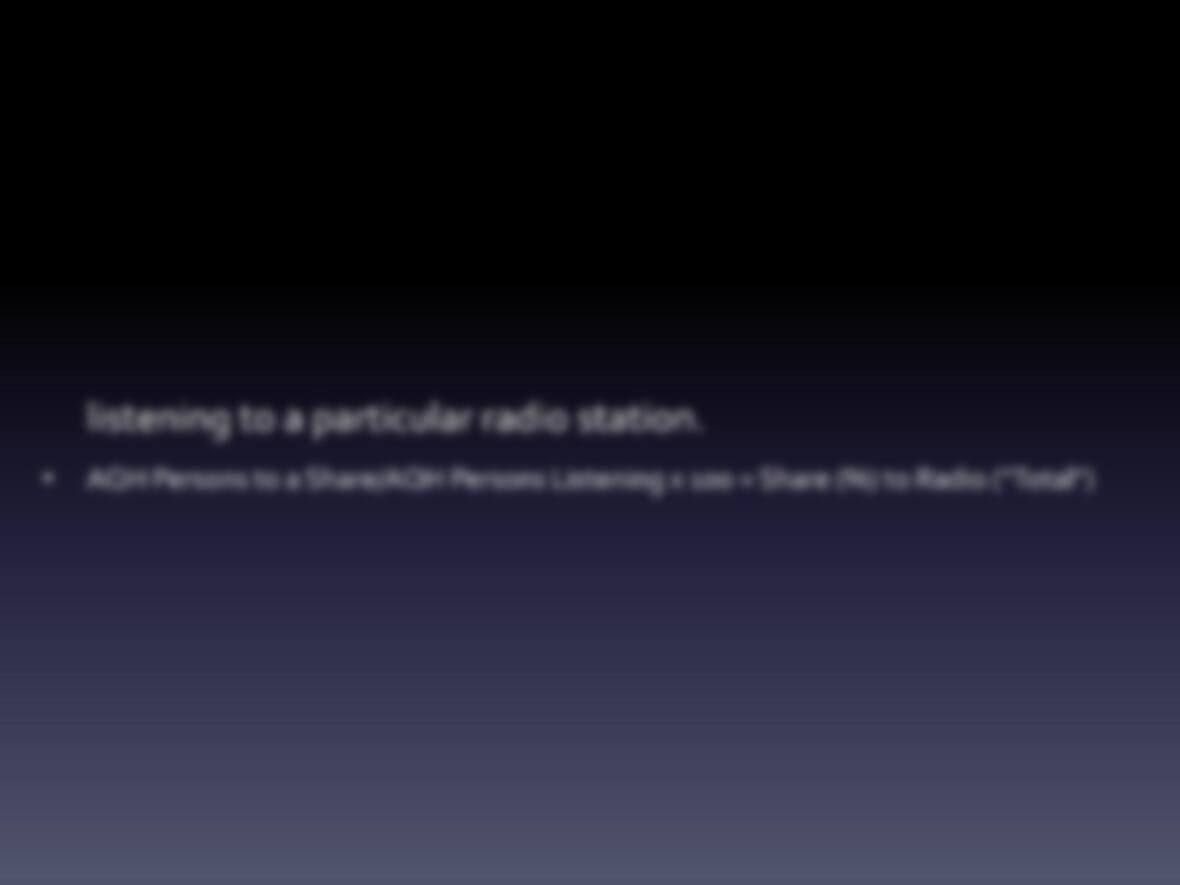
SHARE
•The percentage of those listening to radio in the Metro who are

TIME SPENT LISTENING “TSL”
•An estimate of the amount of time the average listener spent
with a station (or total radio) during a particular daypart. This

TURNOVER
•The number of times the audience turns over within a
given daypart.

GROSS RATING POINTS
“GRPS”
•The sum of all rating points achieved for a particular spot
schedule.

GROSS IMPRESSIONS “GIS”
•The sum of the Average Quarter-Hour Persons
audience for all spots in a given schedule.

COST PER RATING POINT
•The cost of reaching an Average Quarter-Hour
Persons audience that’s equivalent to one percent of
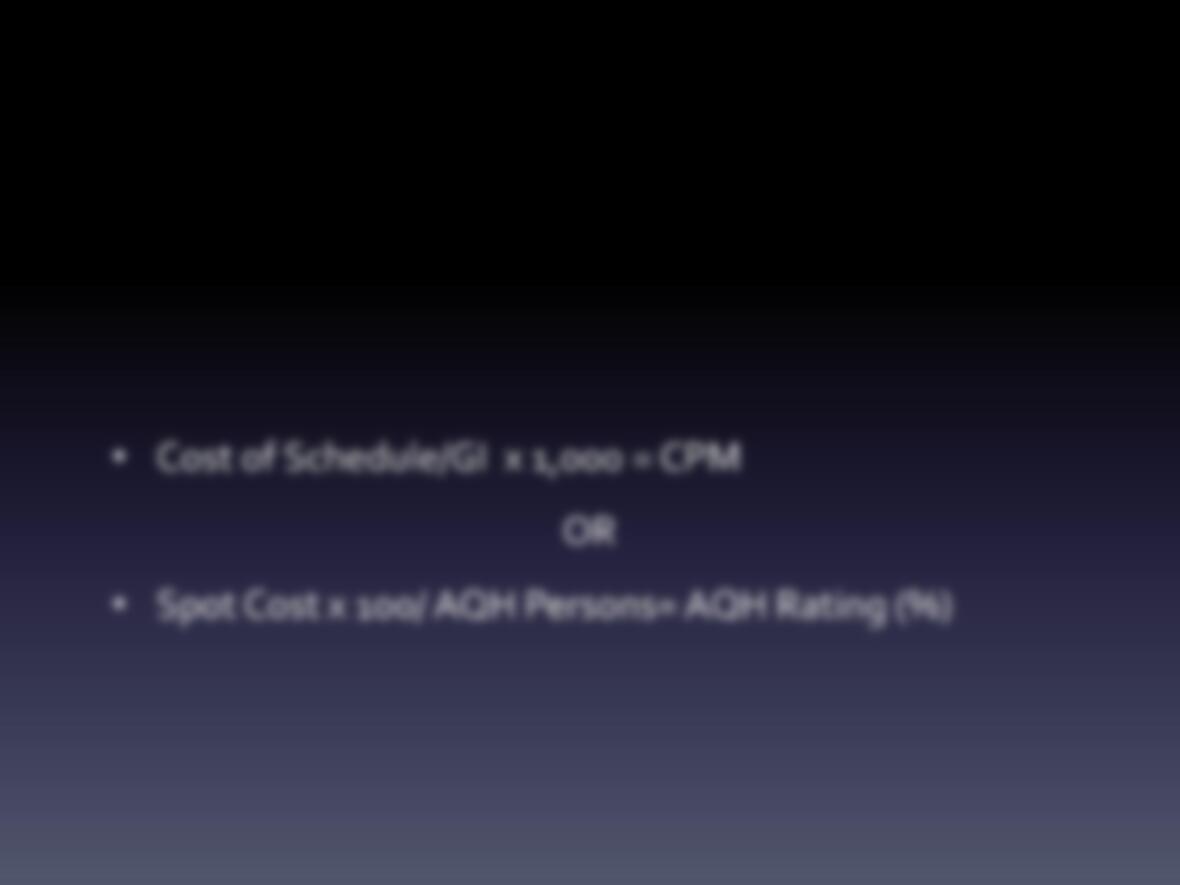
COST PER THOUSAND “CPM”
•The cost of delivering 1,000 gross impressions.

FREQUENCY
•The average number of times a person is exposed to a radio spot
schedule.
•GI/ Net Reach = Frequency
NET REACH
DESIGNATED MARKET AREA
“DMA”
•The DMA is composed of sampling units (counties or
geographically split counties) and is defined and updated
annually, based on historical television viewing patterns. A
county or split county is assigned exclusively to one DMA.
TOTAL SURVEY AREA “TSA”
•A geographic area that encompasses the Metro
Survey Area and may include additional counties

METRO
•Includes a city (or cities) whose population is specified as that of the
central city together with the county (or counties) in which it is
located. The Metro also includes contiguous or additional counties
when the economic and social relationships between the central
and additional counties meet specific criteria.