Chapter 10 – Media Planning and Strategy
10-1
CHAPTER 10
MEDIA PLANNING AND STRATEGY
Chapter Overview
Chapter 10 introduces the concepts involved in media planning. The chapter begins with an overview of
media planning by introducing some key terms and concepts. At this point, the text points out that media
planning is as much an art as it is a science. A number of problems associated with the planning process
Learning Objectives
2. To know how a media plan is developed.
4. To know the process of developing and implementing media strategies.
5. To be familiar with various characteristics of media.
Chapter and Lecture Outline
I. AN OVERVIEW OF MEDIA PLANNING
This overview presents a brief discussion of the factors involved in the media planning process and
illustrates the fact that media planning is an involved process influenced by a variety of factors including
the nature of the media, the overall marketing strategy, and the product or service being advertised.
A. Basic Terms and Concepts—some of the critical terms necessary for understanding media
planning are presented including:
• media planning—the series of decisions involved in delivering the message to the target
audience
• media plan—the actual document detailing these decisions
Chapter 10 – Media Planning and Strategy
10-2
• coverage—the potential audience that might receive a message through a vehicle
• frequency—the number of times the receiver is exposed to the media vehicle in a given time
period
C. Problems in Media Planning—a number of problems are identified, each of which directly
Professor’s Notes
II. DEVELOPING THE MEDIA PLAN
The process of developing the media plan involves a series of steps (see Figure 10-2). These steps are
essentially the same as those presented in the decision sequence model presented in Chapter 1, except
now they are involved directly with media decisions. These steps include: market analysis, establishment
of media objectives, media strategy development and implementation, and evaluation and follow–up.
III. MARKET ANALYSIS AND TARGET MARKET IDENTIFICATION
A. To Whom Should We Advertise? The discussion of target marketing is reviewed, though now the
emphasis is on media, and some of the sources of information that are available to assist in
C. Where to Promote? The decision as to where to promote at this point involves geographical
Chapter 10 – Media Planning and Strategy
10-3
Professor’s Notes
IV. ESTABLISHING MEDIA OBJECTIVES
Media objectives relate to the goals to be attained by the media program, and as such should be limited to
those that can be accomplished through media strategies. Such objectives are often expressed in terms of
coverage, reach, frequency, scheduling, etc.
V. DEVELOPING AND IMPLEMENTING MEDIA STRATEGY
A. Developing a Media Mix—many media strategies require a combination of media to be used. The
media mix involves the determination of the various channels to be used. The objectives of the
plan, the budget and other factors, will directly impact this decision.
D. Scheduling—Because it may not be feasible (or necessary) to maintain a constant advertising
schedule, marketers will typically employ one of three scheduling alternatives:
1. Continuity refers to a continuous pattern of advertising—that is every day, week, or month
(food products, laundry detergents, etc.)
Chapter 10 – Media Planning and Strategy
10-4
E. Reach versus Frequency—Given that advertisers have differing objectives, and are constrained by
budgets, the media decision usually involves a trade-off between reach and frequency. This
decision is essentially one of exposing more persons to the ad, or exposing fewer persons more
often. In making this decision, the media planner must take into consideration a number of factors
involving reach and frequency including:
1. The determination of what levels of reach and frequency are needed
F. Creative Aspects and Mood—Creative aspects of the ad may require the use of specific media.
For example, television may be required to implement certain types of creative campaigns.
Likewise, the mood that a medium creates may carry over to the ad itself. For example, certain
magazines may create various moods as they are being read.
G. Flexibility—the media strategy must be flexible enough to respond to marketing threats and
opportunities, as well as to adjust for changes regarding availability and/or in the media
themselves. Flexibility may need to address the following:
• market opportunities
H. Budget Considerations—it is obvious that costs must be considered in the determination as to
Professor’s Notes
VI. EVALUATION AND FOLLOW-UP
As with other elements of the advertising/promotional program, the media program also requires
evaluation to determine its effectiveness. Essentially, two questions need to be answered: (1) How well
Chapter 10 – Media Planning and Strategy
10-5
VIII. CHARACTERISTICS OF MEDIA
There are a number of sources of information available which define the various advantages and
disadvantages of media. Figure 10-27 lists the major media, and the characteristics of each.
APPENDIX A
Appendix A provides an example of a media flow chart of Asics shoes.
Professors Notes
Teaching Suggestions
Both the length and complexity of this chapter make it a difficult one for students to comprehend. The
chapter contains a large number of terms, definitions, and formulas. Unfortunately, there is no way to
Answers to Discussion Questions
1. One well known media planner has noted that media buying is a combination of art and science with
a definite bias toward art. Explain what this means and give examples of circumstances or situations
in which this might be the case. (LO4)
Marketers have a wealth of information available to them for their use in media planning. Besides
those provided by syndicated services like Simmons and MRI, the media themselves provide valuable
information. There are also computerized media buying software programs, ratings services and
primary research companies that may be employed.
Chapter 10 – Media Planning and Strategy
10-6
2. GfK MRI and Experian Simmons both provide indexes to describe profiles of product users. Using
the index provided in Figure 10-5, describe the profile of the energy drink user. Who is least likely to
drink this product? (LO2)
Using the index, as the number exceeds 100, the potential for use increases. As shown in Figure 10-5,
the profile of the energy drink user is:
Education: did not graduate high school (122); attended college (116); no college (103)
Age: 18-24 (225); 25-34 (160); 35-44 (112)
Sex: male
3. What does it mean for a company when they discover that their product has a High BDI but low CDI?
What about a low CDI and Low BDI? (LO2)
High BDI; low CDI: The product category is not selling well, but the brand is. Probably a
good market to advertise in, but should be monitored for declining sales.
4. As the media landscape continues to change, and advertisers shift more and more of their monies into
new media, there are those who predict that some traditional media like TV and newspapers may not
survive—at least in their present forms. Discuss whether you think this is an accurate statement and
why or why not. (LO5).
Chapter 10 – Media Planning and Strategy
There is no question that companies have shifted their advertising dollars from traditional media to
nontraditional media. It is also true that some traditional media are in trouble—particularly
newspapers and magazines—as advertisers have become enamored with the new media opportunities.
A few years ago, some of the largest traditional advertisers like P&G and American Express made a
5. Some media claim that advertisers should focus more attention to Readers per Dollar than CPM as a
relative cost figure. Explain why they feel this way, and discuss some of the advantages and
disadvantages with the use of both of these measures. (LO2).
The discussion in the text covers the topics of CPM and readers per dollar quite effectively. The basis
for this differentiation is simple—how many people are being reached by the medium for a given
cost? CPM refers to the relative cost for reaching an audience based on the cost of ad space divided
by the circulation. As the text notes, this figure can over estimate or underestimate the relative cost.
Chapter 10 – Media Planning and Strategy
10-8
6. What is meant by engagement (in media terms)? Explain the relevance of engagement to media
planners. (LO1)
The term engagement is nothing new to media planners, and has been discussed for the past few years
but with still no agreement as to exactly what it means. The reason for such attention stems from the
fact that current metrics like CPM and CPP, etc., while still useful, are considered insufficient for
today’s media planners.
7. A criticism of the current rating system for TV is that the numbers are based on sweeps periods. Some
argue that a more accurate picture is provided by the meter system. Discuss some of the advantages
and disadvantages of each method. (LO1)
Television audience measurements are taken on a daily basis, however, the measures used to
determine advertising rates are taken only four times a year—February, May, July and November.
These four data collection periods are referred to as sweeps periods.
Data collection during sweeps may result in inaccuracies for a number of reasons:
• the networks schedule more interesting programs during sweeps
• the networks and individual stations run more promotions during sweeps periods
Chapter 10 – Media Planning and Strategy
10-9
8. Some marketers estimate that the average consumer may be exposed to as many as 3,000 ads per day.
Current estimates of effective frequency are based on 1,500 exposures per day. Discuss how, if at all,
more exposures to advertising may necessitate changes in effective frequency.
First, let’s realize that the number of exposures to ads is a very difficult figure to derive. While
estimates now are supposed to be in the 3,000 area, there are those who believe that the number may
be more like 4,000. Nevertheless, it is safe to recognize that the number of exposures has significantly
increased over the past few years.
9. Some business to business advertisers (for example, copy machine companies) advertise on NFL
Sunday and/or Monday Night football games. As might be expected, such a buy would lead to a high
level of waste coverage. Explain what is meant by waste coverage. Discuss whether this might or
might not be a good media buy. (LO3)
Waste coverage refers to overexposure, in which the media coverage exceeds the target audience. If
the media reaches people who are not sought as buyers and are not potential users, then it is
potentially wasted, and of little or no value to the marketer.
10. Explain what is meant by BDI and CDI. How do advertisers use these indices in their media
planning? (LO1)
Pages 338-341 discuss BDI and CDI. BDI compares the percentage of the brand’s total US sales in a
given market area with the percentage of the total population in the market. The resulting BDI
indicates the sales potential for that brand in that market area. CDI provides information on the
potential for development of the total product category rather than specific brands.
Chapter 10 – Media Planning and Strategy
10–10
Additional discussion questions (not in the text).
11. Explain the differences between CPM and TCPM. Give examples of a company or product that
might select one of the methods versus the other. (LO1)
As products and brands become more and more targeted, the use of CPM has been on the decline. As
you can imagine, years ago with less market differentiation and more use of mass media, CPM was a
12. The chapter discusses some of the many changes taking place in the media environment. Discuss
some of the reasons that marketers may be shifting advertising dollars to less traditional media. Does
this mean that TV advertising may no longer exist in the future? (LO2)
Indeed, there are those who are prematurely burying advertising on TV and other traditional media.
They support their argument on the fact that more and more dollars are being shifted from TV to
nontraditional media (to be discussed in Chapter 13). One reason for the shift stems from the fact that
Chapter 10 – Media Planning and Strategy
10–11
13. As noted in the chapter, there is a trade-off between reach and frequency for advertisers with a limited
budget. Explain what this means. Under which circumstances would a planner wish to emphasize
reach? Frequency? (LO3)
In an ideal world, advertisers would like to maximize reach and frequency. Unfortunately, in the real
world, they are faced with budgetary constraints. Given budget limitations, the media planner is
14. Describe the three methods of promotional scheduling. Give examples of products and/or services
that might employ each method. (LO3)
The text discusses the various scheduling options available to the marketer. Given the fact that there
are always budgetary constraints, and that some products/services do not need to be marketed year
round, scheduling allows for more efficient allocation of advertising and promotional dollars. The
scheduling options available are:
Chapter 10 – Media Planning and Strategy
10–12
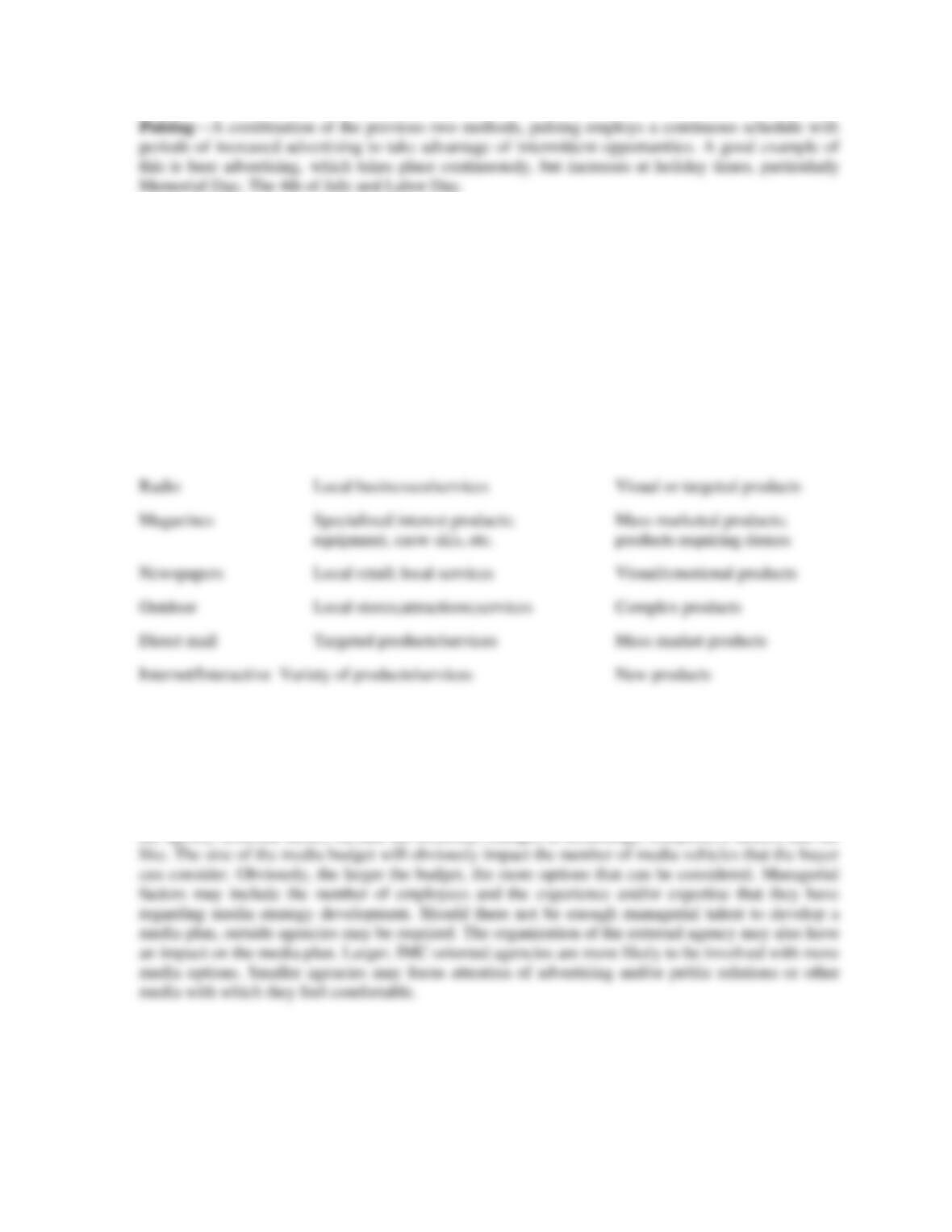
15. Figure 10-27 notes some of the advantages and disadvantages associated with various media options.
Referring to Figure 10-27 provide examples of products and/or services that might most benefit from
the use of each medium. (LO4)
Without repeating the information provided in Figure 10-27, it is obvious that each medium will have
its specific advantages and disadvantages. Following is a list of products for which each medium
might prove to be an advantage or a disadvantage:
Medium Advantage Disadvantage
Television Mass marketed products, soda, Targeted products, niche
detergents, beer, etc. products
16. The text lists both internal and external factors that might impact the media strategy. Provide
examples of each and discuss how they might impact the media plan. (LO3)
Both internal and external factors may affect the development of the media plan. Internal factors
include the size of the media budget, managerial and administrative capabilities or the organization of
Chapter 10 – Media Planning and Strategy
10–13
Changes in the economy may directly impact the media plan. As the economy improves or recesses,
17. Using the BDI and CDI indices, explain the least desirable market situation for marketers. Provide an
example. Then do the same for the most desirable situation. (LO1)
The least desirable situation is one in which the BDI and the CDI are both low. In this situation, there
appears to be little potential for either the category or the brand. For example, consider typewriters. If
IMC Exercise
Have students access MRI online and examine the profiles and media usage characteristics for a
particular product. Have them review the indices and to examine them carefully to determine if they seem
logical. Have them present their findings to the class, describing the media strategy that should be
employed to reach them.
Chapter 10 – Media Planning and Strategy
AdForum Exercise: “ Presenting the Message Through Different Media”
(See Advertising and Promotion Playlist, Chapter 10)
In the chapter it was noted that many companies use a variety of media to communicate with their target
markets. In the playlist for Chapter 10 are a number of ads for companies that have used the same
message in different media. Review these ads and then answer the following questions:
1. Do you feel that the message is communicated as well in different media? For example,
do the commercials communicate better than the print ads?