
CHAPTER 9
INTERNATIONAL BONDS
CHAPTER SUMMARY
This chapter covers international bond markets from the perspective of U.S. investors. U.S.
investors have become increasingly aware of non-U.S. interest-rate movements and their
relationship to U.S. interest rates. Foreign countries have liberalized their bond markets, making
CLASSIFICATION OF GLOBAL BOND MARKETS
From the perspective of a given country, the global bond market can be classified into two
markets: an internal bond market and an external bond market. The internal bond market is
The foreign bond market of a country is where bonds of issuers not domiciled in the country
are issued and traded. Bonds traded in the U.S. foreign bond market are nicknamed Yankee
bonds.
The external bond market is commonly referred to as the offshore bond market, or, more
popularly, the Eurobond market. Another way to classify the world’s bond market is in terms
of trading blocs. The trading blocs used by practitioners for this classification are dollar bloc,
European bloc, Japan, and emerging markets.

NON-U.S. BOND ISSUERS AND BOND STRUCTURES
In this section, we describe the various non-U.S. issuers of international bonds, the type of bond
structures, and the currencies in which international bonds are issued.
Non-U.S. Bond Issuers
Non-U.S. issuers of international bonds include sovereign governments, subsovereign
governments, supranational agencies, financial institutions, and corporations.
Organizations that collect data on international debt issuance use different definitions for
categorizing the nationality of issuers.
FOREIGN EXCHANGE RISK AND BOND RETURNS
The key factor that impacts the price and the yield of a bond is the currency denomination. In
contrast, when a portfolio includes non-dollar denominated issues by non-U.S. entities, there are
two additional factors to consider beyond the analysis of the issuer’s credit. The first is the
If the foreign currency depreciates (i.e., declines in value) relative to the U.S. dollar, the dollar
The return on a portfolio that includes non-dollar denominated bonds consists of three components:
(1) income, (2) capital gain/loss in the local currency, and (3) foreign currency gain/loss.
BONDS ISSUED BY NON-U.S. ENTITIES
Bonds issued by non-U.S. entities include: Yankee bonds, Regulation 144a private placements,
Eurobonds, Euro medium term notes, Global bonds, Non-U.S. domestic bonds, emerging market
bonds. Below we describe each.
Yankee bonds
Yankee bonds are bonds issued by non-U.S. entities that are registered with the U.S. Securities
Regulation 144a Private Placements
SEC Rule 144A allows the trading of privately placed securities among qualified institutional
Eurobonds
The Eurobond market is divided into sectors depending on the currency in which the issue is
denominated. For example, when Eurobonds are denominated in U.S. dollars, they are referred to
as Eurodollar bonds. The Eurodollar bond market is the largest sector within the Eurobond
market.
Corporate Bonds and Covenants
In the Eurobond market, there is a debate regarding the relatively weak protection afforded by
covenants. The chief reason for this is that investors in corporate Eurobonds are geographically
diverse.
Securities Issued in the Eurobond Market
The Eurobond market has been characterized by new and innovative bond structures to
accommodate particular needs of issuers and investors. There are the “plain vanilla,” fixed-rate
coupon bonds, referred to as Euro straights. Coupon payments are made annually, rather than
semiannually, because of the higher cost of distributing interest to geographically dispersed
bondholders. There are also zero-coupon bond issues and deferred-coupon issues.
currency. Such issues are called dual-currency issues. One type of the latter offers to the
investor or the issuer the choice of currency. These bonds are commonly referred to as option
currency bonds.
Convertible Bonds and Bonds with Warrants
A convertible Eurobond is one that can be converted into another asset. Bonds with attached

©2013 Pearson Education
199
issuer at the same price and yield as the host bond. A currency warrant permits the warrant
owner to exchange one currency for another at a set price (i.e., a fixed exchange rate).
Comparing Yields on U.S. Bonds and Eurodollar Bonds
Because Eurodollar bonds pay annually rather than semiannually, an adjustment is required to
make a direct comparison between the yield to maturity on a U.S. fixed-rate bond and that on
a Eurodollar fixed-rate bond. Given the yield to maturity on a Eurodollar fixed-rate bond, its
bond-equivalent yield is computed as follows:
bond-equivalent yield of Eurodollar bond = 2[(1 + yield to maturity on Eurodollar bond)1/2 – 1].
To convert the bond-equivalent yield of a U.S. bond issue to an annual-pay basis so that it can be
and can be issued in any currency. The three characteristics of a global bond are as follows:
(i) they are issued and sold simultaneously in multiple bond markets at the same offering price;
(ii) they are traded in these markets without restrictions with settlement that is similar to a trade
of domestic bonds; and, (iii) the issuance size is large, allowing for multiple tranches by
maturity.
according to different methods in various countries, and these differences will affect the
interpretation of yield spreads. Withholding and transfer tax practices also affect global
investment strategies.
Outside of the United States, the largest government issuer of inflation-linked bonds is the
United Kingdom, followed by France. These bonds, popularly referred to as linkers in Europe,
conditions appear favorable. It is only at the time of the auction that the amount to be auctioned
and the maturity of the security to be offered are announced. In a tap system, additional bonds of
a previously outstanding bond issue are auctioned.
Sovereign debt is the obligation of a country’s central government. The debt of national
governments is rated by the rating agencies. For the reasons discussed subsequently, there are
impair a national government’s ability to satisfy such obligation.
In assessing the credit quality of local currency debt, S&P emphasizes domestic government
policies that foster or impede timely debt service. For foreign currency debt, credit analysis by
S&P focuses on the interaction of domestic and foreign government policies. S&P analyzes
a country’s balance of payments and the structure of its external balance sheet.
compared to residential mortgage-backed securities (RMBS), commercial mortgage-backed
securities (CMBS), and other asset-backed securities (ABS). Four differences results from this
securitization process. First, the bank that originated the loans will issue and sell a pool of loans
to a special purpose vehicle (SPV). Second, investors do not have recourse to the bank that sold
the pool of loans to the SPV. Third, for RMBS/CMBS/ABS backed by residential and
public-sector entities. When the bonds are fully collateralized by residential and commercial
mortgages, they are called HypothekenPfandbriefe.
The Pfandbriefe market is further divided into Traditional Pfandbriefe and JumboPfandbriefe.
The former represents the market for issues of smaller size. The tap method was used for issuing
Traditional Pfandbriefe. The sector of the Pfandbriefe market that has received the greatest
retired their outstanding Brady bonds.
At one time, the securities issued by governments of emerging market countries were exclusively
denominated in U.S. dollars or other major currencies. Today, emerging market local debt issues
are denominated in local currency as well in major currencies. The development of the local
market has been fostered by both the growth of local pension funds and foreign investor interest.
Credit Risk
Investing in the government bonds of emerging market countries entails considerably more credit
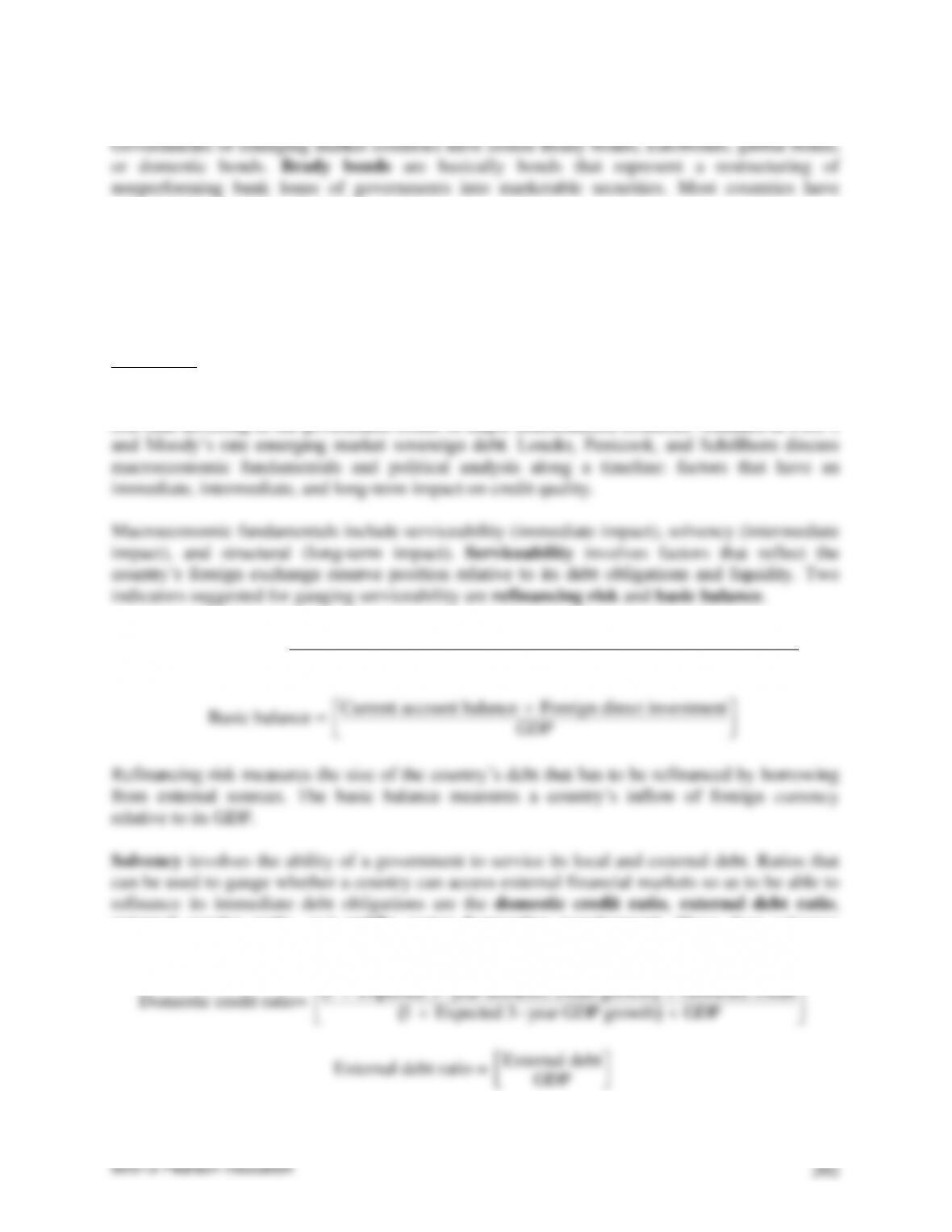
risk than investing in the government bonds of major industrialized countries. Standard & Poor’s
Refinancing risk =
Short-term debt Interest Amortization on medium & long-term debt
Reserves
++
external service ratio, and public sector borrowing requirement. These four solvency
measures are given below:
( )
1 Expected 3 year domestic credit growth Domestic credit
+ −
GDP
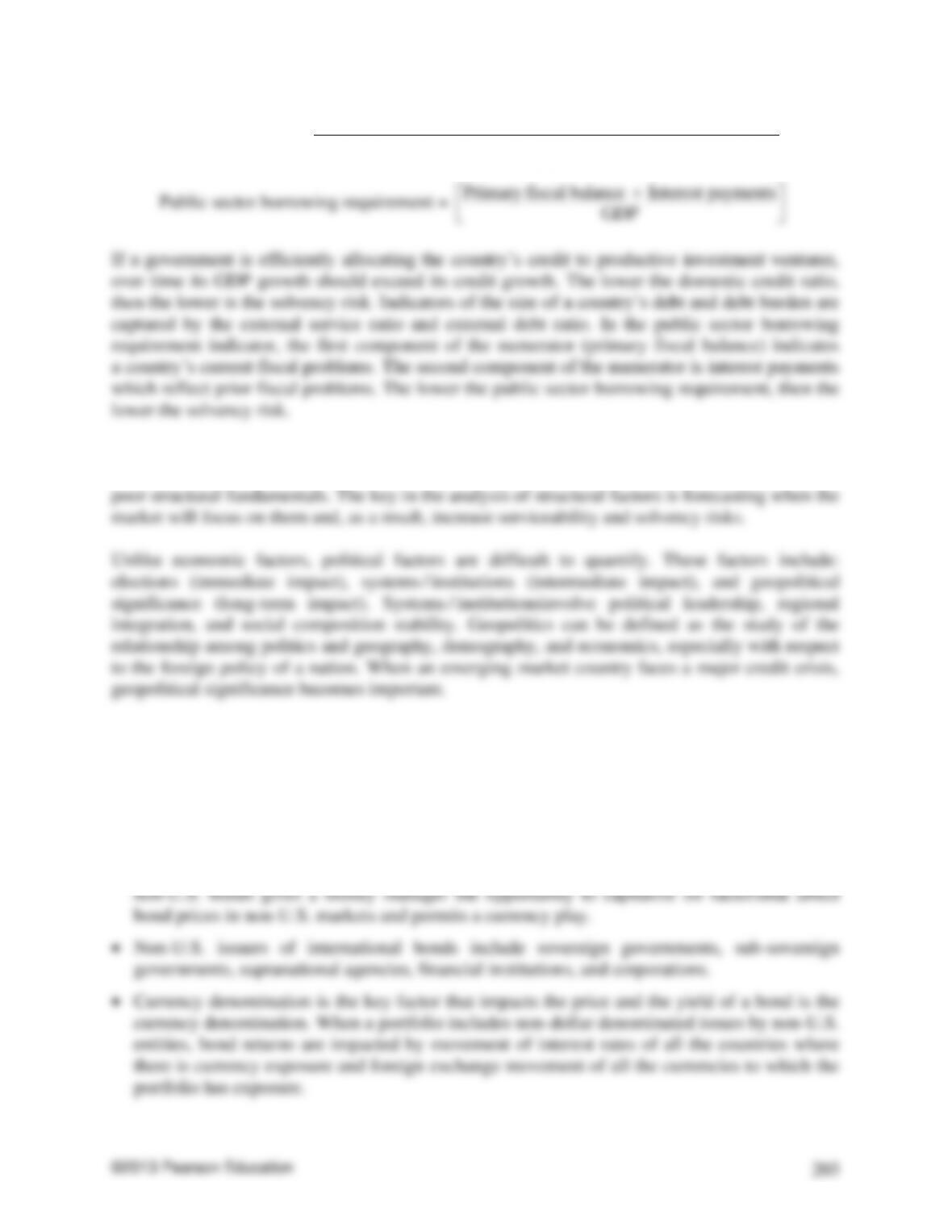
Debt service ratio=
Interest payments Amortization on medium & long-term debt
Exports of goods and services Income receipts
+
+
Primary fiscal balance Interest payments
+
Factors that fall into the structural category involve an assessment of the country’s long-run
health and provide guidance as to the likely development of economic problems when there are
KEY POINTS
• The global bond market can be classified into two markets: the internal or national bond
market, which consists of a domestic bond market and a foreign bond market, and the external
or international bond market (or Eurobond market).
• Although it is often stated that the primary motivation to investing in non-U.S. bondsis that it
provides diversification benefits, such benefits may not be significant. Rather,investing in
©2013 Pearson Education
204
• The return on a portfolio that includes non-dollar denominated bonds consists of three
components: (1) income, (2) capital gain/loss in the local currency, and (3) foreign currency
gain/loss.
• Bonds issued by non-U.S. entities include Yankee bonds, Regulation 144a private placements,
Eurobonds, Euro medium term notes, global bonds, non-U.S. domestic bonds, and emerging
market bonds.
• Domestic bond markets throughout the world offer U.S. investors the opportunity to buy
bonds of non-U.S. entities. The largest sector of domestic bond markets throughout the world
is the government sector.
• Sovereign debt is the obligation of a country’s central government. Ratings are assigned
separately for local currency denominated debt and foreign currency denominated debt. The
ANSWERS TO QUESTIONS FOR CHAPTER 9
(Questions are in bold print followed by answers.)
1. What are the four trading blocs that are used in classifying the world’s bonds markets.
The trading blocs used by practitioners to classify the world’s bond market in terms of trading
bloc include the four classifications. They are: (i) the dollar bloc, (ii) the European bloc, (iii) the
Japan bloc, and (iv) the emerging markets bloc. The trading bloc construct is useful because each
2. What risk is faced by a U.S. life insurance company that buys British government bonds?
From the perspective of a U.S. life insurance company investing in British government bonds,
the cash flows of assets denominated in a foreign currency expose the investor to uncertainty as
to the cash flow in U.S. dollars. The actual U.S. dollars that the investor gets depend on the