Chapter 9 – The Capital Asset Pricing Model
CHAPTER 9: THE CAPITAL ASSET PRICING MODEL
PROBLEM SETS
2. If the security’s correlation coefficient with the market portfolio doubles (with all
other variables such as variances unchanged), then beta, and therefore the risk
premium, will also double. The current risk premium is: 14% – 6% = 8%
3. a. False. β = 0 implies E(r) = rf , not zero.
b. False. Investors require a risk premium only for bearing systematic
4. The expected return is the return predicted by the CAPM for a given level of
systematic risk.
Chapter 9 – The Capital Asset Pricing Model
9-2
5. According to the CAPM, $1 Discount Stores requires a return of 13% based on its
systematic risk level of β = 1.5. However, the forecasted return is only 12%.
6. Correct answer is choice a. The expected return of a stock with a β = 1.0 must, on
average, be the same as the expected return of the market which also has a β = 1.0.
7. Correct answer is choice a. Beta is a measure of systematic risk. Since only
8. The appropriate discount rate for the project is:
rf + β × [E(rM ) – rf ] = .08 + [1.8 (.16 – .08)] = .224, or 22.4%
9. a. Call the aggressive stock A and the defensive stock D. Beta is the sensitivity
of the stock’s return to the market return, i.e., the change in the stock return
Chapter 9 – The Capital Asset Pricing Model
9-3
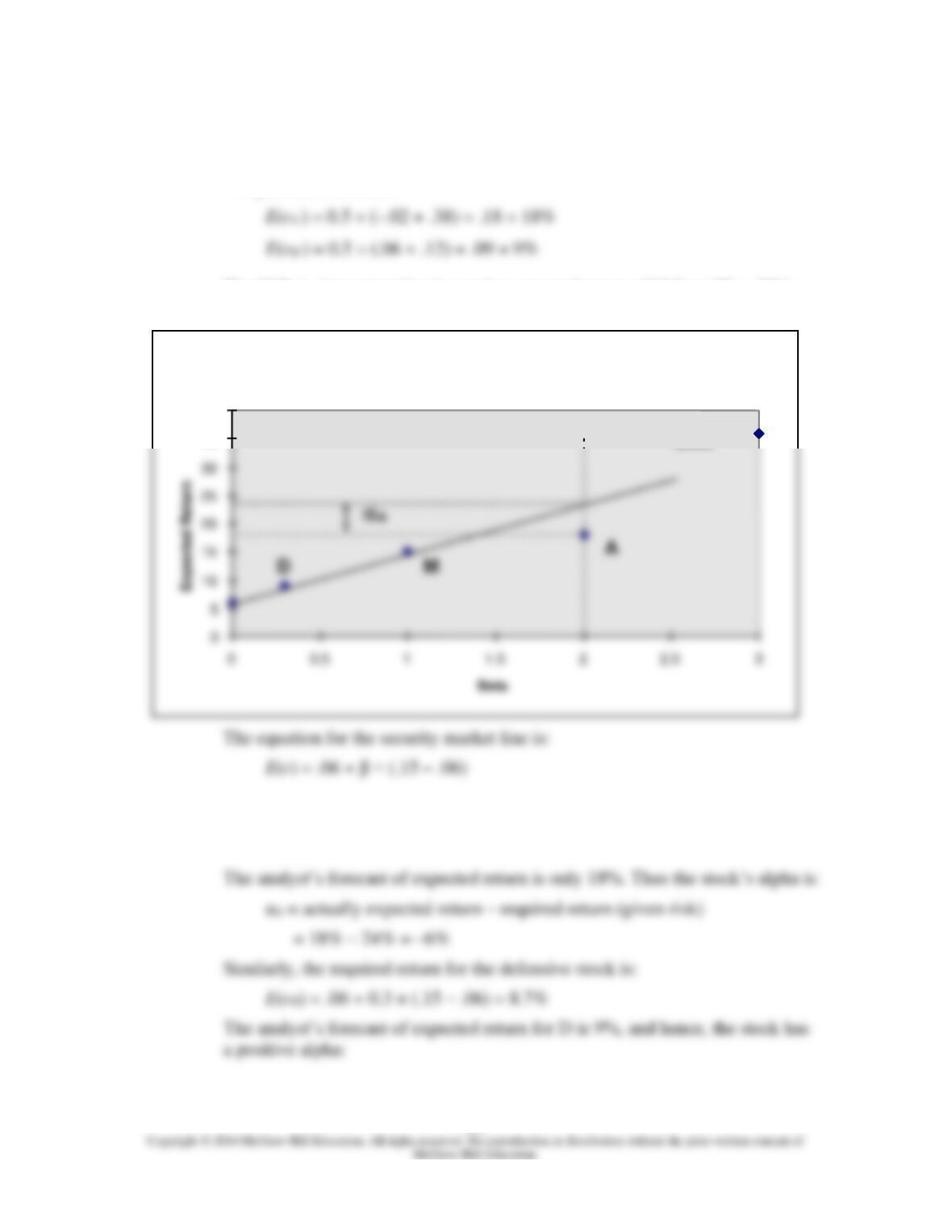
b. With the two scenarios equally likely, the expected return is an average of the
two possible outcomes:
15%, with βM = 1, and rf = 6% (which has βf = 0). See the following graph:
Expected Return – Beta Relationship
30
35
40
SML
d. Based on its risk, the aggressive stock has a required expected return of:
E(rA ) = .06 + 2.0 × (.15 – .06) = .24 = 24%
Chapter 9 – The Capital Asset Pricing Model
9-4
10. Not possible. Portfolio A has a higher beta than Portfolio B, but the expected return
11. Possible. If the CAPM is valid, the expected rate of return compensates only for
12. Not possible. The reward-to-variability ratio for Portfolio A is better than that of the
market. This scenario is impossible according to the CAPM because the CAPM
13. Not possible. Portfolio A clearly dominates the market portfolio. Portfolio A has
both a lower standard deviation and a higher expected return.
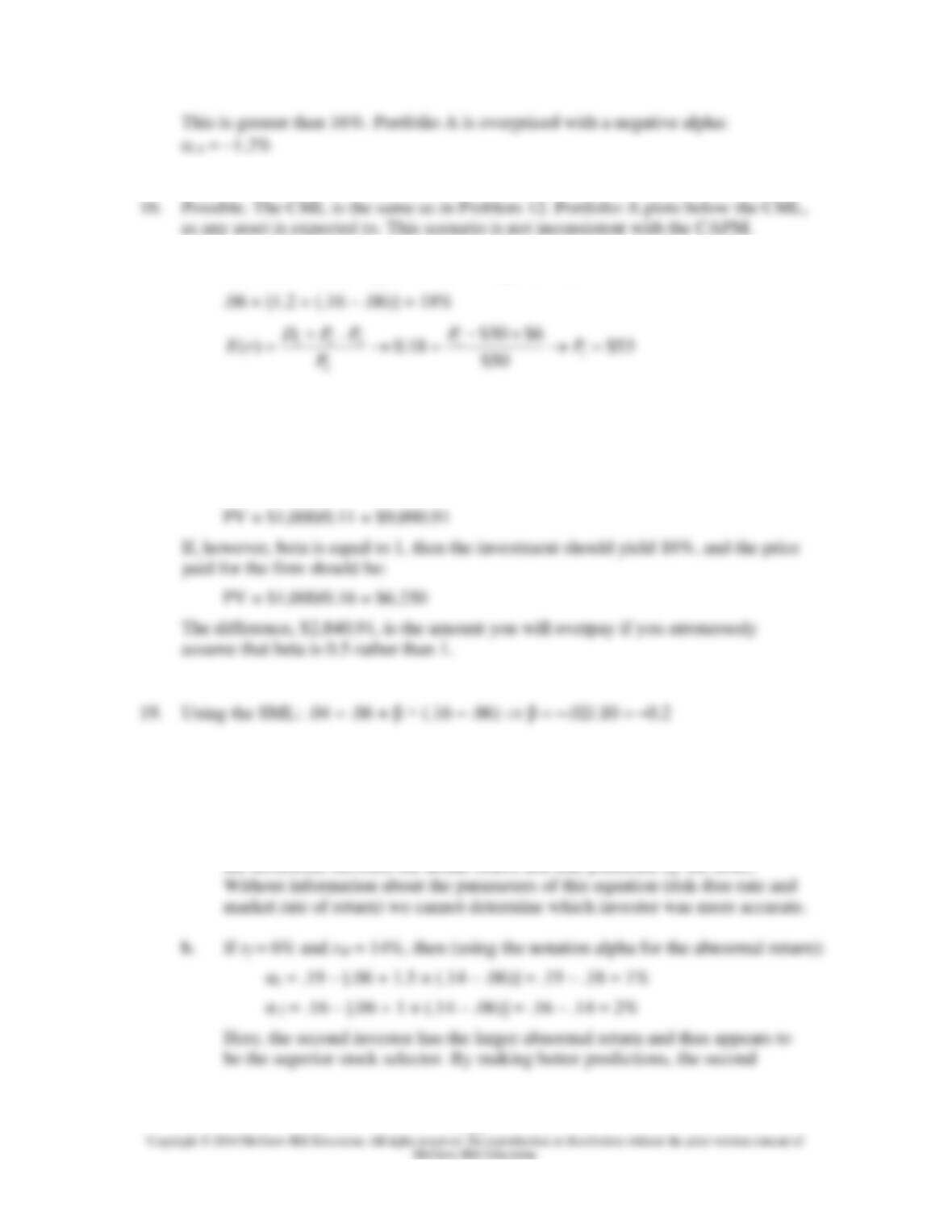
15. Not possible. The SML is the same as in Problem 14. Here, Portfolio A’s required
return is: .10 + (.9 × .08) = 17.2%
Chapter 9 – The Capital Asset Pricing Model
9-5
17. Since the stock’s beta is equal to 1.2, its expected rate of return is:
18. The series of $1,000 payments is a perpetuity. If beta is 0.5, the cash flow should be
discounted at the rate:
.06 + [0.5 × (.16 – .06)] = .11 = 11%
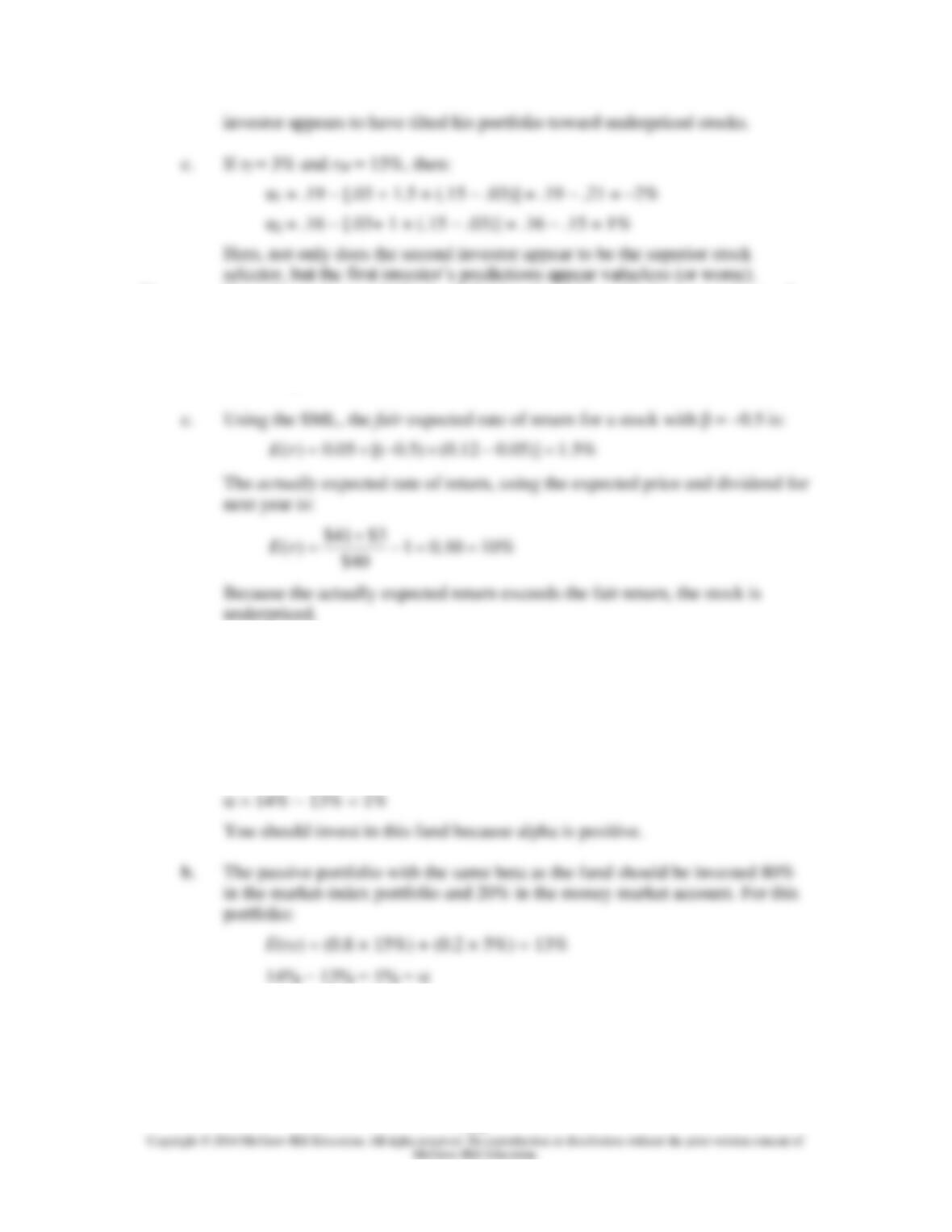
20. r1 = 19%; r2 = 16%; β1 = 1.5; β2 = 1
a. To determine which investor was a better selector of individual stocks we look
at abnormal return, which is the ex-post alpha; that is, the abnormal return is
the difference between the actual return and that predicted by the SML.
Chapter 9 – The Capital Asset Pricing Model
9-6
21. a. Since the market portfolio, by definition, has a beta of 1, its expected rate of
return is 12%.
b. β = 0 means no systematic risk. Hence, the stock’s expected rate of return in
market equilibrium is the risk-free rate, 5%.
22. In the zero-beta CAPM the zero-beta portfolio replaces the risk-free rate, and thus:
E(r) = 8 + 0.6(17 – 8) = 13.4%
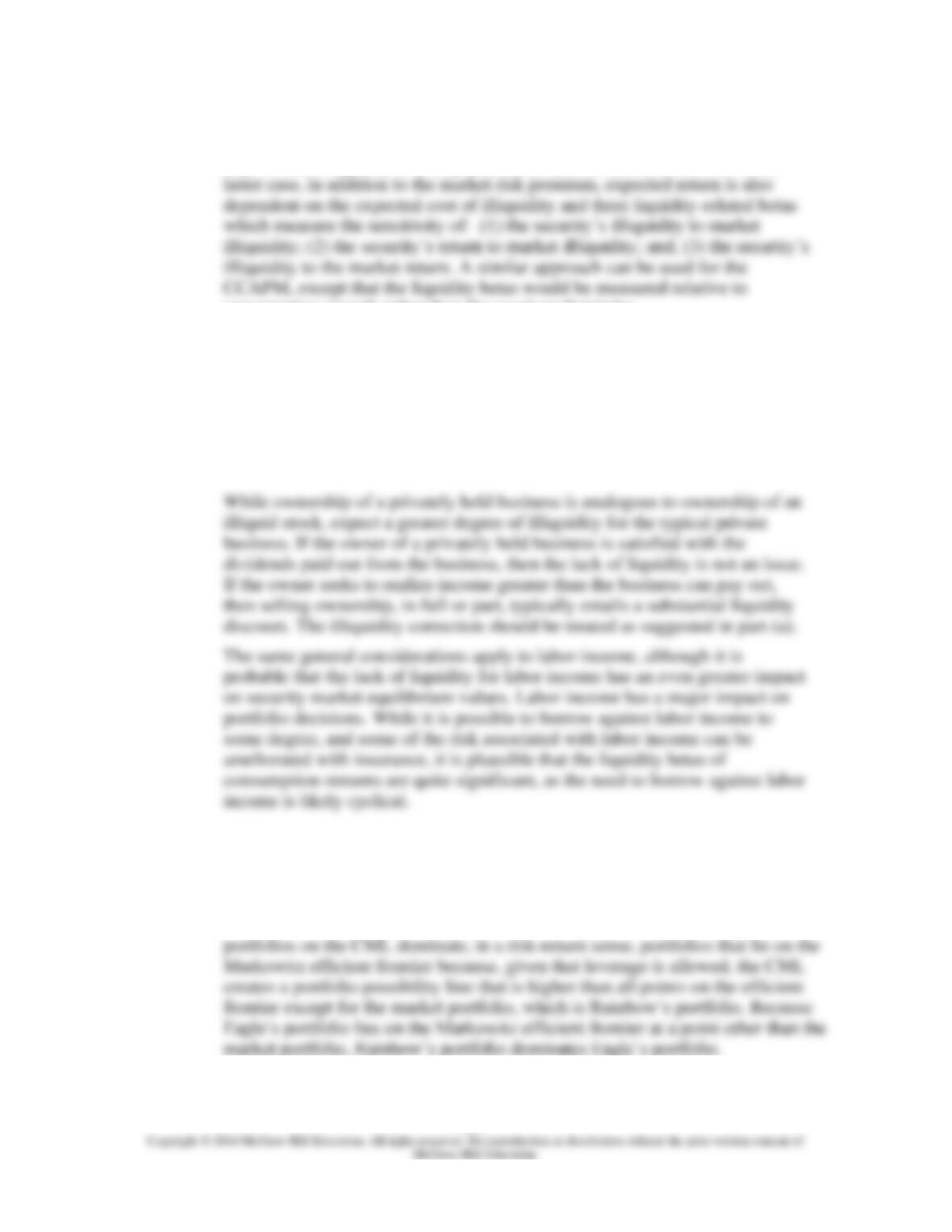
23. a. E(rP) = rf + βP × [E(rM ) – rf ] = 5% + 0.8 (15% − 5%) = 13%
Chapter 9 – The Capital Asset Pricing Model
9-7
24. a. We would incorporate liquidity into the CCAPM in a manner analogous to the
way in which liquidity is incorporated into the conventional CAPM. In the
consumption growth rather than the usual market index.
b. As in part (a), nontraded assets would be incorporated into the CCAPM in a
fashion similar to part (a). Replace the market portfolio with consumption
growth. The issue of liquidity is more acute with nontraded assets such as
privately held businesses and labor income.
CFA PROBLEMS
1. a. Agree; Regan’s conclusion is correct. By definition, the market portfolio lies on
the capital market line (CML). Under the assumptions of capital market theory, all
Chapter 9 – The Capital Asset Pricing Model
b. Nonsystematic risk is the unique risk of individual stocks in a portfolio that is
diversified away by holding a well-diversified portfolio. Total risk is composed of
systematic (market) risk and nonsystematic (firm-specific) risk.
2. E(r) = rf + β × [E(r M ) − rf ]
3. a.
8. d. [You need to know the risk-free rate]
Chapter 9 – The Capital Asset Pricing Model
9-9
10. Under the CAPM, the only risk that investors are compensated for bearing is the
risk that cannot be diversified away (systematic risk). Because systematic risk
11. a. McKay should borrow funds and invest those funds proportionately in
Murray’s existing portfolio (i.e., buy more risky assets on margin). In addition
to increased expected return, the alternative portfolio on the capital market
line will also have increased risk, which is caused by the higher proportion of
risky assets in the total portfolio.
b. McKay should substitute low-beta stocks for high-beta stocks in order to
12. a.
Expected Return
Alpha
Stock X
Stock Y
b. i. Kay should recommend Stock X because of its positive alpha, compared to
Stock Y, which has a negative alpha. In graphical terms, the expected

Chapter 9 – The Capital Asset Pricing Model
The market index has an even more attractive Sharpe ratio than either of the
individual stocks, but, given the choice between Stock X and Stock Y, Stock
Y is the superior alternative.
When a stock is held as a single stock portfolio, standard deviation is the
relevant risk measure. For such a portfolio, beta as a risk measure is irrelevant.