
Pierce Control Systems
Case 9
Bank Financing
Purpose: The case allows the student to compare the cost of floating rate bank financing with longer-term
fixed rate financing. The relative cost of each under different economic scenarios is considered and
expected values are computed. There is also a brief consideration of the term structure of interest rates
and the expectations hypothesis. Another feature is that the student considers the trade-off between
compensating balance requirements and lower quoted interest rates.
Relation to Text: The case draws on material from both Chapter 6 and Chapter 8 and should follow
Chapter 8.
Complexity: This case is reasonably straightforward and requires 30-45 minutes to solve.
Pierce Control Systems
Solutions
Amount needed
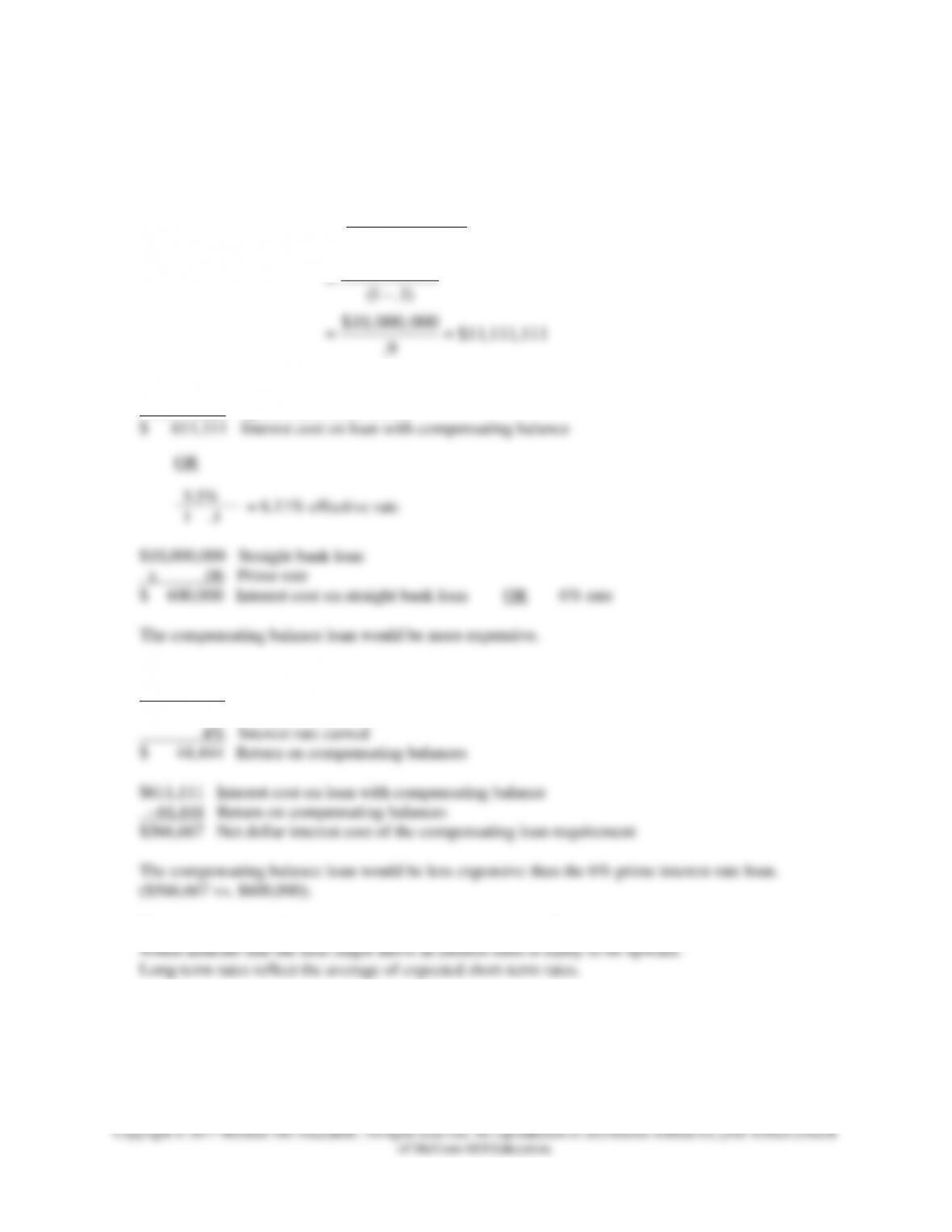
1. Amount to be borrowed (1 )
$10,000,000
(1 .1)
$10,000,000 $11,111,111
.9
C
=−
=−
==
2. $11,111,111 Loan requirement with compensating balance
.055 (prime rate minus 1/2%)
3. $11,111,111 Compensating balance loan
–10,000,000 Actual funds needed
$ 1,111,111 Compensating balances
4. The term structure of interest rate curve is upward sloping. Under the expectations hypothesis, this
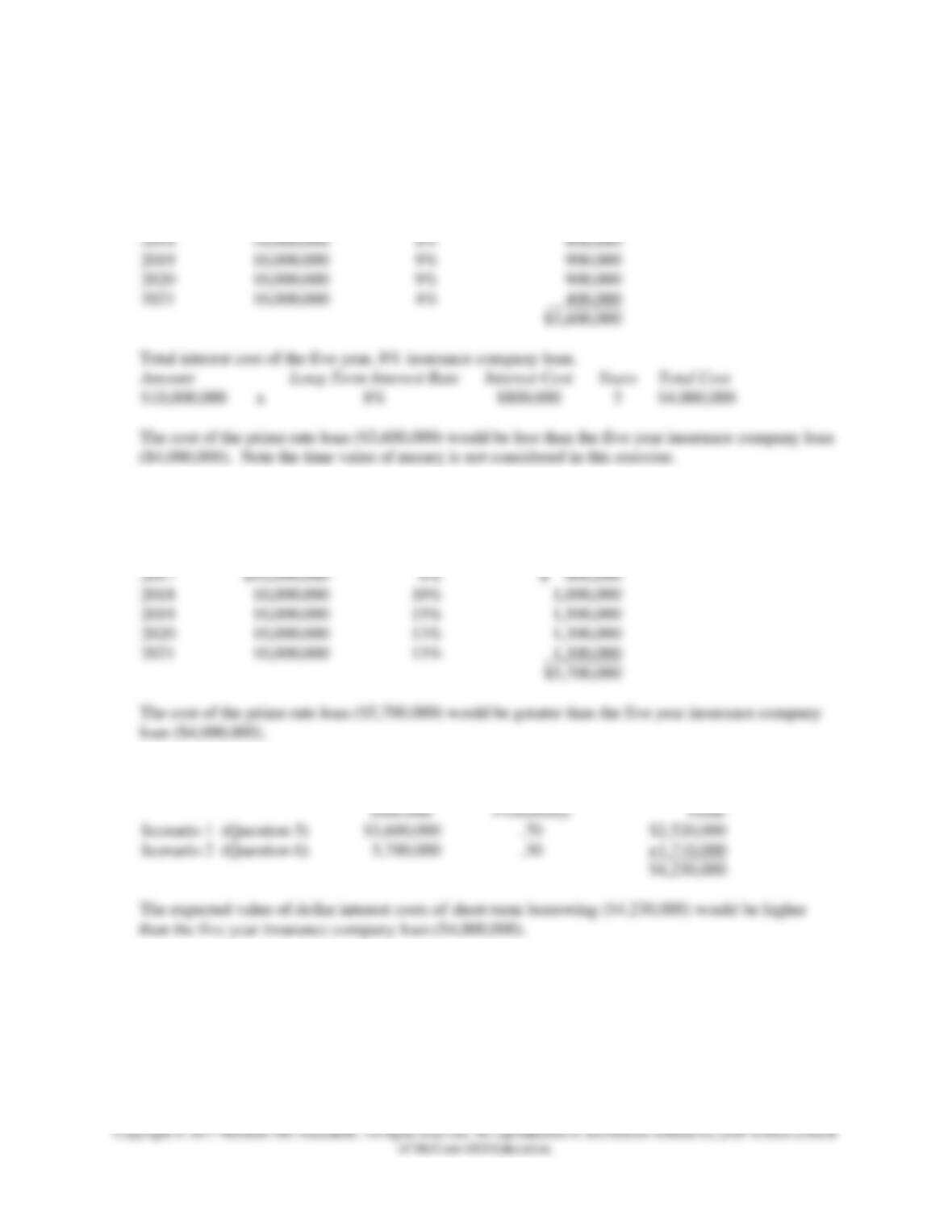
5. Total interest cost with borrowing at prime over the next five years.
Short-Term Projected
Year
Amount
Interest Rate
Interest Cost
2017
$10,000,000
6%
$ 600,000
2018
10,000,000
8%
800,000
2019
10,000,000
9%
900,000
2020
10,000,000
9%
900,000
2021
10,000,000
4%
400,000
$3,600,000
Total interest cost of the five year, 8% insurance company loan.
Amount
x
Long-Term Interest Rate
Interest Cost
Years
Total Cost
$10,000,000
8%
$800,000
5
$4,000,000
6. Total interest cost with borrowing at prime over the next five years (Second Scenario).
Short-Term Projected
Year
Amount
Interest Rate
Interest Cost
2017
$10,000,000
6%
$ 600,000
2018
10,000,000
10%
1,000,000
2019
10,000,000
15%
1,500,000
2020
10,000,000
13%
1,300,000
2021
10,000,000
13%
1,300,000
$5,700,000
The cost of the prime rate loan ($5,700,000) would be greater than the five year insurance company
loan ($4,000,000).
7. Expected Value of Scenarios
Outcome
Probability
Expected
Value
Scenario 1 (Question 5)
$3,600,000
.70
$2,520,000
Scenario 2 (Question 6)
5,700,000
.30
+1,710,000
$4,230,000
The expected value of dollar interest costs of short-term borrowing ($4,230,000) would be higher
than the five year insurance company loan ($4,000,000).
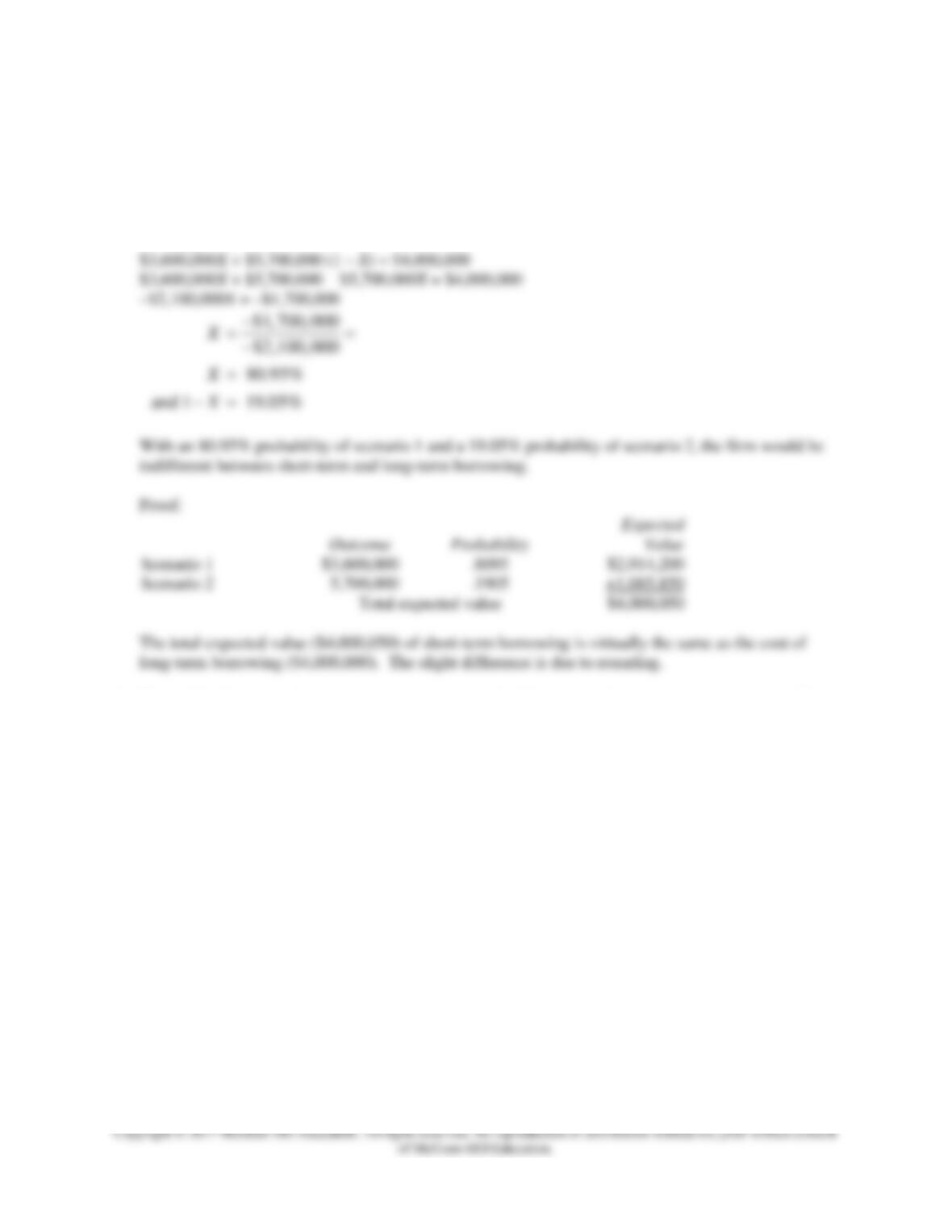
8. Probability of the scenarios that produces an indifference point between short–term and long-term
borrowing. Scenario 1 outcome (X) + Scenario 2 outcome (1 – X) = Interest cost under long-term
borrowing.
Note: X represents the probability of the outcome.
Thus
9. Through hedging, the firm can reduce or eliminate the risk associated with rising interest rates. If
interest rates do rise, the extra cost of borrowing money to actually finance the business can be offset
by the profit on a futures contract.