Chapter 8
Alternative Investments
1. Let us compute the terminal value of $1 invested. The share class with the highest terminal value net
of all expenses would be the most appropriate, because all classes are based on the same portfolio and
thus have the same portfolio risk characteristics.
a. Class A. $1 (1 – 0.05) = $0.95 is the amount available for investment at t = 0, after paying the
front-end sales charge. Because this amount grows at 9% per year, reduced by annual expenses
b. Class A. The terminal value per $1 invested after three years is $0.95 1.093 (1 − 0.0125)3 =
$1.1847.
c. Class A. The terminal value per $1 invested after five years is $0.95 1.095 (1 − 0.0125)5 =
$1.3726.
d. Class A. The terminal value per $1 invested after 15 years is $0.95 1.0915 (1 − 0.0125)15 =
$2.8653.
42 Solnik/McLeavey • Global Investments, Sixth Edition
2. Class A performs quite poorly unless the investment horizon is very long. The reason is the high sales
charge of 5 percent on purchases. Even though the annual expenses for Class A are low, that is not
3. The estimated model is
House value in euros = 140,000 + (210 Living area) + (10,000 Number of bathrooms) +
4. a. The net operating income for the office building is gross potential rental income minus estimated
vacancy and collection costs, minus insurance and taxes, minus utilities, minus repairs and
b. The capitalization rate of the first office building recently sold in the area is
5. The after-tax cash flow for the property sale year is $126,000 + $710,000 = $836,000. At a cost of
equity of 18%, the present value of the after-tax cash flows in years 1 through 5 is as follows.
Chapter 8 Alternative Investments 43
6. a. The amount borrowed is 80% of $1.5 million, which is $1.2 million. The first year’s interest =
9% of $1.2 million = $108,000. So,
After-tax net income = ($176,800 − $37,500 − $106,920) (1 − 0.30) = $22,666
Principal repayment = $120,000 − $106,920 = $13,080
so,
After-tax cash flow in year 2 = $22,666 + $37,500 − $13,080 = $47,086
New NOI in year 3 = 1.04 $176,800 = $183,872. We need to calculate the third year’s interest
payment on the mortgage balance after the second year’s payment. This mortgage balance is the
b. Ending book value = Original purchase price − Total depreciation during three years =
$1,500,000 − 3 $37,500 = $1,387,500.
The net sale price = $1,720,000 (1 − 0.065) = $1,608,200
44 Solnik/McLeavey • Global Investments, Sixth Edition
c. The total after-tax cash flow for the property sale year is $51,683 + $403,397 = $455,080. At a
cost of equity of 19%, the present value of the after-tax cash flows in years 1 through 3 is as
follows:
7. No, one would not suggest using real estate appraisal-based indexes in a global portfolio optimization.
Real estate appraisal values are a smoothed series. One of the reasons for this smoothness is that the
8. Clearly, the two real estate indexes have very different price behaviors. Their correlation is almost
9. a. There are three possibilities.
Project does not survive until the end of the eighth year
Project survives and the investor exits with a payoff of $25 million
Project survives and the investor exits with a payoff of $35 million
b. Because the expected NPV of the project is negative, the project should be rejected.
10. The probability that the venture capital project survives to the end of the first year is (1 − 0.28),
1 minus the probability of failure in the first year; the probability that it survives to the end of
second year is the product of the probability it survives the first year times the probability it survives
Chapter 8 Alternative Investments 45
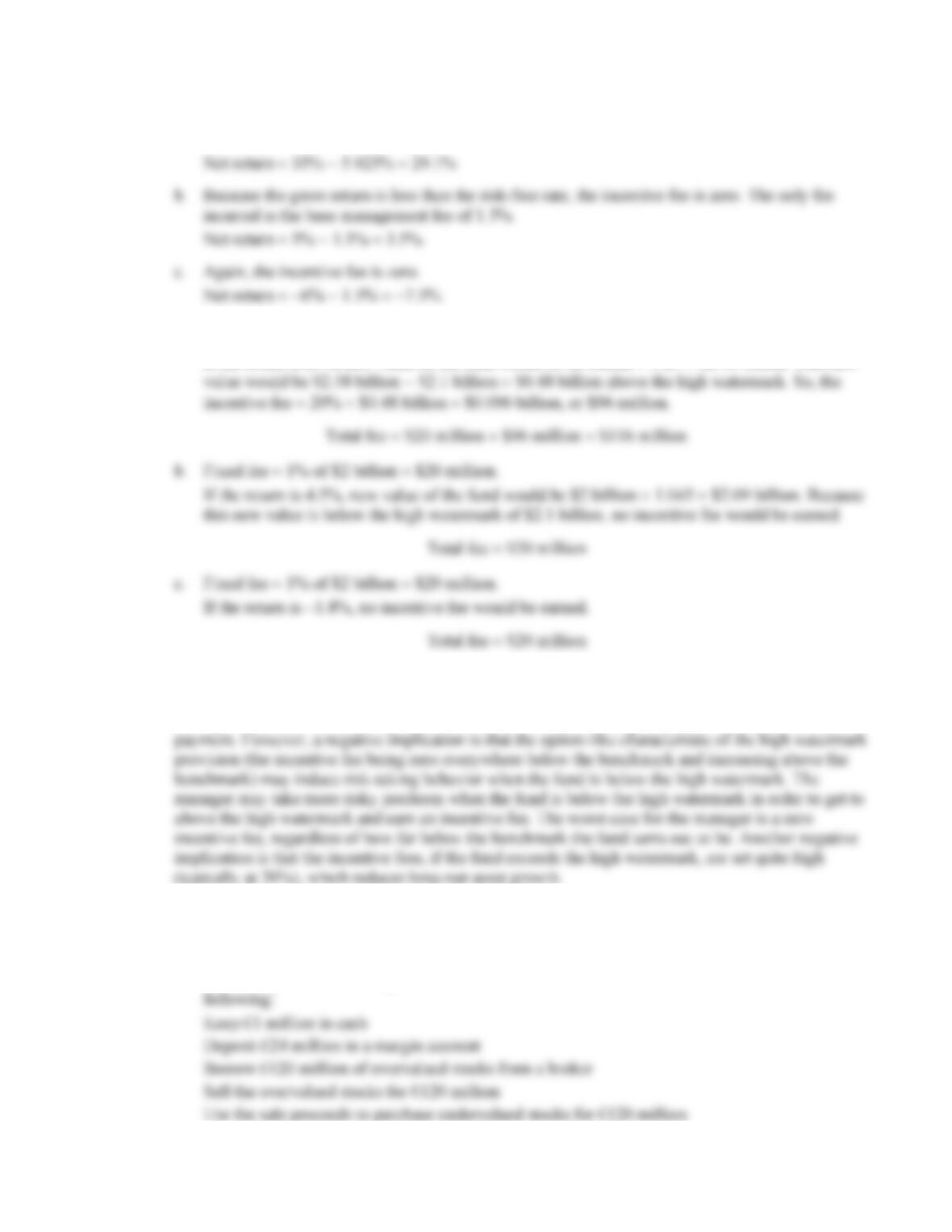
11. a. Fee = 1.5% + 15% (35% − 5.5%) = 1.5% + 4.425% = 5.925%.
12. a. Fixed fee = 1% of $2 billion = $20 million.
If the return is 29%, new value of the fund would be $2 billion 1.29 = $2.58 billion. This new
13. Clearly, the high watermark provision has the positive implication for the investors that they would
have to pay the manager an incentive fee only when they make a profit. Further, the hedge fund
manager would need to make up any earlier losses before becoming eligible for the incentive fee
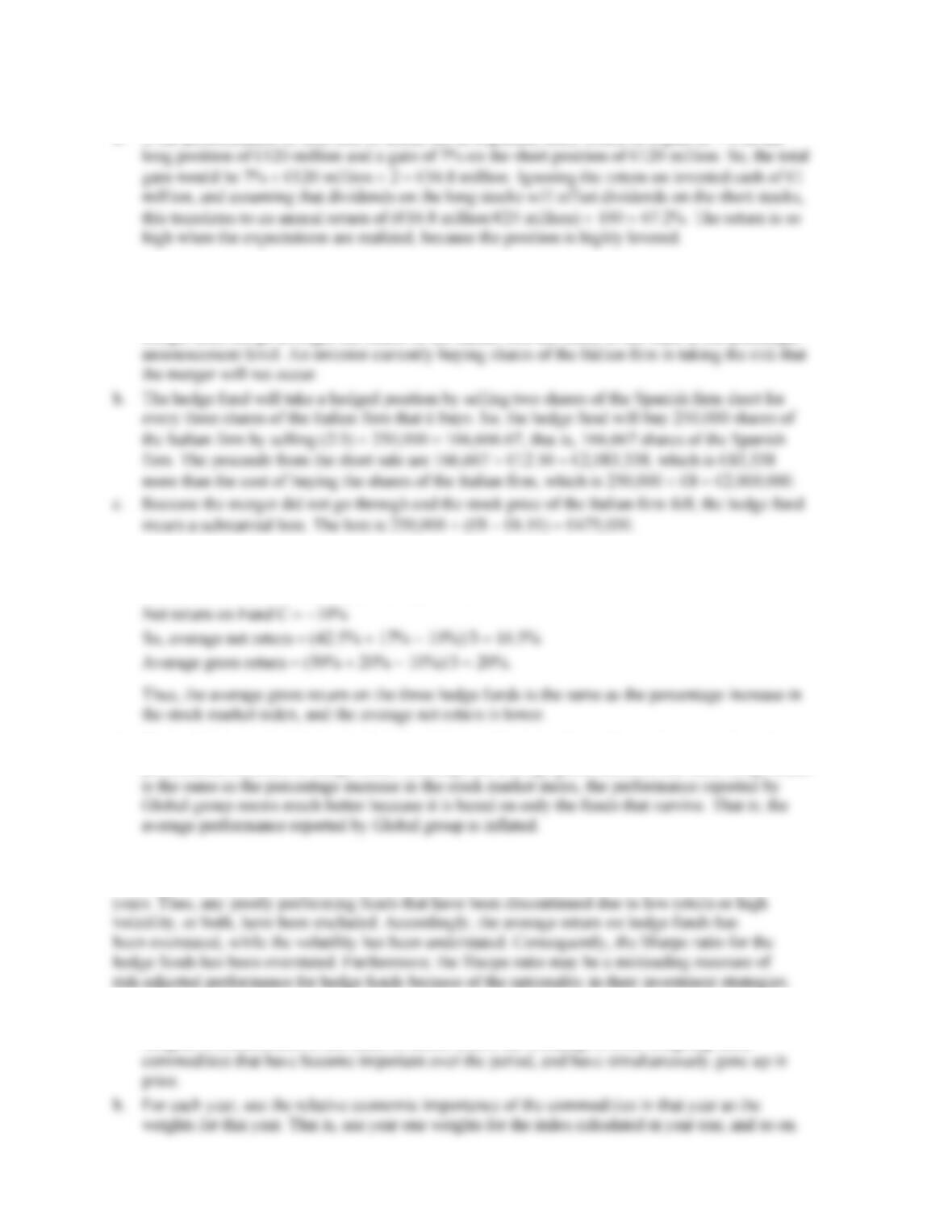
14. a. The hedge fund would sell short the overvalued shares and use the proceeds to buy the
undervalued shares. The fund has €25 million − €1 million = €24 million to be used toward cash
margin deposit. Because the cash margin deposit requirement is 20%, the fund could take long
and short positions totalling €24 million/0.20 = €120 million. So, the fund would do the
46 Solnik/McLeavey • Global Investments, Sixth Edition
b. If the performances of both lists of stocks are as expected, there would be a gain of 7% on the
15. a. The Spanish firm will give two of its shares, which are worth €25, for three of the Italian firm’s
shares, which are worth €24. Thus, the shares of the Italian firm are trading at a discount. The
reason for the discount is that there is a possibility that the merger may not go through. If the
merger does not go through, the shares of the Italian firm are likely to fall back to the premerger
16. a. Net return on Fund A = 50% (1 − 0.15) = 42.5%
Net return on Fund B = 20% (1 – 0.15) = 17%
b. The publicity campaign launched by Global group illustrates the problem of survivorship bias in
performance measure of hedge funds. Although the average gross return on the three hedge funds
17. The measurement of the performance of the hedge funds suffers from survivorship bias. The 90 hedge
funds that the analyst has examined include only those funds that have survived during the last 10
18. a. The construction of the index is okay in year 10 but not in the earlier years. By using today’s
weights in construction of the index in earlier years, the exchange is over-weighing those
Chapter 8 Alternative Investments 47
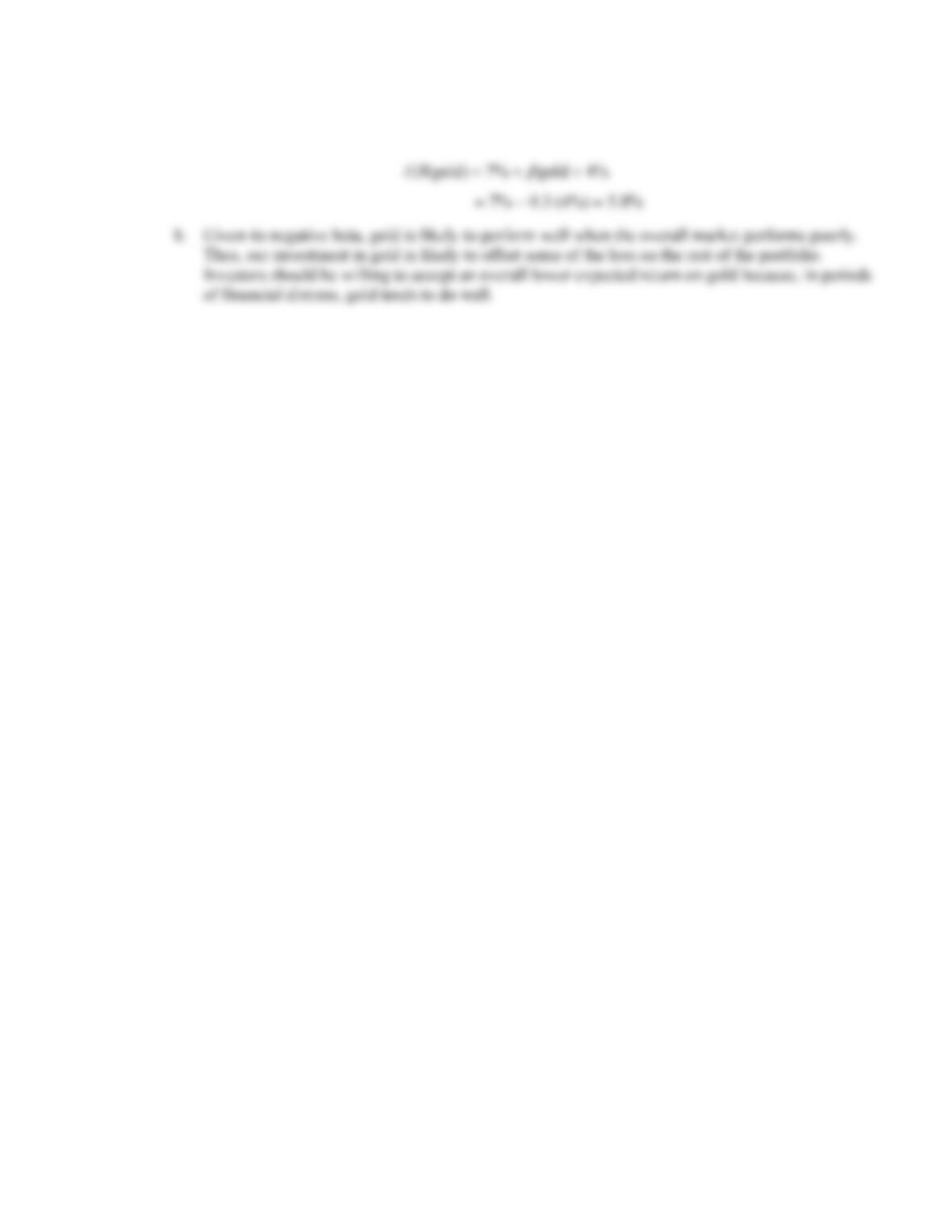
19. a. The expected return on gold, as theoretically derived by the CAPM, is