Chapter 08: Sources of Short-Term Financing
Chapter 8
Sources of Short-Term Financing
Discussion Questions
8-1.
Under what circumstances would it be advisable to borrow money to take a
cash discount?
It is advisable to borrow in order to take a cash discount when the cost of
borrowing is less than the cost of foregoing the discount. If it cost us
36 percent to miss a discount, we would be much better off finding an
alternate source of funds for 8 to 10 percent.
8-2.
Discuss the relative use of credit between large and small firms. Which group
is generally in the net creditor position, and why?
Larger firms tend to be in a net creditor position because they have the
financial resources to be suppliers to credit. The smaller firm must look to the
larger manufacturer or wholesaler to help carry the firm’s financing
requirements.
8-3.
How have new banking laws influenced competition?
New banking laws allowed more competition and gave banks the right to
expand across state lines to create larger, more competitive markets.
They also increased bank mergers.
8-4.
What is the prime interest rate? How does the average bank customer fare
in regard to the prime interest rate?
The prime rate is the rate that a bank charges its most creditworthy customers.
The average customer can expect to pay one or two percent (or more) above
prime.
8-5.
What does LIBOR mean? Is LIBOR normally higher or lower than the
U.S. prime interest rate?
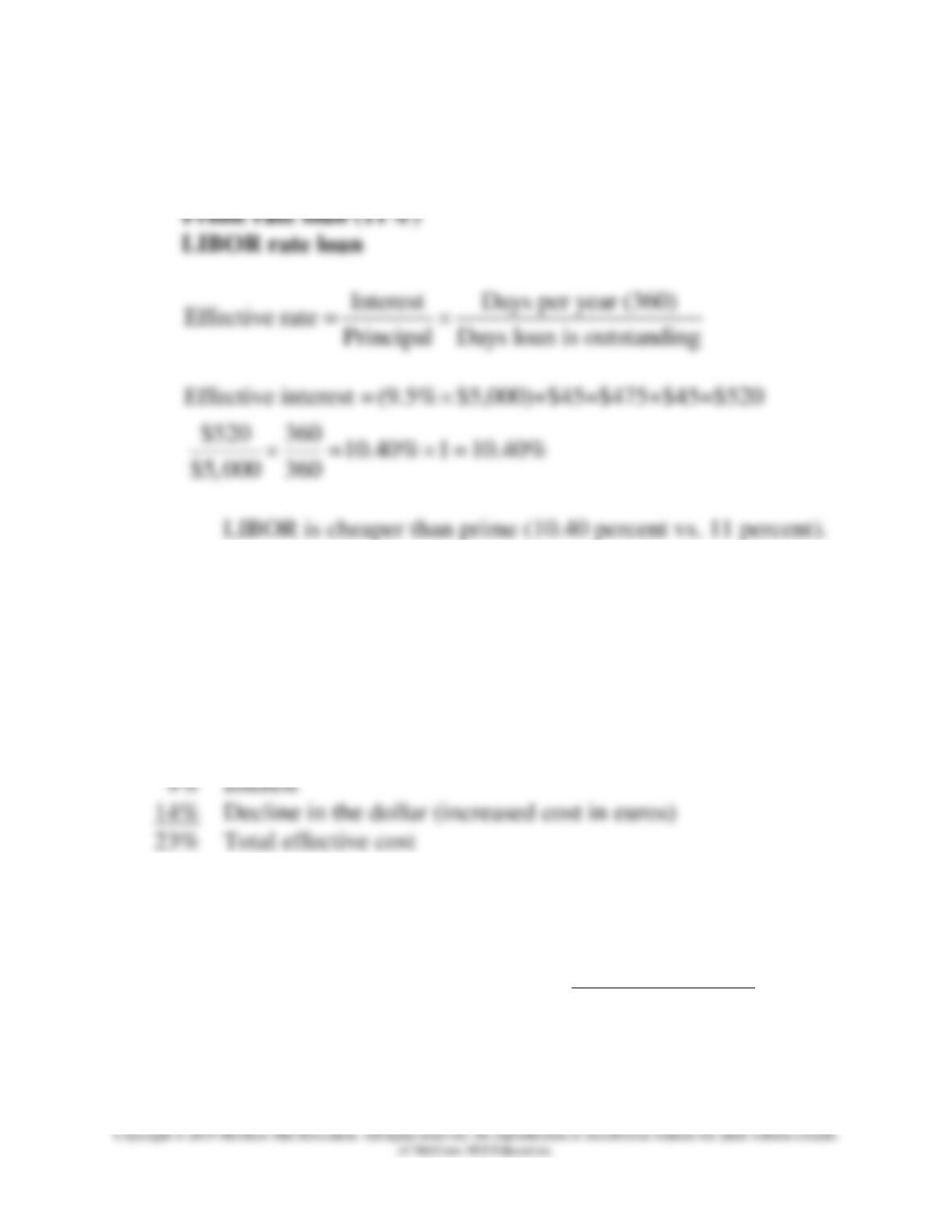
LIBOR stands for London Interbank Offered Rate. As indicated in
Figure 8-1, it is consistently below the prime rate.
Chapter 08: Sources of Short-Term Financing
Chapter 8
Problems
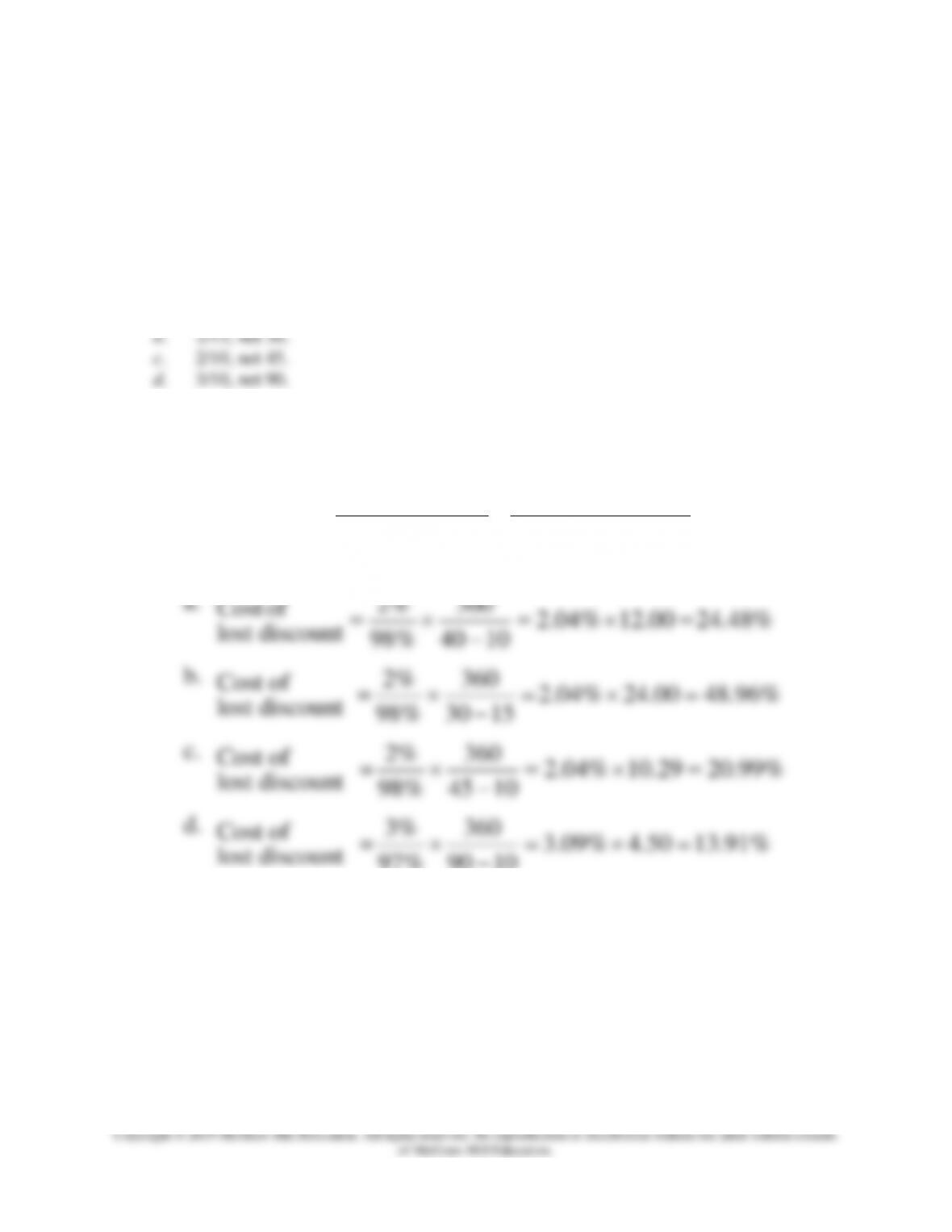
1. Cash discount (LO1) Compute the cost of not taking the following cash discounts.
a. 2/10, net 40.
8-1. Solution:
Cost of not Discount % 360
taking a cash =100% Disc.% Final due date
discount Discount period
−−
Chapter 08: Sources of Short-Term Financing
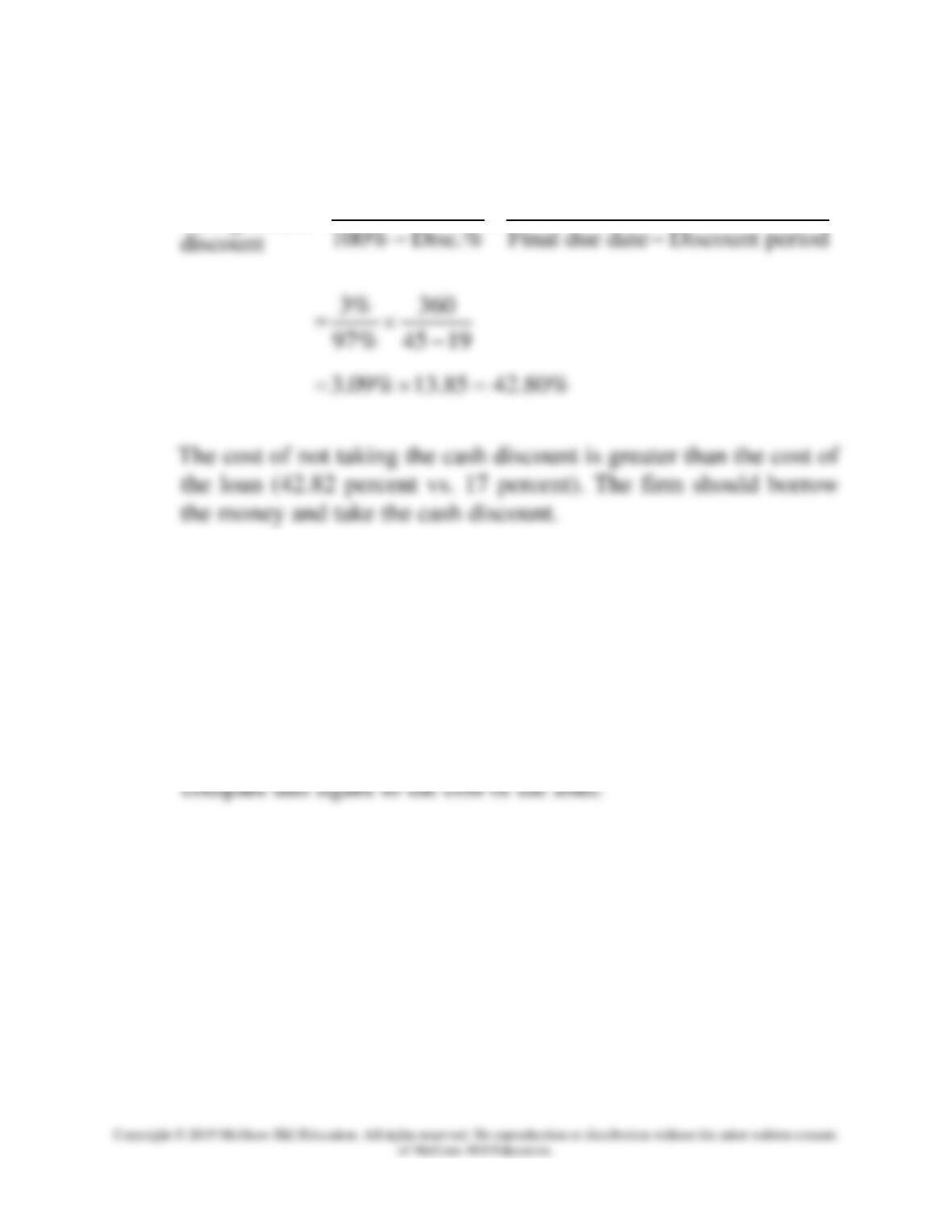
First, compute the cost of not taking the cash discount and
compare this figure to the cost of the loan.
Cost of not Discount% 360
taking a cash =100% Disc.% Final due date Discount period
discount
3% 360
97% 45 19
3.09% 13.85 42.80%
−−
=
−
= =
The cost of not taking the cash discount is greater than the cost of
the loan (42.82 percent vs. 17 percent). The firm should borrow
the money and take the cash discount.
3. Cash discount decision (LO1) Simmons Corp. can borrow from its bank at 17 percent to
take a cash discount. The terms of the cash discount are 1.5/10, net 45. Should the firm
borrow the funds?
8-3. Solution:
Simmons Corporation
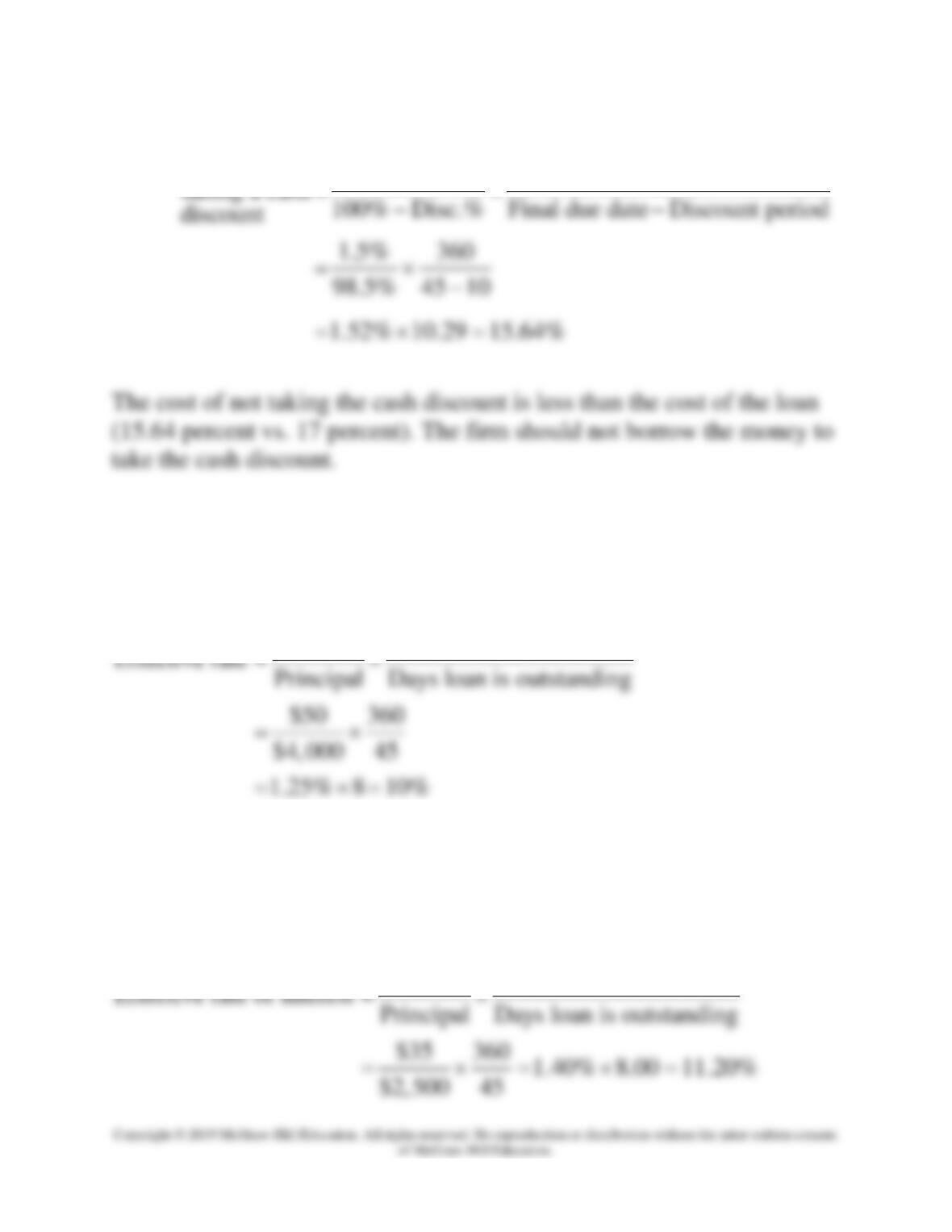
First, compute the cost of not taking the cash discount and
Chapter 08: Sources of Short-Term Financing
Cost of not Discount% 360
taking a cash =100% Disc.% Final due date Discount period
discount
1.5% 360
98.5% 45 10
1.52% 10.29 15.64%
−−
=
−
= =
The cost of not taking the cash discount is less than the cost of the loan
(15.64 percent vs. 17 percent). The firm should not borrow the money to
take the cash discount.
4. Effective rate of interest (LO2) Your bank will lend you $4,000 for 45 days at a cost of
$50 interest. What is your effective rate of interest?
8-4. Solution:
Interest Days in the year (360)
Effective rate = Principal Days loan is outstanding
$50 360
$4, 000 45
1.25% 8 10%
=
= =
5. Effective rate of interest (LO2) A pawnshop will lend $2,500 for 45 days at a cost of $35
interest. What is the effective rate of interest?
8-5. Solution:
Interest Days in the year (360)
Effective rate of interest = Principal Days loan is outstanding
$35 360 1.40% 8.00 11.20%
= = =
Chapter 08: Sources of Short-Term Financing
Dr. Ruth
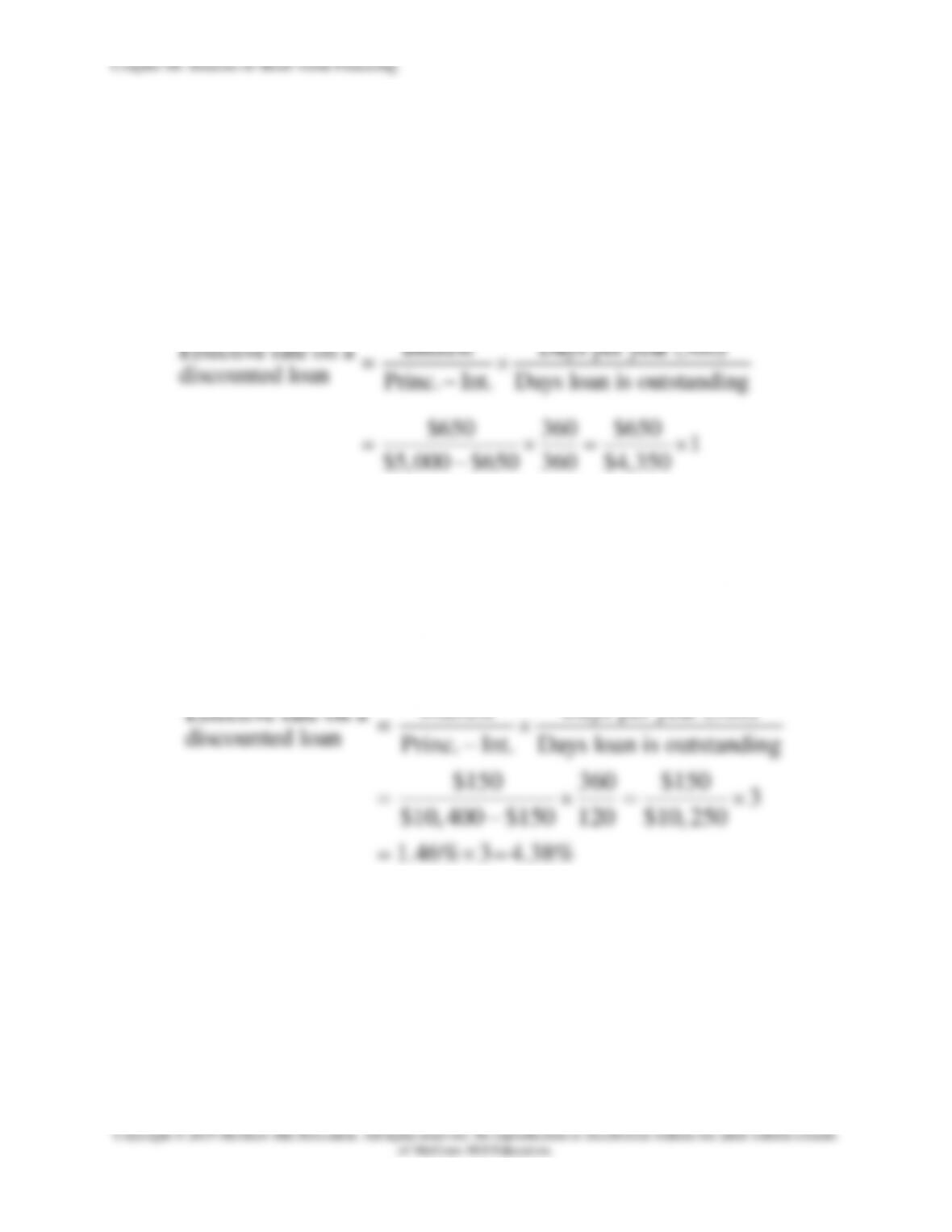
9. Foreign borrowing (LO2) Gulliver Travel Agencies thinks interest rates in Europe are
low. The firm borrows euros at 9 percent for one year. During this time period the dollar
falls 14 percent against the euro. What is the effective interest rate on the loan for one year?
(Consider the 14 percent fall in the value of the dollar as well as the interest payment.)
8-9. Solution:
Gulliver Travel Agencies
10. Dollar cost of a loan (LO2) Talmud Book Company borrows $24,900 for 60 days at 12
percent interest. What is the dollar cost of the loan?
()
Days loan is outstanding
Dollar cost of loan = Amount borrowed × Interest rate ×
Days in the year 360
8-10. Solution:
Chapter 08: Sources of Short-Term Financing
Talmud Book Company
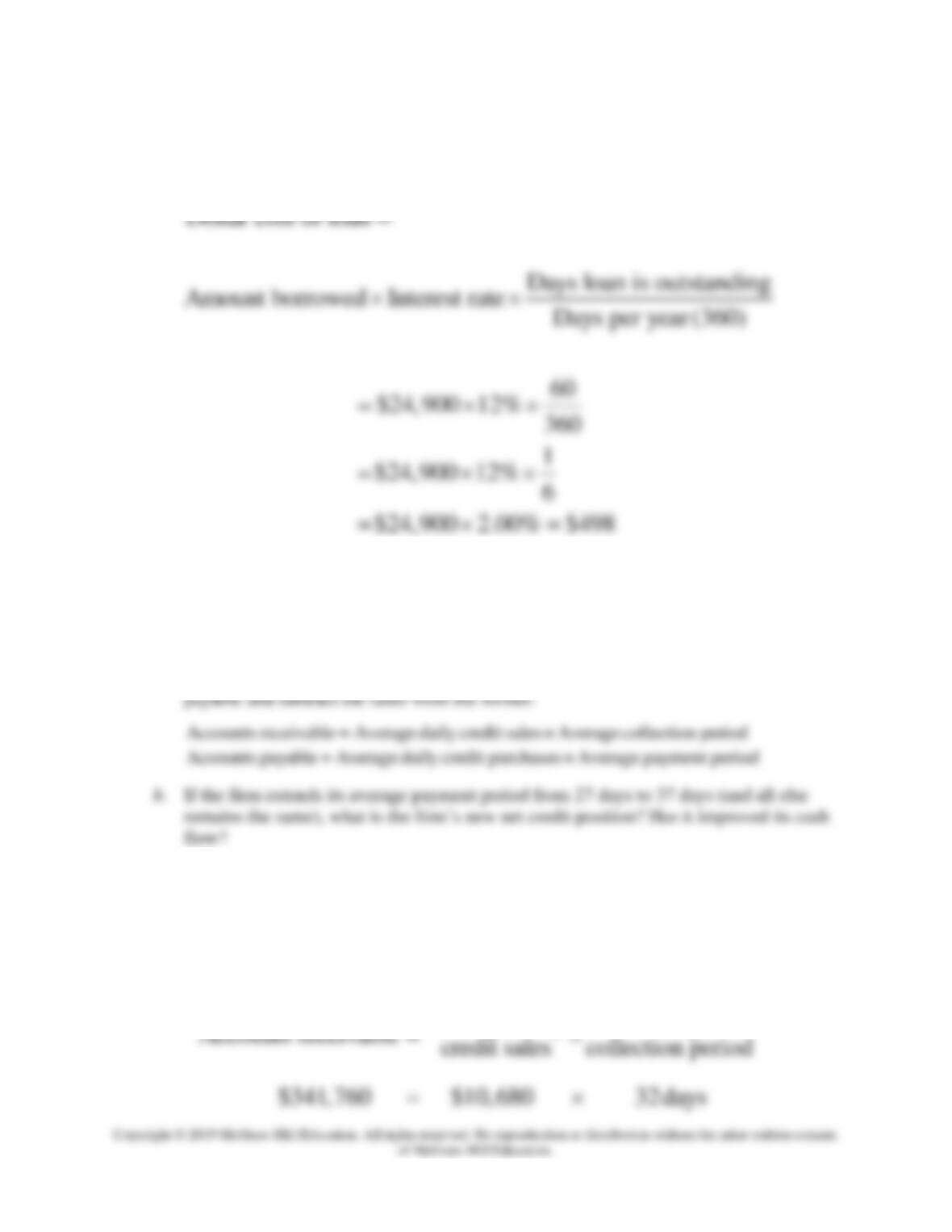
Dollar cost of loan =
Days loan is outstanding
Amount borrowed Interest rate Days per year (360)
60
$24,900 12% 360
1
$24,900 12% 6
$24,900 2.00% $498
=
=
= =
11. Net credit position (LO1) McGriff Dog Food Company normally takes 27 days to pay for
average daily credit purchases of $9,530. Its average daily sales are $10,680, and it collects
accounts in 32 days.
a. What is its net credit position? That is, compute its accounts receivable and accounts
8-11. Solution:
McGriff Dog Food Company
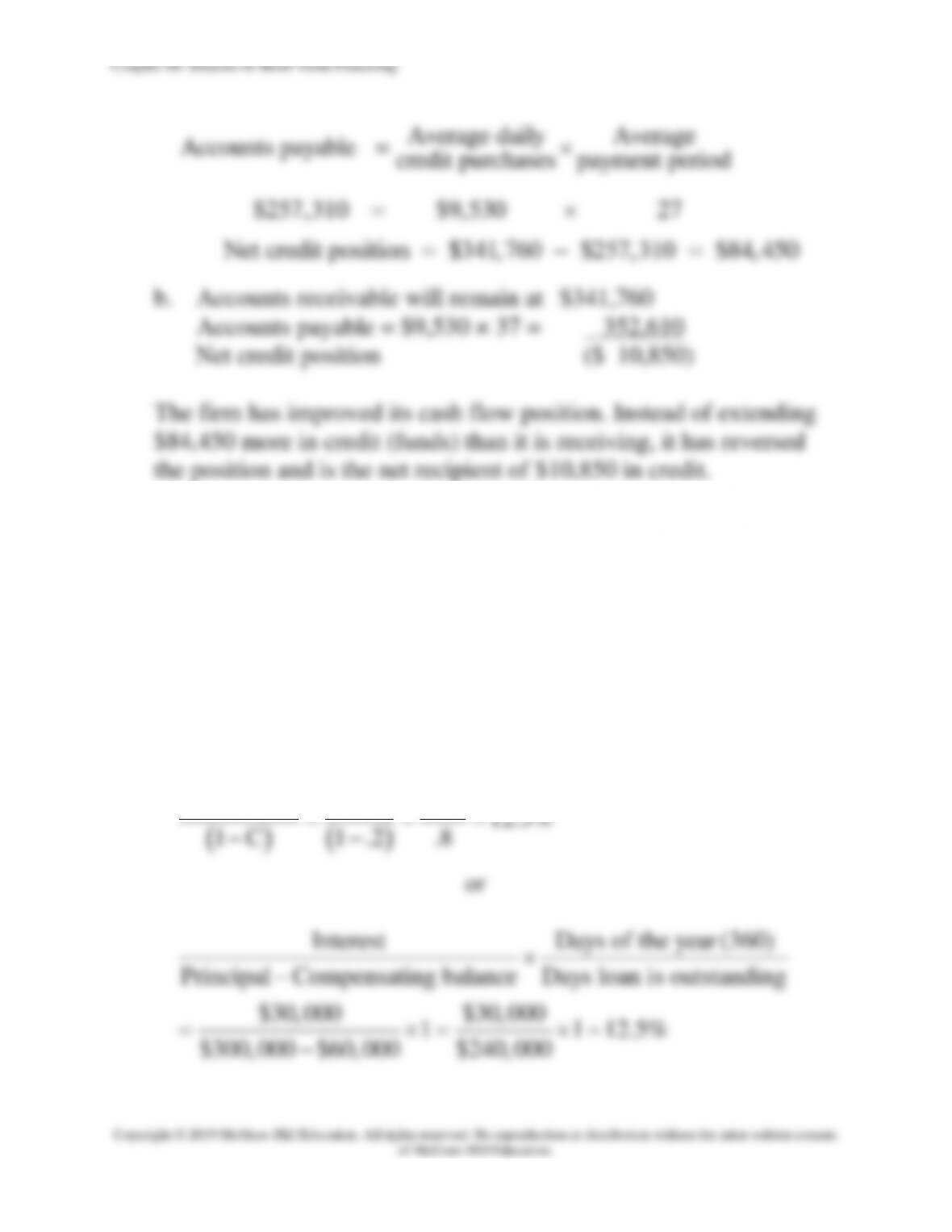
a. Net credit position = Accounts receivable – Accounts payable
Average daily Average
Accounts receivable = credit sales collection period
$341,760 $10,680 32days
=