Chapter 7
Lesson 7-1 Tax Tables,
Worksheets, and Schedules
Check Your Understanding (Example 1)
Check Your Understanding (Example 2)
By looking at the 25% tax bracket, the base tax is
$8,962.50. This is added to 25% of the amount
$65,100.
1,605 + 0.15x – 2,407.50 = 8,962.50
x = 65,100
Check Your Understanding (Example 3)
(a) = taxable income, $118,675
= $22,356.25
Extend Your Understanding (Example 3)
(a) = taxable income, x
Applications
1. When you think of smart people, you may think
2a. $57,723 is at least $57,700 but less than
2b. $60,950 is at least $60,950 but less than
2c. $63,999 is at least $63,650 but less than
$64,000. The tax in the ‘married filing jointly’
column is $8,794.
2d. $57,521 is at least $57,500 but less than
$57,550. The tax in the ‘married filing separately’
column is $10,725.
3a. $60,124 is at least $60,100 but less than
4a. $57,555 is at least $57,550 but less than
$57,600. In interval notation, this is
$57,750 ≤ i < $57,600.
4b. $63,411 is at least $63,400 but less than
4c. $60,002 is at least $60,000 but less than
4d. $63,301 is at least $63,300 but less than
5a. From the table, the row where the ‘head of
household’ column contains $9,406 the taxable
5b. From the table, the row where the ‘single’
5c. From the table, the row where the ‘single’
column contains $11,538 the taxable income is
at least $60,750 but less than $60,800.
5d. From the table, the row where the ‘married filing
$60,650.
5e. From the table, the row where the ‘married filing
6a.$400,000 is over $357,700.
6b. $10,954 is over 0 but not over $11,450.
6c. $108,962 is over $43,650 but not over $112,650.
6d. $201,102 is over $182,400 but not over
$42,755.00 + 0.33($201,102 – $182,400) =
7. By looking at the 25% tax bracket, the base tax
amount over $43,650. When the tax is exactly
$5,975.00, there is no additional amount, so the
8. Try the 28% tax bracket.
23,225 + 0.28(x – 112,650) = 25,000
x ≈ $118,989.29
9. $110,000 is over $43,650 but not over $112,650.
$5,975.00 + 0.25($110,000 – $43,650) =
10. x is over $182,400 but not over $357,700.
11a. $400,000 is over $357,700.
11b. $108,962 is over $100,000 but not over
11d. $106,000 is over $100,000 but not over
12. x is over $357,700.
13c. t is over $182,400 but not over $357,700.
$32,396 – $8,317 = $24,079
15. $115,700 is over $112,650 but not over
16. 24,079 = 24,079; the amounts are the same.
17. $27,811 is at least $27,800 but less than
column is $3,601.
19. $3,601 – $3,599.15 = $1.85; the computation
using Schedule Z is less.
20a. 1990:
Exercise 6:
$120,000 is over $112,650 but not over
Lesson 7-2 Modeling Tax
Schedules
Check Your Understanding (Example 1)
Use the fourth row of the table in Example 1.
Check Your Understanding (Example 2)
Check Your Understanding (Example 3)
Use the equation in the second row of the table in
Check Your Understanding (Example 4)
The maximum income for that equation is
$200,300.
Extend Your Understanding (Example 4)
Applications
2. First interval:
tax schedule notation: Over $0 but not over
$8,025
interval notation: 0 < x ≤ 8,025
compound inequality notation: x > 0 and
compound inequality notation: x > 8,025 and
x ≤ 32,550
Fourth interval:
tax schedule notation: Over $78,850 but not
Fifth interval:
tax schedule notation: Over $164,550 but not
over $357,700
interval notation: 164,550 < x ≤ 357,700
compound inequality notation: x > 357,700
3a. For the 28% tax bracket:
y = 40,052.25 + 0.33(x – 164,550)
3b. The equations demonstrate the transformation
4. There are 3 cases.
5. y = 23,965.50 + 0.31(x – 105,950)
6. There are 6 cases.
When income is over $0 but not over $15,100,
When income is over $188,450 but not over
$336,550, y = 42,170 + 0.33(x – 188,450).
7. Answers will vary.
8. There are 5 cases.
y = 0.15x.
3,802.50 0.28( 25,350) 25,350 61,400
( ) 13,896.50 0.31( 61,400) 61,400 128,100
=+− <≤
== + − <≤
yx x
fx y x x
⎪
⎪
⎨
9. For the 25% tax bracket: y = 0.25x – 4,937.50,
10a. When income is over $71,950 but not over
$150,150:
y = 94,727.75 + 0.35x – 114,257.50;

10b. The partially completed spreadsheet (missing
cells) is shown below.
2 x 28%
(0.28) 0.28x 6,083.50 0.28x –
6,083.50
11a. (0.33x–10635.5)(x≥100150andx<178850)
11b. (0.35x–14212.5)(x≥178850)
12a. (4481.25+0.25(x–32550))(x>32550andx≤65725)
13a. From the graph, when taxable income is
$39,800, tax is $5,449.
increases by about $2,500 for each gridline.
When x is $30,000, y is about $4,500.
13d. The x-axis (taxable income) increases by about
14. $140,000 × 2 = $280,000
$44,828 + 0.33($79,700) = $44,828 + $26,301
= $71,129.
When single, each person’s tax is
$16,056.25 + 0.28($61,150) =
$16,056.25 + $17,122.00 = $33,178.25
Lesson 7-3 Income Statements
Check Your Understanding (Example 1)
Check Your Understanding (Example 2)
for taxes.
Check Your Understanding (Example 3)
Check Your Understanding (Example 4)
$12,200 + $1,000 = $13,200
Applications
1. The intent of Hopkins’s quote was to make a
$8.10 × 40 = $324
2b. $384.75 × 0.062 ≈ $23.85
2c. $384.75 × 0.0145 ≈ $5.58
2d. $23.85 + $5.58 + $61.12 + $21.03 + $6.01
2e. $384.75 – $141.53 = $243.22
2f. $13.05 × 52 = $678.60

3e. $2,203.29 × 0.0365 ≈ $80.42
3f. $2,203.29 – $1,347.34 = $855.95
$855.95 ÷ $2,203.29 ≈ 0.388 ≈ 39%
3g. 100% + 12.5% = 112.5% = 1.125
4. $1,900 + $4,500 = $6,400
$73,094.00 – $6,400 = $66,694
5f. A × C = AC
5g. A × D = AD
0.21B – 0.11B
6c. $74.09 × 18 = $1,333.62
6f. $216 ÷ 18 = $12
6g. $23.95 × 18 = $431.10
$400 × 26 = $10,400
$10,400 × 0.17 = $1,768
9. Box 1 income = x ÷ 0.0145 = 0.0145
x
10. $1,346.76 ÷ 0.0145 = $92,880
11. $40,227 ÷ 0.33 = $121,900
Lesson 7-4 Forms 1040EZ and
1040A
Extend Your Understanding (Example 1)
Line 1 is x.
Check Your Understanding (Example 2)
The tax is lower based on the tax table in the
Extend Your Understanding (Example 3)
Check Your Understanding (Example 4)
Check Your Understanding (Example 5)
Check Your Understanding (Example 6)
Line 26 is 3,500E.
Check Your Understanding (Example 7)
Line 43 is $16,265.
Applications
1. Most people believe that their salary is personal
2. $13,956.95 > $11,874.82, so he will get a
3. $43,871.82 + $15,873.00 + $863.90 + $350.70 +
4a. $712 < $973, so she owes money.
4b. $973 – $712 = $261
5a. $9,873.33 > $8,792.75, so he gets a refund.
6a. $75,431 is at least $75,400 but less than
6b. $14,870 < $15,200, so she owes money and
does not get a refund.
7b. $16,381 < $15,238, so he gets a refund.
7c. $16,381 – $15,238= $1,143
8a. $2,071 > $1,722, so he will get a refund of
9. Line 1 is $21,265.50.
Line 4 (adjusted gross income) is $21,965.50 +
$293 + $0 = $21,558.50, which rounds to
Lines 8a-9 are blank.
Line 11 (tax due) is $1,493.
10. Line 2 (Box for Married filing jointly) is checked.
Line 6a (Box for Yourself) is checked.
Line 6b (Box for Spouse) is checked.
Lines 10–14b are blank.
Line 15 (total income) is $116,463 + $1,287.43
+ $976 = $118,726.43, which rounds to
Line 22 is $118,726.
Line 23 has no boxes checked.
Line 24 is $10,900.
Line 25 is $118,726 – $10,900 = $107,826.
Lines 29–34 and 36 are blank.
Lines 35 and 37 (total tax) are $16,144.
11. Line 1 is $42,126.76 + $66,199.00 + $850 =
Line 6 (taxable income) is $110,187 – $17,900 =
$92,287.
Line 7 is $8,198 + $10,245 = $18,443.
Lines 8a-9 are blank.
12. Line 1 is $40,126 + $68,199 = $108,325.
Line 2 is $1,000.
Line 7 is $7,198 + $11,245 = $18,443.
Lines 8a-9 are blank.
Line 10 is $18,443.
13. Line 1 (Box for Single) is checked.
Line 13 is $900.
Lines 14a and 14b are blank.
Line 15 (total income) is $32,619 + $1,300 +
$672 + $900 = $35,491.
The tax in the ‘single’ column is $2,003.
Line 28 (tax due) is $2,003.
14. Line 4 (Box for Head of Household) is checked.
= $47,965.
Line 16 is $250.
Lines 17–19 are blank.
Line 20 is 250.
Line 25 is $47,715 – $8,000 = $39,715.
Line 26 is $3,500 × 3 = $10,500.
Line 27 (taxable income) is $39,715 – $10,500 =
15. Line 2 (Box for Married filing jointly) is checked.
Line 10–14b are blank.
Line 15 (total income) is $109,130 + $500 +
$304 = $109,934.
Lines 16–20 are blank.
Line 26 is $3,500 × 7 = $24,500.
Line 27 (taxable income) is $99,034 – $24,500 =
$74,534.
Lesson 7-5 Forms 1040 and
Schedules A and B
Check Your Understanding (Example 1)
$1,123 < $1,500, so the family does not have to
Check Your Understanding (Example 2)
Check Your Understanding (Example 3)
7.5% of the adjusted gross income is 0.075x.
Check Your Understanding (Example 4)
Check Your Understanding (Example 5)
Check Your Understanding (Example 6)
10% of the adjusted gross income is 0.01x.
Check Your Understanding (Example 7)
2% of the adjusted gross income is 0.02a.
Check Your Understanding (Example 8)
$1,236 ÷ 3 = $412
Check Your Understanding (Example 9)
Check Your Understanding (Example 10)
Applications
1. “Taxation without representation” was a battle
Insurance pays for 80% of the expenses, so
$1,140 < $2,654.70, so no deduction is allowed.
3. 7.5%
× $101,598 = 0.075 × $101,598
= $7,619.85
4. $63,110 is at least $63,100 but less than
$63,150. The tax in the ‘single’ column is
$12,125.
$9,538.
$12,125 – $9,538 = $2,587
5. Use the tax computation worksheet on
Page 333.
$147,760 is over $112,650 but not over
rounds to $33,056.
6a. $100,830 – $16,848 = $83,982
6b. $83,982 is at least $83,950 but less than
6c. $13,681 – $2,500 = $11,181
6d. $11,181 – $10,201 = $980
7c. $69,940 – $3,500 = $66,640
7d. $66,440 is at least $66,400 but less than
7g. $69,940 – $6,900 = $63,040
7h. $63,040 is at least $63,000 but less than
7i. $69,940 – $6,900 = $63,040
7j. $63,040 is at least $63,000 but less than
8. Start Form 1040:
Line 2 (Box for Married filing jointly) is checked.
Line 6a (Box for Yourself) is checked.
Line 6b (Box for Spouse) is checked.
Line 6c has 1 dependent listed.
Schedule A:
Line 1 is $1,770 + $2,300 = $4,070
Line 4 is $0 because $4,070 < $8,149.35.
Line 9 is the sum of lines 5–8, which is $7,600.
Line 18 is blank.
Line 19 is $270 + $200 = $470.
Line 24 is $400 + $175 = $575.
Line 25 is $108,658.
Line 28 is blank.
Line 29 has the box for No checked and is
Line 38 is $108,658.
Line 39 is blank.
Line 40 is $14,391.
Line 41 is $108,658 – $14,391 = $94,267.
Line 42 is $3,500 × 3 = $10,500.
9. Start Form 1040:
Schedule B:
Lines 1 and 2 are $1,897.
Lines 3 and 4 are blank. Part III must be
filled out.
Lines 10-21 are blank.
Line 22 is $128,973 + $1,897 + $876
= $131,746.
Line 23 is $400.
Schedule A:
Line 2 is $131,346.
Line 3 is $131,346 × 0.075 = $9,850.95.
Line 4 is $0 because $8,650 < $9,850.95.
Line 5 is $1,096 + $3,215 = $4,311.
Line 6 is $9,213.
is $7,110.
Line 19 is $980 + $700 = $1,680.
Line 20 is $3,450 + $600 – $200 = $3,850;
Line 21 is $1,200.
Line 22 is $395.
Line 28 is blank.
Line 40 is $22,314.
Line 41 is $131,346 – $22,314 = $109,032.
Line 42 is $3,500 × 4 = $14,000.
Line 43 (taxable income) is $109,032 – $14,000
Line 45 is blank.
Line 46 is $16,444.
Lines 47–55 are blank.
Line 56 is $0.
$16,444 < $15,125, so taxes are owed.
Assessment
Really? Really! Revisited
1. Plot the data from page 327. Use 1993 as
Year 1, 1994 as Year 2, etc.
1996: April 26 = 92 (leap year) + 26 = 118
1997: April 28 = 91 + 27 = 118
2000: May 3 = 92 (leap year) + 32 = 124
2001: April 30 = 91 + 29 = 120
2004: April 16 = 92 (leap year) + 15 = 107
2005: April 23 = 91 + 22 = 113
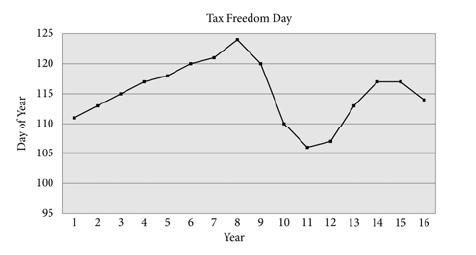
The graph is shown below:
2. Enter the ordered pairs into a graphing
equation of the regression line is y = 0.00185x4
Applications
1. Use the tax computation worksheet on
$182,400.
$120,440 × 0.28 – $8,317 =
2. 7.5% of the adjusted gross income is 0.075y.
3a. $97,642 is at least $97,600 but less than
3b. $95,100 is at least $95,100 but less than
3c. $99,999 is at least $99,950 but less than
3d. $99,002 is at least $99,000 but less than
3e. $97,226 is at least $97,200 but less than
3f. $95,656 is at least $95,650 but less than
4a. $134,786 is over $131,450 but not over
$200,300.
4b. Try the 28% tax bracket.
0.28x – $11,256 = $30,000
0.28x = $41,256
5. y = x × 0.25 – 4,937.50
6. There are 6 cases.
y = 4,481.25 + 0.25(x – 32,550);
y = 12,775 + 0.28(x – 65,725);
When income is over $100,150 but not over
y = 22,414 + 0.33x – 33,049.50;
The piecewise function is
7. 52 × ($50 + $90) = 52 × $140 = $7,280
8. $8,000 × 0.28 = $2,240
9. Medicare tax withheld is $1,405, so total income
$96,900 – $9,800 = $86,100
$86,100 should be in Boxes 1 and 16.
10. Line 2 (Box for Married filing jointly) is checked.
Line 6d = 2 + 3 = 5, so there are 5 exemptions.
Line 7 is $49,000 + $52,000 = $101,000.
Line 8a is $924.78, which rounds to $925.
Line 9a is $1,011.
= $74,536.
$74,536 is at least $74,500 but less than
11. Line 1 is $66,200.
= $58,450.
Line 10 is $9,930.
$58,500. The tax in the ‘single’ column is
12. Start Form 1040:
Line 2 (Box for Married filing jointly) is checked.
Line 6a (Box for Yourself) is checked.
Schedule B:
Lines 1 and 2 are $1,328.
Lines 3 and 4 are blank. Part III must be filled
out.
Schedule A:
Line 1 is $550 + $1,340 + $1,761 + $430
$6,629.
Line 16 is $1,000.
Line 17 is $550 + $150 = $700.
the deduction is $0.
Lines 22–23 are blank.
Line 24 is $1,425.
Line 28 is blank.
Line 29 has the box for No checked and is
Line 39 is blank.
$50,662 is at least $50,650 but less than
$50,700. The tax in the ‘married filing jointly’
Lines 57–60 are blank.
Line 61 is $6,799.