Chapter 7
Global Bond Investing
1. Bonds issued in the United States by a European corporation and denominated in U.S. dollars would
be classified as foreign bonds. The correct answer, accordingly, is (b).
3. a. Both types of bonds would provide some debt reduction for emerging countries. The amount of
debt reduction would be visible immediately in the case of a discount bond. From then on, the
emerging country would pay a market interest rate on the reduced principal. In the case of a par
4. The market price of these bonds is a sum of: (1) the present value of the coupons in yen, with the
discounting done based on the yen interest rate; and (2) the present value of the principal, converted
to yen based on the spot exchange rate, with the discounting done based on the dollar interest rate.
a. If the market interest rate on yen bonds drops significantly—that is, if the yen interest rate
5. a. Full price = Clean price + Accrued interest.
Clean price = 90%.
Chapter 7 Global Bond Investing 37
6. a. Because it is a zero-coupon bond, the YTM, r, is calculated simply as follows:
7. a. In most European markets, the actual YTM would be reported after taking into account that the
coupon frequency is semiannual. Thus, in most European markets, the YTM reported would be
an annual YTM of (1 + 0.08/2)2 – 1 = 0.0816, or 8.16%.
8. a. Simple yield =
Coupon (100 Current price) 1
Current price Current price Years of maturity
−
+
9. a. Expected price change = – 7.5 0.05% = – 0.375%. Given that the time horizon is just the next
few minutes, this is also the expected return over the next few minutes.
38 Solnik/McLeavey • Global Investments, Sixth Edition
10. a. In theory, because U.S. Treasury bonds entail no default risk, a corporate bond’s credit spread
could be measured by comparing its YTM with that of a Treasury bond that has identical cash
flows. However, the problem is that such a Treasury bond will rarely exist. Moreover, the
11. a. The breakeven exchange rate is the forward rate, which can be computed using the interest rate
parity relation. Because the exchange rate is given in £:€ terms, the appropriate expression for the
12. If the interest rate on Swiss francs increases, the bond price will go down. Also, a depreciation of the
Swiss franc relative to the euro is undesirable for the French investor. Finally, the bonds are corporate
bonds with a credit risk. Thus, the correct answer is (e).
13. a. Because the model indicates that the Swiss franc will become stronger relative to the U.S. dollar
than as indicated by the forward rate, the investor would be better off hedging the currency risk.
If he doesn’t hedge, he expects to receive SFr 135 for every US$100 that he gets one year later.
14. The statement is correct. First, within a particular market, the prices of different straight bonds are
highly correlated, because they all tend to move up or down when the interest rate in that market
Chapter 7 Global Bond Investing 39
15. a. The coupon paid on September 1 is based on the rate set on March 1, which is 5%. Because the
coupon is semiannual, the coupon paid is 5% of $1,000/2 = $25.
b. As per the yield curve on September 1, the six-month rate is 4.75%. Thus, the new value of the
16. Under the “freezing” method, the LIBOR is assumed to stay forever at 6%. Under this assumption,
the FRN has an annual fixed coupon of 6.5% (“frozen” LIBOR + original spread). So, the semiannual
17. a. Let x be the coupon rate. The fair interest rate x on the bond should be found by equating the
present yen value of all cash flows to the issue value of ¥150 million. The cash flows are as
follows:
• Coupons in years 1 and 2, of ¥150 x million. The discount rate for these would be the yen
yield.
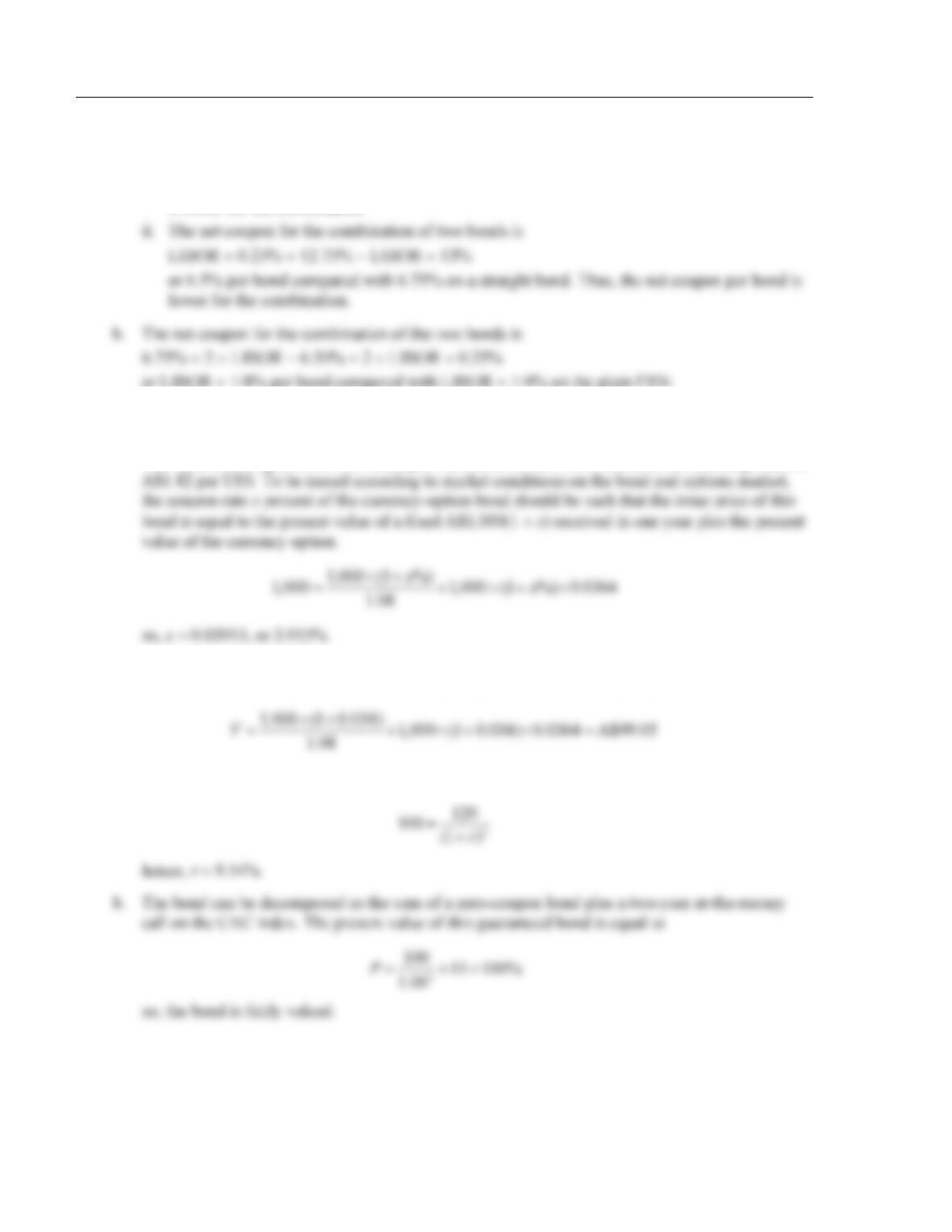
b. Because the coupon is 6% and the face value is 100% of the issue value, the percentage price
can be computed as follows:
40 Solnik/McLeavey • Global Investments, Sixth Edition
18. a. i. The net coupon for the combination of three bonds is
2 (12.75% − LIBOR) + 2 LIBOR − 6.5% = 19%
or 6.333% per bond compared with 6.75% on a straight bond. Thus, the net coupon per bond
is lower for the combination.
or LIBOR + 1/8% per bond compared with LIBOR + 1/4% on the plain FRN.
19. a. The currency-option bond can be replicated by a straight one-year A$ bond redeemed at A$1,000
with an x percent coupon plus an option to exchange A$1,000 (1 + x) for US$1,000(1 + x)/1.82.
The value of the option is 2 U.S. cents per A$, which is A$0.0364, based on the exchange rate of
b. The value of the currency-option bond is the sum of the present value of a straight one-year A$
bond redeemed at A$1,000 with a 3.4% coupon plus the value of the put option on the A$.
20. a. The final payment will be 120. So, the expected yield, r, is given in the following equation: