Chapter 06: Working Capital and the Financing Decision
Chapter 6
Working Capital and the Financing Decision
Discussion Questions
6-1.
Explain how rapidly expanding sales can drain the cash resources of a firm.
Rapidly expanding sales will require a buildup in assets to support the growth.
In particular, more and more of the increase in current assets will be permanent
in nature. A non-liquidating aggregate stock of current assets will be necessary
to allow for floor displays, multiple items for selection, and other purposes. All
of these “asset” investments can drain the cash resources of the firm.
6-2.
Discuss the relative volatility of short- and long-term interest rates.
Figure 6-10 shows the long-run view of short- and long-term interest rates.
Normally, short-term rates are much more volatile than long-term rates.
6-3.
What is the significance to working capital management of matching sales and
production?
If sales and production can be matched, the level of inventory and the amount
of current assets needed can be kept to a minimum; therefore, lower financing
costs will be incurred. Matching sales and production has the advantage of
maintaining smaller amounts of current assets than level production, and
therefore less financing costs are incurred. However, if sales are seasonal or
cyclical, workers will be laid off in a declining sales climate and machinery
(fixed assets) will be idle. Here lies the trade-off between level and seasonal
production: Full utilization of fixed assets with skilled workers and more
financing of current assets versus unused capacity, training and retraining
workers, with lower financing for current assets.
6-4.
How is a cash budget used to help manage current assets?
A cash budget helps minimize current assets by providing a forecast of inflows
and outflows of cash. It also encourages the development of a schedule as to
when inventory is produced and maintained for sales (production schedule), and
accounts receivables are collected. The cash budget allows us to forecast the
level of each current asset and the timing of the buildup and reduction of each.
Chapter 06: Working Capital and the Financing Decision
Chapter 6
Problems
1. Expected value (LO6) Gary’s Pipe and Steel Company expects sales next year to be
$800,000 if the economy is strong, $500,000 if the economy is steady, and $350,000 if the
economy is weak. Gary believes there is a 20 percent probability the economy will be
strong, a 50 percent probability of a steady economy, and a 30 percent probability of a
weak economy. What is the expected level of sales for next year?
6-1. Solution:
Gary’s Pipe and Steel Company
State of
Economy
Sales
Probability
Expected
Outcome
Strong
$800,000
.20
$160,000
Steady
500,000
.50
250,000
Weak
350,000
.30
105,000
Expected level of sales =
$515,000
2. Expected value (LO6) Sharpe Knife Company expects sales next year to be $1,550,000 if
the economy is strong, $825,000 if the economy is steady, and $550,000 if the economy is
weak. Mr. Sharpe believes there is a 30 percent probability the economy will be strong, a
40 percent probability of a steady economy, and a 30 percent probability of a weak
economy. What is the expected level of sales for the next year?
6-2. Solution:
Chapter 06: Working Capital and the Financing Decision
Sharpe Knife Company
State of
Economy
Sales
Probability
Expected
Outcome
Strong
$1,550,000
0.30
$465,000
Steady
825,000
0.40
330,000
Weak
550,000
0.30
165,000
Expected level of sales =
$960,000
3. External financing (LO1) Tobin Supplies Company expects sales next year to be
$500,000. Inventory and accounts receivable will increase $90,000 to accommodate this
sales level. The company has a steady profit margin of 12 percent with a 40 percent
dividend payout. How much external financing will Tobin Supplies Company have to
seek? Assume there is no increase in liabilities other than that which will occur with the
external financing.
6-3. Solution:
Tobin Supplies Company
$500,000 Sales
0.12 Profit margin
60,000 Net income
4. External financing (LO1) Antivirus Inc. expects its sales next year to be $2,500,000.
Inventory and accounts receivable will increase $480,000 to accommodate this sales level.
The company has a steady profit margin of 15 percent with a 35 percent dividend payout.
How much external financing will the firm have to seek? Assume there is no increase in
Chapter 06: Working Capital and the Financing Decision
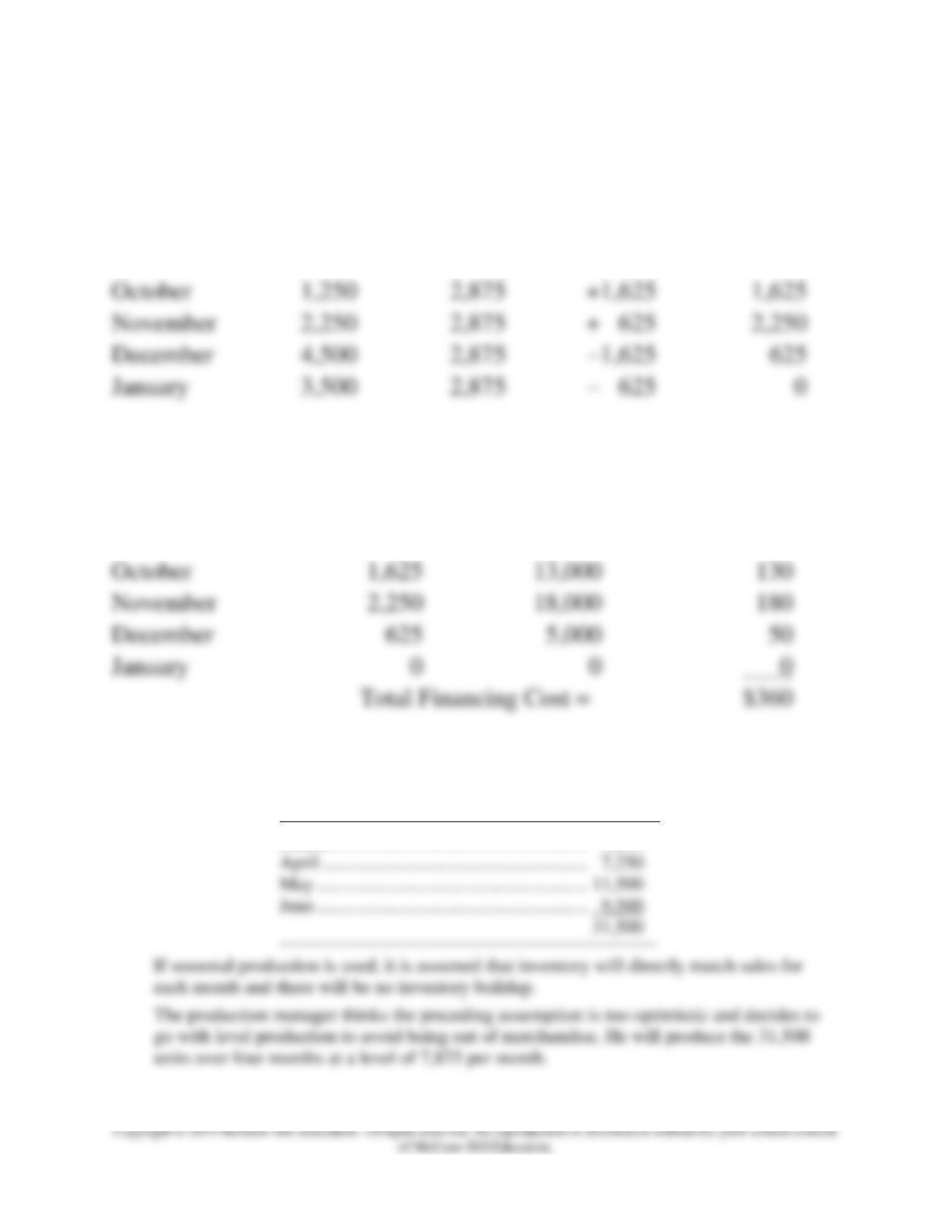
Antonio Banderos and Scarves
a.
Units
Sold
Units
Produced
Change in
Inventory
Ending
Inventory
October
1,250
2,875
+1,625
1,625
November
2,250
2,875
+ 625
2,250
December
4,500
2,875
–1,625
625
January
3,500
2,875
– 625
0
b.
Ending
Inventory
Total Cost
per Unit
($8 per unit)
Inventory
Financing Cost
(at 1% per
month)
October
1,625
13,000
130
November
2,250
18,000
180
December
625
5,000
50
January
0
0
0
Total Financing Cost =
$360
6. Level versus seasonal production (LO1) Bambino Sporting Goods makes baseball gloves
that are very popular in the spring and early summer season. Units sold are anticipated as
follows:
March ………………………………………………. 3,250
Chapter 06: Working Capital and the Financing Decision
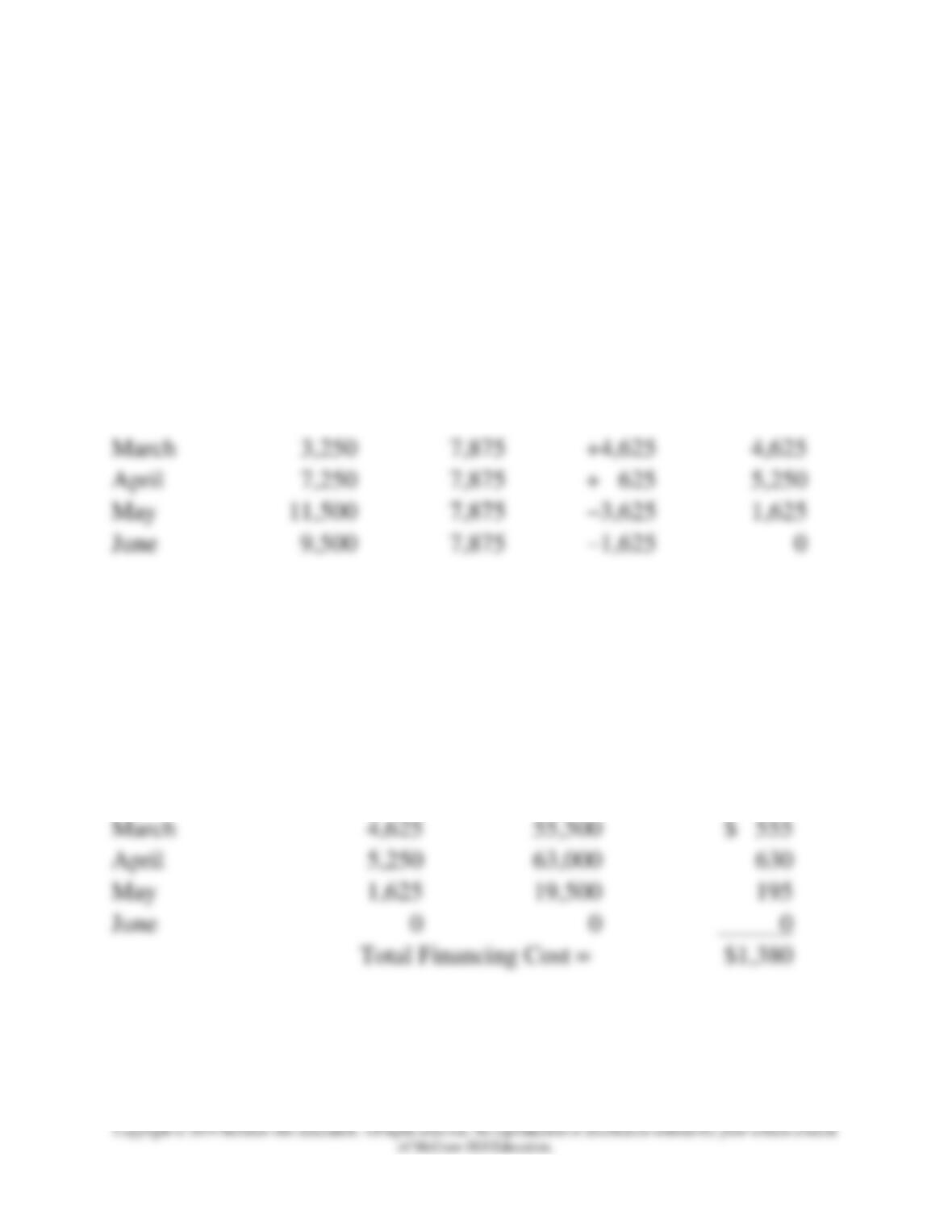
a. What is the ending inventory at the end of each month? Compare the unit sales to the
units produced and keep a running total.
b. If the inventory costs $12 per unit and will be financed at the bank at a cost of 12
percent, what is the monthly financing cost and the total for the four months? (Use 0.01
as the monthly rate.)
6-6. Solution:
Bambino Sporting Goods
a.
Units
Sold
Units
Produced
Change in
Inventory
Ending
Inventory
March
3,250
7,875
+4,625
4,625
April
7,250
7,875
+ 625
5,250
May
11,500
7,875
–3,625
1,625
June
9,500
7,875
–1,625
0
6-6. (Continued)
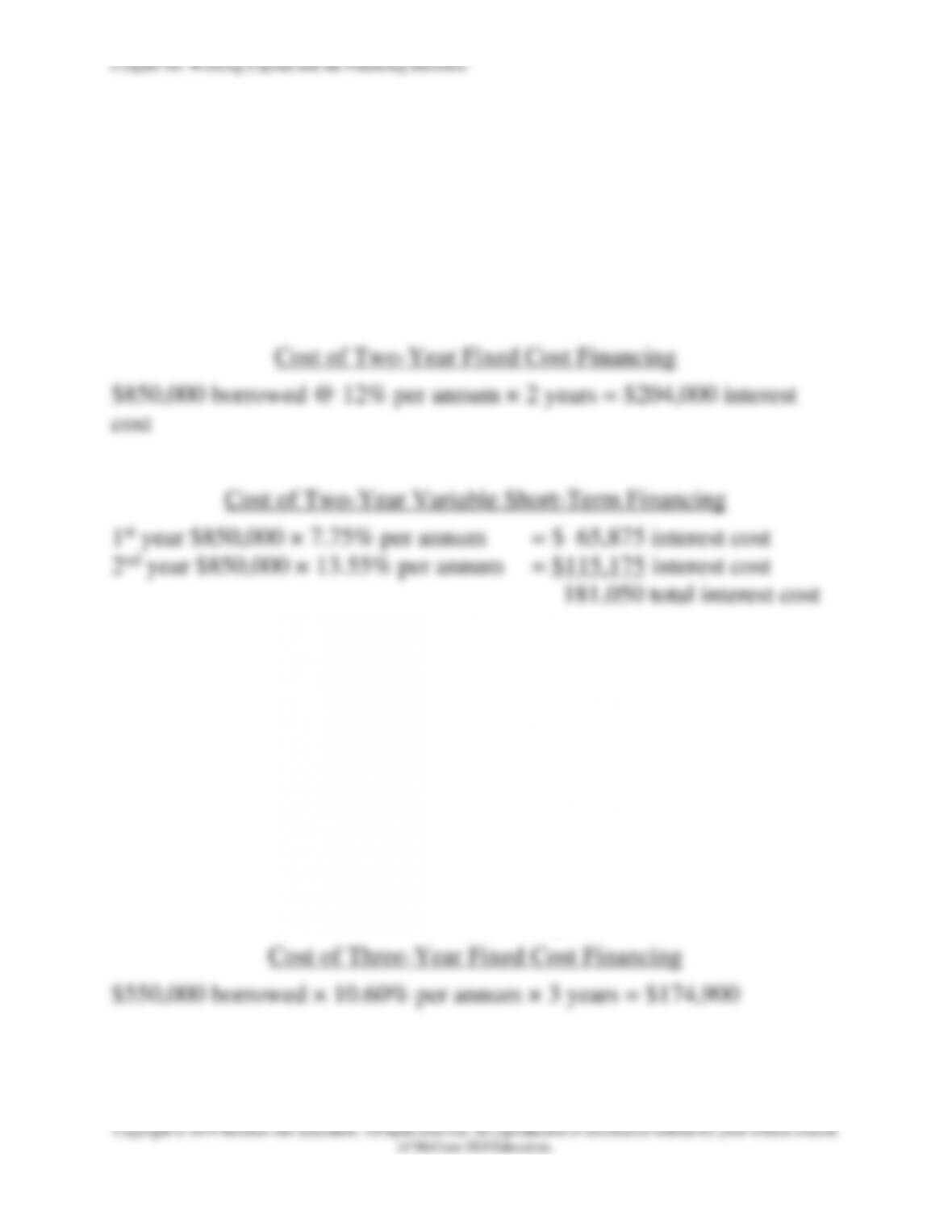
b.
Ending
Inventory
Total Cost
($12 per unit)
Inventory
Financing Cost
(at 1% per
month)
March
4,625
55,500
$ 555
April
5,250
63,000
630
May
1,625
19,500
195
June
0
0
0
Total Financing Cost =
$1,380
Chapter 06: Working Capital and the Financing Decision
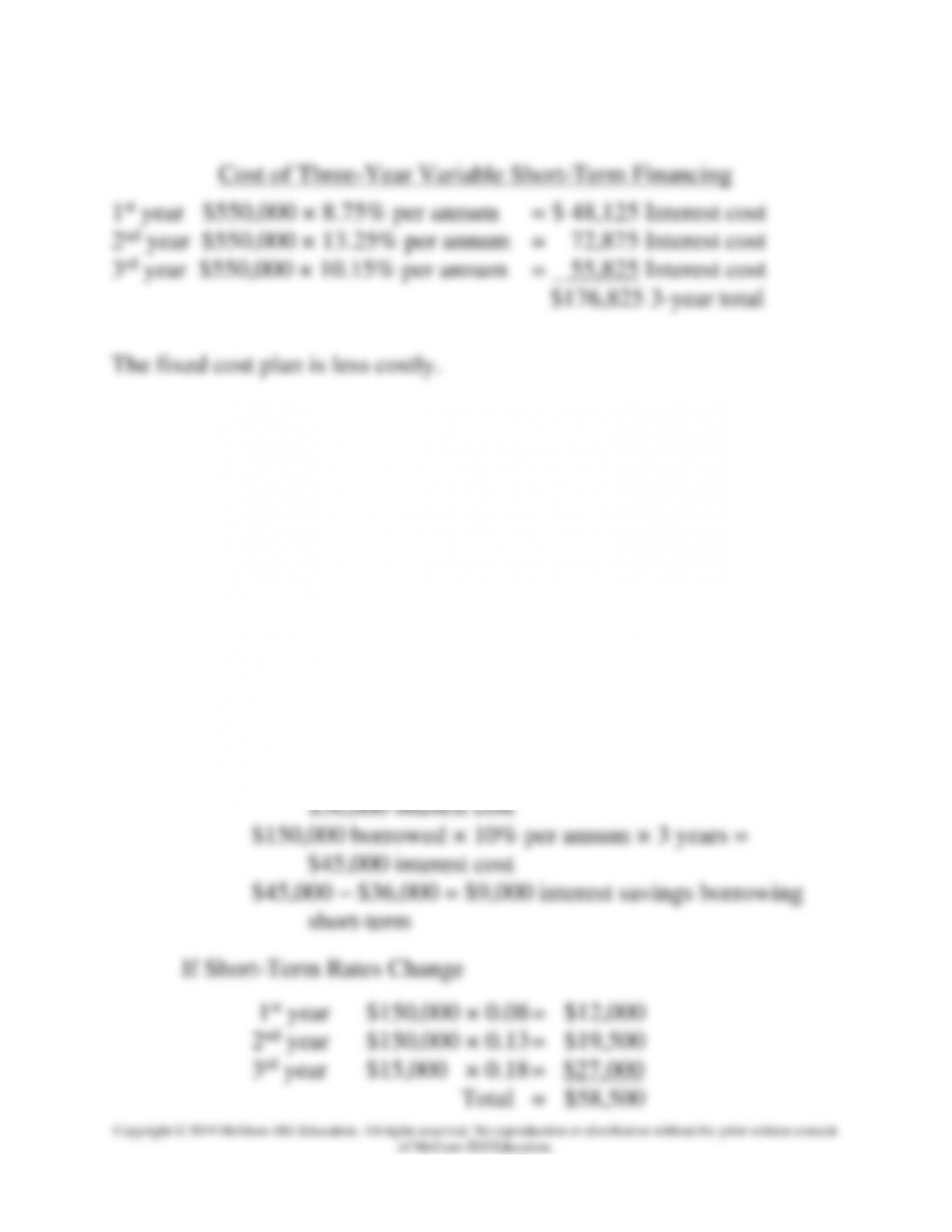
9. Short-term versus longer-term borrowing (LO3) Sauer Food Company has decided to
buy a new computer system with an expected life of three years. The cost is $150,000. The
company can borrow $150,000 for three years at 10 percent annual interest or for one year
at 8 percent annual interest.
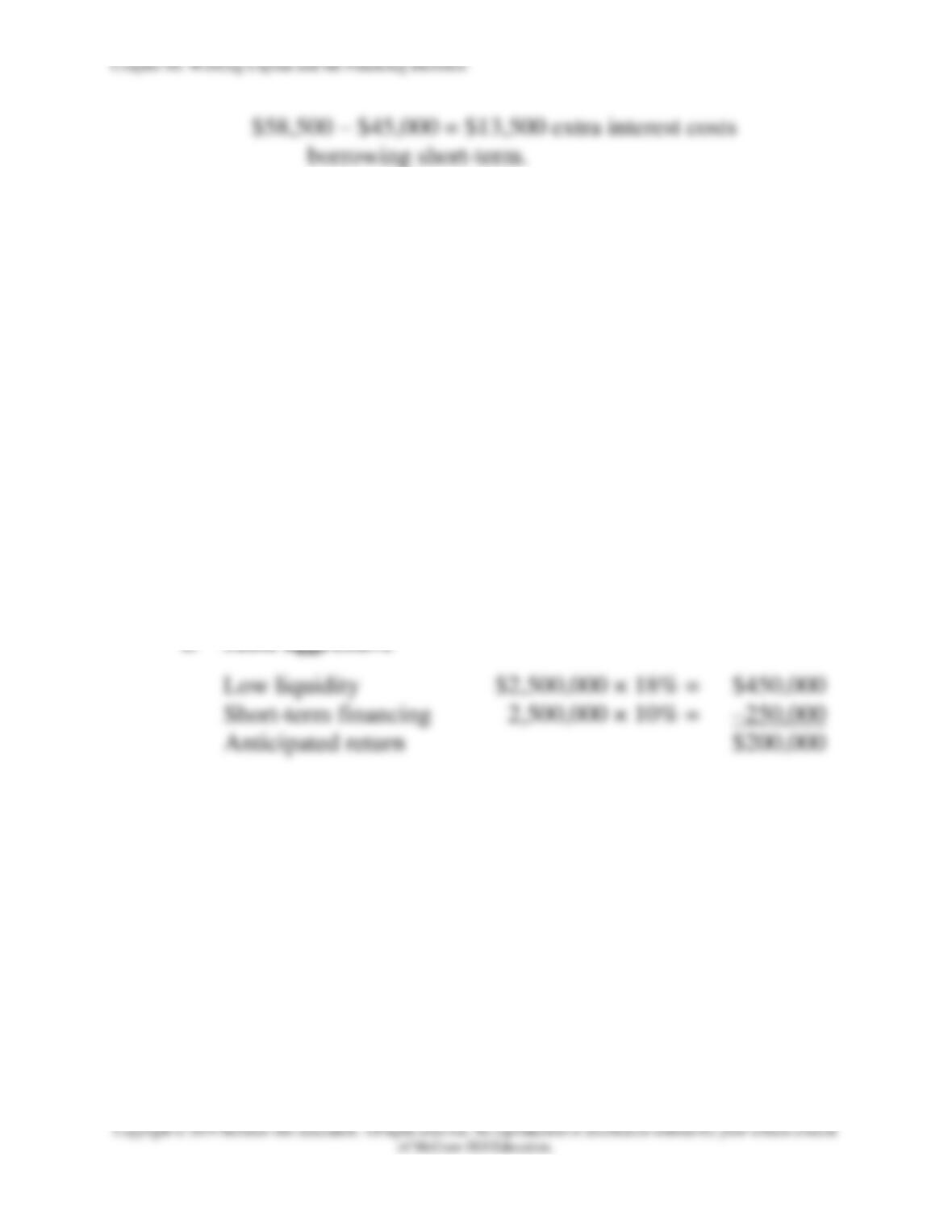
How much would Sauer Food Company save in interest over the three-year life of the
computer system if the one-year loan is utilized and the loan is rolled over (reborrowed)
each year at the same 8 percent rate? Compare this to the 10 percent three-year loan. What
if interest rates on the 8 percent loan go up to 13 percent in year 2 and 18 percent in year 3?
What would be the total interest cost compared to the 10 percent, three-year loan?
6-9. Solution:
Sauer Food Company
If Rates Are Constant
$150,000 borrowed × 8% per annum × 3 years =
Chapter 06: Working Capital and the Financing Decision
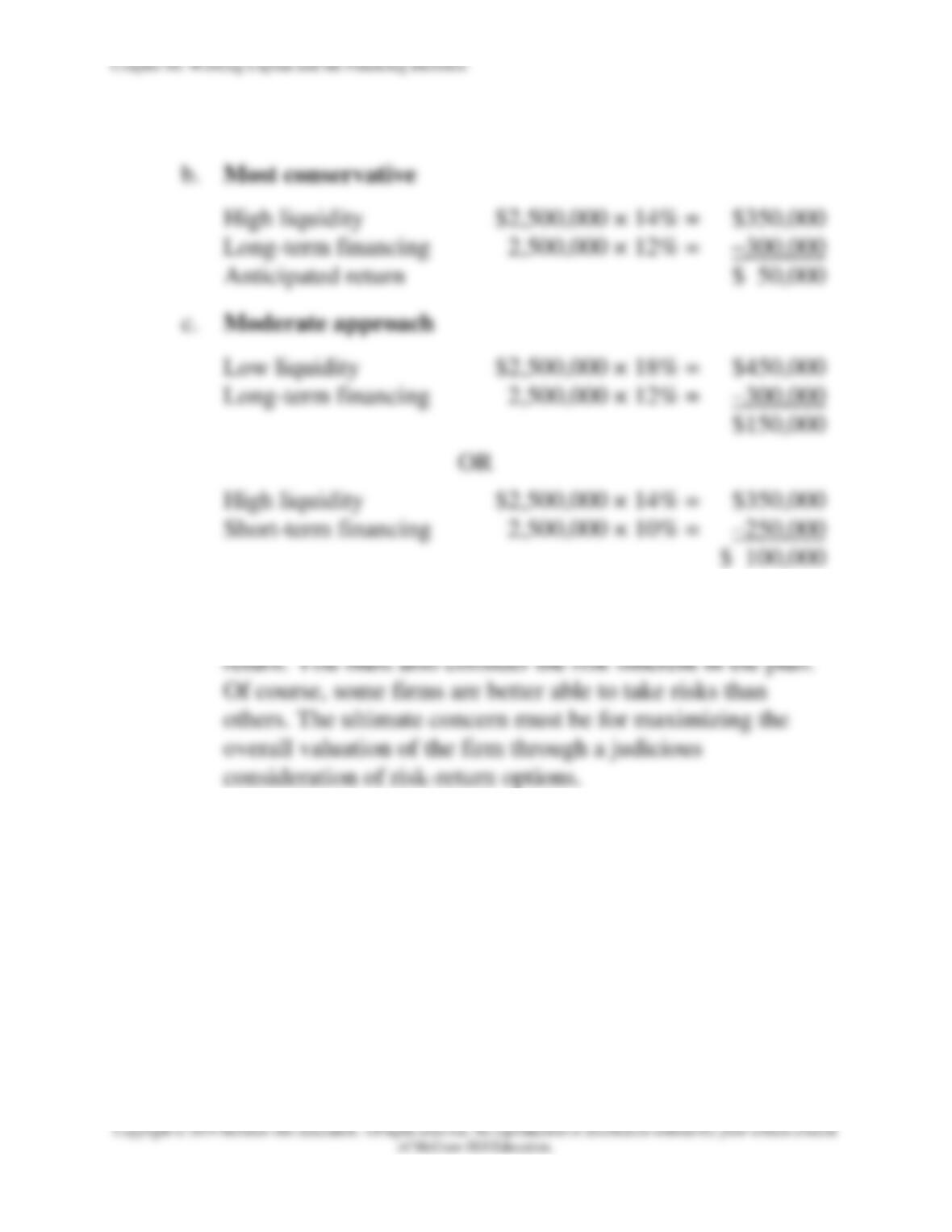
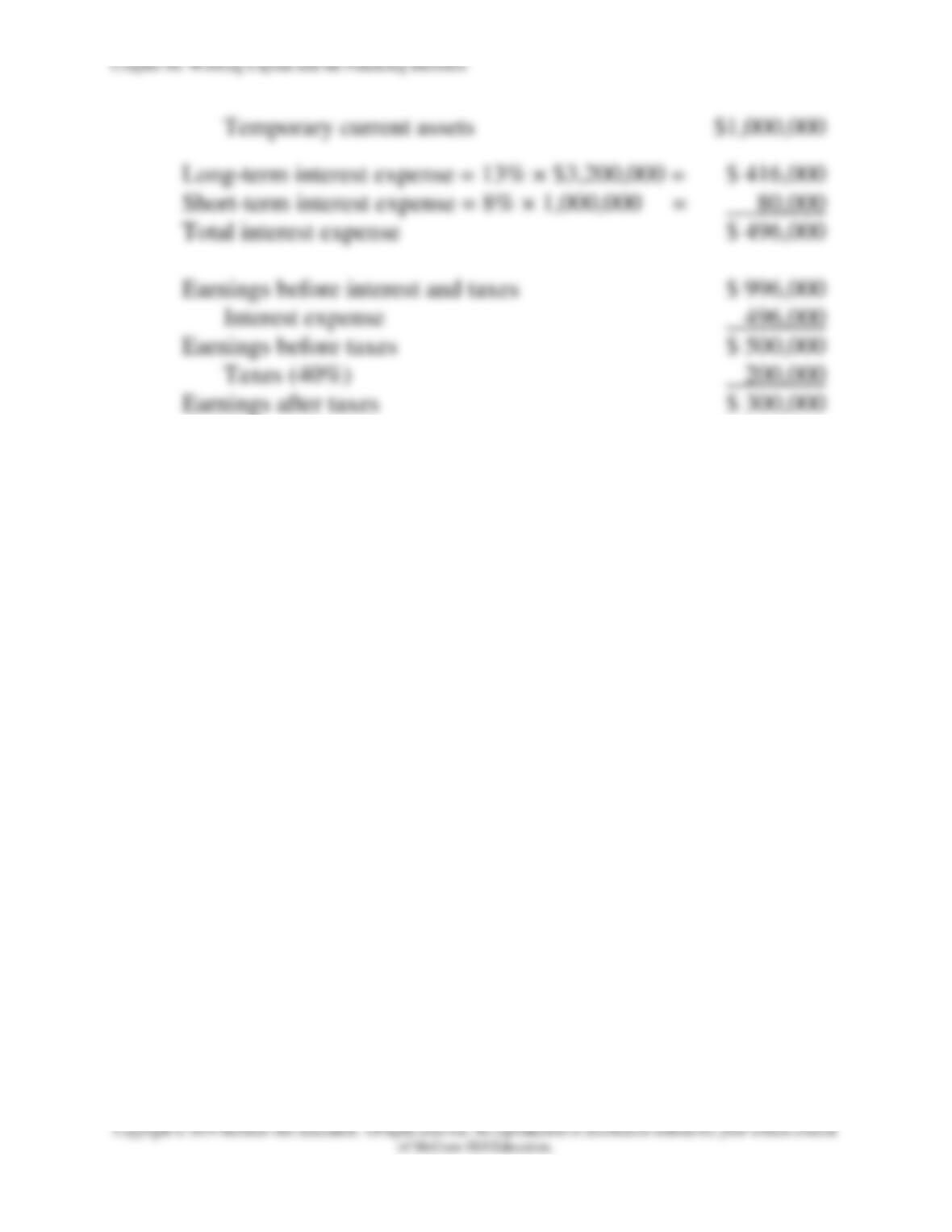
d. If the firm used the most aggressive asset-financing mix described in part a and had the
anticipated return you computed for part a, what would earnings per share be if the tax
rate on the anticipated return was 30 percent and there were 20,000 shares outstanding?
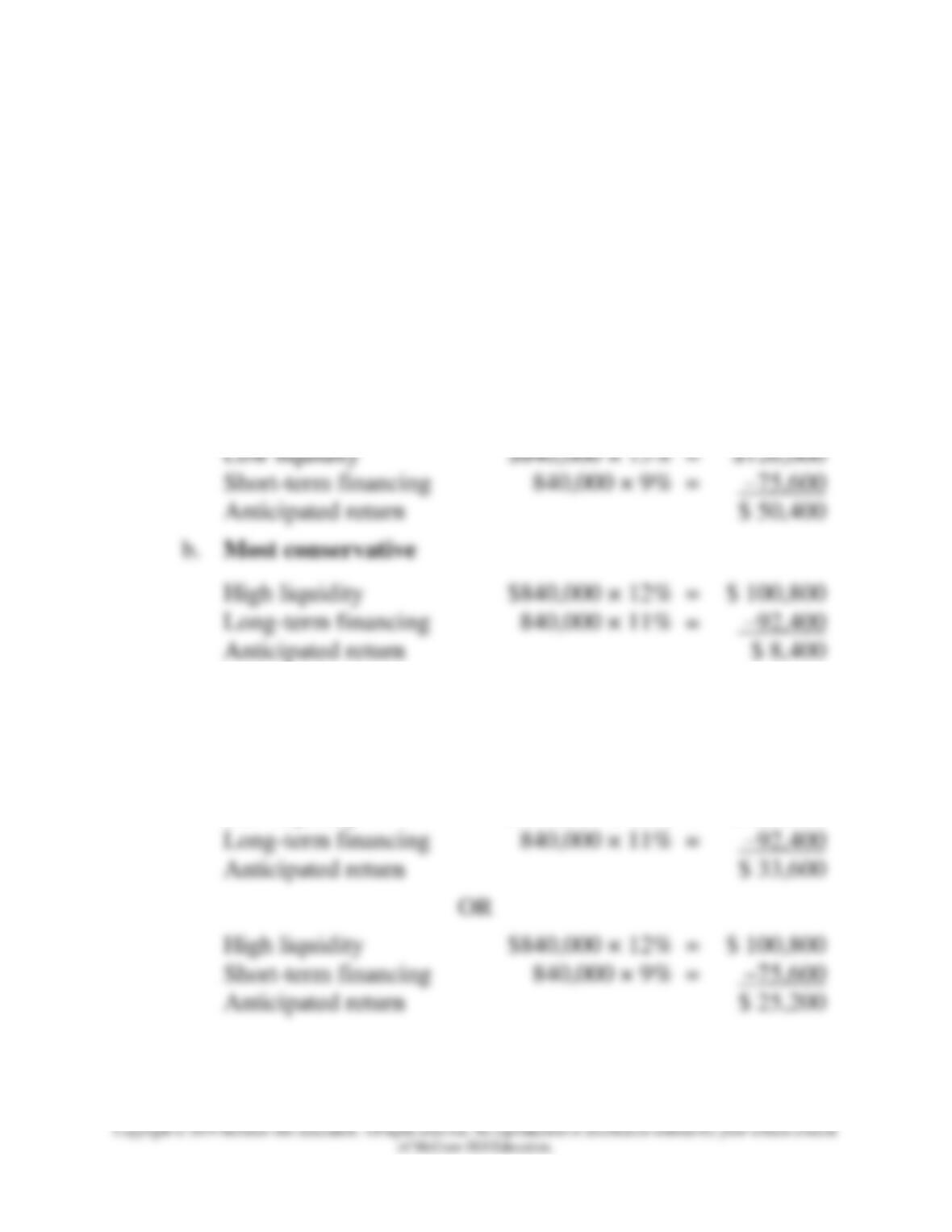
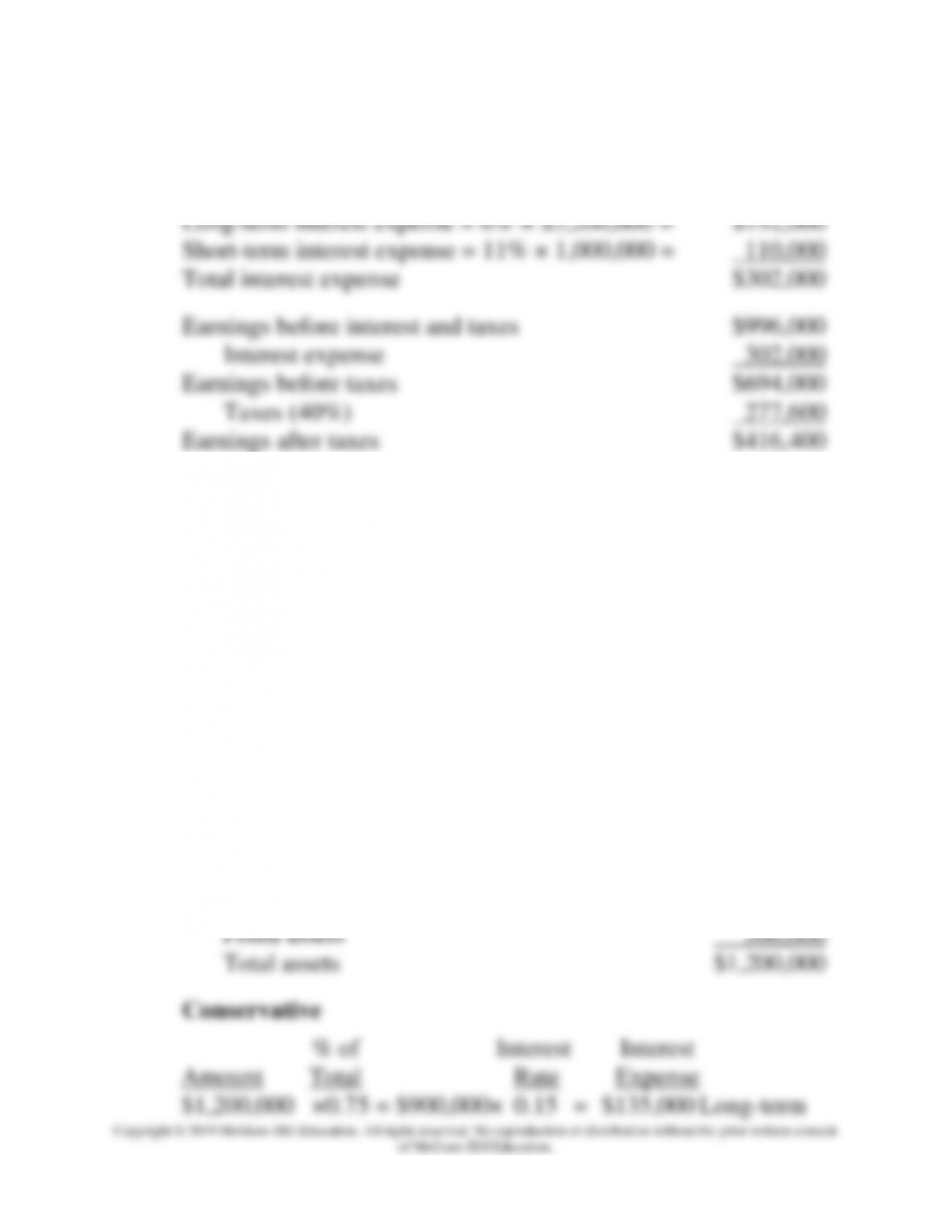
e. Now assume the most conservative asset-financing mix described in part b will be
utilized. The tax rate will be 30 percent. Also assume there will only be 5,000 shares
outstanding. What will earnings per share be? Would it be higher or lower than the
earnings per share computed for the most aggressive plan computed in part d?
6-11. Solution:
Atlas Sporting Goods Inc.
a. Most aggressive
6-11. (Continued)
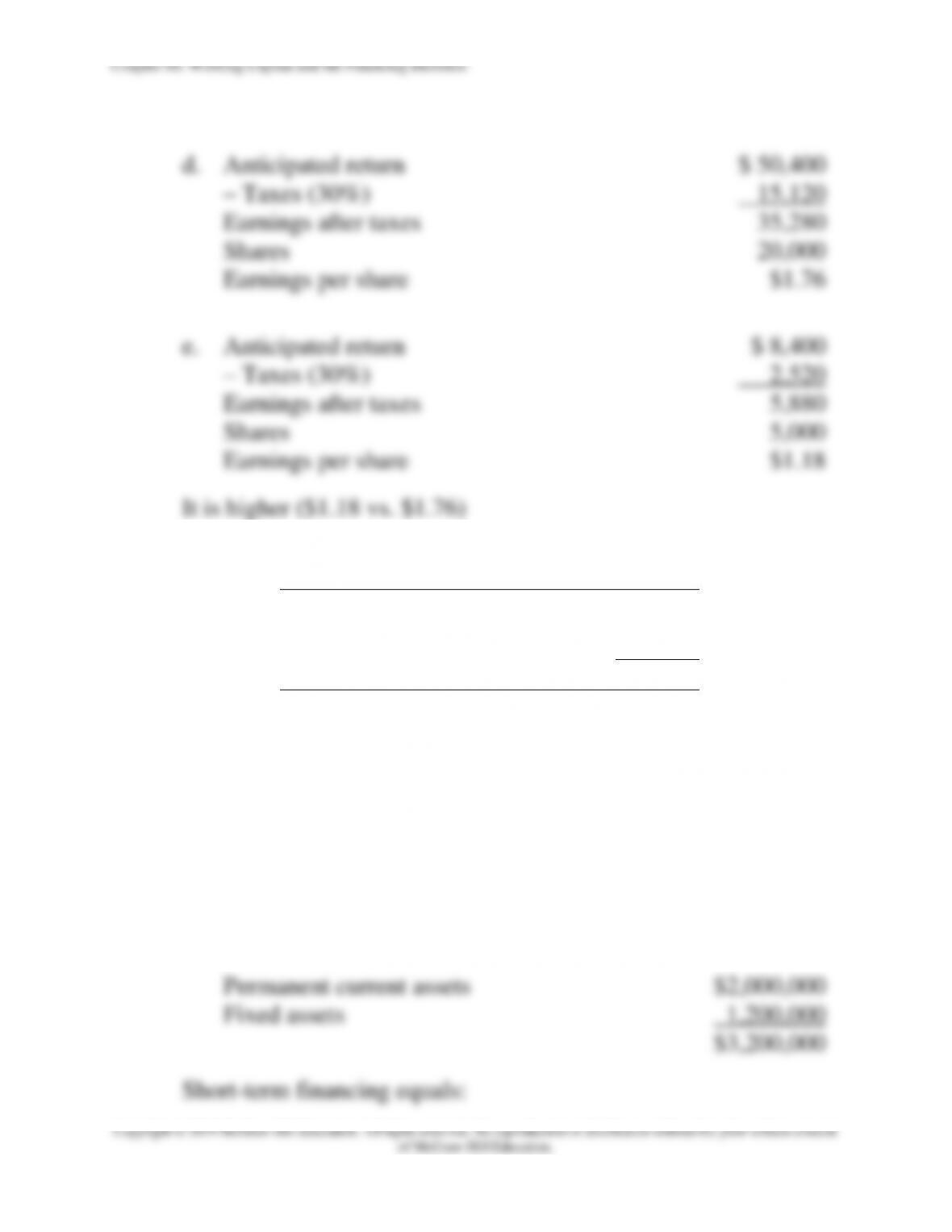
c. Moderate approach
Low liquidity $840,000 × 15% = $126,000
Chapter 06: Working Capital and the Financing Decision
Colter Steel (Continued)
14. Conservative versus aggressive financing (LO5) Guardian Inc. is trying to develop an
asset-financing plan. The firm has $400,000 in temporary current assets and $300,000 in
permanent current assets. Guardian also has $500,000 in fixed assets. Assume a tax rate of
40 percent.
a. Construct two alternative financing plans for Guardian. One of the plans should be
conservative, with 75 percent of assets financed by long-term sources, and the other
should be aggressive, with only 56.25 percent of assets financed by long-term sources.
The current interest rate is 15 percent on long-term funds and 10 percent on short-term
financing.
b. Given that Guardian’s earnings before interest and taxes are $200,000, calculate
earnings after taxes for each of your alternatives.
c. What would happen if the short- and long-term rates were reversed?
6-14. Solution:
Guardian Inc.
a. Temporary current assets $ 400,000
Permanent current assets 300,000