
CHAPTER 6
TREASURY AND FEDERAL AGENCY SECURITIES
CHAPTER SUMMARY
The second largest sector of the bond market (after the mortgage market) is the market for U.S.
Treasury securities. One of the smallest sector is the U.S. government agency securities market.
We discuss these two sectors together in this chapter. As explained in Chapter 11, a majority of
TREASURY SECURITIES
Two factors account for the prominent role of U.S. Treasury securities: volume (in terms of
dollars outstanding) and liquidity. The Department of the Treasury is the largest single issuer of
Types of Treasury Securities
The Treasury issues marketable and nonmarketable securities. Our focus here is on marketable
securities. Marketable Treasury securities are categorized as fixed-principal securities or
inflation-indexed securities. Fixed-income principal securities include Treasury bills, Treasury
notes, and Treasury bonds.
All securities with initial maturities of two years or more are issued as coupon securities. Coupon
securities are issued at approximately par and, in the case of fixed-principal securities, mature at
par value. Treasury coupon securities issued with original maturities of more than one year and

©2013 Pearson Education
128
coupon payment and the maturity value on is adjusted semiannually. This is called the inflation-
adjusted principal.
The Treasury Auction Process
Treasury securities are sold in the primary market through sealed-bid auctions. Each auction is
announced several days in advance by means of a Treasury Department press release or press
When a noncompetitive bid is submitted, the bidder only specifies the quantity sought. The
quantity in a noncompetitive bid may not exceed $5 million. A competitive bid specifies both
Secondary Market
The secondary market for Treasury securities is an over-the-counter market where a group of
U.S. government securities dealers offer continuous bid and ask prices on outstanding
Government dealers trade with the investing public and with other dealer firms. When they trade
with each other, it is through intermediaries known as interdealer brokers. Dealers leave firm

©2013 Pearson Education
129
a computer network tied to each trading desk and displayed on a monitor. Dealers use interdealer
brokers because of the speed and efficiency with which trades can be accomplished.
Price Quotes for Treasury Bills
The convention for quoting bids and offers is different for Treasury bills and Treasury coupon
securities. Bids and offers on Treasury bills are quoted in a special way. Unlike bonds that pay
Quotes on Treasury Coupon Securities
Treasury coupon securities are quoted in a different manner than Treasury bills—on a price basis
in points where one point equals 1% of par. The points are split into units of 32nds, so that
When an investor purchases a bond between coupon payments, if the issuer is not in default, the
investor must compensate the seller of the bond for the coupon interest earned from the time of
The calculation of the number of days in the accrued interest period and the number of days in
the coupon period begins with the determination of three key dates: the trade date, settlement

The number of days in the accrued interest period and the number of days in the coupon period
STRIPPED TREASURY SECURITIES
The Treasury does not issue zero-coupon notes or bonds. However, because of the demand for
zero-coupon instruments with no credit risk, the private sector has created such securities.
In August 1982, both Merrill Lynch and Salomon Brothers created synthetic zero-coupon
Other investment banking firms followed suit by creating their own receipts. They all are
referred to as trademark zero-coupon Treasury securities because they are associated with
particular firms.
On dealer quote sheets and vendor screens STRIPS are identified by whether the cash flow is
created from the coupon (denoted ci), principal from a Treasury bond (denoted bp), or principal
Tax Treatment
A disadvantage of a taxable entity investing in stripped Treasury securities is that accrued

Reconstituting a Bond
Reconstitution is the process of coupon stripping and reconstituting that will prevent the actual
spot rate curve observed on zero-coupon Treasuries from departing significantly from the
theoretical spot rate curve. As more stripping and reconstituting occurs, forces of demand and
supply will cause rates to return to their theoretical spot rate levels.
FEDERAL AGENCY SECURITIES
Federal agency securities are securities issued by government-chartered entities. These entities
are either federally related institutions or government-sponsored enterprises. Federally related
An important issue associated with federal agency securities is their credit quality. A commonly
shared view is that although any agency issue may not carry the explicit guarantee of the U.S.
government, there is an implicit guarantee due to their ability to borrow from the U.S. Treasury.
Fannie Mae and Freddie Mac
Fannie Mae and Freddie Mac are the two major suppliers of funds to the residential mortgage
market. They issue similar debt instruments and currently face the same legal constraint.
Federal Farm Credit Bank System
The Federal Farm Credit Bank System (FFCBS) was established by Congress is to facilitate the
supply of credit the agricultural sector of the economy. The Farm Credit System consists of three
entities: the Federal Land Banks, Federal Intermediate Credit Banks, and Banks for

©2013 Pearson Education
132
Cooperatives. The FFCBFC or simply Farm Credit issues debt with a broad range of structures
and maturities. Farm Credit Discount Notes are similar to U.S. Treasury bills with maturities
from one day to 365 days. Farm Credit Designated Bonds can have a non-callable or callable
structure that generally has 2– to 10-year maturities at issuance. The callable Designated Bonds
have a one-time only redemption feature. Farm Credit Bonds can be customized for institutional
investors as structured notes. Farm Credit Master Notes are debt obligations whose coupon rate
is indexed to some reference rate.
Federal Agricultural Mortgage Corporation
The purpose of the Federal Agricultural Mortgage Corporation (Farmer Mac) is to provide
Federal Home Loan Bank System
Tennessee Valley Authority
The Tennessee Valley Authority (TVA) was established by Congress in 1933 primarily to
provide flood control, navigation, and agricultural and industrial development. Created to
KEY POINTS
• The U.S. Treasury market is closely watched by all participants in the financial markets
because interest rates on Treasury securities are the benchmark interest rates throughout the
world.

• Treasury securities are issued on a competitive bid auction basis, according to a regular
auction cycle. The secondary market for Treasury securities is an over-the-counter market,
where dealers trade with the general investing public and with other dealers.

ANSWERS TO QUESTIONS FOR CHAPTER 6
(Questions are in bold print followed by answers.)
1. What are the differences among a Treasury bill, Treasury note, and Treasury bond?
Fixed-Principal Treasury Securities are fixed-income principal securities that include Treasury
bills, Treasury notes, and Treasury bonds. As discussed below the main differences involve
maturity and how earnings are received over time.
2. The following questions are about Treasury Inflation Protected Securities (TIPS).
(a) What is meant by the “real rate”?
In terms of TIPS, the real rate is the coupon rate. This is discussed below.
(b) What is meant by the “inflation–adjusted principal”?
For TIPS, the inflation-adjusted principal is the principal that the Treasury Department will base

©2013 Pearson Education
135
Because of the possibility of disinflation (i.e., price declines), the inflation-adjusted principal at
maturity may turn out to be less than the initial par value. However, the Treasury has structured
TIPS so that they are redeemed at the greater of the inflation adjusted principal and the initial par
value.
An inflation-adjusted principal must be calculated for a settlement date. The inflation-adjusted
principal is defined in terms of an index ratio, which is the ratio of the reference CPI for the
settlement date to the reference CPI for the issue date. The reference CPI is calculated with
a three-month lag. For example, the reference CPI for May 1 is the CPI-U reported in February.
The U.S. Department of the Treasury publishes and makes available on its website
(www.publicdebt.treas.gov) a daily index ratio for an issue.
(c) Suppose that the coupon rate for a TIPS is 3%. Suppose further that an investor
purchases $10,000 of par value (initial principal) of this issue today and that the semiannual
inflation rate is 1%.
Answer the below questions.
(1) What is the dollar coupon interest that will be paid in cash at the end of the first six
months?
In our example, the coupon rate for a TIPS is 3%, the annual inflation rate is 2%, and an investor
purchases today $10,000 par value (principal) of this issue. The semiannual inflation rate is 1%
(2) What is the inflation-adjusted principal at the end of six months?
As seen in part (1) when computing the coupon payment, we find that the inflation adjusted
(d) Suppose that an investor buys a five-year TIP and there is deflation for the entire
period. What is the principal that will be paid by the Department of the Treasury at the
maturity date?
With deflation, the inflation-adjusted principal would fall. However, the Treasury has structured
TIPS so that they are redeemed at the greater of the inflation adjusted principal and the initial par

©2013 Pearson Education
136
value. Thus, the investor who buys a five-year TIP is promised the original principle amount at
the maturity date.
(e) What is the purpose of the daily index ratio?
The purpose of the daily index ratio is to help compute an inflation-adjusted principal for
a settlement date. The inflation-adjusted principal is defined in terms of an index ratio, which is
(f) How is interest income on TIPS treated at the federal income tax level?
3. What is the when-issued market?
Treasury securities are traded prior to the time they are issued by the Treasury. This component
4. Why do government dealers use government brokers?
When government dealers trade with each other, it is through intermediaries known as
5. Suppose that the price of a Treasury bill with 90 days to maturity and a $1 million face
value is $960,000. What is the yield on a bank discount basis?
The convention for quoting bids and offers is different for Treasury bills and Treasury coupon
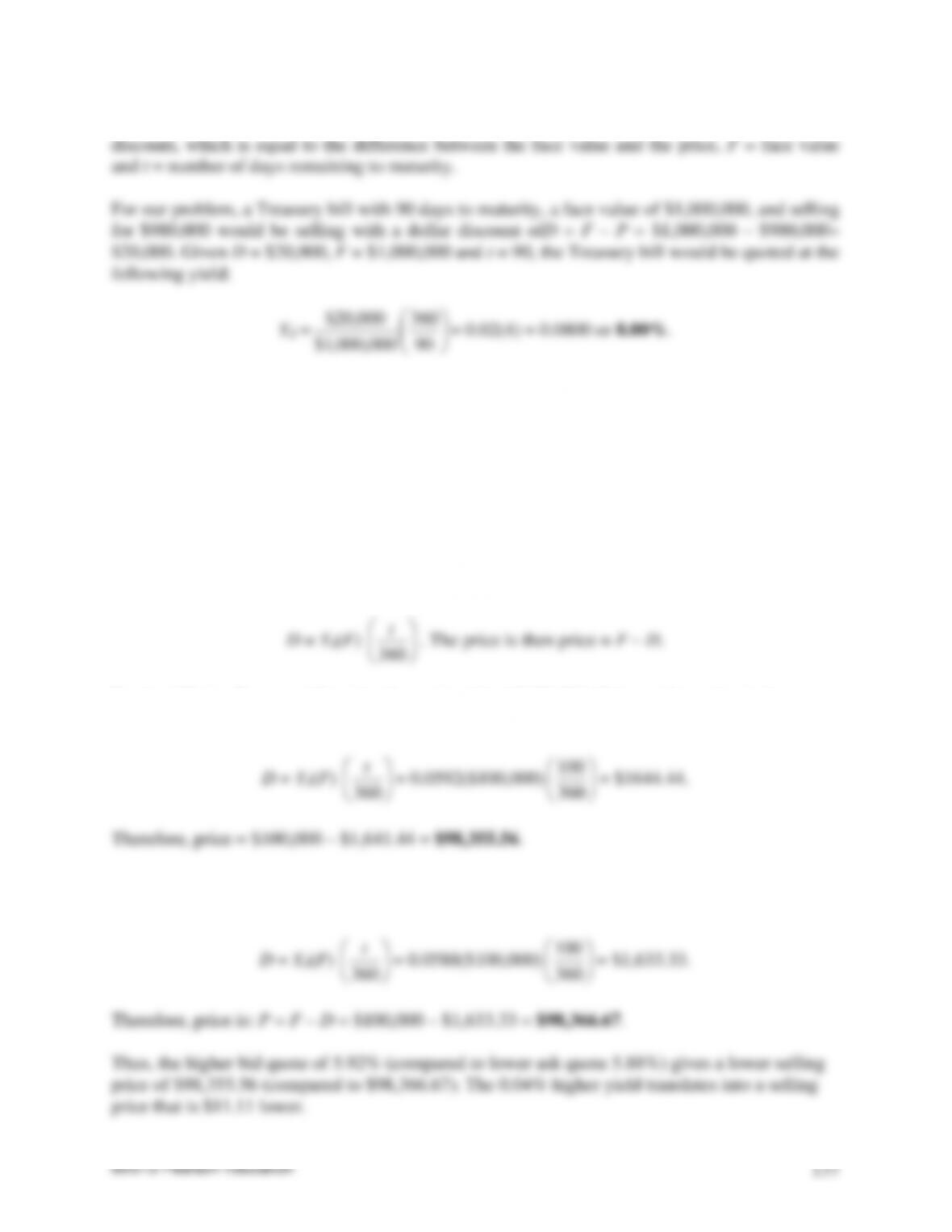
whereYd= annualized yield on a bank discount basis (expressed as a decimal), D = dollar
90
000,000,1$
6. The bid and ask yields for a Treasury bill were quoted by a dealer as 5.92% and 5.88%,
respectively. Shouldn’t the bid yield be less than the ask yield, because the bid yield
indicates how much the dealer is willing to pay and the ask yield is what the dealer is
willing to sell the Treasury bill for?
The higher bid means a lower price. So the dealer is willing to pay less than would be paid for
the lower ask price. We illustrate this below.
Given the yield on a bank discount basis (Yd), the price of a Treasury bill is found by first solving
the formula for the dollar discount (D), as follows:
t
For the 100-day Treasury bill with a face value (F) of $100,000, if the yield on a bank discount
basis (Yd) is quoted as 5.92%, D is equal to:
For the 100-day Treasury bill with a face value (F) of $100,000, if the yield on a bank discount
basis (Yd) is quoted as 5.88%, D is equal to:

In general, the quoted yield on a bank discount basis is not a meaningful measure of the return
from holding a Treasury bill, for two reasons. First, the measure is based on a face-value
7. Assuming a $100,000 par value, calculate the dollar price for the following Treasury
coupon securities given the quoted price:
(a) 84-15
Treasury coupon securities are quoted in a different manner than Treasury bills—on a price basis
96.453125), and a price of 96–142 refers to a price of 96 plus 14 32nds plus 2 256ths, or
96.4453125 (96 + 14/32 + 2/256 = 96 + 0.4375 + 0.0078125 = 96.4453125).
(b) 84-15+

(c) 103-286
(d) 105-051
8. Answer the below questions for a treasury auction.
(a) For a Treasury auction what is meant by a noncompetitive bidder?
A noncompetitive bidder is a bidder is who is willing to purchase the auctioned security at the
yield that is determined by the auction process. More details are supplied below.
(b) For a Treasury auction what is meant by the high yield?
In a Treasury auction, the results are determined by first deducting the total noncompetitive
tenders and nonpublic purchases (such as purchases by the Federal Reserve) from the total
securities being auctioned. The remainder is the amount to be awarded to the competitive

©2013 Pearson Education
140
for which they tendered. So, if an entity tendered for $5 million, then that entity would be
awarded only 0.75($5 million) = $3.75 million.
9. In a Treasury auction, how is the price that a competitive bidder must pay determined in
a single-price auction format?
10. In a Treasury auction, how is the price that a noncompetitive bidder must pay determined
in a single–price auction format?
11. Suppose that a Treasury coupon security is purchased on April 8 and that the last
coupon payment was on February 17. Assume that the year in which this security is
purchased is not a leap year.
Answer the below questions.
(a) How many days are in the accrued interest period?
The calculation of the number of days in the accrued interest period and the number of days in
the coupon period begins with the determination of three key dates: the trade date, settlement
The number of days in the accrued interest period and the number of days in the coupon period
may not be simply the actual number of calendar days between two dates. The reason is that
The day count convention used for Treasury coupon securities involves determining the actual
number of days between two dates. This is referred to as the actual/actual day count convention.
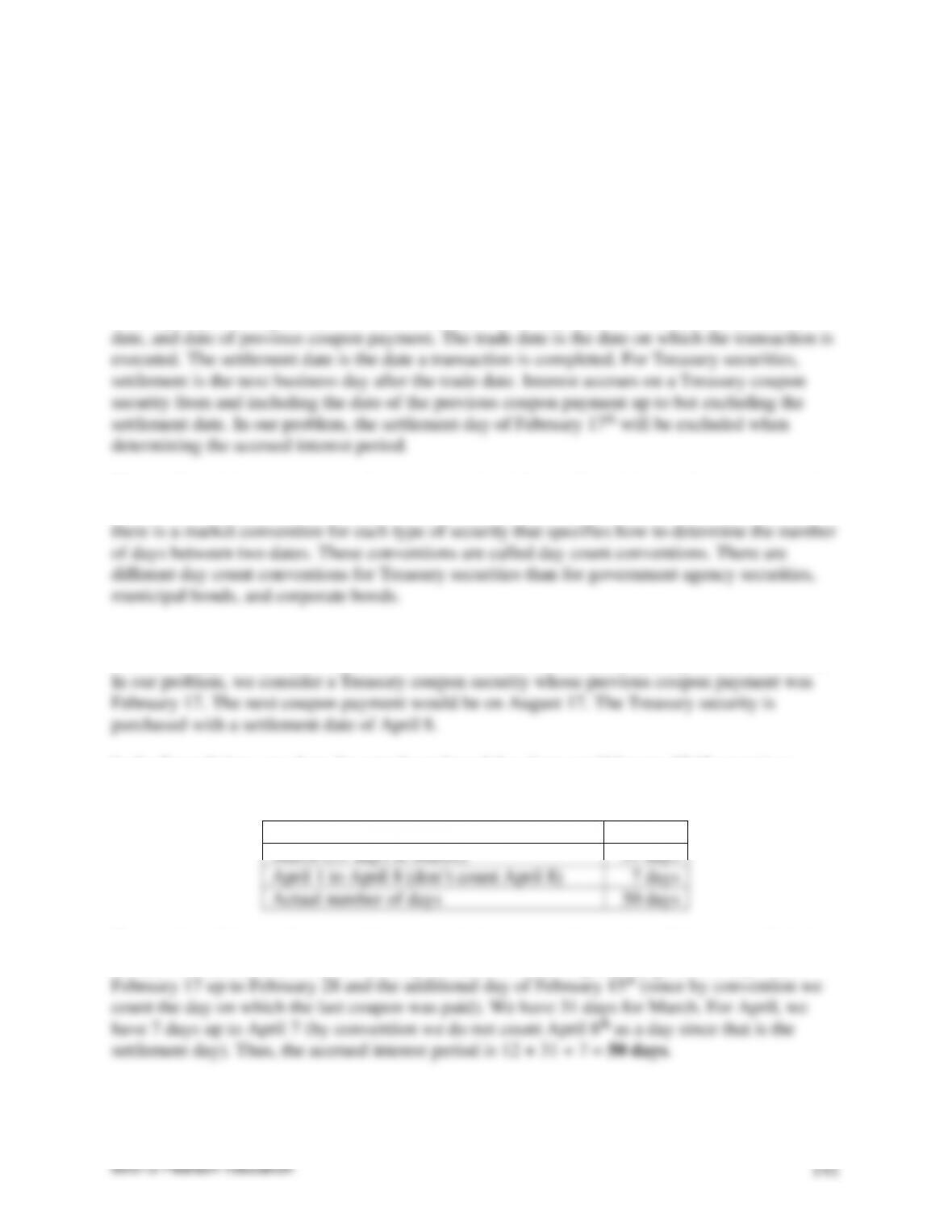
In the figure below, we show the actual number of days between February 17 (the previous
coupon date) and April 8 (the settlement date):
February 17 to February 28 (count Feb. 17)
12 days
March (31 days in March)
31 days
April 1 to April 8 (don’t count April 8)
7 days
Actual number of days
50 days
The number of days in the accrued interest period represents the number of days over which the
investor has earned interest. For February we have 12 remaining days (e.g., the 11 days from
[NOTE. The number of days in the coupon period is the actual number of days between February
17 and August 17, which is 182 days. The number of days between the settlement date (April 8)
(b) If the coupon rate for this Treasury security is 6% and the par value of the issue
purchased is $1 million, what is the accrued interest?
When an investor purchases a bond between coupon payments, if the issuer is not in default, the
investor must compensate the seller of the bond for the coupon interest earned from the time of
the last coupon payment to the settlement date of the bond. This amount is called accrued
interest.
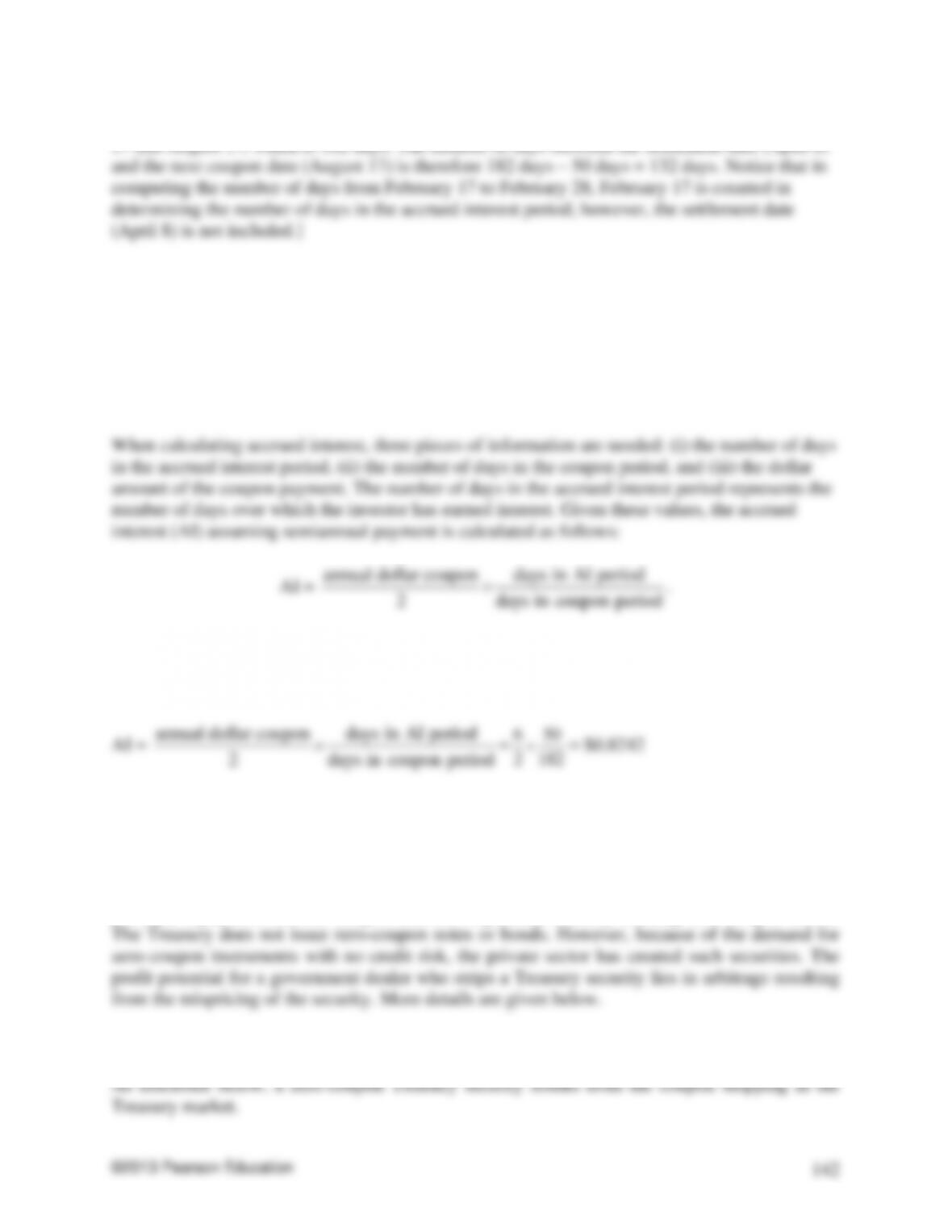
annual dollar coupon days in AI period
2 days in coupon period
In our problem, we have 50 days in the accrued interest period, 182 days in a coupon period from
February 17 through August 17, and the annual dollar coupon per $100 of par value is $6. The
accrued interest is:
annual dollar coupon days in AI period
2 days in coupon period
2 182
12. Answer the below questions.
(a) What is meant by coupon stripping in the Treasury market?
Coupon stripping, in general, refers to detaching the coupons from a bond and trading the
principal repayment and the coupon amounts separately, thereby creating zero coupon bonds.
(b) What is created as a result of coupon stripping in the Treasury market?

To illustrate the process of coupon stripping and what is created, suppose that$500 million of
a 10-year fixed-principal Treasury note with a coupon rate of 5% is purchased by a dealer firm to
13. Why is a stripped Treasury security identified by whether it is created from the coupon
or the principal?
On dealer quote sheets and vendor screens STRIPS are identified by whether the cash flow is
created from the coupon (denoted ci), principal from a Treasury bond (denoted bp), or principal
14. What is the federal income tax treatment of accrued interest income on stripped
Treasury securities?
Interest income from Treasury securities is subject to federal income taxes but is exempt from state
15. What is a government-sponsored enterprise?
A government-sponsored enterprise (GSE) is a one of several types of government-chartered
entities. GSEs are divided into two types. The first is a publicly owned shareholder corporation.

©2013 Pearson Education
144
securities. Because of credit risk and liquidity, GSEs trade in the market at a yield premium to (i.e.,
yield greater than) comparable-maturity Treasury securities.
16. Explain why you agree or disagree with the following statement: “The debt of
government-owned corporations is guaranteed by the full faith and credit of the U.S.
government, but that is not the case for the debt of government-sponsored enterprises.”
One would not agree with this statement because both government-owned corporations and also
government-sponsored enterprises are not backed by the full faith and credit of the U.S.
17.In the fall of 2010, the author of this book received an offering sheet for very short-term
Treasury bills from a broker. The offering price for a few of the issues exceeded the
maturity value of the Treasury bill. When the author inquired if this was an error, the
broker stated that it was not and that there were institutional investors who were buying
very short-term Treasury bills above the maturity value. What does that mean in terms of
the yield such investors were willing to receive at that time?
As show in our illustration below, paying above the maturity value means that investors are
ceteris paribus willing to earn a negative rate of return.
To begin with, T-bills are sold at a discount, and prices are quoted as a percentage of the
maturity value. The discount is the difference between the face value and the purchase price, and
©2013 Pearson Education
145
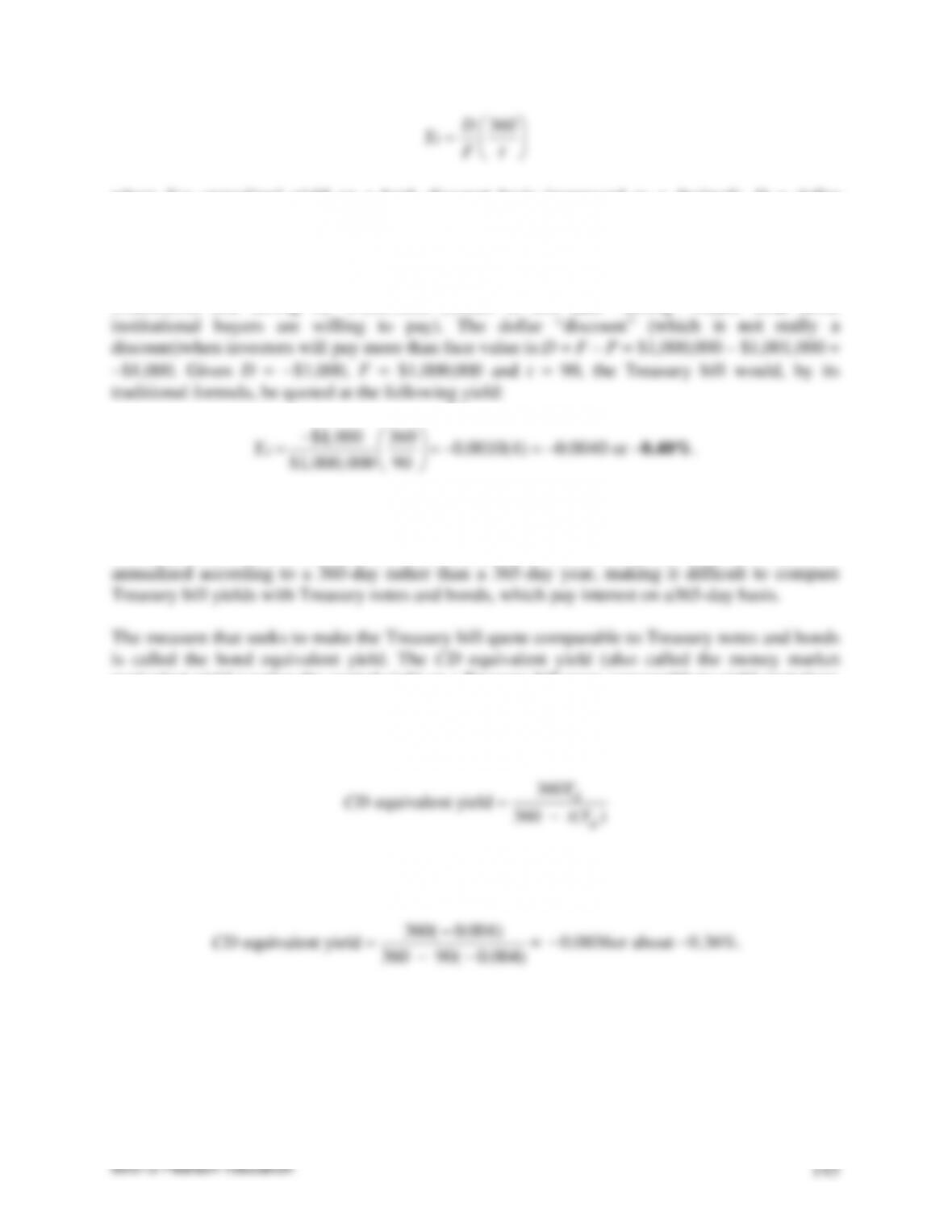
=tF
D
Yd360
where Yd= annualized yield on a bank discount basis (expressed as a decimal), D = dollar
discount, which is equal to the difference between the face value and the price, F = face value
and t = number of days remaining to maturity.
For our problem, let us assume a Treasury bill with 90 days to maturity, a face value of
$1,000,000, and selling for $1,001,000 (which in this case “selling” means what some
–$1,000 360
$1,000,000 90
Even if Yd was its normal positive quoted yield on a bank discount basis, it is not a meaningful
measure of the return from holding a Treasury bill for two reasons. First, the measure is based on
a face value investment rather than on the actual dollar amount invested. Second, the yield is
equivalent yield ) makes the quoted yield on a Treasury bill more comparable to yield quotations
on other money market instruments that pay interest on a 360-day basis. It does this by taking
into consideration the price of the Treasury bill rather than its face value. The formula for the CD
equivalent yield is
d
Considering out hypothetical 90-day Treasury bill with a face value of $1,000,000, selling for
$1,000,100, and offering a yield on a bank discount basis of −0.40%, we get: