Data
port value probability
70000 0.5
200000 0.5
E(x) $135,000.00
Problem 6-4
Consider a risky portfolio. The end-of-year cash flow derived from the portfolio will be either $70,000 or $200,000 with equal probabilities of .5. The
alternative risk-free investment in T-bills pays 6% per year.
a.If you require a risk premium of 8%, how much will you be willing to pay for the portfolio? (Round your answer to the nearest whole dollar
amount. Omit the “$” sign in your response.)
Price$
c.Now suppose that you require a risk premium of 12%. What is the price that you will be willing to pay?(Round your answer to the
Data
r 0.12
100 107 A
1 1.54321 0.015432 101.5432 0.1038 0.0338
1.5 1.028807 0.010288 101.0288 0.0957 0.0257
2 0.771605 0.007716 100.7716 0.0876 0.0176
Problem 6-5
Consider a portfolio that offers an expected rate of return of 12% and a standard deviation of 18%. T-bills
offer a risk-free 7% rate of return.
What is the maximum level of risk aversion for which the risky portfolio is still preferred to bills? (Do not
Data
SD 0.2
Risk premium
0.08
Problem 6-10 Problem 6-10 Problem 6-11 Problem 6-12
Wbills tbills Windex rindex Rp U 2 3
0 0.05 1 0.13 0.13 0.2 0.04 0.0900 0.0700
Problem 6-10
Consider historical data showing that the average annual rate of return on the S&P 500 portfolio over the past 85
Problem 6-11
Calculate the utility levels of each portfolio for an investor with A= 2. Assume the utility function is U=E(r) − 0.5
×Aσ2.
Problem 6-12
Data
E(r ) 0.18
SD 0.28
SD 0.196
Problem 6-13
Assume that you manage a risky portfolio with an expected rate of return of 18% and a standard
deviation of 28%. The T-bill rate is 8%.
Your client chooses to invest 70% of a portfolio in your fund and 30% in a T-bill money market
fund. What is the expected value and standard deviation of the rate of return on his portfolio? (Do
Data
E(r ) 0.18 Stock A 0.25
Erp 0.15
SD 0.196
Problem 14
T-bills 0.3
Problem 15
Problem 16
target return 0.16
a proportion y 0.8
1-y for t-bills 0.2
Problem 18
max rate 0.18
a proportion y 0.643
Problem 6-14
Assume that you manage a risky portfolio with an expected rate of return of 18% and a standard deviation of 28%. The T-bill
rate is 8%. Your client chooses to invest 70% of a portfolio in your fund and 30% in a T-bill money market fund.
Suppose that your risky portfolio includes the following investments in the given proportions:

Data
ER-rf 8.1 0.081
SD 20.48 0.2048
A 4
Problem 6-20
Refer the table below on the average risk premium of the S&P 500 over T-bills, and the standard deviation of that risk premium. Suppose that the S&P 500 is your risky portfolio.
SD 16.71 0.1671
A 4
Data
a y 0.5
1-y 0.5
Problem 6-21
Consider the following information about a risky portfolio that you manage, and a risk-free asset: E(rP)= 11%, σP= 15%, rf= 5%.
a.Your client wants to invest a proportion of her total investment budget in your risky fund to provide an expected rate of return on her
overall or complete portfolio equal to 8%. What proportion should she invest in the risky portfolio, P, and what proportion in the risk-free
asset? (Round your answers to the nearest whole number. Omit the “%” sign in your response.)
Data
E(rm) 0.12
Problem 6-22
Investment Management Inc. (IMI) uses the capital market line to make asset allocation recommendations. IMI derives the
following forecasts:
• Expected return on the market portfolio: 12%.• Standard deviation on the market portfolio: 20%.• Risk-free rate: 5%. Samuel
Data
borrowing rate 0.09
Problem 6-24
Suppose that the borrowing rate that your client faces is 9%. Assume that the S&P 500 index has an expected return of
13% and standard deviation of 25%, that rf= 5%.
Data
Data
borrowing rate 0.09
0.32
y<1 0.012
Problem 6-26
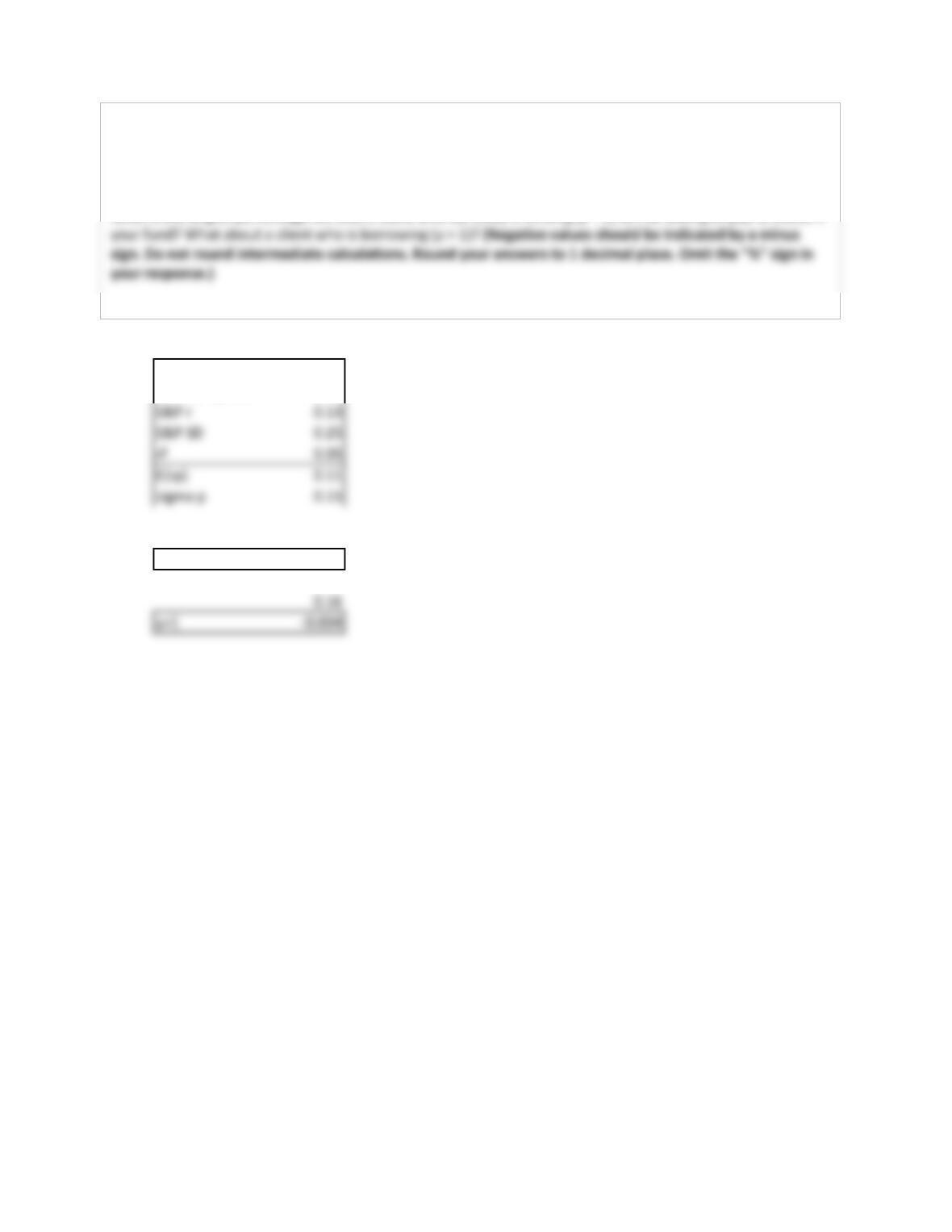
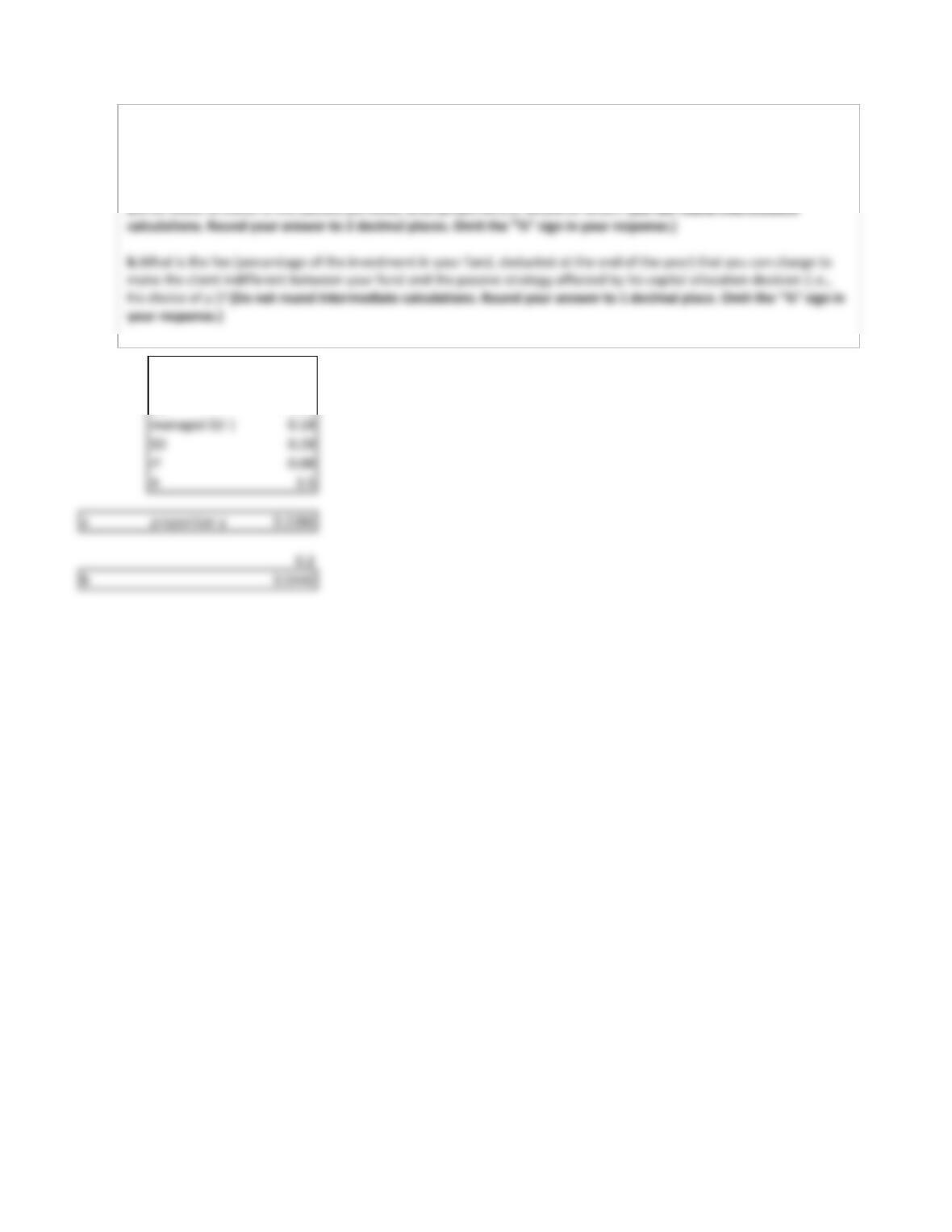
Suppose that the borrowing rate that your client faces is 9%. Assume that the S&P 500 index has an expected
return of 13% and standard deviation of 25%. Also assume that the risk-free rate is rf= 5%. Your fund manages
a risky portfolio, with the following details: E(rp)= 11%, σp= 15%.
What is the largest percentage fee that a client who currently is lending (y< 1) will be willing to pay to invest in
Data
E(r ) 0.13
SD 0.25
Problem 6-29
You estimate that a passive portfolio, that is, one invested in a risky portfolio that mimics the S&P 500 stock index, yields
an expected rate of return of 13% with a standard deviation of 25%. You manage an active portfolio with an expected
return of 18% and a standard deviation of 28%. The risk-free rate is 8%. Your client’s degree of risk aversion is A= 3.5.