
Modern Kitchenware Co.
Case 6
Cash Discount
Purpose: The case illustrates how the offering of a cash discount can affect the profitability of the firm.
Three different cash discount policies are evaluated in terms of cost, freed up funds and the associated
profitability. The impact of a cash discount on sales volume is also considered and has an impact on the
final decision in the case.
Relation to Text: The case should follow Chapter 7.
Complexity: The case is moderately complex. It should require 1 hour.
Solutions
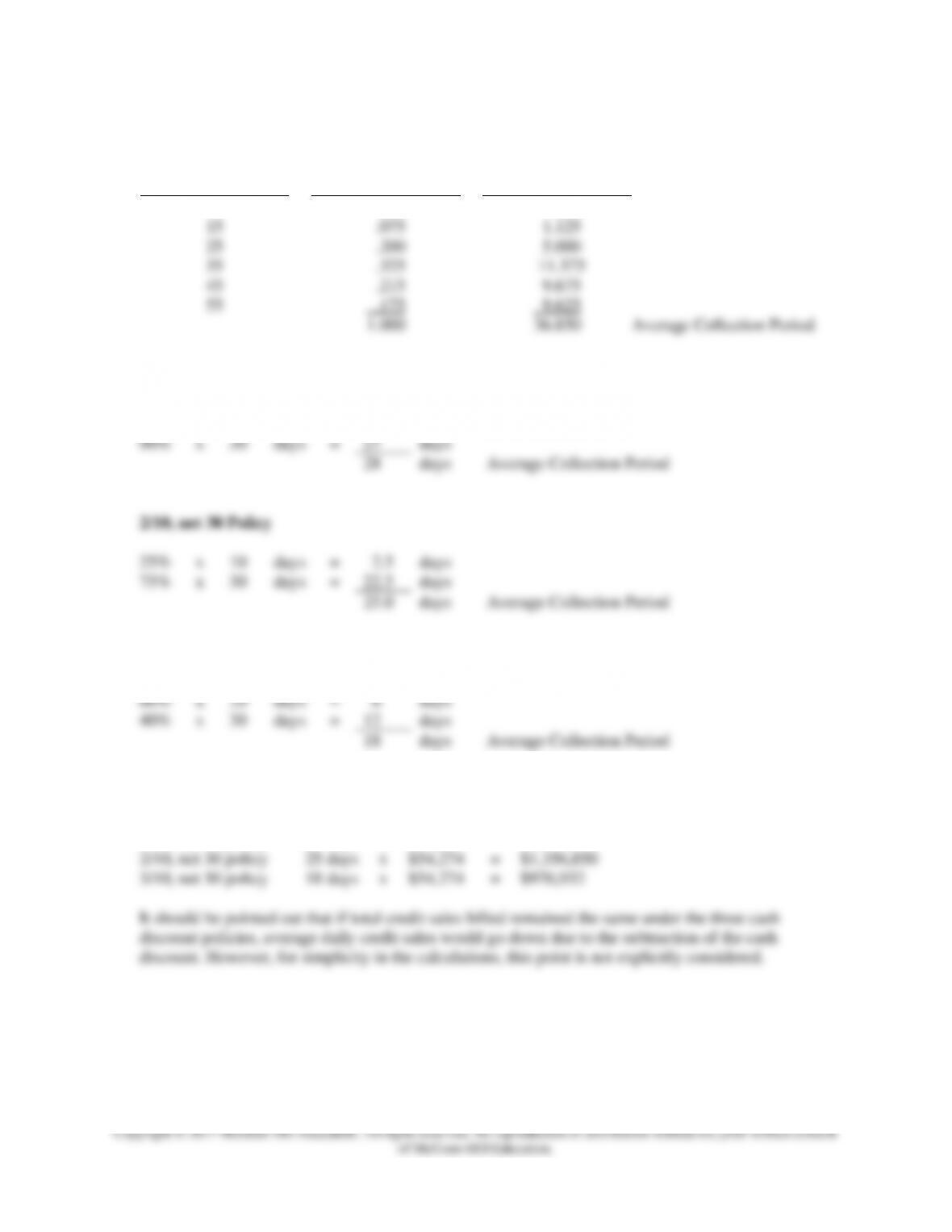
1.
Midpoint of
Days Outstanding
Weights
Weighted Number
of Days
5
.010
.050
15
.075
1.125
25
.200
5.000
35
.325
11.375
45
.215
9.675
55
.175
9.625
1.000
36.850
Average Collection Period
2. 1/10, net 30 Policy
10%
x
10
days
=
1
day
90%
x
30
days
=
27
days
28
days
Average Collection Period
25%
x
10
days
=
2.5
days
75%
x
30
days
=
22.5
days
25.0
days
Average Collection Period
3/10, net 30 Policy
60%
x
10
days
=
6
days
40%
x
30
days
=
12
days
18
days
Average Collection Period
3. Accounts receivable = average collection period x average daily credit sales
1/10, net 30 policy
28 days
x
$54,274
=
$1,519,672
2/10, net 30 policy
25 days
x
$54,274
=
$1,356,850
3/10, net 30 policy
18 days
x
$54,274
=
$976,932
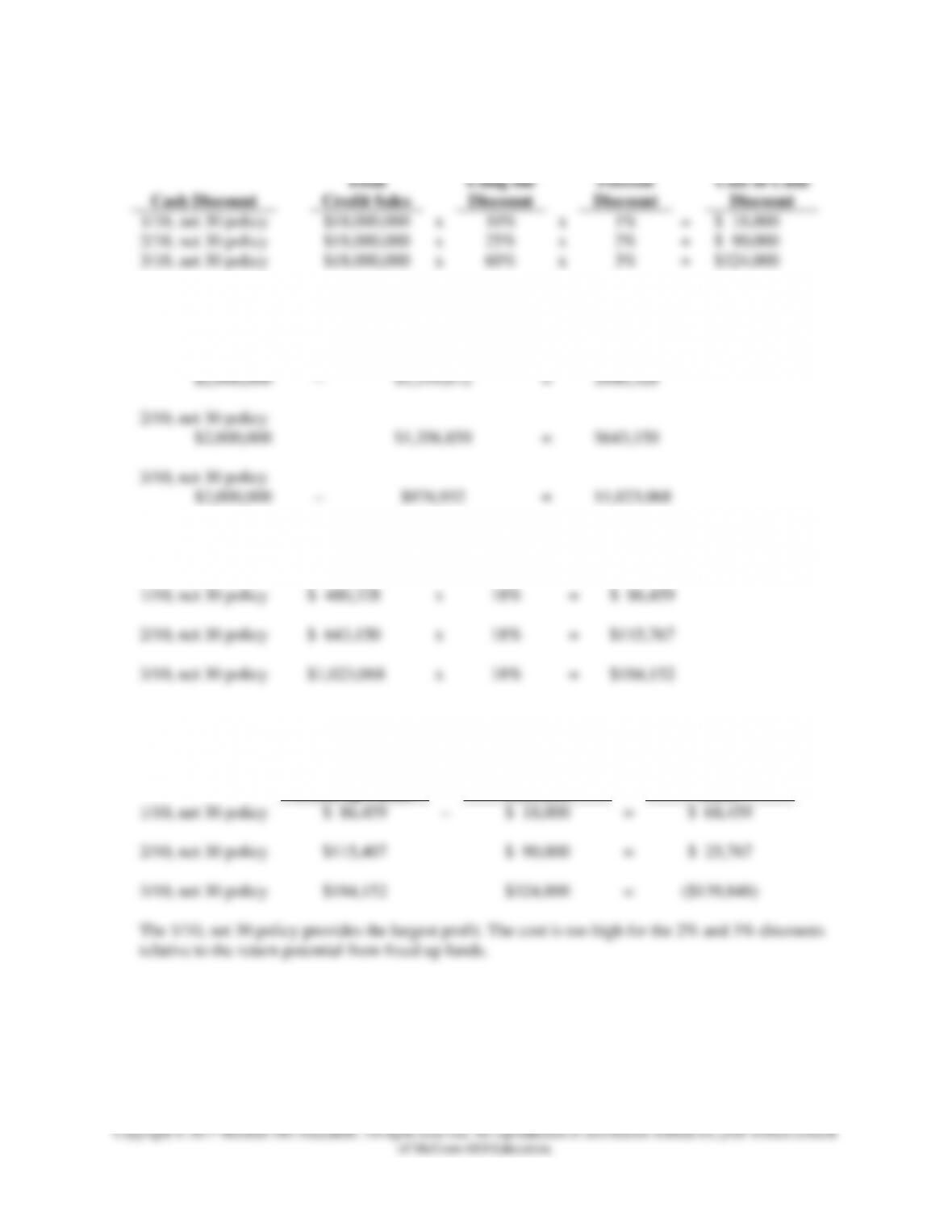
4. Cost of cash discount: Total credit sales x percent using the discount x % discount.
Cash Discount
Total
Credit Sales
Percent
Using the
Discount
Percent
Discount
Cost of Cash
Discount
1/10, net 30 policy
$18,000,000
x
10%
x
1%
=
$ 18,000
2/10, net 30 policy
$18,000,000
x
25%
x
2%
=
$ 90,000
3/10, net 30 policy
$18,000,000
x
60%
x
3%
=
$324,000
5. Old accounts receivable – new accounts receivable = freed up funds
1/10, net 30 policy
$2,000,000
–
$1,519,672
=
$480,328
2/10, net 30 policy
$2,000,000
–
$1,356,850
=
$643,150
3/10, net 30 policy
$2,000,000
–
$976,932
=
$1,023,068
6. The return is equal to the freed up funds times 18%
1/10, net 30 policy
$ 480,328
x
18%
=
$ 86,459
2/10, net 30 policy
$ 643,150
x
18%
=
$115,767
3/10, net 30 policy
$1,023,068
x
18%
=
$184,152
7. Returns on freed up funds – cost of cash discounts = profit or loss
Return on
Freed up Funds
Cost of Cash
Discount
Profit
(loss)
1/10, net 30 policy
$ 86,459
–
$ 18,000
=
$ 68,459
2/10, net 30 policy
$115,407
–
$ 90,000
=
$ 25,767
3/10, net 30 policy
$184,152
–
$324,000
=
($139,848)
The 1/10, net 30 policy provides the largest profit. The cost is too high for the 2% and 3% discounts
relative to the return potential from freed up funds.
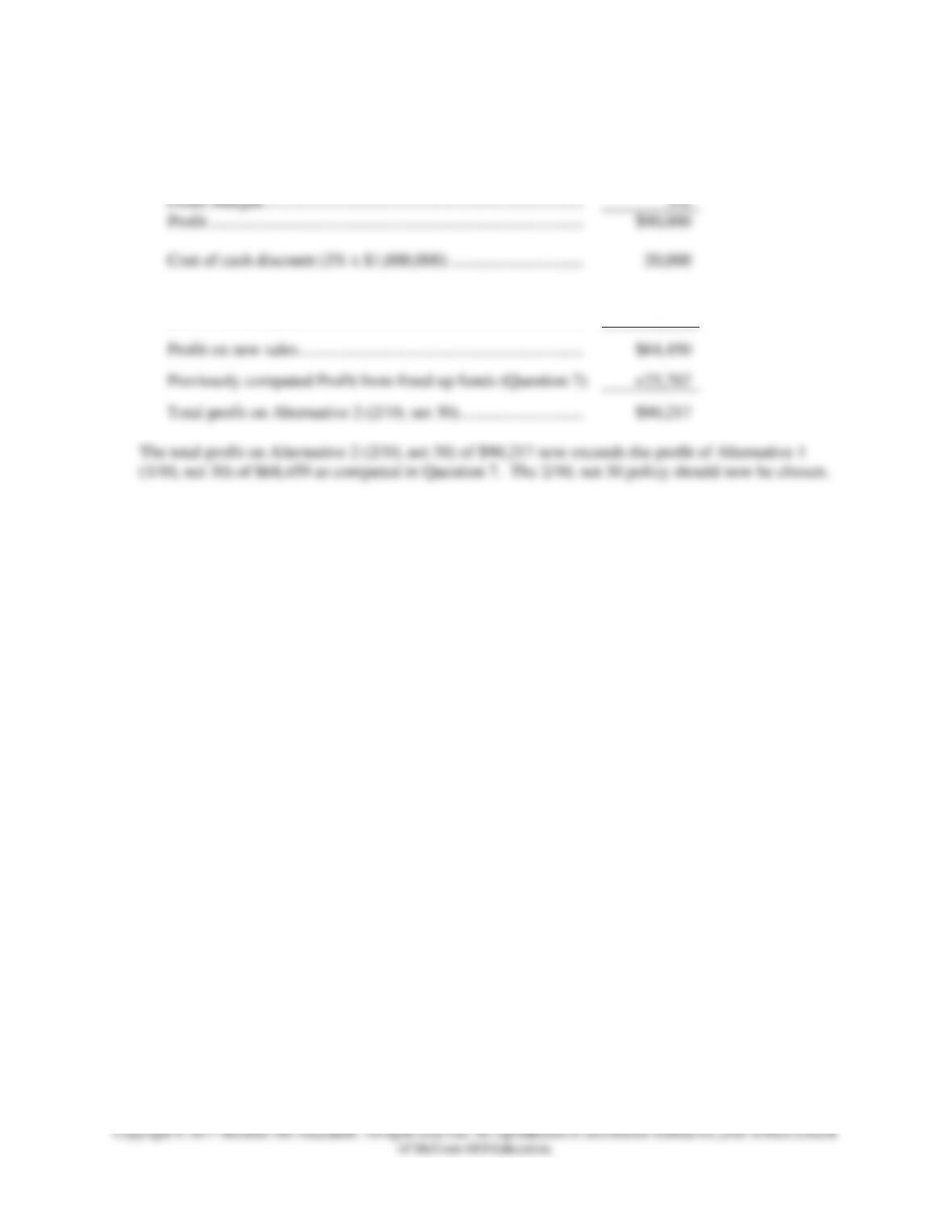
8. Increased profitability of Alternative 2 (2/10, net 30) under the assumption of a $1,000,000 increase
in sales.
Increased Sales ………………………………………………………………
$1,000,000
Profit Margin …………………………………………………………………
9%
Profit ……………………………………………………………………………
$90,000
–
Cost of cash discount (2% x $1,000,000) ………………………….
–20,000
–
Lost profit on funds committed to accounts receivable
(20% x $27,750) ……………………………………………………………
–5,550
Profit on new sales …………………………………………………………
$64,450
Previously computed Profit from freed up funds (Question 7)
+25,767
Total profit on Alternative 2 (2/10, net 30) ………………………..
$90,217
The total profit on Alternative 2 (2/10, net 30) of $90,217 now exceeds the profit of Alternative 1