Chapter 05: Operating and Financial Leverage
Chapter 5
Operating and Financial Leverage
Discussion Questions
5-1.
Discuss the various uses for break-even analysis.
Such analysis allows the firm to determine at what level of operations it
will break even (earn zero profit) and to explore the relationship between
volume, costs, and profits.
5-2.
What factors would cause a difference in the use of financial leverage for a
utility company and an automobile company?
A utility is in a stable, predictable industry and therefore can afford to use
more financial leverage than an automobile company, which is generally
subject to the influences of the business cycle. An automobile manufacturer
may not be able to service a large amount of debt when there is a downturn
in the economy.
5-3.
Explain how the break-even point and operating leverage are affected by
the choice of manufacturing facilities (labor intensive versus capital
intensive).
A labor-intensive company will have low fixed costs and a correspondingly
low break-even point. However, the impact of operating leverage on the
firm is small and there will be little magnification of profits as volume
increases. A capital-intensive firm, on the other hand, will have a higher
break-even point and enjoy the positive influences of operating leverage as
volume increases.
5-4.
What role does depreciation play in break-even analysis based on
accounting flows? Based on cash flows? Which perspective is longer term
in nature?
For break-even analysis based on accounting flows, depreciation is
considered part of fixed costs. For cash flow purposes, it is eliminated from
fixed costs.
The accounting flows perspective is longer term in nature because we must
consider the problems of equipment replacement.
Chapter 05: Operating and Financial Leverage
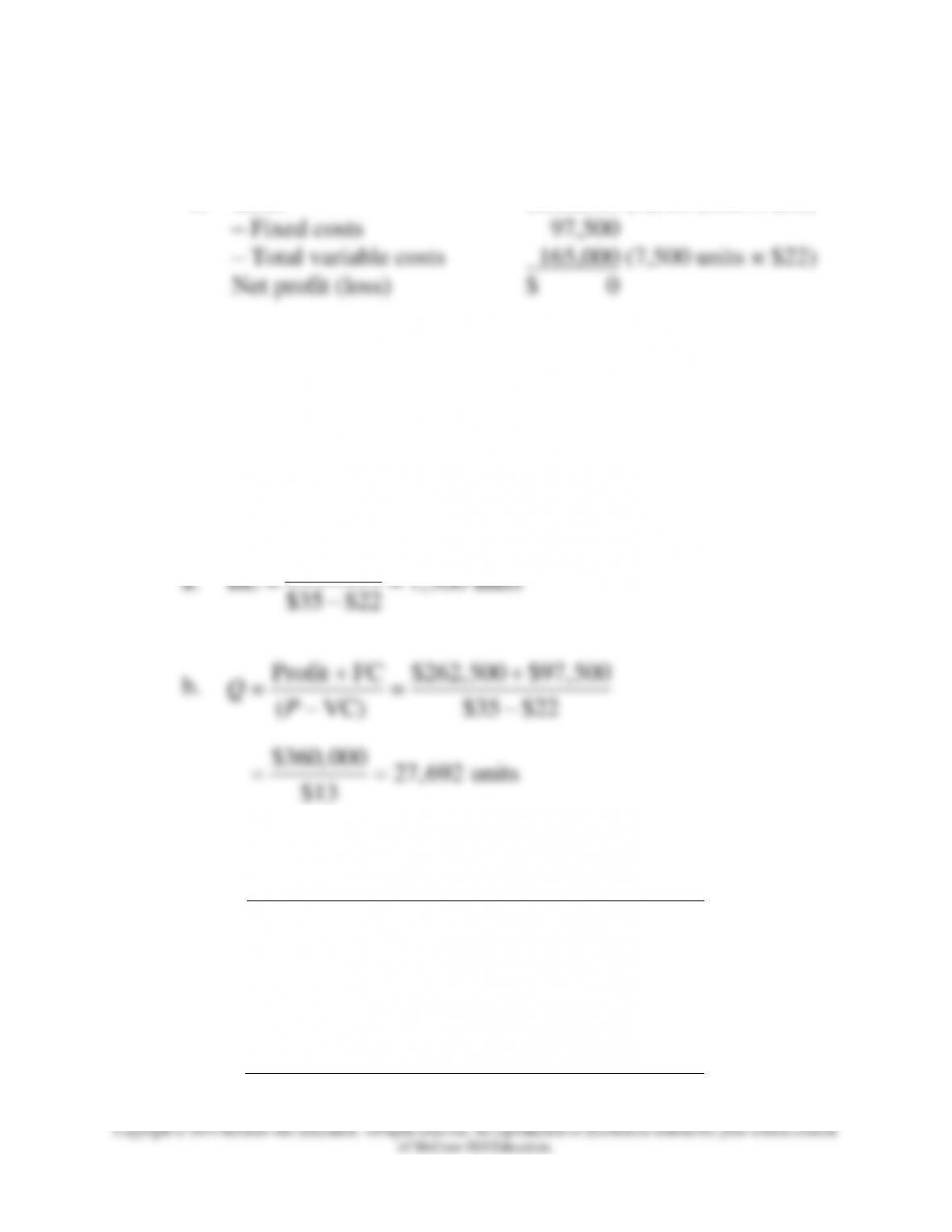
b. Sales
$262,500 (7,500 units × $35)
– Fixed costs
97,500
– Total variable costs
165,000 (7,500 units × $22)
Net profit (loss)
$ 0
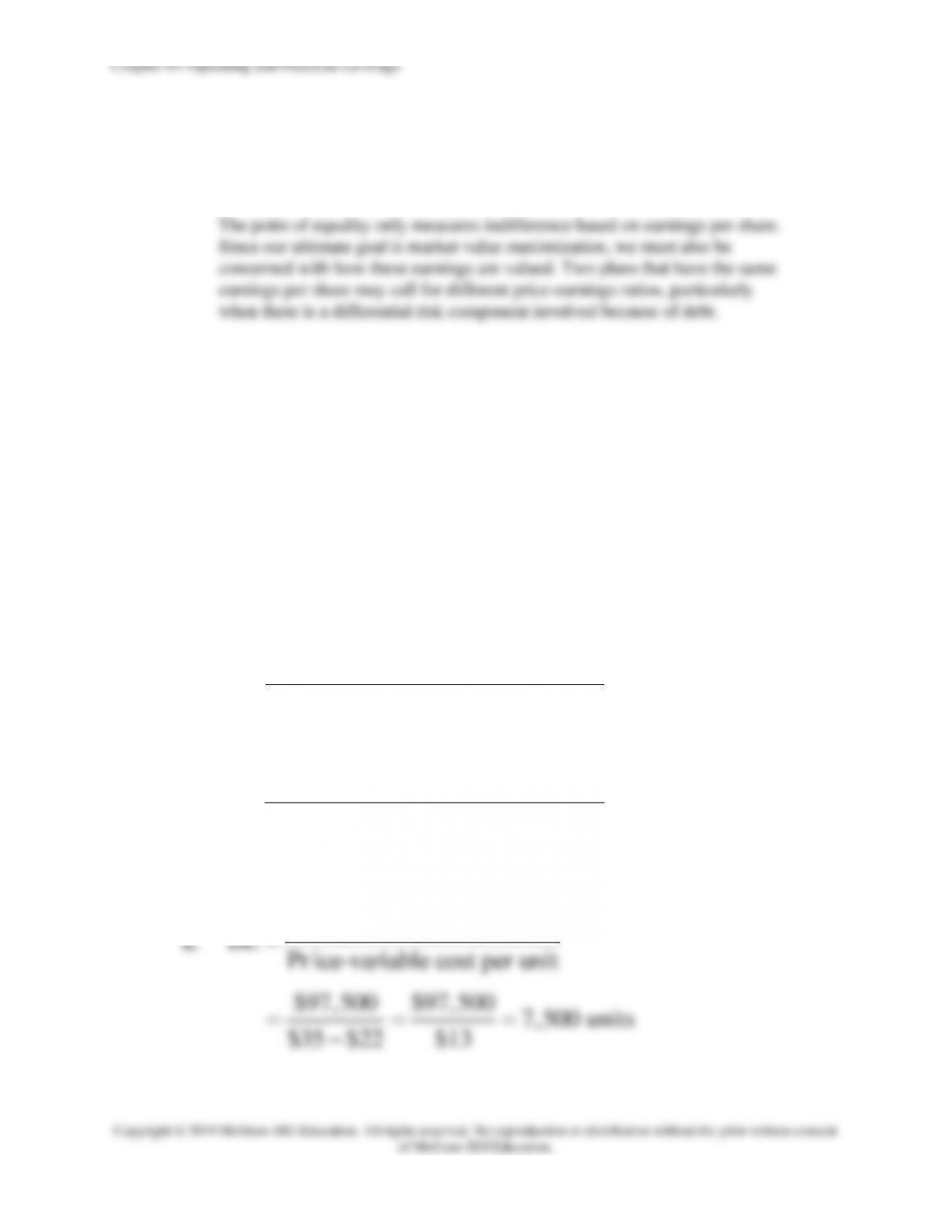
2. Break-even analysis (LO2) The Hartnett Corporation manufactures baseball bats with
Pudge Rodriguez’s autograph stamped on them. Each bat sells for $35 and has a variable
cost of $22. There are $97,500 in fixed costs involved in the production process.
a. Compute the break-even point in units.
b. Find the sales (in units) needed to earn a profit of $262,500.
5-2. Solution:
Hartnett Corporation
$97,500
$35 $22
−
b.
Profit FC $262,500 $97,500
( VC) $35 $22
$360,000 27,692 units
$13
QP
++
==
−−
==
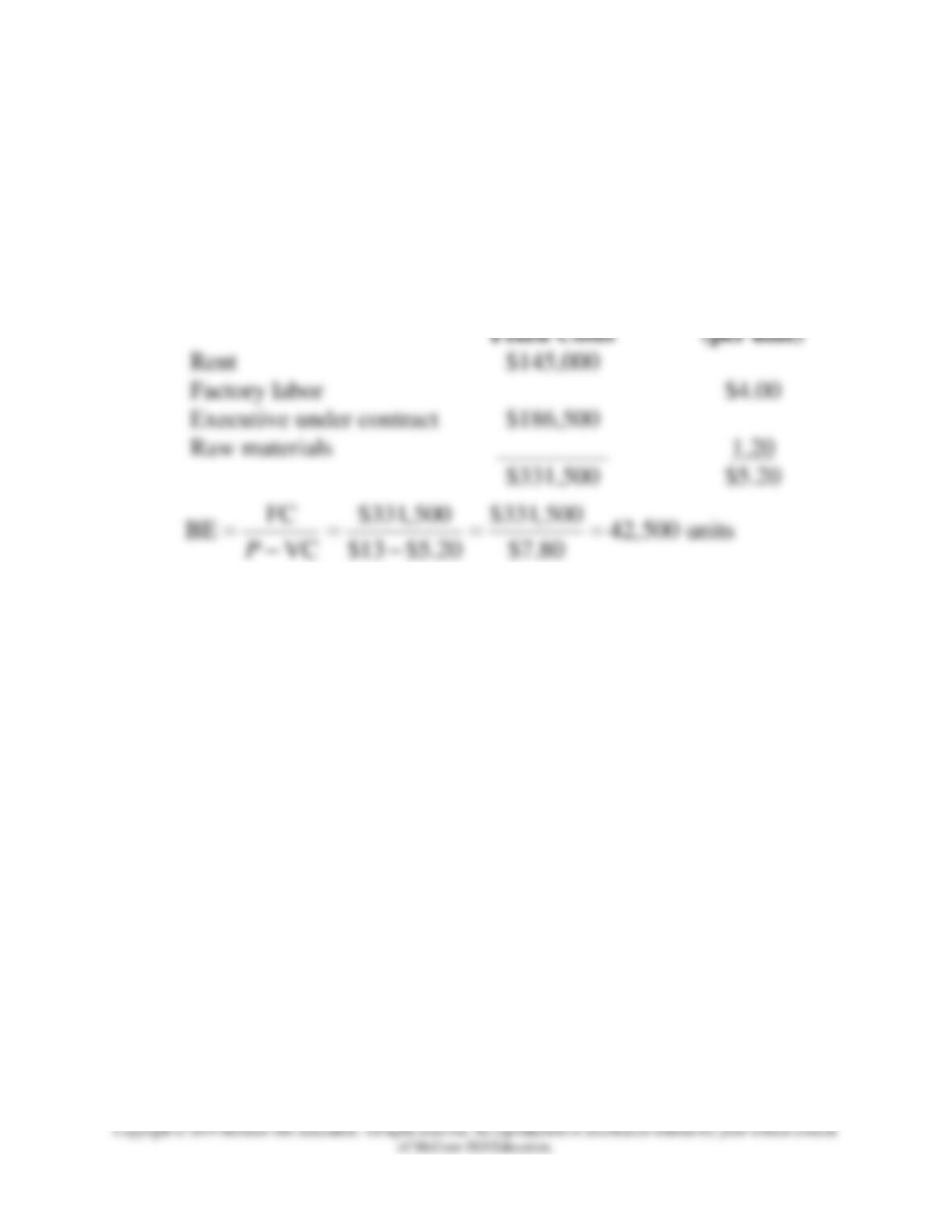
3. Break-even analysis (LO2) Therapeutic Systems sells its products for $13 per unit. It has
the following costs:
Rent ……………………………………..
$145,000
Factory labor …………………………
$4.00 per unit
Executives under contract ……….
$186,500
Raw material …………………………
$1.20 per unit
Chapter 05: Operating and Financial Leverage
Separate the expenses between fixed and variable costs per unit. Using this information and
the sales price per unit of $13, compute the break-even point.
5-3. Solution:
Therapeutic Systems
Fixed Costs
Variable Costs
(per unit)
Rent
$145,000
Factory labor
$4.00
Executive under contract
$186,500
Raw materials
1.20
$331,500
$5.20
FC $331,500 $331,500
BE 42,500 units
VC $13 $5.20 $7.80P
= = = =
−−
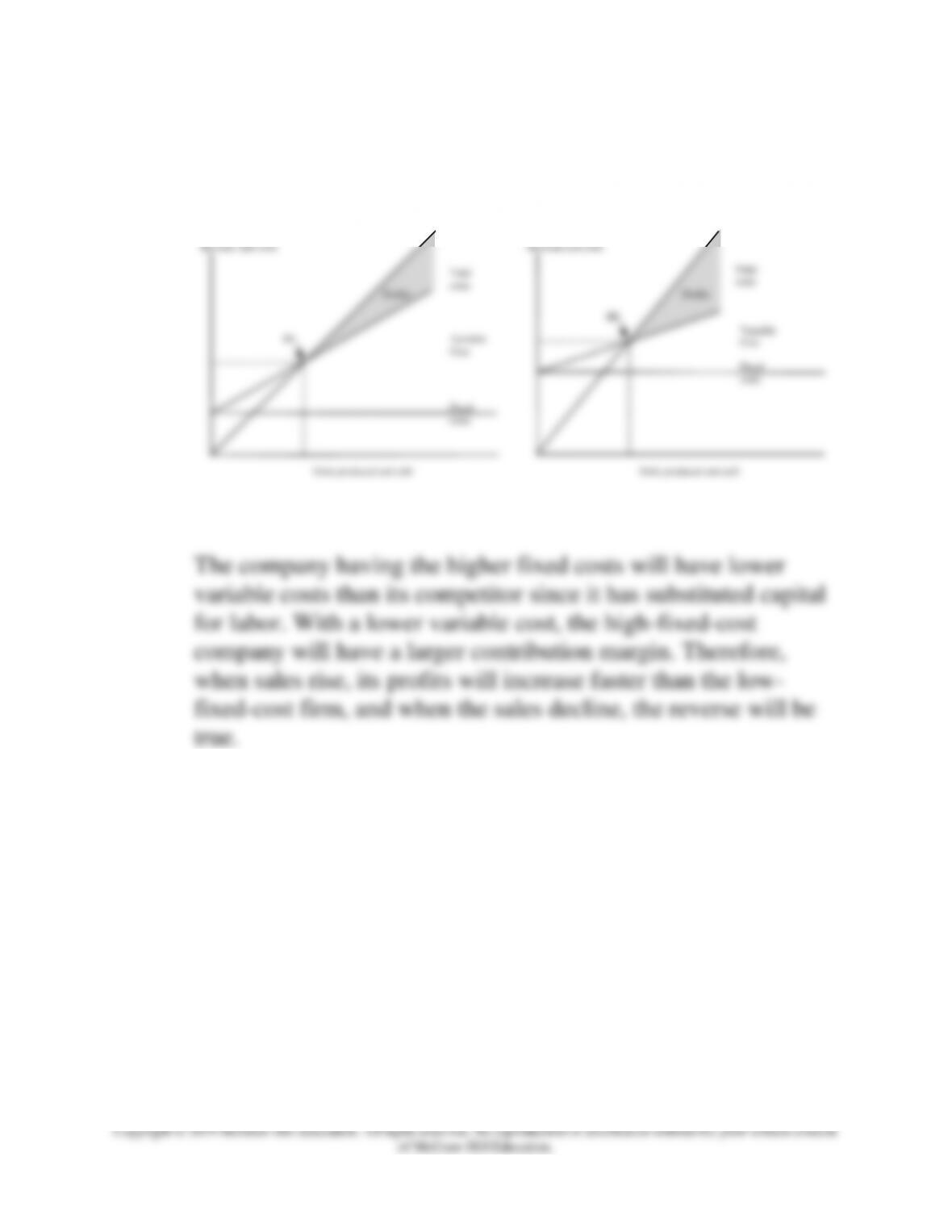
4. Break-even analysis (LO2) Draw two break-even graphs—one for a conservative firm
using labor-intensive production and another for a capital-intensive firm. Assuming these
companies compete within the same industry and have identical sales, explain the impact of
changes in sales volume on both firms’ profits.
5-4. Solution:
Labor-Intensive and Capital-Intensive Break-Even Graphs
Chapter 05: Operating and Financial Leverage
Units produced and sold
Revenue and costs
Total revenue
Total
costs
Variable
Cost
Profits
BE
Fixed
costs
Labor-Intensive Capital-Intensive
Units produced and sold
Revenue and costs
Total revenue
Total
costs
Variable
Cost
Profits
BE
Fixed
costs
The company having the higher fixed costs will have lower
variable costs than its competitor since it has substituted capital
for labor. With a lower variable cost, the high-fixed-cost
company will have a larger contribution margin. Therefore,
when sales rise, its profits will increase faster than the low–
fixed-cost firm, and when the sales decline, the reverse will be
true.
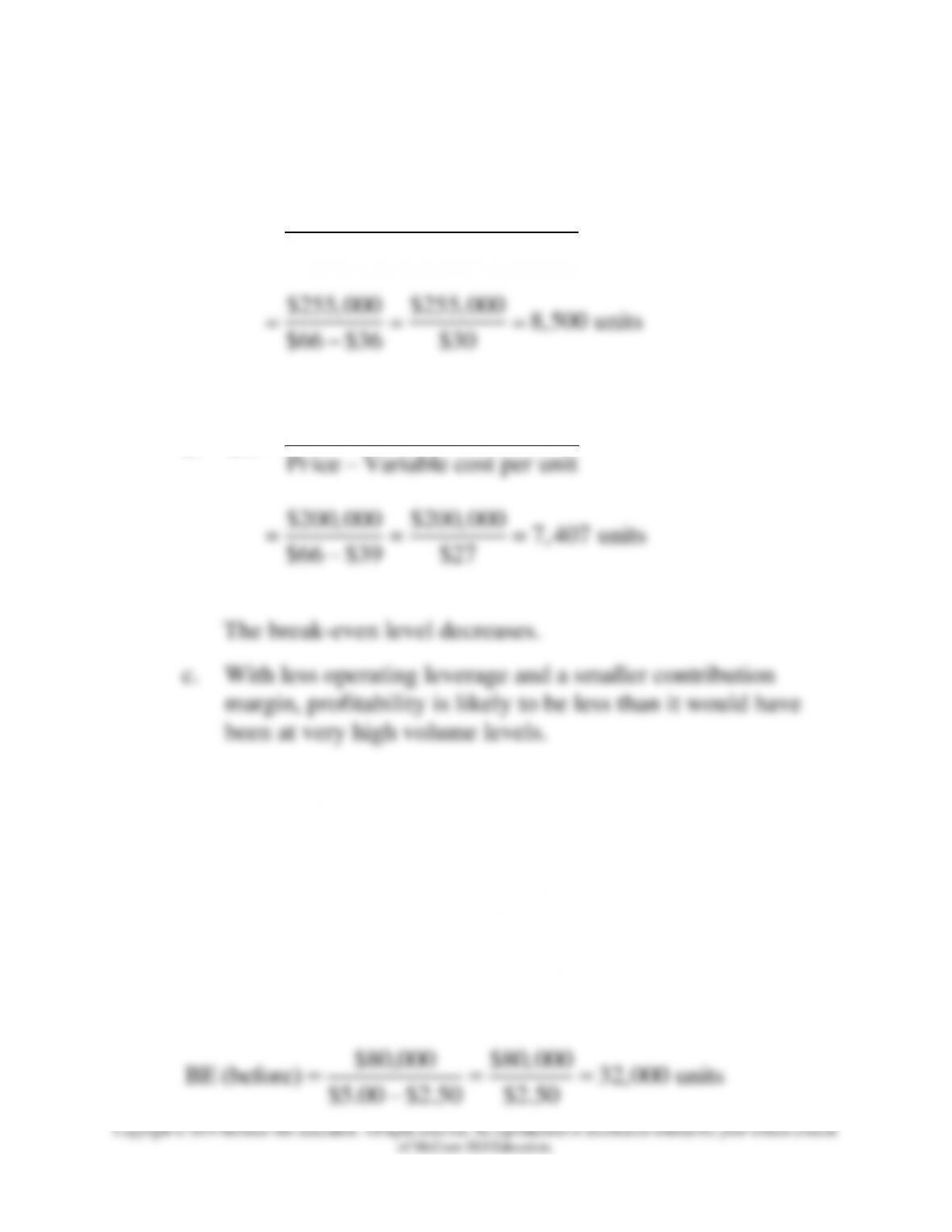
5. Break-even analysis (LO2) Eaton Tool Company has fixed costs of $255,000, sells its
units for $66, and has variable costs of $36 per unit.
a. Compute the break-even point.
b. Ms. Eaton comes up with a new plan to cut fixed costs to $200,000. However, more
labor will now be required, which will increase variable costs per unit to $39. The
sales price will remain at $66. What is the new break-even point?
c. Under the new plan, what is likely to happen to profitability at very high volume
levels (compared to the old plan)?
5-5. Solution:
Chapter 05: Operating and Financial Leverage
Eaton Tool Company
a.
Fixed costs
BE Price Variable cost per unit
$255,000 $255,000 8,500 units
$66 $36 $30
=
−
= = =
−
b.
Fixed costs
BE Price Variable cost per unit
$200,000 $200,000 7,407 units
$66 $39 $27
=
−
= = =
−
The break-even level decreases.
c. With less operating leverage and a smaller contribution
margin, profitability is likely to be less than it would have
been at very high volume levels.
6. Break-even analysis (LO2) Shawn Pen & Pencil Sets Inc. has fixed costs of $80,000. Its
product currently sells for $5 per unit and has variable costs of $2.50 per unit. Mr. Bic, the head
of manufacturing, proposes to buy new equipment that will cost $400,000 and drive up fixed
costs to $120,000. Although the price will remain at $5 per unit, the increased automation will
reduce costs per unit to $2.00.
As a result of Bic’s suggestion, will the break-even point go up or down? Compute the
necessary numbers.
5-6. Solution:
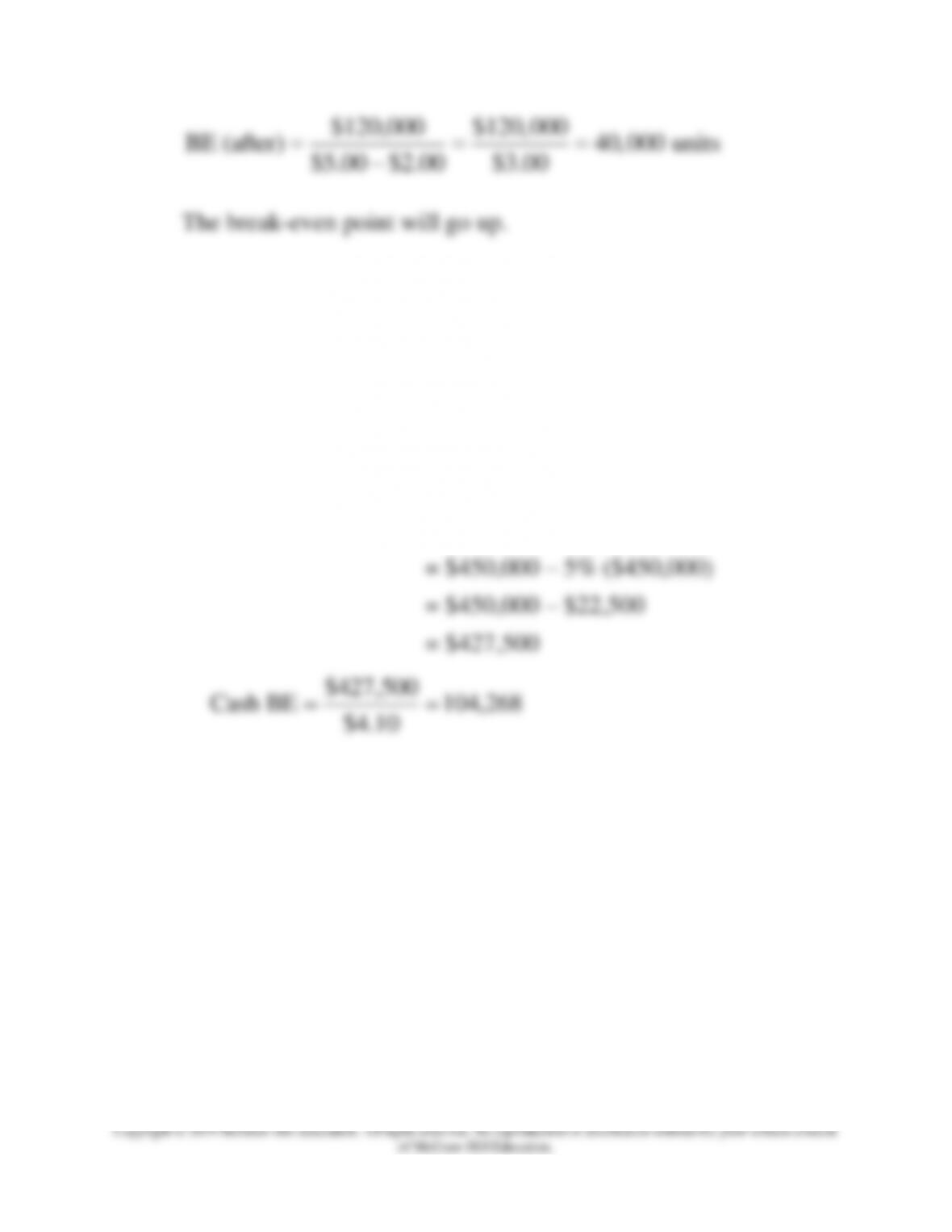
Shawn Pen & Pencil Sets Inc.
$80,000 $80,000
BE (before) 32,000 units
$5.00 $2.50 $2.50
= = =
−
Chapter 05: Operating and Financial Leverage
$120,000 $120,000
BE (after) 40,000 units
$5.00 $2.00 $3.00
= = =
−
The break-even point will go up.
7. Cash break-even analysis (LO2) Calloway Cab Company determines its break-even
strictly on the basis of cash expenditures related to fixed costs. Its total fixed costs are
$450,000, but 5 percent of this value is represented by depreciation. Its contribution
margin (price minus variable cost) for each unit is $4.10. How many units does the firm
need to sell to reach the cash break-even point?
5-7. Solution:
Calloway Cab Company
Cash-related fixed costs = Total fixed costs – Depreciation
$4.10
8. Cash break-even analysis (LO2) Air Purifier Inc. computes its break-even point strictly
on the basis of cash expenditures related to fixed costs. Its total fixed costs are $2,450,000,
but 15 percent of this value is represented by depreciation. Its contribution margin (price
minus variable cost) for each unit is $40. How many units does the firm need to sell to
reach the cash break-even point?
5-8. Solution:
Air Purifier Inc.
Cash-related fixed costs = Total fixed costs – Depreciation
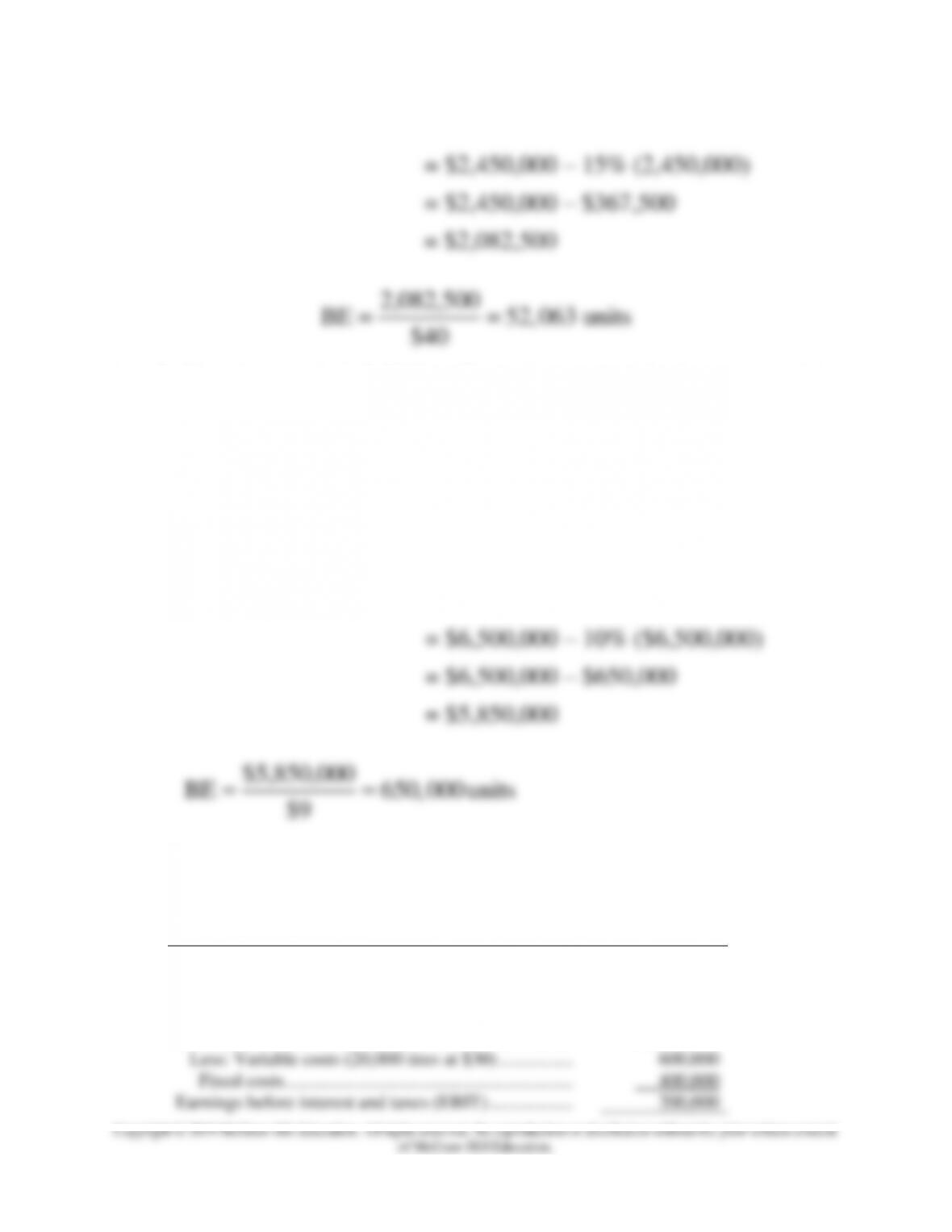
Chapter 05: Operating and Financial Leverage
$40
9. Cash break-even analysis (LO2) Boise Timber Co. computes its break-even point strictly
on the basis of cash expenditures related to fixed costs. Its total fixed costs are $6,500,000,
but 10 percent of this value is represented by depreciation. Its contribution margin (price
minus variable cost) for each unit is $9. How many units does the firm need to sell to reach
the cash break-even point?
5-9. Solution:
Boise Timber Co.
Cash-related fixed costs = Total fixed costs – Depreciation
$9
10. Degree of leverage (LO2 and 5) The Sterling Tire Company’s income statement for 20X1
is as follows:
STERLING TIRE COMPANY
Income Statement
For the Year Ended December 31, 20X1
Sales (20,000 tires at $60 each)……………………………..
$1,200,000
Less: Variable costs (20,000 tires at $30) …………….
600,000
Fixed costs ……………………………………………………..
400,000
Earnings before interest and taxes (EBIT) ………………
200,000
Chapter 05: Operating and Financial Leverage
Interest expense …………………………………………………..
50,000
Earnings before taxes (EBT) …………………………………
150,000
Income tax expense (30%) ……………………………………
45,000
Earnings after taxes (EAT)……………………………………
$ 105,000
Given this income statement, compute the following:
a. Degree of operating leverage.
b. Degree of financial leverage.
c. Degree of combined leverage.
d. Break-even point in units.
5-10. Solution:
Sterling Tire Company
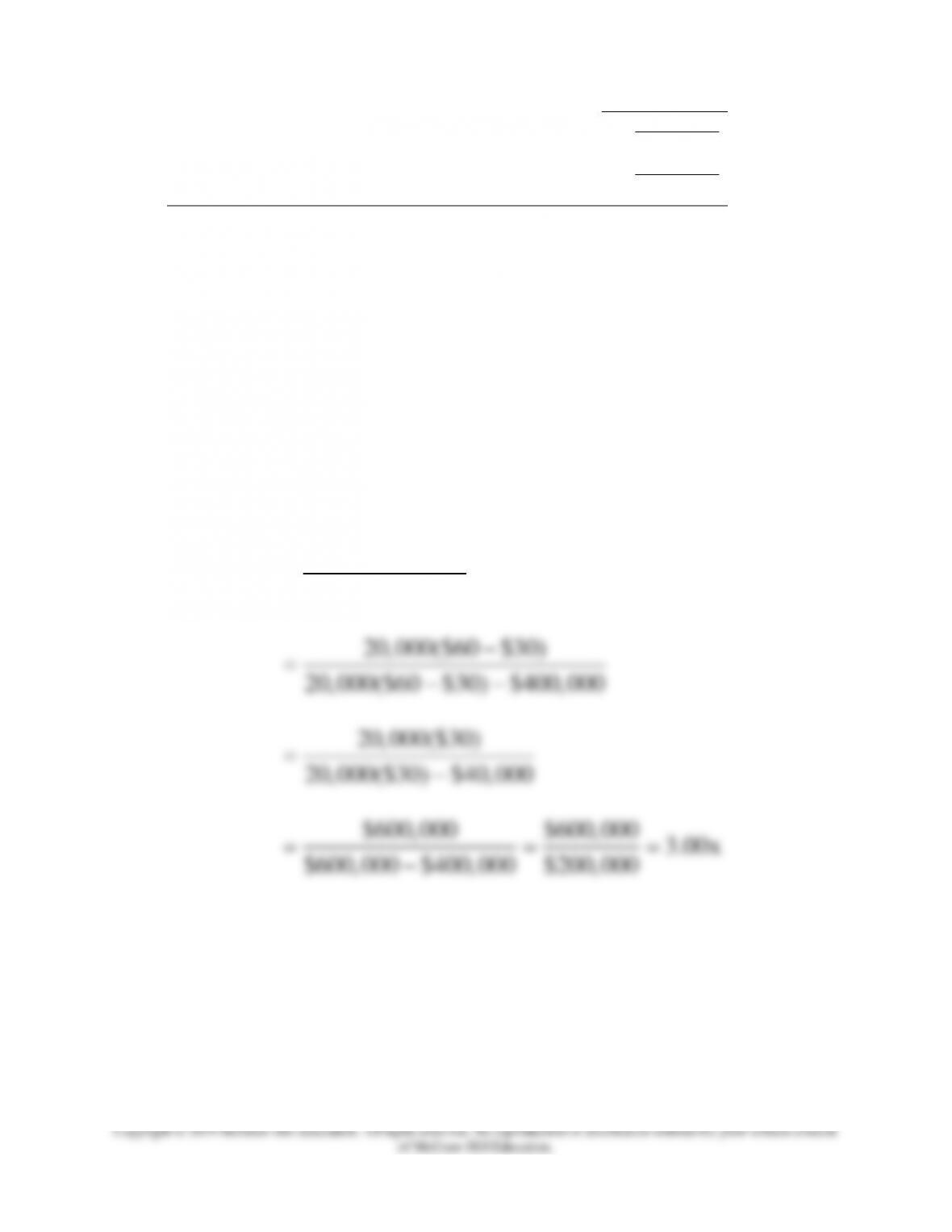
Q = 20,000, P = $60, VC = $30, FC = $400,000, I = $50,000
a.
( VC)
DOL ( VC) FC
20,000($60 $30)
20,000($60 $30) $400,000
20,000($30)
20,000($30) $40,000
$600,000 $600,000 3.00x
$600,000 $400,000 $200,000
QP
QP
−
=
−−
−
=
−−
=
−
= = =
−
5-10. (Continued)
Chapter 05: Operating and Financial Leverage
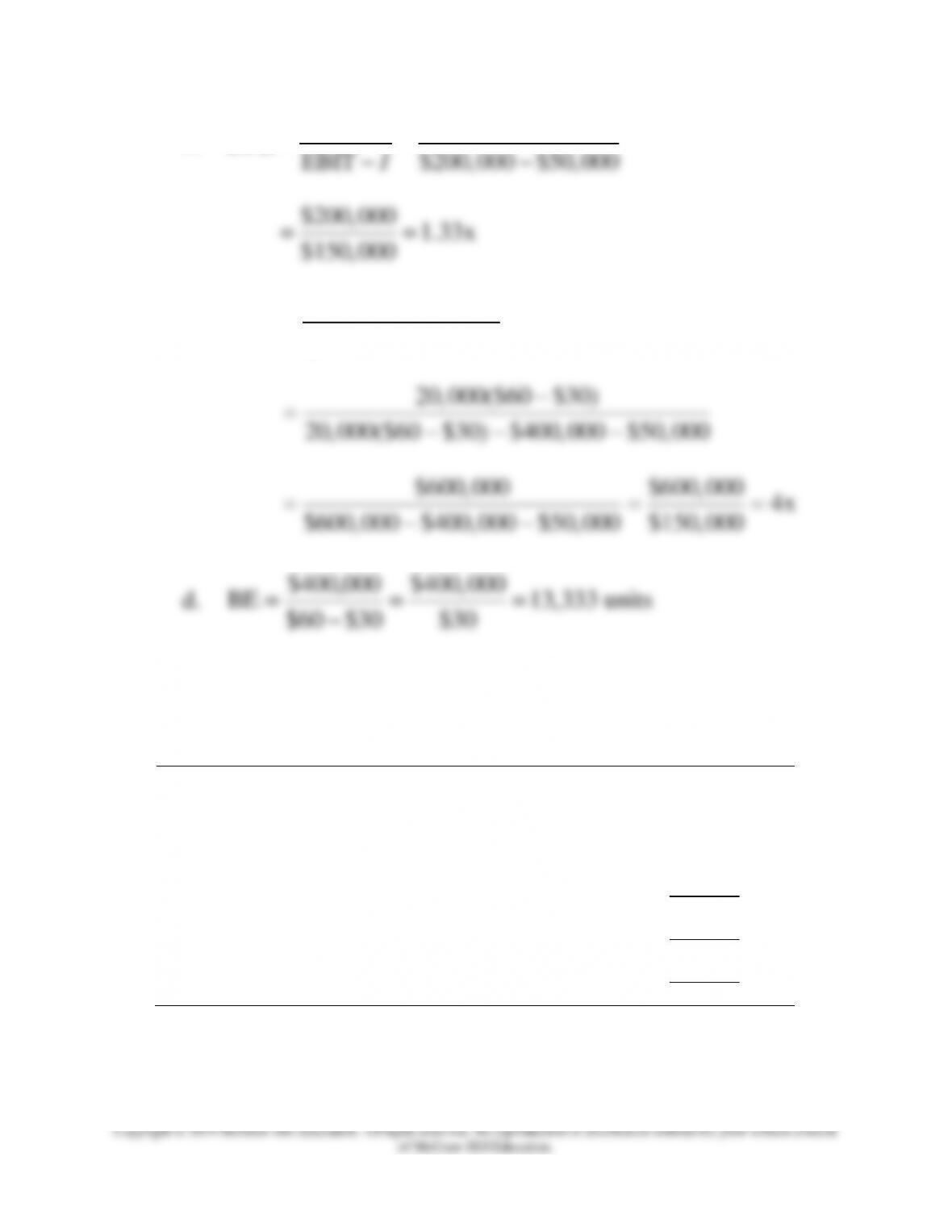
b.
EBIT $200,000
DFL EBIT $200,000 $50,000
$200,000 1.33x
$150,000
I
==
−−
==
c.
( VC)
DCL ( VC) FC
20,000($60 $30)
20,000($60 $30) $400,000 $50,000
$600,000 $600,000 4x
$600,000 $400,000 $50,000 $150,000
QP
Q P I
−
=
− − −
−
=
− − −
= = =
−−
d.
$400,000 $400,000
BE 13,333 units
$60 $30 $30
= = =
−
11. Degree of leverage (LO2 and 5) The Harding Company manufactures skates. The
company’s income statement for 20X1 is as follows:
HARDING COMPANY
Income Statement
For the Year Ended December 31, 20X1
Sales (10,500 skates @ $60 each) ……………………………
$630,000
Less: Variable costs (10,500 skates at $25) ……………….
262,500
Fixed costs ………………………………………………………..
200,000
Earnings before interest and taxes (EBIT) ………………..
167,500
Interest expense …………………………………………………….
62,500
Earnings before taxes (EBT) …………………………………..
105,000
Income tax expense (30%) ……………………………………..
31,500
Earnings after taxes (EAT) …………………………..…………
$ 73,500
Given this income statement, compute the following:
a. Degree of operating leverage.
Chapter 05: Operating and Financial Leverage
c. Degree of combined leverage.
d. Break-even point in units (number of skates).
5-11. Solution:
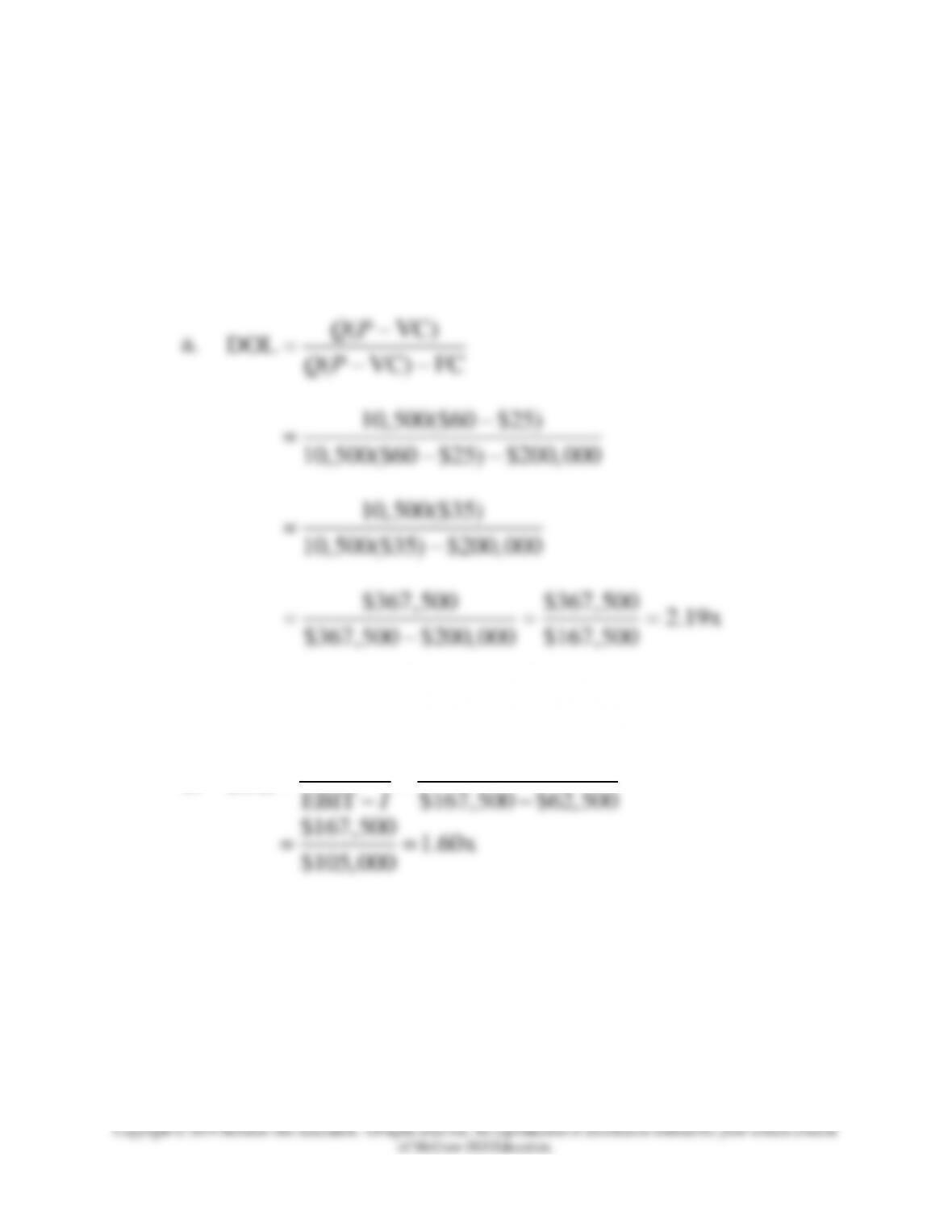
Harding Company
Q = 10,500, P = $60, VC = $25, FC = $200,000, I = $62,500
( VC)
10,500($35)
10,500($35) $200,000
$367,500 $367,500 2.19x
$367,500 $200,000 $167,500
QP
−
=
−
= = =
−
5-11. (Continued)
b.
EBIT $167,500
DFL EBIT $167,500 $62,500
$167,500 1.60x
$105,000
I
==
−−
==
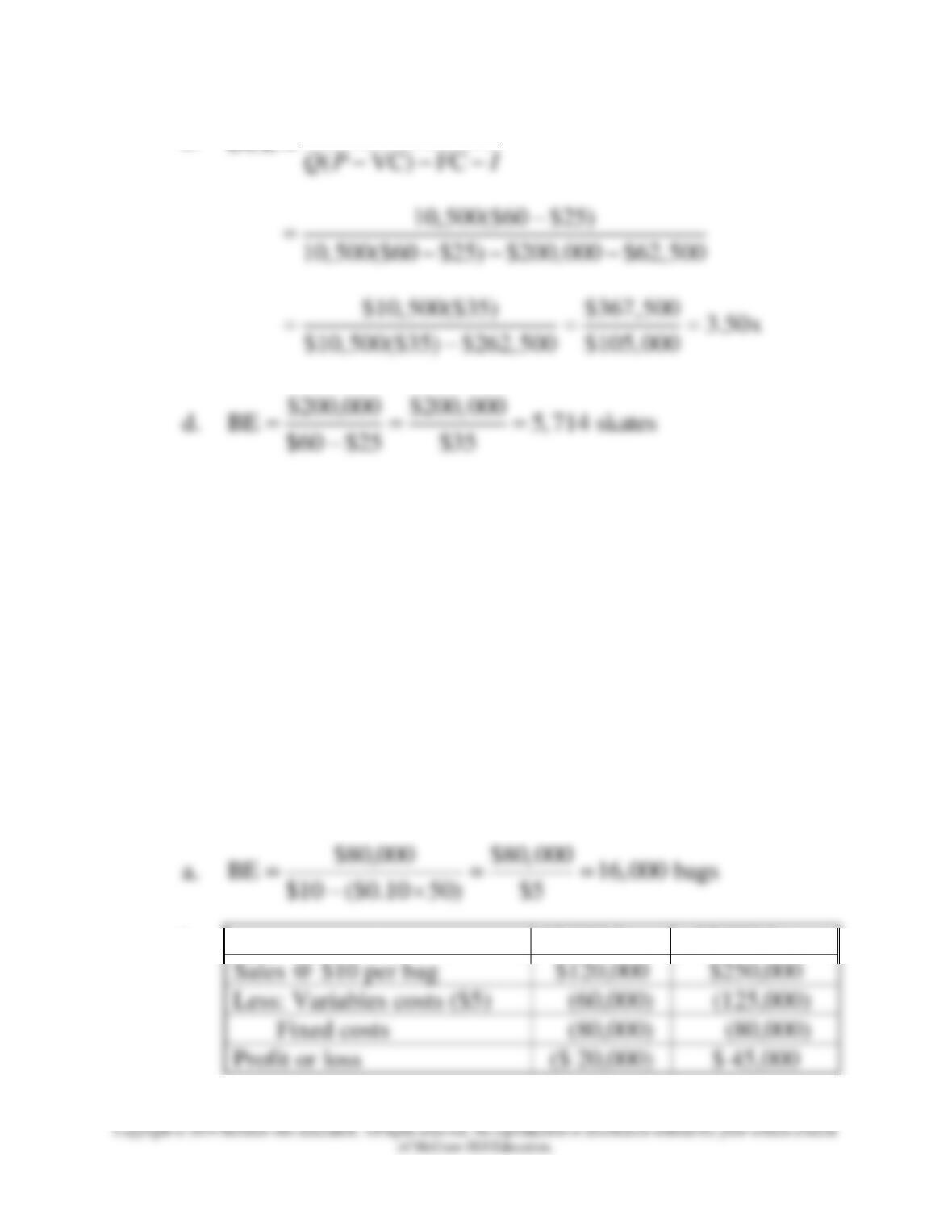
Chapter 05: Operating and Financial Leverage
c.
( VC)
DCL ( VC) FC
10,500($60 $25)
10,500($60 $25) $200,000 $62,500
$10,500($35) $367,500 3.50x
$10,500($35) $262,500 $105,000
QP
Q P I
−
=
− − −
−
=
− − −
= = =
−
d.
$200,000 $200,000
BE 5,714 skates
$60 $25 $35
= = =
−
12. Break-even point and degree of leverage (LO2 and 5) Healthy Foods Inc. sells 50-pound
bags of grapes to the military for $10 a bag. The fixed costs of this operation are $80,000,
while the variable costs of grapes are $0.10 per pound.
a. What is the break-even point in bags?
b. Calculate the profit or loss on 12,000 bags and on 25,000 bags.
c. What is the degree of operating leverage at 20,000 bags and at 25,000 bags?
Why does the degree of operating leverage change as the quantity sold increases?
d. If Healthy Foods has an annual interest expense of $10,000, calculate the degree of
financial leverage at both 20,000 and 25,000 bags.
e. What is the degree of combined leverage at both sales levels?
5-12. Solution:
Healthy Foods Inc.
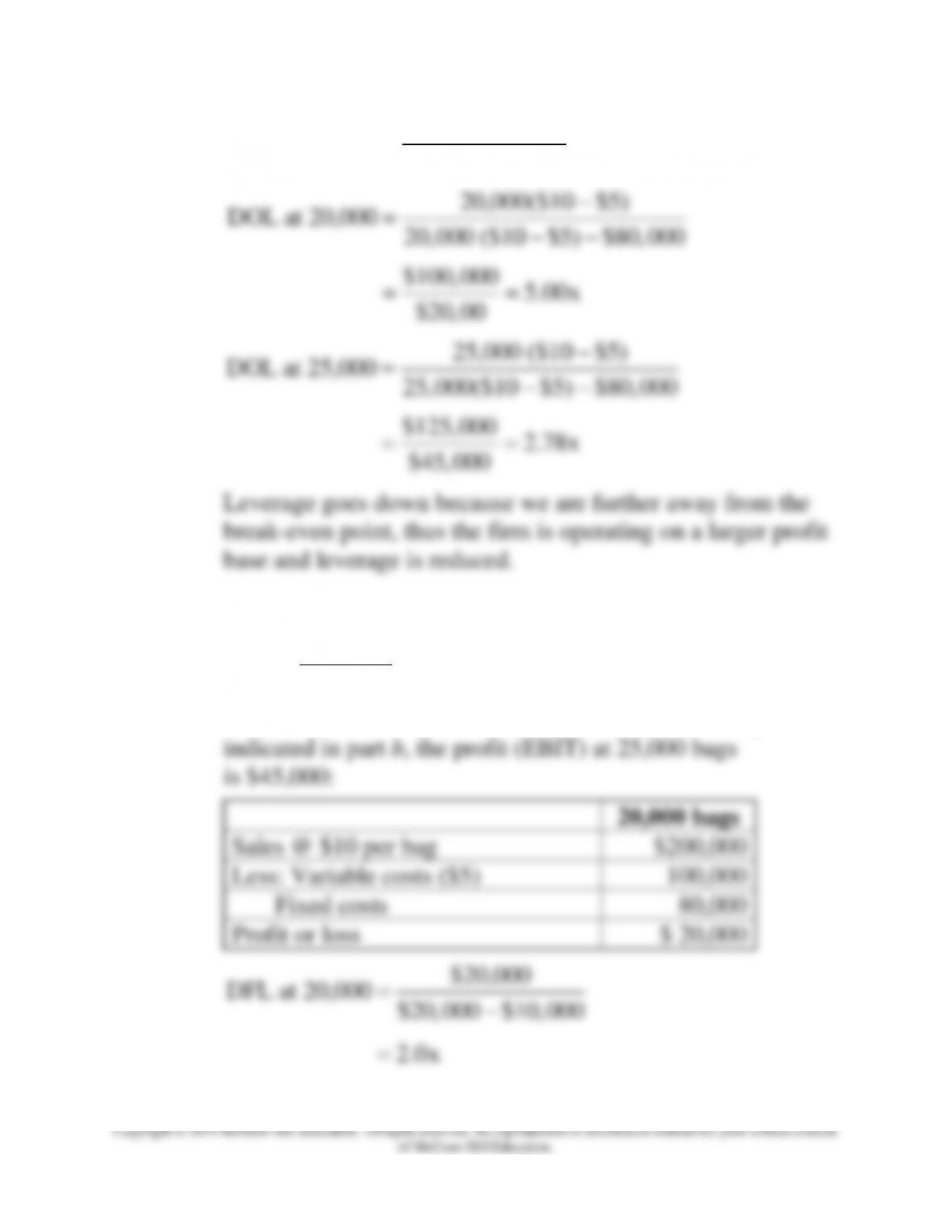
$80,000 $80,000
b.
12,000 bags
25,000 bags
Sales @ $10 per bag
$120,000
$250,000
Less: Variables costs ($5)
(60,000)
(125,000)
Fixed costs
(80,000)
(80,000)
Profit or loss
($ 20,000)
$ 45,000
Chapter 05: Operating and Financial Leverage
c.
( VC)
DOL ( VC) FC
20,000($10 $5)
$100,000 5.00x
$20,00
QP
QP
−
=
−−
−
−−
==
25,000 ($10 $5)
DOL at 25,000 25,000($10 $5) $80,000
$125,000 2.78x
$45,000
−
=
−−
==
Leverage goes down because we are further away from the
break-even point, thus the firm is operating on a larger profit
base and leverage is reduced.
5-12. (Continued)
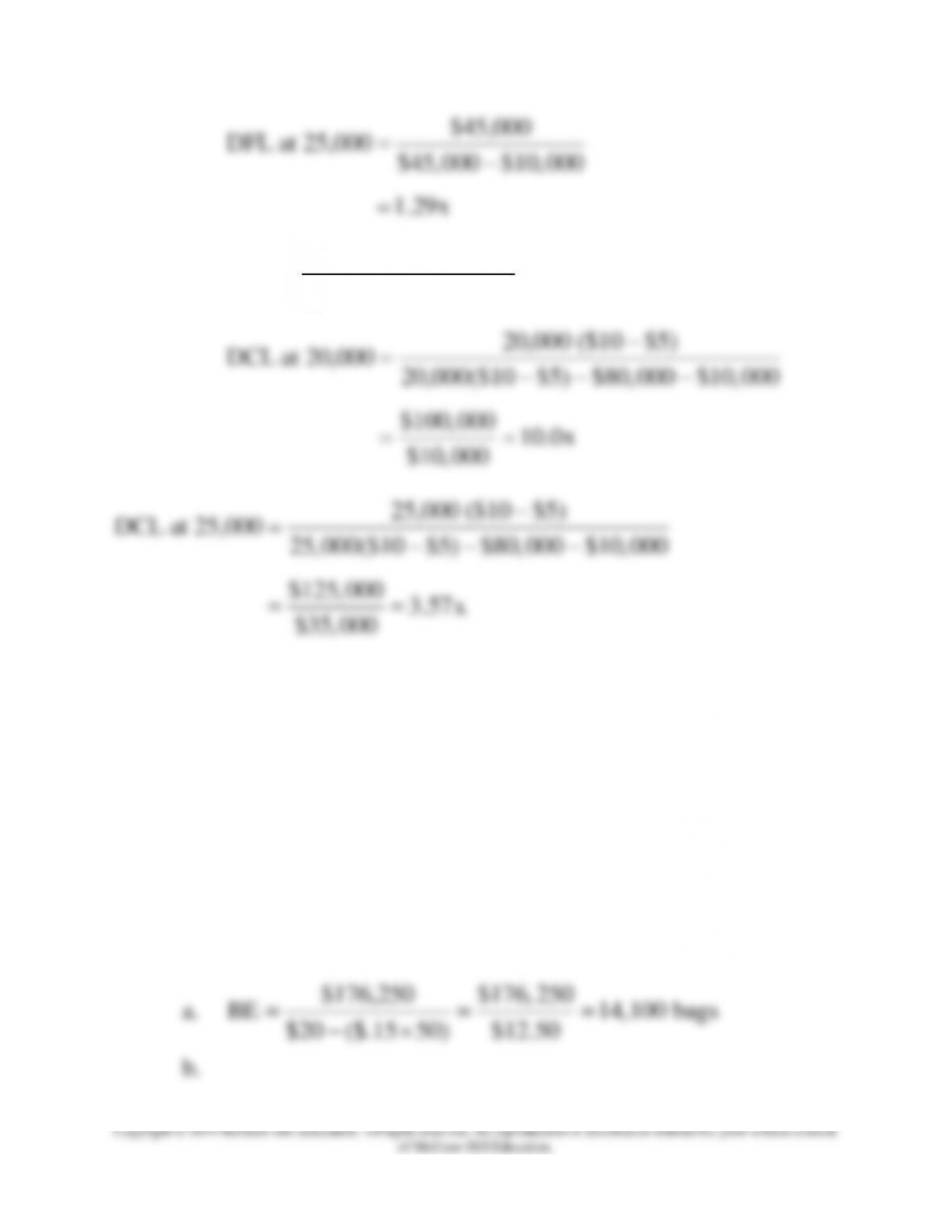
d.
EBIT
DFL EBIT I
=
−
First determine the profit or loss (EBIT) at 20,000 bags. As
2.0x
=
Chapter 05: Operating and Financial Leverage
$45,000
DFL at 25,000 $45,000 $10,000
1.29x
=
−
=
e.
( VC)
DCL ( VC) FC
QP
Q P I
−
=
− − −
20,000 ($10 $5)
DCL at 20,000
20,000($10 $5) $80,000 $10,000
$100,000 10.0x
$10,000
−
=
− − −
==
25,000 ($10 $5)
DCL at 25,000 25,000($10 $5) $80,000 $10,000
$125,000 3.57x
$35,000
−
=
− − −
==
13. Break-even point and degree of leverage (LO2 and 5) United Snack Company sells
50-pound bags of peanuts to university dormitories for $20 a bag. The fixed costs of this
operation are $176,250, while the variable costs of peanuts are $.15 per pound.
a. What is the break-even point in bags?
b. Calculate the profit or loss on 7,000 bags and on 20,000 bags.
c. What is the degree of operating leverage at 19,000 bags and at 24,000 bags? Why
does the degree of operating leverage change as the quantity sold increases?
d. If United Snack Company has an annual interest expense of $15,000, calculate the
degree of financial leverage at both 19,000 and 24,000 bags.
e. What is the degree of combined leverage at both sales levels?
5-13. Solution:
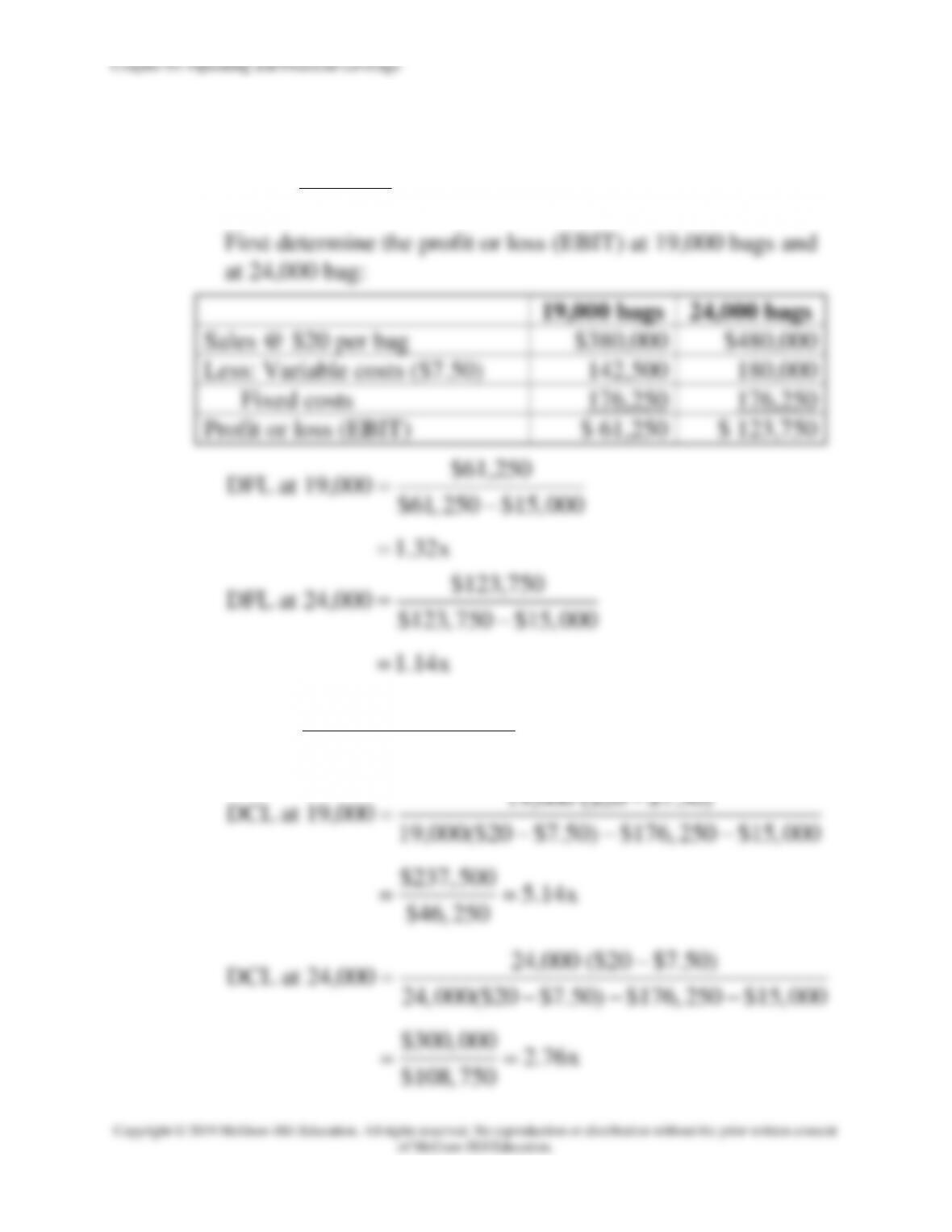
United Snack Company
$176,250 $176, 250
Chapter 05: Operating and Financial Leverage
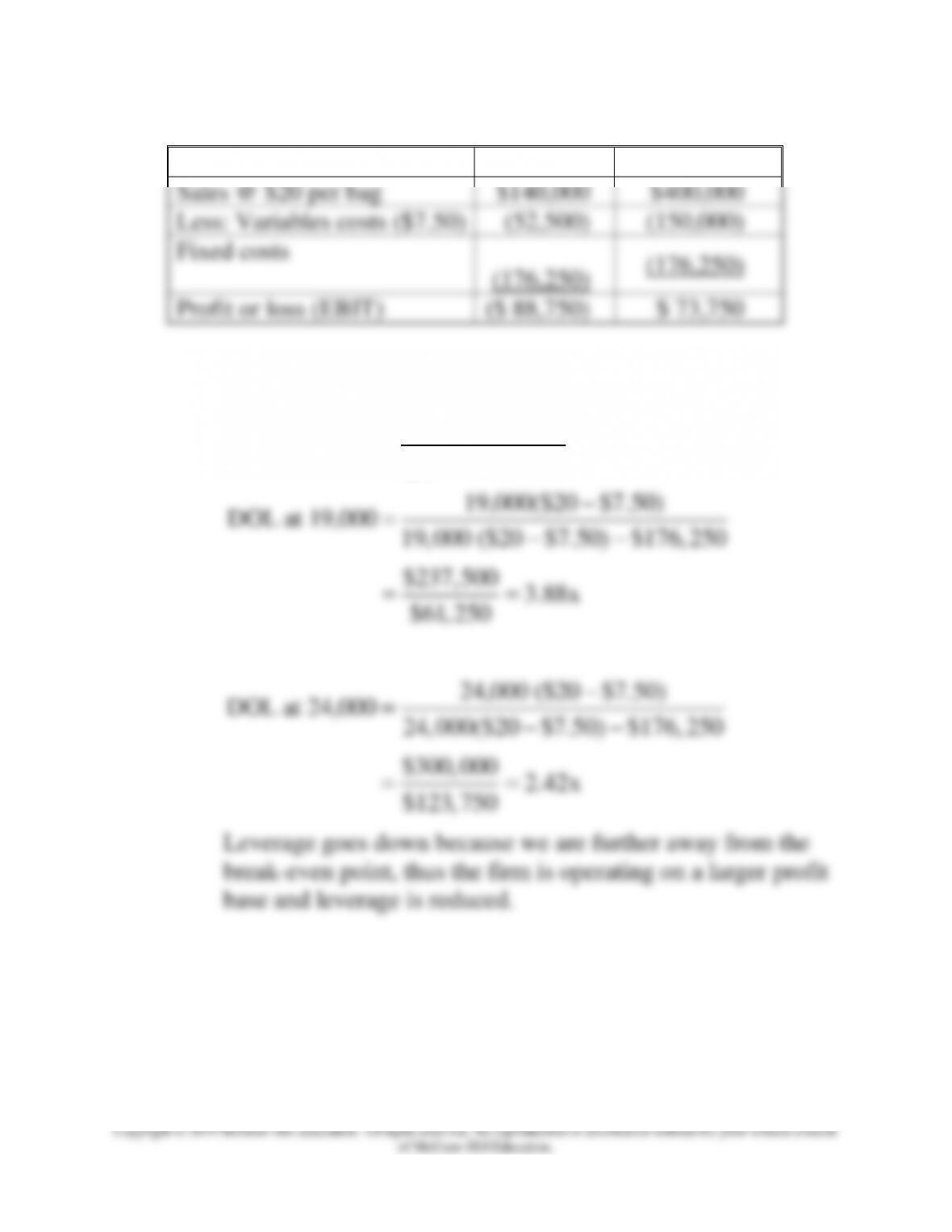
7,000 bags
20,000 bags
Sales @ $20 per bag
$140,000
$400,000
Less: Variables costs ($7.50)
(52,500)
(150,000)
Fixed costs
(176,250)
(176,250)
Profit or loss (EBIT)
($ 88,750)
$ 73,750
5-13. (Continued)
c.
( VC)
DOL ( VC) FC
19,000($20 $7.50)
$237,500 3.88x
$61,250
QP
QP
−
=
−−
−
−−
==
24,000 ($20 $7.50)
DOL at 24,000 24, 000($20 $7.50) $176, 250
$300,000 2.42x
$123,750
−
=
−−
==
Leverage goes down because we are further away from the
break-even point, thus the firm is operating on a larger profit
base and leverage is reduced.
Chapter 05: Operating and Financial Leverage
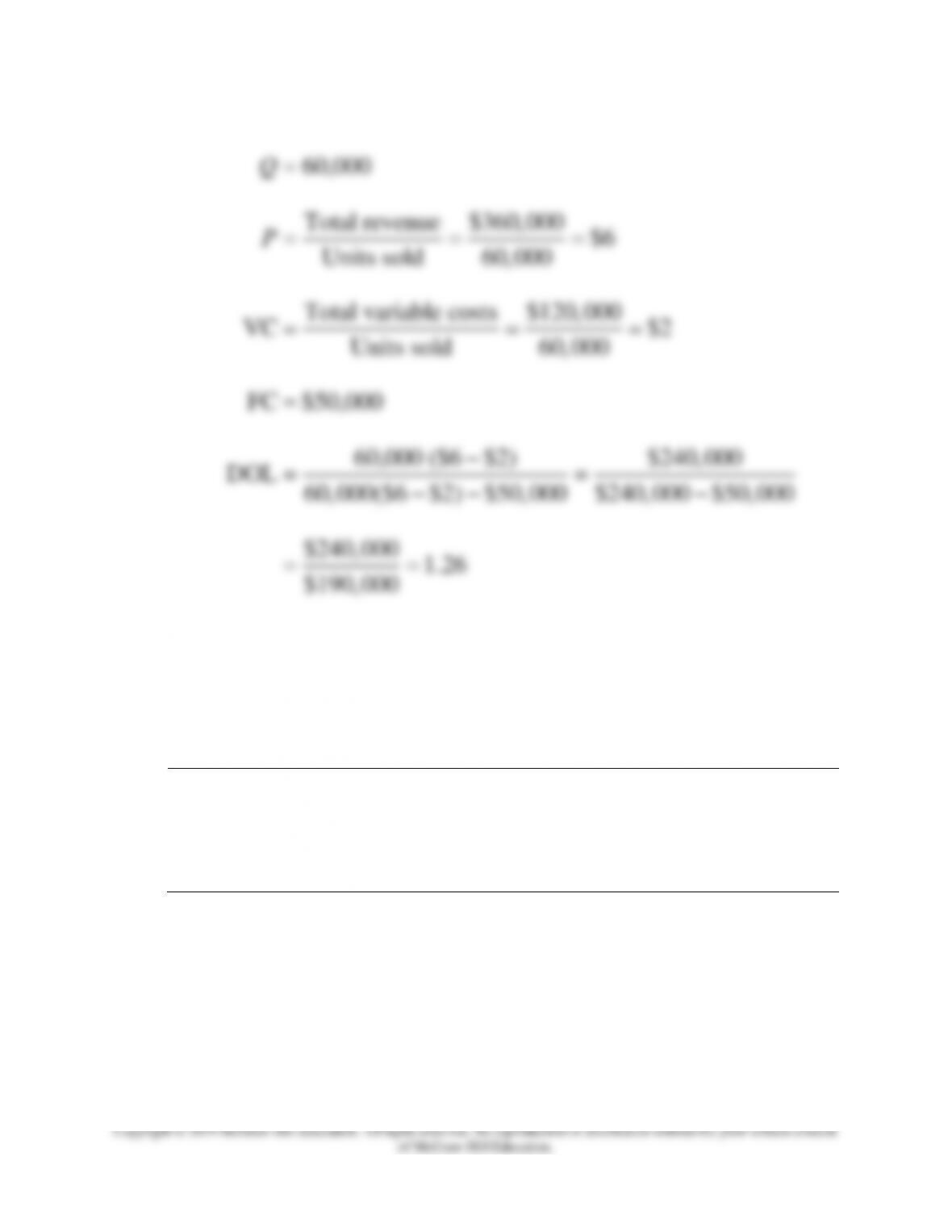
60,000
Total revenue $360,000 $6
Units sold 60,000
Total variable costs $120,000
VC $2
Units sold 60,000
FC $50,000
60,000 ($6 $2) $240,000
DOL 60,000($6 $2) $50,000 $240,000 $50,000
$240,000 1.26
$190,000
Q
P
=
= = =
= = =
=
−
==
− − −
==
16. Earnings per share and financial leverage (LO4) Lenow’s Drug Stores and Hall’s
Pharmaceuticals are competitors in the discount drug chain store business. The separate
capital structures for Lenow and Hall are presented next.
Lenow
Hall
Debt @ 10% …………………….
$100,000
Debt @ 10% ……………………..
$200,000
Common stock, $10 par …….
200,000
Common stock, $10 par ……..
100,000
Total ……………………………….
$300,000
Total ………………………………..
$300,000
Shares ……………………………..
20,000
Common shares …………………
10,000
a. Compute earnings per share if earnings before interest and taxes are $20,000,
$30,000, and $120,000 (assume a 30 percent tax rate).
b. Explain the relationship between earnings per share and the level of EBIT.
c. If the cost of debt went up to 12 percent and all other factors remained equal, what
would be the break-even level for EBIT?