Chapter 5 – Risk, Return, and the Historical Record
5-1
CHAPTER 5: RISK, RETURN, AND THE HISTORICAL
RECORD
PROBLEM SETS
1. The Fisher equation predicts that the nominal rate will equal the equilibrium
real rate plus the expected inflation rate. Hence, if the inflation rate increases
2. If we assume that the distribution of returns remains reasonably stable over
the entire history, then a longer sample period (i.e., a larger sample) increases
the precision of the estimate of the expected rate of return; this is a
3. The true statements are (c) and (e). The explanations follow.
Statement (c): Let
= the annual standard deviation of the risky
Chapter 5 – Risk, Return, and the Historical Record
Statement (e): The first investment alternative is more attractive to investors
with lower degrees of risk aversion. The first alternative (entailing a sequence
4. For the money market fund, your holding-period return for the next year
depends on the level of 30-day interest rates each month when the fund rolls
over maturing securities. The one-year savings deposit offers a 7.5% holding
period return for the year. If you forecast that the rate on money market
5. a. If businesses reduce their capital spending, then they are likely to
decrease their demand for funds. This will shift the demand curve in
Figure 5.1 to the left and reduce the equilibrium real rate of interest.
5-3
6. a. The “Inflation–Plus” CD is the safer investment because it guarantees the
purchasing power of the investment. Using the approximation that the real
rate equals the nominal rate minus the inflation rate, the CD provides a real
rate of 1.5% regardless of the inflation rate.
b. The expected return depends on the expected rate of inflation over the next
year. If the expected rate of inflation is less than 3.5% then the conventional
7. E(r) = [0.35 × 44.5%] + [0.30 × 14.0%] + [0.35 × (–16.5%)] = 14%
8. Probability distribution of price and one-year holding period return for a 30-
year U.S. Treasury bond (which will have 29 years to maturity at year-end):
Economy
Probability
YTM
Price
Capital
Gain
Coupon
Interest
HPR
Boom
11.0%
Normal growth
8.0
0.00
8.00
Recession
7.0
12.28
20.28
Chapter 5 – Risk, Return, and the Historical Record
5-4
10. (a) With probability 0.9544, the value of a normally distributed
11. From Table 5.4, the average risk premium for the period 7/1926-9/2012 was:
12.34% per year.
12.
(01/1928-06/1970)
Small
Big
Low
2
High
Low
2
High
Average
1.03%
1.21%
1.46%
0.78%
0.88%
1.18%
8.55%
8.47%
5.89%
6.91%
9.11%
Skew
1.6704
1.6673
2.3064
1.6251
1.6348
Kurtosis
(07/1970-12/2012)
Small
Big
Low
2
High
Low
2
High
Average
0.91%
1.33%
1.46%
0.93%
1.02%
1.13%
7.00%
5.49%
5.66%
4.81%
4.50%
4.78%
Skew
Kurtosis
1.7962
3.1917
3.8320
2.0756
2.8629
No. The distributions from (01/1928–06/1970) and (07/1970–12/2012) periods
have distinct characteristics due to systematic shocks to the economy and
Chapter 5 – Risk, Return, and the Historical Record
5-5
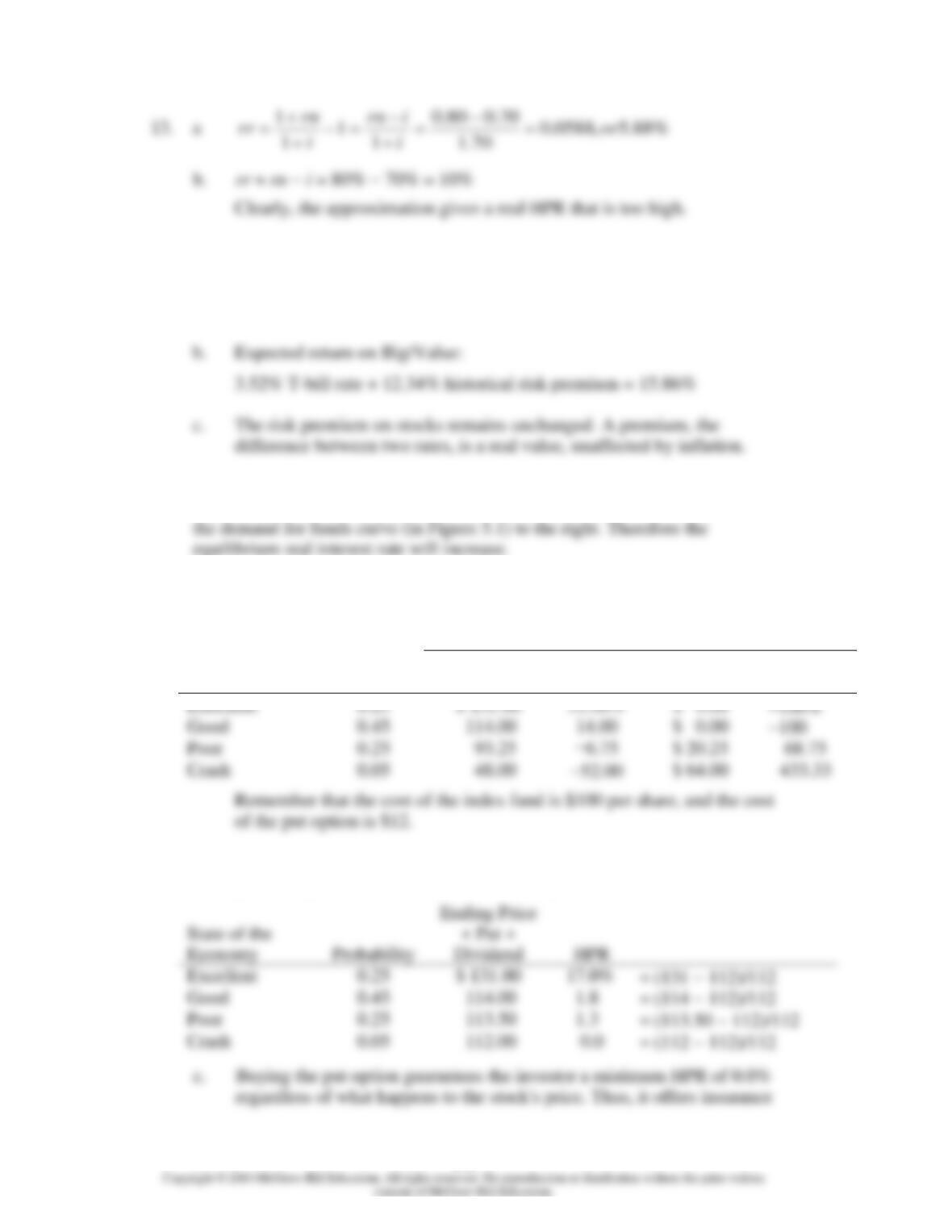
14. From Table 5.2, the average real rate on T-bills has been 0.52%.
a. T-bills: 0.52% real rate + 3% inflation = 3.52%
b. Expected return on Big/Value:
15. Real interest rates are expected to rise. The investment activity will shift
16. a. Probability distribution of the HPR on the stock market and put:
STOCK
PUT
State of the
Economy
Probability
Ending Price
+ Dividend
HPR
Ending
Value
HPR
Excellent
Good
Poor
Crash
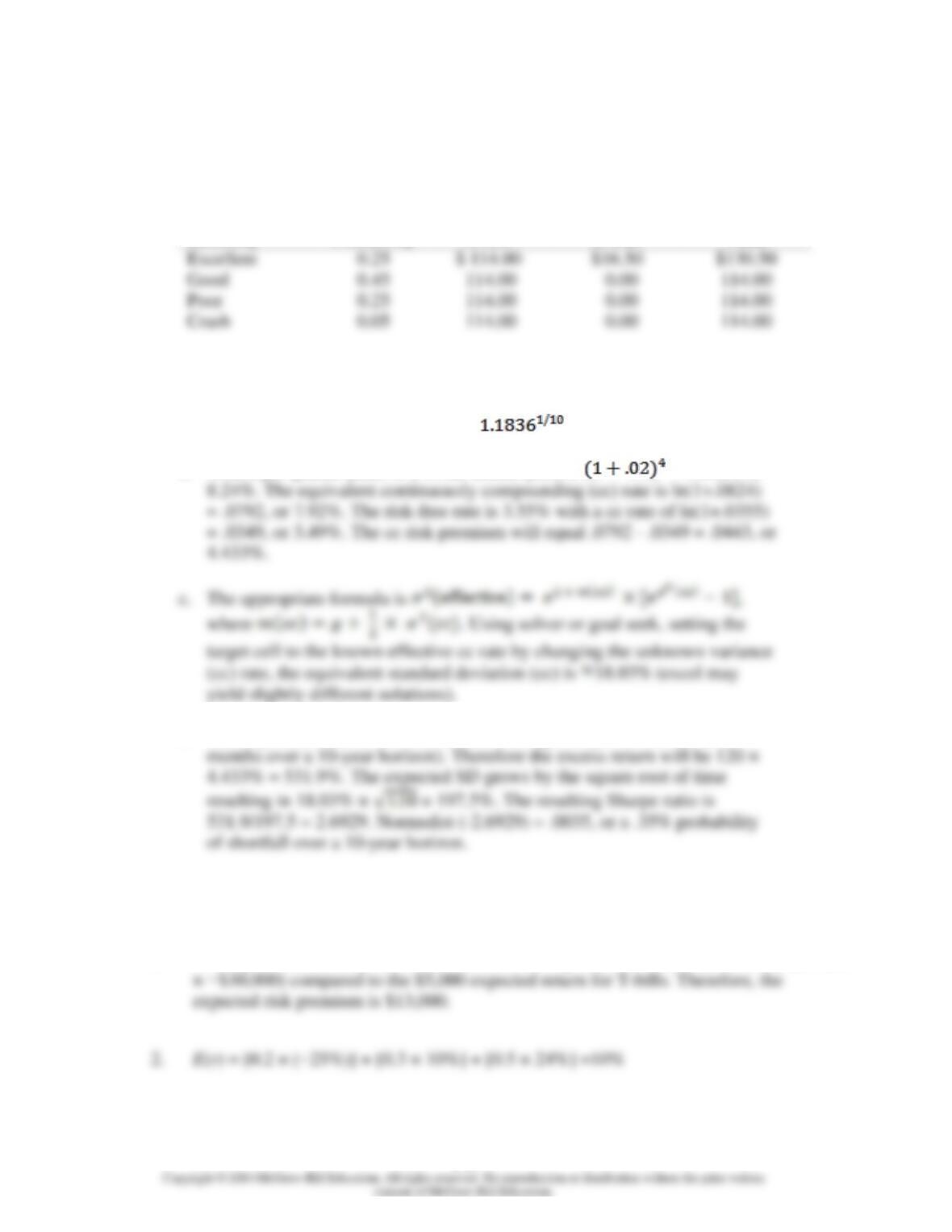
b. The cost of one share of the index fund plus a put option is $112. The
probability distribution of the HPR on the portfolio is:
State of the
Economy
Probability
Dividend
Excellent
17.0%
Good
1.8
Poor
1.3
Crash
Chapter 5 – Risk, Return, and the Historical Record
5-6
against a price decline.
17. The probability distribution of the dollar return on CD plus call option is:
State of the
Economy
Probability
Ending Value
of CD
Ending Value
of Call
Combined
Value
Excellent
$16.50
Good
114.00
Poor
114.00
Crash
114.00
18.
a. Total return of the bond is (100/84.49)-1 = 0.1836. With t = 10, the annual
rate on the real bond is (1 + EAR) = = 1.69%.
b. With a per quarter yield of 2%, the annual yield is = 1.0824, or
d. The expected value of the excess return will grow by 120 months (12
CFA PROBLEMS
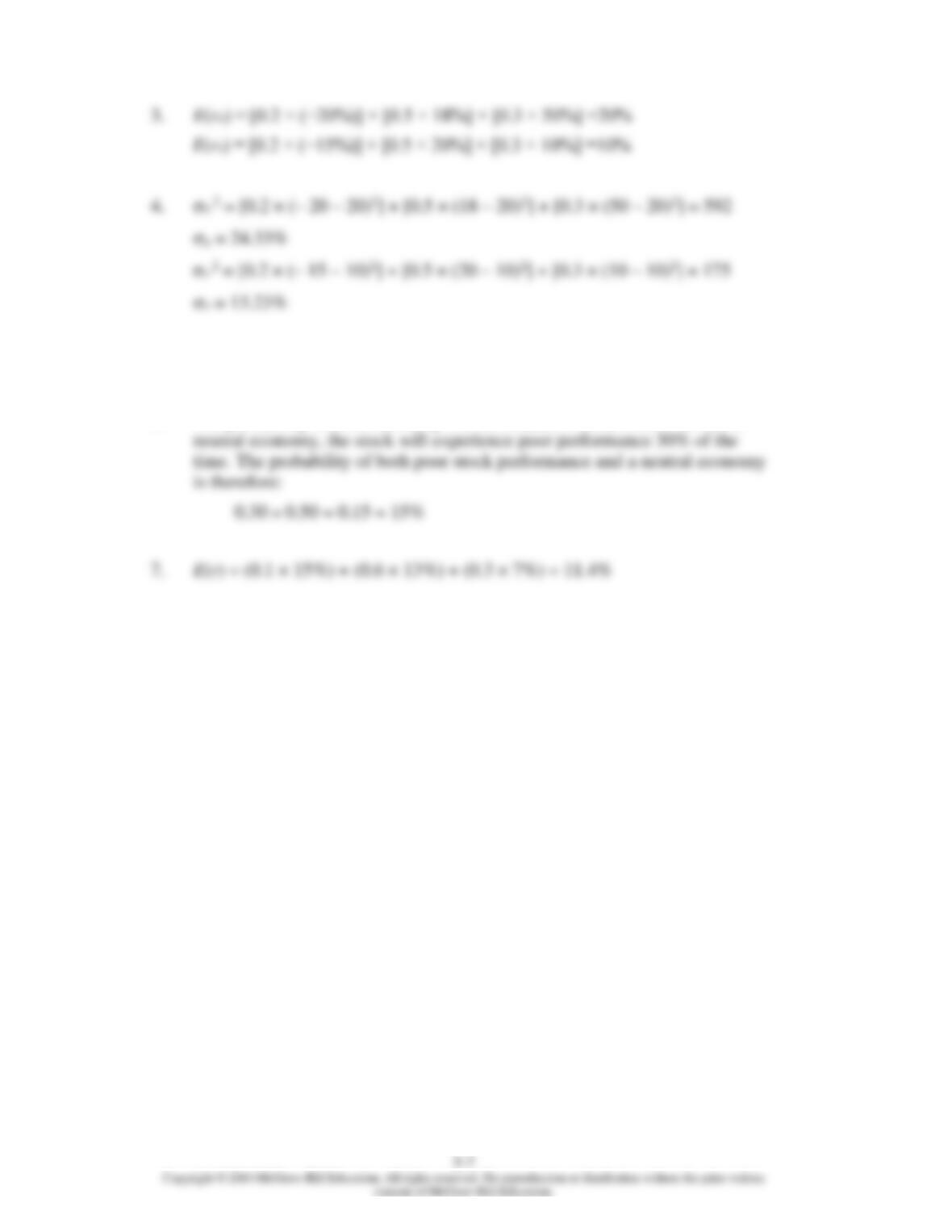
1. The expected dollar return on the investment in equities is $18,000 (0.6 × $50,000 + 0.4
Chapter 5 – Risk, Return, and the Historical Record
5. E(r) = (0.9 × 20%) + (0.1 × 10%) =19% → $1,900 in returns
6. The probability that the economy will be neutral is 0.50, or 50%. Given a