
CHAPTER 5
FACTORS AFFECTING BOND YIELDS AND THE TERM
STRUCTURE OF INTEREST RATES
CHAPTER SUMMARY
In this chapter we look at the factors that affect the yield offered in the bond market. We begin
with the minimum interest rate that an investor wants from investing in a bond, the yield on U.S.
Treasury securities. Then we describe why the yield on a non-U.S. Treasury security will differ
BASE INTEREST RATE
The securities issued by the U.S. Department of the Treasury are backed by the full faith and
credit of the U.S. government. As such, interest rates on Treasury securities are the key interest
rates in the U.S. economy as well as in international capital.
BENCHMARK SPREAD
The difference between the yields of any two bonds is called a yield spread. For example,
consider two bonds, bond A and bond B. The yield spread is then
yield spread = yield on bond A – yield on bond B.
When bond B is a benchmark bond and bond A is a non-benchmark bond, the yield spread is
referred to as a benchmark spread; that is,

Some market participants measure the risk premium on a relative basis by taking the ratio of the
yield spread to the yield level. This measure, called a relative yield spread, is computed as
follows:
relative yield spread = (yield on bond A – yield on bond B) / yield on bond B.
The yield ratio is the quotient of two bond yields:
Some market sectors are further subdivided into categories intended to reflect common economic
characteristics. For example, within the credit market sector, issuers are classified as follows:
industrial, utility, finance, and non-corporate. The spread between the interest rate offered in two
sectors of the bond market with the same maturity is referred to as an intermarket sector
spread. The spread between two issues within a market sector is called an intramarket sector
embedded option has an effect on the spread of an issue relative to a Treasury security and the
spread relative to otherwise comparable issues that do not have an embedded option.

Taxability of Interest
Because of the tax-exempt feature of municipal bonds, the yield on municipal bonds is less than
that on Treasuries with the same maturity. The yield on a taxable bond issue after federal income
taxes are paid is called the after-tax yield:
Alternatively, we can determine the yield that must be offered on a taxable bond issue to give the
same after-tax yield as a tax-exempt issue. This yield, called the equivalent taxable yield:
The municipal bond market is divided into two major sectors: general obligations and revenue
bonds. State and local governments may tax interest income on bond issues that are exempt from
federal income taxes. Some municipalities’ exempt interest income from all municipal issues
Municipalities are not permitted to tax the interest income from securities issued by the U.S.
Treasury. Thus part of the spread between Treasury securities and taxable non-Treasury
securities of the same maturity reflects the value of the exemption from state and local taxes.
Expected Liquidity of an Issue
Financeability of an Issue
A portfolio manager can use an issue as collateral for borrowing funds. By borrowing funds,
a portfolio manager can create leverage. The typical market used by portfolio managers to
borrow funds using a security as collateral for a loan is the repurchase agreement market or
“repo” market.
When a portfolio manager wants to borrow funds via a repo agreement, a dealer provides the
funds. The interest rate charged by the dealer is called the repo rate. There is not one repo rate

Term to Maturity
The time remaining on a bond’s life is referred to as its term to maturity or simply maturity.
The volatility of a bond’s price is dependent on its term to maturity. More specifically, with all
other factors constant, the longer the term to maturity of a bond, the greater the price volatility
TERM STRUCTURE OF INTEREST RATES
The term structure of interest rates plays a key role in the valuation of bonds.
Yield Curve
The graphical depiction of the relationship between the yield on bonds of the same credit quality
but different maturities is known as the yield curve. In the past, most investors have constructed
Why the Yield Curve Should Not Be Used to Price a Bond
The price of a bond is the present value of its cash flow. The bond pricing formula assumes that
one interest rate should be used to discount all the bond’s cash flows. Because of the different
cash flow patterns, it is not appropriate to use the same interest rate to discount all cash flows.

©2013 Pearson Education
100
to generate riskless profits by stripping off the coupon payments and creating stripped securities.
To determine the value of each zero-coupon instrument, it is necessary to know the yield on a
zero-coupon Treasury with that same maturity. This yield is called the spot rate, and the
graphical depiction of the relationship between the spot rate and maturity is called the spot rate
curve. Because there are no zero-coupon Treasury debt issues with a maturity greater than one
year, it is not possible to construct such a curve solely from observations of market activity on
Treasury securities. Rather, it is necessary to derive this curve from theoretical considerations as
applied to the yields of the actually traded Treasury debt securities. Such a curve is called a
theoretical spot rate curve and is the graphical depiction of the term structure of interest
rate.
Constructing the Theoretical Spot Rate Curve for Treasuries
A default-free theoretical spot rate curve can be constructed from the yield on Treasury securities.
The Treasury issues that are candidates for inclusion are (i) on-the-run Treasury issues,
On-the-Run Treasury Issues
The on-the-run Treasury issues are the most recently auctioned issue of a given maturity.
These issues include the 3-month, 6-month, and 1-year Treasury bills; the 2-year, 5-year, and
10-year Treasury notes; and the 30-year Treasury bond. Treasury bills are zero-coupon
instruments; the notes and the bond are coupon securities.
yield at higher maturity yield at lower maturity
number of semiannual periods between the two maturity points 1
−
+
.

Then, the yield for all intermediate semiannual maturity points is found by adding to theyield at
the lower maturity the amount computed here.
There are two problems with using just the on-the-run issues. First, there is a large gap between
yield is the one year spot rate. Given these two spot rates, we can compute the spot rate for a
theoretical 1.5-year zero-coupon Treasury. The price of a theoretical 1.5-year zero-coupon
Treasury should equal the present value of three cash flows from an actual 1.5-year coupon
Treasury, where the yield used for discounting is the spot rate corresponding to the cash flow.
We can solve for the theoretical 1.5-year spot rate. Doubling this rate, we can obtain the
securities. Specifically, the accrued interest on strips is taxed even though no cash is received by
the investor. Finally, there are maturity sectors in which non-U.S. investors find it advantageous
to trade off yield for tax advantages associated with a strip.
On-the-Run Treasury Issues and Selected Off-the-Run Treasury Issues
One of the problems with using just the on-the-run issues is the large gaps between maturities,

problems with using the observed rates on strips. First, the liquidity of the strips market is not as
great as that of the Treasury coupon market. Second, the tax treatment of strips is different from
that of Treasury coupon securities. Finally, there are maturity sectors in which non–U.S.
investors find it advantageous to trade off yield for tax advantages associated with a strip.
Using the Theoretical Spot Rate Curve
illustrate, buying either a one-year instrument or a six-month instrument and when it matures in
six months, buy another six-month instrument. Given the one-year spot rate, there is some rate
on a six-month instrument six months from now that will make the investor indifferent between
the two alternatives. We denote that rate by f which can be readily determined given the
theoretical one-year spot rate and the six-month spot rate. Doubling f gives the bond-equivalent

Other Forward Rates
It is not necessary to limit ourselves to six-month forward rates. The spot rates can be used to
calculate the forward rate for any time in the future for any investment horizon.
Forward Rate as a Hedgeable Rate
A natural question about forward rates is how well they do at predicting future interest rates. The
forward rate may never be realized but is important in what it tells investors about his
Determinants of the Shape of the Term Structure
If we plot the term structure—the yield to maturity, or the spot rate, at successive maturities against
maturity—we find three typically shapes: an upward-sloping yield curve; a downward-sloping or
inverted yield curve, or a flat yield curve.
There are several forms of the expectations theory: pure expectations theory, liquidity
theory, and preferred habitat theory. Expectations theories share a hypothesis about the
behavior of short-term forward rates and also assume that the forward rates in current long-term
Pure Expectations Theory
According to the pure expectations theory, the forward rates exclusively represent the expected
Liquidity Theory
The pure expectations theory states that investors will hold longer-term maturities if they are
offered a long-term rate higher than the average of expected future rates by a risk premium that

estimate of the market’s expectations of future interest rates because they embody a liquidity
premium.
Preferred Habitat Theory
Market Segmentation Theory
The market segmentation theory also recognizes that investors have preferred habitats dictated
by the nature of their liabilities. However, the market segmentation theory differs from the
The Main Influences of the Shape of the Yield Curve
Empirical evidence suggests that the three main influences on the shape of the Treasury yield
curve are (1) the market’s expectations of future rate changes, (2) bond risk premiums, and (3)
RATE SWAP YIELD CURVE
The basic elements of an interest rate swap are important for us to understand because it is
a commonly used interest rate benchmark. In fact, the interest rate swap market in most countries
is increasingly used as an interest rate benchmark despite the existence of a liquid government
bond market.
In a generic interest rate swap, the parties exchange interest rate payments on specified dates:
one party pays a fixed rate and the other party pays a floating rate over the life of the swap. In
The fixed interest rate that is paid by the fixed rate counterparty is called the swap rate. Dealers
in the swap market quote swap rates for different maturities. The relationship between the swap

©2013 Pearson Education
105
There is a swap curve for most countries. For Euro interest rate swaps, the reference rate is the
Euro Interbank Offered Rate (Euribor), which is the rate at which bank deposits in countries that
have adopted the euro currency and are member states of the European Union are offered by one
prime bank to another prime bank.
The swap curve is used as a benchmark in many countries outside the United States. Unlike
a country’s government bond yield curve, however, the swap curve is not a default-free yield
curve. Instead, it reflects the credit risk of the counterparty to an interest rate swap.
One would expect that if a country has a government bond market, the yields in that market
would be the best benchmark. That is not necessarily the case. There are several advantages of
using a swap curve over a country’s government securities yield curve. First, there may be
KEY POINTS
• The price–yield relationship for all option-free bonds is convex.
• There are three properties of the price volatility of an option-free bond: (1) for small changes
• In all economies, there is not just one interest rate but a structure of interest rates.
• The difference between the yields on any two bonds is called the yield spread. When one of
the two bonds is a benchmark bond, the yield spread is called a benchmark spread and reflects
a risk premium.
• The relationship between yield and maturity is referred to as the term structure of interest
rates. The graphical depiction of the relationship between the yield on bonds of the same
credit quality but different maturities is known as the yield curve.

• There is a problem with using the Treasury yield curve to determine the one yield at which to
discount all the cash payments of any bond. Each cash flow should be discounted at a unique
securities and bills are used.
• Under certain assumptions, the market’s expectation of future interest rates can be
extrapolated from the theoretical Treasury spot rate curve. The resulting forward rate is called
the implied forward rate. The spot rate is related to the current six-month spot rate and the
implied six-month forward rates.
• Several theories have been proposed about the determination of the term structure: pure
expectations theory, the biased expectations theory (the liquidity theory and preferred habitat
• Empirical evidence suggests that the three main influences on the shape of the Treasury yield
curve are (1) the market’s expectations of future rate changes, (2) bond risk premiums, and
(3) convexity bias.
• The swap rate yield curve also provides information about interest rates in a country and is

ANSWERS TO QUESTIONS FOR CHAPTER 5
(Questions are in bold print followed by answers.)
1. Following are U.S. Treasury benchmarks available on December 31, 2007:
US/T 3.375 11/30/2012 3.507
US/T 4.75 02/15/2037 4.518
On the same day, the following trades were executed:
Issuer
Issue
Yield (%)
Time Warner Cable Inc.
TWC 6.55 05/01/2037
6.373
McCormick & Co. Inc.
MKC 5.75 12/15/2017
5.685
Goldman Sachs Group Inc.
GS 5.45 11/01/2012
4.773
Based on the above, complete the following table:
Issue
Yield
(%)
Treasury
Benchmark
Benchmark
Spread (bps)
Relative Yield
Spread
Yield
Ratio
TWC 6.55 05/01/2037
6.373
MKC 5.75 12/15/2017
5.685
GS 5.45 11/01/2012
4.773
To finish the above table we first put in the Treasury benchmarks as given in the problem. For
We can now compute the benchmark spread (bps) given as:
benchmark spread = yield on issuer – yield on benchmark bond
Inserting our values give the following benchmark spreads:
benchmark spread (05/01/2037) = 6.373% – 4.518% = 1.855%
We can now compute the relative yield spread given as:
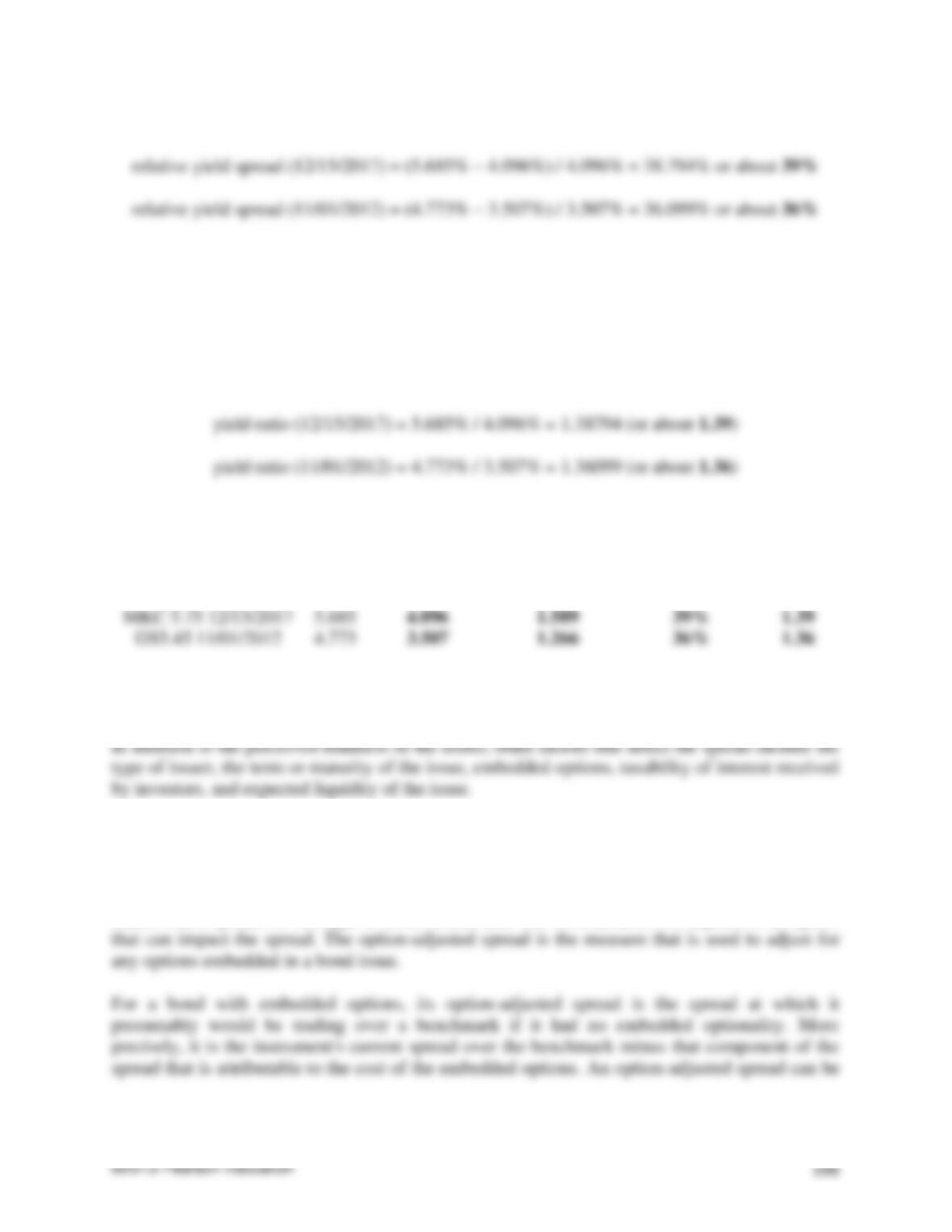
relative yield spread (05/01/2037) = (6.373% – 4.518%) / 4.518% = 41.085% or about41%
We can now compute the yield ratio given as:
yield ratio = yield on issuer / yield on benchmark
Inserting our values give the following relative yield spreads:
yield ratio (05/01/2037) = 6.373% / 4.518% = 1.41058 (or about 1.41)
Below we fill in the missing spaces in bold-face print. We have:
Issue
Yield
(%)
Treasury
Benchmark
Benchmark
Spread (bps)
Relative Yield
Spread
Yield
Ratio
TWC 6.55 05/01/2037
6.373
4.518
1.855
41%
1.41
MKC 5.75 12/15/2017
5.685
4.096
1.589
39%
1.39
GS5.45 11/01/2012
4.773
3.507
1.266
36%
1.36
2. The yield spread between two corporate bond issues reflects more than just differences
in their credit risk. What other factors would the spread reflect?
3. Why is an option-adjusted spread more suitable for a bond with an embedded option
than a yield spread?
A bond with an option can be broken down into both a bond and an option. Thus, it stands to
reason that a spread for this type of bond should take into consideration the aspects of an option

©2013 Pearson Education
109
calculated with respect to various benchmarks: Treasuries, swap rates, a short-term “risk-free”
rate, and so forth.
4. The yield between two corporate bond issues may not be the same, and thus there is a
yield spread between the two issues. The spread reflects more than just differences in their
time to maturity. What other factors would the spread reflect?
5. In the May 29, 1992, Weekly Market Update published by Goldman, Sachs & Co., the
following information was reported in an exhibit for high-grade, tax-exempt securities as of
the close of business Thursday, May 28, 1992:
Maturity (years)
Yield (%)
Yield (%) as a Percentage of
Treasury Yield
1
3.20
76.5
3
4.65
80.4
5
5.10
76.4
10
5.80
78.7
30
6.50
82.5
Answer the below questions.
(a) What is meant by a tax-exempt security?
A tax-exempt security is a security in which the investor is exempt from paying certain taxes.
(b) What is meant by high-grade issue?
By high-grade issue, we mean a security issue that has low credit risk. Higher bond ratings such
(c) Why is the yield on a tax-exempt security less than the yield on a Treasury security of
the same maturity?
The yield on a tax-exempt security is less because investors are excused from paying certain

(d) What is the equivalent taxable yield?
The equivalent taxable yield is the yield that must be offered on a taxable bond issue to give the
)rate tax marginal1(
−
(e) Also reported in the same issue of the Goldman, Sachs report is information on
intramarket yield spreads. What are these?
6. Answer the below questions.
(a) What is an embedded option in a bond?
An embedded option is an option found in a bond that includes a provision giving either the
(b) Give three examples of an embedded option that might be included in a bond issue.
Below are three examples of an embedded option.
Example one is a callable bond. A bond with a call provision gives the issuer the right to call the
issue by redeeming it as a designated price.
(c) Does an embedded option increase or decrease the risk premium relative to the base
interest rate?

7. Answer the below questions.
(a) What is a yield curve?
The yield curve is the graphical depiction of the relationship between the yield on bonds of the
(b) Why is the Treasury yield curve the one that is most closely watched by market
participants?
8. What is a spot rate?
9. Explain why it is inappropriate to use one yield to discount all the cash flows of a
financial asset.
10. Explain why a financial asset can be viewed as a package of zero-coupon instruments.
A financial asset generates cash flows over time. The value of the asset is the present value of all
the cash flows. Since each cash flow can occur at a different point in time, each cash flow should
11. How are spot rates related to forward rates?