Chapter 04: Financial Forecasting
Chapter 4
Financial Forecasting
Discussion Questions
4-1.
What are the basic benefits and purposes of developing pro forma statements and
a cash budget?
The pro forma financial statements and cash budget enable the firm to determine
its future level of asset needs and the associated financing that will be required.
Furthermore, one can track actual events against the projections. Bankers and
other lenders also use these financial statements as a guide in credit decisions.
4-2.
Explain how the collections and purchases schedules are related to the borrowing
needs of the corporation.
The collections and purchase schedules measure the speed at which receivables
are collected and purchases are paid. To the extent collections do not cover
purchasing costs and other financial requirements, the firm must look to
borrowing to cover the deficit.
4-3.
With inflation, what are the implications of using LIFO and FIFO inventory
methods? How do they affect the cost of goods sold?
LIFO inventory valuation assumes the latest purchased inventory becomes part
of the cost of goods sold, while the FIFO method assigns inventory items that
were purchased first to the cost of goods sold. In an inflationary environment, the
LIFO method will result in a higher cost of goods sold figure and one that more
accurately matches the sales dollars recorded at current dollars.
4-4.
Explain the relationship between inventory turnover and purchasing needs.
The more rapid the turnover of inventory, the greater the need for purchase and
replacement. Rapidly turning inventory makes for somewhat greater ease in
foreseeing future requirements and reduces the cost of carrying inventory.
4-5.
Rapid corporate growth in sales and profits can cause financing problems.
Elaborate on this statement.
Rapid growth in sales and profits is often associated with rapid growth in asset
commitment. A $100,000 increase in sales may cause a $50,000 increase in
assets, with perhaps only $10,000 of the new financing coming from profits. It is
very seldom that incremental profits from sales expansion can meet new
financing needs.

Chapter 04: Financial Forecasting
11. Cost of goods sold—FIFO (LO2) On December 31 of last year, Wolfson Corporation had
an inventory of 450 units of its product, which cost $22 per unit to produce. During
January, the company produced 850 units at a cost of $25 per unit. Assuming that Wolfson
Corporation sold 800 units in January, what was the cost of goods sold? (Assume FIFO
inventory accounting.)
4-11. Solution:
Wolfson Corporation
Cost of goods sold on 800 units
Old inventory:
Chapter 04: Financial Forecasting
Mineral Labs
a. LIFO Accounting
Cost of goods sold on 1,500 units
New inventory:
Quantity (units) ………………………………. 900
Cost per unit …………………………………… $ 16
b. FIFO Accounting
Cost of goods sold on 1,000 units
Old inventory:
14. Gross profit and ending inventory (LO2) Convex Mechanical Supplies produces a
product with the following costs as of July 1, 20X1:
Material ……………………. $ 6
Labor ……………………….. 4
Overhead ………………….. 2
$12
Chapter 04: Financial Forecasting
Beginning inventory at these costs on July 1 was 5,000 units. From July 1 to December 1,
Convex produced 15,000 units. These units had a material cost of $10 per unit. The costs
for labor and overhead were the same. Convex uses FIFO inventory accounting.
Assuming that Convex sold 17,000 units during the last six months of the year at $20 each,
what would gross profit be? What is the value of ending inventory?
4-14. Solution:
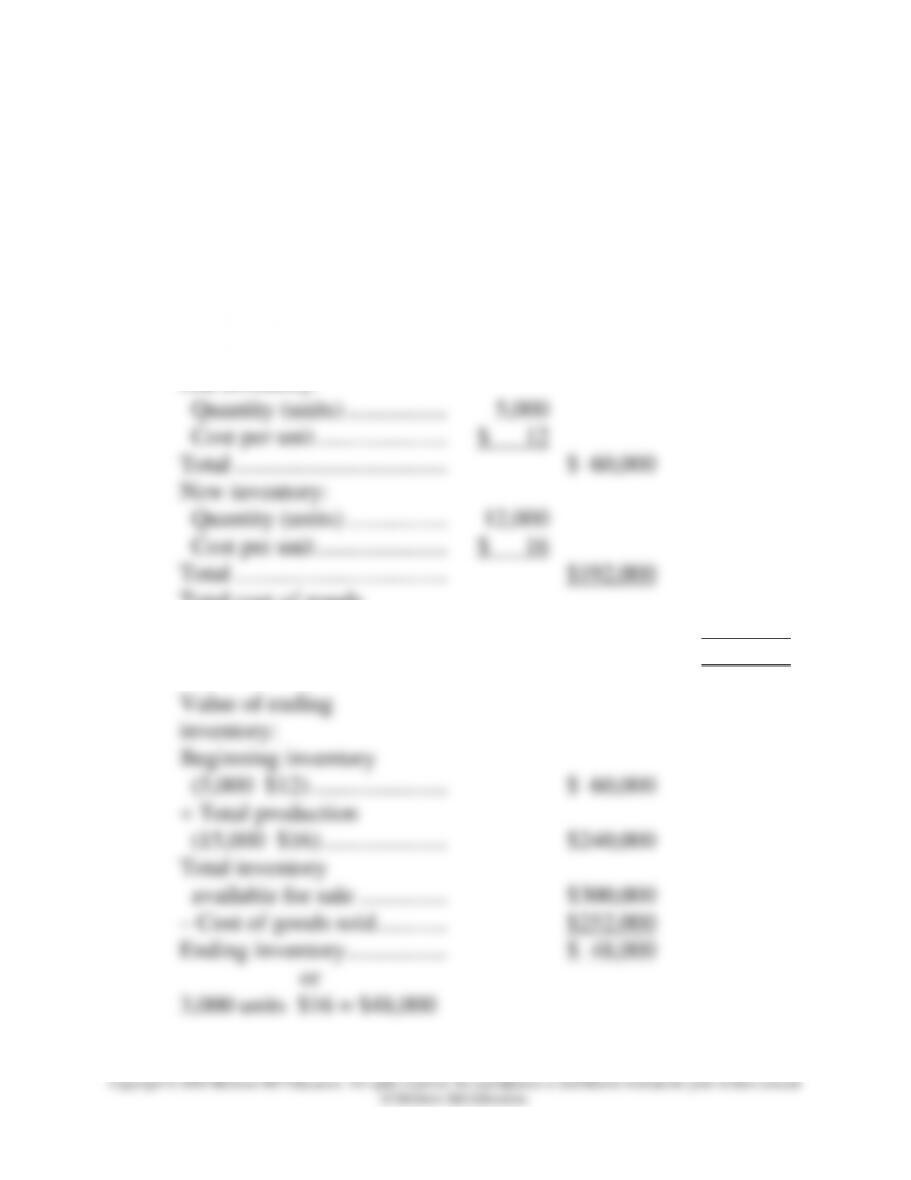
Convex Mechanical Supplies
Sales (17,000 @ $20)
$340,000
Cost of goods sold:
Old inventory:
Quantity (units) ……………..
5,000
Cost per unit ………………….
$ 12
Total ………………………………
$ 60,000
New inventory:
Quantity (units) ……………..
12,000
Cost per unit ………………….
$ 16
Total ………………………………
$192,000
Total cost of goods
sold ………………………………
$252,000
Gross profit……………………..
$ 88,000
Value of ending
inventory:
Beginning inventory
(5,000 $12) …………………..
$ 60,000
+ Total production
(15,000 $16) …………………
$240,000
Total inventory
available for sale ……………
$300,000
– Cost of goods sold …………
$252,000
Ending inventory ……………..
$ 48,000
or
3,000 units $16 = $48,000