CHAPTER 4
BOND PRICE VOLATILITY
CHAPTER SUMMARY
The purpose of this chapter is twofold. First, we offer an explanation of the pricevolatility
characteristics of a bond. Second, we present and illustrate several measures for quantifyingthe
exposure of a position or a portfolio to interest rate risk.
REVIEW OF THE PRICE-YIELD RELATIONSHIP FOR OPTION-FREE BONDS
An increase (decrease) in the required yield decreases (increases) the present value of its expected
PRICE VOLATILITY CHARACTERISTICS OF OPTION-FREE BONDS
There are four properties concerning the price volatility of an option-free bond. (i) Although the
prices of all option-free bonds move in the opposite direction from the change in yield required,
the percentage price change is not the same for all bonds. (ii) For very small changes in the yield
Characteristics of a Bond that Affect its Price Volatility
There are two characteristics of an option-free bond that determine its price volatility: coupon
and term to maturity.
Effects of Yield to Maturity
A bond trading at a higher yield to maturity will have lower price volatility. An implication of
MEASURES OF BOND PRICE VOLATILITY
Money managers, arbitrageurs, and traders need to have a way to measure a bond’s price
Price Value of a Basis Point
The price value of a basis point, also referred to as the dollar value of an 01, is the change in the
price of the bond if the required yield changes by 1 basis point. Note that this measure of
price volatility indicates dollar price volatility as opposed to percentage price volatility (price
Yield Value of a Price Change
Another measure of the price volatility of a bond used by investors is the change in the yield for
a specified price change. This is estimated by first calculating the bond’s yield to maturity if the
Duration
The Macaulay duration is one measure of the approximate change in price for a small change in
yield.
( ) ( ) ( ) ( )
12
12
1 1 1 1
nn
C C nC nM
+ +. . .+ +
y y y y
+ + + +
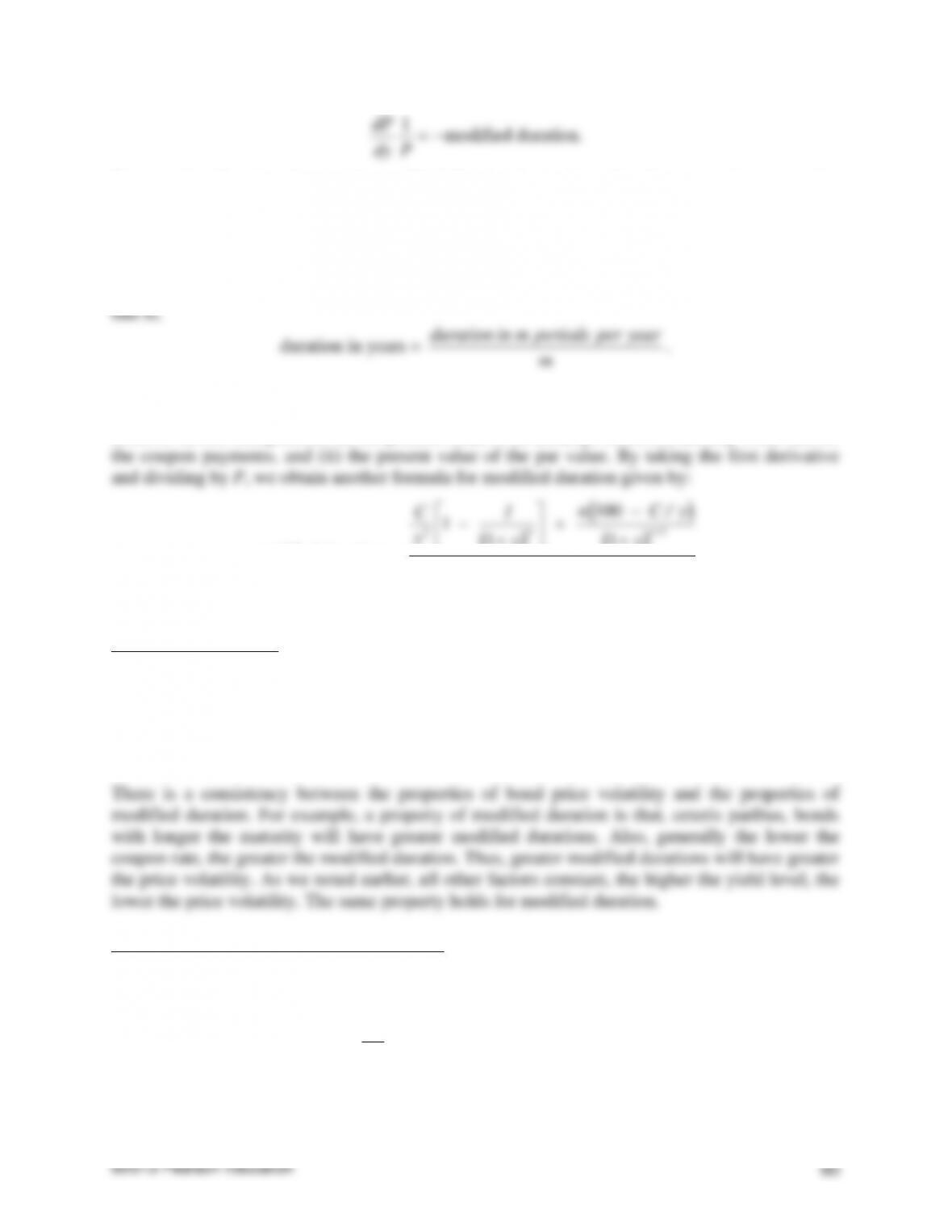
60
P
dy
dP 1
= −modified duration.
Because for all option-free bonds modified duration is positive, the above equation states that
there is an inverse relationship between modified duration and the approximate percentage
change in price for a given yield change. This is to be expected from the fundamental principle
that bond prices move in the opposite direction of the change in interest rates.
In general, if the cash flows occur m times per year, the durations are adjusted by dividing by m,
m
We can derive an alternative formula that does not have the extensive calculations of the
Macaulay duration and the modified duration. This is done by rewriting the price of a bond in
terms of its two components: (i) the present value of an annuity, where the annuity is the sum of
modified duration =
()
( )
()
1
2
100
111
nn
n C / y
C1
yyy
P
+
−
−+
++
where the price is expressed as a percentage of par value.
Properties of Duration
The modified duration and Macaulay duration of a coupon bond are less than the maturity. The
Macaulay duration of a zero-coupon bond is equal to its maturity; a zero–coupon bond’s
modified duration, however, is less than its maturity. Also, lower coupon rates generally have
greater Macaulay and modified bond durations.
Approximating the Percentage Price Change
The below equation can be used to approximate the percentage price change for a given change
in required yield:
P
dP
=−(modified duration)(dy).
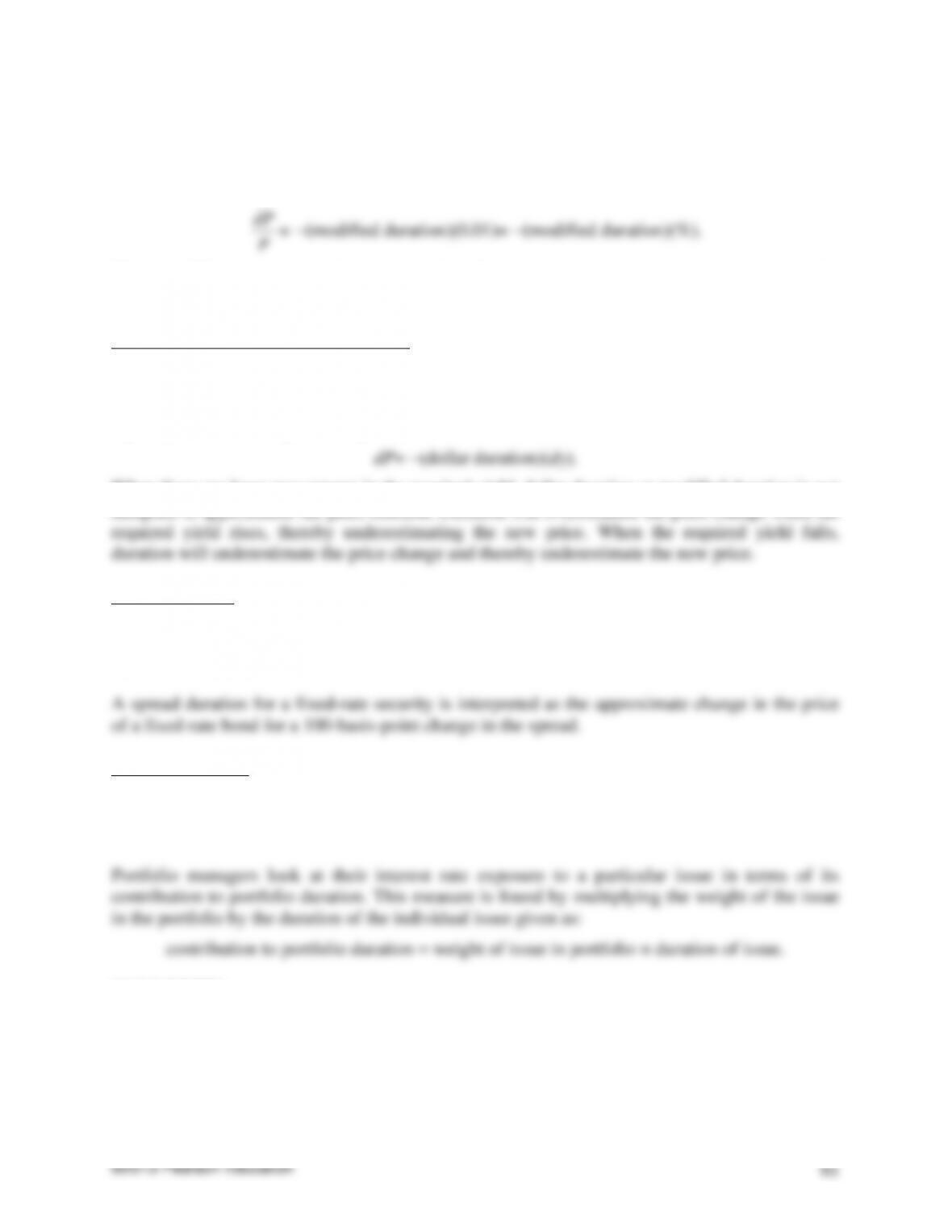
We can use this equation to provide an interpretation of modified duration. Suppose that the
yield on any bond changes by 100 basis points. Then, substituting 100 basis points (0.01) for dy
into the above equation, we get:
P
dP
= −(modified duration)(0.01)= −(modified duration)(%).
Thus, modified duration can be interpreted as the approximate percentage change in price for
a 100-basis-point change in yield.
Approximating the Dollar Price Change
Modified duration is a proxy for the percentage change in price. Investors also like to know the
dollar price volatility of a bond. For small changes in the required yield, the below equation does
a good job in estimating the change in price:
When there are large movements in the required yield, dollar duration or modified duration is not
adequate to approximate the price reaction. Duration will overestimate the price change when the
Spread Duration
Market participants compute a measure called spread duration. This measure is used in two
ways: for fixed bonds and floating-rate bonds.
Portfolio Duration
Thus far we have looked at the duration of an individual bond. The duration of a portfolio is
simply the weighted average duration of the bonds in the portfolios.
CONVEXITY
Because all the duration measures are only approximations for small changes in yield, they do
not capture the effect of the convexity of a bond on its price performance when yields change by
more than a small amount. The duration measure can be supplemented with an additional
measure to capture the curvature or convexity of a bond.
Measuring Convexity
Duration (modified or dollar) attempts to estimate a convex relationship with a straight line (the
tangent line). We can use the first two terms of a Taylor series to approximate the price change.
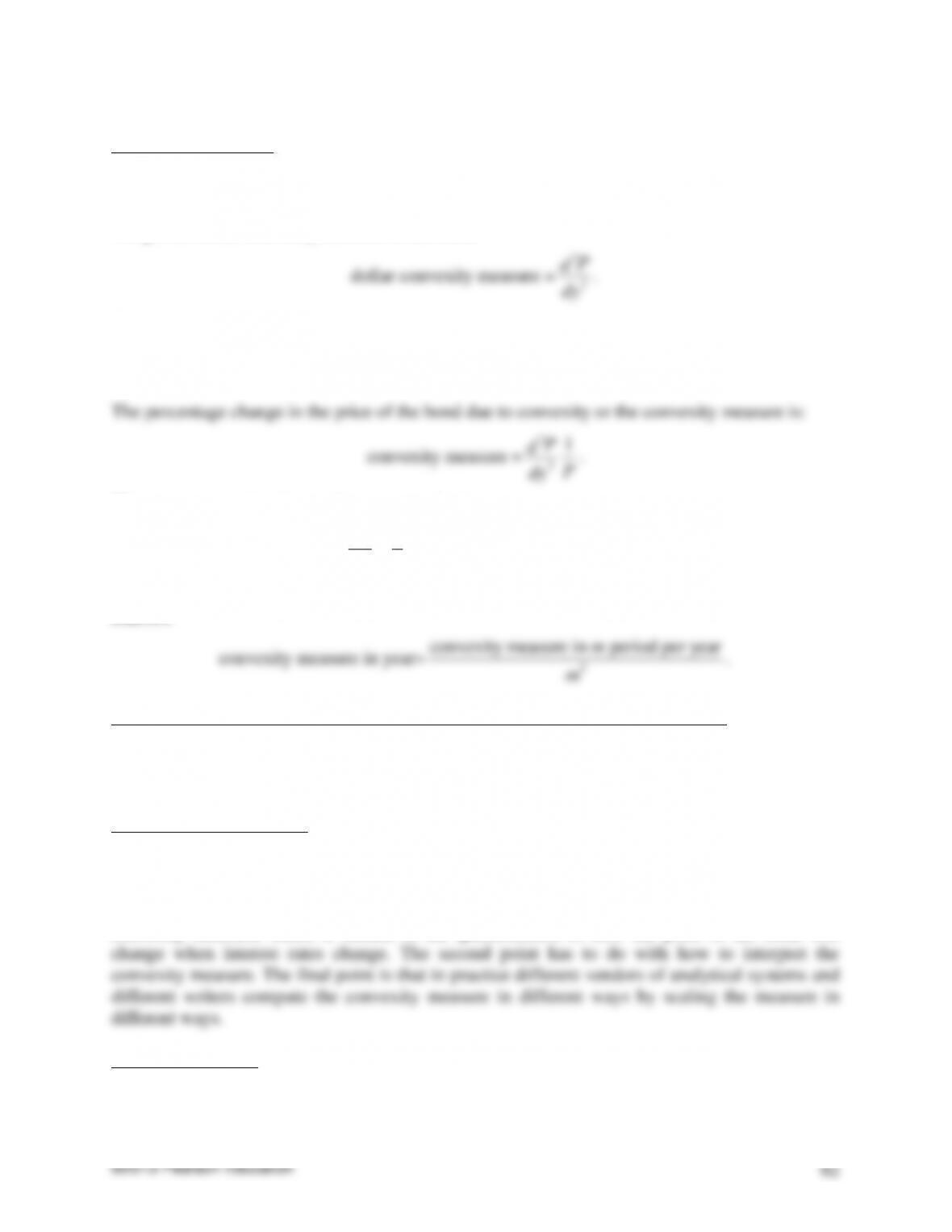
We get the dollar convexity measure of the bond:
2
2 .
P
d
dy
The approximate change in price due to convexity is:
dP= (dollar convexity measure)(dy)2.
2
dy
The percentage price change due to convexity is:
()()
2
1convexity measure
2
dP dy .
P=
In general, if the cash flows occur m times per year, convexity is adjusted to an annual figure as
follows:
2
convexity measure in period per year .
m
m
Approximating Percentage Price Change Using Duration and Convexity Measures
Using duration and convexity measures together gives a better approximation of the actual price
change for a large movement in the required yield.
Some Notes on Convexity
There are three points that should be kept in mind regarding a bond’s convexity and convexity
measure. First, it is important to understand the distinction between the use of the term
convexity, which refers to the general shape of the price-yield relationship, and the term
convexity measure, which is related to the quantification of how the price of the bond will
Value of Convexity
Generally, the market will take the greater convexity bonds into account in pricing them. How
much should the market want investors to pay up for convexity? If investors expect that market
yields will change by very little—that is, they expect low interest rate volatility—investors
Properties of Convexity
All option-free bonds have the following convexity properties. First, as the required yield
increases (decreases), the convexity of a bond decreases (increases). This property is referred to
ADDITIONAL CONCERNS WHEN USING DURATION
Relying on duration as the sole measure of the price volatility of a bond may mislead investors.
There are two other concerns about using duration that we should point out. First, in the
DO NOT THINK OF DURATION AS A MEASURE OF TIME
Unfortunately, market participants often confuse the main purpose of duration by constantly
referring to it as some measure of the weighted average life of a bond. This is because of the
original use of duration by Macaulay.
APPROXIMATING A BOND’S DURATION AND CONVEXITY MEASURE
Because duration is related to the percentage price change, a simple formula can be used to
calculate the approximate duration of a bond or any other more complex derivative securities or
options. All we are interested in is the percentage price change of a bond when interest rates
change by a small amount. The equation is:
()
()
0
2
Py
where ∆y is the change in yield used to calculate the new prices (in decimal form). What the
formula is measuring is the average percentage price change (relative to the initial price) per
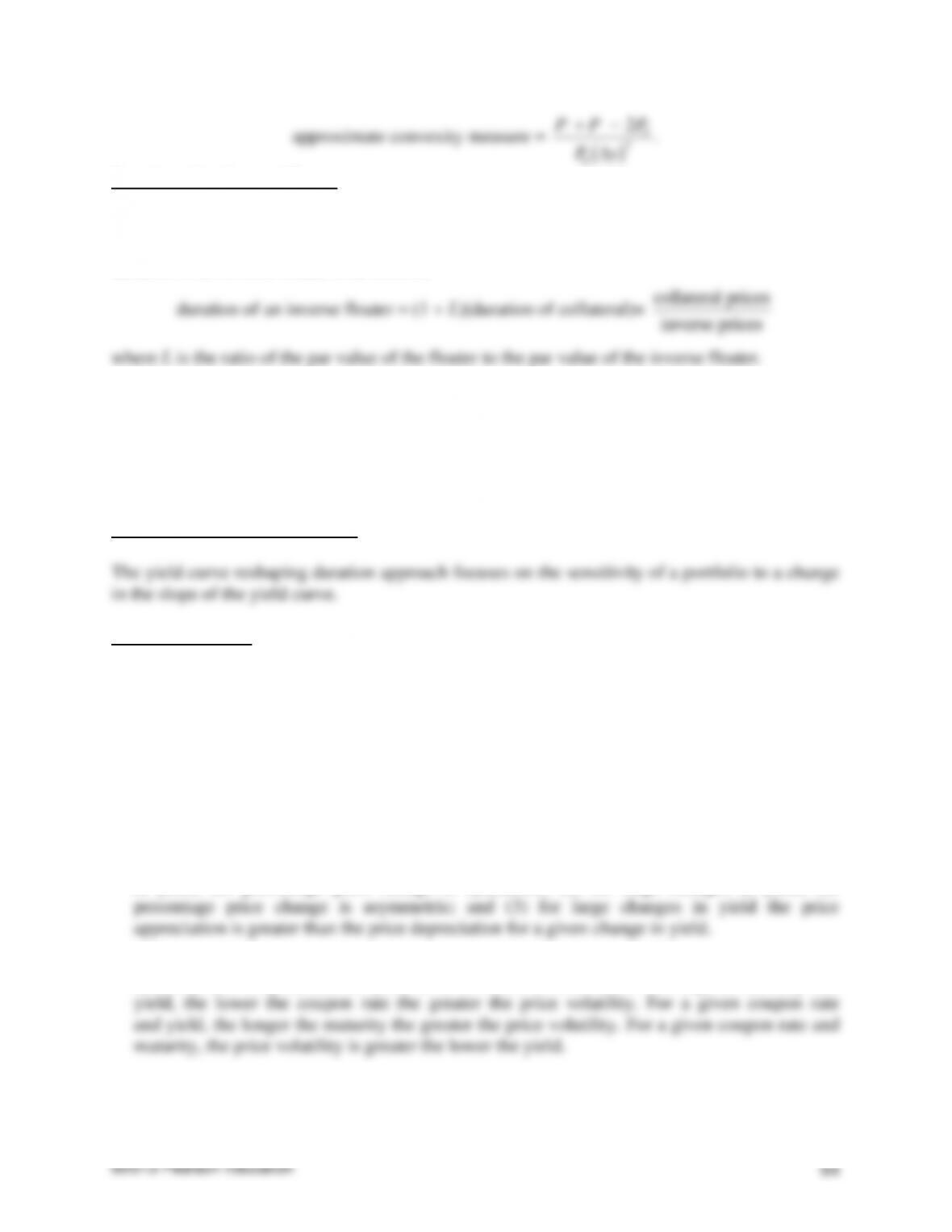
The convexity measure of any bond can be approximated using the following formula:
©2013 Pearson Education
64
approximate convexity measure =
()
0
2
0
2P P P
Py
+−
+−
.
Duration of an Inverse Floater
The duration of an inverse floater is a multiple of the duration of the collateral from which it is
created. Assuming that the duration of the floater is close to zero, it can be shown that the
duration of an inverse floater is as follows:
collateral prices
MEASURING A BOND PORTFOLIO’S RESPONSIVENESS TO
NONPARALLEL CHANGES IN INTEREST RATES
There have been several approaches to measuring yield curve risk. The two major ones are yield
curve reshaping duration and key rate duration.
Yield Curve Reshaping Duration
Key Rate Duration
The most popular measure for estimating the sensitivity of a security or a portfolio to changes in
the yield curve is key rate duration. The basic principle of key rate duration is to change the yield
for a particular maturity of the yield curve and determine the sensitivity of a security or portfolio
to that change holding all other yields constant.
KEY POINTS
• The price–yield relationship for all option-free bonds is convex.
• There are three properties of the price volatility of an option-free bond: (1) for small changes
in yield, the percentage price change is symmetric; (2) for large changes in yield, the
• The price volatility of an option-free bond is affected by two characteristics of a bond
(maturity and coupon) and the yield level at which a bond trades. For a given maturity and
• There are two measures of bond price volatility: price value of a basis point and duration.
Modified duration is the approximate percentage change in price for a 100-basis-point change
in yield. The dollar duration is the approximate dollar price change.
• Duration does a good job of estimating a bond’s percentage price change for a small change
in yield. However, it does not do as good a job for a large change in yield. The percentage
• Duration is an approximation of price change assuming a parallel shift in the yield curve.
Duration should not be interpreted as a measure of the weighted life of a bond. For certain
bonds, the modified duration can be greater than the maturity of a bond.
• For a fixed-rate bond, spread duration is a measure of how a non–Treasury bond’s price will
change if the spread sought by the market changes.
• Duration and convexity can be approximated by looking at how the price of a bond changes
• The duration of a portfolio is the weighted average duration of the bonds in the portfolio.
When a manager attempts to gauge the sensitivity of a bond portfolio to changes in interest
rates by computing a portfolio’s duration, it is assumed that the interest rate for all maturities
changes by the same number of basis points.
• A rate duration is the approximate change in the value of a portfolio (or bond) to a change in
the interest rate of a particular maturity assuming that the interest rate for all other maturities
is held constant. Practitioners compute a key rate duration, which is simply the rate duration
for key maturities.
ANSWERS TO QUESTIONS FOR CHAPTER 4
(Questions are in bold print followed by answers.)
1. The price value of a basis point will be the same regardless if the yield is increased or
decreased by 1 basis point. However, the price value of 100 basis points (i.e., the change in
price for a 100-basis-point change in interest rates) will not be the same if the yield is
increased or decreased by 100 basis points. Why?
2. Calculate the requested measures in parts (a) through (f) for bonds A and B (assume that
each bond pays interest semiannually):
Bond A
Bond B
Coupon
8%
9%
Yield to maturity
8%
8%
Maturity (years)
2
5
Par
$100.00
$100.00
Price
$100.00
$104.055
(a) What is the price value of a basis point for bonds A and B?
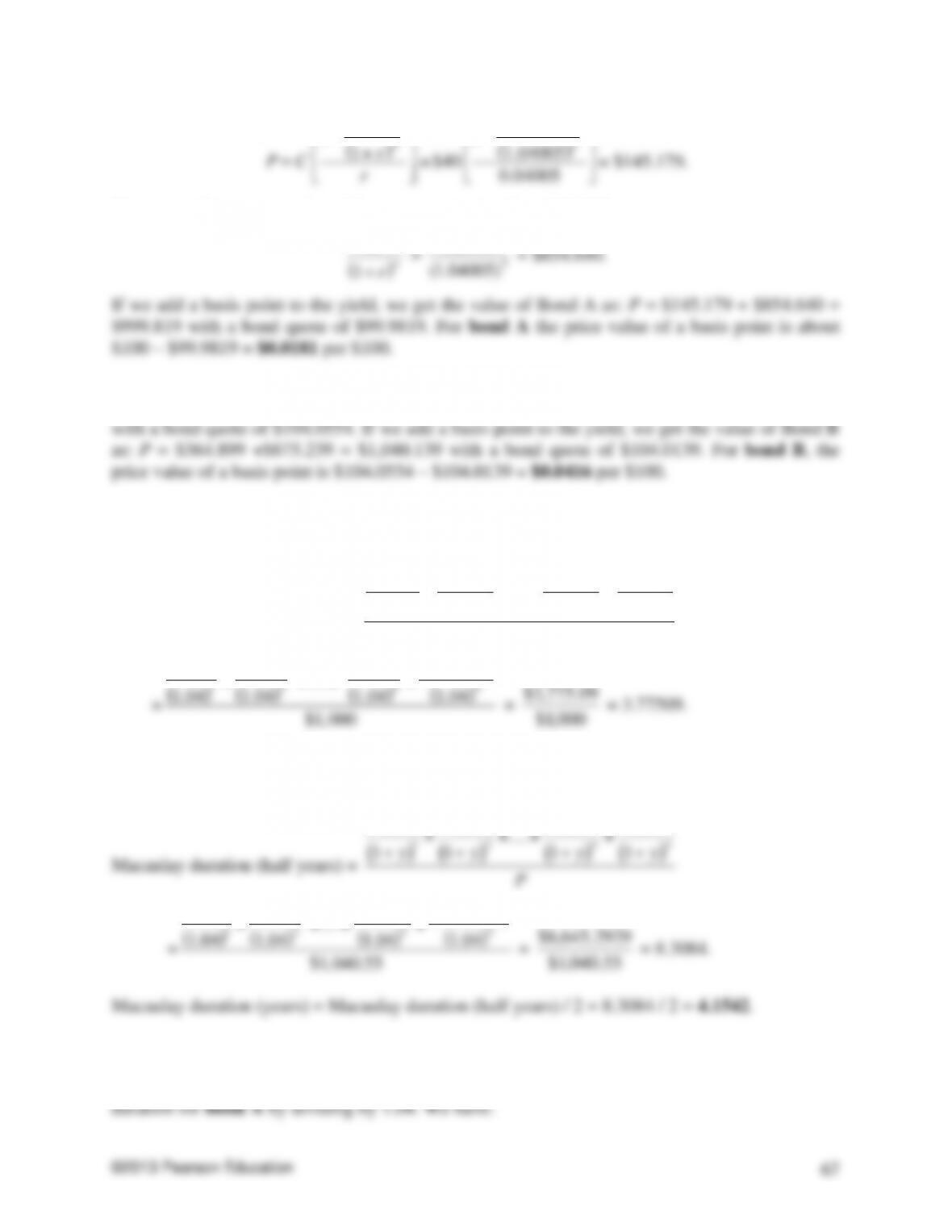
( )
1
11n
+ r
P = C r
−
=
( )
4
1
1
1 .04005
$40 0.04005
−
= $145.179.
Computing the present value of the par or maturity value of $1,000 gives:
( )
1n
M
r+
=
4
$1, 000
(1.04005)
= $854.640.
If we add a basis point to the yield, we get the value of Bond A as: P = $145.179 + $854.640 =
$999.819 with a bond quote of $99.9819. For bond A the price value of a basis point is about
$100 – $99.9819 = $0.0181 per $100.
Using the bond valuation formulas as just completed above, the value of bond B with a yield of
8%, a coupon rate of 9%, and a maturity of 5 years is: P = $364.990 + $675.564 = $1,040.554
(b) Compute the Macaulay durations for the two bonds.
For bond A with C = $40, n = 4, y = 0.04, P = $1,000 and M = $1,000, we have:
Macaulay duration (half years) =
()()()()
12
12
1 1 1 1
nn
C C nC nM
+ +. . .+ +
y y y y
P
+ + + +
()()()()
12
12
1 1 1 1
nn
C C nC nM
+ +. . .+ +
y y y y
P
+ + + +
()()()()
1 2 4 4
1($40) 2($40) 4($40) 4($1,000)
1.04 1.04 1.04 1.04
$1,000
+ +. . .+ +
000,1$
09.775,3$
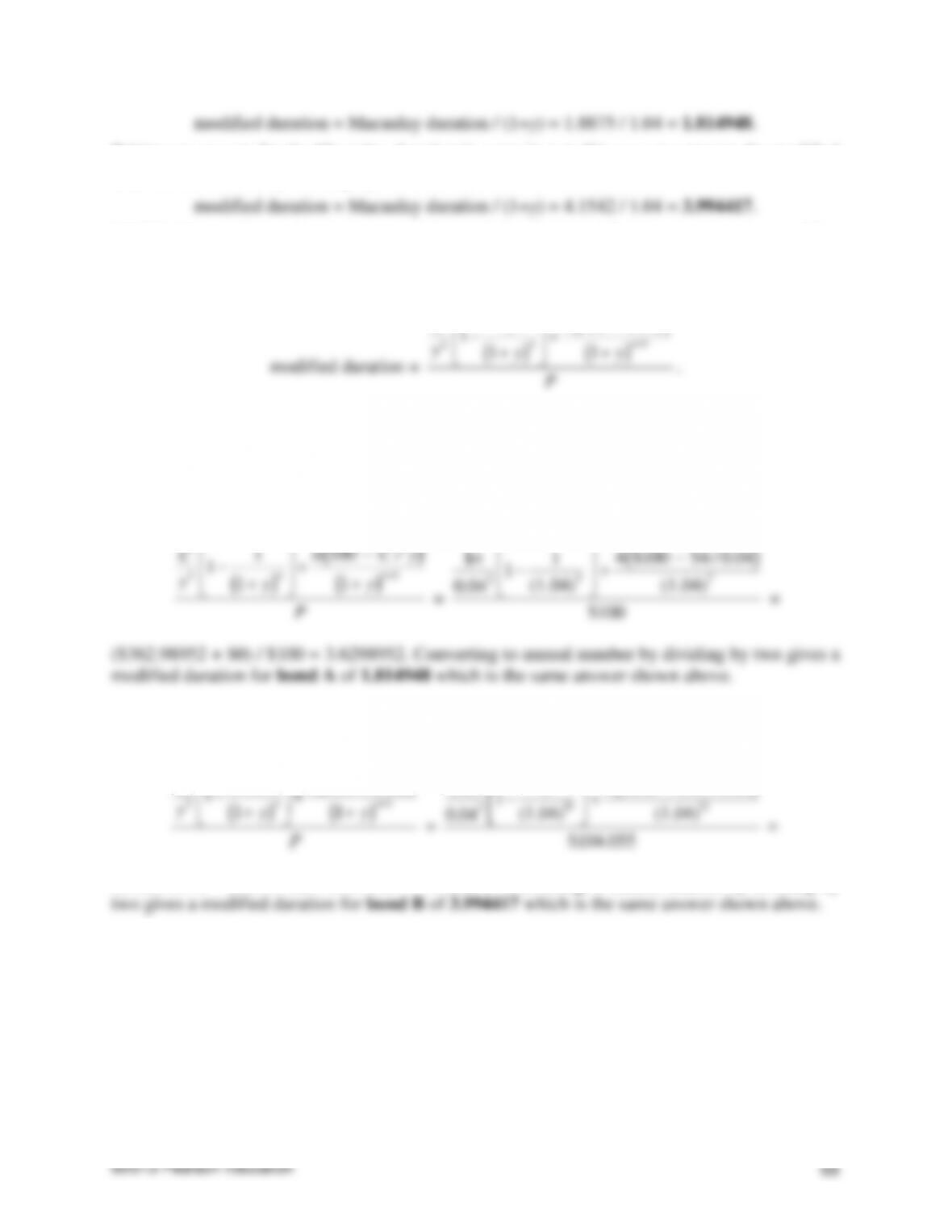
modified duration = Macaulay duration / (1+y) = 1.8875 / 1.04 = 1.814948.
Taking our answer for the Macaulay duration in years in part (b), we can compute the modified
duration for bond B by dividing by 1.04. We have:
[NOTE. We could get the same answers for both bonds A and B by computing the modified
duration using an alternative formula that does not require the extensive calculations required by
the procedure in parts (a) and (b). This shortcut formula is:
()
( )
()
1
2
100
111
nn
n C / y
C1
yyy
+
−
−+
++
()
( )
()
1
2
100
nn
yyy
+
−
−+
++
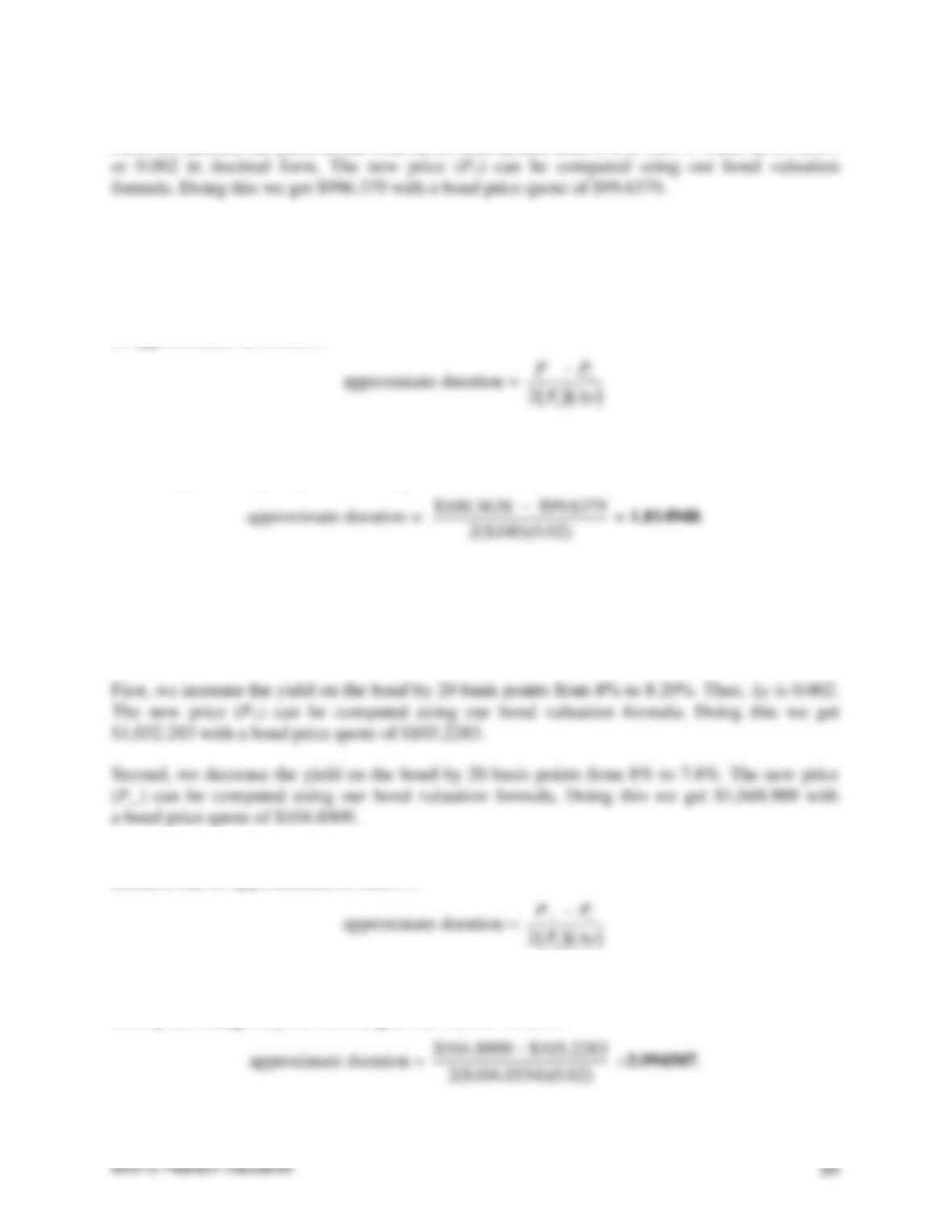
First, we increase the yield on the bond by 20 basis points from 8% to 8.20%. Thus, ∆y is 0.20%
Second, we decrease the yield on the bond by 20 basis points from 8% to 7.8%. The new price
(P_) can be computed using our bond valuation formula. Doing this we get $1,003.638 with a
bond price quote of $100.3638.
Third, with the initial price, P0, equal to $100 (when expressed as a bond quote), the duration can
be approximated as follows:
()
()
0
2
_PP
Py
+
−
where ∆y is the change in yield used to calculate the new prices (in decimal form). What
the formula is measuring is the average percentage price change (relative to the initial price) per
20-basis-point change in yield. Inserting in our values, we have:
$100.3638 $99.6379
2($100)(0.02)
−
This compares with 1.814948 computed in part (c). Thus, the approximate duration measure (to six
decimal places for this problem) is the same as the modified duration computed in part (c).
To compute the approximate measure for bond B, which is a 5-year 9% coupon bond trading at
8% with an initial price (P0) of $104.0554, we proceed as follows.
Third, with the initial price, P0, equal to $104.0554 (when expressed as a bond quote), the
duration can be approximated as follows:
()
()
0
2
_PP
Py
+
−
where ∆y is the change in yield used to calculate the new prices (in decimal form). What the
formula is measuring is the average percentage price change (relative to the initial price) per 20–
basis-point change in yield. Inserting in our values, we have:
)02.0)(104.0554($2
03.22831$ 8909.104$
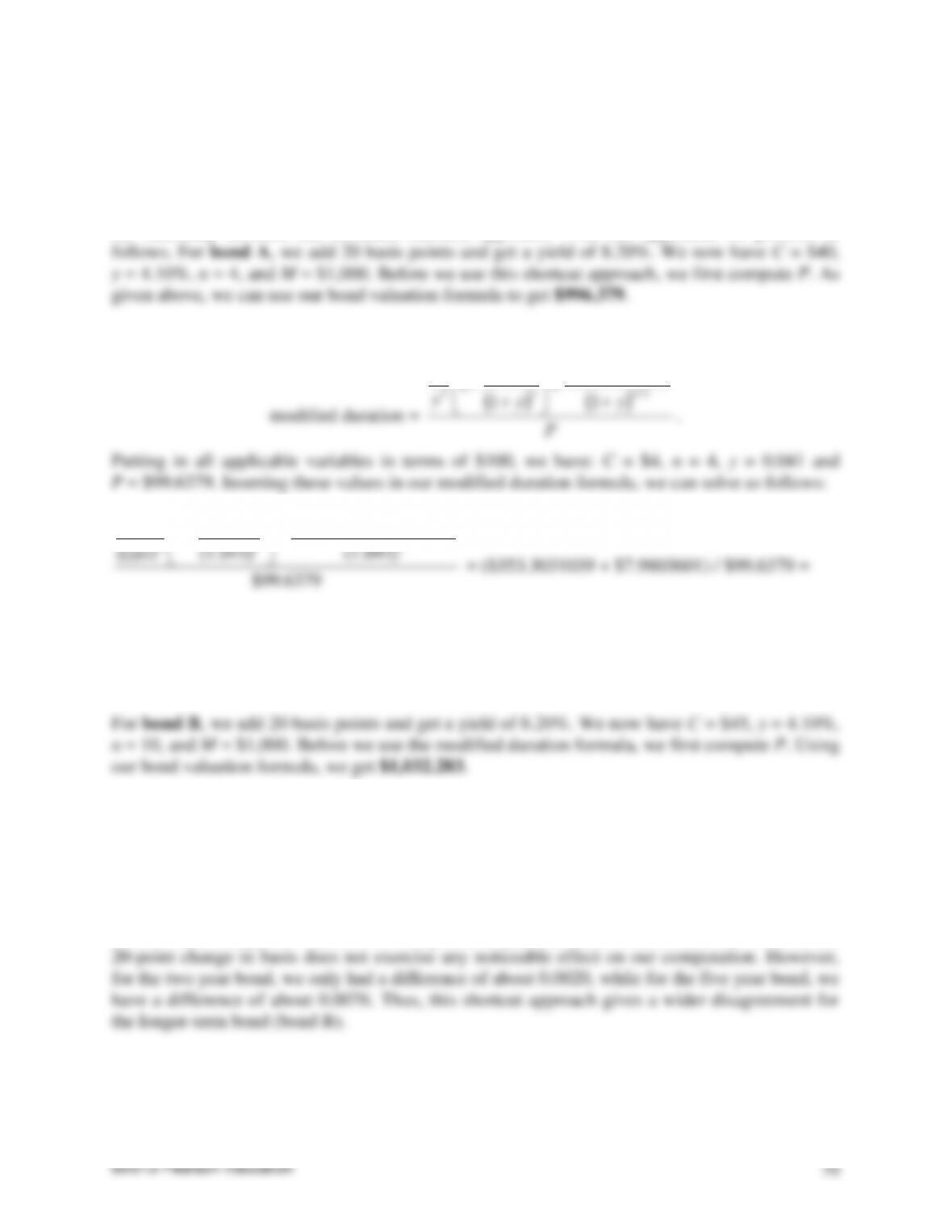
This compares with 3.994417 computed in part (c). Thus, the approximate duration measure is
virtually the same as the modified duration computed in part (c).
Besides the above approximate duration approach, there is another approach that is shorter than
the Macaulay duration and modified duration approach. With this approach, we proceed as
Now we can compute the modified duration for bond A using the below formula:
()
( )
()
1
2
100
1
111
nn
n C / y
C
yyy
+
−
−+
++
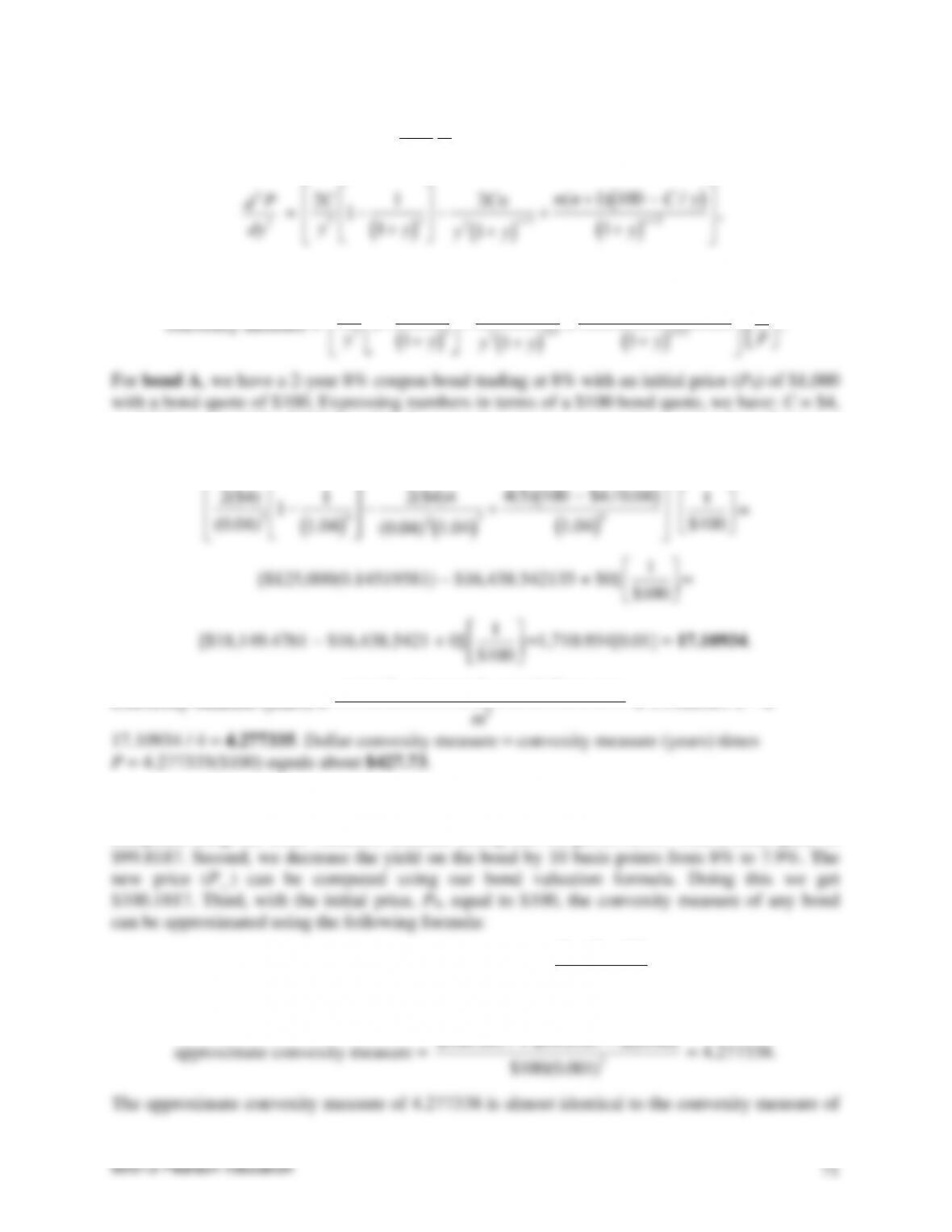
In half years, the convexity measure =
P
dy
P
d1
2
2
. Noting that
2
2
dy
P
d
=
( ) ( )
( )
( )
3 1 2
2
( 1) 100 /
2 1 2
1
11
1
n n n
n n C y
C Cn
yyy
y
y++
+−
− − +
++
+
,
we can insert this quantity into our convexity measure (half year) formula to get:
( )
( 1) 100 /
2 1 2
n n C y
C Cn
+−
1
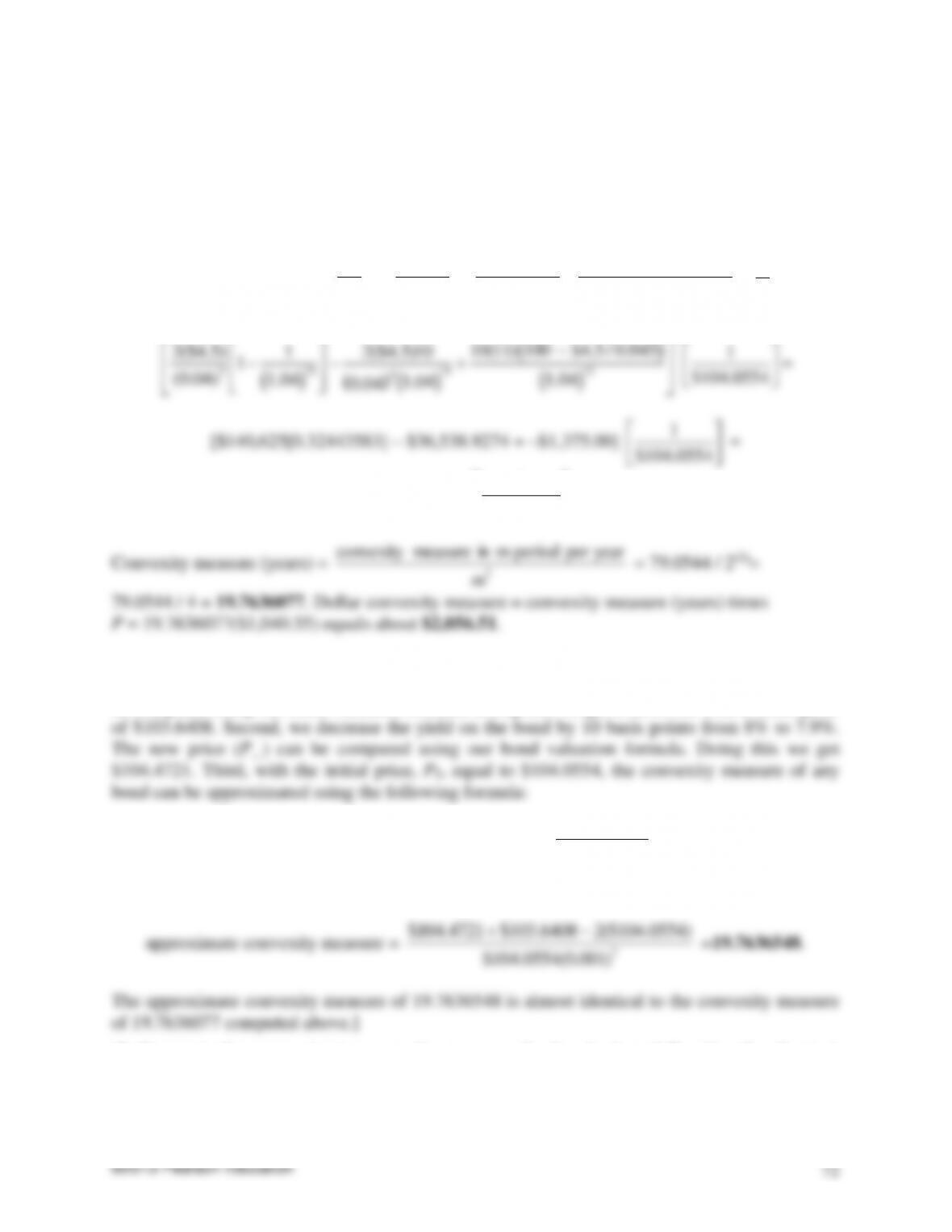
4.277335 computed above.]
For bond B, we have a 5-year 9% coupon bond trading at 8% with an initial price (P0) of
$104.055. Expressing numbers in terms of a $100 bond quote, we have: C = $4.5, y = 0.04,
n = 10, and P = $104.0554. Inserting these numbers into our convexity measure formula gives:
convexity measure =
( ) ( )
( )
( )
3 1 2
2
( 1) 100 /
2 1 2
1
11
1
n n n
n n C y
C Cn
yyy
y
y++
+−
− − +
++
+
1
P
.
( )
()
( )
( )
( )
3 10 11 12
2
10(11) 100 $4.5 / 0.045
2($4.5) 1 2($4.5)10
1
(0.04) 1.04 1.04
1.04
0.04
−
− − +
0554.104$
1
=
[$140,625[0.32443583] – $36,538.9274 + –$1,375.00]
0554.104$
1
=
[$45,623.7888 – $36,538.9274 + –$858.8209]
0554.104$
1
=8,226.04[0.0096103] = 79.0544.
yearper period min measureconvexity
[NOTE. We can get the same convexity measure by proceeding as follows. First, we increase the
yield on the bond by 10 basis points from 8% to 8.1%. Thus, ∆y is 0.001. The new price (P+) can
be computed using our bond valuation formula. Doing this we get $1,036.408 with a bond quote
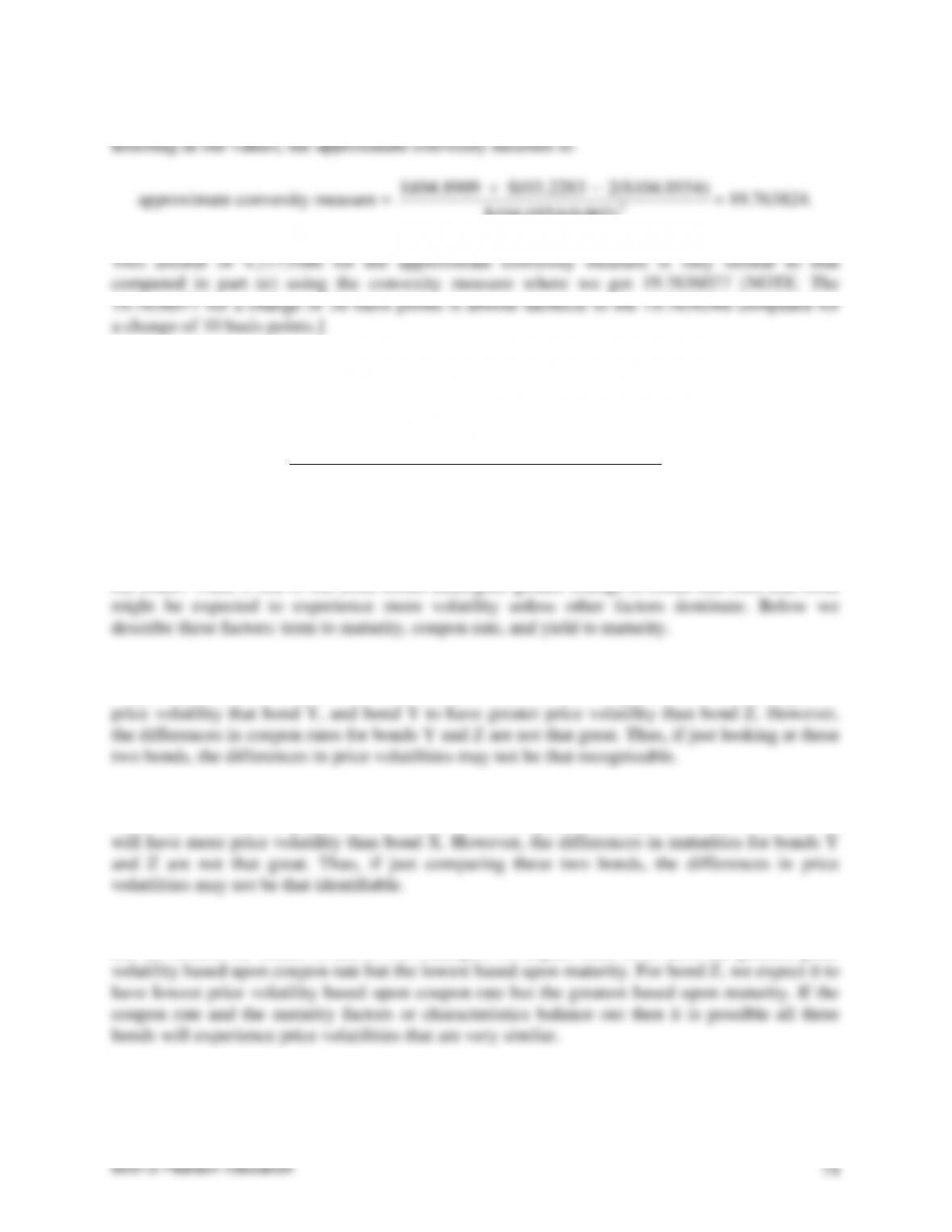
approximate convexity measure =
( )
0
2
0
2P P P
Py
+−
+−
.
Inserting in our values, the approximate convexity measure for bond B is
)($104.05542 03.64081$ 4721.104$
−+
(f) Compute the approximate convexity measure for bonds A and B using the shortcut
formula by changing yields by 20 basis points and compare your answers to the convexity
measure calculated in part (e).
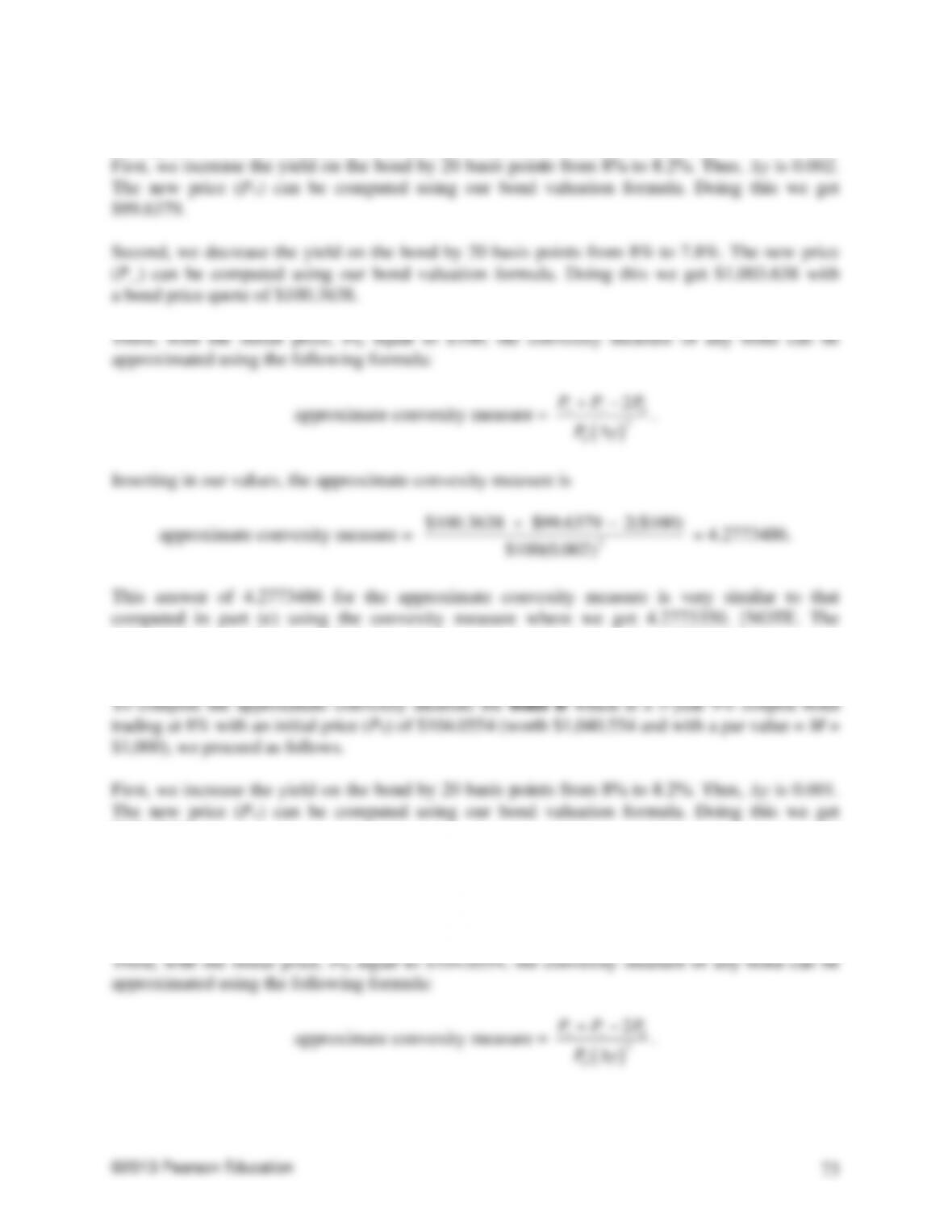
To compute the approximate convexity measure for bond A, which is a 2-year 8% coupon bond
trading at 8% with an initial price (P0) of $100, we proceed as follows.
4.2773486 for a change of 20 basis points is almost identical to the 4.2773384 that we can
compute for a change of 10 basis points.]
$103.2283.
Second, we decrease the yield on the bond by 20 basis points from 8% to 7.8%. The new price
(P_) can be computed using our bond valuation formula. Doing this we get $1,048.909 with
a bond price quote of $104.8909.
hold bonds with long maturities in the portfolio. To reduce a portfolio’s price volatility in
anticipation of a rise in interest rates, bonds with shorter-term maturities should be held in the
portfolio.]
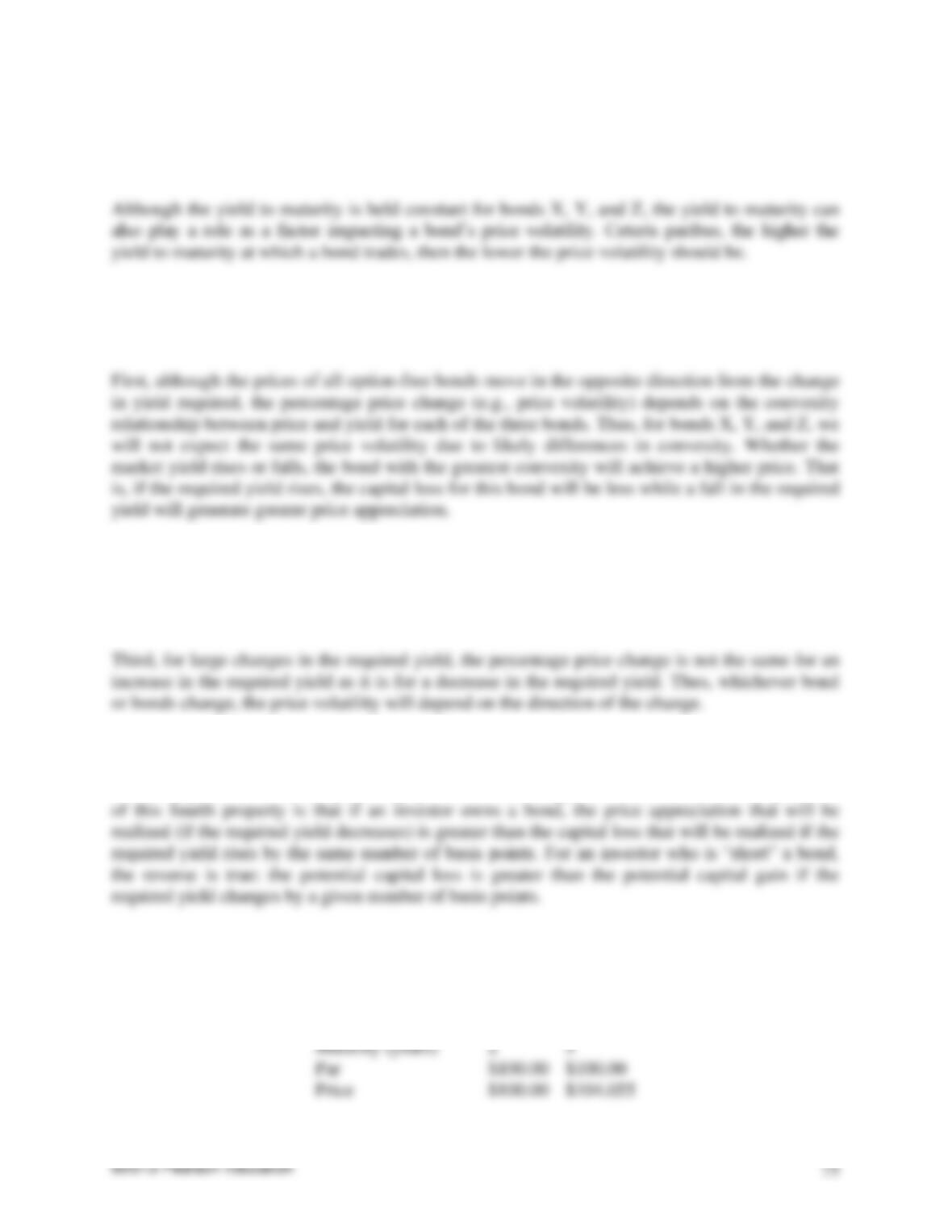
In addition to the above factors, we have to keep in mind four important properties concerning
the price volatility of an option-free bond that result from the convex shape of the price-yield
relationship.
Second, for very small changes in the yield required, the percentage price change for a given
bond is roughly the same, whether the yield required increases or decreases. Thus, for bonds X,
Y, and Z if the percentage price change is very small, we will not likely detect which bond has
the greatest price volatility.
Fourth, for a given large change in basis points, the percentage price increase is greater than the
percentage price decrease. Thus, whichever bond or bonds change, the price volatility will be
relatively greater if there is a percentage price increase as opposed to a decrease. The implication
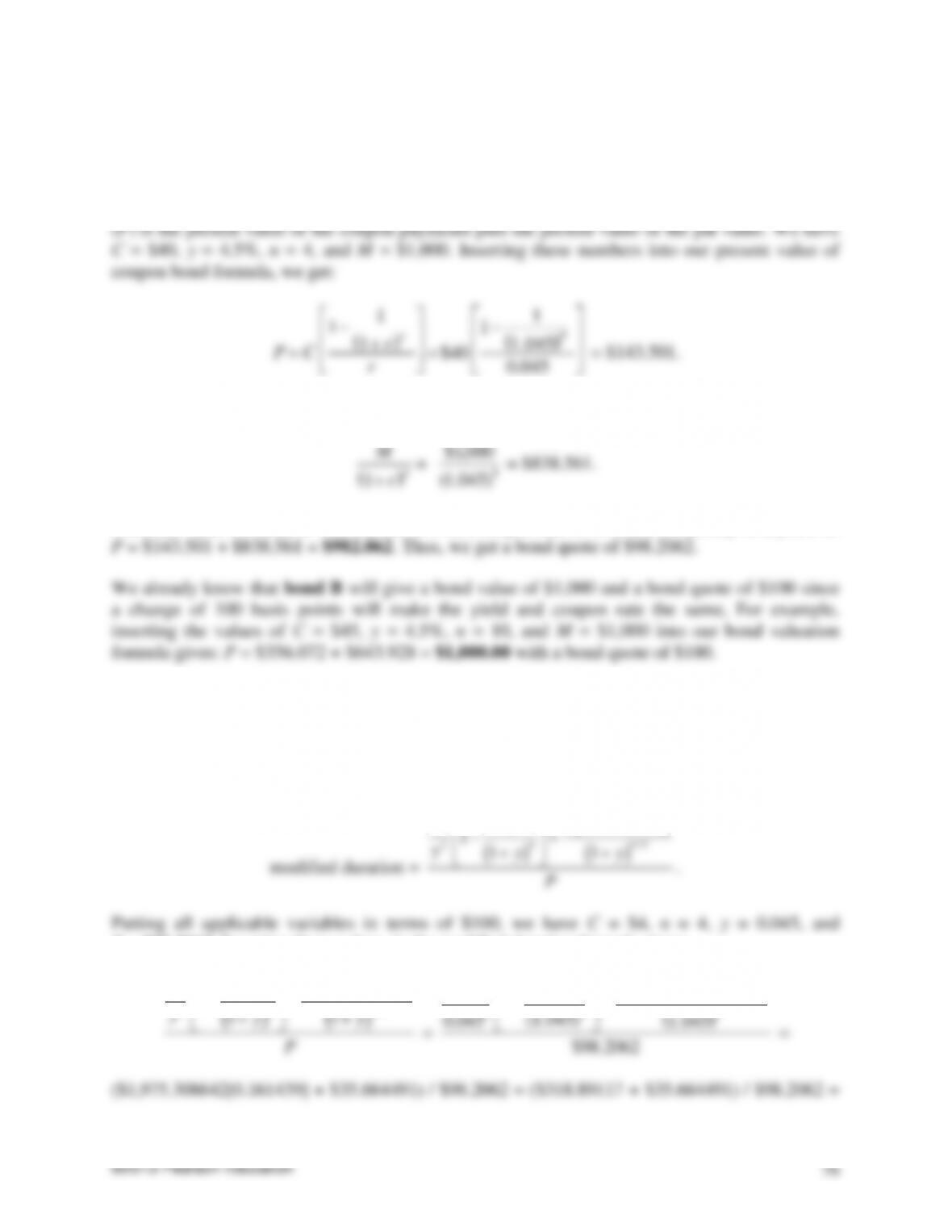
4. Answer the below questions for bonds A and B.
Bond A
Bond B
Coupon
8%
9%
Yield to maturity
8%
8%
Maturity (years)
2
5
Par
$100.00
$100.00
Price
$100.00
$104.055
(a) Calculate the actual price of the bonds for a 100-basis-point increase in interest rates.
For Bond A, we get a bond quote of $100 for our initial price if we have an 8% coupon rate and
an 8% yield. If we change the yield 100 basis point so the yield is 9%, then the value of the bond
.
The present value of the par or maturity value of $1,000 is:
( )
1n
M
r+
=
)045.1(
000,1$
4
= $838.561.
Thus, the value of bond A with a yield of 9%, a coupon rate of 8%, and a maturity of 2 years is:
(b) Using duration, estimate the price of the bonds for a 100-basis–point increase in interest
rates.
To estimate the price of bond A, we begin by first computing the modified duration. We can use
an alternative formula that does not require the extensive calculations required by the Macaulay
procedure. The formula is:
()
( )
()
1
2
100
1
111
nn
n C / y
C
yyy
+
−
−+
++