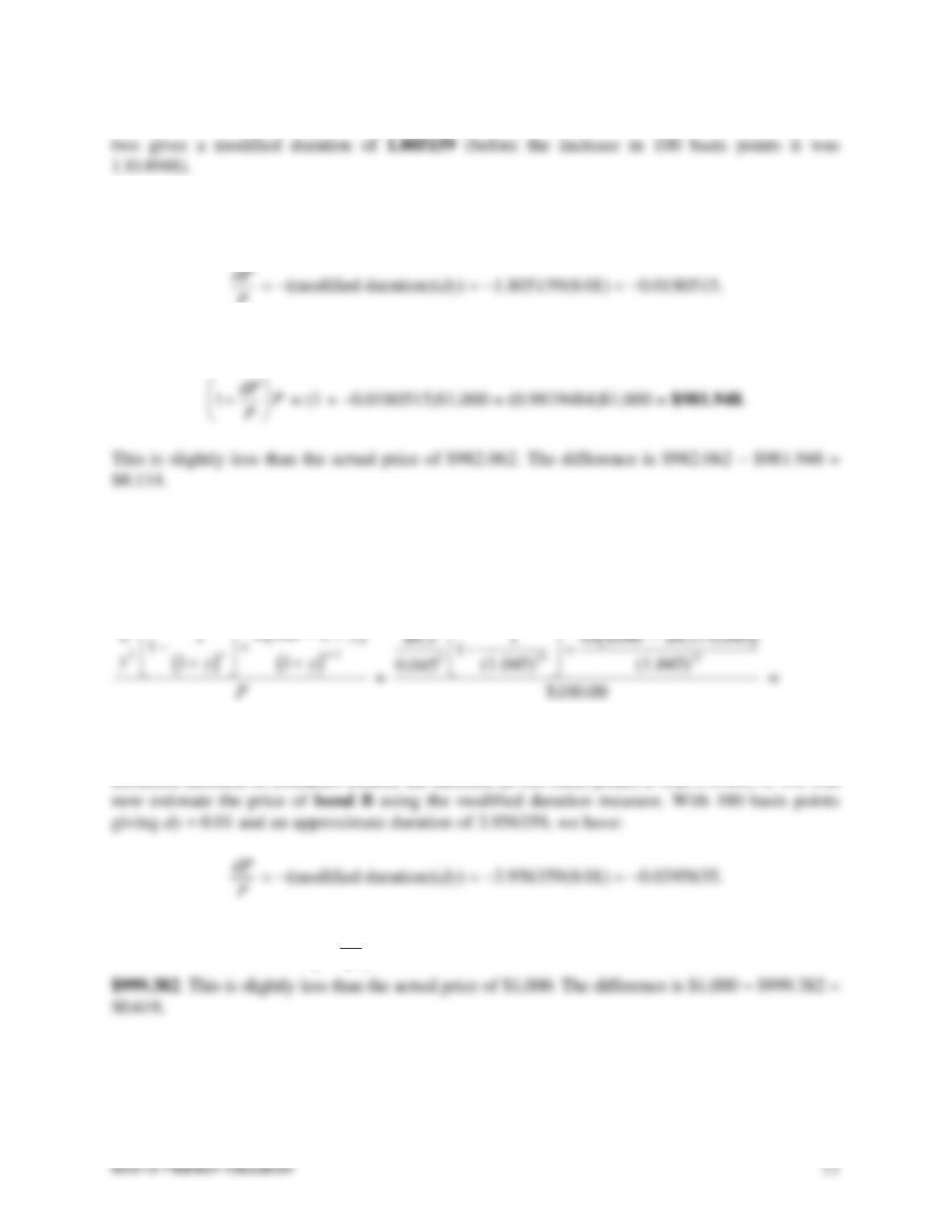
$354.555664 / $98.2062 = 3.6103185 or about 3.61. Converting to annual number by dividing by
We next solve for the change in price using the modified duration of 1.805159 and dy = 100
basis points = 0.01. We have:
P
dP
= −(modified duration)(dy) = −1.805159(0.01) = −0.0180515.
We can now solve for the new price of bond A as shown below:
1dP P
P
+
= (1 + −0.0180515)$1,000 = (0.9819484)$1,000 = $981.948.
This is slightly less than the actual price of $982.062. The difference is $982.062 – $981.948 =
$0.114.
To estimate the price of bond B, we follow the same procedure just shown for bond A. Using the
alternative formula for modified duration that does not require the extensive calculations
required by the Macaulay procedure and noting that C = $45, n = 10, y = 0.045, and P = $100,
we get: modified duration =
()
( )
()
1
2
100
1
111
nn
n C / y
C
yyy
P
+
−
−+
++
=
( )
10 11
2
10 $100 $4.5 / 0.045
$4.5 1
1
(1 .045 (1 .045
))
0.045
$100.00
−
−+
=
($791.27182 + $0) / $100 = 7.912718 or about 7.91 (before the increase in 100 basis points it
was 7.988834 or about 7.99). Converting to an annual number by dividing by two gives a
modified duration of 3.956359 (before the increase in 100 basis points it was 3.994417). We will
P
Thus, the new price is
1dP P
P
−
= (1 – 0.0395635)$1,040.55 = (0.9604364)$1,040.55 =
(c) Using both duration and convexity measures, estimate the price of the bonds for a
100-basis-point increase in interest rates.
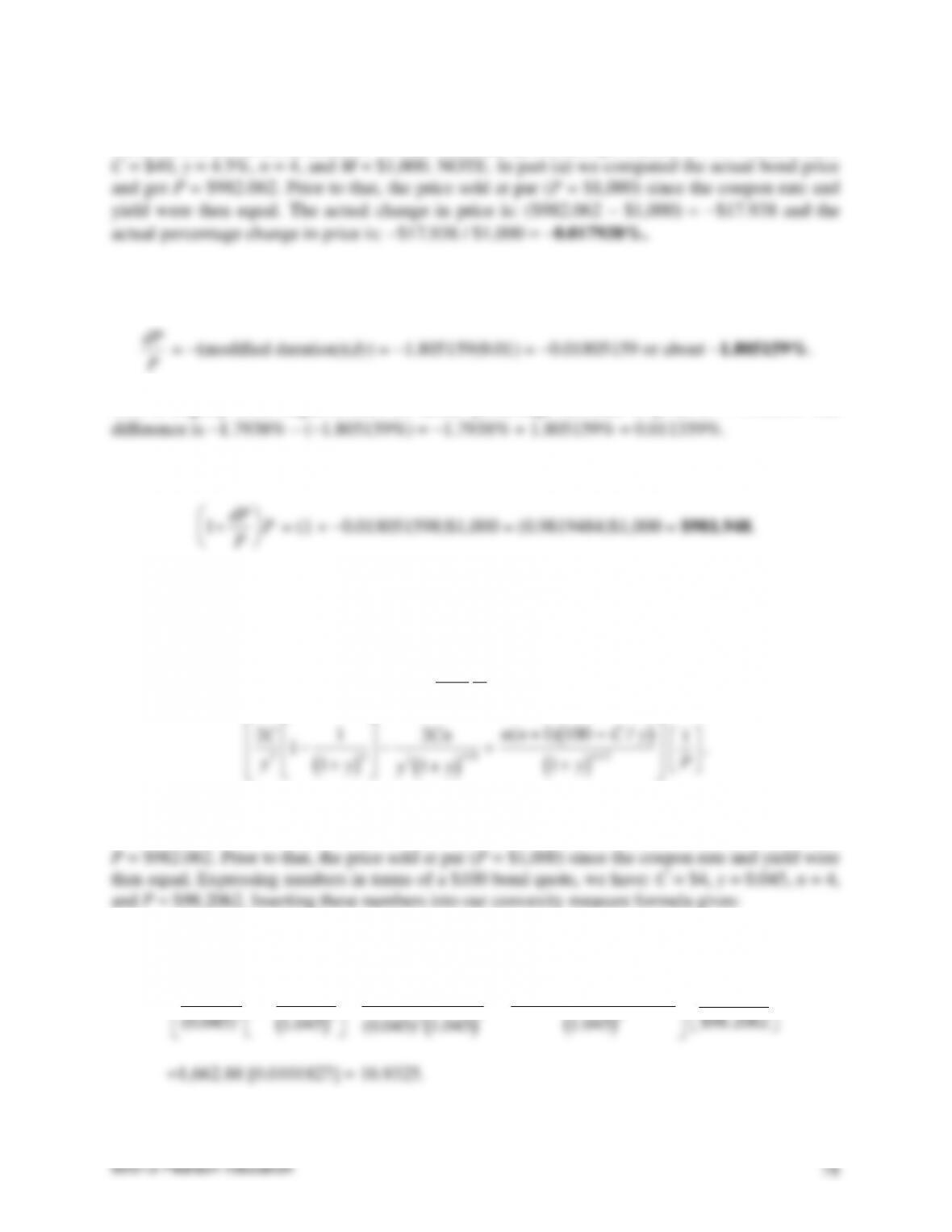
For bond A, we use the duration and convexity measures as given below.
First, we use the duration measure. We add 100 basis points and get a yield of 9%. We now have
We will now estimate the price by first approximating the dollar price change. With 100 basis
points giving dy = 0.01 and a modified duration computed in part (b) of 1.805159, we have:
P
dP
= −(modified duration)(dy) = −1.805159(0.01) = −0.01805159 or about −1.805159%.
This is slightly more negative than the actual percentage decrease in price of −1.7938%. The
Using the −1.805159% just given by the duration measure, the new price for bond A is:
P
This is slightly less than the actual price of $982.062. The difference is $982.062 – $981.948 =
$0.114.
Next, we use the convexity measure to see if we can account for the difference of 0.011359%.
We have: convexity measure (half years) =
P
dy
P
d1
2
2
=
( ) ( )
( )
( )
3 1 2
2
( 1) 100 /
2 1 2
111
1
n n n
n n C y
C Cn
yyy
y
y++
+−
− − +
++
+
1
P
.
For bond A, we add 100 basis points and get a yield of 9%. We now have C = $40, y = 4.5%,
n = 4, and M = $1,000. NOTE. In part (a) we computed the actual bond price and got
convexity measure (half years) =
( ) ( )
( )
( )
3 4 5 6
2
4(5) 100 $4 / 0.045
2($4) 1 2($4)4
1
(0.045) 1.045 1.045
1.045
(0.045)
−
− − +
1
$98.2062
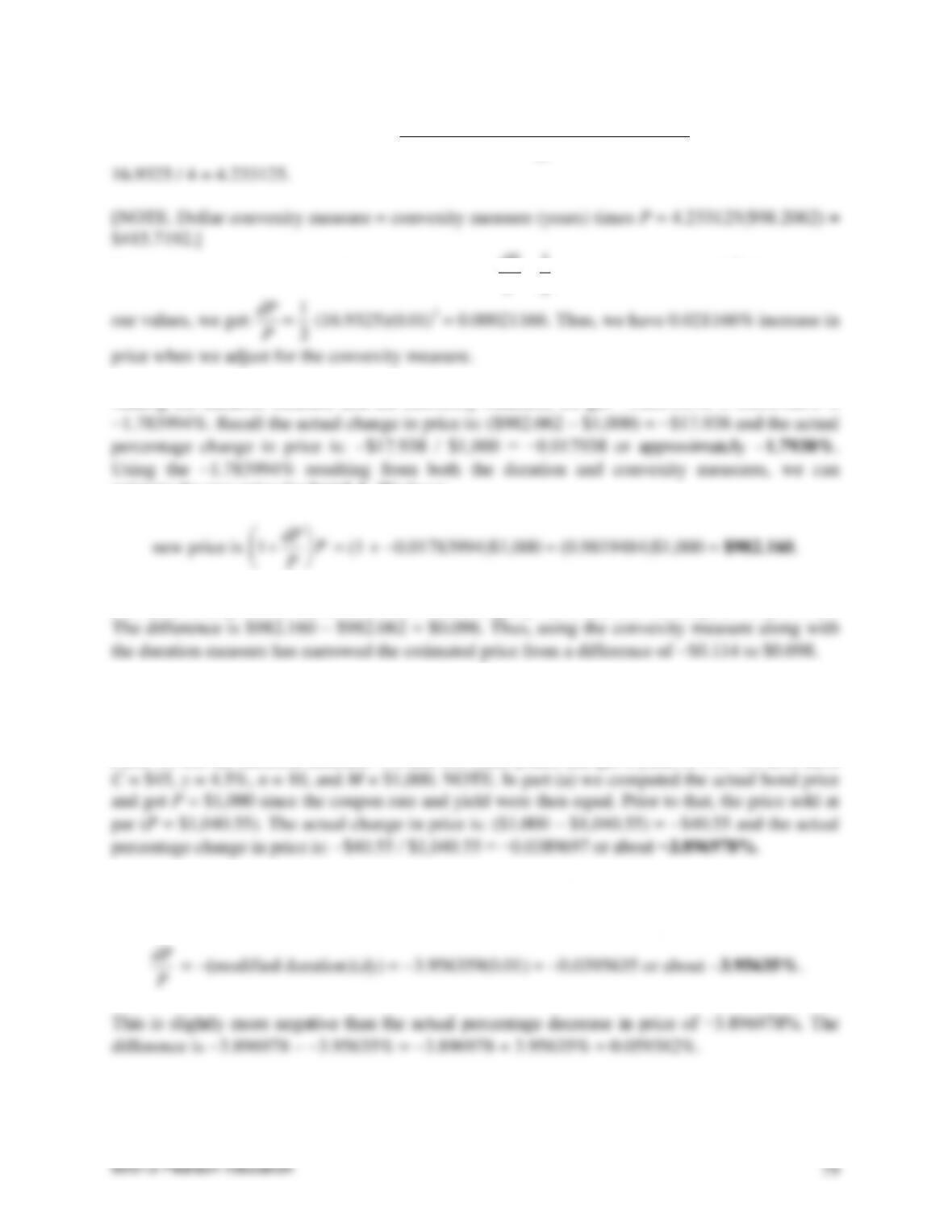
The convexity measure (in years) =
yearper period min measureconvexity
2
m
=16.9325 / 2(2) =
The percentage price change due to convexity is:
2
1
=
P
dP
convexity measure (dy)2. Inserting in
2
1
dP
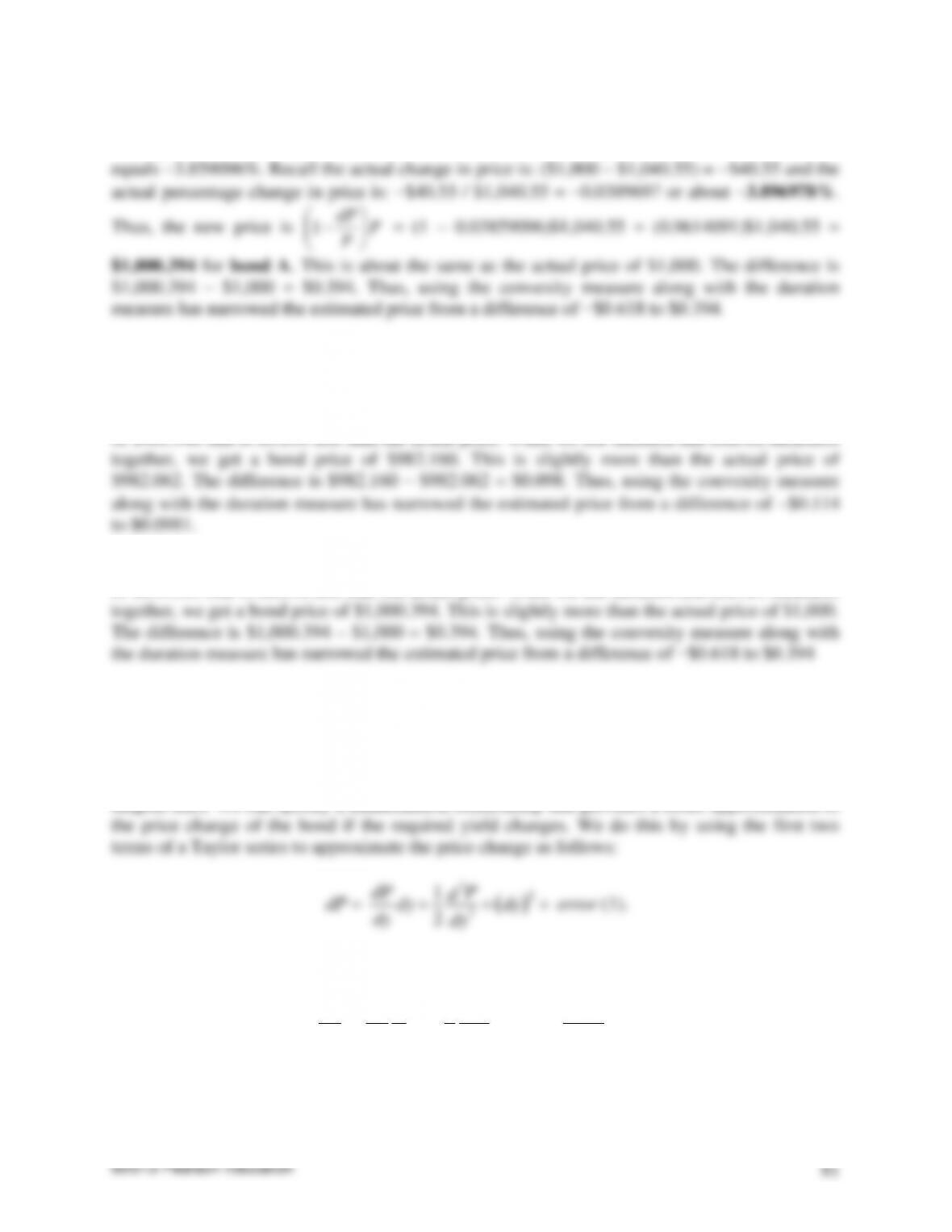
Adding the duration measure and the convexity measure, we get −1.805159% + 0.021166% =
estimate the new price for bond A. We have:
P
This estimated price for bond A of $982.160 is slightly more than the actual price of $982.062.
For bond B, we can also estimate its price using both the duration and convexity measures as
just shown for bond A.
First, we use the duration measure. We add 100 basis points and get a yield of 9%. We now have
We will now estimate the price by first approximating the dollar price change. With 100 basis
points giving dy = 0.01 and a modified duration computed in part (b) of 3.956359, we have:
P
dP
= −(modified duration)(dy) = −3.956359(0.01) = −0.0395635 or about −3.95635%.
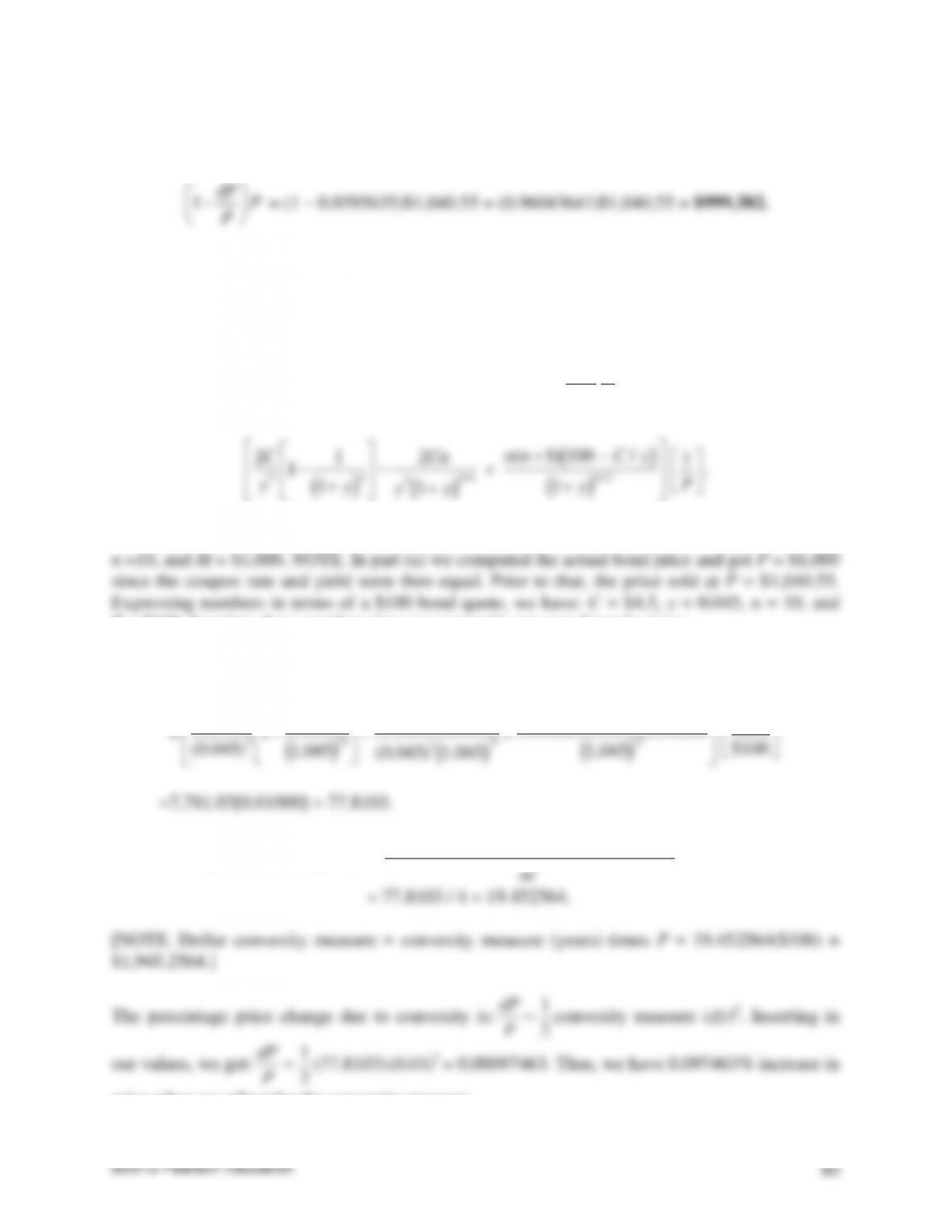
Using the −3.95635% just given by the duration measure, the new price for bond B is:
1dP P
P
−
= (1 – 0.0395635)$1,040.55 = (0.96043641)$1,040.55 = $999.382.
This is slightly less than the actual price of $1,000. The difference is $1,000 – $999.382 =
$0.618.
Next, we use the convexity measure to see if we can account for the difference of 0.0594%. We
have:
convexity measure (half years) =
2
2
1
P
d
P
dy
=
( ) ( )
( )
( )
3 1 2
2
( 1) 100 /
2 1 2
1
11
1
n n n
n n C y
C Cn
yyy
y
y++
+−
− − +
++
+
1
P
.
For bond B, we add 100 basis points and get a yield of 9%. We now have C = $45, y = 4.5%,
P = $100. Inserting these numbers into our convexity measure formula gives:
convexity measure (half years)
( )
10(11) 100 $4.5 / 0.045
2($4.5) 1 2($4.5)4
−
1
Adding the duration measure and the convexity measure, we get −3.956359% + 0.097263%
(d) Comment on the accuracy of your results in parts b and c, and state why one
approximation is closer to the actual price than the other.
For bond A, the actual price is $982.062. When we use the duration measure, we get a bond price
of $981.948 that is $0.114 less than the actual price. When we use duration and convex measures
For bond B, the actual price is $1,000. When we use the duration measure, we get a bond price
of $999.382 that is $0.618 less than the actual price. When we use duration and convex measures
As we see, using the duration and convexity measures together is more accurate. The reason is
that adding the convexity measure to our estimate enables us to include the second derivative
that corrects for the convexity of the price-yield relationship. More details are offered below.
Duration (modified or dollar) attempts to estimate a convex relationship with a straight line (the
tangent line). We can specify a mathematical relationship that provides a better approximation to
2
2
dy dy
Dividing both sides of this equation by P to get the percentage price change gives us:
()
22
2
11
2
dP dP P error
d
dy dy
P dy P P
dy
= + + +
(2).
The first term on the right-hand side of equation (1) is equation for the dollar price change based
on dollar duration and is our approximation of the price change based on duration. In equation
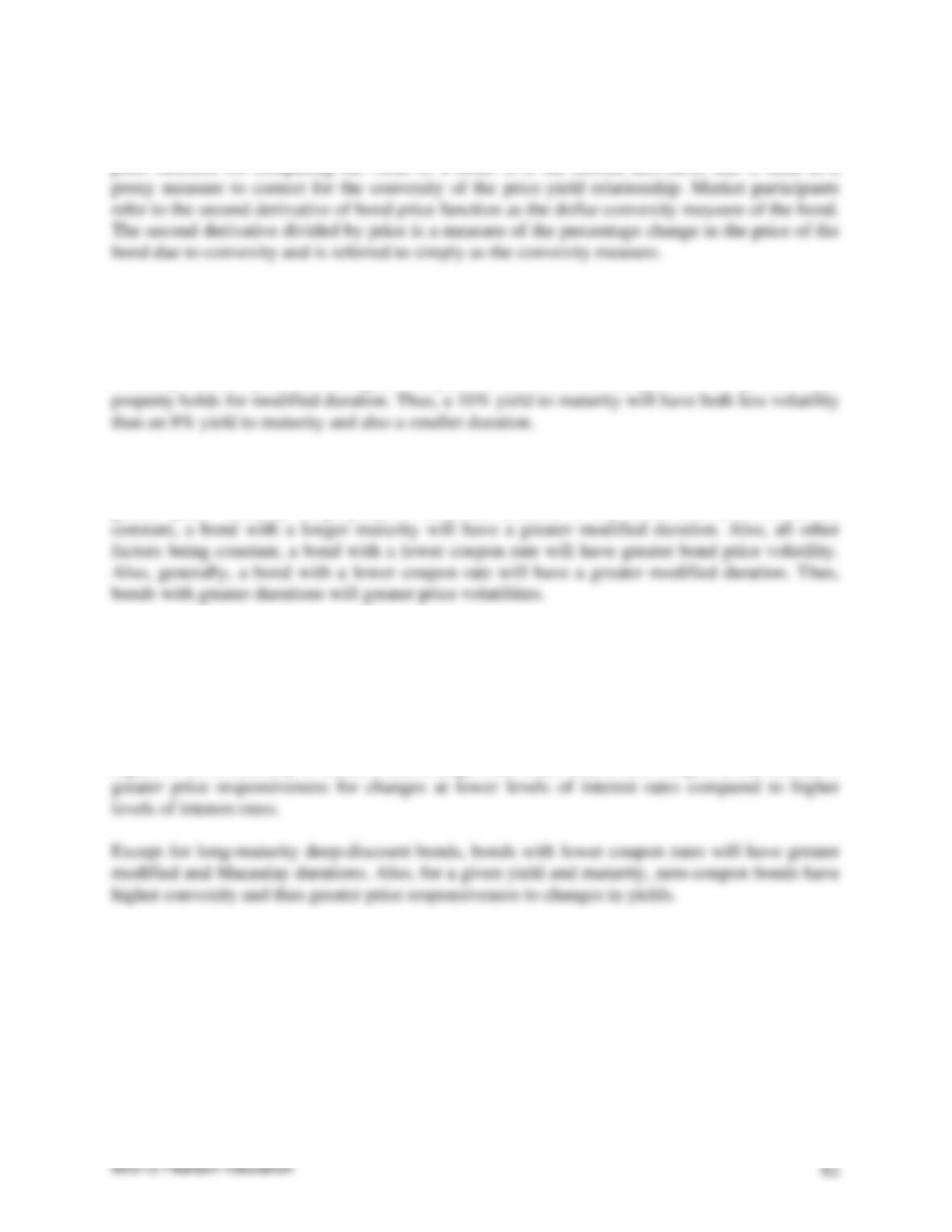
(2), the first term on the right-hand side is the approximate percentage change in price based on
modified duration. The second term in equations (1) and (2) includes the second derivative of the
price function for computing the value of a bond. It is the second derivative that is used as a
(e) Without working through calculations, indicate whether the duration of the two bonds
would be higher or lower if the yield to maturity is 10% rather than 8%.
Like term to maturity and coupon rate, the yield to maturity is a factor that influences price
volatility. Ceteris paribus, the higher the yield level, the lower the price volatility. The same
There is consistency between the properties of bond price volatility and the properties of
modified duration. When all other factors are constant, a bond with a longer maturity will have
greater price volatility. A property of modified duration is that when all other factors are
5. State why you would agree or disagree with the following statement: As the duration of a
zero-coupon bond is equal to its maturity, the price responsiveness of a zero-coupon bond
to yield changes is the same regardless of the level of interest rates.
As seen in Exhibit 4-3, the price responsiveness of a zero-coupon bond is different as yields
change. Like other bonds, zero-coupon bonds have greater price responsiveness for changes at
higher levels of maturity as interest rates change. Like other bonds, zero-coupon bonds also have
6. State why you would agree or disagree with the following statement: When interest rates
are low, there will be little difference between the Macaulay duration and modified
duration measures.
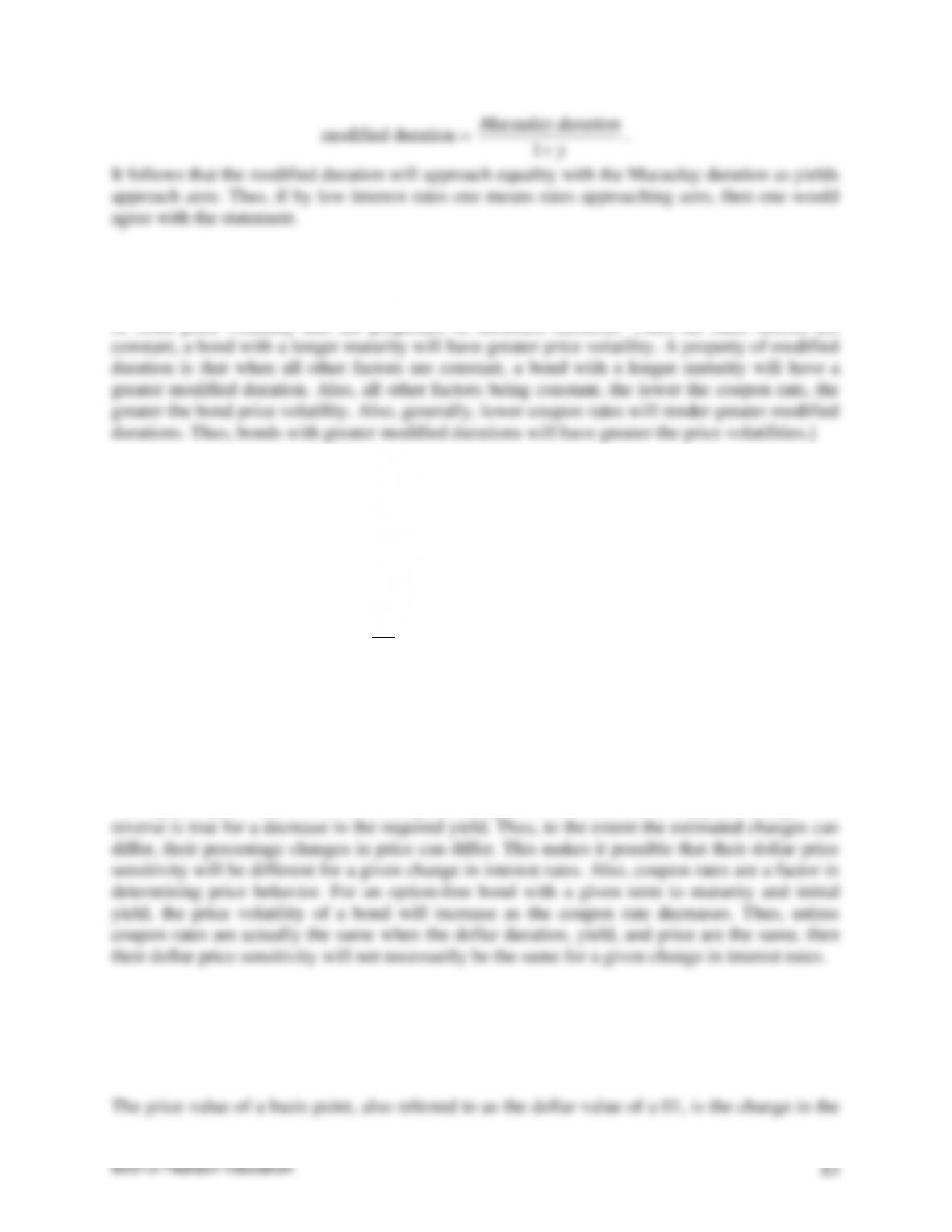
The Macaulay duration is equal to the modified duration times one plus the yield. Rearranging
this expression gives:
©2013 Pearson Education
83
modified duration =
1
Macaulay duration
y+
.
It follows that the modified duration will approach equality with the Macaulay duration as yields
approach zero. Thus, if by low interest rates one means rates approaching zero, then one would
agree with the statement.
[NOTE. Like term to maturity and coupon rate, the yield to maturity is a factor that will
influence price volatility. All other factors constant, the higher the yield level, the lower the price
volatility. The same property holds for duration. There is also consistency between the properties
of bond price volatility and the properties of modified duration. When all other factors are
7. State why you would agree or disagree with the following statement: If two bonds have
the same dollar duration, yield, and price, their dollar price sensitivity will be the same for
a given change in interest rates.
If the two bonds have the same dollar duration then their percentage change in price is the same.
This implies they will have the same dollar price sensitivity. This possibility is seen from the
following equation:
dy
dP
= −(modified duration)P
where the expression on the right-hand side is the estimated dollar duration. By having the same
dollar duration, price (P), and yield, we see they can have the same price change (dP) for a given
change in yield (dy). Thus, their dollar price change or dollar price sensitivity can be the same.
There are possible caveats to the above argument that make it possible that the dollar price
sensitivity can be different for a given change in interest rates. For example, for an increase in
the required yield, the estimated dollar price change is more than the actual price change. The
8. State why you would agree or disagree with the following statement: For a 1-basis point
change in yield, the price value of a basis point is equal to the dollar duration.
The validity of the above statement is discussed below.
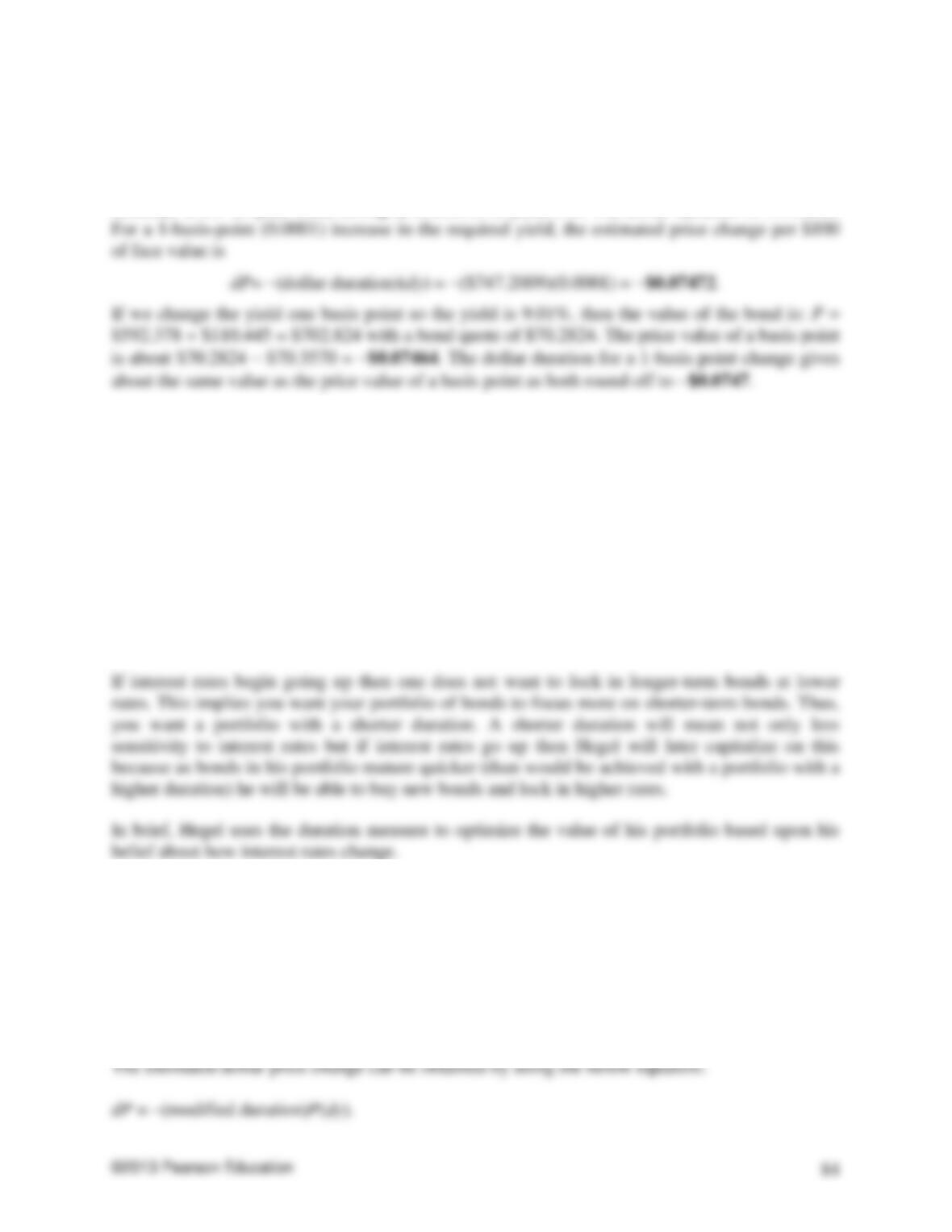
price of the bond if the required yield changes by 1 basis point. For small changes in the required
yield, the below equation does a good job in estimating the change in price:
dP= −(dollar duration)(dy).
Consider a 6% 25-year bond selling at $70.3570 to yield 9%. The dollar duration is 747.2009.
9. The November 26, 1990, issue of BondWeek includes an article, “Van Kampen Merritt
Shortens.” The article begins as follows:
“Peter Hegel, first v.p. at Van Kampen Merritt Investment Advisory, is shortening
his $3 billion portfolio from 110% of his normal duration of 6½ years to 103–105%
because he thinks that in the short run the bond rally is near an end.”
Explain Hegel’s strategy and the use of the duration measure in this context.
If Hegel thinks the bond rally is over it implies that he thinks bond prices will not go up. This
implies the belief that Hegel thinks interest rates will stop falling.
10. Consider the following two Treasury securities:
Bond
Price
Modified duration (years)
A
$90
11
B
$80
12
Which bond will have the greater dollar price volatility for a 25-basis-point change in
interest rates?
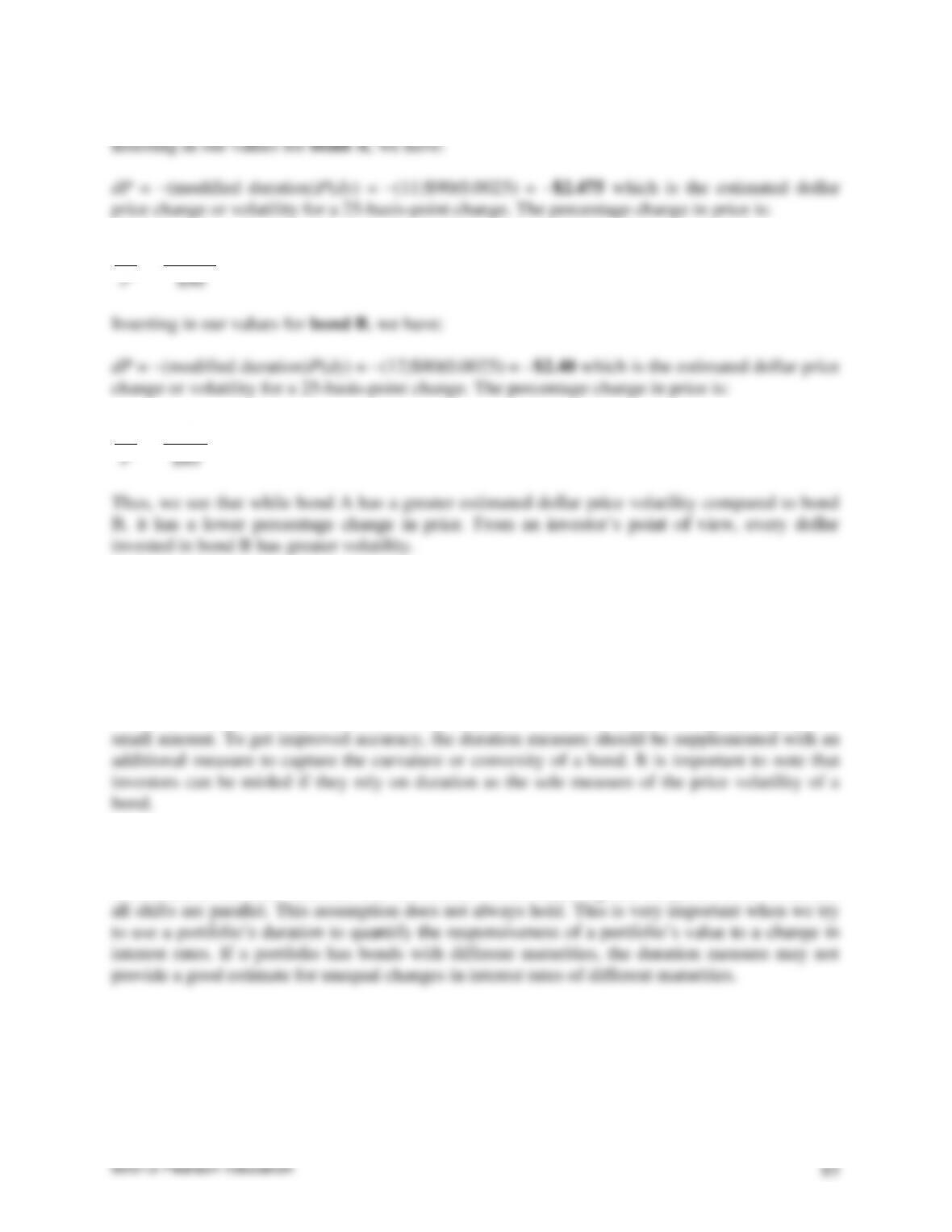
dP
P
=
90$
475.2$
= –0.0275or – 2.750%.
dP
P
=
80$
40.2$
= –0.0300 or – 3.000%.
11. What are the limitations of using duration as a measure of a bond’s price sensitivity to
interest-rate changes?
Below we discuss three limitations of using duration.
First, duration measures are only approximations for small changes in yield. They do not capture
the effect of the convexity of a bond on its price performance when yields change by more than a
Second, in the derivation of the relationship between modified duration and bond price volatility,
we started with the bond price equation that assumes that all cash flows for the bond are
discounted at the same discount rate. In essence we are assuming that the yield curve is flat and
12. The following excerpt is taken from an article titled “Denver Investment to Make $800
Million Treasury Move,” that appeared in the December 9, 1991, issue of BondWeek, p. 1:
“Denver Investment Advisors will swap $800 million of long zero-coupon
Why would the swap described here shorten the duration of the portfolio?
Duration captures the price sensitivity of a fixed-income investment to changes in yields. Thus,
lowering the duration should lower the sensitivity. This is desired if one feels interest rates are
going to increase in which case the value of your fixed-income investment would decline.
Denver Investment Advisors are swapping $800 million long zero-coupon Treasuries for
As seen in Exhibit 4-3, the price responsiveness of a bond is different as yields change. For
example, bonds have greater price responsiveness for changes at higher levels of maturity as
interest rates change. Furthermore, bonds have greater price responsiveness for changes at lower
13. You are a portfolio manager who has presented a report to a client. The report
indicates the duration of each security in the portfolio. One of the securities has a maturity
of 10 years but a duration of 30. The client believes that there is an error in the report
because he believes that the duration cannot be greater than the security’s maturity. What
would be your response to this client?
Unfortunately, market participants often confuse the main purpose of duration by constantly
referring to it as some measure of the weighted average life of a bond. This is because of the
original use of duration by Macaulay where the cash flow for each period divided by the market
(CMO) bond classes. Certain CMO bond classes have a greater duration than the underlying
mortgage loans (because CMO bond classes are leveraged instruments whose price sensitivity or
duration are a multiple of the underlying mortgage loans from which they were created). That is,
14. Answer the below questions.
(a) Suppose that the spread duration for a fixed-rate bond is 1.5. What is the approximate
change in the bond’s price if the spread changes by 25 basis points?
about 0.375% for 25 basis points as shown below in more detail.
Let us begin by noting that
P
dP
= –modified duration (dy).
Substituting spread duration for modified duration to approximate the percentage price change
for a given change in the yield we get:
P
dP
= –spread duration (dy).
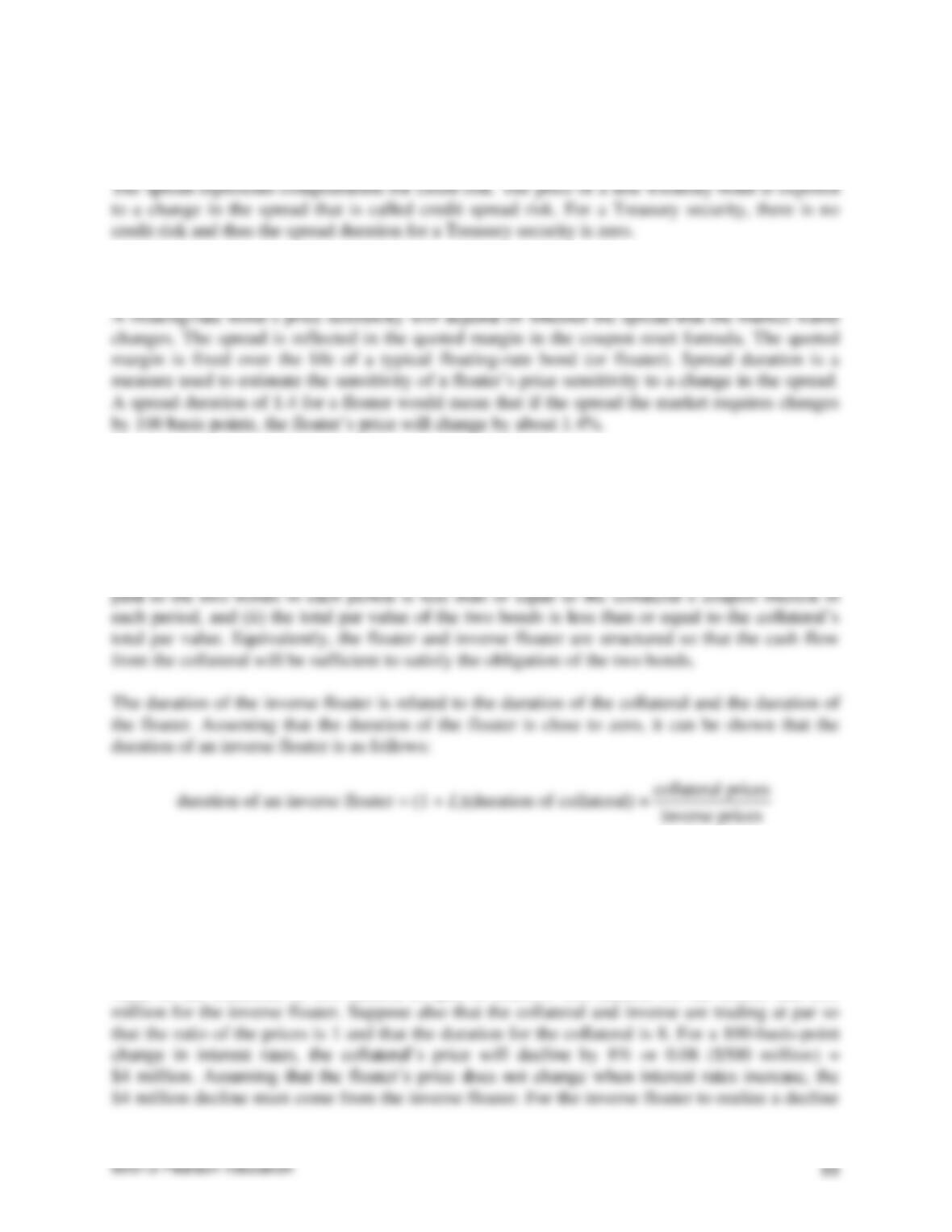
Putting in 1.5 for the spread duration and 0.0025 for dy (since the spread changes by 25 basis
points), we get:
P
dP
(b) What is the spread duration of a Treasury security?
15. What is meant by the spread duration for a floating-rate bond?
16. Explain why the duration of an inverse floater is a multiple of the duration of the
collateral from which the inverse floater is created.
In general, an inverse floater is created from a fixed-rate security. The security from which the
inverse floater is created is called the collateral. From the collateral two bonds are created: a
floater and an inverse floater. The two bonds are created such that (i) the total coupon interest
inverse prices
where Lis the ratio of the par value of the floater to the par value of the inverse floater. For
example, if collateral with a par value of $100 million is used to create a floater with a par value
of $80 million and an inverse floater with a par value of $20 million, then L = ($80 million /
$20 million) = 4.
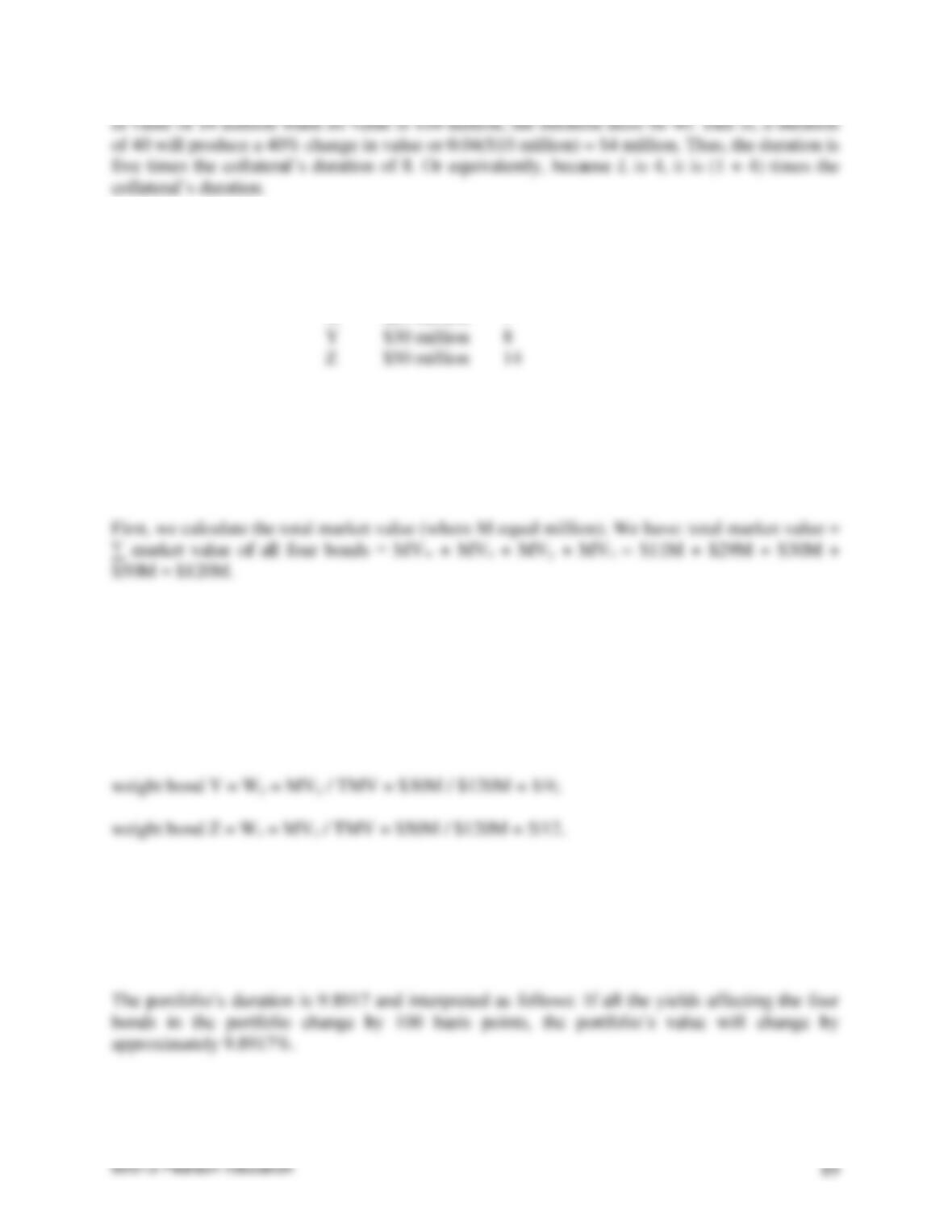
We can illustrate why an inverse’s duration is a multiple of the collateral. Suppose that the par
value of the collateral of $50 million is split as follows: $40 million for the floater and $10
©2013 Pearson Education
89
in value of $4 million when its value is $10 million, the duration must be 40. That is, a duration
of 40 will produce a 40% change in value or 0.04($10 million) = $4 million. Thus, the duration is
five times the collateral’s duration of 8. Or equivalently, because L is 4, it is (1 + 4) times the
collateral’s duration.
17. Consider the following portfolio:
Bond
Market Value
Duration (years)
W
$11 million
4
X
$29 million
7
Y
$30 million
8
Z
$50 million
14
(a) What is the portfolio’s duration?
The portfolio duration is equivalent to the weighted average of the duration for bond W (Dw),
bond X (Dx), bond (Dy), and bond Z (Dz). We proceed as follows to calculate the portfolio
duration.
Second, we compute the portfolio weights as given by the following formula: weight (W) =
market value of bond (MV) ÷ total market value (TMV) or Wi = MVi / TMV for i = W, X, Y and
Z. For the four weights we have:
weight bond W = Ww = MVw / TMV = $11M / $120M = 11/120;
weight bond X = Wx = MVx / TMV = $29M / $120M = 29/120;
The portfolio duration equals the weighted average of the duration for bond W(Dw), bond X (Dx),
bond (Dy), and bond Z (Dz). We have:
(Ww)Dw + (Wx)Dx + (Wy)Dy + (Wz)Dz = (11/120)4 + (29/120)7 + (1/4)8 + (5/12)14 = 9.8917 or
about 10 years.
(b) If interest rates for all maturities change by 25 basis points, what is the approximate
percentage change in the value of the portfolio?
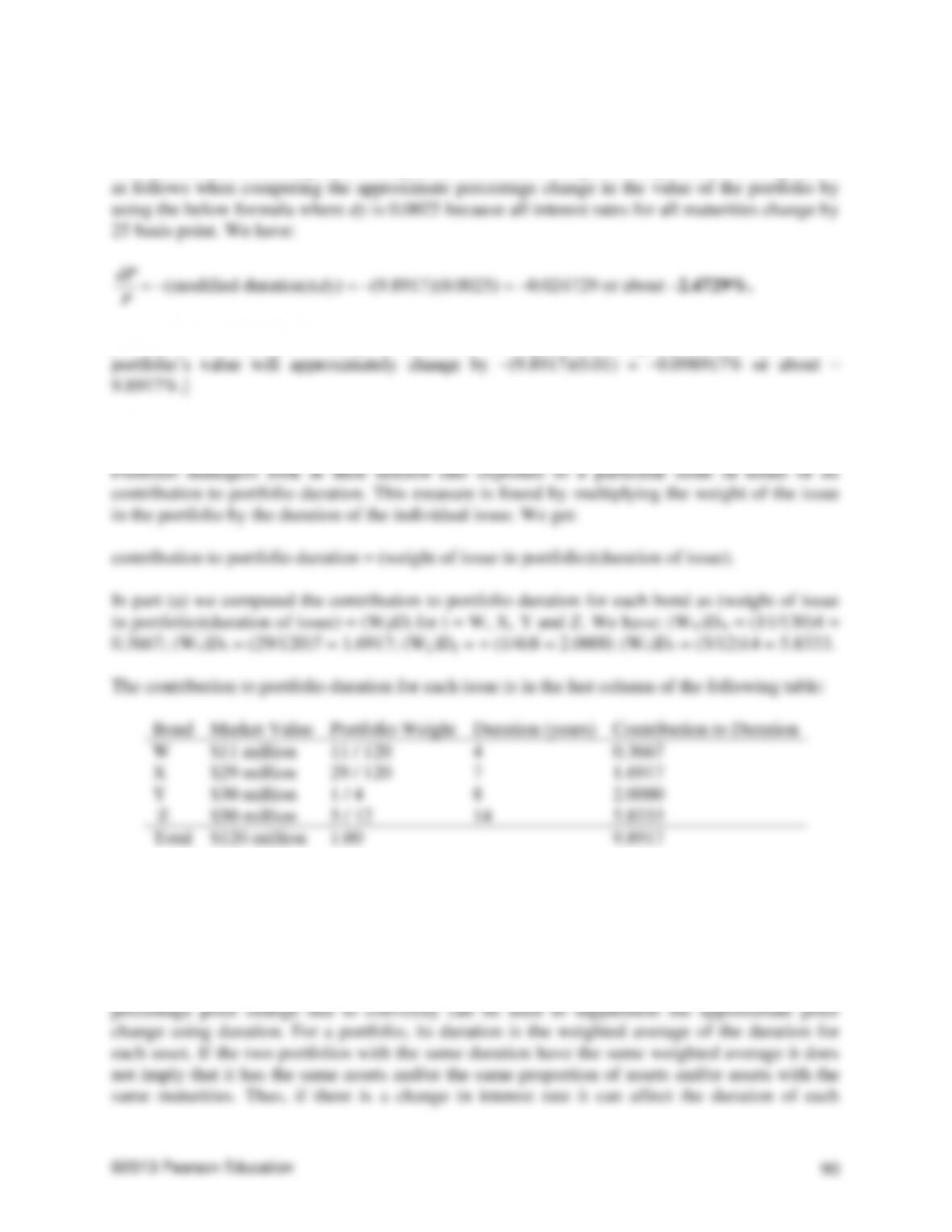
The total change in value of a portfolio if all rates (for each point on the yield curve) change by
the same number of basis points is simply the duration of a single security. Thus, we can proceed
P
[NOTE. If all the yields affecting the four bonds in the portfolio change by 100 basis points, the
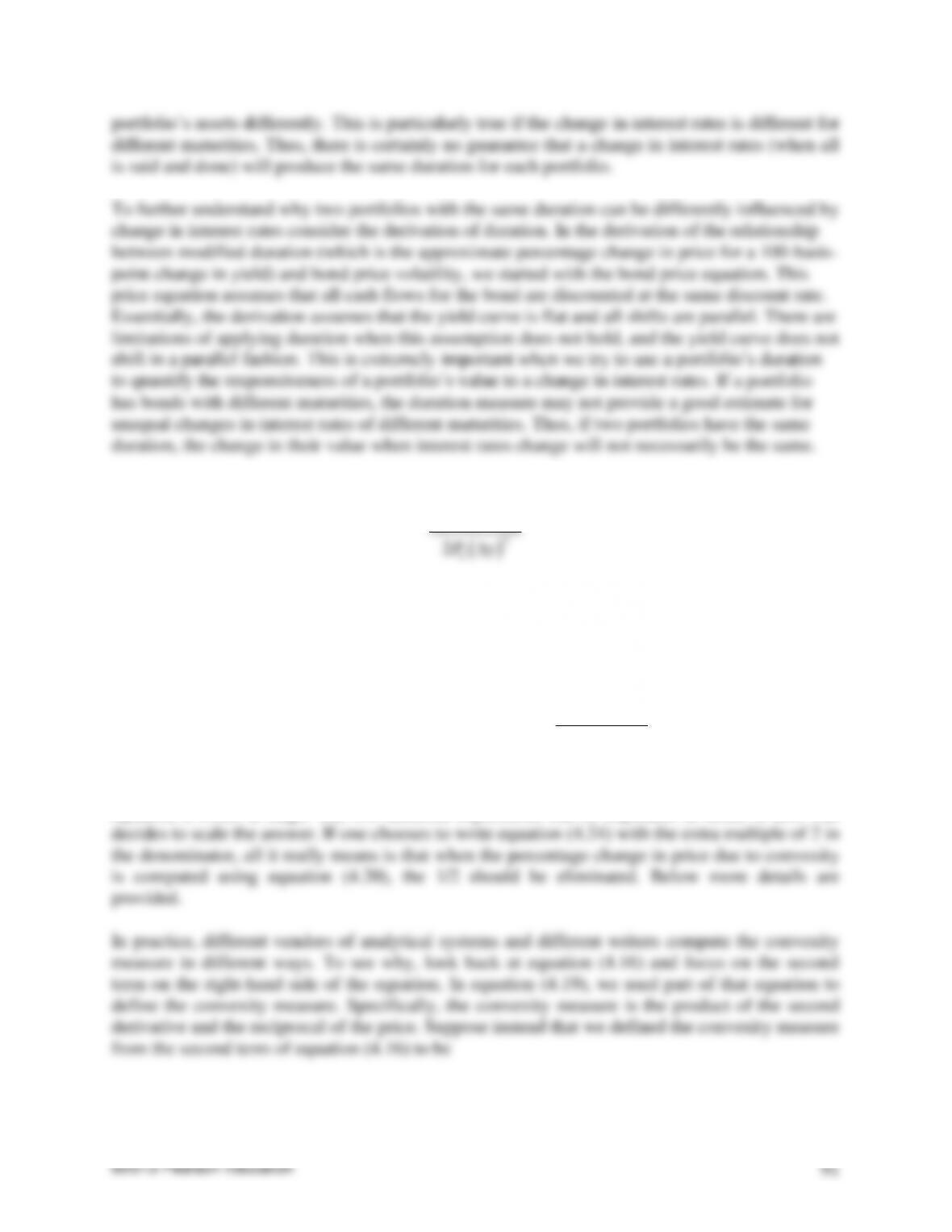
(c) What is the contribution to portfolio duration for each bond?
©2013 Pearson Education
91
portfolio’s assets differently. This is particularly true if the change in interest rates is different for
different maturities. Thus, there is certainly no guarantee that a change in interest rates (when all
is said and done) will produce the same duration for each portfolio.
19. Some authors give the following formula for the approximate convexity measure:
( )
0
2
0
2
2
+−
+−
P P P
Py
where the variables are defined as in equation (4.24) of this chapter. Compare this formula
with the approximate convexity measure given by equation (4.24). Which formula is
correct?
Below is equation (4.24):
approximate convexity measure =
( )
0
2
0
2P P P
Py
+−
+−
.
We see that the two equations are identical except that the denominator in the handbook’s
equation is twice as large. The two different expressions can be explained in terms of how one
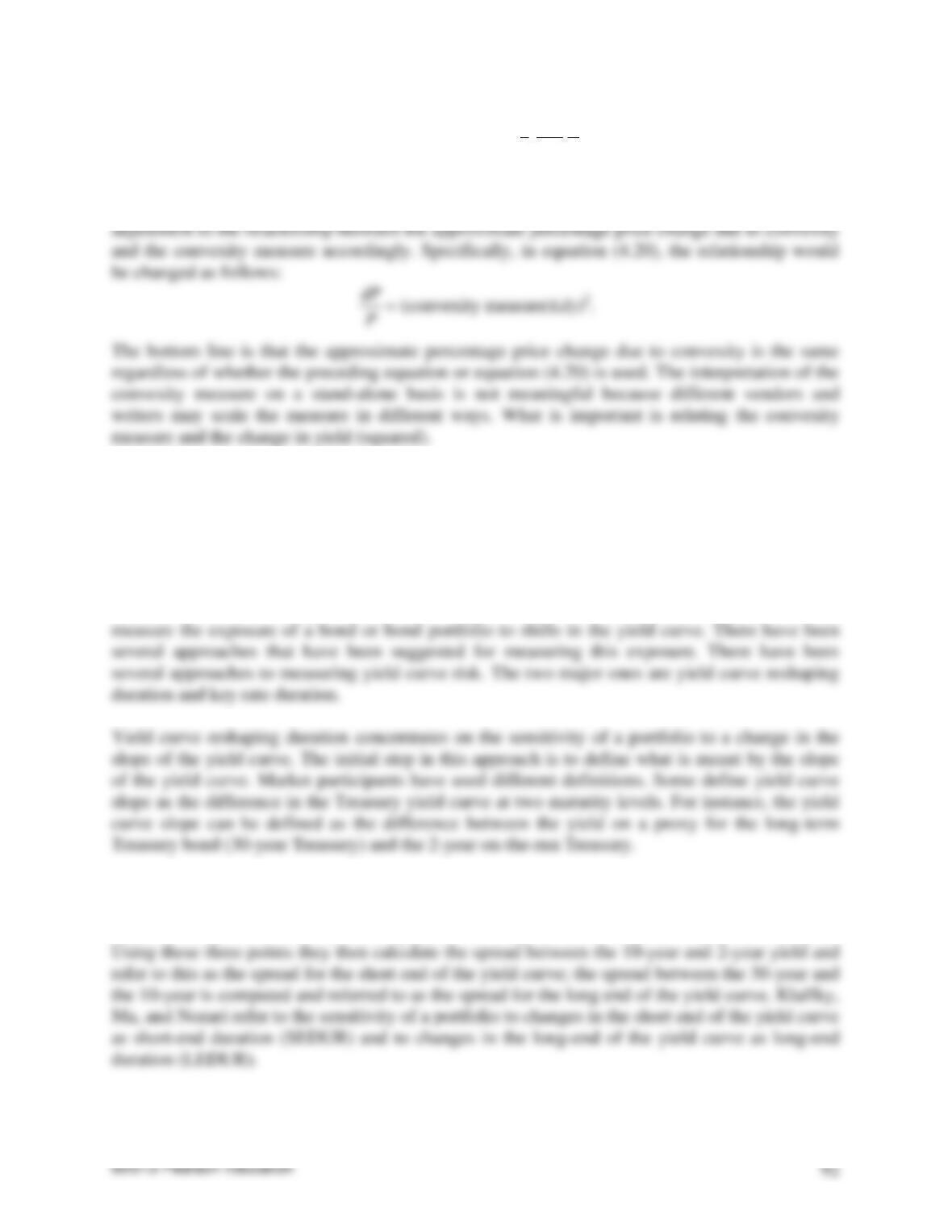
convexity measure =
2
2
11
2
P
d
P
dy
.
That is, the convexity measure shown is just one-half the convexity measure given by equation
(4.19). Does it make a difference? Not at all. We must just make sure that we make the
20. Answer the below questions.
(a) How is the short-end duration of a portfolio computed?
The shortcoming of duration is that this measure may be inadequate in measuring how a
security’s price or a portfolio’s value will change when interest rates do not change in a parallel
manner. This is particularly the case for a bond portfolio. As a result, it is necessary to be able to
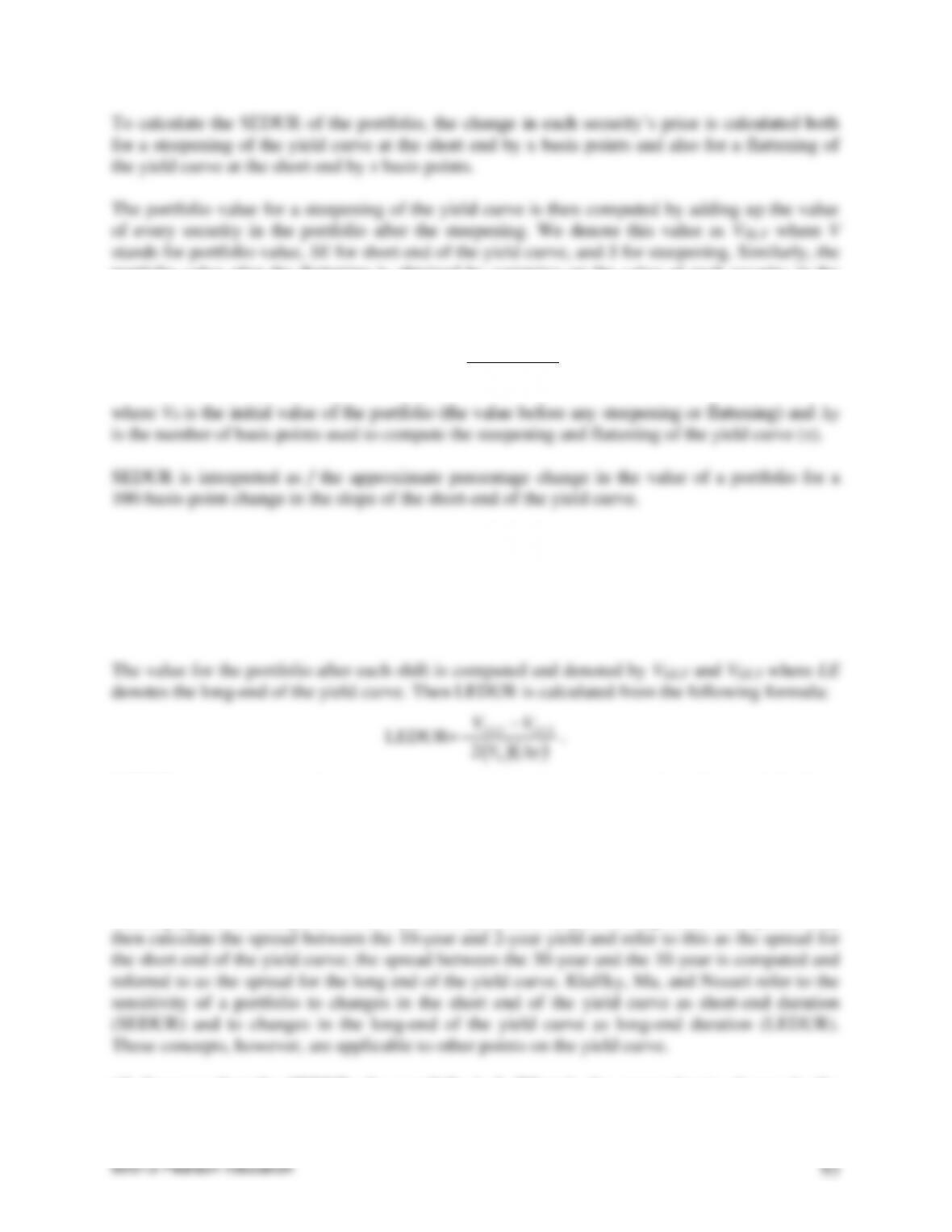
One of the first measures of this approach was introduced by Klaffky, Ma, and Nozari at
Salomon Smith Barney. They called their measure by the name of yield curve reshaping
duration. They focus on three maturity points on the yield curve: 2-year, 10-year, and 30-year.
©2013 Pearson Education
93
To calculate the SEDUR of the portfolio, the change in each security’s price is calculated both
for a steepening of the yield curve at the short end by x basis points and also for a flattening of
the yield curve at the short end by x basis points.
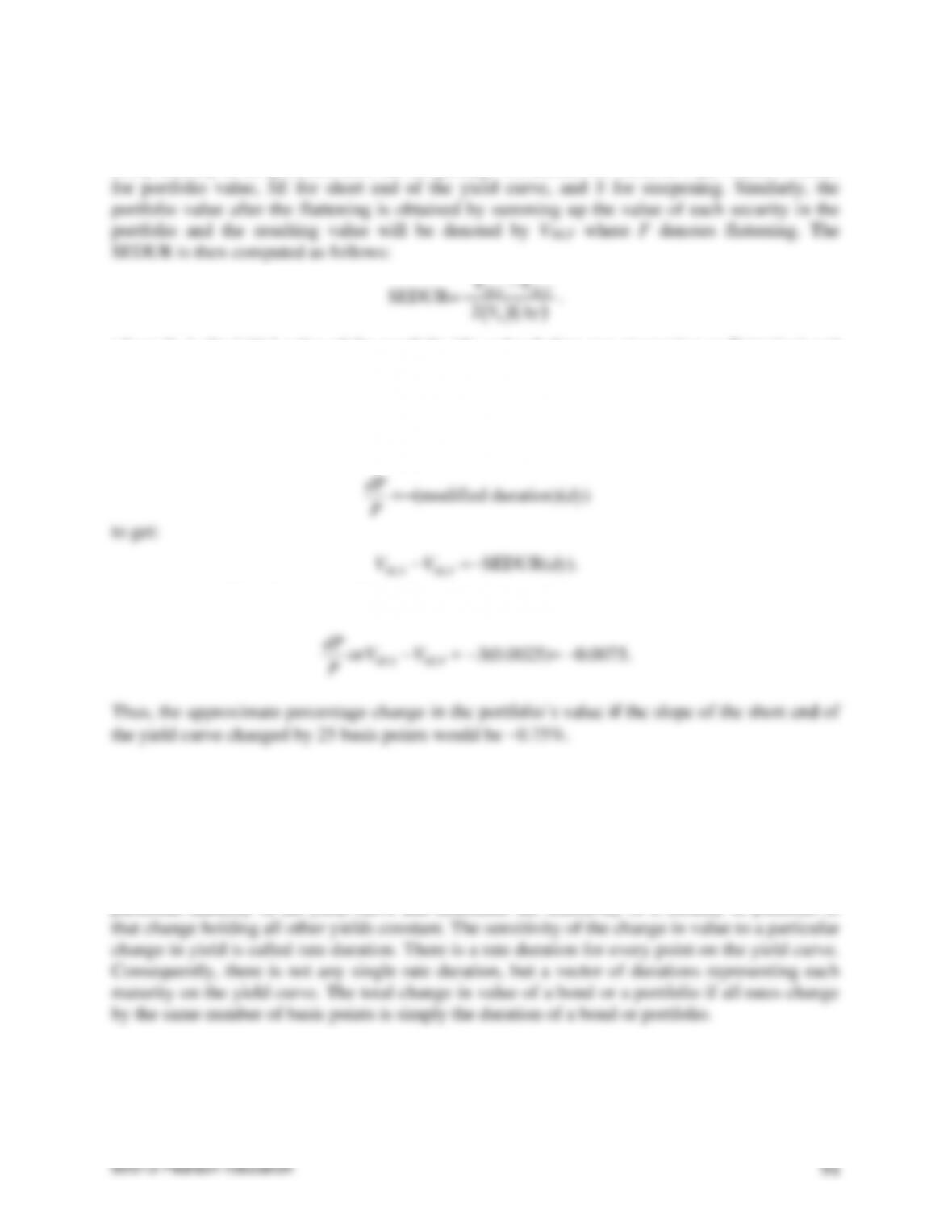
The portfolio value for a steepening of the yield curve is then computed by adding up the value
of every security in the portfolio after the steepening. We denote this value as VSE,F where V
stands for portfolio value, SE for short end of the yield curve, and S for steepening. Similarly, the
portfolio value after the flattening is obtained by summing up the value of each security in the
portfolio and the resulting value will be denoted by VSE,F where F denotes flattening. The
SEDUR is then computed as follows:
SEDUR =
( )
( )
0
2
SE,S SE,F
V V
Vy
−
(b) How is the long-end duration of a portfolio computed?
To compute the long-end duration (LEDUR) of the portfolio, the change in each security’s price
is calculated both for a flattening of the yield curve at the long end by x basis points and also for
a steepening of the yield curve at the long end by x basis points
( )
( )
0
2
Vy
LEDUR is interpreted as the approximate percentage change in the value of a portfolio for a
100-basis-point change in the slope of the long-end of the yield curve.
(c) How is the short end and long end of a portfolio defined?
Klaffky, Ma, and Nozari of Salomon Brothers (now Salomon Smith Barney) focus on three
maturity points on the yield curve: 2-year, 10-year, and 30-year. Using these three points they
(d) Suppose that the SEDUR of a portfolio is 3. What is the approximate change in the
portfolio’s value if the slope of the short end of the yield curve changed by 25 basis points?
The portfolio value for a steepening of the yield curve is computed by adding up the value of
every security in the portfolio after the steepening. We denote this value as VSE,F where V stands
( )
( )
0
2
Vy
where V0 is the initial value of the portfolio (the value before any steepening or flattening) and
∆y is the number of basis points used to compute the steepening and flattening of the yield curve.
Noting that the change in price is approximated by
SE,S SE,F
VV−
and SEDUR represents the
duration, then we can substitute in the formula
P
dP
=−(modified duration)(dy)
to get:
SE,S SE,F
VV−
Inserting 3 for SEDUR and 0.0025 for dy (since the spread changes by 25 basis points), we get:
VV−
SE,S SE,F
21. Answer the following two questions.
(a) Explain what a 5-year key rate duration of 0.45 means.
The key rate duration is an approach to measure the exposure of a bond or bond portfolio to
shifts in the yield curve. The basic principle of key rate duration is to change the yield for a
particular maturity of the yield curve and determine the sensitivity of a security or portfolio to
A key rate duration for a particular portfolio maturity should be interpreted as follows: Holding
the yield for all other maturities constant, the key rate duration is the approximate percentage
change in the value of a portfolio (or bond) for a 100-basis-point change in the yield for the
©2013 Pearson Education
95
maturity whose rate has been changed. Thus, a 5-year key rate duration of 0.45 means that if the
5-year spot rate changes by 100 basis points and the spot rate for all other maturities does not
change, the portfolio’s value will change by approximately 0.45%.
(b) How is a key rate duration computed?
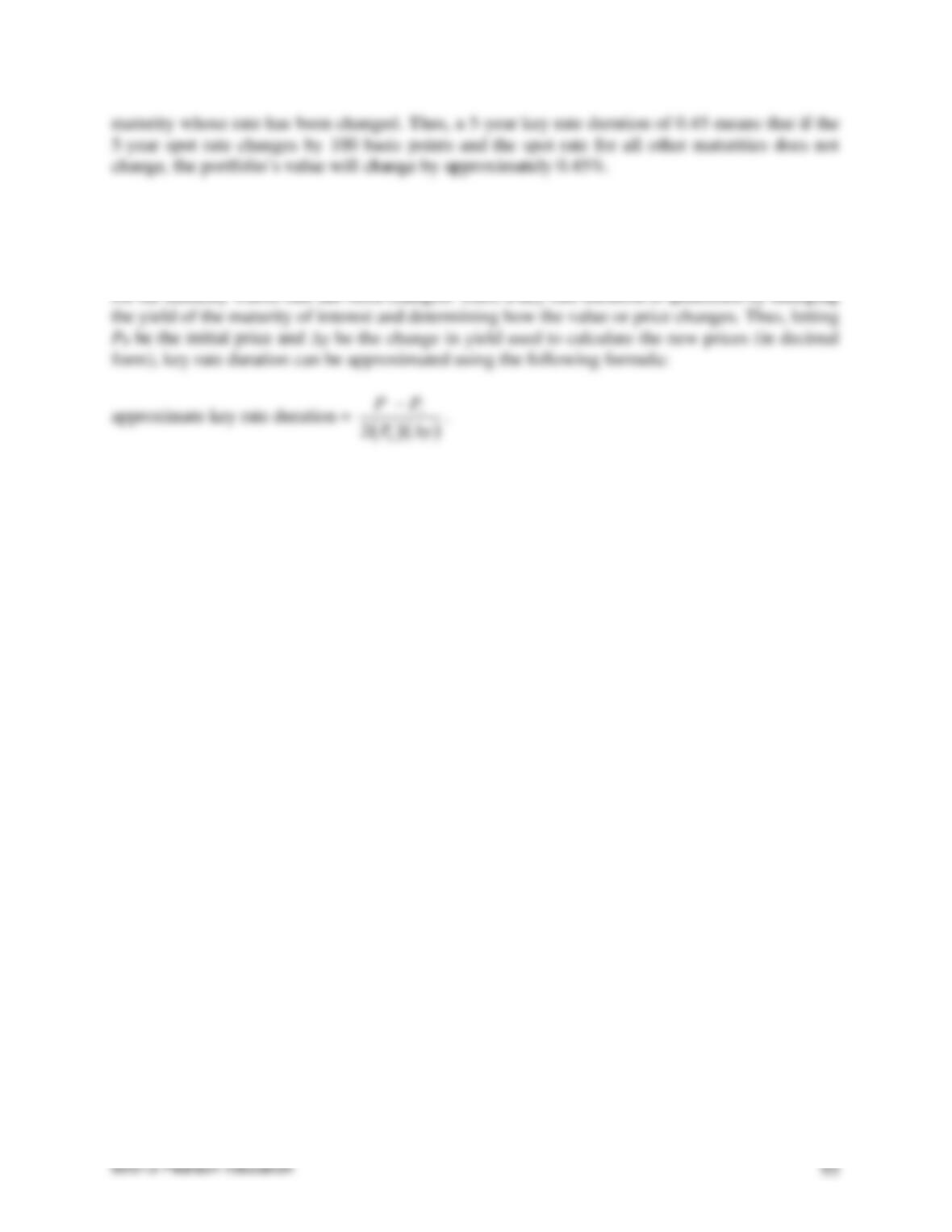
Holding the yield for all other maturities constant, the key rate duration is the approximate
percentage change in the value of a portfolio (or bond) for a 100-basis-point changes in the yield
for the maturity whose rate has been changed. Thus, a key rate duration is quantified by changing
( )
( )
0
2
Py
The prices denoted by P_ and P+ in the equation are the prices in the case of a bond and the
portfolio values in the case of a bond portfolio found by holding all other interest rates constant
and changing the yield for the maturity whose key rate duration is sought.