Chapter 3 – How Securities Are Traded
3-1
CHAPTER 3: HOW SECURITIES ARE TRADED
PROBLEM SETS
1. Stop-loss order: allows a stock to be sold if the price falls below a predetermined
2. In response to the potential negative reaction to large [block] trades, trades will be split
up into many small trades, effectively hiding the total number of shares bought or sold.
3. The use of leverage necessarily magnifies returns to investors. Leveraging
borrowed money allows for greater return on investment if the stock price increases.
4. (a) A market order is an order to execute the trade immediately at the best
possible price. The emphasis in a market order is the speed of execution (the
5. (a) A broker market consists of intermediaries who have the discretion to trade
for their clients. A large block trade in an illiquid security would most likely
trade in this market as the brokers would have the best access to clients
Chapter 3 – How Securities Are Traded
6. a. The stock is purchased for: 300 $40 = $12,000
The amount borrowed is $4,000. Therefore, the investor put up equity, or
margin, of $8,000.
7. a. The initial margin was: 0.50 1,000 $40 = $20,000
As a result of the increase in the stock price Old Economy Traders loses:
$10 1,000 = $10,000
Chapter 3 – How Securities Are Traded
3-3
8. a. The buy order will be filled at the best limit-sell order price: $50.25
b. The next market buy order will be filled at the next-best limit-sell
9. a. You buy 200 shares of Telecom for $10,000. These shares increase in value by
10%, or $1,000. You pay interest of: 0.08 $5,000 = $400
10. a. Initial margin is 50% of $5,000, or $2,500.
11. The total cost of the purchase is: $20 1,000 = $20,000
You borrow $5,000 from your broker and invest $15,000 of your own funds.
Your margin account starts out with equity of $15,000.
a. (i) Equity increases to: ($22 1,000) – $5,000 = $17,000
Chapter 3 – How Securities Are Traded
3-4
b. The value of the 1,000 shares is 1,000P. Equity is (1,000P – $5,000). You will
receive a margin call when:
P
P
000,1
000,5$000,1 −
= 0.25 when P = $6.67 or lower
$5,000 1.08 = $5,400
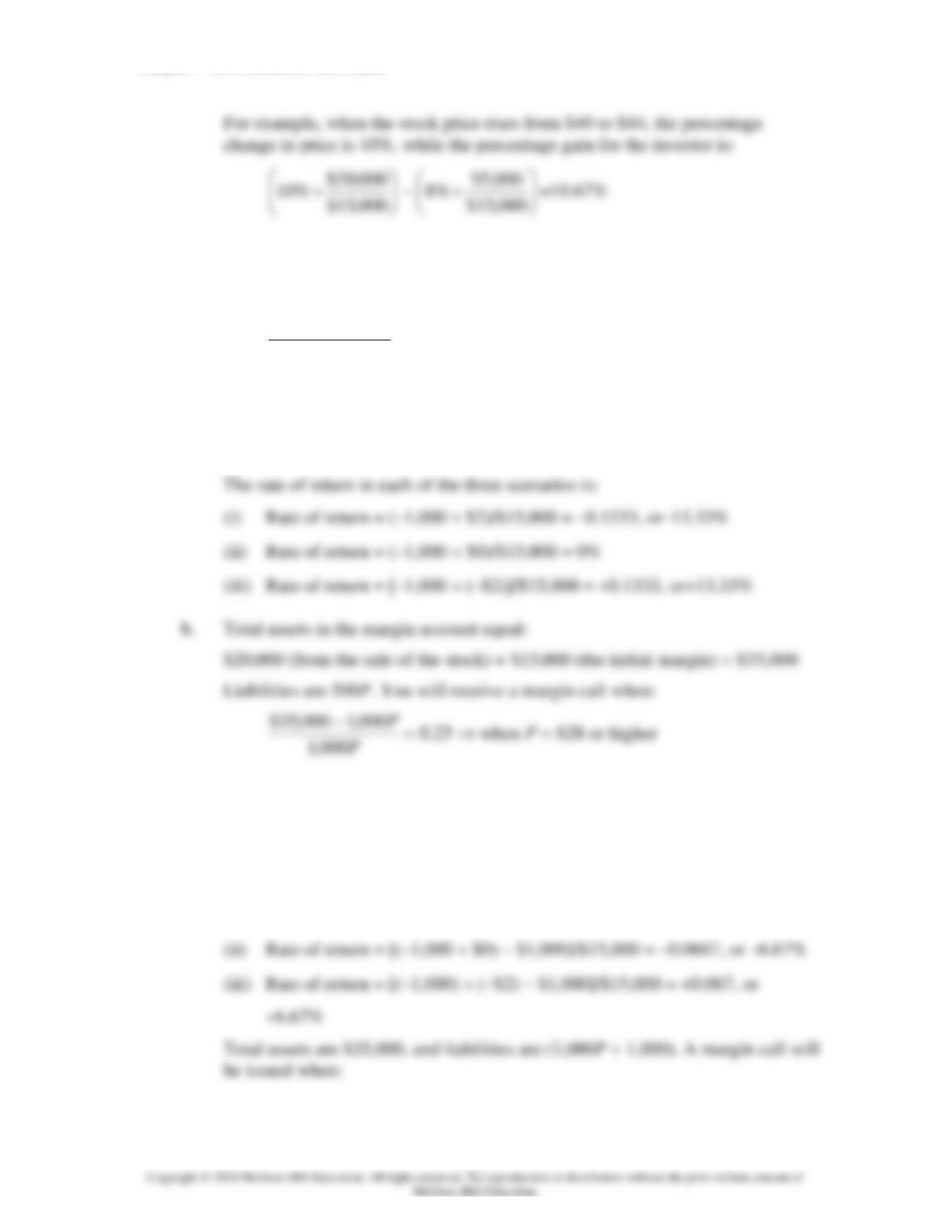
The equity in your account is (1,000P – $5,400). Initial equity was $15,000.
Therefore, your rate of return after one year is as follows:
Chapter 3 – How Securities Are Traded
3-5
e. The value of the 1000 shares is 1,000P. Equity is (1,000P – $5,400). You will
receive a margin call when:
P
P
000,1
400,5$000,1 −
= 0.25 when P = $7.20 or lower
12. a. The gain or loss on the short position is: (–1,000 ΔP)
Invested funds = $15,000
Therefore: rate of return = (–1,000 ΔP)/15,000
c. With a $1 dividend, the short position must now pay on the borrowed shares:
($1/share 1000 shares) = $1000. Rate of return is now:
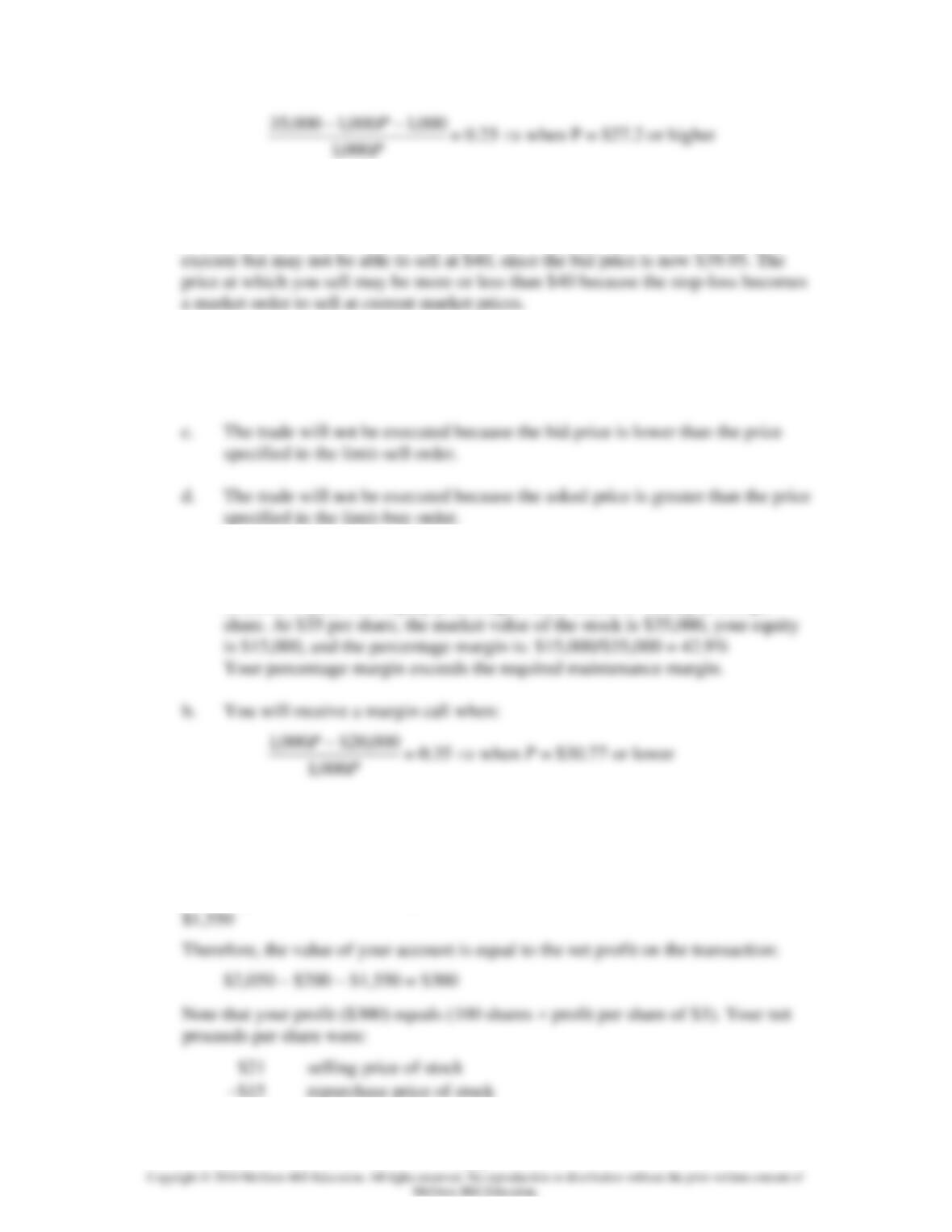
[(–1,000 ΔP) – 1,000]/15,000
(i) Rate of return = [(–1,000 $2) – $1,000]/$15,000 = –0.2000, or –
20.00%
Chapter 3 – How Securities Are Traded
3-6
13. The broker is instructed to attempt to sell your Marriott stock as soon as the
Marriott stock trades at a bid price of $40 or less. Here, the broker will attempt to
14. a. $55.50
b. $55.25
15. a. You will not receive a margin call. You borrowed $20,000 and with another
$20,000 of your own equity you bought 1,000 shares of Disney at $40 per
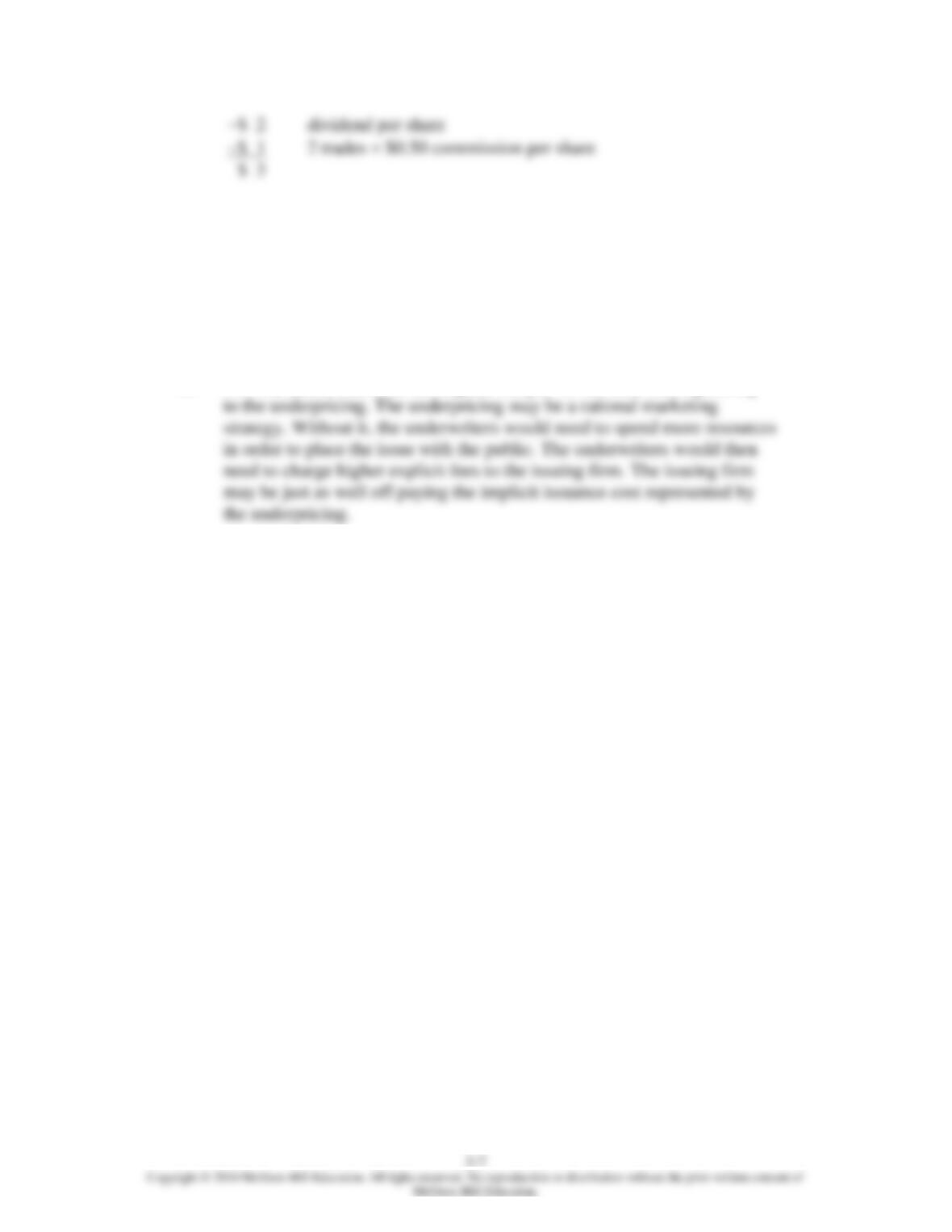
16. The proceeds from the short sale (net of commission) were: ($21 100) – $50 = $2,050
A dividend payment of $200 was withdrawn from the account.
Covering the short sale at $15 per share costs (with commission): $1,500 + $50 =
Chapter 3 – How Securities Are Traded
CFA PROBLEMS
1. a. In addition to the explicit fees of $70,000, FBN appears to have paid an
implicit price in underpricing of the IPO. The underpricing is $3 per share, or
a total of $300,000, implying total costs of $370,000.
b. No. The underwriters do not capture the part of the costs corresponding
2. (d) The broker will sell, at current market price, after the first transaction at
$55 or less.
3. (d)