Chapter 3
Foreign Exchange Determination and
Forecasting
1. Applying expansionary macroeconomic policy, which results in higher goods prices and lower real
interest rates, will not reduce the balance of payments deficit. Higher prices will make the country’s
2. a. One advantage of a wider band is “emotional.” France could claim that it did not devalue its
currency. Another advantage is flexibility. If there were no long-term fundamental reasons
3. a. The American investor has paid a 25 percent premium over the price paid by a domestic investor.
Yet, he receives the same dividends as the domestic investor. Therefore, his investment bears a
smaller yield than it would for a domestic investor.
4. Remember that the Eurozone is made up of those countries in the EU that have adopted the euro as
common currency. Statements I and III are clearly correct. Statement II is clearly not correct, because
5. The statement is true. Because of riskless arbitrage, interest rate parity between two currencies would
hold if the markets for both are free and deregulated. Developed financial markets tend to be more
free and deregulated. A developing country is more likely to impose various forms of capital controls
Chapter 3 Foreign Exchange Determination and Forecasting 15
6. a. Using the first-order approximation of PPP relationship, the variation in rupee to dollar exchange
rate should equal the inflation differential between rupee and dollar. So, the rupee to dollar
exchange rate should increase by 6 − 2.5 = 3.5%. That is, the rupee should depreciate by 3.5%
7. If a country’s currency is undervalued, it means that the real prices of assets in this country are low
compared with other countries. Also, the wages are lower in real terms than in other countries. Thus,
8. In risk-neutral efficient foreign exchange markets, the forward rate is the expected value of the future
spot rate. The forward rate can be computed using the interest rate parity relation. Because the
exchange rate is given in $:SFr terms, the appropriate expression for the interest rate parity relation is
9. As per the model, one € would be worth $0.9781 six months later. Based on the forward rate, one €
would be worth $0.9976 six months later. Therefore, the market participants, who believe that the
model is quite good, would buy the dollar in the forward market (sell euros). Consequently, the price
of the euro forward would decrease (the dollar forward would increase) and the forward rate would
16 Solnik/McLeavey • Global Investments, Sixth Edition
10. a. The forward rate can be computed using the interest rate parity relation. Because the exchange
rate is given in £:$ terms, the appropriate expression for the interest rate parity relation is
b. Based on the forward rate, one pound would be worth $1.5283 one year later. The model predicts
that one pound would be worth $1.5315 one year later. Thus, as per the model, the pound is
underpriced in the forward market. Accordingly, Dustin Green would buy pounds forward at
$1.5283/£.
c. If everyone were to buy pounds forward, the price of pounds forward would increase and become
11. a. If the market participants are risk-neutral, the expected future spot exchange rate would be the
same as the current forward rate. The forward rate is determined based on the current spot
exchange rate and the interest rate differential between the two currencies. Thus, the expected
12. There is some evidence of positive serial correlation in exchange rate movements (real and nominal).
Hence, when a currency is going up, a reasonable forecast is that it will continue going up. Similarly,
when a currency is going down, a reasonable forecast is that it will continue going down. However, at
13. Statements (a), (c), and (d) are true. Statement (b) is not true, because the objective of central bank
activity in the foreign exchange market is not to profit from trading activities, but to implement
monetary policy and exchange rate targets.
Chapter 3 Foreign Exchange Determination and Forecasting 17
14. A mean-reverting time series is one that may diverge from its fundamental value in the short run but
reverts to its fundamental value in the long run. Empirical evidence suggests that exchange rates are
15. Most econometric models are unsuitable for short-term exchange rate forecasts, as they model long-
term structural economic relationships. For long-term exchange rate forecasts, the use of econometric
16. Technical analysis is more likely to be used for short-term exchange rate movements, while the
econometric approach is more likely to be used for long-term exchange rate movements. The manager
of a currency hedge fund and currency traders change their foreign exchange positions quite quickly,
and are interested in short-term changes in exchange rates. On the other hand, the manager of an
17. a. The absolute values of prediction errors are as follows: Forward rate: 1.440 − 1.308 = 0.132;
Analyst A: 1.410 − 1.308 = 0.102; and Analyst B: 1.580 − 1.308 = 0.272. Thus, the forecast by
18. a. The absolute values of forecast errors are as follows: Forward rate: 148.148 − 144.697 = 3.451;
Commerzbank: 148.148 − 142 = 6.148; and Harris Bank: 156 − 148.148 = 7.852. Thus, the
forecast as per the forward rate was the most accurate, followed by Commerzbank, and then by
Harris Bank.
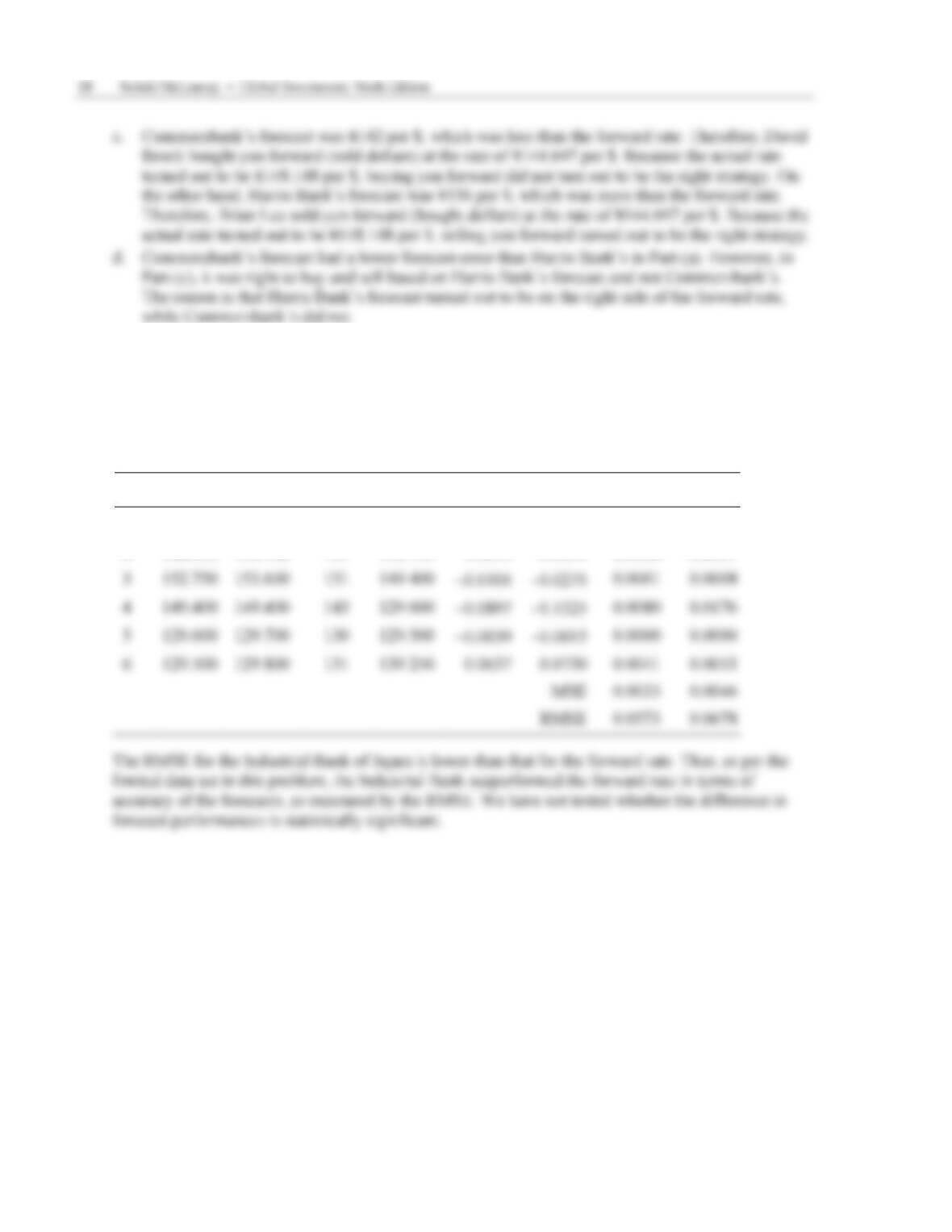
19. Let the forecasts made by the Industrial Bank of Japan at the beginning of period t for the beginning
of period t + 1 be E(St + 1|t). Let the forward rates quoted at the beginning of period t for the
beginning of period t + 1 be Ft, and the actual spot rates at the beginning of periods t and t + 1 be St
and St+1, respectively. The percentage forecast errors
(
and e) for each forecast made by the
Industrial Bank of Japan and the forward rate are computed as t+ = [St+1 − E(St +1|t)]/St and et+1 =
[St+1 − Ft]/St, respectively. The following table details the computations.
Pd.
St
Ft
E(St+1|t)
St+1
t +1
et
+
1
2t +1
e2t+1
1
143.164
142.511
140
144.300
0.0300
0.0125
0.0009
0.0002
2
144.300
143.968
141
152.750
0.0814
0.0609
0.0066
0.0037
6
129.500
129.800
131
139.250
0.0637
0.0730
0.0041
0.0053
0.0033
0.0046