(c) Suppose that the portfolio manager is managing the assets of a life insurance company
that has issued a five-year guaranteed investment contract (GIC). The interest rate that the
life insurance company has agreed to pay is 9% on a semiannual basis. Which of the two
bonds should the portfolio manager purchase to ensure that the GIC payments will be
satisfied and that a profit will be generated by the life insurance company?
7. Consider the following bond:
Coupon rate = 11%
Maturity = 18 years
Par value = $1,000
First par call in 13 years
Only put date in five years and putable at par value
(a) Show that the yield to maturity for this bond is 9.077%.
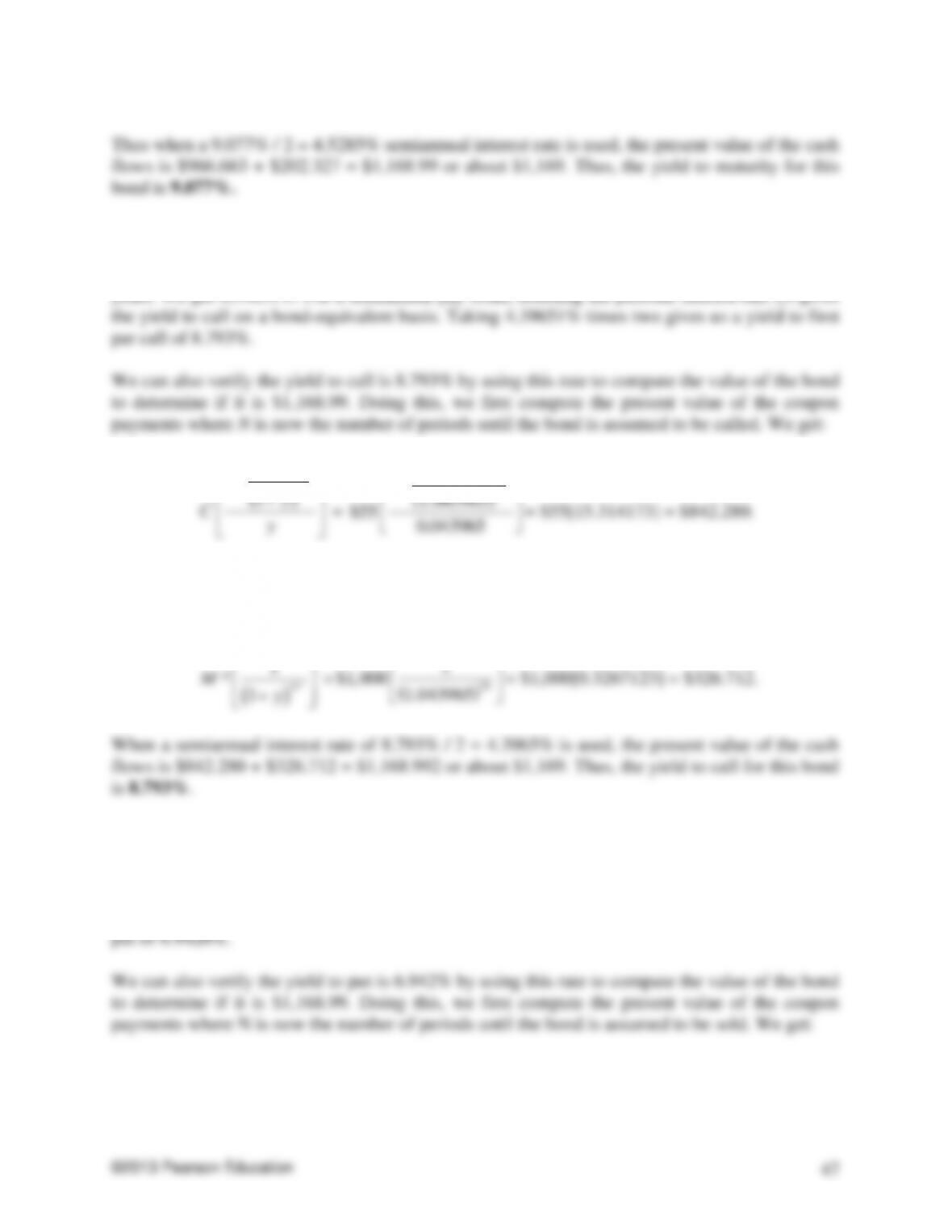
First of all, we compute the internal return based upon the cash flows if the bond is held to
maturity. We get 4.5385%. For a semiannual pay bond, doubling the periodic interest rate (y)
coupon payments where C is the annuity coupon payment and N is the number of periods. We
have:
( )
1
11N
y
C y
−
+
=
( )
36
1
1
1 .045385
$55 0.045385
−
=$55[17.57569] = $966.663.
We next compute the present value of the maturity value where M is the par value of $1,000.
We get:
( )
1
1N
M
y
+
=
( )
36
1
$1,000 1.045385
= $1,000[0.2023273] = $202.327.
(b) Show that the yield to first par call is 8.793%.
First of all, we compute the internal return based upon the cash flows if the bond is held for 13
years. We get 4.39651%. For a semiannual pay bond, doubling the periodic interest rate (y) gives
( )
1
11N
y
C y
−
+
=
26
1
1
(1 .043965)
$55 0.043965
−
= $55[15.314173] = $842.280.
We next compute the present value of the maturity value under the assumption it will be called in
13 years where M is now M* (which is the call price in dollars), and n is now n* (which is the
number of periods until the assumed call date, e.g., number of years times 2). We get:
( )
*
1
*1N
M
y
+
=
( )
26
1
$1,000 1.043965
= $1,000[0.3267123] = $326.712.
(c) Show that the yield to put is 6.942%.
First of all, we compute the internal return based upon the cash flows if the bond is held for
5 years. We get 3.4710%. For a semiannual pay bond, doubling the periodic interest rate (y)
gives the yield to put on a bond-equivalent basis. Taking 3.4710% times two gives us a yield to
( )
1
11N
y
C
y
−
+
=
10
1
1
(1 .03471)
$55
0. 03471
−
= $55[8.328775] = $458.083.
(d) Suppose that the call schedule for this bond is as follows:
Can be called in eight years at $1,055
Can be called in 13 years at $1,000
And suppose this bond can only be put in five years and assume that the yield to first par
call is 8.535%.What is the yield to worst for this bond?
A practice in the industry is for an investor to calculate the yield to maturity, the yield to every
possible call date, and the yield to every possible put date. The minimum of all of these yields is
8. Answer the below questions.
(a) What is meant by an amortizing security?
Amortized securities are fixed income securities whose cash flows include scheduled principal
repayments prior to maturity. That is, the cash flow in each period includes interest plus principal
repayment.
(b) What are the three components of the cash flow for an amortizing security?
As stated in part (a), an amortizing security includes both interest plus principal repayment.
However, we must also note that the amount the borrower can repay in principal may exceed the
©2013 Pearson Education
49
scheduled amount. This excess amount of principal repayment over the amount scheduled is
called a prepayment. Thus, for amortizing securities, the cash flow each period consists of three
components: (1) coupon interest, (2) scheduled principal repayment, and (3) prepayments.
(c) What is meant by a cash flow yield?
For amortizing securities, market participants calculate a cash flow yield. It is the interest rate
9. How is the internal rate of return of a portfolio calculated?
The yield for a portfolio of bonds is not simply the average or weighted average of the yield to
maturity of the individual bond issues in the portfolio. It is computed by determining the cash
( ) ( ) ( ) ( )
1 2 3
1 1 1 1+ + + +
N
y y y y
This expression can be rewritten in shorthand notation as
=1
= (1 + )
N
t
t
t
CF
Py
whereCFt= cash flows from all investments in the portfolio for year t, P = price of the investment
(or present value of the portfolio’s cash flows), N = number of years, and y is the yield or internal
rate of return.
Years from
Now
Promised Annual Payments
(Cash Flow to Investor)
1
$100
2
$100
3
$100
4
$1,000
To compute the portfolio internal rate of return, different interest rates must be tried until the
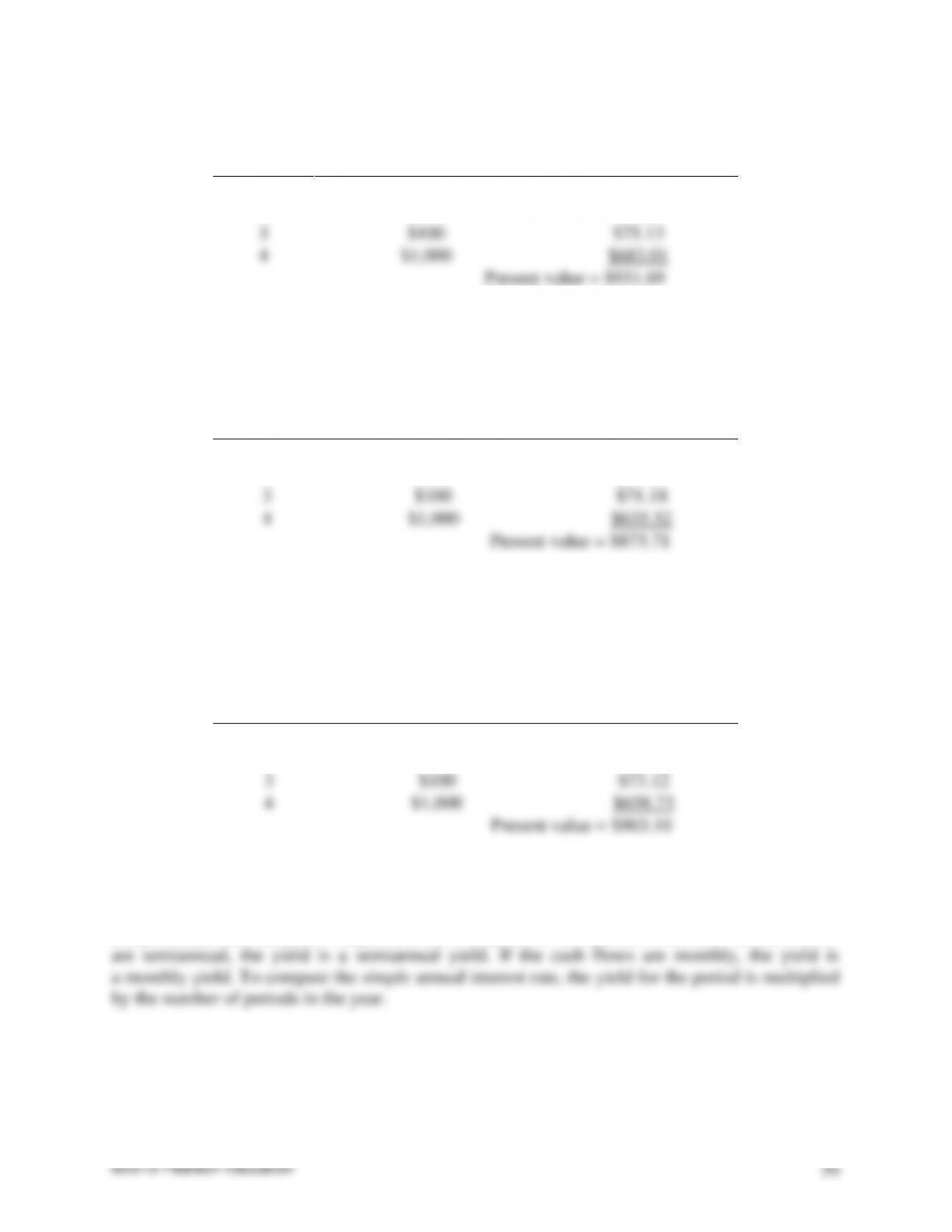
Years from
Now
Promised Annual Payments
(Cash Flow to Investor)
Present Value
of Cash Flow at 10%
1
$100
$90.91
2
$100
$82.64
3
$100
$75.13
4
$1,000
$683.01
Present value = $931.69
Because the present value computed using a 10% interest rate exceeds the price of $903.10,
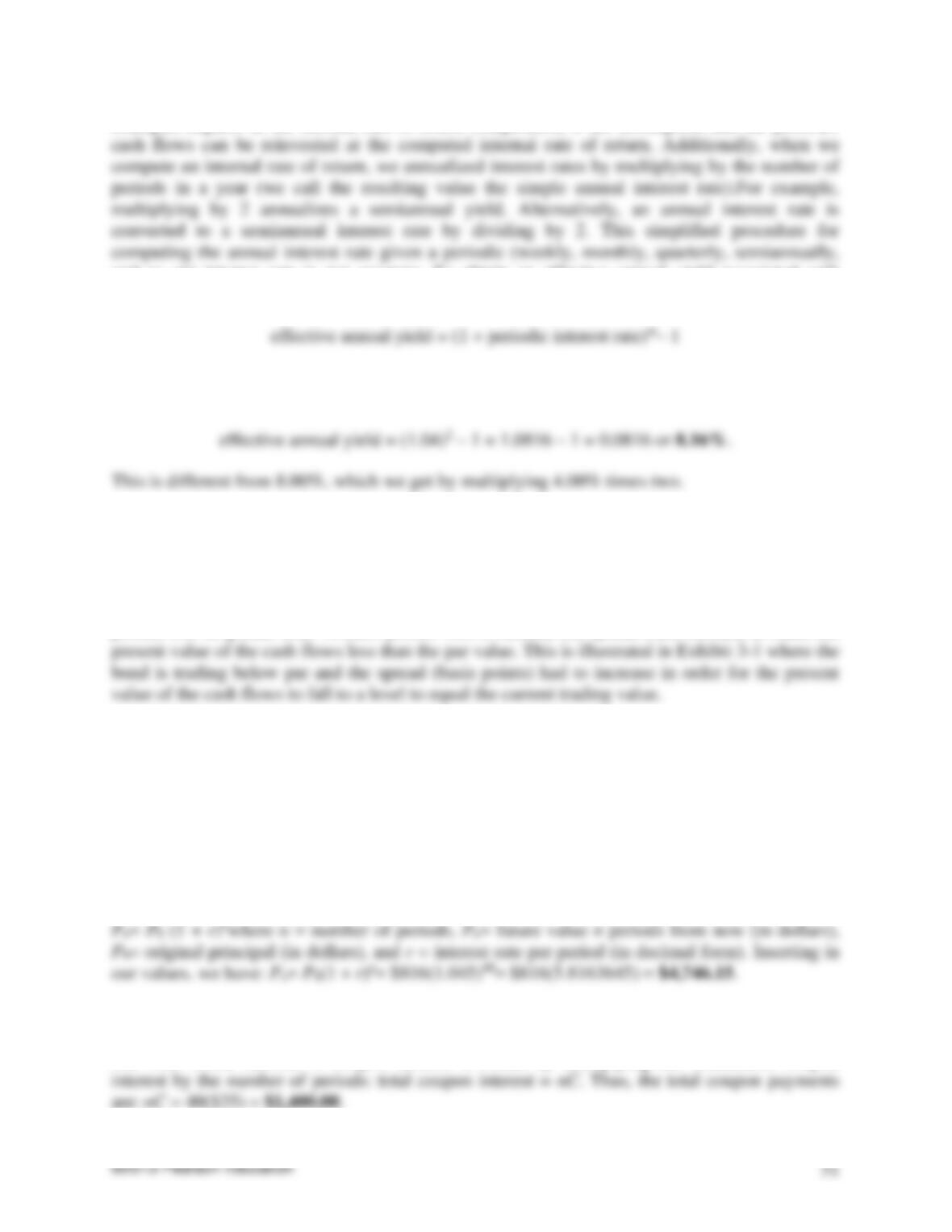
a higher interest rate must be used, to reduce the present value. If a 12% interest rate is used, the
present value is $875.71, computed as follows:
Years from
Now
Promised Annual Payments
(Cash Flow to Investor)
Present Value
of Cash Flow at 12%
1
$100
$89.29
2
$100
$79.72
3
$100
$71.18
4
$1,000
$635.52
Present value = $875.71
Using 12%, the present value of the cash flow is less than the price of the financial instrument.
Therefore, a lower interest rate must be tried, to increase the present value. Using an 11%
interest rate:
Years from
Now
Promised Annual
Payments
(Cash Flow to Investor)
Present Value
of Cash Flow at 11%
1
$100
$90.09
2
$100
$81.16
3
$100
$73.12
4
$1,000
$658.73
Present value = $903.10
Using 11%, the present value of the cash flow is equal to the price of the portfolio. Therefore, the
yield is 11%.
Keep in mind that the yield computed is now the yield for the period. That is, if the cash flows
10. What is the limitation of using the internal rate of return of a portfolio as a measure of
the portfolio’s yield?
The limitation lies in the assumption about how the periodic cash flows will be invested. For
example, implicit in the internal rate of return computation is the assumption that the portfolio
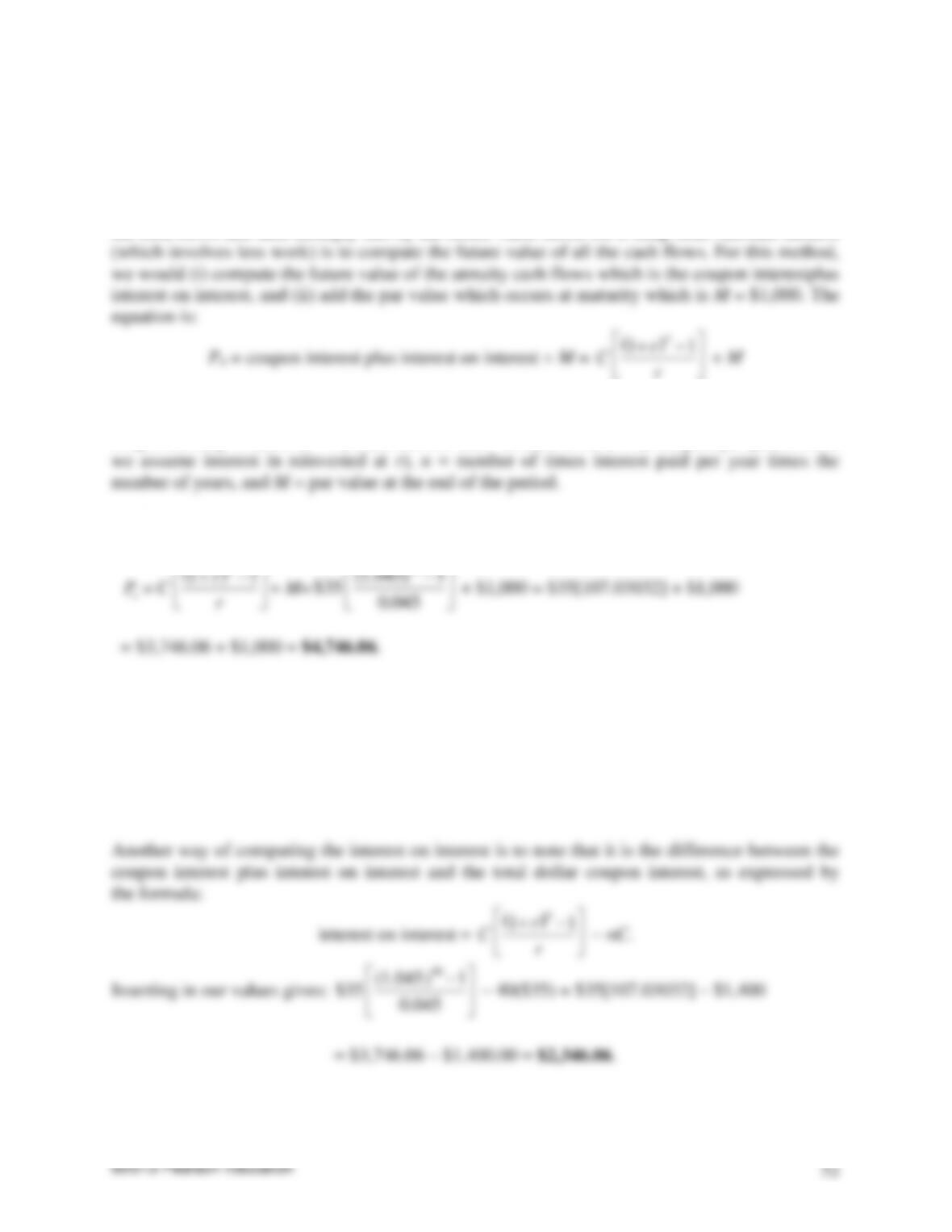
and so on) interest rate is not accurate. To obtain an effective annual yield associated with
a periodic interest rate, the following formula is used:
where m is the frequency of payments per year. For example, suppose that the periodic interest
rate is 4% and the frequency of payments is twice per year. Inserting in the values we get:
11. Suppose that the coupon rate of a floating-rate security resets every six months at
a spread of 70 basis points over the reference rate. If the bond is trading at below par
value, explain whether the discount margin is greater than or less than 70 basis points.
If the bond is trading below par value, then the discount margin or assumed annual spread (basis
points) will be greater than 70 basis points. This is because the spread must increase to make the
12. An investor is considering the purchase of a 20-year 7% coupon bond selling for $816
and a par value of $1,000. The yield to maturity for this bond is 9%.
Answer the below questions.
(a) What would be the total future dollars if this investor invested $816 for 20 years earning
9% compounded semiannually?
To determine the future value of any sum of money invested today, we use the below equation:
(b) What are the total coupon payments over the life of this bond?
The total dollar amount of coupon interest is found by multiplying the semiannual coupon
(c) What would be the total future dollars from the coupon payments and the repayment of
principal at the end of 20 years?
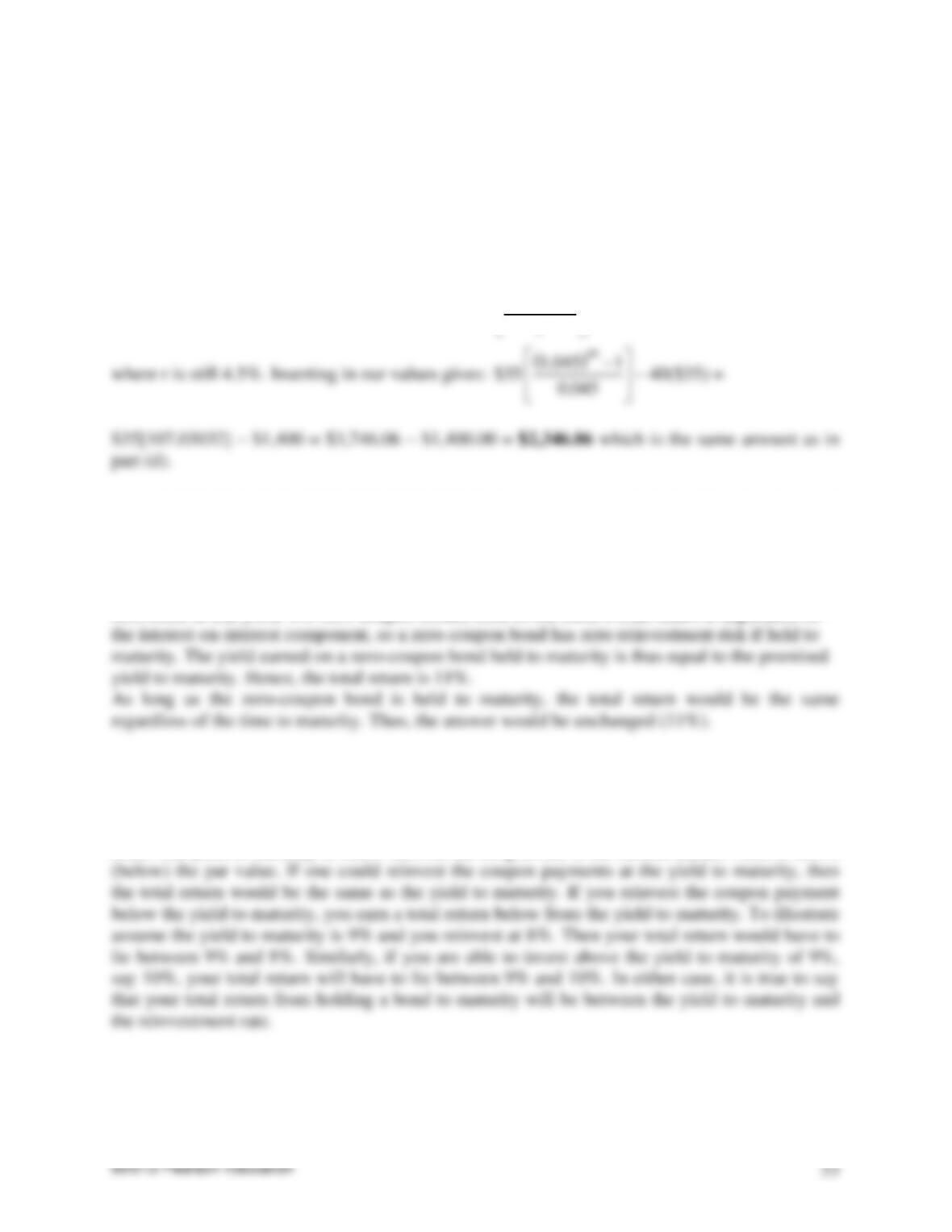
There are several ways to approach this problem. One method is to compute the present value of
the cash flows and then multiply this by the future value factor for a lump sum. Another method
r
where Pn is the future value of all cash flows at time N, C is the amount of the semiannual
coupon annuity in dollars, r = annual interest rate / number of times interest paid per year (where
Using this formula and inserting our values, we have:
(d) For the bond to produce the same total future dollars as in part (a), how much must the
interest on interest be?
We can note that the future value of the interest payment just computed in part (c) is $3,746.06
and the coupon payments over the life of the bond computed in part (b) is $1,400. The different
is the interest on interest, which is $2,346.06.
( )
11
n
n
r
P = C r
+−
+ M=
40
(1.045 1
)
$35
0.045
−
+ $1,000 = $35[107.03032] + $1,000
= $3,746.06 + $1,000 = $4,746.06.
(e) Calculate the interest on interest from the bond assuming that the semiannual coupon
payments can be reinvested at 4.5% every six months and demonstrate that the resulting
amount is the same as in part (d).
Since the computation assumes interest on interest is invested at 4.5% we have the same
computation given in part (d) where the yield to maturity of 4.5% was used in computation. Once
again, we have:
interest on interest =
( )
11
n
r
C r
+−
– nC
( )
40
1.045 1
−
13. What is the total return for an 8-year zero-coupon bond that is offering a yield to
maturity of 11% if the bond is held to maturity? Would the answer be changed if the time
to maturity is increased from 8 years to 20 years?
For a bond held to maturity, the total return is equal to the yield to maturity if the coupons can be
reinvested at that yield. For zero-coupon bonds, none of the bond’s total return is dependent on
14. Explain why the total return from holding a bond to maturity will be between the yield
to maturity and the reinvestment rate.
The yield to maturity is based upon the coupon payments and the current market value of the
bond. The yield to maturity is below (above) the coupon rate if the current market value is above
15. For a long-term high-yield coupon bond, do you think that the total return from
holding a bond to maturity will be closer to the yield to maturity or the reinvestment rate?
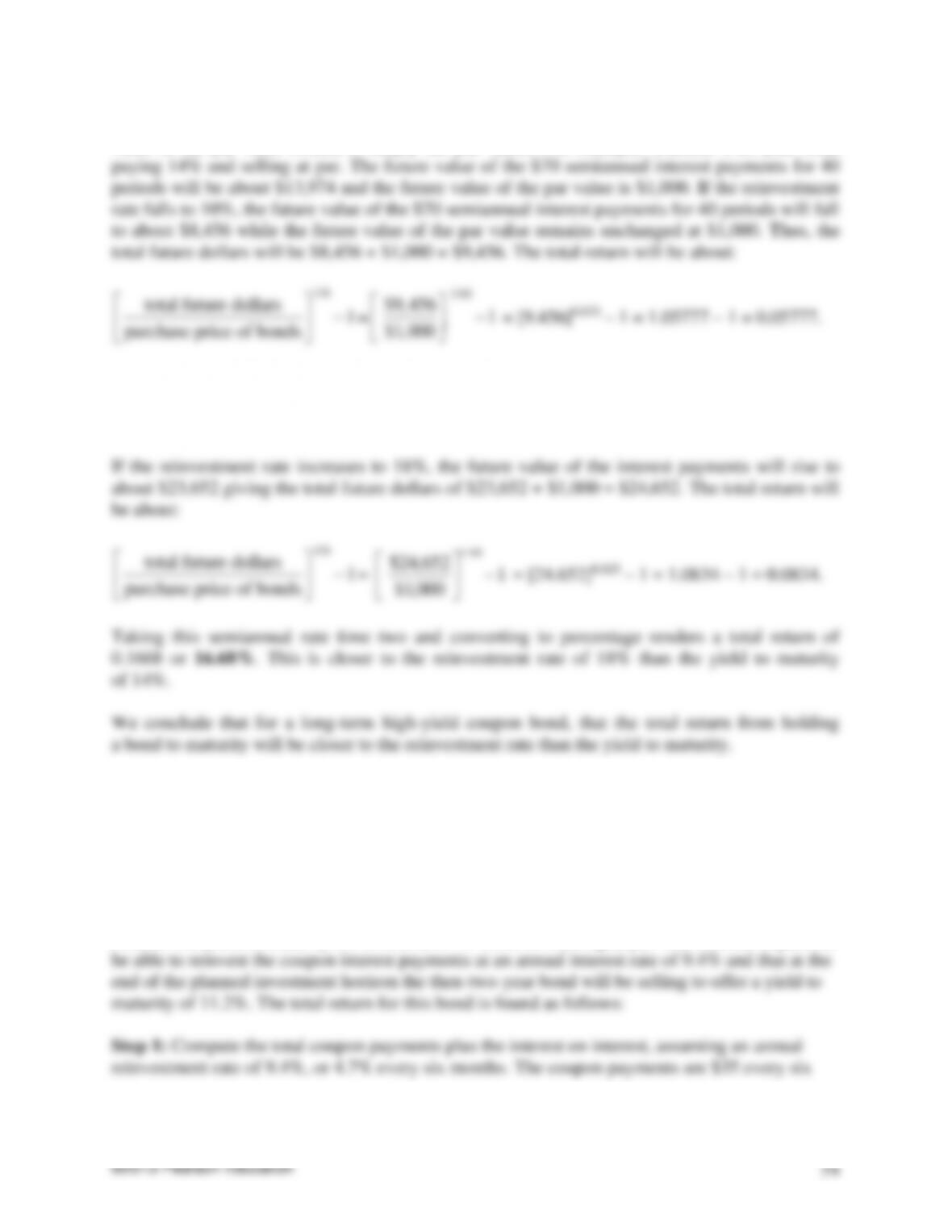
For a longer term bond the future value of the coupon payments will be greater than the future
value of the par value (which is simply the par value). For example, consider a 20-year bond
purchase price of bonds
$1,000
Taking this semiannual rate time two and converting to percentage renders a total return of about
0.1155 or about 11.55%. This is closer to the reinvestment rate of 10% than the yield to maturity
of 14%.
16. Suppose that an investor with a five-year investment horizon is considering purchasing
a seven-year 7% coupon bond selling at par. The investor expects that he can reinvest the
coupon payments at an annual interest rate of 9.4% and that at the end of the investment
horizon two-year bonds will be selling to offer a yield to maturity of 11.2%. What is the
total return on this investment?
The investor has a five-year investment horizon and purchases a seven-year 7% coupon bond for
$1,000. The yield to maturity for this bond is 7% since it is selling at par. The investor expects to
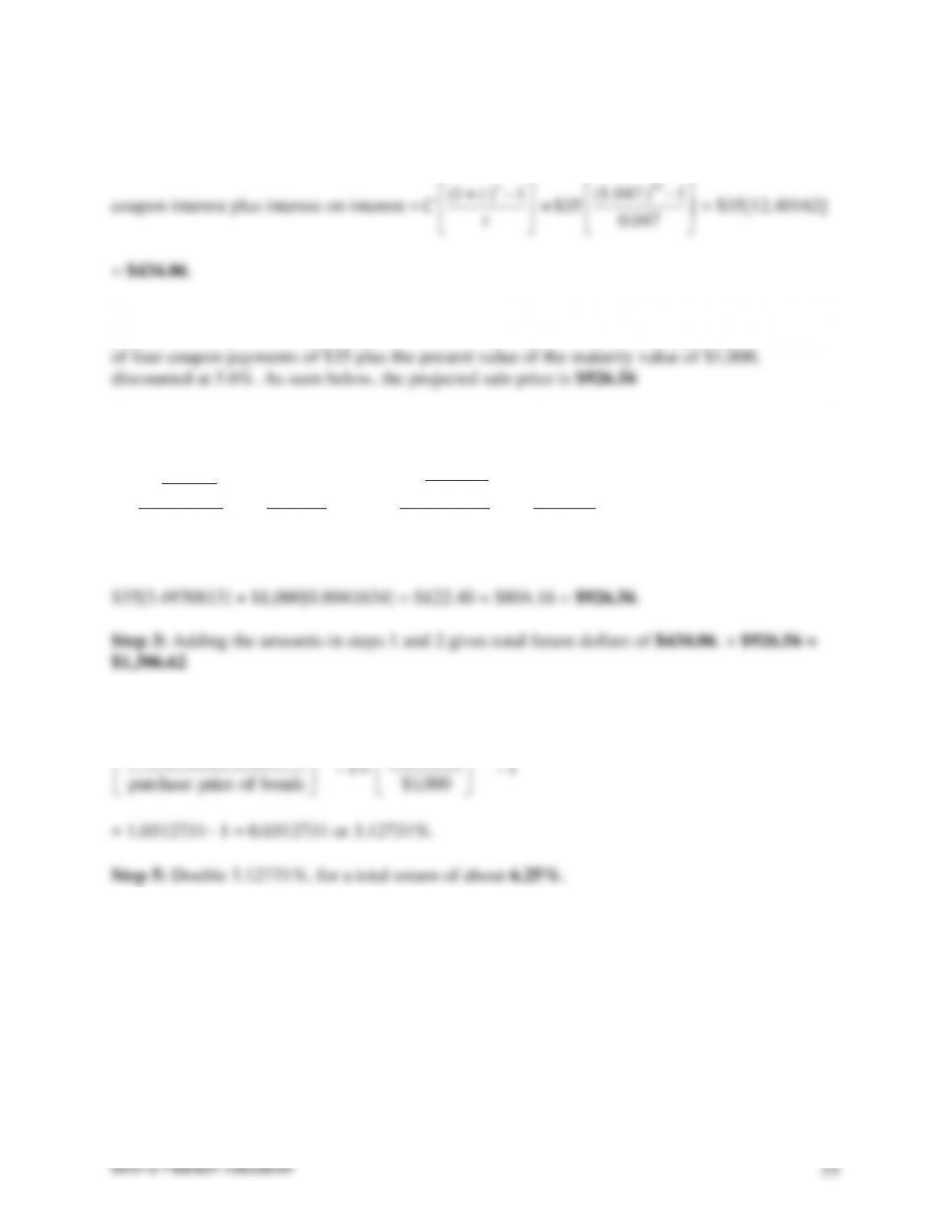
months for five years or ten periods (the planned investment horizon). Applying equation (3.7),
the total coupon interest plus interest on interest is
1
)
r + (1
n
−
1
)
047. (1
10
−
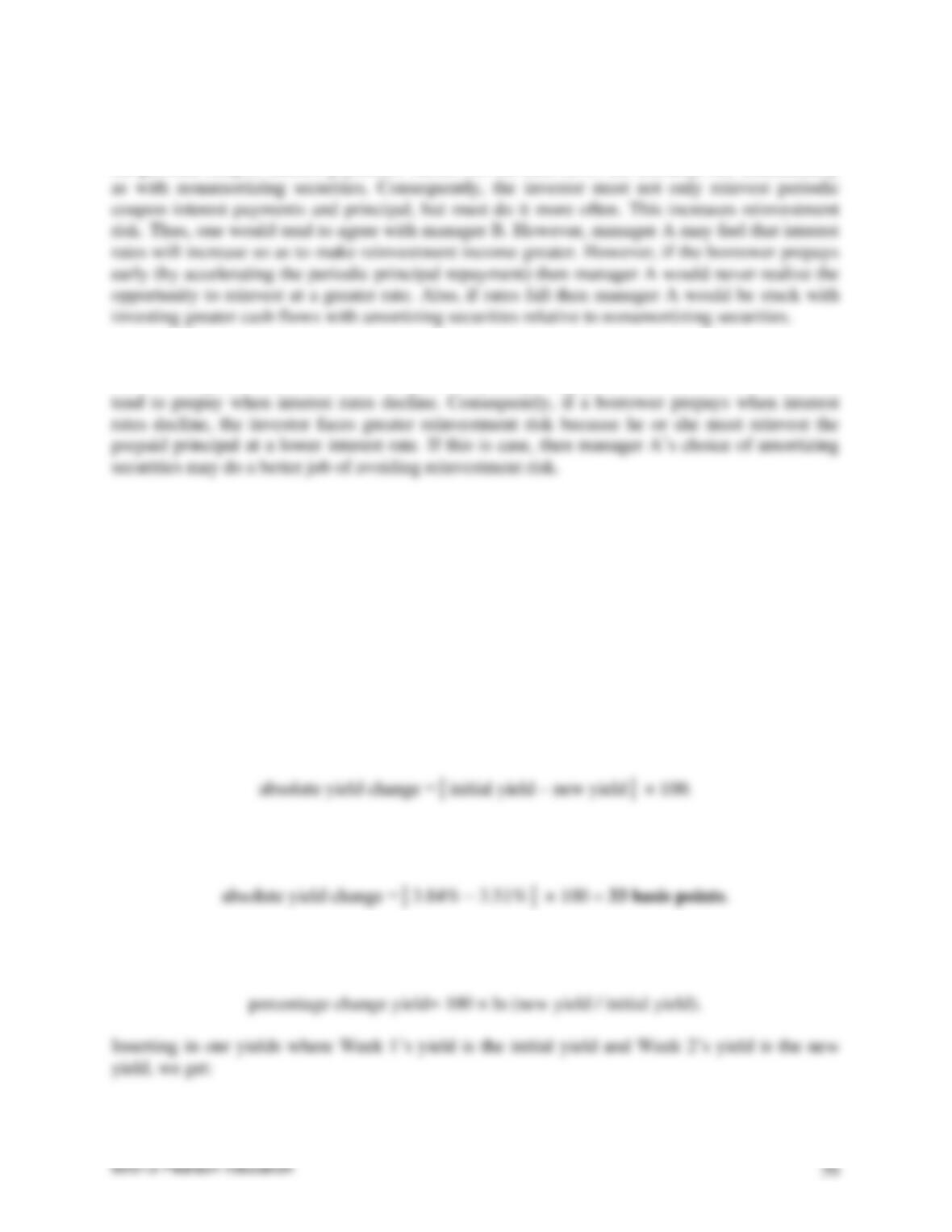
Step 2: Determining the projected sale price at the end of five years, assuming that the required
yield to maturity for two-year bonds is 11.2%, is accomplished by calculating the present value
projected sale price = present value of coupon payments + present value of par value =
( )
1
11n
r
C
r
−
+
+
1n
M
( + r )
=
( )
056.0
056.1
1
1
35$
4
−
+
4
$1,000
(1.056)
=
Step 4: To obtain the semiannual total return, compute the following:
dollars future total
/1
h
62.360,1$
10/1
For amortizing securities, reinvestment risk is even greater than for nonamortizing securities.
The reason is that the investor must now reinvest the periodic principal repayments in addition to
the periodic coupon interest payments. Moreover, the cash flows are monthly, not semiannually
In regard to accelerating the periodic principal repayment, nonamortizing securities typically
allow for a greater acceleration of the periodic principal repayment for the borrower who will
18. Assuming the following yields:
Week 1: 3.84%
Week 2: 3.51%
Week 3: 3.95%
Answer the below questions.
(a) Compute the absolute yield change and percentage yield change from week 1 to week 2.
The absolute yield change (or absolute rate change) is measured in basis points and is the
absolute value of the difference between the two yields as given by
Inserting in our yields where Week 1’s yield is the initial yield and Week 2’s yield is the new
yield, we get:
The percentage change is computed as the natural logarithm of the ratio of the change in yield as
shown by

©2013 Pearson Education
57
percentage change yield= 100 × ln (3.51% / 3.84%) = −8.99%.
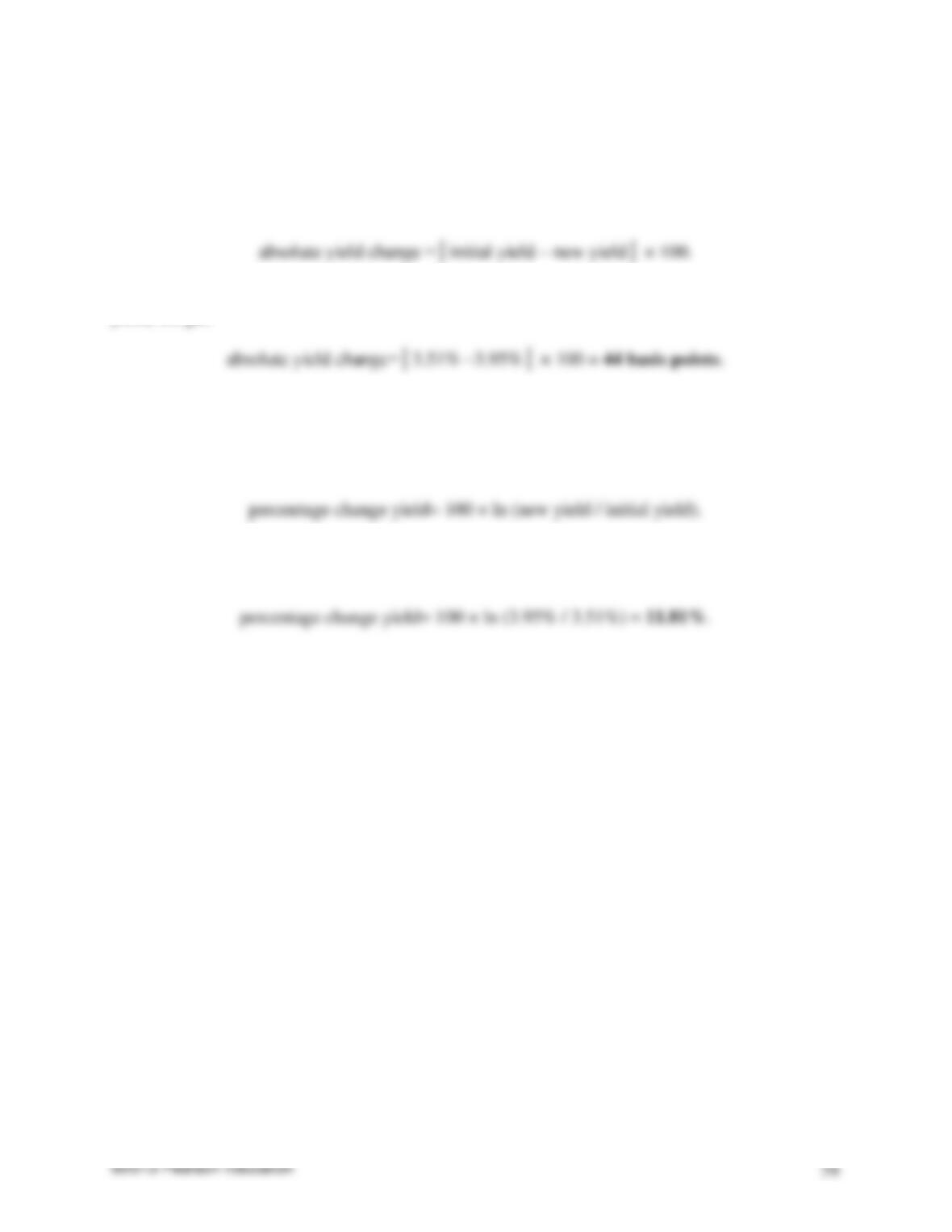
(b) Compute the absolute yield change and percentage yield change from week 2 to week 3.
The absolute yield change (or absolute rate change) is measured in basis points and is the
absolute value of the difference between the two yields as given by
Inserting in our yields where Week 2’s yield is the initial yield and Week 3’s yield is the new
yield, we get:
We see that there has been a greater change in basis point compared to (a).
The percentage change is computed as the natural logarithm of the ratio of the change in yield as
shown by
Inserting in our yields where Week 2’s yield is the initial yield and Week 3’s yield is the new
yield, we get:
We see that unlike part (a), the percentage change yield has now increased. Keep in mind that
these are weekly percentage changes and if annualized they would be extraordinarily large.