CHAPTER 3
MEASURING YIELD
CHAPTER SUMMARY
In Chapter 2 we showed how to determine the price of a bond, and we described the relationship
between price and yield. In this chapter we discuss various yield measures and their meaning for
evaluating the relative attractiveness of a bond. We begin with an explanation of how to compute
the yield on any investment.
COMPUTING THE YIELD OR INTERNAL RATE OF RETURN
ON ANY INVESTMENT
The yield on any investment is the interest rate that will make the present value of the cash flows
from the investment equal to the price (or cost) of the investment.
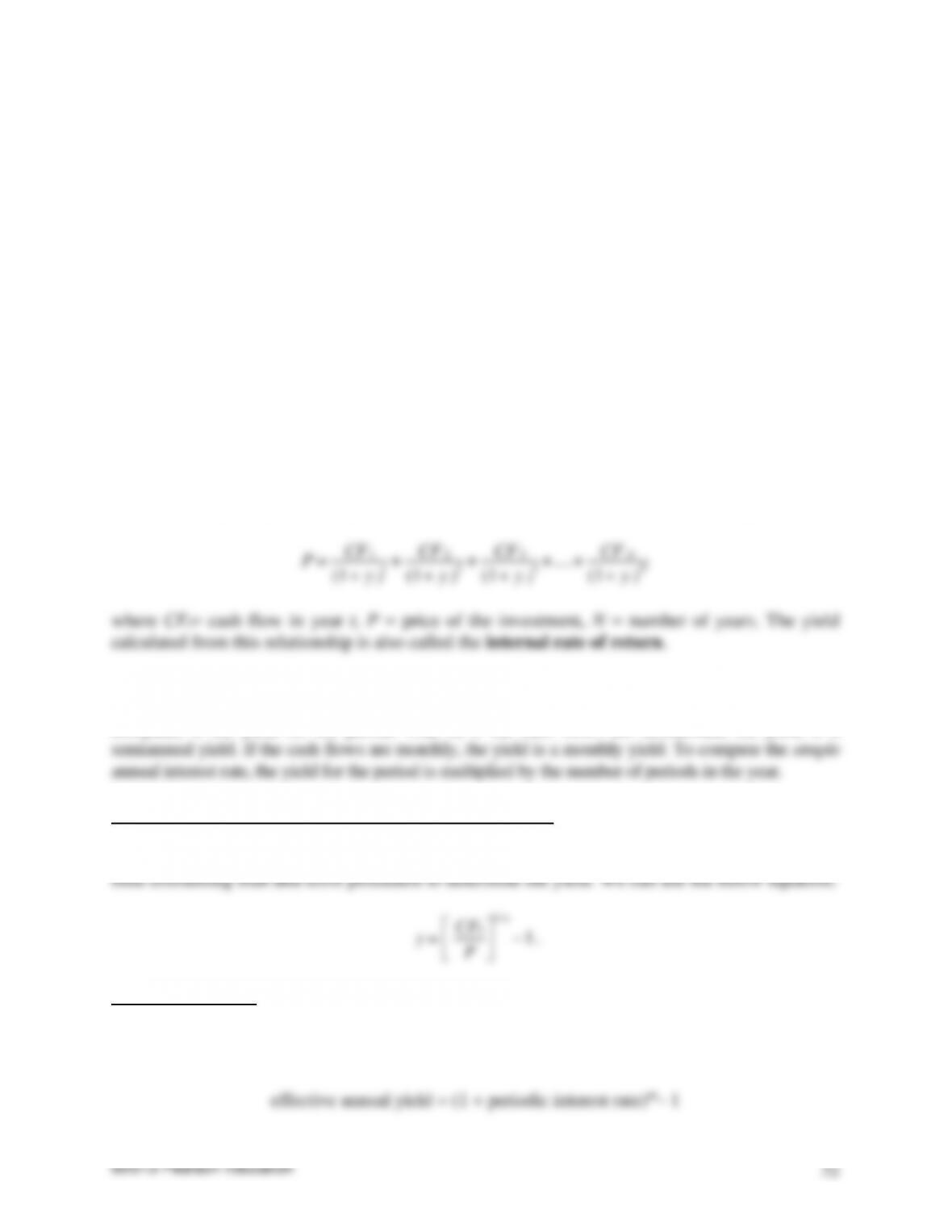
Mathematically, the yield on any investment, y, is the interest rate that satisfies the equation.
Solving for the yield (y) requires a trial-and-error (iterative) procedure. The objective is to find the
yield that will make the present value of the cash flows equal to the price. Keep in mind that the yield
computed is the yield for the period. That is, if the cash flows are semiannual, the yield is a
Special Case: Investment with Only One Future Cash Flow
When the case where there is only one future cash flow, it is not necessary to go through the
P
Annualizing Yields
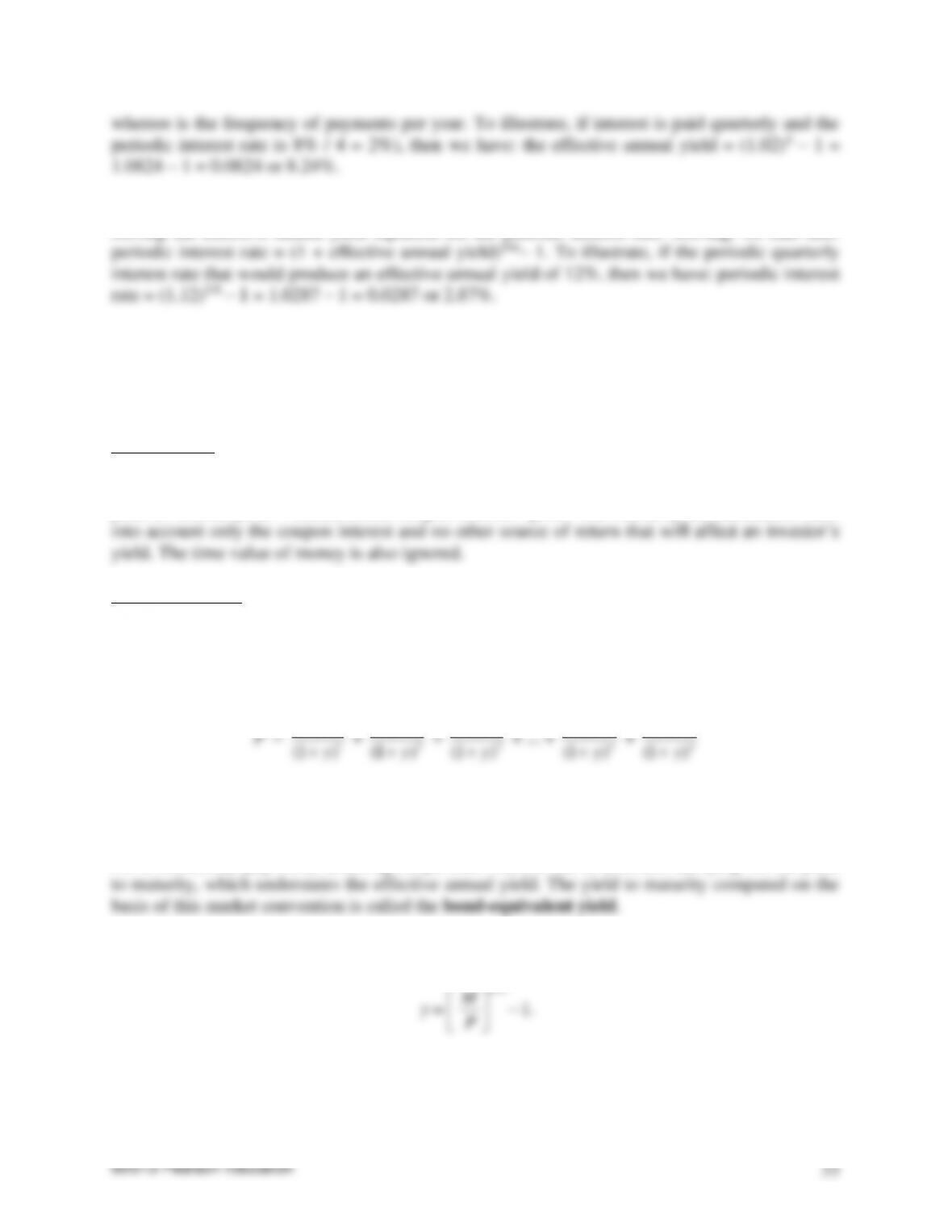
To obtain an effective annual yield associated with a periodic interest rate, the following formula
is used:
©2013 Pearson Education
33
wherem is the frequency of payments per year. To illustrate, if interest is paid quarterly and the
periodic interest rate is 8% / 4 = 2%), then we have: the effective annual yield = (1.02)4 – 1 =
1.0824 – 1 = 0.0824 or 8.24%.
We can also determine the periodic interest rate that will produce a given annual interest rate by
solving the effective annual yield equation for the periodic interest rate. Solving, we find that:
CONVENTIONAL YIELD MEASURES
There are several bond yield measures commonly quoted by dealers and used by portfolio
managers. These are described below.
Current Yield
Current yield relates the annual coupon interest to the market price. The formula for the current
yield is: current yield = annual dollar coupon interest / price. The current yield calculation takes
Yield to Maturity
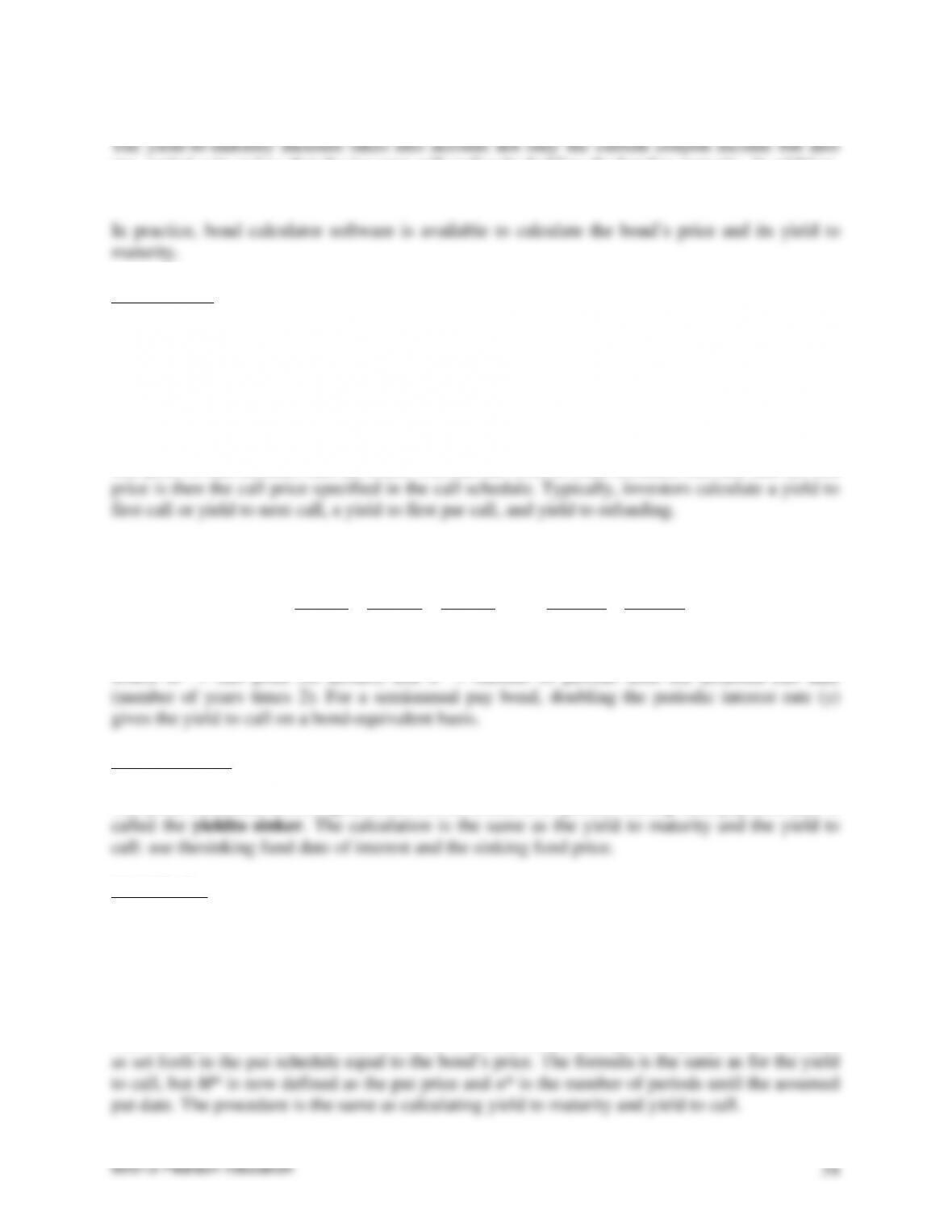
The yield to maturityis the interest rate that will make the present value of the cash flows equal
to the price (or initial investment). For a semiannual pay bond, the yield to maturity is found by
first computing the periodic interest rate, y, which satisfies the relationship:
1 2 3
+ + + … + +
(1 ) (1 ) (1 ) (1 ) (1 )
nn
C C C C M
Py y y y y
=+ + + + +
where P = price of the bond, C = semiannualcoupon interest (in dollars), M = maturity value (in
dollars), and n = number of periods (number of years × 2).
For a semiannual pay bond, doubling the periodic interest rate or discount rate (y) gives the yield
It is much easier to compute the yield to maturity for a zero-coupon bond because we can use:
/1
P
M
n
any capital gain or loss that the investor will realize by holding the bond to maturity. In addition,
the yield to maturity considers the timing of the cash flows.
Yield To Call
The price at which the bond may be called is referred to as the call price. For some issues, the
call price is the same regardless of when the issue is called. For other callable issues, the call
price depends on when the issue is called. That is, there is a call schedule that specifies a call
price for each call date.
For callable issues, the practice has been to calculate a yield to call as well as a yield to maturity.
The yield to call assumes that the issuer will call the bond at some assumed call date and the call
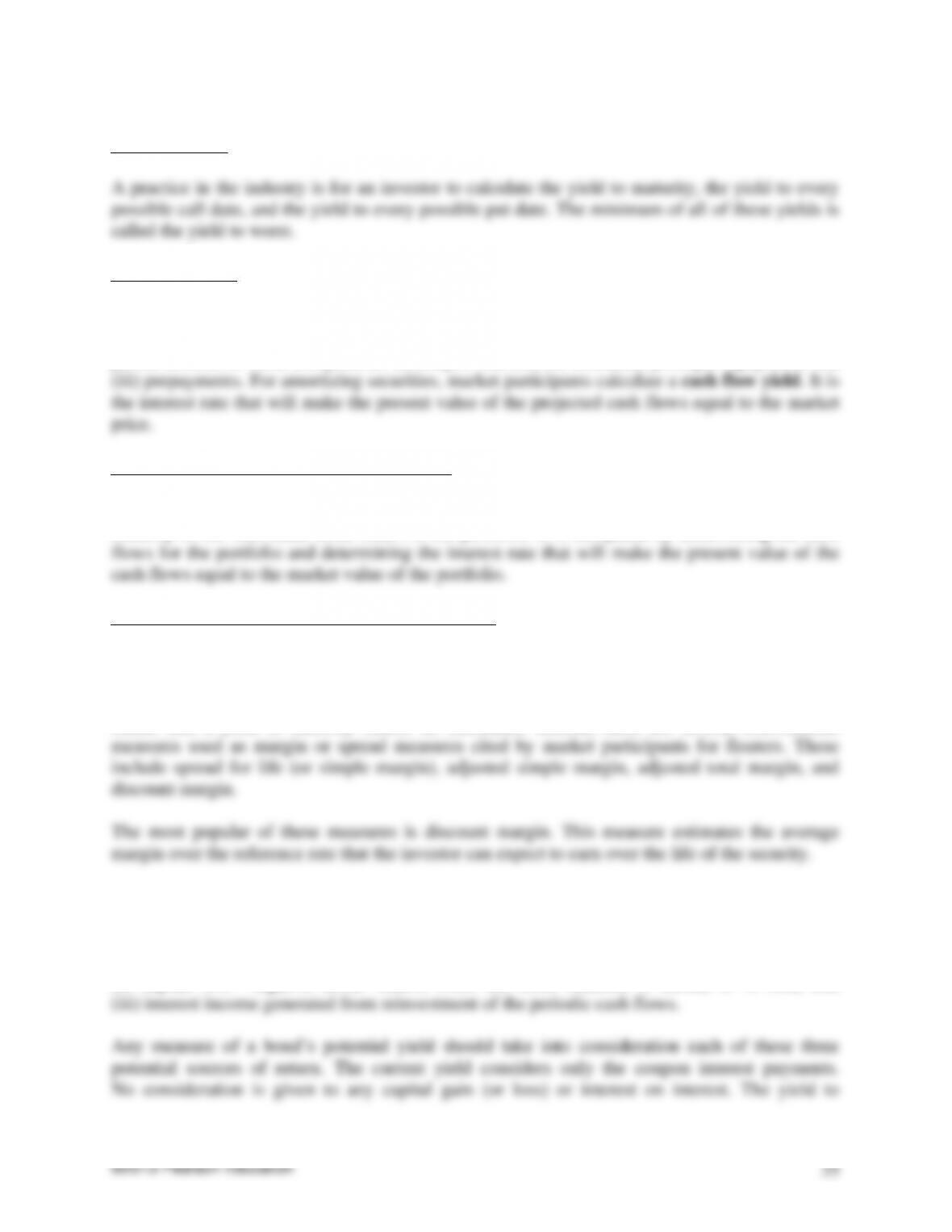
Mathematically, the yield to call can be expressed as follows:
P =
( ) ( ) ( ) ( ) ( )
1 2 3
*
1 1 1 1 1
n* n*
C C C C M
+ + + . . .+ +
y y y y y+ + + + +
where M* = call price (in dollars) and n* = number of periods until the assumed call date
Yield To Sinker
The yield calculated assumingthe bond will be retired at a specific sinking fund payment date is
Yield To Put
If an issue is putable, it means that the bondholder can force the issuer to buy the issue at
a specified price. As with a callable issue, a putable issue can have a put schedule. The schedule
specifies when the issue can be put and the price, called the put price.
When an issue is putable, a yield to put is calculated. The yield to put is the interest rate that
makes the present value of the cash flows to the assumed put date plus the put price on that date
Yield To Worst
Cash Flow Yield
Some fixed income securities involve cash flows that include interest plus principal repayment.
Such securities are called amortizing securities. For amortizing securities, the cash flow each
period consists of three components: (i) coupon interest, (ii) scheduled principal repayment, and
Yield (Internal Rate of Return) for a Portfolio
The yield for a portfolio of bonds is not simply the average or weighted average of the yield to
maturity of the individual bond issues in the portfolio. It is computed by determining the cash
Yield Spread Measures for Floating-Rate Securities
The coupon rate for a floating-rate security changes periodically based on the coupon reset
formula. This formula consists of the reference rate and the quoted margin. Since the future
value for the reference rate is unknown, it is not possible to determine the cash flows. This
means that a yield to maturity cannot be calculated. Instead, there are several conventional
POTENTIAL SOURCES OF A BOND’S DOLLAR RETURN
An investor who purchases a bond can expect to receive a dollar return from one or more of
these sources: (i) the periodic coupon interest payments made by the issuer, (ii) any capital gain
(or capital loss—negative dollar return) when the bond matures, is called, or is sold, and
maturity takes into account coupon interest and any capital gain (or loss). It also considers the
interest-on-interest component. Implicit in the yield-to-maturity computation is the assumption
that the coupon payments can be reinvested at the computed yield to maturity.
The yield to call also takes into account all three potential sources of return. In this case, the
assumption is that the coupon payments can be reinvested at the yield to call. Therefore, the
Determining the Interest-On-Interest Dollar Return
The interest-on-interest component can represent a substantial portion of a bond’s potential
return. The coupon interest plus interest on interest can be found by using the following
equation:
( )
11
n
r
C r
+−
where r denotes the semiannual reinvestment rate.
The total dollar amount of coupon interest is found by multiplying the semiannual coupon
interest by the number of periods: total coupon interest = nC
r
Yield To Maturity and Reinvestment Risk
The investor will realize the yield to maturity at the time of purchase only if the bond is held to
maturity and the coupon payments can be reinvested at the computed yield to maturity. The risk
that the investor faces is that future reinvestment rates will be less than the yield to maturity at
the time the bond is purchased. This risk is referred to as reinvestment risk.
the time of purchase. In other words, the longer the maturity, the greater the reinvestment risk.
For a given maturity and a given yield to maturity, higher coupon rates will make the bond’s
Cash Flow Yield and Reinvestment Risk
TOTAL RETURN
In the preceding section we explain that the yield to maturity is a promised yield. At the time of
purchase an investor is promised a yield, as measured by the yield to maturity, if both of the
The total return is a measure of yield that incorporates an explicit assumption about the
reinvestment rate.
Computing the Total Return for a Bond
The idea underlying total return is simple. The objective is first to compute the total future
dollars that will result from investing in a bond assuming a particular reinvestment rate. The total
APPLICATIONS OF THE TOTAL RETURN (HORIZON ANALYSIS)
Using total return to assess performance over some investment horizon is called horizon
analysis. When a total return is calculated over an investment horizon, it is referred to as
a horizon return.
An often-cited objection to the total return measure is that it requires the portfolio manager to
CALCULATING YIELD CHANGES
The absolute yield change (or absolute rate change) is measured in basis points and is the
absolute value of the difference between the two yields as given by
absolute yield change =│initial yield – new yield│ × 100.
The percentage change is computed as the natural logarithm of the ratio of the change in yield as
shown by
KEY POINTS
• For any investment, the yield or internal rate of return is the interest rate that will make the
present value of the cash flows equal to the investment’s price (or cost). The same procedure
• The conventional yield measures commonly used by bond market participants are the current
yield, yield to maturity, yield to call, yield to sinker, yield to put, yield to worst, and cash flow
yield.
• The three potential sources of dollar return from investing in a bond are coupon interest,
reinvestment income, and capital gain (or loss).
• The risk that the coupon payments will be reinvested at a rate less than the yield to maturity is
called reinvestment risk. The yield to call has the same shortcoming; it assumes that the
coupon interest can be reinvested at the yield to call. The cash flow yield makes the same
ANSWERS TO QUESTIONS FOR CHAPTER 3
(Questions are in bold print followed by answers.)
1. A debt obligation offers the following payments:
Years from Now
Cash Flow to Investor
1
$1,000
2
$2,000
3
$2,500
4
$4,000
Suppose that the price of this debt obligation is $6,809. What is the yield or internal rate of
return offered by this debt obligation?
The yield on any investment is the interest rate that will make the present value of the cash flows
from the investment equal to the price (or cost) of the investment.
Mathematically, the yield on any investment, y, is the interest rate that satisfies the equation:
P =
( ) ( ) ( ) ( )
1 2 3
1 2 3
1 1 1 1
N
N
CF
CF CF CF
+ + + . . .+
+ y + y + y + y
where CFt = cash flow in period t, P = price of the investment, and N = number of periods. The
yield calculated from this relationship is also called the internal rate of return. To solve for the
yield (y), we can use a trial-and-error (iterative) procedure. The objective is to find the interest
Years from Now
Promised Annual Payments
(Cash Flow to Investor)
Present Value
of Cash Flow at 10%
1
$1,000
$909.09
2
$2,000
$1,652.89
3
$2,500
$1,878.29
4
$4,000
$2,732.05
Present value = $7,172.32
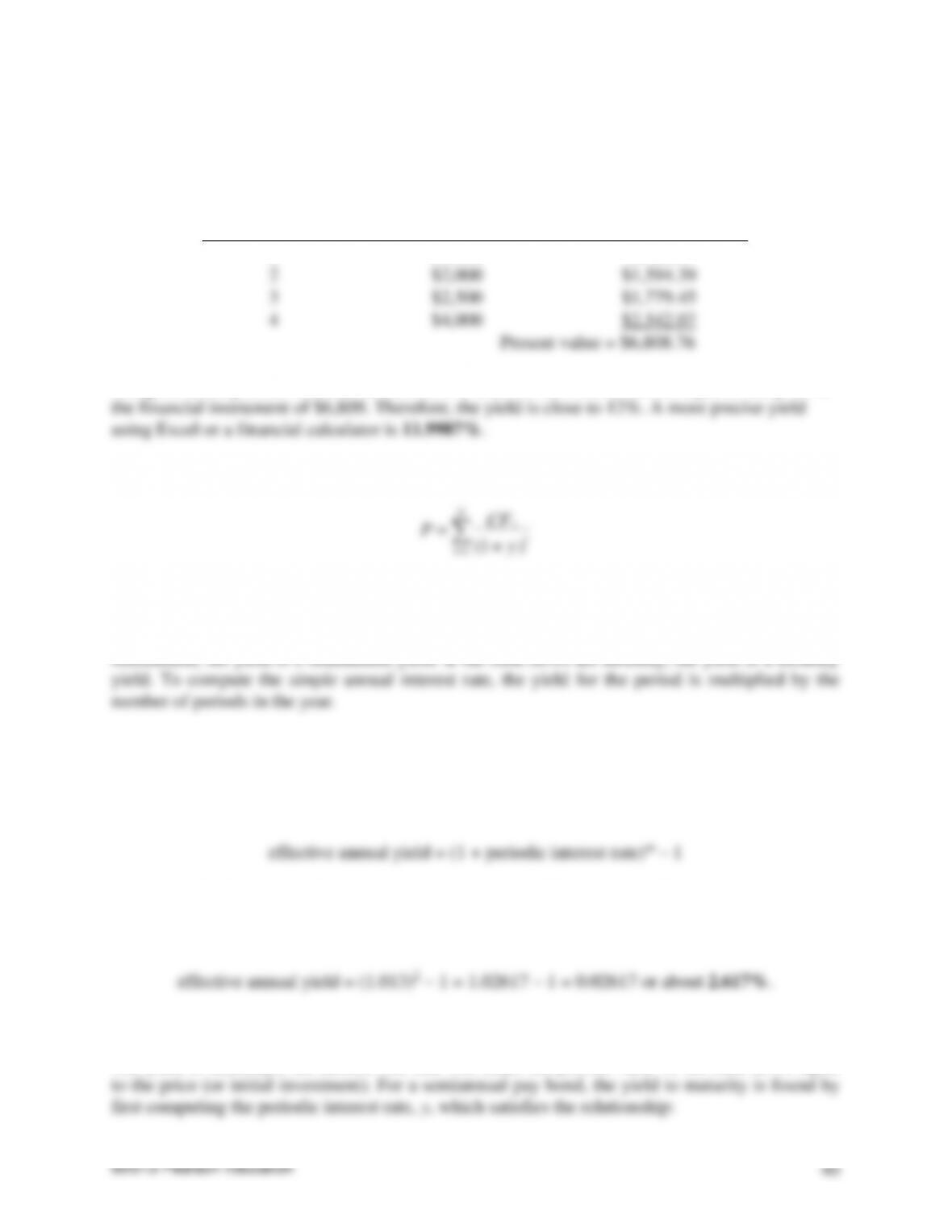
Because the present value of $7,172.32 computed using a 10% interest rate exceeds the price of
$6,809, a higher interest rate must be used, to reduce the present value. Trying an annual interest
rate of 12% gives the following present value:
Years from Now
Promised Annual Payments
(Cash Flow to Investor)
Present Value
of Cash Flow at 12%
1
$1,000
$892.86
2
$2,000
$1,594.39
3
$2,500
$1,779.45
4
$4,000
$2,542.07
Present value = $6,808.76
Using 12%, the present value of the cash flow is $6,808.76, which is almost equal to the price of
Another way to write the formula for determining the yield is
)
+ (1
= t
t
1=t y
CF
P
N
where CFt = cash flow in period t, and N = number of periods.
Keep in mind that the yield computed is the yield for the period. That is, if the cash flows are
semiannual, the yield is a semiannual yield. If the cash flows are monthly, the yield is a monthly
2. What is the effective annual yield if the semiannual periodic interest rate is 1.3%?
To obtain an effective annual yield associated with a periodic interest rate, the following formula
is used:
where m is the frequency of payments per year. In our problem, the periodic interest rate is a
semiannual rate of 1.3% and the frequency of payments is twice per year. Inserting these
numbers, we have:
3. What is the yield to maturity of a bond?
The yield to maturityis the interest rate that will make the present value of the cash flows equal
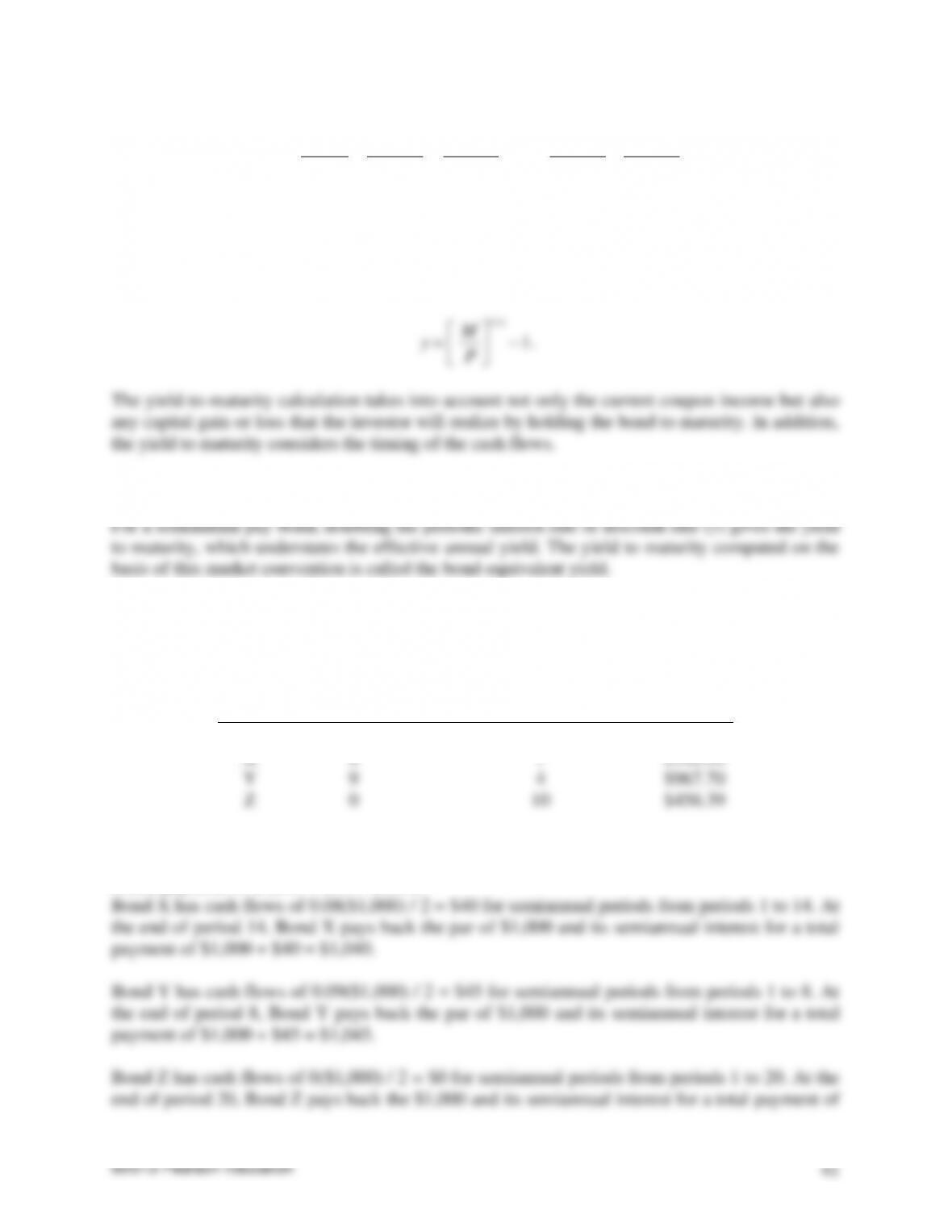
P =
( ) ( ) ( ) ( ) ( )
23
11 1 1 1
nn
C C C C M
+ + + . . .+ +
yy y y y
++ + + +
where P = price of the bond, C= semiannualcoupon interest (in dollars), M = maturity value
(in dollars), and n = number of periods (number of years times 2).
It is much easier to compute the yield to maturity for a zero-coupon bond because we can use:
4. What is the yield to maturity calculated on a bond-equivalent basis?
5. Answer the below questions.
(a) Show the cash flows for the following four bonds, each of which has a par value of
$1,000 and pays interest semiannually.
Bond
Coupon Rate(%)
Number of Yearsto Maturity
Price
W
7
5
$884.20
X
8
7
$948.90
Y
9
4
$967.70
Z
0
10
$456.39
Bond W has cash flows of 0.07($1,000) / 2 = $35 for semiannual periods from periods 1 to 10.
At the end of period 10, Bond W pays back the par of $1,000 and its semiannual interest for
a total payment of $1,000 + $35 = $1,035.
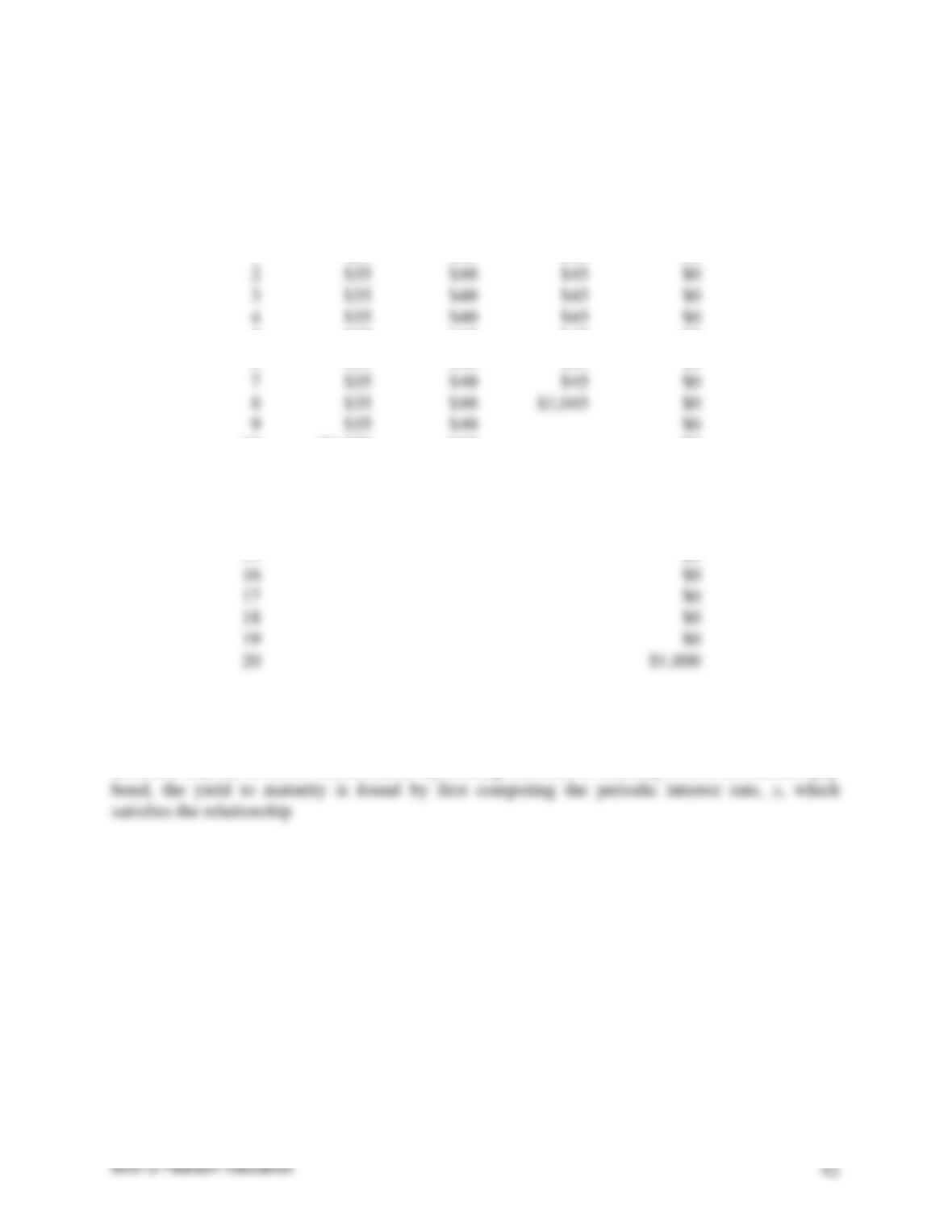
$1,000 + $0 = $1,000.
Below we show these cash flows in table format.
Period
Cash Flow
for Bond W
Cash Flow
for Bond X
Cash Flow
for Bond Y
Cash Flow
for Bond Z
1
$35
$40
$45
$0
2
$35
$40
$45
$0
3
$35
$40
$45
$0
4
$35
$40
$45
$0
5
$35
$40
$45
$0
6
$35
$40
$45
$0
7
$35
$40
$45
$0
8
$35
$40
$1,045
$0
9
$35
$40
$0
10
$1,035
$40
$0
11
$40
$0
12
$40
$0
13
$40
$0
14
$1,040
$0
15
$0
16
$0
17
$0
18
$0
19
$0
20
$1,000
(b) Calculate the yield to maturity for the four bonds.
The yield to maturityis computed in the same way as the internal rate of return; the cash flows
are those that the investor would realize by holding the bond to maturity. For a semiannual pay
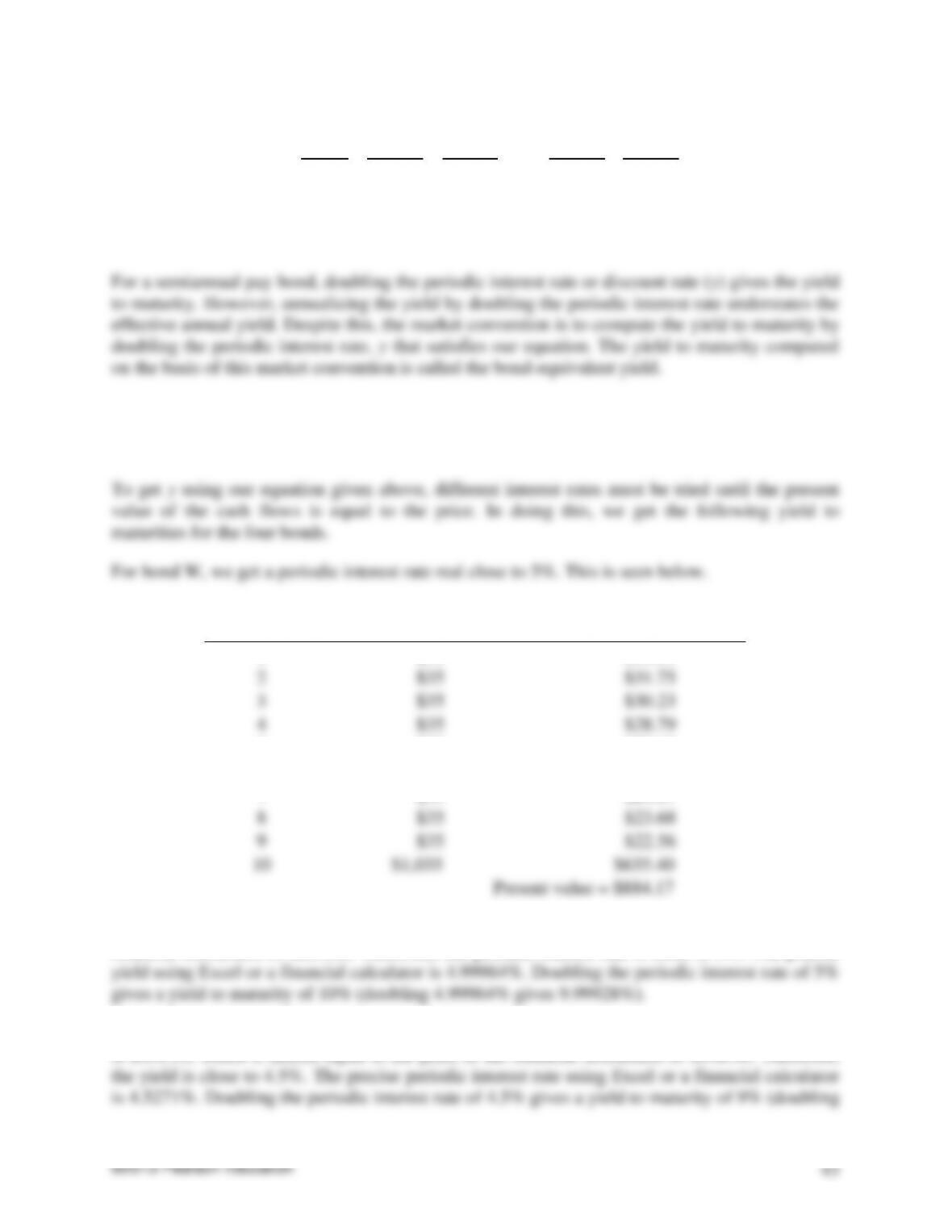
P =
( ) ( ) ( ) ( ) ( )
23
11 1 1 1
nn
C C C C M
+ + + . . .+ +
yy y y y
++ + + +
where P = price of the bond, C = semiannualcoupon interest (in dollars), M = maturity value (in
dollars), and n = number of periods (number of years times 2).
The computation of the yield to maturity requires a trial-and-error procedure. To illustrate the
computation, we first look at bond W. The cash flows for this bond are ten coupon payments of
$35 every six months and the principal of $1,000 to be paid in ten six-month periods from now.
Years
fromNow
Promised Annual Payments
(Cash Flow to Investor)
Present Value
of Cash Flow at 5%
1
$35
$33.33
2
$35
$31.75
3
$35
$30.23
4
$35
$28.79
5
$35
$27.42
6
$35
$26.12
7
$35
$24.87
8
$35
$23.68
9
$35
$22.56
10
$1,035
$635.40
Present value = $884.17
Using 5%, the present value of the cash flow is $884.17, which is almost equal to the price of the
financial instrument of $884.20. Therefore, the periodic interest rate is close to 5%. The precise
For bond X, we get an interest rate real close to 4.50%. Using this rate, the value of the cash flow
is $951.59, which is almost equal to the price of the financial instrument of $948.90. Therefore,
4.5271% gives 9.0542%).
For bond Z, we get an interest rate close to 4%. Using this rate, the value of the cash flow is
$456.39, which is equal to the price of the financial instrument of $456.39. Therefore, the yield
6. A portfolio manager is considering buying two bonds. Bond A matures in three years
and has a coupon rate of 10% payable semiannually. Bond B, of the same credit quality,
matures in 10 years and has a coupon rate of 12% payable semiannually. Both bonds are
priced at par.
(a) Suppose that the portfolio manager plans to hold the bond that is purchased for three
years. Which would be the best bond for the portfolio manager to purchase?
The shorter term bond will pay a lower coupon rate but it will likely cost less for a given market
rate. Since the bonds are of equal risk in terms of credit quality (the maturity premium for the
To begin with, an investor who purchases a bond can expect to receive a dollar return from
(i) the periodic coupon interest payments made by the issuer; (ii) any capital gain (or capital
loss—negative dollar return) when the bond matures, is called, or is sold; and, (iii) interest
If we are going to compute a potential yield to make a decision, we should be aware of the fact
that any measure of a bond’s potential yield should take into consideration each of the three
interest-on-interest component. Additionally, implicit in the yield–to-maturity computation is the
assumption that the coupon payments can be reinvested at the computed yield to maturity. The
Given the facts that (i) one bond, if bought, will not be held to maturity, and (ii) the coupon
interest payments will be reinvested at an unknown rate, we cannot determine which bond might
give the highest actual realized rate. Thus, we cannot compare them based upon this criterion.
Finally, a manger can try to project the total return performance of a bond on the basis of the
planned investment horizon and expectations concerning reinvestment rates and future market
yields. This permits the portfolio manager to evaluate which of several potential bonds
(b) Suppose that the portfolio manager plans to hold the bond that is purchased for six
years instead of three years. In this case, which would be the best bond for the portfolio
manager to purchase?