Chapter 03 – How Securities are Traded
3-1
CHAPTER 3: HOW SECURITIES ARE TRADED
PROBLEM SETS
2. The SuperDot system expedites the flow of orders from exchange members to the
3. The dealer sets the bid and asked price. Spreads should be higher on inactively traded stocks
4. a. In principle, potential losses are unbounded, growing directly with increases in the
b. If the stop-buy order can be filled at $128, the maximum possible loss per share is
5. a. The stock is purchased for: 300 $40 = $12,000
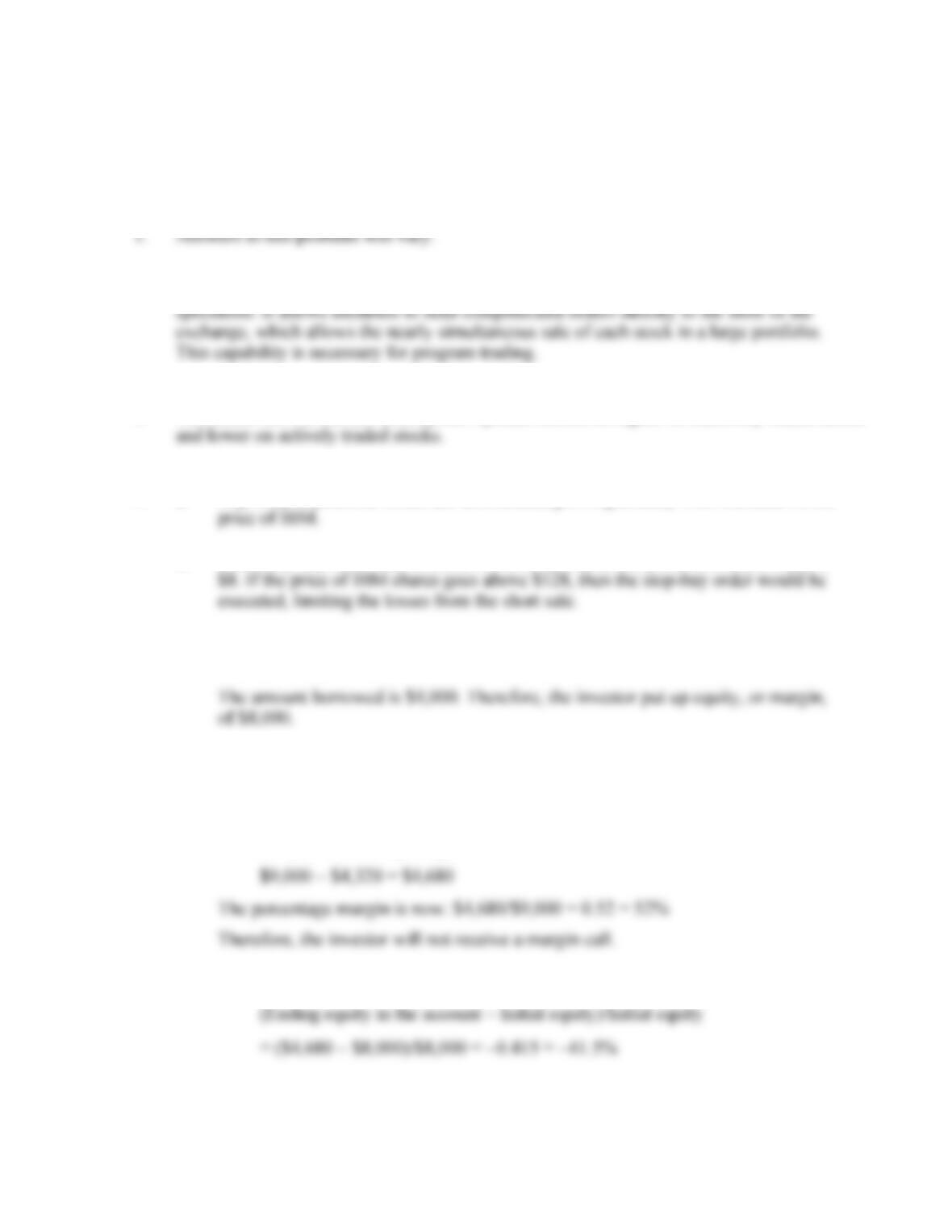
b. If the share price falls to $30, then the value of the stock falls to $9,000. By the
end of the year, the amount of the loan owed to the broker grows to:
$4,000 1.08 = $4,320
Therefore, the remaining margin in the investor’s account is:
c. The rate of return on the investment over the year is:
Chapter 03 – How Securities are Traded
3-2
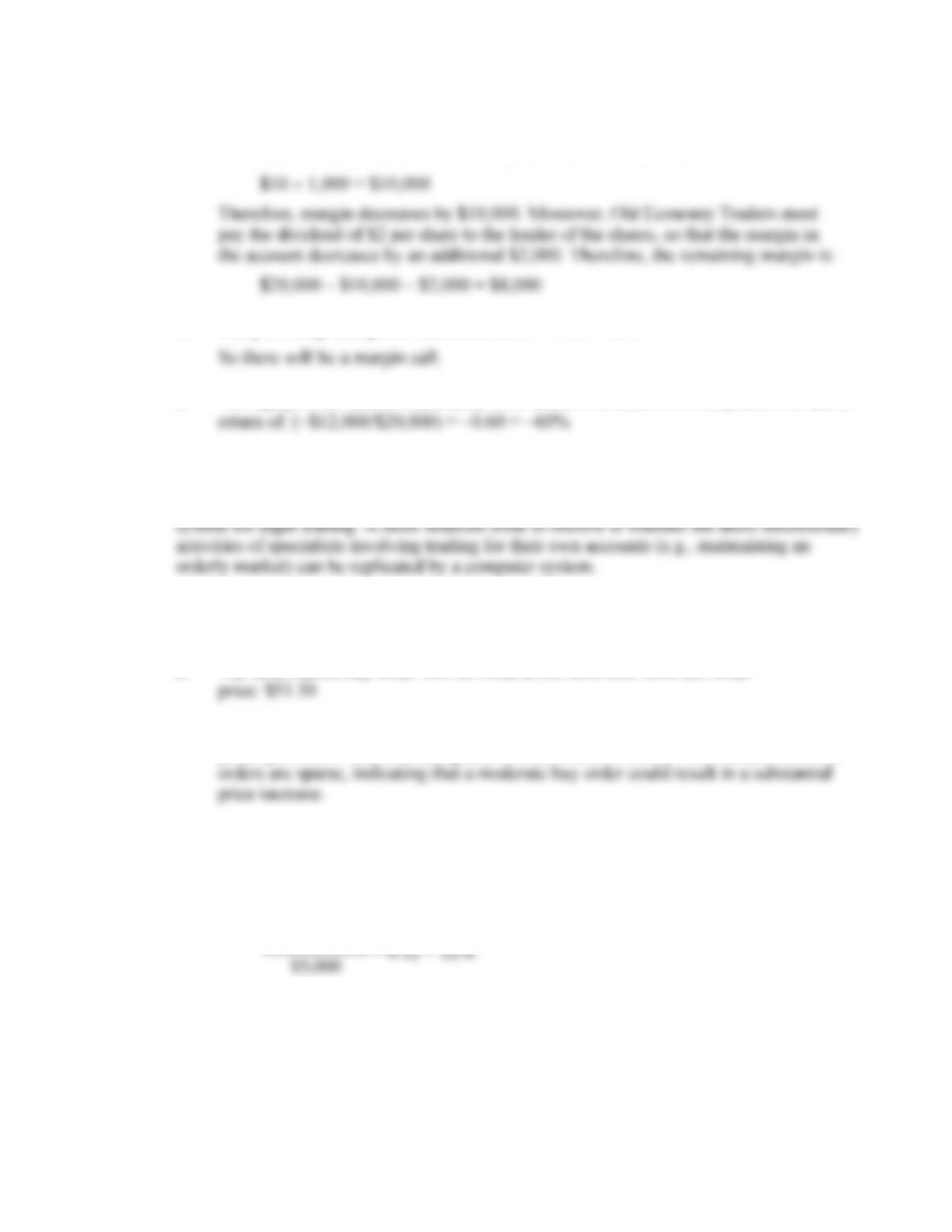
6. a. The initial margin was: 0.50 1,000 $40 = $20,000
As a result of the increase in the stock price Old Economy Traders loses:
b. The percentage margin is: $8,000/$50,000 = 0.16 = 16%
c. The equity in the account decreased from $20,000 to $8,000 in one year, for a rate of
7. Much of what the specialist does (e.g., crossing orders and maintaining the limit order book)
can be accomplished by a computerized system. In fact, some exchanges use an automated
8. a. The buy order will be filled at the best limit-sell order price: $50.25
b. The next market buy order will be filled at the next-best limit-sell order
c. You would want to increase your inventory. There is considerable buying demand at
prices just below $50, indicating that downside risk is limited. In contrast, limit sell
9. a. You buy 200 shares of Telecom for $10,000. These shares increase in value by 10%,
or $1,000. You pay interest of: 0.08 $5,000 = $400
The rate of return will be:
000,5$
400$000,1$ −
Chapter 03 – How Securities are Traded
3-3
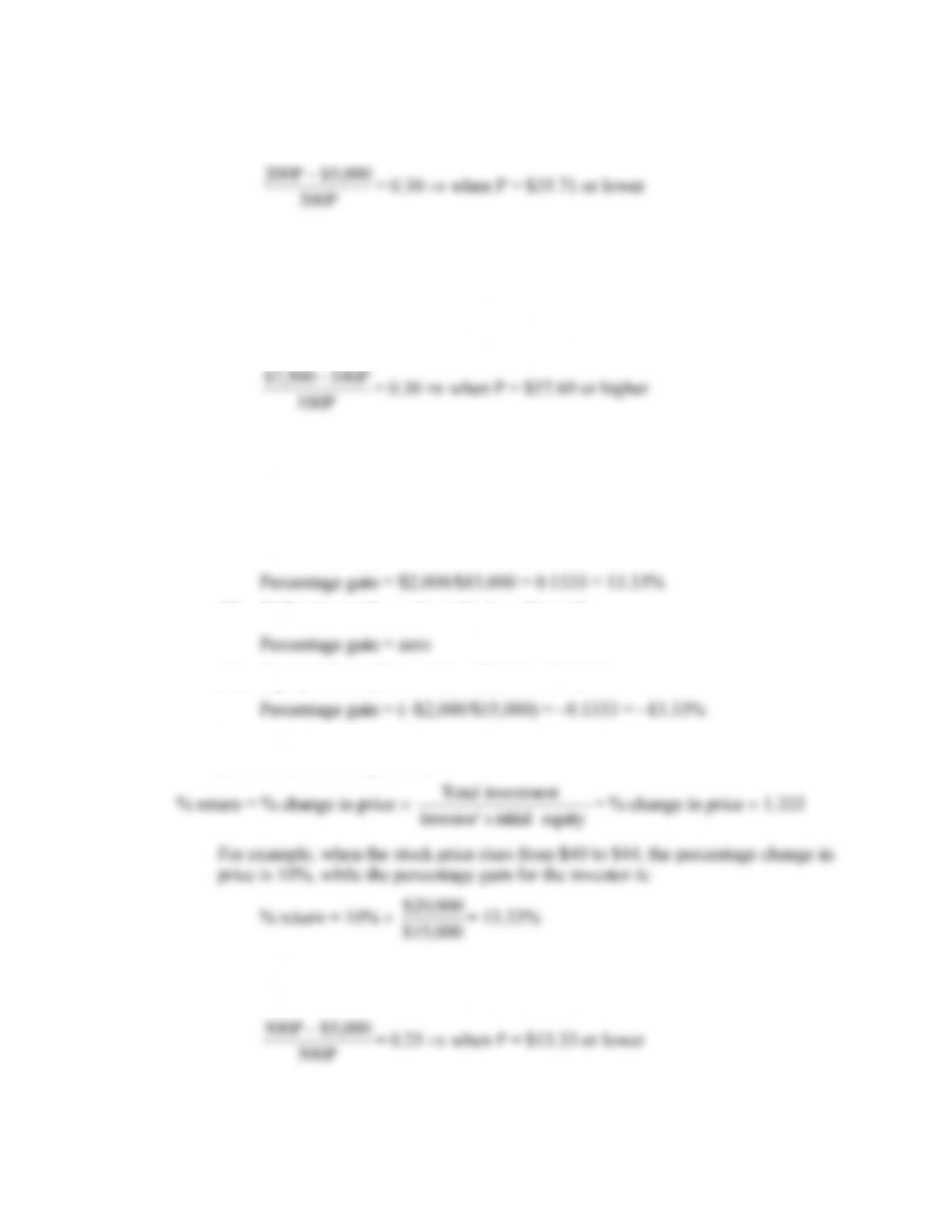
b. The value of the 200 shares is 200P. Equity is (200P – $5,000). You will receive a
margin call when:
P200
000,5$P200 −
= 0.30 when P = $35.71 or lower
10. a. Initial margin is 50% of $5,000 or $2,500.
b. Total assets are $7,500 ($5,000 from the sale of the stock and $2,500 put up for
margin). Liabilities are 100P. Therefore, equity is ($7,500 – 100P). A margin call
will be issued when:
P100
P100500,7$ −
= 0.30 when P = $57.69 or higher
11. The total cost of the purchase is: $40 500 = $20,000
You borrow $5,000 from your broker, and invest $15,000 of your own funds. Your
margin account starts out with equity of $15,000.
a. (i) Equity increases to: ($44 500) – $5,000 = $17,000
(ii) With price unchanged, equity is unchanged.
(iii) Equity falls to ($36 500) – $5,000 = $13,000
The relationship between the percentage return and the percentage change in the
price of the stock is given by:
investment Total
000,15$
b. The value of the 500 shares is 500P. Equity is (500P – $5,000). You will receive a
margin call when:
P500
000,5$P500 −
= 0.25 when P = $13.33 or lower
Chapter 03 – How Securities are Traded
3-4
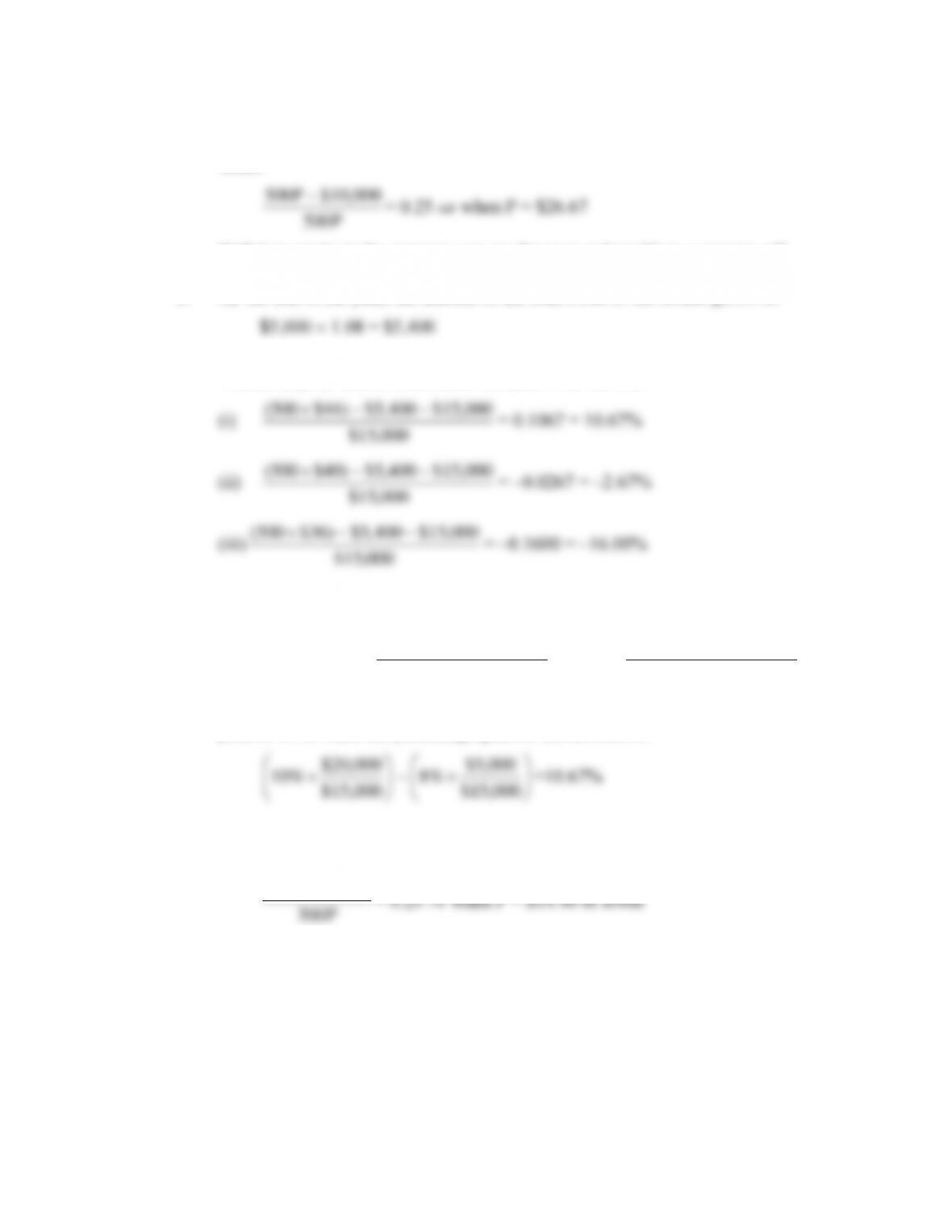
c. The value of the 500 shares is 500P. But now you have borrowed $10,000 instead
of $5,000. Therefore, equity is (500P – $10,000). You will receive a margin call
when:
P500
000,10$P500 −
= 0.25 when P = $26.67
With less equity in the account, you are far more vulnerable to a margin call.
d. By the end of the year, the amount of the loan owed to the broker grows to:
The equity in your account is (500P – $5,400). Initial equity was $15,000.
Therefore, your rate of return after one year is as follows:
000,15$
000,15$
000,15$400,5$)40$500(−−
000,15$400,5$)36$500(−−
000,15$400,5$)44$500(−−
000,15$
The relationship between the percentage return and the percentage change in the
price of Intel is given by:
% return =
equity initial sInvestor‘
investment Total
pricein change %
− equity initial sInvestor’
borrowed Funds
%8
For example, when the stock price rises from $40 to $44, the percentage change in
price is 10%, while the percentage gain for the investor is:
000,15$
000,20$
%10
− 000,15$
000,5$
%8
=10.67%
e. The value of the 500 shares is 500P. Equity is (500P – $5,400). You will receive a
margin call when:
P500
400,5$P500 −
Chapter 03 – How Securities are Traded
3-5
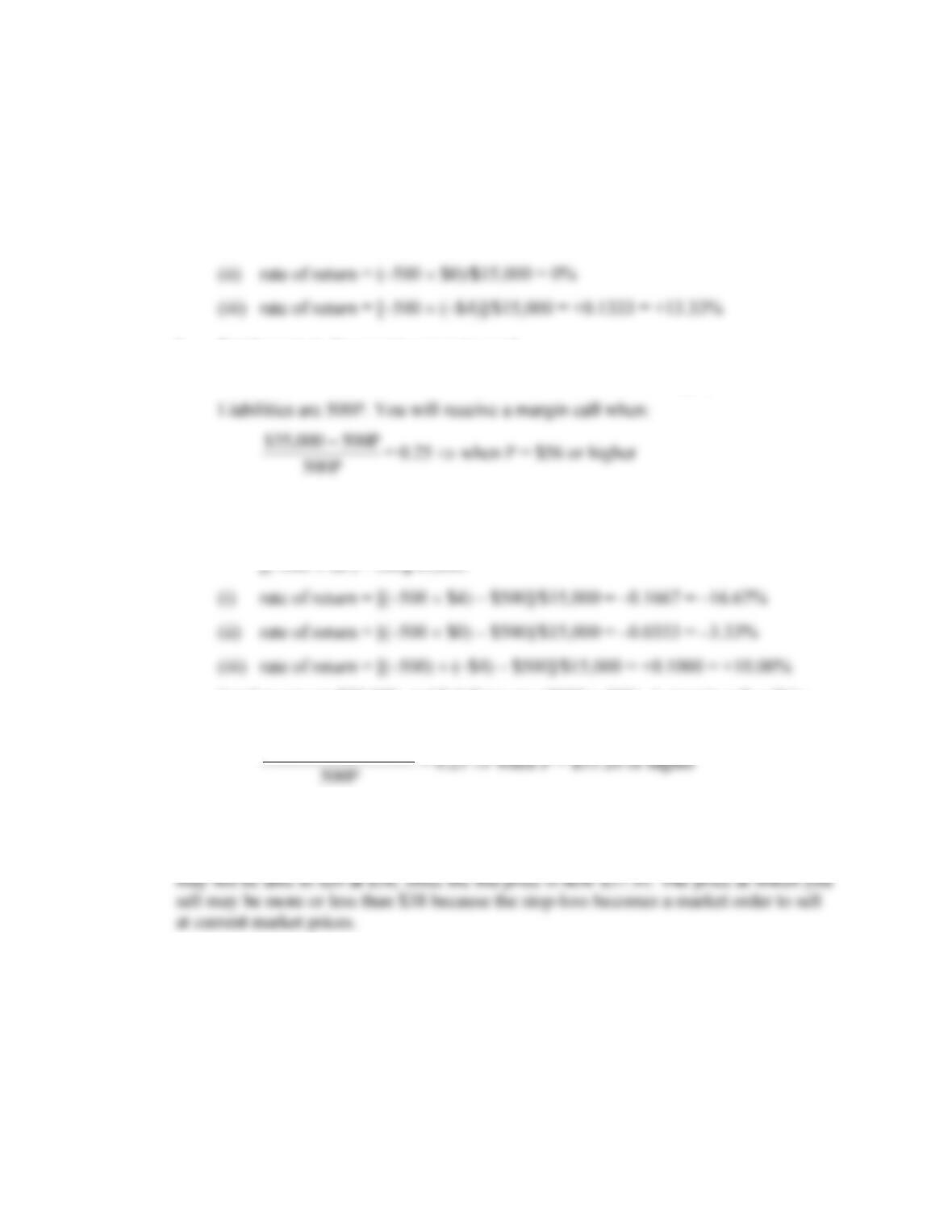
12. a. The gain or loss on the short position is: (–500 P)
Invested funds = $15,000
Therefore: rate of return = (–500 P)/15,000
The rate of return in each of the three scenarios is:
(i) rate of return = (–500 $)/$15,000 = –0.1333 = –13.33%
b. Total assets in the margin account equal:
$20,000 (from the sale of the stock) + $15,000 (the initial margin) = $35,000
P500
c. With a $1 dividend, the short position must now pay on the borrowed shares:
($1/share 500 shares) = $500. Rate of return is now:
[(–500 P) – 500]/15,000
Total assets are $35,000, and liabilities are (500P + 500). A margin call will be
issued when:
P500
500P500000,35 −−
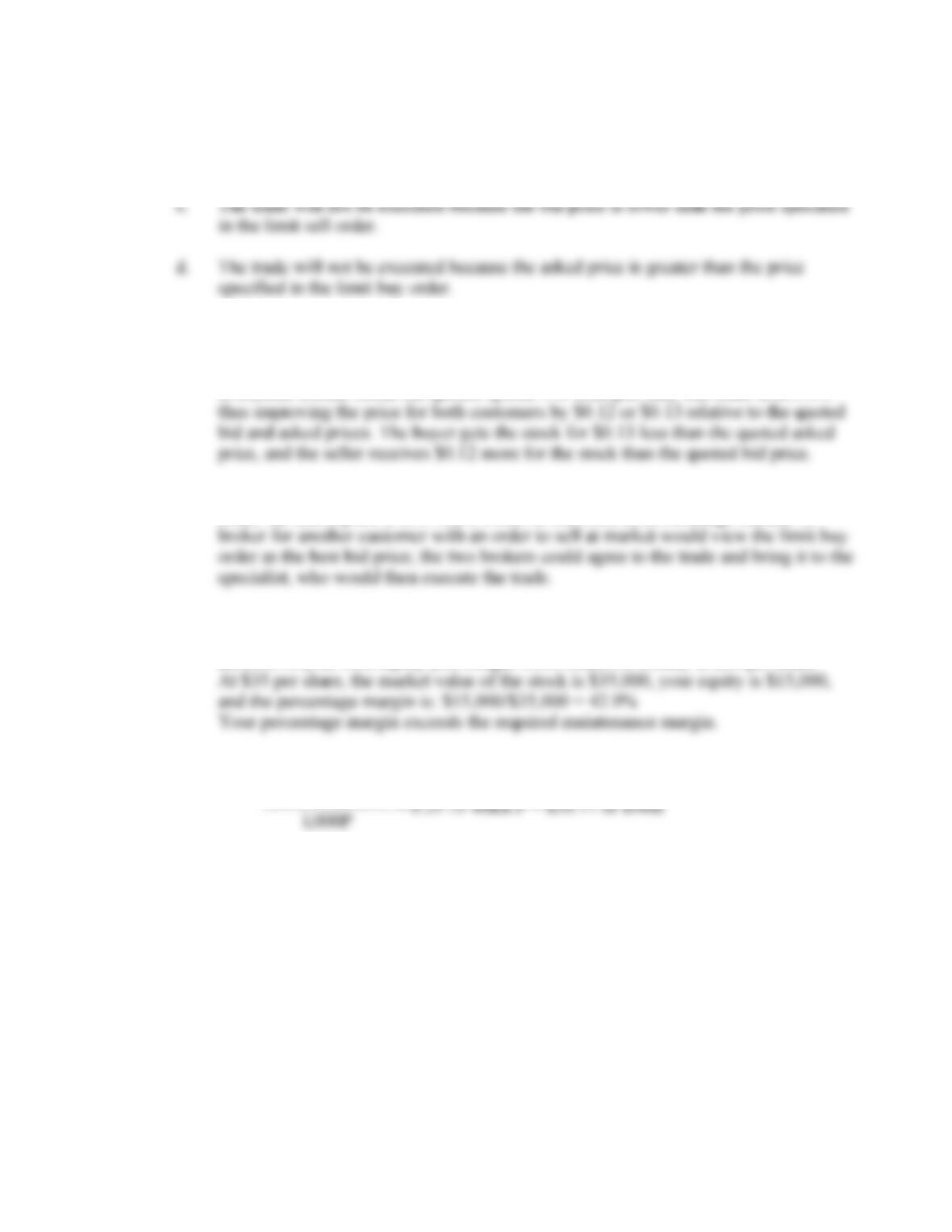
13. The broker is instructed to attempt to sell your Marriott stock as soon as the Marriott
stock trades at a bid price of $38 or less. Here, the broker will attempt to execute, but
Chapter 03 – How Securities are Traded
3-6
14. a. $55.50
b. $55.25
15. a. In an exchange market, there can be price improvement in the two market orders.
Brokers for each of the market orders (i.e., the buy order and the sell order) can agree
to execute a trade inside the quoted spread. For example, they can trade at $55.37,
b. Whereas the limit order to buy at $55.37 would not be executed in a dealer market
(since the asked price is $55.50), it could be executed in an exchange market. A
16. a. You will not receive a margin call. You borrowed $20,000 and with another
$20,000 of your own equity you bought 1,000 shares of Disney at $40 per share.
b. You will receive a margin call when:
P000,1
000,20$P000,1 −
Chapter 03 – How Securities are Traded
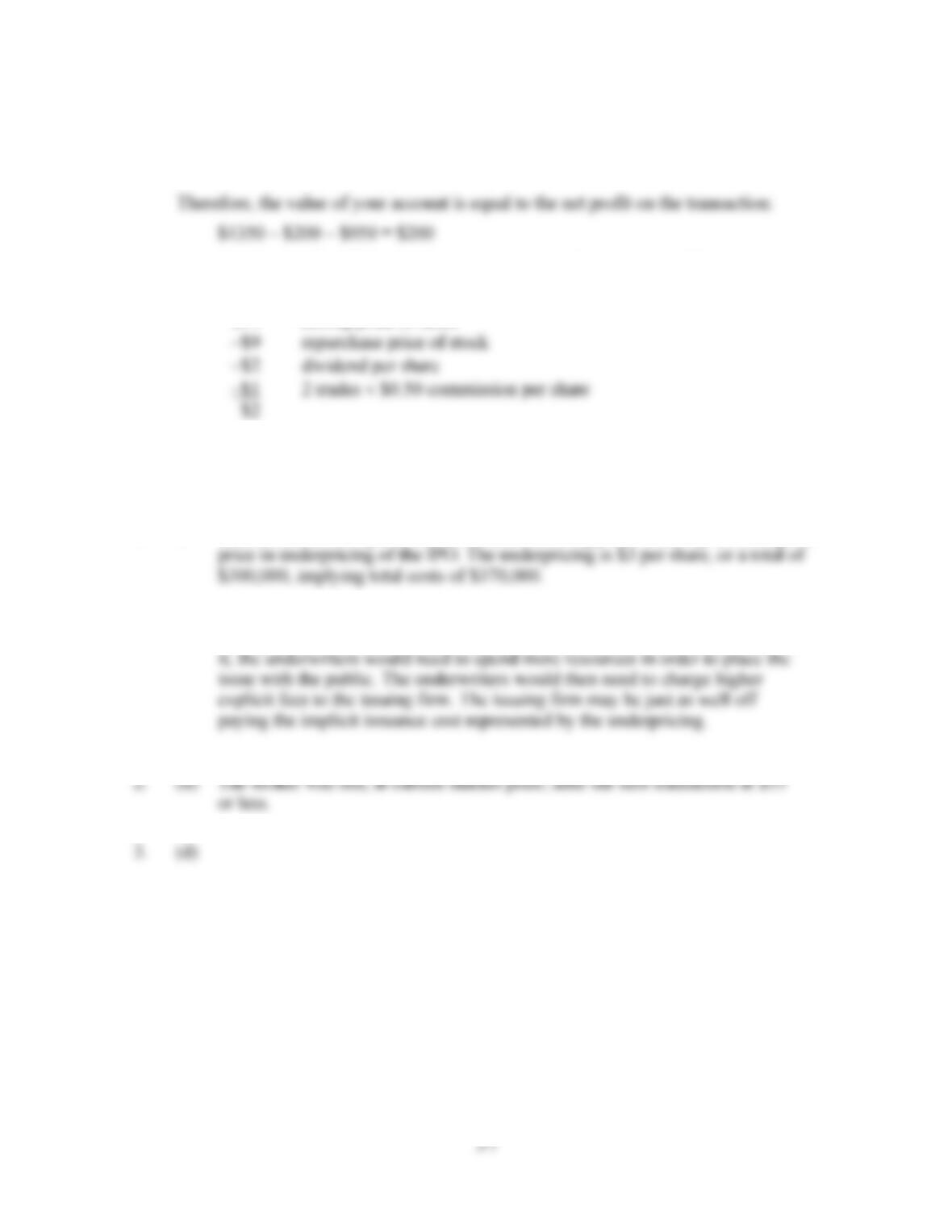
17. The proceeds from the short sale (net of commission) were: ($14 100) – $50 = $1,350
A dividend payment of $200 was withdrawn from the account. Covering the short sale at $9
per share cost you (including commission): $900 + $50 = $950
Note that your profit ($200) equals (100 shares profit per share of $2). Your net proceeds
per share was:
$14 selling price of stock
CFA PROBLEMS
1. a. In addition to the explicit fees of $70,000, FBN appears to have paid an implicit
b. No. The underwriters do not capture the part of the costs corresponding to the
underpricing. The underpricing may be a rational marketing strategy. Without