Chapter 3: Discussion Questions and Problems
1. Differentiate the following terms/concepts:
a. Lottery and insurance
A lottery is a prospect with a low probability of a high payoff. Many people buy lottery
b. Segregation and integration
c. Risk aversion and loss aversion
d. Weighting function and event probability
2. According to prospect theory, which is preferred?
a. Prospect A or B?
Decision (i). Choose between:
b. Prospect C or D?
2 | P a g e
c. Are these choices consistent with expected utility theory? Why or why
not?
3. Consider a person with the following value function under prospect theory:
v(w) = w.5 when w > 0
= -2(-w) .5 when w < 0
a. Is this individual loss-averse? Explain.
b. Assume that this individual weights values by probabilities, instead of
using a prospect theory weighting function. Which of the following prospects
would be preferred?
P1(.8, 1000, -800)
4. Now consider a person with the following value function under prospect
theory:
v(z) = z.8 when z ≥ 0
= -3(-z).8 when z < 0
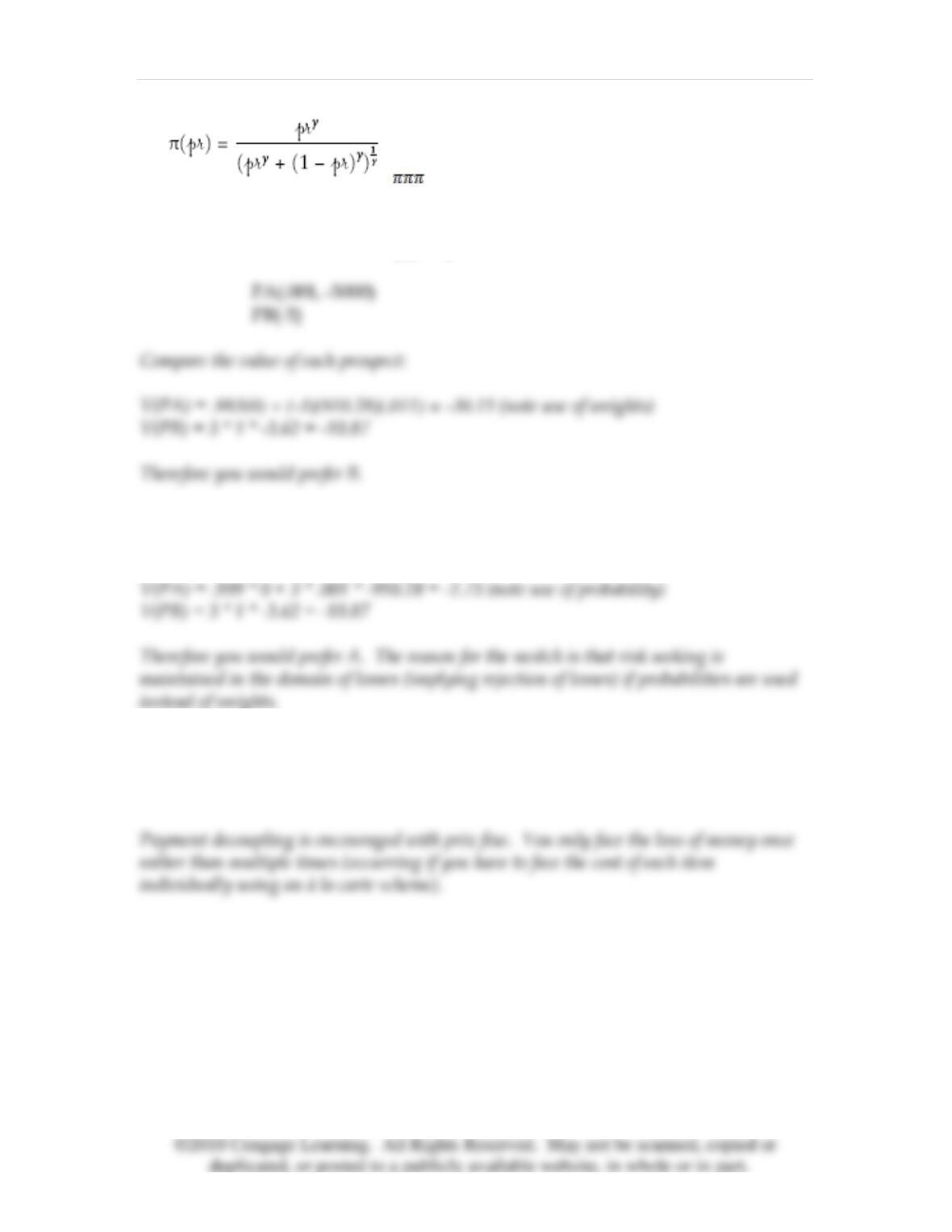
This individual has the following weighting function:
3 | P a g e
where we set =.65.
a. Which of the following prospects would he choose?
b. Repeat the calculation but using probabilities instead of weights. What
does this illustrate?
5. Why might some prefer a prix fixe (fixed price) dinner costing about the same
as an a la carte one (where you pay individually for each item)? (Assume the
food is identical.)