
make the new terms less attractive to the debt holder than the original terms. The terms that can
be changed would typically include, but are not limited to, one or more of the following:
(i) a reduction in the interest rate, (ii) a reduction in the principal, (ii) a rescheduling of the
principal repayment schedule (e.g., lengthening the maturity of the obligation) or postponement
of an interest payment, or (iv) a change in the level of seniority of the obligation in the reference
entity’s debt structure.
The reason why restructuring is so controversial is a protection buyer benefits from the inclusion
of a restructuring as a credit event and feels that eliminating restructuring as a credit event will
erode its credit protection. The protection seller, in contrast, would prefer not to include
restructuring since even routine modifications of obligations that occur in lending arrangements
8. All other factors constant, for a given reference obligation and a given scheduled term,
explain whether a credit default swap using full or old restructuring or modified
restructuring would be more expensive.
A credit default swap using the old restructuring should be more expensive to the protection
seller to the extent that it allows for a wider range of acceptable credit events through a more
liberal interpretation that has fewer constraints as to what qualifies for a credit event. However,
to the extent a modified restructuring reduces the costs associated with a credit event, then the
expenses can be reduced. More details are supplied below.
©2013 Pearson Education
680
rates in 2002 and the sovereign defaults, particularly the experience with the 2001-2002 Argentina
debt crisis. In January 2003, the ISDA published its revised credit events definitions in the 2003
ISDA Credit Derivative Definitions (referred to as the “2003 Definitions”). The revised definitions
reflected amendments to several of the definitions for credit events set forth in the 1999
Definitions. Specifically, there were amendments for bankruptcy, repudiation, and restructuring.
The major change was to restructuring, whereby the ISDA allows parties to a given trade to select
from among the following four definitions: (i) no restructuring; (ii) “full” or “old” restructuring,
which is based on the 1993 Definitions; (ii) “modified restructuring,” which is based on the
Supplement Definition; and (iv) “modified modified restructuring.” The last choice is new and was
included to address issues that arose in the European market.
9. The focus in an asset-backed securitiesCDS is on the cash-paying ability of thecollateral
and not on bankruptcy. Why?
CDS are written on asset-backed securities (ABS) and referred to as ABS CDS. As explained in
Chapters 13, 14, and 15, ABS includes a wide range of asset types. Recall that the convention in
the marketplace prior to 2007 was to classify those residential mortgage-backed securities where
the collateral was a pool of subprime mortgage loans as part of the ABS market and not the MBS
1) Failure to pay. The underlying reference obligation fails to make a scheduled interest or
principal payment.
10. Answer the below questions.
(a) For a single-name credit default swap, what is the difference between physical settlement
and cash settlement?
For a single-name credit default swap, physical delivery for a credit event means that the
protection buyer delivers a reference obligation to the protection seller in exchange for a cash

payment. For a single-name credit default swap, physical delivery does not rely on getting
market prices for the reference obligation in determining the amount of cash payment.
The standard contract for a single-name credit default swap calls for a quarterly payment of the
swap premium. The quarterly payment is determined using one of the day count conventions in
the bond market. The day count convention used for credit default swaps is actual/360, the same
convention as used in the interest-rate swap market. A day convention of actual/360 means that
to determine the payment in a quarter, the actual number of days in the quarter is used and
360 days are assumed for the year.
Thus, the swap premium payment for a quarter is:
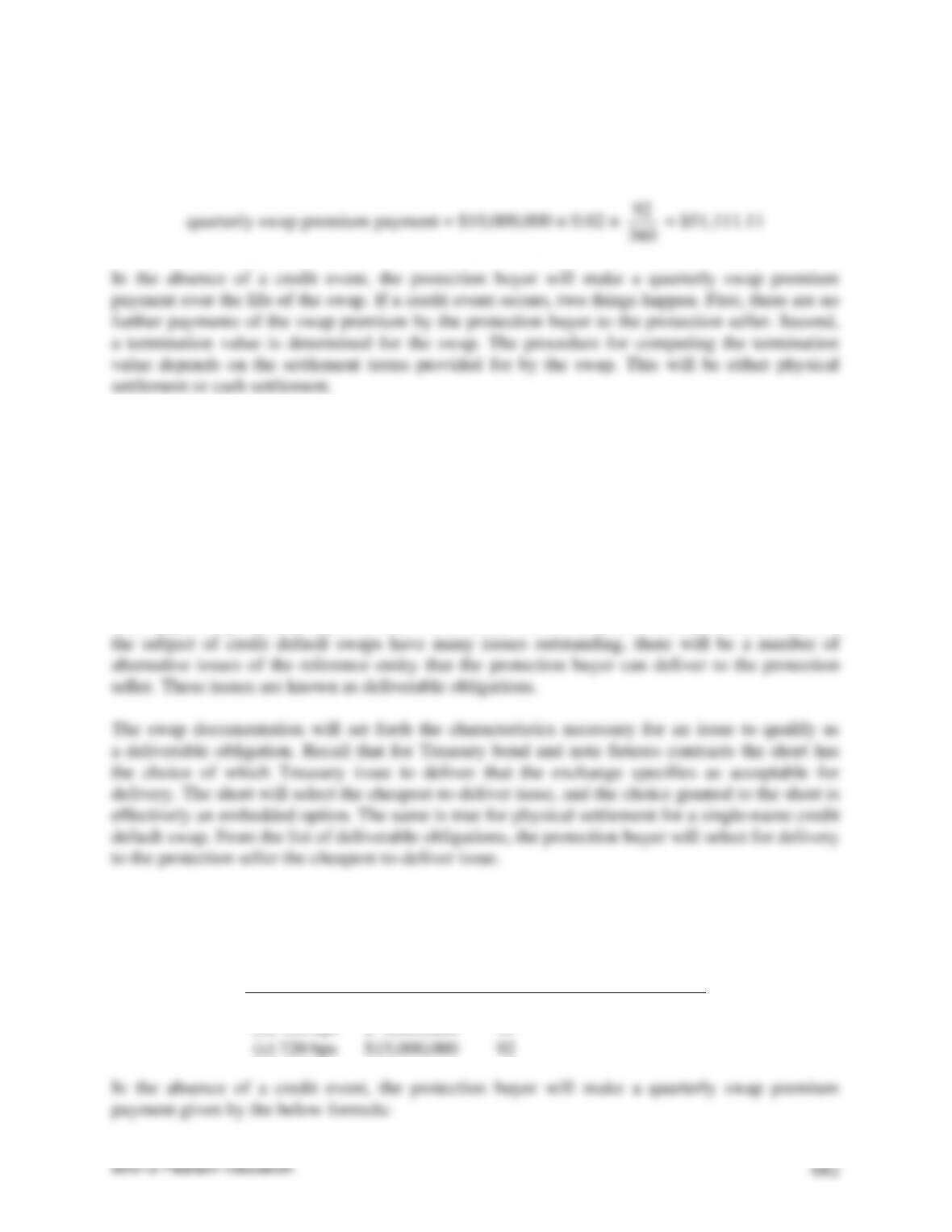
For example, assume a hypothetical credit default swap where the notional amount is $10 million
and there are 92 actual days in a quarter. Since the swap premium is 200 basis points (0.02), the
quarterly swap premium payment made by the protection buyer is:
360
(b) In physical settlement, why is there a cheapest-to-deliver issue?
There is a cheapest-to-deliver issue because (by convention or design) protection sellers have
been granted an embedded option allowing them to deliver that issue which is the least expensive
or at least the most convenient. More details are given below.
The market practice for settlement for single-name credit default swaps is physical settlement as
opposed to cash settlement. With physical settlement the protection buyer delivers a specified
amount of the face value of bonds of the reference entity to the protection seller. The protection
seller pays the protection buyer the face value of the bonds. Since all reference entities that are
11. For a CDS with the following terms, indicate the quarterly premium payment by filling
in the below exhibit.
Swap
Premium
Notional
Amount
Days in
Quarter
Quarterly
Premium Payment
(a) 600 bps
$15,000,000
90
(b) 450 bps
$ 8,000,000
91
(c) 720 bps
$15,000,000
92

quarterly swap premium payment =
notional amount × swap rate (in decimal) ×
actual number of days in quarter
360
.
360
For swap premium (b) of 450 bps, we insert the given value into our quarterly swap premium
payment formula and get:
quarterly swap premium payment = $8,000,000 × 0.045 ×
91
360
= $91,000.00.
For swap premium (c) of 720 bps, we insert the given value into our quarterly swap premium
payment formula and get:
360
Below we fill in the missing values in the above exhibit. We have:
Swap
Premium
Notional
Amount
Days in
Quarter
Quarterly
Premium Payment
(a) 600 bps
$15,000,000
90
$225,000.00
(b) 450 bps
$ 8,000,000
91
$ 91,000.00
(c) 720 bps
$15,000,000
92
$276,000.00
12. In the ISDA’s pay–as-you go template, why might there be payments by the credit
protection buyer to the credit protection seller beyond that of the swap premium?
Under the ISDA’s pay–as-you go template, a trigger event can occur. If so, this causes the credit
protection buyer to make additional payments to the credit protection beyond that of the swap
premium. More details are given below.
The mechanics of an ABX.HE differ from that of the other index CDS described above beyond
that of defining of a credit event. The other index CDS we have described exchange payments
quarterly. In the case of the ABX.HE, the protection buyer makes the swap payment monthly
13. How do the cash flows for a CDS swap differ from that of a single-name CDS?
The cash flows for a credit default index swap differ from that of a single-name credit default
swap in that the cash flows cease for the latter when a credit event occurs. More details are
provided below.
In a credit default index swap, the credit risk of a standardized basket of reference entities is
transferred between the protection buyer and protection seller. As of year-end 2005, the only
standardized indexes are those compiled and managed by Dow Jones. For the corporate bond
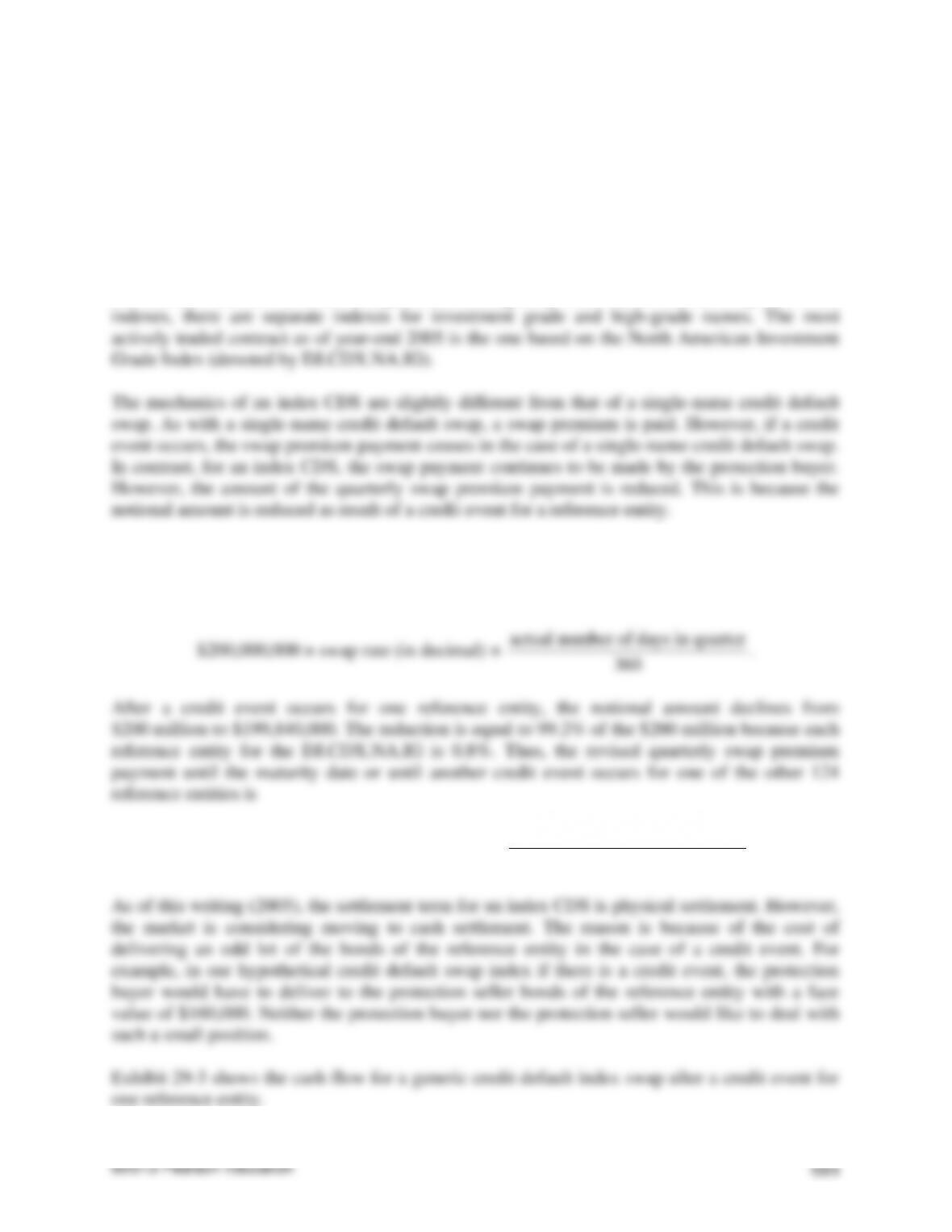
For example, suppose that a portfolio manager is the protection buyer for a DJ.CDX.NA.IG and
the notional amount is $200 million. Using the formula below for computing the quarterly swap
premium payment, the payment before a credit event occurs would be
$199,840,000 × swap rate (in decimal) ×
actual number of days in quarter
360
.

©2013 Pearson Education
685
Because an index CDS, such as the DJ.CDX.NA.IG, provides exposure to a diversified basket of
credits, it can be used by a portfolio manager to help adjust a portfolio’s exposure to the credit
sector of a bond market index. By entering into an index CDS as the protection seller, a portfolio
manager increases exposure to the credit sector. Exposure to the credit sector is reduced by
a portfolio manager being the protection buyer.
14. How does one approximate the credit default swap spread for a single-name credit default
swap on a corporate entity?
15. Answer the below questions.
(a) What is an asset swap?
An asset swap is created by an investor when the investor owns an asset and converts its cash
flow characteristics. An asset swap is an interest rate swap or cross currency swap used to
convert the cash flows from an underlying security (a bond or floating rate note), from fixed
coupon to floating coupon, floating coupon to fixed coupon, or from one currency to another.
The underlying security and swap may be transacted together (as a package) with the same
(b)In pricing a single–name CDS, what information does the par asset swap market contain?
There are eight assumptions needed to value a single-name credit default swap with a maturity of
T years for a reference entity. Assumption 1 states that there exists a floating-rate security issued
by the reference entity that has a maturity of T that is trading at par value and offers a coupon

16. The following is an excerpt from “MCDX Municipal CDS index on the rise,” Credit Default
Swap Market Reporting, July 1, 2010 (http://blog.creditlime.com/2010/07/01/municipal–cds–index–rising/)
“The 5-year MCDX increased from 115 bps to 209 bps during the period from April 20 to
June 11, 2010 and had nearly doubled 11 days later when it closed at 226.5 bps on June
22. Between September 28, 2009 and April 20, 2010, the index had only increased from 90
bps to 115 bps.
(a) What is meant by a 5-year MCDX?
A 5-year MCDX is a credit default swap (CDS) index of 50 municipal credits ranging from
general obligation debt to revenue bonds from municipal authorities (excluding tobacco and
healthcare bond issues). By buying (or selling) the index, you are in effect buying (or selling)
equal portions of 50 different protection contracts. If one of the credits within the MCDX
(b) What is the link between the “ballooning municipal deficits and lower revenues” and
the increase in CDS spreads?
With ballooning municipal deficits and lower revenues, the default probability increases. Thus,
the link between the “ballooning municipal deficits and lower revenues” and the increase in CDS
spreads reflect the market’s view on the default probability associated with the reference entity
and the amount that will be recovered should a default occur. More details are given below.
©2013 Pearson Education
687
Given an assumed recovery rate, then an implied default probability can be obtained by solving
the above equation for the default probability:
Implied default probability =
( )
Observed CDSspread in bps / 10,000
1 – Assumed recovery rate
So, for example, if the observed 5-year CDS spread for a corporation is 500 basis points and the
assumed recovery rate is 40%, then the implied default probability is 8.33% as shown below:
Implied default probability =
( )
500 / 10,000
1 – 0.40
= 0.0833 = 8.33%
Notice that the higher the recovery rate assumed, the higher the implied default probability for
a given CDS spread. So, for example, if a 60% recovery rate is assumed, the implied default
probability is 12.5%.
Market players will employ an industry standard fixed recovery rate depending on the underlying
to obtain the implied default probability. For example, the market practice is to assume a higher
recovery rate for loans compared to corporate bonds and higher recovery rates for municipal
bonds than for corporate debt.
17. In an April 21, 2011 article in Bloomberg.com by Abigail Moses entitled, “Greece, Portugal
Sovereign Credit-Default Swaps Jump to Records,”(http://www.bloomberg.com/news/2011-04–
21/greece-portugal-sovereign-credit-default-swaps-jump-to-records.html), the following statement
appears:
(a) How is the “68 percent chance of default” obtained?
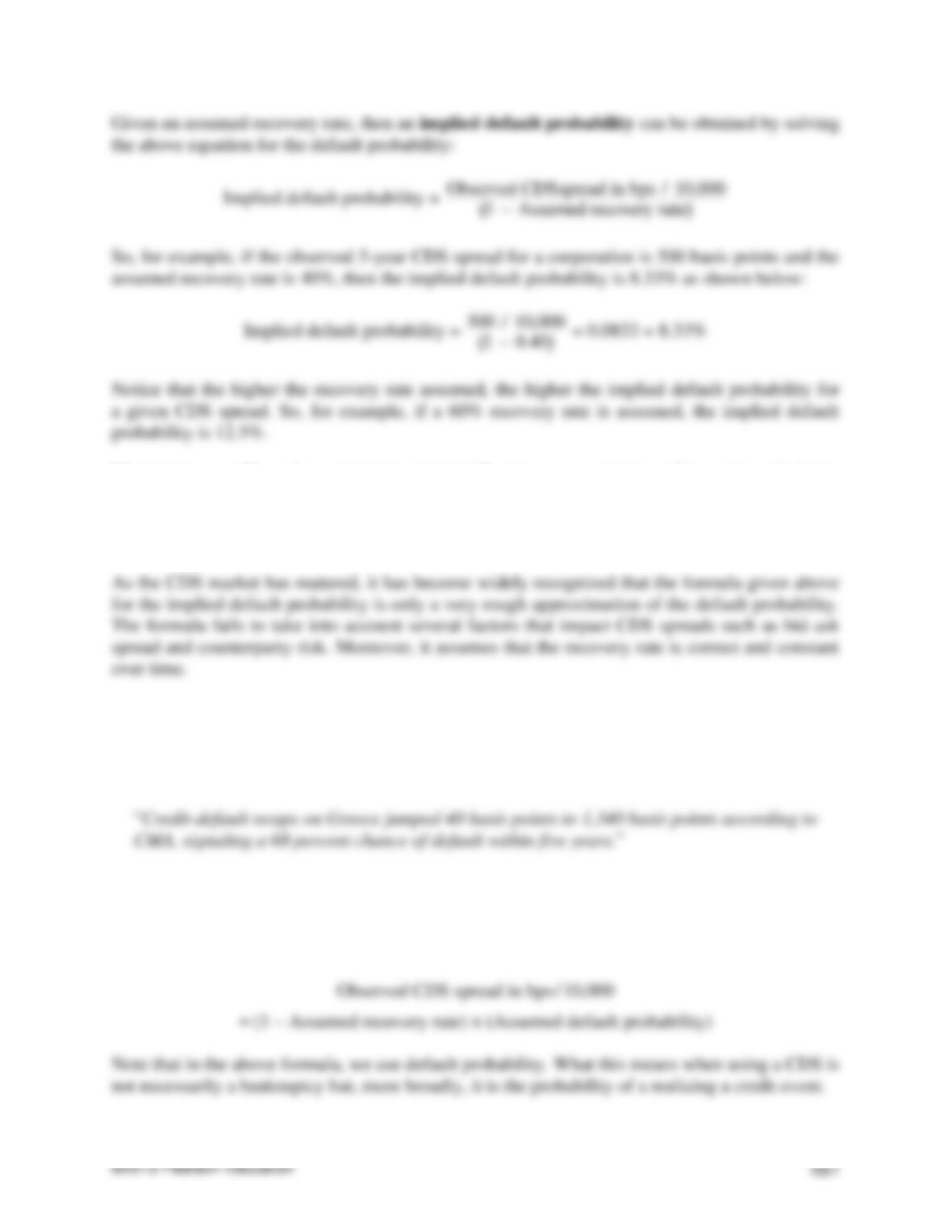
The “68 percent chance of default” can be obtained from relations that back out default
probabilities from the observed CDS spread. We begin with the equation:
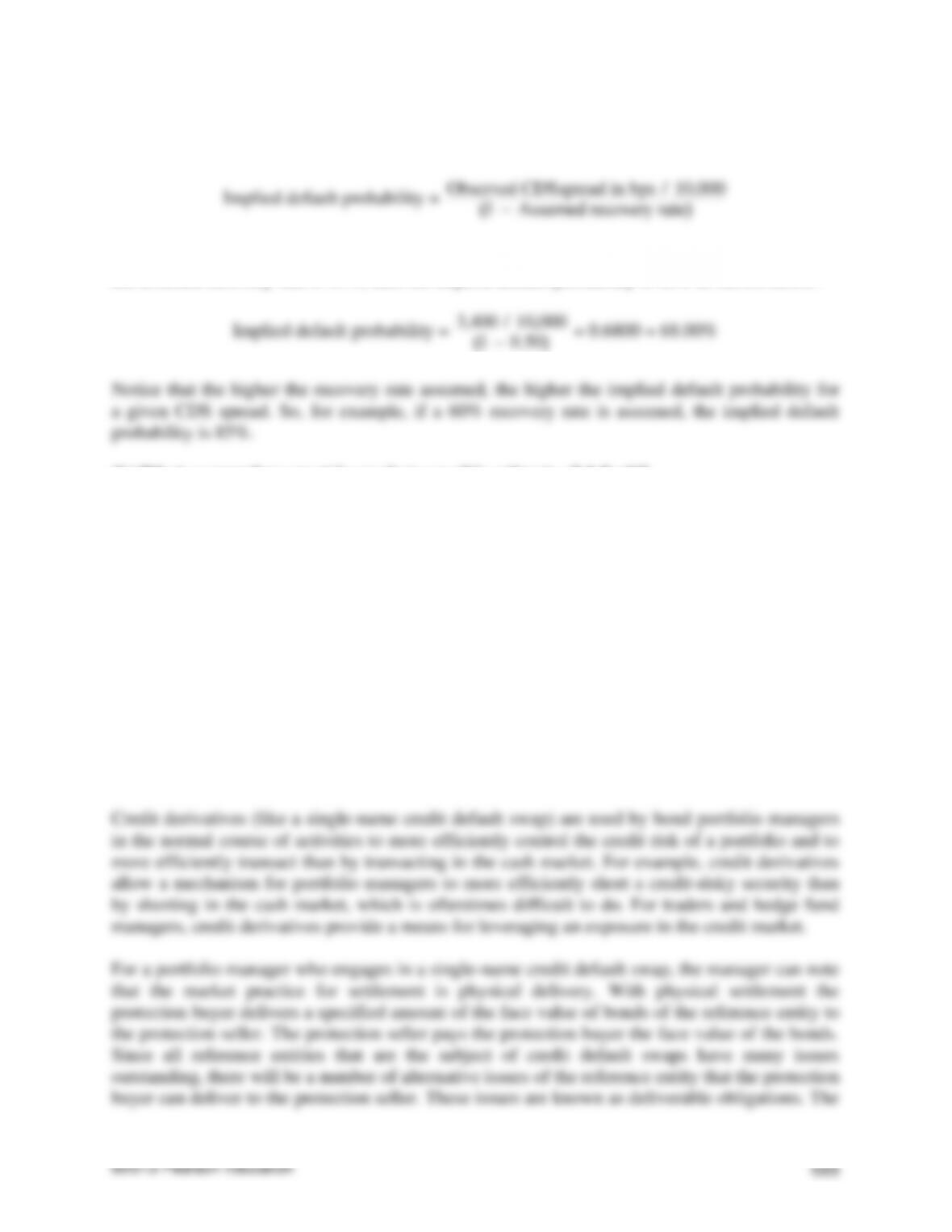
Given an assumed recovery rate, then an implied default probability can be obtained by solving
the above equation for the default probability:
( )
1 – Assumed recovery rate
So, for example, if the observed 5-year CDS spread for a corporation is 3,400 basis points and
the assumed recovery rate is 50%, then the implied default probability is 68% as shown below:
(b) What assumptions must be made to use this estimate of default?
The 68 percent chance of default was determined from a series of formulas that allows
a computation of the probability of default given assumption about of several factors that impact
CDS spreads. These factors include the bid-ask spread, counterparty risk, and the recovery rate.
18. Answer the below questions.
(a) Explain how a single-name CDS can be used by a portfolio manager who wants to short
a reference entity.
If a portfolio manager expects that an issuer will have difficulties in the future and wants to take
a position based on that expectation, it will short the bond of that issuer. However, shorting
bonds in the corporate bond market is difficult. The equivalent position can be obtained by
entering into a swap as the protection buyer. More details are provided below.

©2013 Pearson Education
689
swap documentation will set forth the characteristics necessary for an issue to qualify as
a deliverable obligation. Just like for Treasury bond and note futures contracts, the short (in
a single-name credit default swap) has the choice of which issue to deliver that is specified as
acceptable for delivery. The short will select the cheapest-to-deliver issue, and the choice granted
to the short is effectively an embedded option. From the list of deliverable obligations, the
protection buyer will select for delivery to the protection seller the cheapest–to-deliver issue.
(b) Explain how a single-name CDS can be used by a portfolio manager who is having
difficulty acquiring the bonds of a particular corporation in the cash market.
If the portfolio manager desires a bond it is likely because of the cash flows (associated with the
bond) help the manager match assets and liabilities. While the “ideal” bond may be hard to find
and purchase, a single-name credit default swap can help realize the same desired cash flows.
Thus, a single-name credit default swap can be used by a portfolio manager who is having
difficulty acquiring the bonds of a particular corporation in the cash market. More details are
given below.
• The liquidity of the swap market compared to the corporate bond market makes it more
efficient to obtain exposure to a reference entity by taking a position in the swap market

©2013 Pearson Education
690
• For a portfolio manager seeking a leveraged position in a corporate bond, this can be
done in the swap market. The economic position of a protection buyer is equivalent to a
leveraged position in a corporate bond.
19. How are index CDS used by portfolio managers?
20. How can a client determine if a portfolio manager is using a CDS for leveraging in such
a way to increase the portfolio’s risk relative to a bond index?
A credit default swap is an agreement between two parties, one of whom (the protection seller)
will collect periodic payments from the other (the protection buyer). In the event of default in the
underlying bond portfolio, the protection seller will owe the protection buyer a lump sum
payment equivalent to the loss of principal in the bond portfolio.If the protection buyer owns
a portfolio of bonds representing the index, then a credit default swap effectively transfers that