
CHAPTER 29
CREDIT DEFAULT SWAPS
CHAPTERSUMMARY
In this chapter, we describe the different types of CDS, the basics of CDS valuation for
a single-name CDS, and how a CDS can be used to control risk. We begin with the critical
element in a CDS: the definition of a credit event.
CREDIT EVENTS
A CDS has a payout that is contingent upon a credit event occurring. The ISDA provides
definitions of what credit events are.
Credit Events
The 1999 ISDA Credit Derivatives Definitions (referred to as the “1999 Definitions”) provides
a list of eight credit events: (1) bankruptcy, (2) credit event upon merger, (3) cross acceleration,
(4) cross default, (5) downgrade, (6) failure to pay, (7) repudiation/moratorium, and
(8) restructuring. These eight events attempt to capture every type of situation that could cause
the credit quality of the reference entity to deteriorate, or cause the value of the reference
obligation to decline.
The most controversial credit event that may be included in a credit default product is
restructuring of an obligation. A restructuring occurs when the terms of the obligation are
altered so as to make the new terms less attractive to the debt holder than the original terms. The
Credit Events for an Asset-Backed Security
CDS are written on asset-backed securities (ABS) and referred to as ABS CDS. There are unique
aspects of an ABS that required a modification of the ISDA documentation with respect credit
event definitions when the reference entity is an ABS tranche.In June 2005, the ISDA released

©2013 Pearson Education
668
what it refers to as its pay-as-you-go (PAUG) template for ABS. The focus was on cash flow
adequacy of the ABS structure rather than the potential for bankruptcy. Accordingly, the ISDA
PAUG template provided the following three credit events that focus on cash flow adequacy for
ABS transactions:
• Failure to pay. The underlying reference obligation fails to make a scheduled interest or
principal payment.
• Writedown. The principal component of the underlying reference obligation is written
down and deemed irrecoverable.
• Distressed ratings downgrade. The underlying reference obligation is downgraded to
a rating of Caa2/CCC or lower
SINGLE-NAME CDS
In a single-name CDS, there is only one reference entity or reference obligation. There are
single-name CDSs written on a
• corporate debt issuer (bonds or leverage loans)
• sovereign issuer
• municipal bond issuer
• tranche of an asset-backed security
360
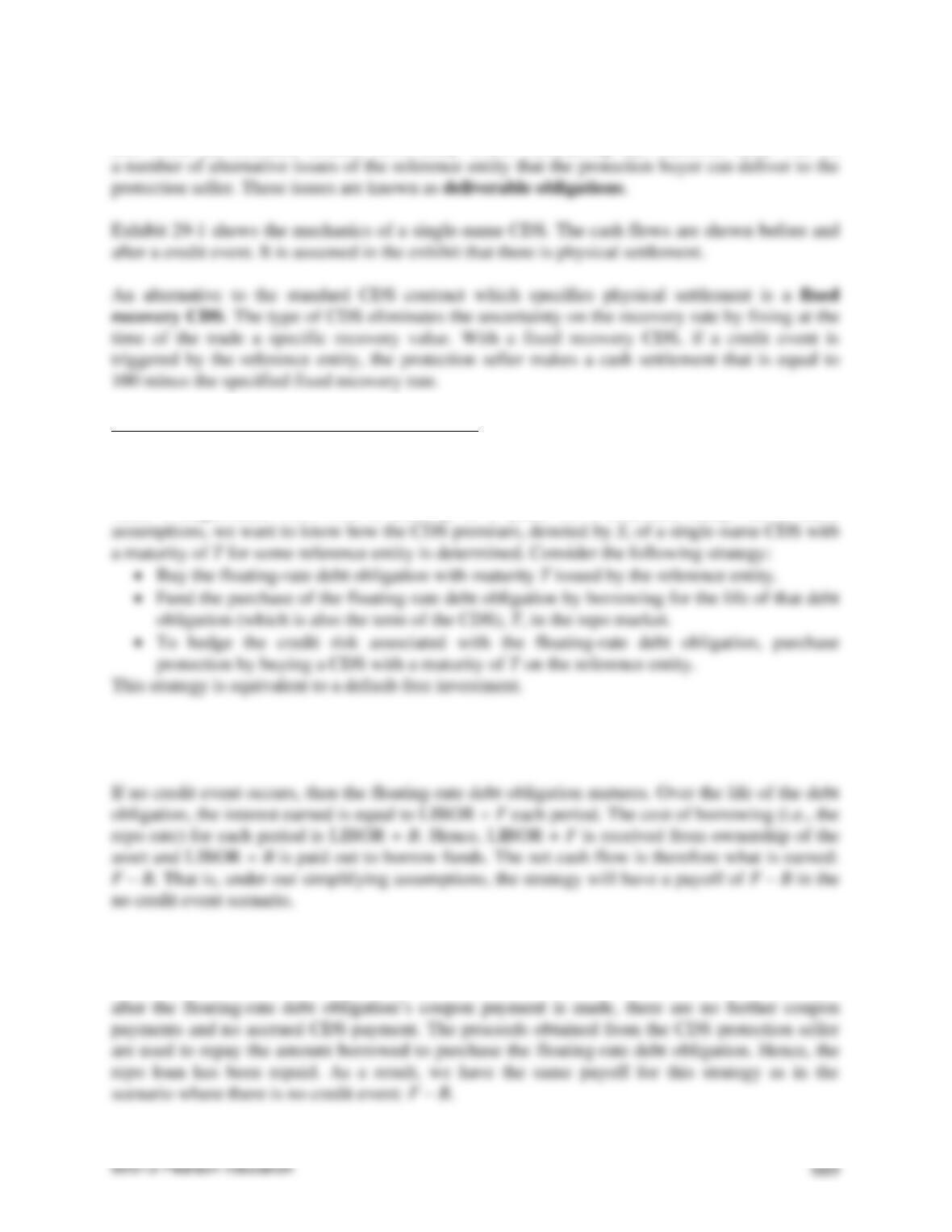
Given 92 actual days in a quarter and the swap premium of 200 basis points (0.02), the quarterly
swap premium payment made by the protection buyer would be
92
Corporation where only one issue of the reference entity was assumed to be outstanding, in the
real world all reference entities have many issues outstanding and therefore there will be
Approximating the Value of a Single-Name CDS
Let’s look at the general principles for pricing or valuing single-name CDS on a corporate bond
issuer. We begin with a set of simplifying assumptions. There are eight assumptions needed to
value a single-name CDS with a maturity of T years for a reference entity. Given these
Let’s look at the payoff for the two possible outcomes: no credit event occurs or a credit event
occurs.
Consider next what would happen if there is a credit event. Assuming physical delivery of the
floating-rate debt obligation, the floating-rate debt obligation is delivered to the credit protection
seller (i.e., the seller of the single-name CDS). Because we assume the credit event occurs right

Asset Swap
When an investor owns an asset and converts its cash flow characteristics, the investor is said to
have created an asset swap. Let’s now illustrate a basic asset swap. Suppose that an investor
purchases $10 million par value of a 7.85%, 5-year bond of a BBB rated corporation at par value.
Let’s look at the cash flow for the investor every six months for the next five years:
Received from bond: 7.85%
Thus, regardless of how interest rates change, if the issuer does not default, the investor earns 85
basis points over 6-month LIBOR. Effectively, the investor has converted a fixed-rate BBB
5-year bond into a 5-year floating-rate bond with a spread over 6-month LIBOR. Thus, the
investor has created a synthetic floating-rate bond. The purpose of an asset swap is to do
precisely that: create a synthetic credit-risky floating-rate security.
An asset swap typically combines the sale of a credit-risky bond owned to a counterparty at par
and with no interest accrued, with an interest-rate swap. This type of asset swap structure or
To illustrate this asset swap structure, suppose that in our previous illustration the swap rate
prevailing in the market is 7.30% rather than 7.00%. The investor owns the bonds and sells them
Let’s look at the cash flow for the investor every six months for the next five years for this asset
swap structure:
Received from bond: 7.85%
In our first illustration of an asset swap, the investor is creating a synthetic floater without
a dealer. The investor owns the bonds. The only involvement of the dealer is as a counterparty to

the interest-rate swap. In the second structure, the dealer is the counterparty to the asset swap
structure and the dealer owns the underlying credit-risky bonds. If there is a default, the dealer
returns the bonds to the investor.
CDS Implied Default Probabilities
In the early days of the CDS market, the following naïve relationship was used to back out
default probabilities from the observed CDS spread:
Note that in the above formula, we use default probability. Given an assumed recovery rate, then
an implied default probability can be obtained by solving the above equation for the default
probability:
INDEX CDS
An index CDS is a CDS written on a standardized basket of reference entities and include CDS
written on
• Corporate debt issuers
• Sovereign government issuers
• Municipal debt issuers
• Tranches of asset-backed securities
• Tranches of commercial mortgage-backed securities
Index CDS Written on Corporate, Sovereign, and Municipal Debt Issuers
The two most actively traded CDX on corporate bonds for reference entities in North America
are the North America Investment Grade Index (denoted by CDX.NA.IG) and the North
America High Yield Index (denoted by CDX.NA.HY).
©2013 Pearson Education
672
In addition to index CDS on corporate bond issuers, there is an index CDS on leveraged loans
(denoted LCDX). What differentiates the LCDX from the corporate bond CDX such as the
CDX.HY is that the LCDX references a collection of loans (i.e., any/all outstanding senior
secured bank debt of the reference issuer).
There are index CDS written on sovereign governments in regions throughout the world. There
is an index CDS written on 50 municipal entities (denoted by MCDX) ranging from general
obligation debt to revenue bonds from municipal authorities.
Index CDS Written on Tranches of ABS
The index CDS written on ABS transactions are called ABX.HE. The index includes 20 home
equity loan deals from the “top 20” issuers at the time. The mechanics of an ABX.HE differ from
Index CDS Written on Tranches of Commercial Mortgage-Backed Securities
There are index CDS written on deals of commercial mortgage-backed securities (CMBS). This
index CDS, denoted by CMBX, consists of deals from 25 CMBS transactions. As with the
ABX.HE, there are sub-indices based on tranche ratings. The PAUG template is used as with the
ABX.HE.
ECONOMIC INTERPRETATION OF A CDS AND INDEX CDS
Credit Protection Seller
Consider first the credit protection seller in a single-name CDS. What is the equivalent position
of the credit protection seller in the cash market? For illustration purposes, we will assume that
the reference obligation is bond ABC. If an investor buys bond ABC, then the investor will have
the following cash flow:

below the purchase price paid by the investor (i.e., PT<P0). The investor then realizes a loss equal
to the PT − P0.
Let’s now suppose that a credit event occurs. The protection seller must make a payment to the
protection buyer. This payment represents a cash outlay or loss for the protection seller. But
consider that there is a loss that occurs for the investor who buys bond ABC if an adverse event
occurs. Once again, this cash flow attribute is similar for both the protection seller and an
investor in a bond.
Credit Protection Buyer
It should be no surprise that if the protection seller in a CDS has a position analogous to a long
position in the cash bond that the protection buyer in a CDS has a position analogous to a short
position in a cash bond. Let’s see why once again using a single-name CDS where the reference
obligation is bond ABC.
The semiannual coupon payments will be made by the investor because the short is responsible
for reimbursing the party that it borrowed the bond from an amount equal to the coupon
payment. This payment occurs as long as bond ABC does not default.
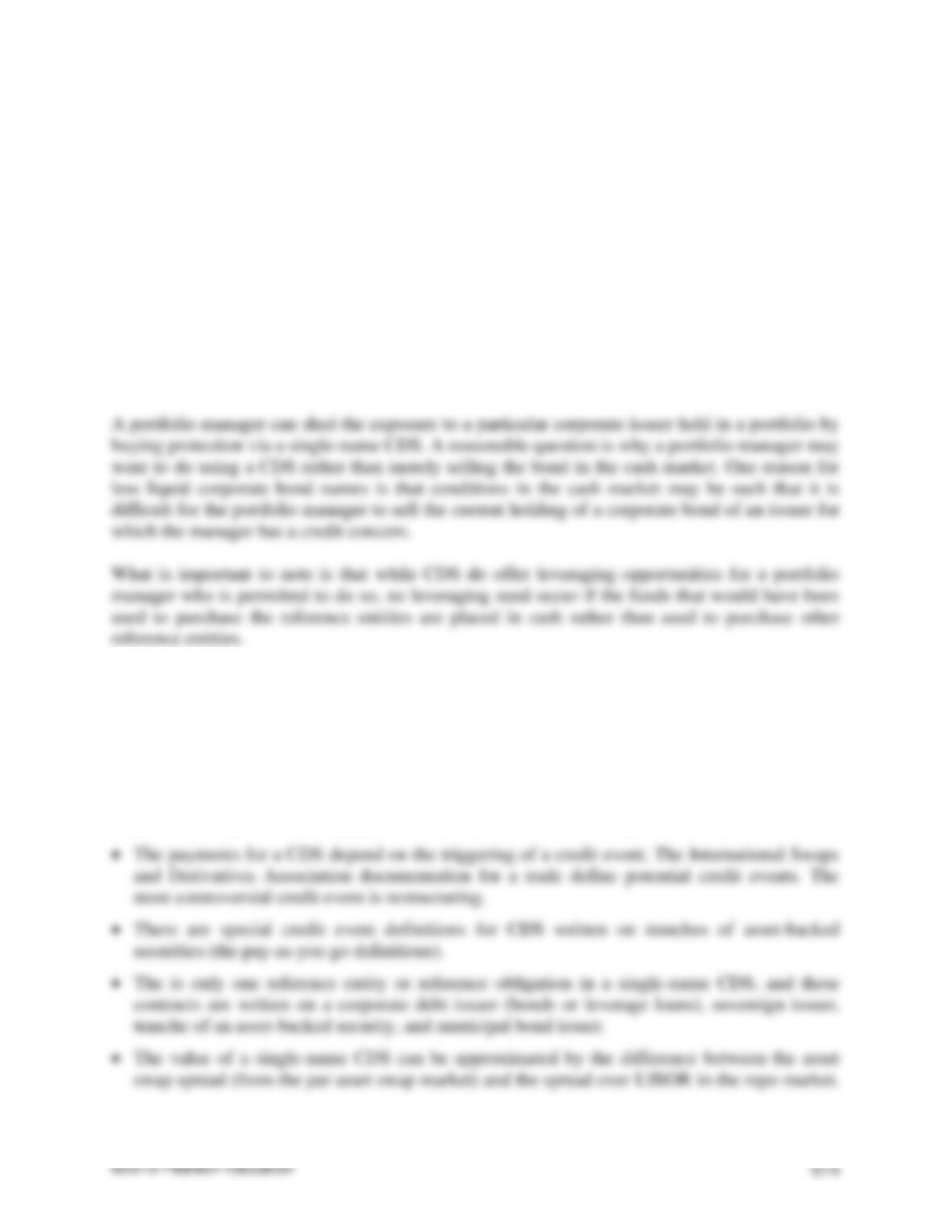
Let’s look at the cash flow for the credit protection buyer where the reference obligation is bond
ABC. This party to the CDS makes a quarterly payment equal to the CDS spread. However, the
swap payments are only made if bond ABC does not trigger a credit event. Thus, as with an
Let’s now suppose that a credit event occurs. The protection buyer no longer must make any
payment to the protection buyer. Consequently, the protection buyer has an economic position
that is analogous to a short position in a cash bond.
USING CDS FOR CONTROLLING CREDIT RISK
Consider a single-name credit CDS written on a corporate reference entity. The liquidity of the
CDS market compared to the corporate bond market makes it more efficient to obtain exposure
to a reference entity by taking a position in the CDS market rather than in the cash market.
For a portfolio manager seeking a leveraged position in a corporate bond, this can be done with
a CDS since the economic position of a protection seller is equivalent to a leveraged position in
a corporate bond.
KEY POINTS
• Interest-rate derivatives can be used to control interest-rate risk with respect to changes in the
level of interest rates. Credit derivatives can be used to control the credit risk of a security.
• By far, the most dominant type of credit derivative is the credit default swap wherein the
protection buyer makes a payment of the swap premium to the protection seller; however, the
protection buyer receives a payment from the protection seller only if a credit event occurs.

An asset swap structured by a dealer firm involves an investor selling a fixed-rate credit risky
bond to the dealer firm and receiving floating-rate payments.
• A CDS valuation model can be used to obtain the implied default probability for a reference
entity. However, the probability calculated depends on the validity of the model and the
estimated inputs.
• The economic interpretation of the credit protection seller is that it is analogous to a leveraged
position in the reference entity (in the case of a single-name CDS) or the standardized basket
of reference entities (in the case of an index CDS). For the credit protection buyer, the
position is analogous to a short position in the reference entity or reference entities.

ANSWERS TO QUESTIONS FOR CHAPTER 29
(Questions are in bold print followed by answers.)
1. How does the role of a credit derivative differ from that of an interest-rate swap in terms
of controlling risk?
Recall that derivatives can be used to control risk (hedging being a special case of risk
controlwhere risk is eliminated) and provide a more transactionally efficient vehicle for doingso.
Thus, a credit derivative controls for a credit risk in a manner that an interest-rate swap cannot.
More details are given below.
An interest rate swap is a derivative involving an agreement between two parties (known as
counterparties) where one stream of future interest payments is exchanged for another based on
a specified principal amount. A company will typically use interest rate swaps to limit or manage
exposure to fluctuations in interest rates, or to obtain a marginally lower interest rate than it
would have been able to get without the swap.Interest rate swaps expose users to interest rate
risk and credit risk. A typical swap consists of two legs, one fixed, the other floating. Some think
that the risky component is the floating leg, since the underlying interest rate floats and so is
unknown. However, the risky component is in fact the fixed leg because the value of the floating
2. Why is a portfolio manager concerned with more than default risk when assessing
a portfolio’s credit exposure?

3. Answer the below questions.
(a) What is meant by a reference entity?
(b) What is meant by a reference obligation?
4. What authoritative source is used for defining a “credit event”?
The International Swap and Derivatives Association (ISDA) provide definitions of what credit
events are. The 1999 ISDA Credit Derivatives Definitions (referred to as the “1999 Definitions”)
provides a list of eight credit events: bankruptcy, credit event upon merger, cross acceleration,
cross default, downgrade, failure to pay, repudiation/moratorium, and restructuring. These eight
5. Why is “restructuring” the most controversial credit event?
The most controversial credit event that may be included in a credit default swap is restructuring
of an obligation. A restructuringoccurs when the terms of the obligation are altered so as to make

©2013 Pearson Education
678
The reason why restructuring is controversial is that a protection buyer profits from the inclusion
of a restructuring as a credit event and feels that eliminating restructuring as a credit event will
erode its credit protection. The protection seller, in contrast, would prefer not to include
restructuring since even routine modifications of obligations that occur in lending arrangements
would trigger a payout to the protection buyer. Moreover, if the reference obligation is a loan and
the protection buyer is the lender, there is a dual benefit for the protection buyer to restructure
a loan. First, the protection buyer receives a payment from the protection seller. Second, the
accommodating restructuring fosters a link between the lender (who is the protection buyer) and
its customer (the corporate entity that is the obligor of the reference obligation).
6. Why does a credit default swap have an option-type payoff?
A credit default swap has an option-type payoff because the occurrence of a contingent event
triggers the buyer to exercise their right to enhance their value. More details are given below.
Credit default swaps are used to shift credit exposure to a credit protection seller. Their primary
purpose is to hedge the credit exposure to a particular asset or issuer. In this sense, credit default
swaps operate much like a standby letter of credit or insurance policy. In a credit default swap,
the protection buyer pays a fee to the protection seller in return for the right to receive a payment
conditional upon the occurrence of a credit event by the reference obligation or the reference
entity. If a credit event occurs, then the protection seller must make a payment. Because an
7. Comment on the following statement: “Restructuring is included in credit default swaps
and therefore the reduction in a reference obligation’s interest rate will result in the
triggering of a payout. This exposes the protection seller to substantial risk.”
Reduction in a reference obligation’s interest rate is one term of the contract that can cause
a restructuring. This exposes the protection seller to risk because restructuring tends to favor the
protection buyer. More details are given below.