then this involves the manager entering into a swap as the fixed-rate payer. It can be shown that
the dollar duration for a notional amount of $7,699,779 is $340,881. Hence a 5-year interest-rate
7. A portfolio manager buys a swaption with a strike rate of 4.5% that entitles the portfolio
manager to enter into an interest-rate swap to pay a fixed-rate and receives a floating rate.
The term of the swaption is five years.
Answer the below questions.
(a) Is this swaption a payer swaption or a receiver swaption? Explain.
It is a payer swaption because it entitles the option buyer to enter into an interest-rate swap in
which the buyer of the option pays a fixed-rate and receives a floating rate. More details are
given below.
There are two types of swaptions—a payer swaption and a receiver swaption. A payer swaption
entitles the option buyer to enter into an interest-rate swap in which the buyer of the option pays
a fixed-rate and receives a floating rate. For example, suppose that the strike rate is 7.25%, the
term of the swap is five years, and the swaption expires in two years. Also assume that it is an
(b) What does the strike rate of 4.5% mean?
8. The following appeared on a quote sheet: “Receiver Swaption: An option to receive the
fixed leg of a swap (i.e., long receiver is long duration). Payer Swaption: An option to pay
the fixed leg of a swap (i.e., long payer is short duration)”.
(a) Explain why for the receiver swaption the party is long duration.
In a receiver swaption the swaption buyer has the right to enter into an interest-rate swap that
requires paying a floating rate and receiving a fixed rate. As with any fixed-income contract, the
value of a swap will change as interest rates change.Dollar duration is a measure of the
interest-rate sensitivity of a fixed-income contract.From the perspective of the party who pays
Most of the dollar price sensitivity of a swap due to interest-rate changes will result from the
dollar duration of the fixed-rate bond because the dollar duration of the floating-rate bond will be
small. The closer the swap is to the date that the coupon rate is reset, the smaller the dollar
duration of a floating-rate bond. The implication here is that to increase the dollar duration of a
If we want to add duration to a portfolio and a fixed-rate receiver swap will add duration, this
means that the manager should buy a receiver swaption (i.e., receive fixed and pay floating).
Suppose on March 31, 2011, the manager decides to use a 1×5 ATM receiver European swaption
As we explained in describing options in Chapter 27, an option can be in-the-money (ITM),
at-the-money (ATM), or out-of-the-money (OTM). The terminology applies based on how the
How is a swaption used? Its usefulness can be found in two applications of a swap: controlling
the duration of a portfolio and asset-liability management. Below we focus on the duration
aspect.
In Chapter 27 we illustrated how to use futures options to control the interest rate risk of an
individual bond. Let’s look at how a swaption can be used to create an option-type payoff for the
bond portfolio that was used in Chapter 26 to show to use futures to change duration and earlier
in this chapter to show how to use swaps for the same purpose.
Let’s look at the type of position that must be taken. Recall in the illustration that the manager
wants to increase the interest rate risk exposure of the portfolio. With a futures contract this is
done by buying Treasury futures and with an interest rate swap this accomplished by being the
fixed-rate receiver. Using an option-type instrument such as a swaption, the manager wants
(b) Explain why for the payer swaption the party is short duration.
A payer swaption entitles the option buyer to enter into an interest-rate swap in which the
option buyer pays a fixed rate and receives a floating rate. As noted in the previous question:
9. The manager of a savings and loan association is considering the use of a swap as part of
its asset/liability strategy. The swap would be used to convert the payments of its portfolio
of fixed-rate residential mortgage loans into a floating payment.
Answer the below questions.
(a) What is the risk with using a plain vanilla or generic interest-rate swap?
Assuming its liabilities are composed of floating-rate payments, converting its assets (i.e., its
portfolio of fixed-rate mortgage loans) in floating payment should be risk reducing. However,
the risk reduction depends on the reference rates used as well as the extent the liabilities are
(b) Why might a manager consider using an interest-rate swap in which the notional
principal amount declines over time?
A manager would consider using an interest-rate swap in which the notional principal amount
declines over time where the principal of the asset that is being hedged with the swap amortizes
over time. Such a swap is called an amortizing swap. More details are given below.
An amortizing swapis one in which the notional principal amount decreases in a predetermined
way over the life of the swap. Such a swap would be used where the principal of the asset that is
(c) Why might a manager consider buying a swaption?
Managers will consider buying a swaption if at a later date they plan on entering into a swap and
need to lock in a desired swap rate that they will either pay or receive. More details on swaptions
are given below.
option can be exercised only at the option’s expiration date.
There are two types of swaptions—a payer swaption and a receiver swaption. A payer swaption
entitles the option buyer to enter into an interest-rate swap in which the buyer of the option pays
a fixed-rate and receives a floating rate. For example, suppose that the strike rate is 7%, the term
of the swap is three years, and the swaption expires in two years. Also assume that it is an
10. Consider the following interest-rate swap:
• the swap starts today, January 1 of year 1 (swap settlement date)
• the floating-rate payments are made quarterly based on actual / 360
Answer the below questions.
(a) Suppose that today’s three-month LIBOR is 5.7%. What will the fixed-rate payer for
this interest rate swap receive on March 31 of year 1 (assuming that year 1 is not a leap
year)?
The quarterly floating-rate payments are based on an actual / 360 day count convention. This
convention means that 360 days are assumed in a year and that in computing the interest for the
quarter the actual number of days in the quarter is used. The floating-rate payment is set at the
360
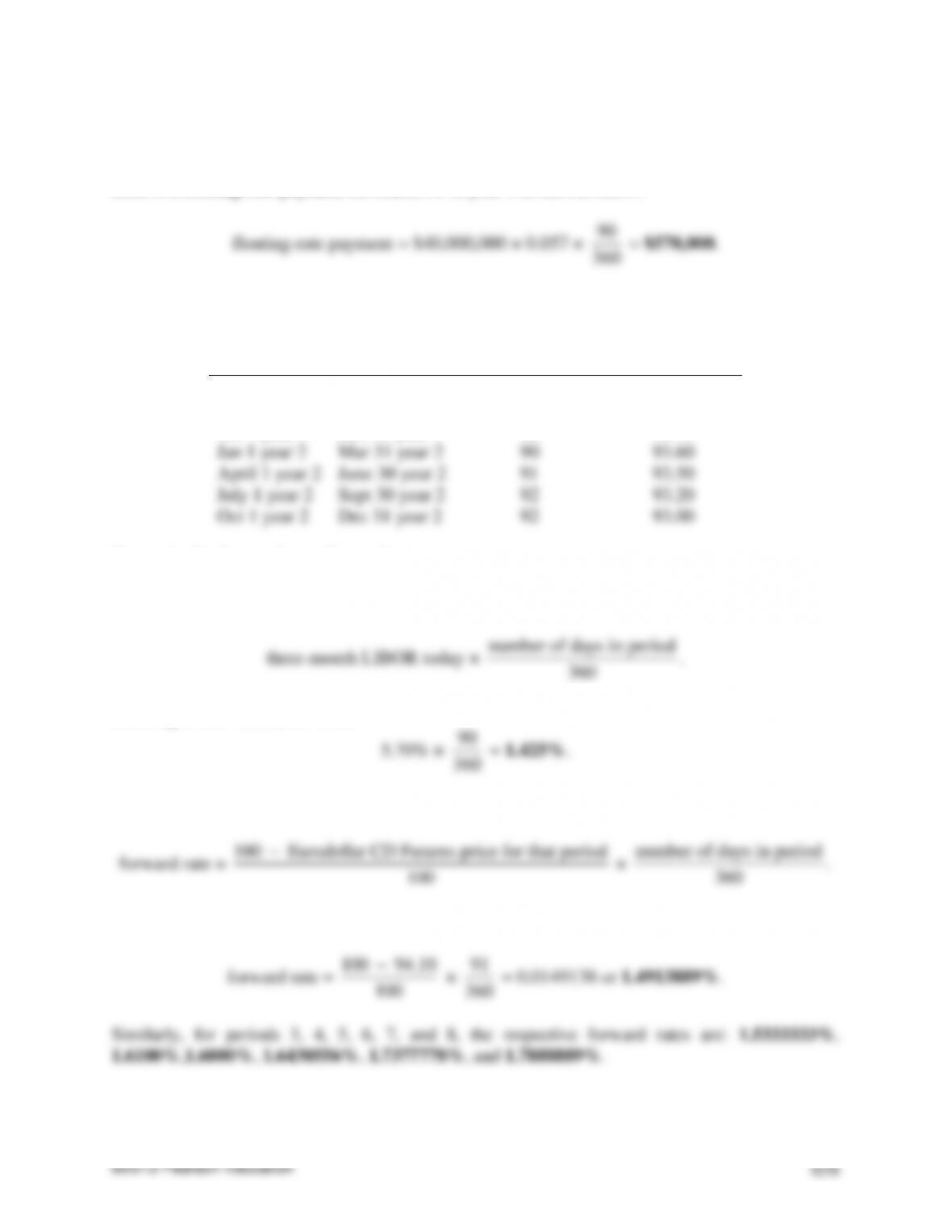
In our problem, assuming a non-leap year, the number of days from January 1 of year 1 to March 31
of year 1 (the first quarter) is 90. If three-month LIBOR is 5.7%, then the fixed-rate payer will
receive a floating-rate payment on March 31 of year 1 as shown below:
360
(b) Assume the Eurodollar futures price for the next seven quarters is as follows:
Quarter Starts
Quarter Ends
Number of Days
in Quarter
Eurodollar
Futures Price
April 1 year 1
June 30 year 1
91
94.10
July 1 year 1
Sept 30 year 1
92
94.00
Oct 1 year 1
Dec 31 year 1
92
93.70
Jan 1 year 2
Mar 31 year 2
90
93.60
April 1 year 2
June 30 year 2
91
93.50
July 1 year 2
Sept 30 year 2
92
93.20
Oct 1 year 2
Dec 31 year 2
92
93.00
Compute the forward rate for each quarter.
Forward rate for period 1 is:
360
Inserting in our values, we have:
90
360
The forward rate for periods 2 through 8 is given by:
100
360
Inserting in the value for period two (i.e., April 1 year1 to June 30 year 1), we have:
91
360
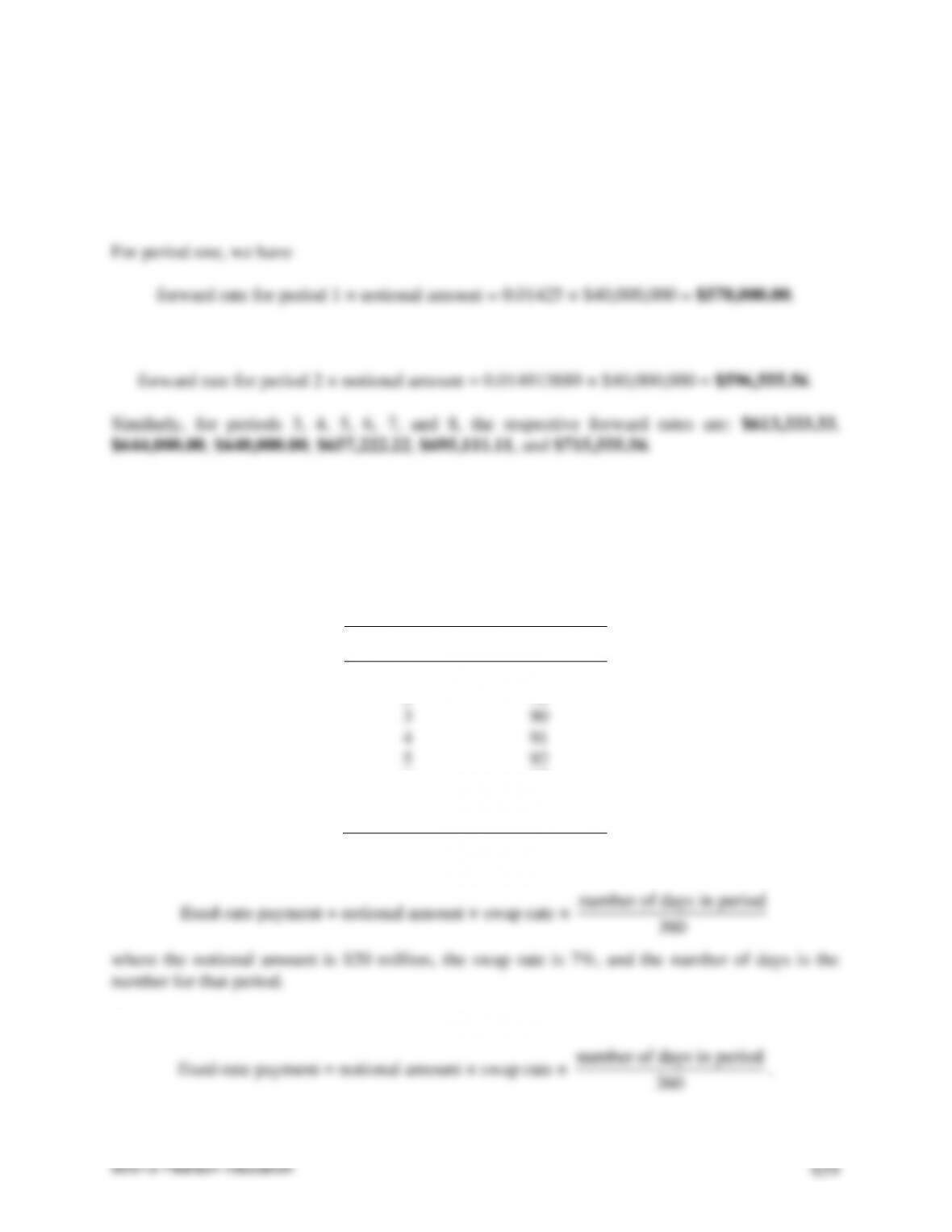
(c) What is the floating-rate payment at the end of each quarter for this interest-rate swap?
The floating-rate payment for each period is the forward rate for that period, as given in the part
(b), times the notional amount of $40 million.
For period two, we have:
11. Answer the below questions.
(a) Assume that the swap rate for an interest-rate swap is 7% and that the fixed-rate swap
payments are made quarterly on an actual / 360 basis. If the notional amount of a two-year
swap is $20 million, what is the fixed-rate payment at the end of each quarter assuming the
following number of days in each quarter?
Period Quarter
Days in Quarter
1
92
2
92
3
90
4
91
5
92
6
92
7
90
8
91
The fixed-rate payment for each quarter is given by:
number of days in period
For period one, we have:
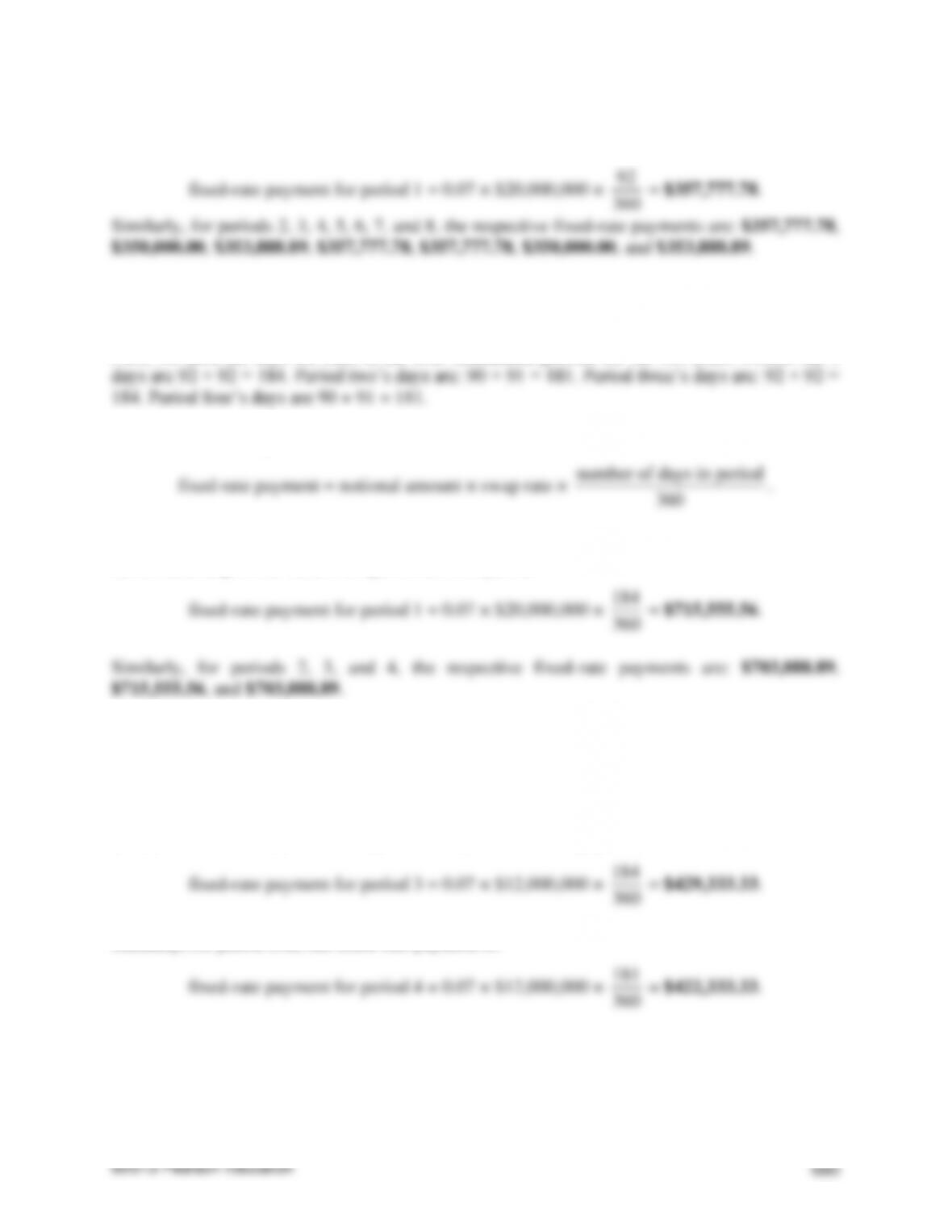
Inserting in our values, we have:
92
(b) Assume that the swap in part (a) requires payments semiannually rather than quarterly.
What is the semiannual fixed-rate payment?
First, we need the days for each of the four semiannual periods for the two years. Period one’s
We use the formula given above as:
360
where the notional amount and swap rate are the same but the number of days change as given
above. Inserting in our values, we get for the first period:
(c) Suppose that the notional amount for the two-year swap is not the same in both years.
Suppose instead that in year 1 the notional amount is $20 million, but in year 2 the notional
amount is $12 million. What is the fixed-rate payment every six months?
The fixed-payments for the first two six-month periods are the same as given in part (b) as
$715,555.56 and $703,888.89. For period three, the fixed-rate payment is:
360
Similarly, for period four, the fixed-rate payment is:
360
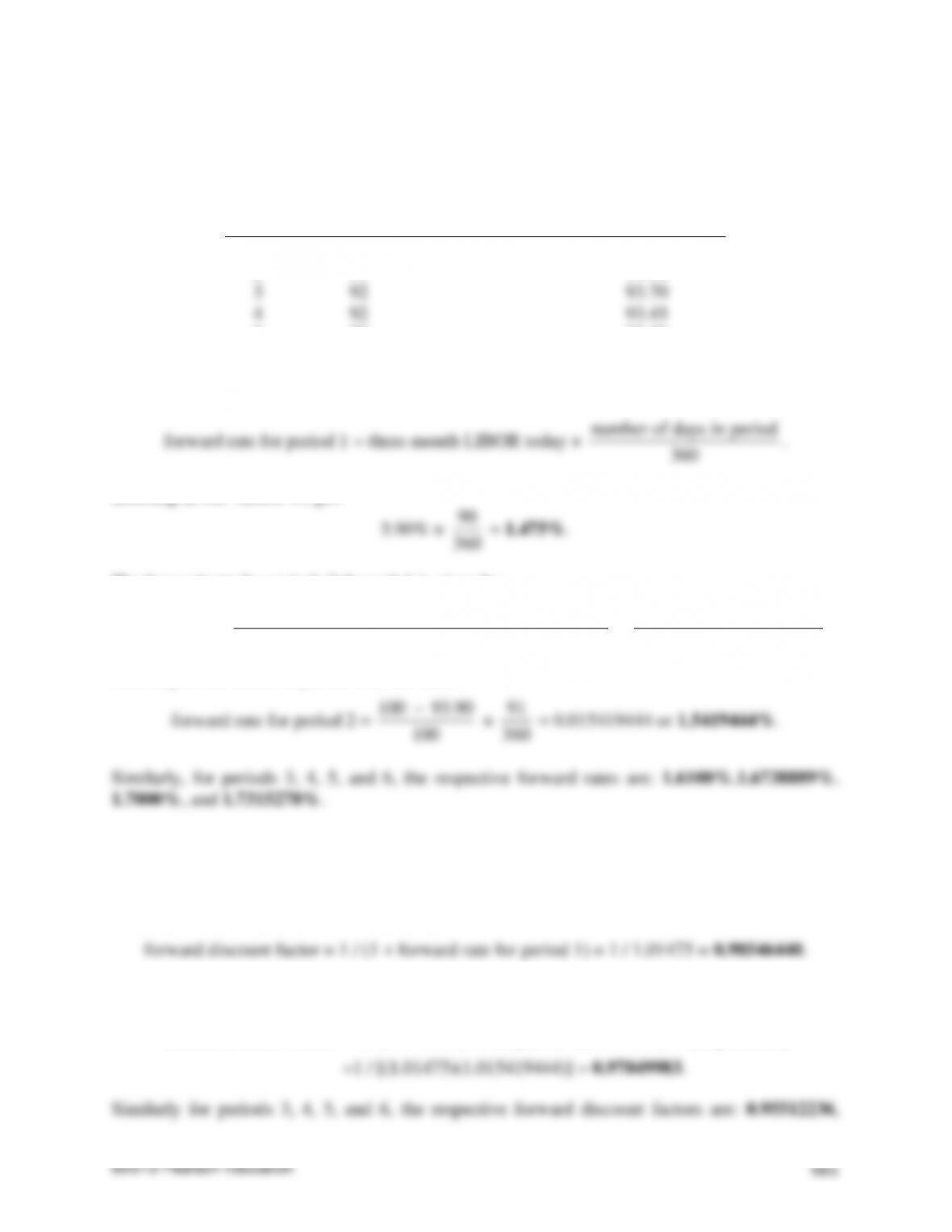
12. Given the current three-month LIBOR and the Eurodollar futures prices shown in the
table below, compute the forward rate and the forward discount factor for each period.
Period
Days in Quarter
3-month LIBOR
Current Eurodollar
Futures Price
1
90
5.90%
2
91
93.90
3
92
93.70
4
92
93.45
5
90
93.20
6
91
93.15
For period one, we haves:
number of days in period
360
Inserting in our values, we get:
90
The forward rate for periods 2 through 6 is given by:
forward rate =
100 Eurodollar CD Futures price for that period
100
−
×
number of days in period
360
.
Inserting in the value for period two, we have:
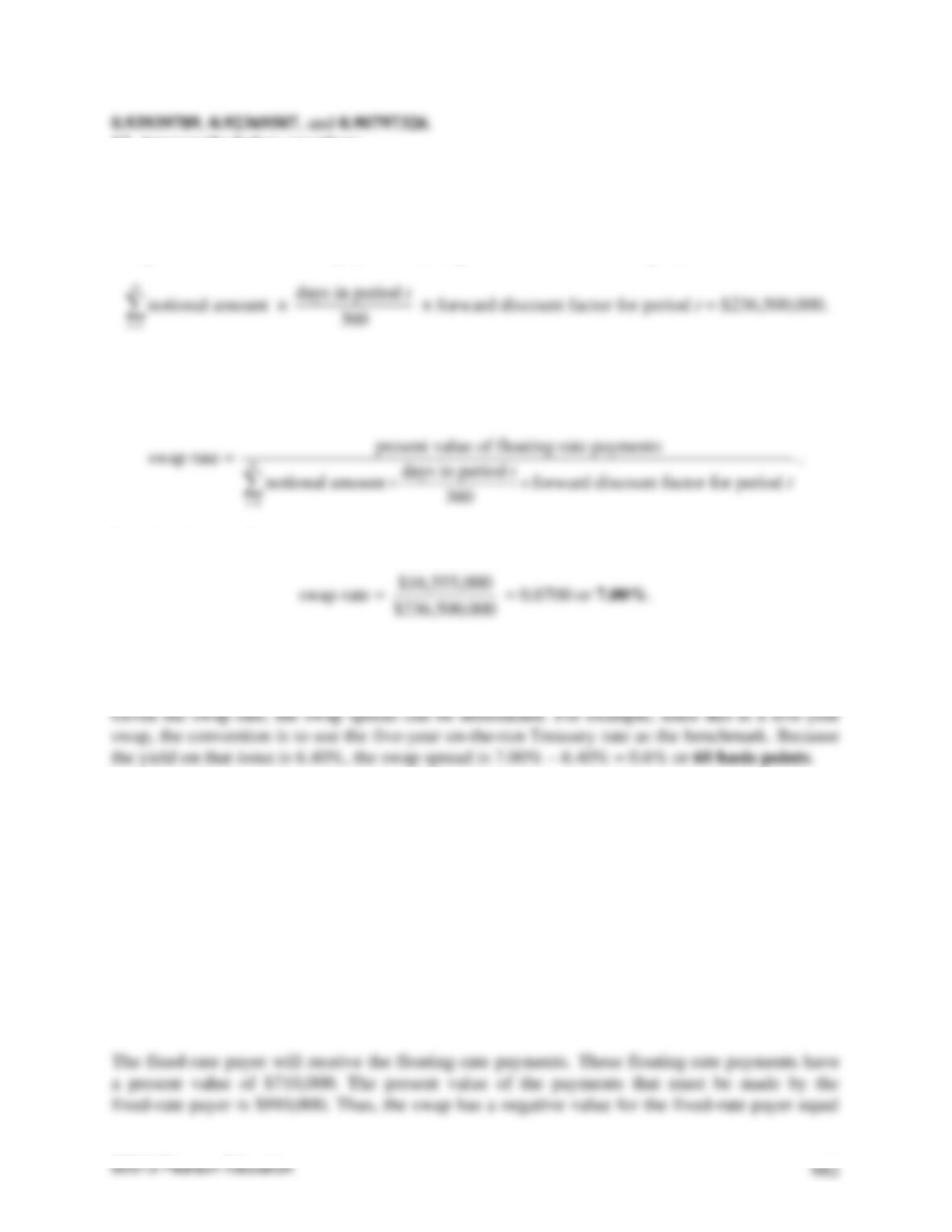
The forward discount factor for period t is given by:
1 / [(1 + forward rate period 1)(1 + forward rate period 2) . . . (1 + forward rate period t)].
For period 1, the forward discount factor is:
For period 2, the forward discount factor is:
forward discount factor = 1 / [(1 + forward rate period 1)(1 + forward rate period 2)]
©2013 Pearson Education
662
0.93939789, 0.92369507, and 0.90797326.
13. Answer the below questions.
(a) Suppose that at the inception of a five-year interest-rate swap in which the reference
rate is three-month LIBOR the present value of the floating-rate payments is $16,555,000.
The fixed-rate payments are assumed to be semiannual. Assume also that the following is
computed for the fixed-rate payments (using the notation in the chapter):
What is the swap rate for this swap?
The swap rate is given by:
Inserting in our values we get:
$236,500,000
(b) Suppose that the five-year yield from the on-the-run Treasury yield curve is 6.4%.
What is the swap spread?
14. An interest-rate swap had an original maturity of five-years. Today, the swap has two
years to maturity. The present value of the fixed-rate payments for the remainder of the
term of the swap is $910,000. The present value of the floating-rate payments for the
remainder of the swap is $710,000.
Answer the below questions.
(a) What is the value of this swap from the perspective of the fixed-rate payer?
We have: present value of fixed-rate payments = $910,000 and present value of floating-rate
payments = $710,000. The two present values are not equal, therefore, for one party the value of
the swap increased while for the other party the value of the swap decreased.
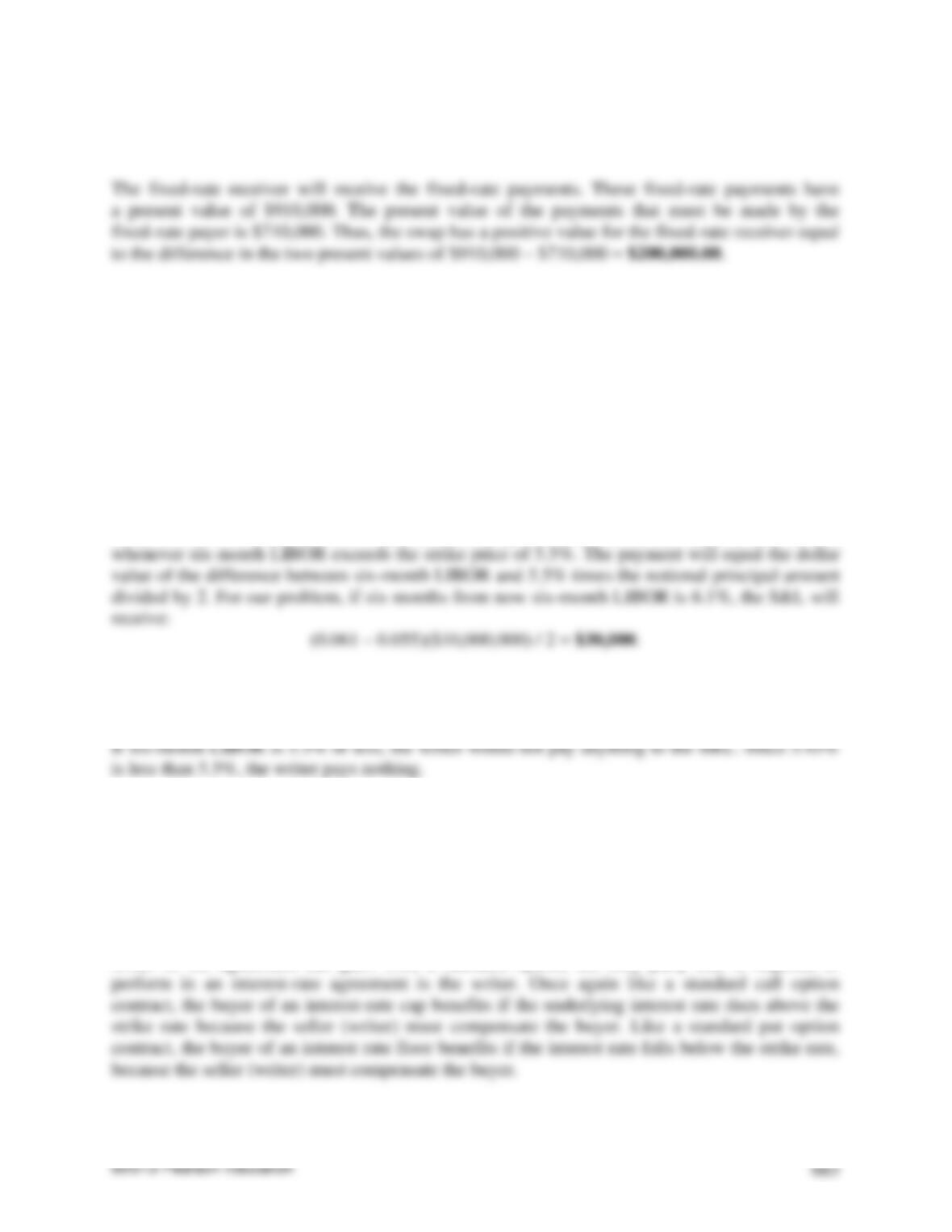
to the difference in the two present values of $710,000 – $910,000 = −$200,000.00.
(b) What is the value of this swap from the perspective of the fixed-rate receiver?
15. Suppose that a savings and loan association buys an interest–rate cap that has these
terms: The reference rate is the six-month Treasury bill rate; the cap will last for five
years; payment is semiannual; the strike rate is 5.5%; and the notional amount is
$10 million. Suppose further that at the end of a six-month period, the six-month Treasury
bill rate is 6.1%.
Answer the below questions.
(a) What is the amount of the payment that the savings and loan association will receive?
The buyer of a cap benefits if the interest rate rises above the strike rate. Under this agreement,
every six months for the next five years, the savings and loan association (S&L) will receive
(b) What would the writer of this cap pay if the six-month Treasury rate were 5.45%
instead of 6.1%?
16. What is the relationship between an interest-rate agreement and an option on an interest
rate?
An interest-rate agreement is a package of interest-rate options. More details are given below.
Just like a standard option contract, the buyer of an interest-rate agreement pays an upfront fee
which represents the maximum amount that the buyer can lose and the maximum amount that the
writer of the agreement can gain. Like a standard option, the only party that is required to
17. How can an interest-rate collar be created?
18. Value a three-year interest rate floor with a $10 million notional amount and a floor
rate of 4.8% using the binomial interest-rate trees shown in Exhibit 28-11.
The arbitrage-free binomial model described in Chapter 18 can also be used to value a floor and
a cap. This is because a floor and a cap are nothing more than a package or strip of options. More
specifically, they are a strip of European options on interest rates. To value a floor, the value of
each period’s floor, called a floorlet, is found and all the floorlets are then summed. We refer to
this approach to valuing a floor as the floorlet method. (The same approach can be used to value
a cap.)
©2013 Pearson Education
665
the reference rate is greater than 4.8% nothing is received. This agreement specifies payment in
arrears. For example, consider at Date 1 the interest rate (reference rate) of 4.4448%. Here there
would be a payoff of:
(4.8% – 4.4448%) × $10,000,000 = $35,520.00.
The payment of $35,520.00 would be made at Date 2.
With this background, we will use the floorlet method to value the three-year floor.
This value of $125,603.86 occurs at Date 0 and is the Value of Year One floorlet.
We now move on to the Year Two floorlet. There are two interest rates at Date 1: 4.4448% and
5.4289%. If the interest rate is 4.4448% on Date 1, there is a payoff as explained earlier. The
payoff is $35,520.00 and will be made at Date 2. If the interest rate is 5.4289%, there is no
payoff because the rate is greater than 4.8%.
This value of $16,429.18 occurs at Date 0 and is the Value of Year Two floorlet.
For the valuation of the Year Three floorlet, there are three interest rates shown at Date 2. They
©2013 Pearson Education
666
This payoff is shown at Date 3 because it is paid in arrears. The present value of this payoff on
Date 2 to be received at Date 3 is:
$10,420.00 /1.046958 = $9,952.64.
This present value is shown at Date 2.
This value of $2,301.71 occurs at date 0 and is the Value of Year Three floorlet.
The value of the three-year interest rate floor is the sum of the three floorlets given as:
value of floor =
value of Year One floorlet + value of Year Two floorlet + value of Year Three floorlet.
For our floor floorlet problem, we get:
Value of Year One floorlet:
$125,603.86
Value of Year Two floorlet:
$16,429.18
Value of Year Three floorlet:
$2,301.71
Three-year interest rate floor:
$144,334.75