Chapter 28 – Investment Policy and the Framework of the CFA Institute
28-1
CHAPTER 28: INVESTMENT POLICY AND
THE FRAMEWORK OF THE CFA INSTITUTE
PROBLEM SETS
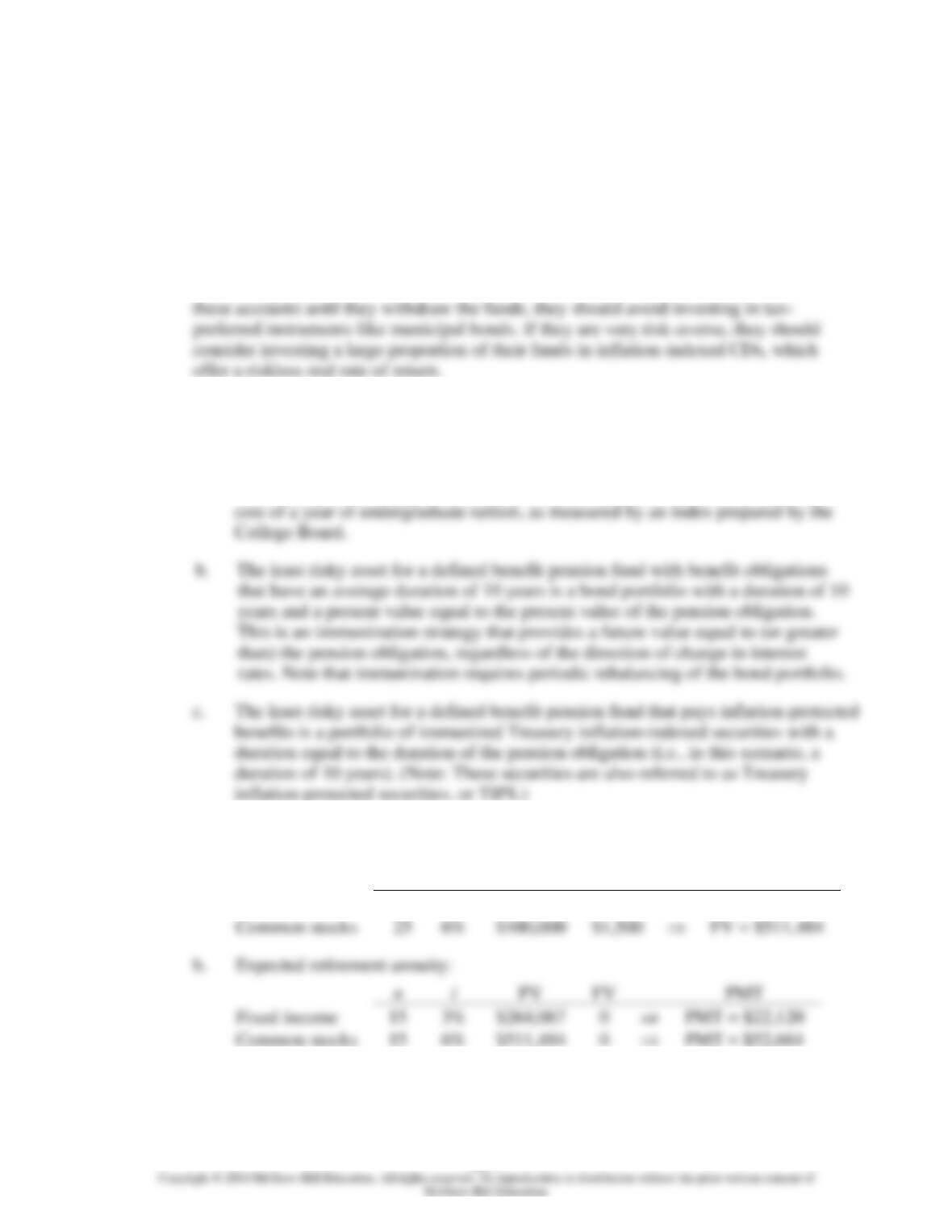
1. You would advise them to exploit all available retirement tax shelters, such as 403b,
401k, Keogh plans, and IRAs. Since they will not be taxed on the income earned from
2. a. The least risky asset for a person investing for her child’s college tuition is an
account denominated in units of college tuition. Such an account is the College
Sure CD offered by the College Savings Bank of Princeton, New Jersey. A unit of
this CD pays, at maturity, an amount guaranteed to equal or exceed the average
3. a. George More’s expected accumulation at age 65:
n
i
PV
PMT
FV
Fixed income
25
3%
$100,000
$1,500
FV = $264,067
Common stocks
$1,500
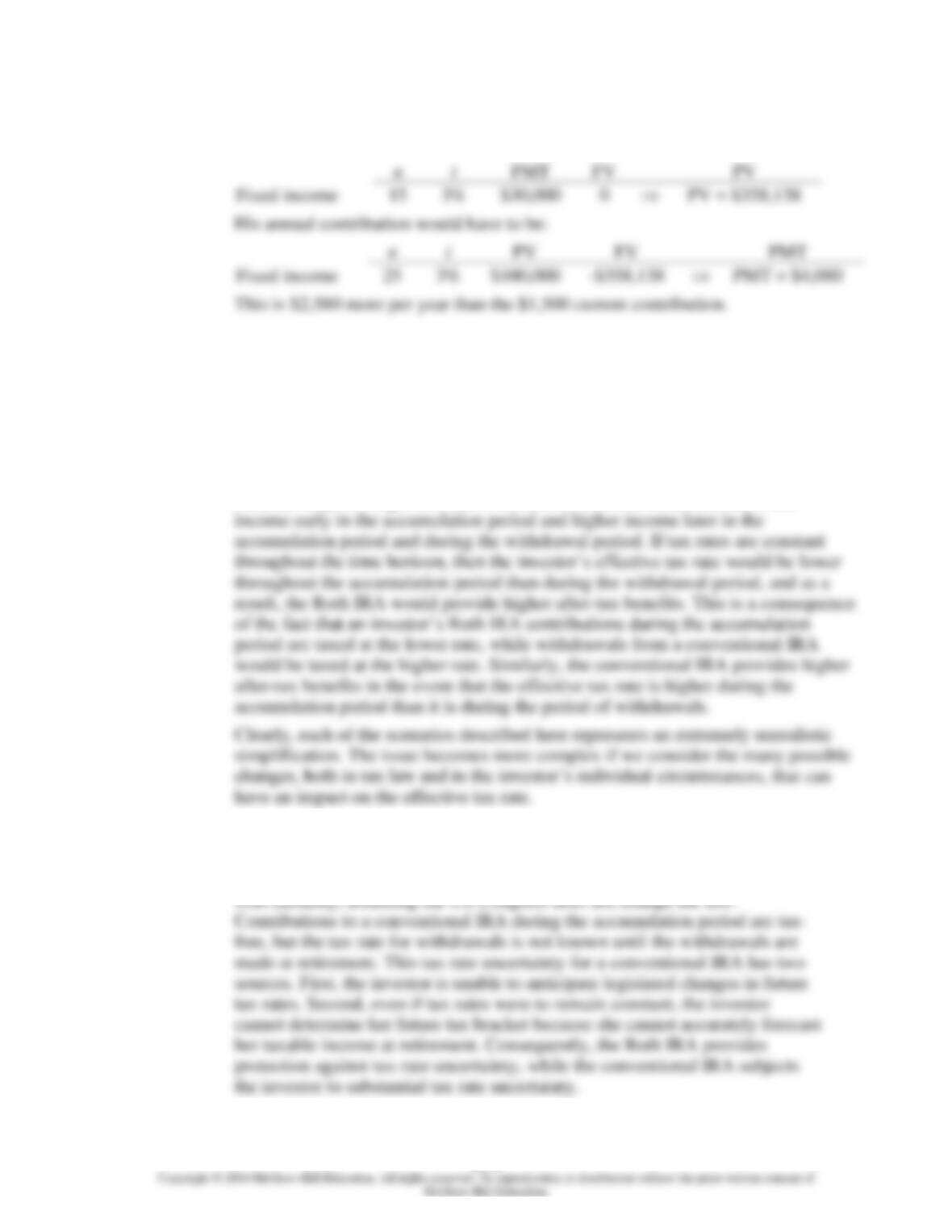
i
PV
Fixed income
15
Common stocks
15
Chapter 28 – Investment Policy and the Framework of the CFA Institute
28-2
c. In order to get a fixed-income annuity of $30,000 per year, his
accumulation at age 65 would have to be:
4. a. The answer depends on the assumptions made about the investor’s effective income
tax rates for the period of accumulation and for the period of withdrawals. First, we
assume that (i) tax rates remain constant throughout the entire time horizon; and (ii)
the investor’s taxable income remains relatively constant throughout. Consequently,
the investor’s effective tax rate does not change, and we find that the Roth IRA and
the conventional IRA provide the same after-tax benefits.
Alternatively, we might consider a scenario in which a household has a low
b. For the Roth IRA, contributions are made with after-tax dollars, so the tax rate
is known (and taxes are paid) during the accumulation period; the tax rate for
withdrawals at retirement from a Roth IRA is zero and is therefore also known
Chapter 28 – Investment Policy and the Framework of the CFA Institute
CFA PROBLEMS
1. a. (i) Return requirement: IPS Y has the appropriate language. Since the plan is
currently underfunded, the primary objective should be to make the pension fund
financially stronger. The risk inherent in attempting to maximize total returns
would be inappropriate.
(ii) Risk tolerance: IPS Y has the appropriate language. Because of the fund’s
b. The current portfolio is the most appropriate choice for the pension plan’s asset
allocation. The current portfolio offers:
(i) An expected return that exceeds the plan’s return requirement.
(ii) An expected standard deviation that only slightly exceeds the plan’s target.
(iii) A level of liquidity that should be sufficient for future needs.
The higher expected return will ameliorate the plan’s underfunded status
The Michael portfolio offers:
(i) An expected return that is substantially above the plan’s requirement.
(ii) An expected standard deviation that far exceeds the plan’s target.

Chapter 28 – Investment Policy and the Framework of the CFA Institute
28-4
2. c. Liquidity
4. a. An approach to asset allocation that GSS could use is the one detailed in the
chapter. It consists of the following steps:
1. Specify asset classes to be included in the portfolio. The major classes
usually considered are:
Money market instruments (usually called cash)
Fixed income securities (usually called bonds)
b. A guardian investor typically is an individual who wishes to preserve the
purchasing power of his assets. Extreme guardians would be exclusively in AAA
short-term credits. GSS should first determine how long the time horizon is and
5. a. OBJECTIVES
1. Return
The required total rate of return for the JU endowment fund is the sum of the
spending rate and the expected long-term increase in educational costs:
Spending rate = $126 million (current spending need) / ($2,000 million

Chapter 28 – Investment Policy and the Framework of the CFA Institute
28-5
Ability: Average risk
• Endowment funds are long term in nature, having infinite lives. This long time
horizon by itself would allow for above-average risk.
• However, creative tension exists between the JU endowment’s demand for high
current income to meet immediate spending requirements and the need for long–
term growth to meet future requirements. This need for a spending rate (in
excess of 5 percent) and the university’s heavy dependence on those funds
allow for only average risk.
Willingness: Above average risk
CONSTRAINTS
1. Time Horizon.
2. Liquidity.
Generally, endowment funds have long time horizons, and little liquidity is needed
in excess of annual distribution requirements. However, the JU endowment
3. Taxes. U.S. endowment funds are tax-exempt.
4. Legal/Regulatory.
U.S. endowment funds are subject to predominantly state (but some federal)

Chapter 28 – Investment Policy and the Framework of the CFA Institute
28-6
5. Unique Circumstances.
Only 25 percent of donated Bertocchi Oil and Gas shares may be sold in any
one-year period (constraint imposed by donor). This constraint reinforces the
need for diversification of the portfolio. A secondary consideration is the need to
budget the one-time $200 million library payment in eight months.
b. (Answers may vary)
U.S. money market fund: 15% (Range: 14% – 17%)
Liquidity needs for the next year are
Intermediate global bond fund: 10% (Range: 10% – 20%)
To achieve a 10 percent portfolio return, the fund needs to take above average
risk (e.g., 10% in global bond fund and 20% venture capital). An allocation
below 10 percent would involve taking unnecessary risk that would put the
safety and preservation of the endowment fund in jeopardy. An allocation in
the 11% to 20% range could still be tolerated because the slight reduction in
portfolio expected return would be partially compensated by the reduction in
portfolio risk. An allocation above 20% would not satisfy the endowment fund
return requirements.
Chapter 28 – Investment Policy and the Framework of the CFA Institute
28-7
To help fund short-term cash outflows, exposure to venture capital will be
reduced. This will be a modest decrease since divesting more than 1/5 (25%
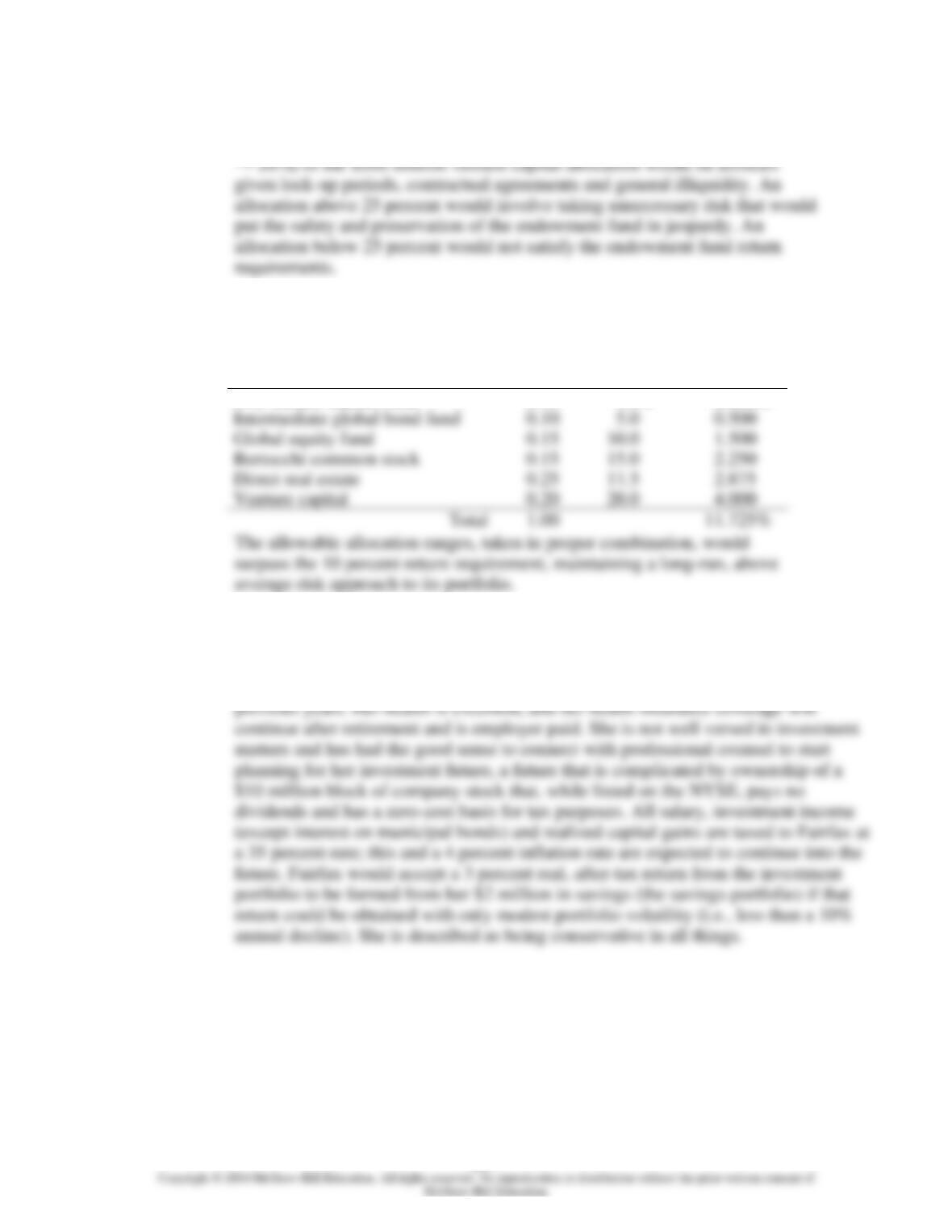
The suggested allocations (point estimates) would allow the JU endowment fund
to meet the 10 percent return requirement, calculated as follows:
Asset
Suggested
Allocation
Expected
Return
Weighted
Return
U.S. money market fund
0.15
4.0%
0.600%
1.00
6. a. Overview. Fairfax is 58 years old and has seven years until a planned retirement. She
has a fairly lavish lifestyle but few money worries. Her large salary pays all current
expenses, and she has accumulated $2 million in cash equivalents from savings in
OBJECTIVES
• Return Requirement. Fairfax’s need for portfolio income begins seven years from
now, at the date of retirement. The investment focus for her savings portfolio should
be on growing the portfolio’s value in the interim in a way that provides protection
against loss of purchasing power. Her 3 percent real, after-tax return preference
implies a gross total return requirement of at least 10.8 percent, assuming her

Chapter 28 – Investment Policy and the Framework of the CFA Institute
28-8
• Risk Tolerance. The information provided indicates that Fairfax is quite risk averse;
she is unwilling to experience a decline of more than 10 percent in the value of the
savings portfolio in any given year. This would indicate that the portfolio should
have below average risk exposure in order to minimize its downside volatility. In
terms of overall wealth, Fairfax is able to take more than average risk, but because of
her preferences and the nondiversified nature of the total portfolio, a below-average
she actually experiences as long as this holding remains intact.
CONSTRAINTS
• Time Horizon. Two-time horizons are applicable to Fairfax’s life. The first time
• Taxes. Fairfax’s taxable income (salary, taxable investment income, and realized
capital gains on securities) is taxed at a 35 percent rate. Careful tax planning and
coordination with investment planning is required. Investment strategy should
include seeking income that is sheltered from taxes and holding securities for
lengthy time periods in order to produce larger after-tax returns. Sale of the Reston
stock will have sizeable tax consequences because Fairfax’s cost basis is zero;
special planning will be needed for this eventuality. Fairfax may want to consider

Chapter 28 – Investment Policy and the Framework of the CFA Institute
28-9
some form of charitable giving, either during her lifetime or at death. She has no
immediate family, and we know of no other potential gift or bequest recipients.
• Laws and Regulations. Fairfax should be aware of, and abide by, any securities (or
lifestyle can be maintained after retirement with the combined portfolio. A
significant and prolonged setback for Reston Industries, however, could have
disastrous consequences. Such circumstances would require a dramatic downscaling
of Fairfax’s lifestyle or generation of alternate sources of income in order to
maintain her current lifestyle. A worst-case scenario might be characterized by a 50
planning and legal needs, her progress toward retirement, and the value of her
Reston stock. The Reston stock holding is a unique circumstance of decisive
significance in this situation. Developments should be monitored closely, and
protection against the effects of a worst-case scenario should be implemented as
soon as possible.
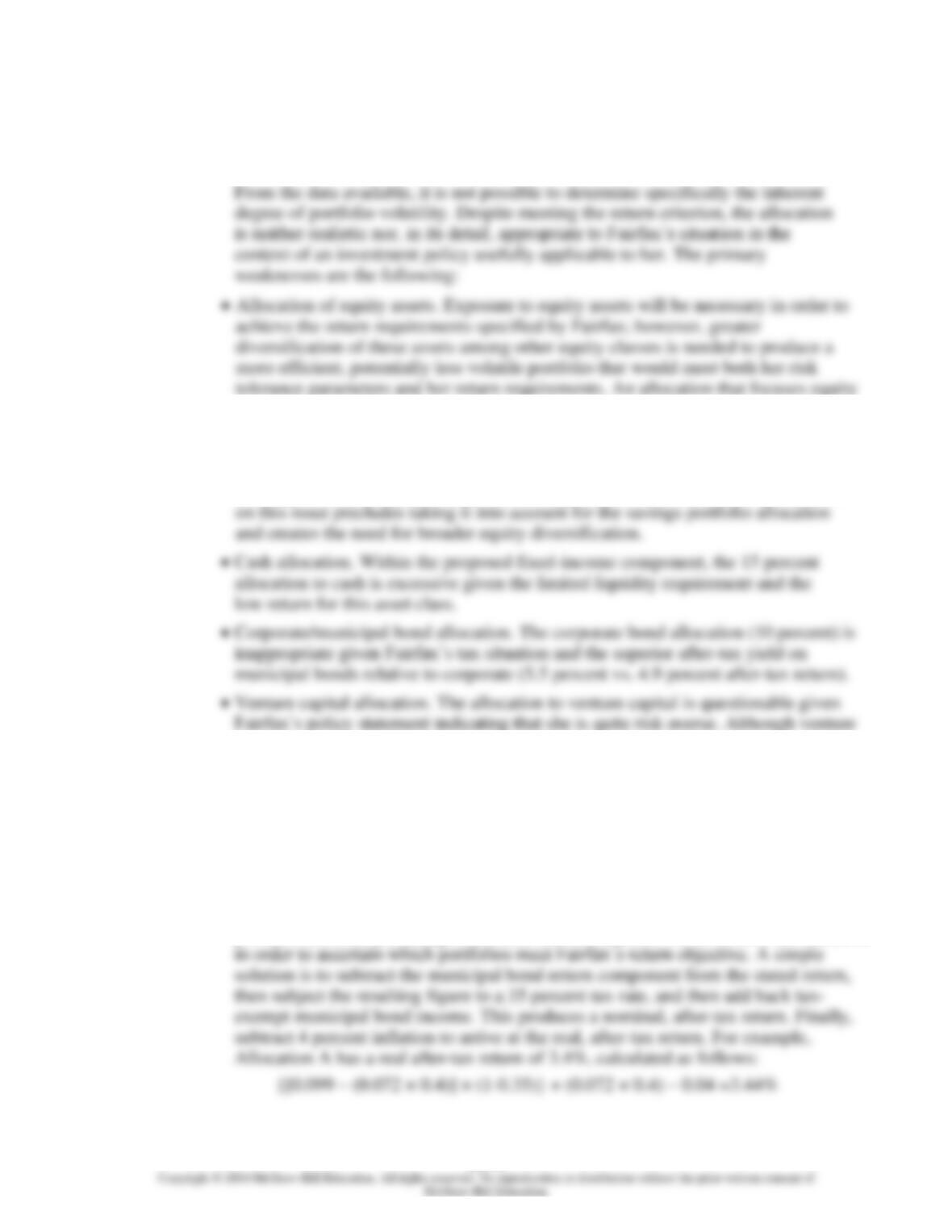
b. Critique. The Coastal proposal produces a real, after-tax expected return of
approximately 5.18 percent, which exceeds the 3 percent level sought by Fairfax.
Chapter 28 – Investment Policy and the Framework of the CFA Institute
28–10
This result can also be obtained by computing these returns for each of the
individual holdings, weighting each result by the portfolio percentage and then
adding to derive a total portfolio result.
investments in U.S. large-cap and/or small-cap holdings and also includes smaller
international and real estate investment trust exposure is more likely to achieve the
return and risk tolerance goals. If more information were available concerning the
returns and volatility of the Reston stock, an argument could be made that this
holding is the U.S. equity component of her portfolio. But the lack of information
capital may provide diversification benefits, venture capital returns historically have
been more volatile than other risky assets such as U.S. large- and small-cap stocks.
Hence, even a small percentage allocation to venture capital may be inappropriate.
• Lack of risk/volatility information. The proposal concentrates on return
expectations and ignores risk/volatility implications. Specifically, the proposal
should have addressed the expected volatility of the entire portfolio to determine
whether it falls within the risk tolerance parameters specified by Fairfax.
c. (i) Fairfax has stated that she is seeking a 3 percent real, after-tax return. Table 28G
provides nominal, pretax figures, which must be adjusted for both taxes and inflation
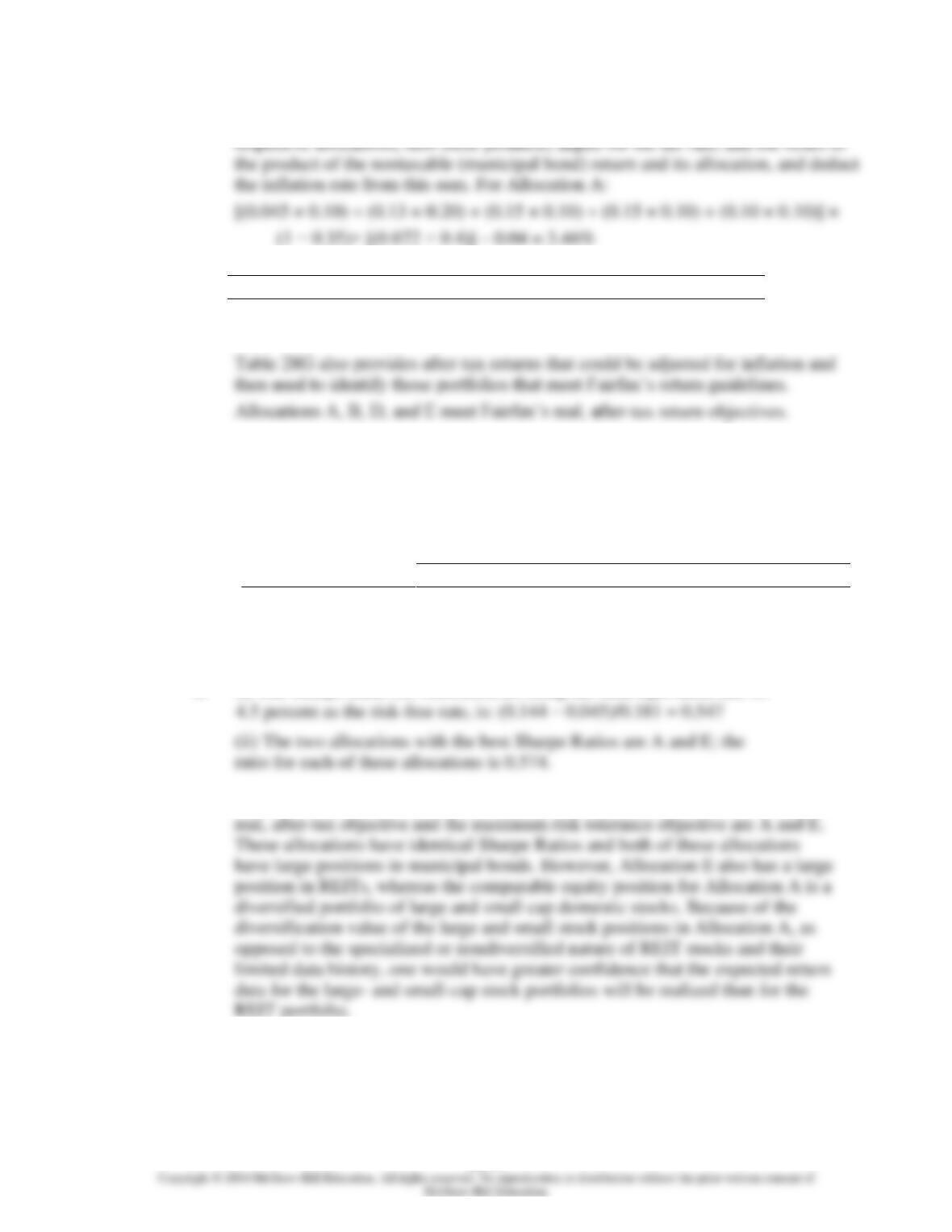
Chapter 28 – Investment Policy and the Framework of the CFA Institute
28–11
Alternatively, this can be calculated as follows: multiply the taxable returns by their
Allocation
Return Measure
A
B
C
D
E
Nominal return
9.9%
11.0%
8.8%
14.4%
10.3%
Real after-tax return
3.5
3.1
2.5
5.3
3.5
(ii) Fairfax has stated that a worst case return of –10 percent in any 12-month
period would be acceptable. The expected return less two times the portfolio risk
(expected standard deviation) is the relevant risk tolerance measure. In this case,
three allocations meet the criterion: A, C, and E.
Allocation
Parameter
A
B
C
D
E
Expected return
9.9%
11.0%
8.8%
14.4%
10.3%
Exp. std. deviation
9.4
12.4
8.5
18.1
10.1
Worst-case return
−8.9
−13.8
−8.2
−21.8
−9.9
d. (i) The Sharpe Ratio for Allocation D, using the cash equivalent rate of
e. The recommended allocation is A. The allocations that meet both the minimum
7. a. The key elements that should determine the foundation’s grant-making
(spending) policy are

Chapter 28 – Investment Policy and the Framework of the CFA Institute
28–12
(i) Average expected inflation over a long time horizon;
(ii) Average expected nominal return on the endowment portfolio over the same
Chapter 28 – Investment Policy and the Framework of the CFA Institute
28–13
b. OBJECTIVES
Return Requirement: Production of current income, the committee’s focus
before Mr. Franklin’s gift, is no longer a primary objective, given the increase in
the asset base and the committee’s understanding that investment policy must
accommodate long-term as well as short-term goals. The need for a minimum
annual payout equal to 5 percent of assets must be considered, as well as the
CONSTRAINTS
Liquidity Requirements: Liquidity needs are low, with little likelihood of
unforeseen demands requiring either forced asset sales or immense cash.
Such needs as exist, principally for annual grant-making, are known in
advance and relatively easy to plan for in a systematic way.
Unique Circumstances: The need to maintain real value after grants is a key
consideration, as is the 5 percent of assets requirement for tax exemption. The
real return achieved must meet or exceed the grant rate, with the 5 percent level
a minimum requirement.

Chapter 28 – Investment Policy and the Framework of the CFA Institute
28–14
c. To meet requirements of this scenario, it is first necessary to identify a spending
rate that is both sufficient (i.e., 5 percent or higher in nominal terms) and feasible
The allocation philosophy will reflect the foundation’s need for real returns at or
above the grant rate, its total return orientation, its above-average risk tolerance,
its low liquidity requirements, and its tax exempt status. While the Table 26H data
and historical experience provide needed inputs to the process, several
generalizations are also appropriate:
1. Allocations to fixed income instruments will be less than 50 percent as bonds
have provided inferior real returns in the past, and while forecasted real returns
2. Allocations to equities will be greater than 50 percent, and this asset class will be
3. Within the equity universe there is room in this situation for small-cap as well as
4. Given its value as an alternative to stocks and bonds as a way to maintain real
return and provide diversification benefits, real estate could be included in this
portfolio. In a long-term context, real estate has provided good inflation
protection, helping to protect real return production.
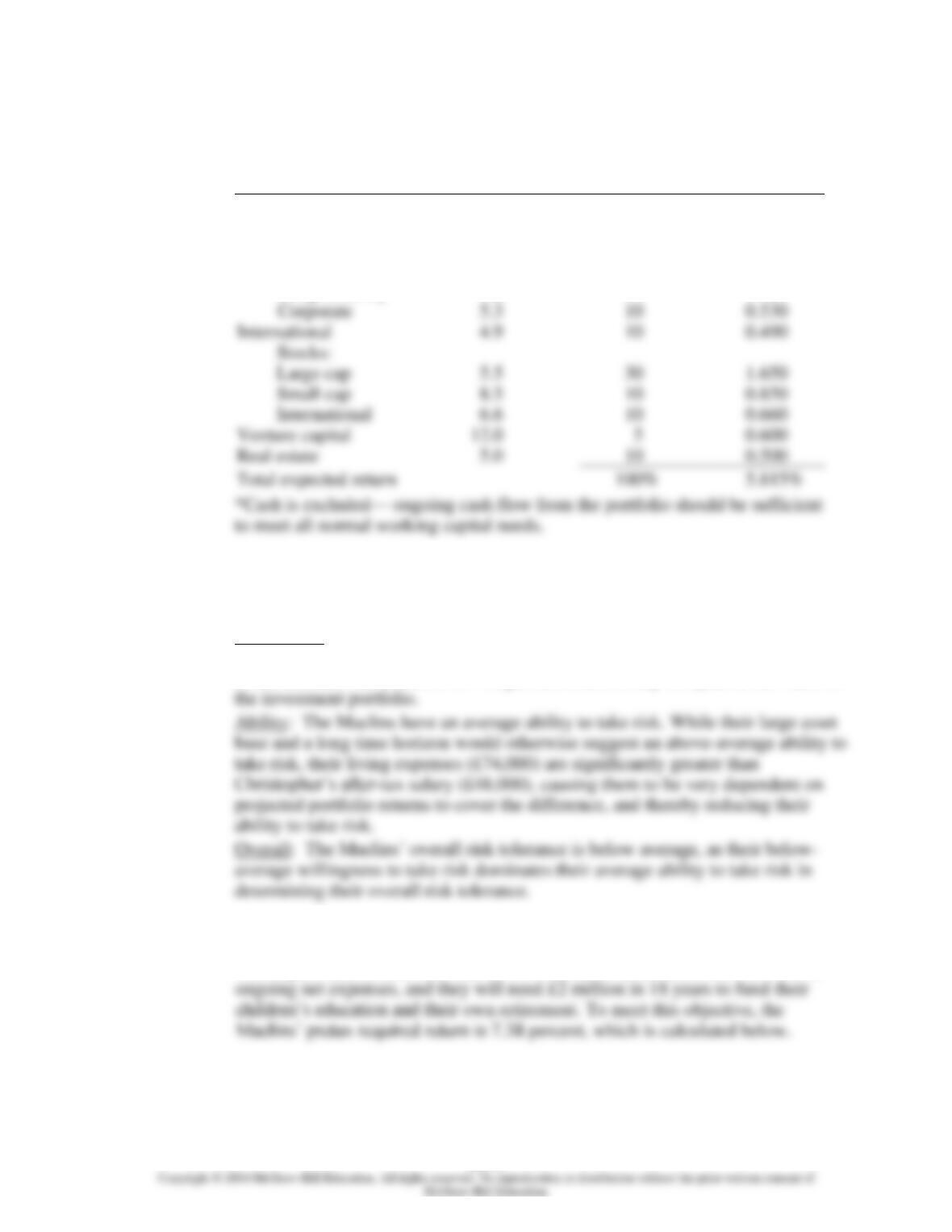
An example of an appropriate, modestly aggressive allocation is shown below.
Chapter 28 – Investment Policy and the Framework of the CFA Institute
28–15
Intermediate Term
Forecast of
Real Returns
Recommended
Allocation
Real Return
Contribution
Cash (U.S.) T-bills
0.7%
*0%
Bonds:
Intermediate
2.3
5
0.115%
Long Treasury
4.2
10
0.420
Corporate
5.3
10
0.530
International
4.9
10
0.490
Stocks:
Large cap
5.5
30
1.650
Small cap
8.5
10
0.850
International
6.6
10
0.660
Venture capital
5
0.600
Real estate
5.0
10
0.500
Total expected return
5.815%
8. a. The Maclins’ overall risk objective must consider both willingness and ability
to take risk.
Willingness: The Maclins have a below-average willingness to take risk, based
on their unhappiness with the portfolio volatility in recent years and their desire to
avoid shortfall risk in excess of –12 percent return in any one year in the value of
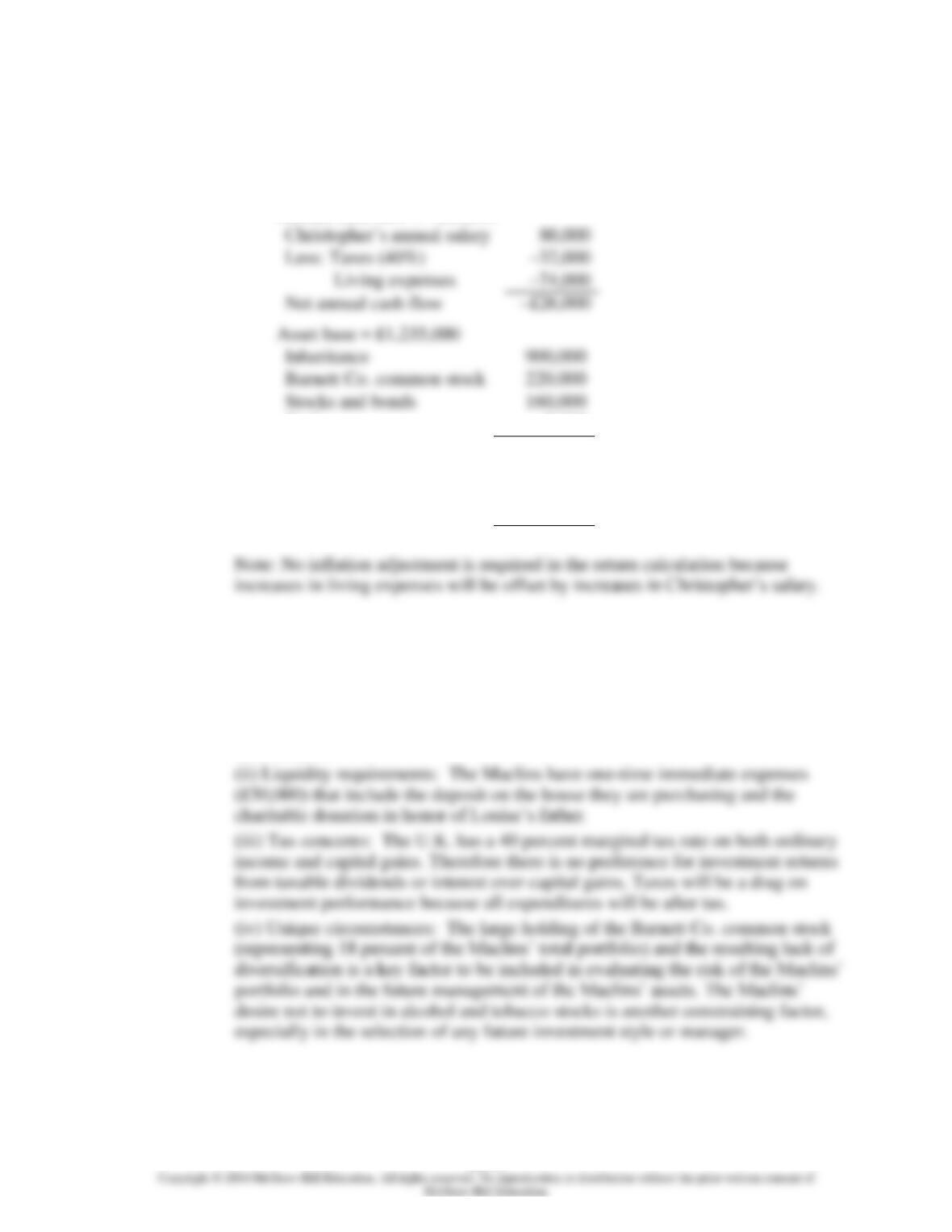
b. The Maclins’ return objective is to grow the portfolio to meet their educational
and retirement needs as well as to provide for ongoing net expenses. The Maclins
will require annual after-tax cash flows of £26,000 (calculated below) to cover
Chapter 28 – Investment Policy and the Framework of the CFA Institute
28–16
The after-tax return required to accumulate £2 million in 18 years, beginning
with an investable base of £1,235,000 (calculated below) and with annual
outflows of £26,000, is 4.427 percent. When adjusted for the 40 percent tax
rate, this results in a 7.38 percent pretax return: 4.427%/(1 − 0.40) = 7.38%
Annual cash flow = –£26,000
Less: Taxes (40%)
Net annual cash flow
Asset base = £1,235,000
Inheritance
Stocks and bonds
Cash
5,000
Subtotal
£1,285,000
Less one-time needs:
Down payment on house
–30,000
Charitable donation
–20,000
Total assets
£1,235,000
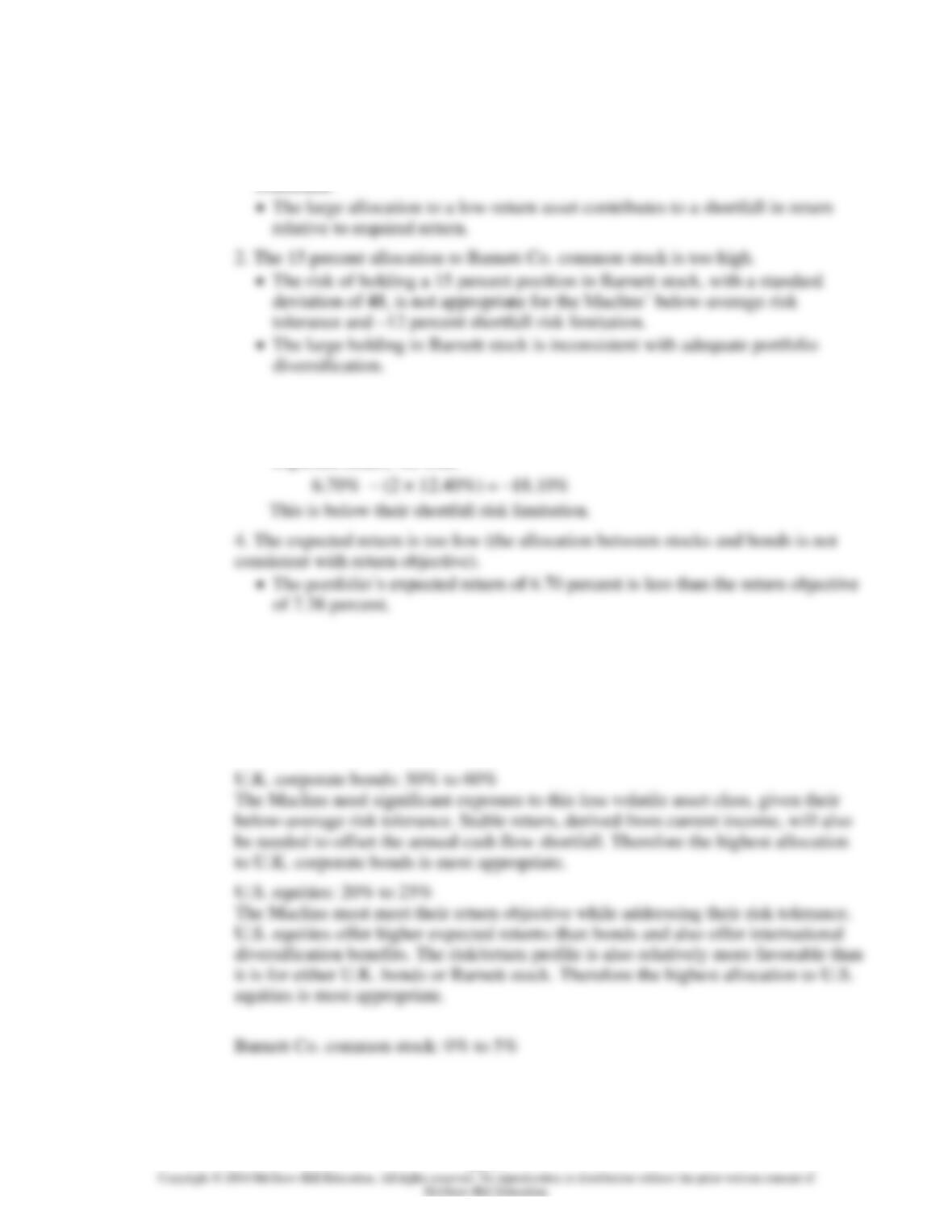
c. The Maclins’ investment policy statement should include the following
constraints:
(i) Time horizon: The Maclins have a two-stage time horizon because of their
changing cash flow and resource needs. The first stage is the next 18 years. The
second stage begins with their retirement and the university education years for
their children.
Chapter 28 – Investment Policy and the Framework of the CFA Institute
28–17
9. a. 1. The cash reserve is too high.
The 15 percent (or £185,250) cash allocation is not consistent with the liquidity
constraint.
3. Shortfall risk exceeds the limitation of –12 percent return in any one year.
• The Maclins have stated that their shortfall risk limitation is –12 percent return
in any one year. Subtracting 2 times the standard deviation from the portfolio’s
expected return, we find:
b. Note: The Maclins have purchased their home and made their charitable contribution.
Cash: 0% to 3%
The Maclins do not have an ongoing need for a specific cash reserve fund. Liquidity
needs are low and only a small allocation for emergencies need be considered.
Portfolio income will cover the annual shortfall in living expenses. Therefore the
lowest allocation to cash is most appropriate.
Chapter 28 – Investment Policy and the Framework of the CFA Institute
28–18
The Maclins’ below-average risk tolerance includes a shortfall risk limitation of –12
percent return in any one year, and the Barnett stock is very volatile. There is too
much stock-specific (nonsystematic) risk in this concentrated position for such an
investor. They also have employment risk with Barnett. Therefore the lowest
allocation to Barnett stock is most appropriate.
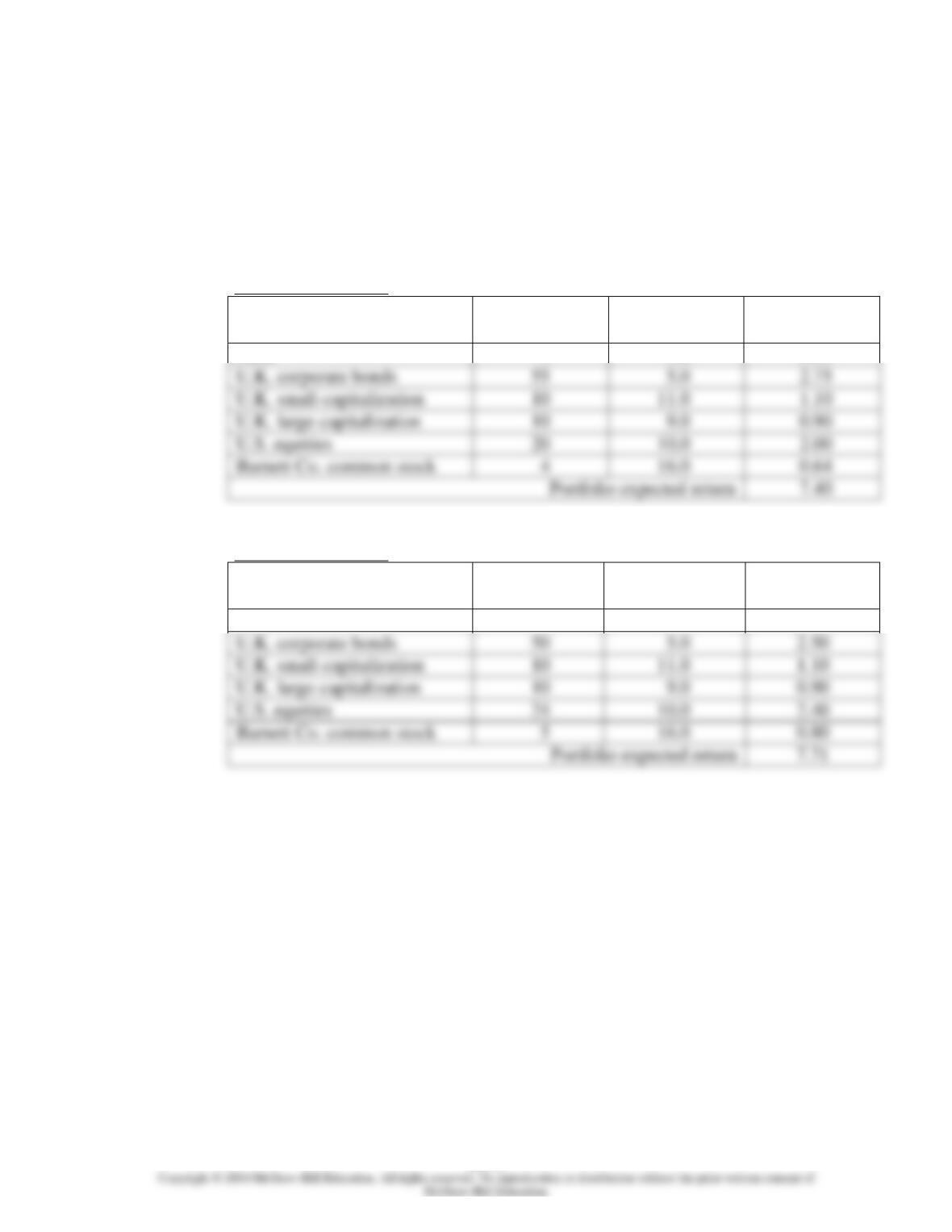
The following sample allocations are provided to illustrate that selected ranges
meet the return objective.
Sample allocation 1:
Asset Class
Weight (%)
Return (%)
Weighted
Return (%)
Cash
1
1.0
0.01
U.K. corporate bonds
55
5.0
2.75
U.K. small-capitalization
10
1.10
U.K. large-capitalization
10
9.0
0.90
U.S. equities
20
2.00
Barnett Co. common stock
4
0.64
7.40
Sample allocation 2:
Asset Class
Weight (%)
Return (%)
Weighted
Return (%)
Cash
1
1.0
0.01
U.K. small-capitalization
10
1.10
U.K. large-capitalization
10
9.0
0.90
U.S. equities
24
2.40
Barnett Co. common stock
5
0.80
7.71