CHAPTER 28
INTEREST-RATE SWAPS, CAPS, AND FLOORS
CHAPTER SUMMARY
In Chapters 26 and 27, we discussed how interest-rate futures and options can be used to control
interest-rate risk. There are other contracts useful for controlling such risk that commercial banks
and investment banks can customize for their clients. These include (1) interest-rate swaps and
options on swaps, and (2) interest-rate caps and floors and options on these agreements. In this
chapter, we review each of them and explain how they can be used by institutional investors.
INTEREST-RATE SWAPS
In an interest-rate swap, two parties (called counterparties) agree to exchange periodic interest
payments. The dollar amount of the interest payments exchanged is based on a predetermined
Entering into a Swap and Counterparty Risk
Interest-rate swaps are over-the-counter instruments. This means that they are not traded on an
exchange. An institutional investor wishing to enter into a swap transaction can do so through
either a securities firm or a commercial bank that transacts in swaps. The risks that parties take
Interpreting a Swap Position
There are two ways that a swap position can be interpreted:
Terminology, Conventions, and Market Quotes
The date that the counterparties commit to the swap is called the trade date. The date that the
swap begins accruing interest is called the effective date, and the date that the swap stops
accruing interest is called the maturity date.
©2013 Pearson Education
640
dealer would quote the fixed-rate payer would be to pay 8.85% and receive LIBOR “flat” (“flat”
meaning with no spread to LIBOR). The bid price that the dealer would quote the fixed-rate
receiver would be to pay LIBOR flat and receive 8.75%. The bid-offer spread is 10 basis points.
Calculation of the Swap Rate
At the initiation of an interest-rate swap, the counterparties are agreeing to exchange future
interest-rate payments and no upfront payments by either party are made. While the payments of
the fixed-rate payer are known, the floating-rate payments are not known. This is because they
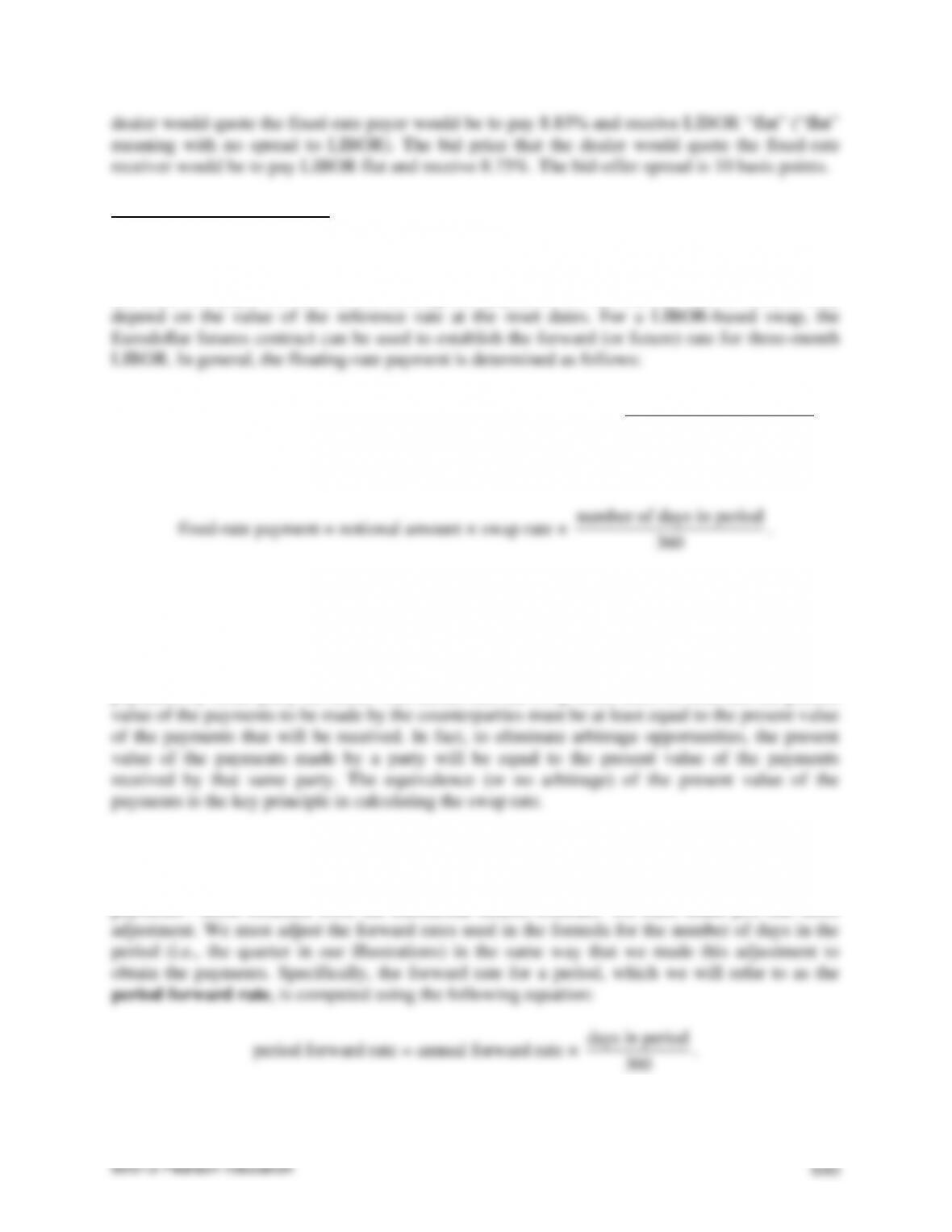
floating-rate payment = notional amount × three-month LIBOR ×
number of days in period
360
.
The equation for determining the dollar amount of the fixed-rate payment for the period is:
360
It is the same equation as for determining the floating-rate payment except that the swap rate is
used instead of the reference rate (three-month LIBOR in our illustration).
Given the swap payments, we can demonstrate how to compute the swap rate. At the initiation of
an interest-rate swap, the counterparties are agreeing to exchange future payments and no upfront
payments by either party are made. This means that the swap terms must be such that the present
We refer to the present value of $1 to be received in period t as the forward discount factor. In
calculations involving swaps, we compute the forward discount factor for a period using the
forward rates. These are the same forward rates that are used to compute the floating-rate
payments—those obtained from the Eurodollar futures contract. We must make just one more
360
Beginning with the basic relationship for no arbitrage to exist:
PV of floating-rate payments = PV of fixed-rate payments
The formula for the swap rate is derived as follows. We begin with:
360
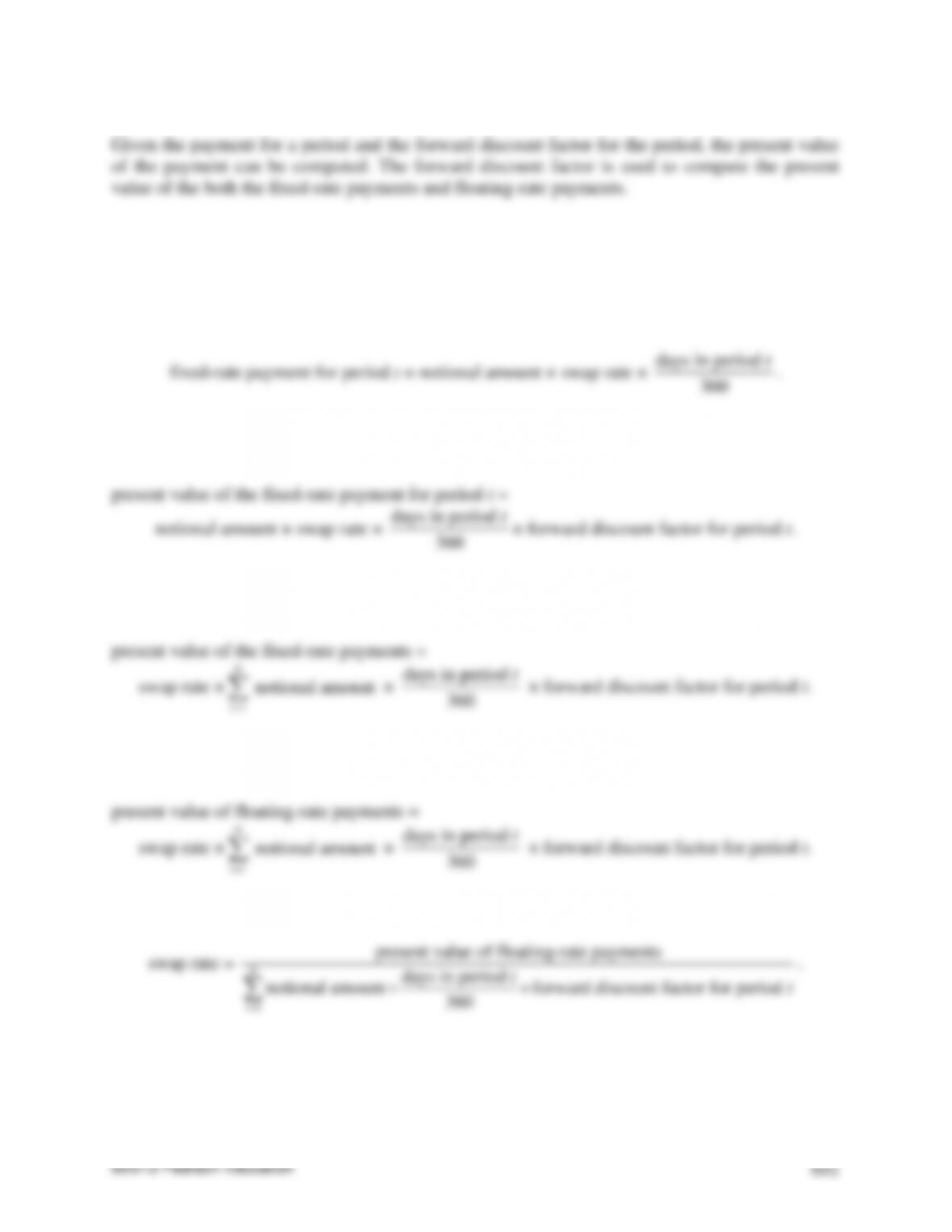
The present value of the fixed-rate payment for period t is found by multiplying the previous
expression by the forward discount factor for period t. We have:
360
Summing up the present value of the fixed-rate payment for each period gives the present value
of the fixed-rate payments. Letting N be the number of periods in the swap, we have:
=1
t
360
The condition for no arbitrage is that the present value of the fixed-rate payments as given by the
expression above is equal to the present value of the floating-rate payments. We have:
=1
t
360
Solving for the swap rate gives
1
days in period
notional amount forward discount factor for period
360
N
t
tt
=
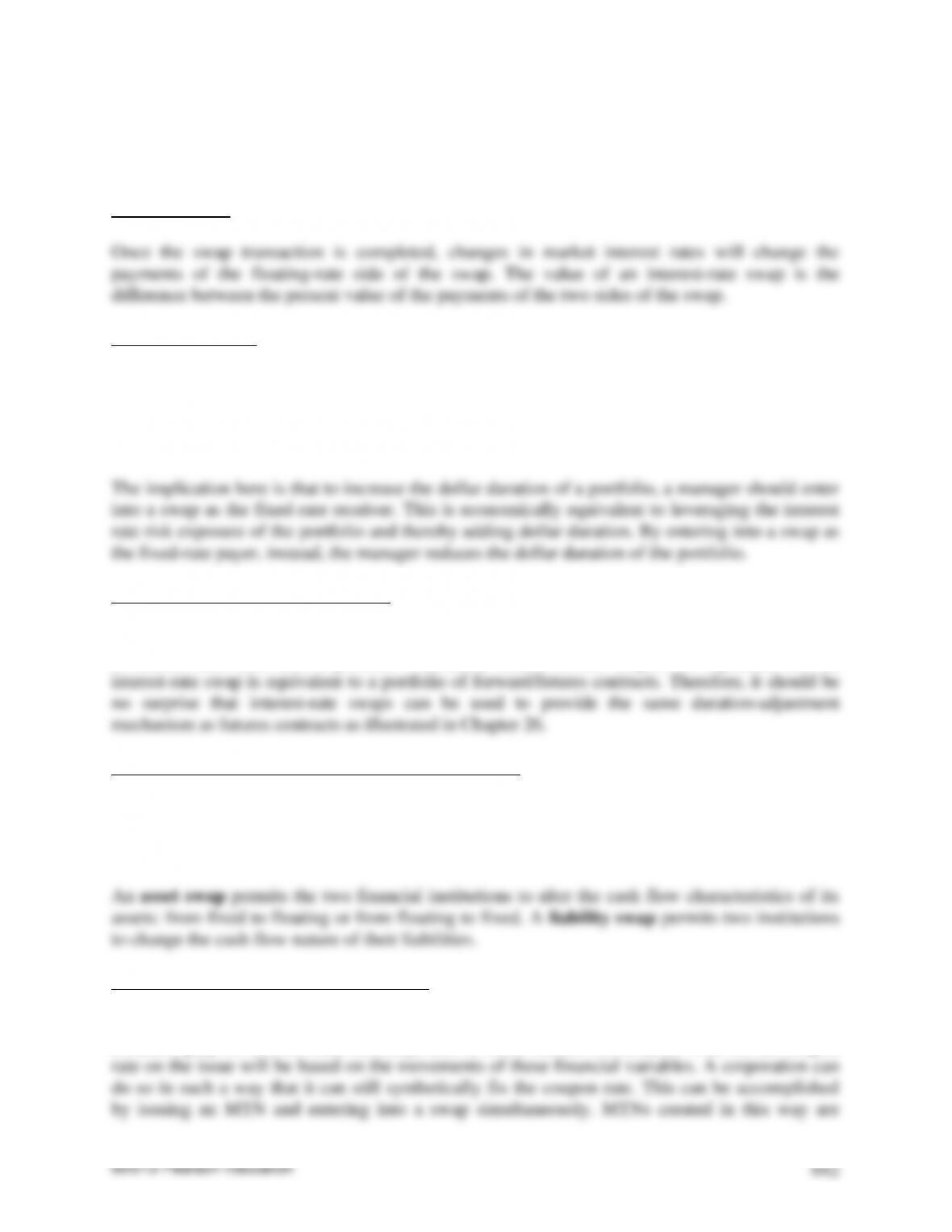
The calculation of the swap rate for all swaps follows the same principle: equating thepresent
value of the fixed-rate payments to that of the floating-rate payments.
Valuing a Swap
Duration of a Swap
As with any fixed-income contract, the value of a swap will change as interest rates change.
Dollar duration is a measure of the interest-rate sensitivity of a fixed-income contract. From the
perspective of the party who pays floating and receives fixed, the interest-rate swap position can
be viewed as follows: long a fixed-rate bond + short a floating-rate bond.
Application to Portfolio Risk Control
In Chapter 26, we explained how to use futures to alter the risk exposure of a portfolio to changes
in interest rates (i.e., alter a portfolio’s duration). Earlier in this chapter we explained how an
Application of a Swap to Asset /Liability Management
An interest-rate swap can be used to alter the cash flow characteristics of an institution’s assets
so as to provide a better match between assets and liabilities. An interest-rate swap allows each
party to accomplish its asset /liability objective of locking in a spread.
Creation of Structured Notes Using Swaps
Corporations can customize medium-term notes for institutional investors who want to make
a market play on interest rate, currency, and/or stock market movements. That is, the coupon
called structured MTNs.
Variants of the Generic Interest-Rate Swap
Nongeneric or individualized swaps have evolved as a result of the asset/liability needs of
borrowers and lenders. These include swaps where the notional principal changes in
a pre-determined way over the life of the swap and swaps in which both counterparties pay
Varying Notional Principal Amount Swaps
In a generic or plain vanilla swap, the notional principal amount does not vary over the life of the
swap. Thus it is sometimes referred to as a bullet swap. In contrast, for amortizing, accreting,
and roller coaster swaps, the notional principal amount varies over the life of the swap.
An amortizing swap is one in which the notional principal amount decreases in a predetermined
way over the life of the swap. Such a swap would be used where the principal of the asset that is
being hedged with the swap amortizes over time. Less common than the amortizing swap are the
Swaptions
There are options on interest-rate swaps. These swap structures are called swaptions and grant
the option buyer the right to enter into an interest-rate swap at a future date. The buyer of the
swaption must pay the swaption seller a fee, the swaption price or premium. The time until
©2013 Pearson Education
644
rate and receives a floating rate. In a receiver swaption the swaption buyer has the right to enter
into an interest-rate swap that requires paying a floating rate and receiving a fixed rate.
INTEREST-RATE CAPS AND FLOORS
An interest-rate agreement is an agreement between two parties whereby one party, for an
upfront premium, agrees to compensate the other at specific time periods if a designated interest
rate, called the reference rate, is different from a predetermined level. When one party agrees to
pay the other when the reference rate exceeds a predetermined level, the agreement is referred to
Risk/Return Characteristics
In an interest-rate agreement, the buyer pays an upfront fee representing the maximum amount
that the buyer can lose and the maximum amount that the writer of the agreement can gain. The
only party that is required to perform is the writer of the interest-rate agreement. The buyer of an
Valuing Caps and Floors
The arbitrage-free binomial model can be used to value a cap and a floor. This is because a cap
and a floor are nothing more than a package or strip of options. More specifically, they are a strip
Applications
To see how interest-rate agreements can be used for asset /liability management, consider the
problems faced by a commercial bank which needs to lock in an interest-rate spread over its cost
of funds. Because it borrows short term, its cost of funds is uncertain. The bank may be able to
©2013 Pearson Education
645
The bank can reduce the cost of purchasing the cap by selling a floor. In this case the bank agrees
to pay the buyer of the floor if the reference rate falls below the strike rate. The bank receives a fee
for selling the floor, but it has sold off its opportunity to benefit from a decline in rates below the
strike rate. By buying a cap and selling a floor the bank creates a “collar” with a predetermined
range for its cost of funds.
KEY POINTS
• An interest-rate swap is an agreement specifying that the parties exchange interest payments
at designated times.
• In a generic interest-rate swap, one party will make fixed-rate payments (called the fixed-rate
payer), and the other will make floating-rate payments (called the fixed-rate receiver), with
payments based on the notional principal amount.
• Asset and risk managers use interest-rate swaps to alter the duration of a portfolio, alter the
cash flow characteristics of their assets or liabilities, or to capitalize on perceived capital
market inefficiencies.
• A swap position can be interpreted as either a package of forward/futures contracts or
a package of cash flows from buying and selling cash market instruments.
• There are complex swap structures, such as swaps where the swap does not begin until some
future time (forward start swaps) and options on swaps (swaptions).
• Swaptions can be used to create a portfolio with option-type payoffs that will have the desired
duration if rates move in a favorable direction but limit adverse movements when interest
rates moves in the opposite direction. The cost of creating such a favorable risk-return

©2013 Pearson Education
646
• An interest-rate cap can be used to establish a ceiling on the cost of funding; an interest-rate
floor can be used to establish a floor return. Buying a cap and selling a floor creates a collar.
• A cap and a floor can be valued using the binomial model.
ANSWERS TO QUESTIONS FOR CHAPTER 28
(Questions are in bold print followed by answers.)
1. Suppose that a dealer quotes these terms on a five-year swap: fixed-rate payer to pay
4.4% for LIBOR and fixed-rate receiverto pay LIBOR for 4.2%.
Answer the below questions.
(a) What is the dealer’s bid-asked spread?
(b) How would the dealer quote the terms by reference to the yield on five-year Treasury
notes?
The fixed rate is some spread above the Treasury yield curve with the same term to maturity as
the swap. Suppose the five-year Treasury yield is 9.0%. Then the offer price that the dealer
would quote to the fixed-rate payer is the five-year Treasury rate plus 50 basis points versus
2. Give two interpretations of an interest-rate swap.
3. In determining the cash flow for the floating-rate side of a LIBOR swap, explain how the
cash flow is determined.
Assume a swap of 12 quarterly floating-rate payments for three years with the first quarter
consisting of 90 days from January 1st of year 1 to March 31st of year 1 assuming a non-leap
Note that each futures contract is for $1 million and hence 100 contracts have a notional amount
of $100 million. Let’s assume $100 million notional amount and a LIBOR of 5%. The cash flow
for period 1 is:
payment = $100,000,000 × 0.05 × 0.25 = $1,250,000.
While this first quarterly payment is known, the next 11 are not. The second quarterly payment,
from April 1 of year 1 to June 30 of year 1, has 91 days. The floating-rate payment is determined
by three-month LIBOR on April 1 of year 1 and paid on June 30 of year 1. This is achieved by
looking at the three-month Eurodollar futures contract for settlement on June 30 of year 1. That
payment = notional amount × annual forward rate ×
number of days in period
360
.
4. How is the swap rate calculated?
To compute the swap rate, we begin with the basic relationship for no arbitrage to exist:
present value of fixed-rate payments = present value of floating-rate payments.
For the fixed-rate payment for period t, we have:
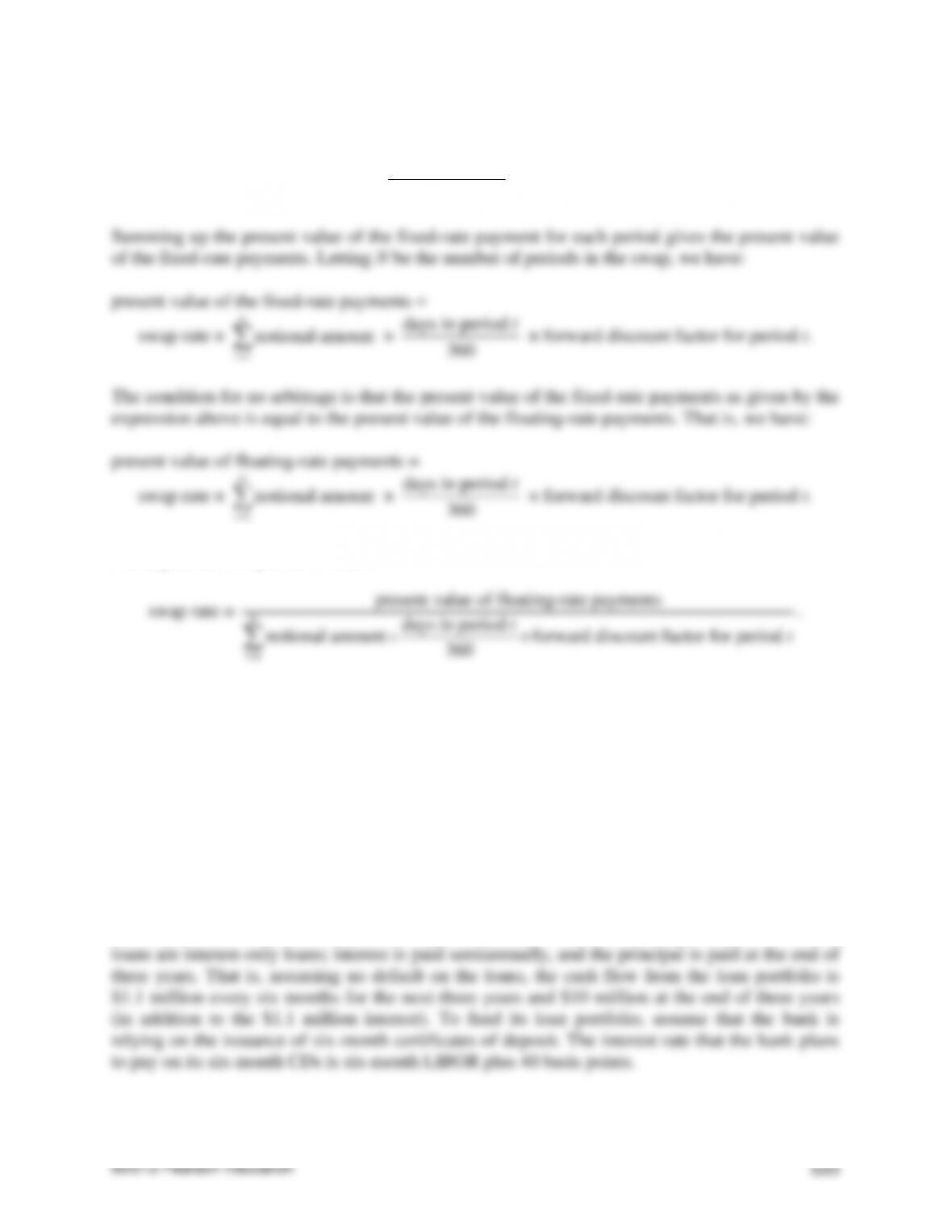
present value of the fixed-rate payment for period t =
notional amount × swap rate ×
days in period
360
t
× forward discount factor for period t.
=1
t
360
Solving for the swap rate, we have:
1
days in period
notional amount forward discount factor for period
360
N
t
tt
=
5. Suppose that a life insurance company has issued a three-year GIC with a fixed-rate of
10%. Under what circumstances might it be feasible for the life insurance company to
invest the funds in a floating-rate security and enter into a three-year interest-rate swap in
which it pays a floating rate and receives a fixed-rate?
If the life insurance can enter a swap that guarantees a satisfactory spread above the 10% it is
committed to pay, then it would not only be feasible but desirable to enter into the swap. More
details are given below.
Suppose the life insurance company can enter into a swap with a bank which has a portfolio
consisting of three-year term commercial loans with a fixed interest rate. The principal value of
bank’s portfolio is $10 million, and the interest rate on all its loans in its portfolio is 11%. The
The risk that the bank faces is that six-month LIBOR will be 10.6% or greater. To understand
why, remember that the bank is earning 11% annually on its commercial loan portfolio.
If six-month LIBOR is 10.6%, it will have to pay 10.6% plus 40 basis points, or 11%, to
We can summarize the asset /liability problems of the bank and the life insurance company as
follows.
Bank:
(i) Has lent long term and borrowed short term.
(ii) If six-month LIBOR rises, spread income declines.
Life Insurance Company:
(i) Has lent short term and borrowed long term.
(ii) If six-month LIBOR falls, spread income declines.
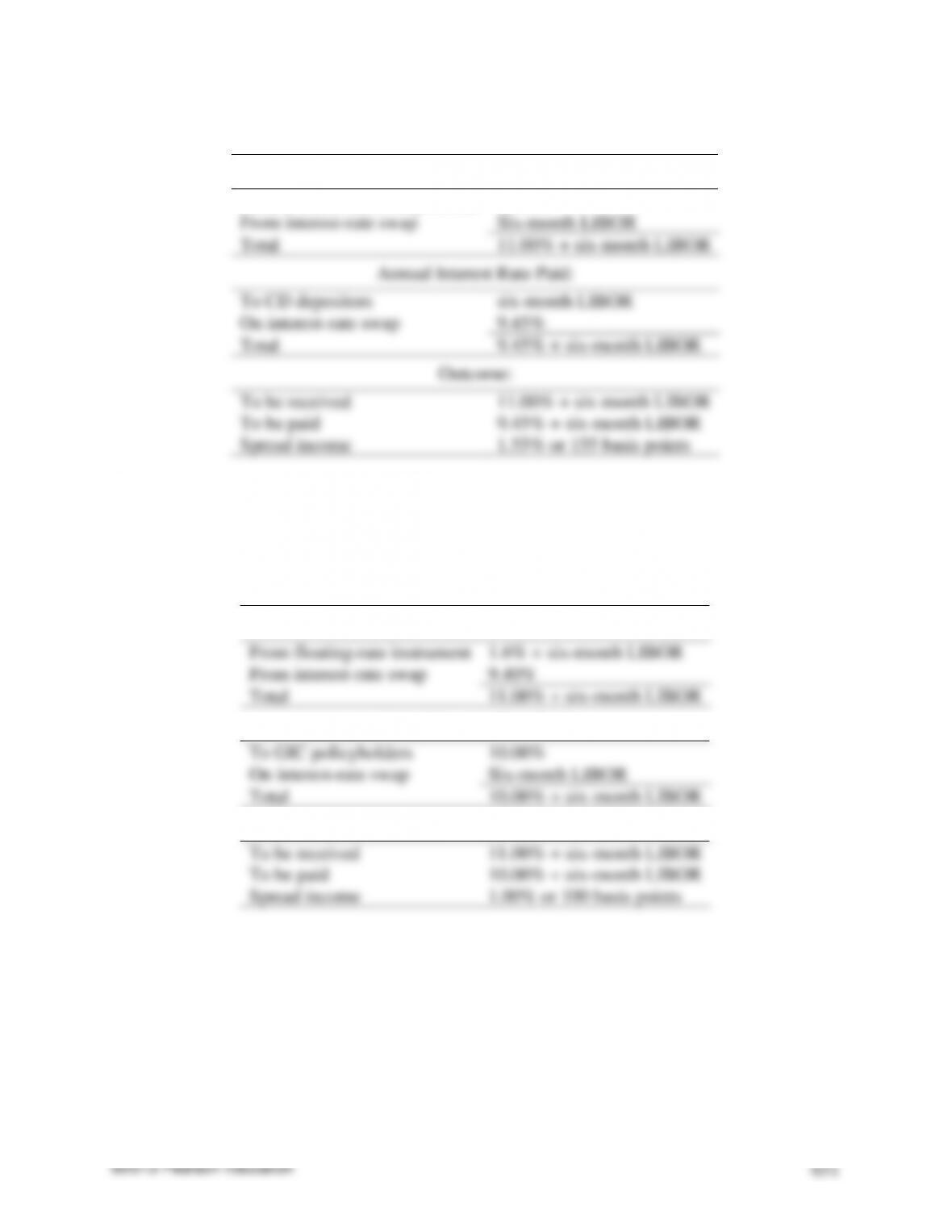
Consider first the bank. For every six-month period for the life of the swap agreement, the
interest-rate spread will be as follows:
Annual Interest Rate Received:
From commercial loan portfolio
11.00%
From interest-rate swap
Six-month LIBOR
Total
11.00% + six-month LIBOR
Annual Interest Rate Paid:
To CD depositors
six-month LIBOR
On interest-rate swap
9.45%
Total
9.45% + six-month LIBOR
Outcome:
To be received
11.00% + six-month LIBOR
To be paid
9.45% + six-month LIBOR
Spread income
1.55% or 155 basis points
Thus, whatever happens to six-month LIBOR, the bank locks in a spread of 155 basis points.
Now let’s look at the effect of the interest-rate swap from the perspective of the life insurance
company:
Annual Interest Rate Received:
From floating-rate instrument
1.6% + six-month LIBOR
From interest-rate swap
9.40%
Total
11.00% + six-month LIBOR
Annual Interest Rate Paid:
To GIC policyholders
10.00%
On interest-rate swap
Six-month LIBOR
Total
10.00% + six-month LIBOR
Outcome:
To be received
11.00% + six-month LIBOR
To be paid
10.00% + six-month LIBOR
Spread income
1.00% or 100 basis points
Thus, whatever happens to six-month LIBOR, the insurance company locks in a spread of 100
basis points.
The interest-rate swap has allowed each party to accomplish its asset /liability objective of
locking in a spread.It permits the two financial institutions to alter the cash flow characteristics
of its assets: from fixed to floating in the case of the bank, and from floating to fixed in the case
of the life insurance company.
6. How can interest rate swap be used to reduce the duration of portfolio to match the
duration of a benchmark?
To reduce the duration so as to match the benchmark, the manager can enter into a swap as the
fixed-rate payer. If the manager wanted to increase the duration, a position in a swap can be
taken to be a fixed-rate receiver. More details are given below.
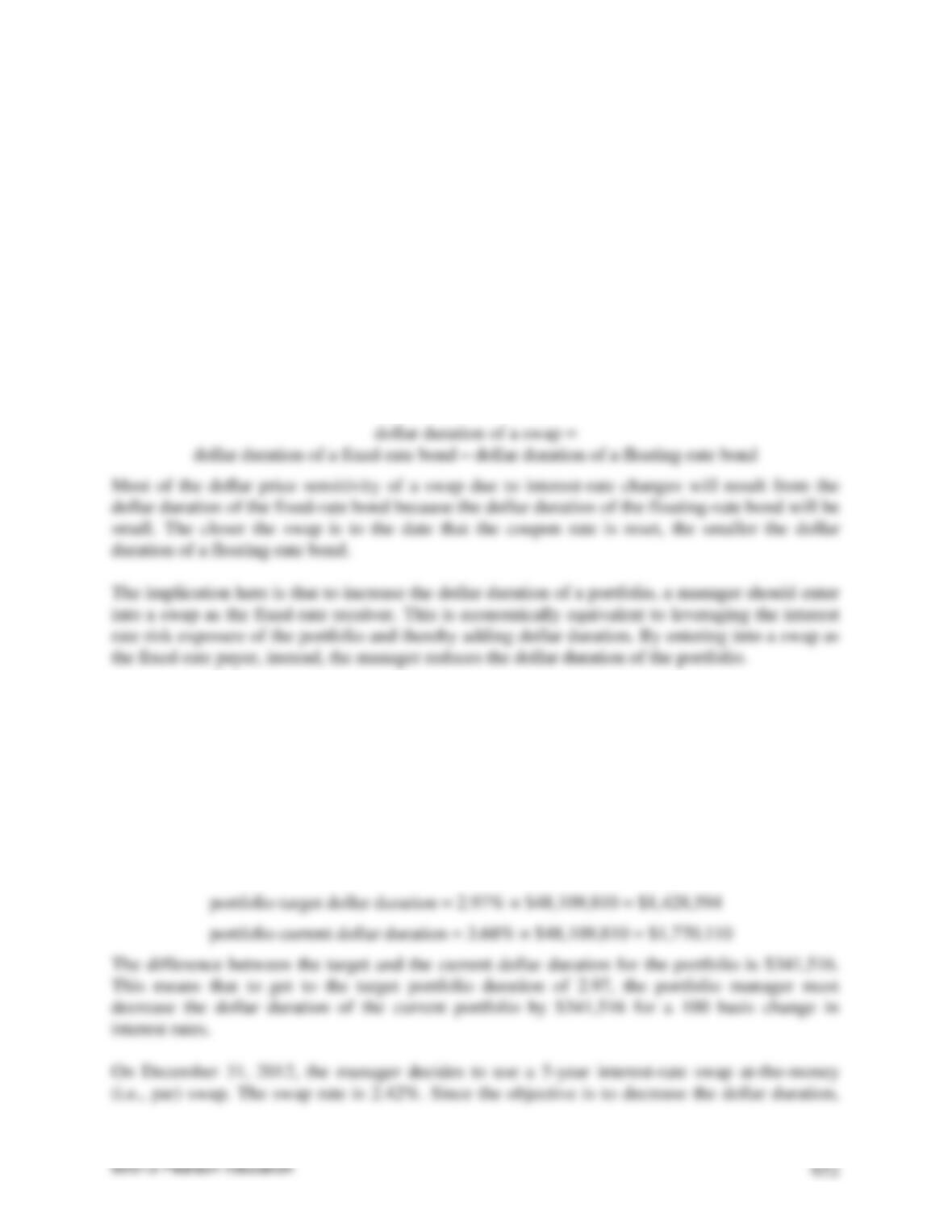
As with any fixed-income contract, the value of a swap will change as interest rates change.
Dollar duration is a measure of the interest-rate sensitivity of a fixed-income contract. From the
perspective of the party who pays floating and receives fixed, the interest-rate swap position can
be viewed as follows: long a fixed-rate bond + short a floating-rate bond. This means that the
dollar duration of an interest-rate swap from the perspective of a fixed-rate receiver is simply the
difference between the dollar duration of the two bond positions that make up the swap; that is,
We now illustratehow an interest-rate swap can reduce the duration to match the duration of
a benchmark.
Suppose the manager of a portfolio with a market value as of December 31, 2012 of $48,109,810
has a benchmark that is the Barclays Capital Intermediate Aggregate Index. On December 31,
2012, the duration of the index and the portfolio were 2.97 and 3.68, respectively. The manager
wants to restructure the portfolio so that the portfolio’s duration matches that of the benchmark.
That is, the portfolio manager seeks to follow a duration-neutral strategy and therefore the
portfolio’s target duration is 2.97. We know that for a 100 basis point change in rates: