CHAPTER 27
INTEREST-RATE OPTIONS
CHAPTER SUMMARY
In this chapter we explain the various types of interest-rate options, their applications to portfolio
management, and how they are priced.
OPTIONS DEFINED
An optionis a contract in which the writer of the option grants the buyer of the option the right to
purchase from or sell to the writer a designated instrument at a specified price within
a specified period of time. The writer, also referred to as the seller, grants this right to the buyer
in exchange for a certain sum of money called the option price or option premium.
DIFFERENCES BETWEEN AN OPTION AND A FUTURES CONTRACT
Notice that options differ from futures contracts, in that the buyer of an option has the right but
not the obligation to perform, whereas the option seller (writer) has the obligation to perform. In
the case of a futures contract, both the buyer and the seller are obligated to perform.
TYPES OF INTEREST-RATE OPTIONS
Interest-rate options can be written on cash instruments or futures. At one time, there were
several exchange-traded option contracts whose underlying instrument was a debt instrument.
Exchange-Traded Futures Options
futures price. Thus the futures position of the two parties will be at the prevailing futures price.
At the same time, the option buyer will receive from the option seller the economic benefit from
exercising.
There are three reasons why futures options on fixed-income securities have largely supplanted
options on physicals as the options vehicle of choice for institutional investors. First, unlike
Specifications for the Actively Traded Futures Options
There are options on all of the futures contracts. All futures options are of the American type.
Trading of futures options on Treasury bonds stops in the month prior to the underlying futures
contract’s delivery month. In an attempt to compete with the over-the-counter (OTC) option
market, flexible Treasury futures options were introduced. These futures options allow
counterparties to customize options within certain limits.
INTRINSIC VALUE AND TIME VALUE OF AN OPTION
Intrinsic Value of an Option
The intrinsic value of an option is the economic value of the option if it is exercised immediately.
The intrinsic value of a call option on a bond is the difference between the bond price and the
strike price. When a call option has intrinsic value, it is said to be in-the-money. When the strike
Time Value of an Option
option. First, the investor may exercise the option. Secondly, the investor may sell the call
option. The latter alternative is never less than the first and always greater if the time value is
not equal to zero.
PROFIT AND LOSS PROFILES FOR SIMPLE NAKED OPTION STRATEGIES
To appreciate the opportunities available with interest-rate options, the profit and loss profiles for
various option strategies must be understood. We begin with simple strategies in only one option
Long Call Strategy (Buying Call Options)
The most straightforward option strategy for participating in an anticipated decrease in interest
rates (increase in the price of bonds) is to buy a call option on a debt instrument. This is called
a long call strategy. To illustrate this strategy, suppose that the current price of an 8% coupon
paying bond is $100, which is its par value), which means that the yield on this bond is currently
Now, suppose that in one month the market yield declines to 6% so that the price of the bond
increases to $123.11. The long call strategy will result in a profit of [($23.11)(25)] – $100 =
$477.75, which is a return (less transaction costs) of $477.75 / $100 = 4.7775 or 477.75% on the
Short Call Strategy (Selling or Writing Call Options)
Long Put Strategy (Buying Put Options)
The most straightforward option strategy for benefiting from an expected increase in interest
rates is to buy a put option. This strategy is called a long put strategy.
Short Put Strategy (Selling or Writing Put Options)
The short put strategy involves the selling (writing) of put options. This strategy is employed if
the investor expects interest rates to fall or stay flat so that the price of the bond will increase or
Considering the Time Value of Money
Our illustrations of the four naked option positions do not reflect the time value of money.
Specifically, the buyer of an option must pay the seller the option price at the time the option is
purchased. The seller, in contrast, assuming that the option price does not have to be used as
PUT-CALL PARITY RELATIONSHIP AND EQUIVALENT POSITIONS
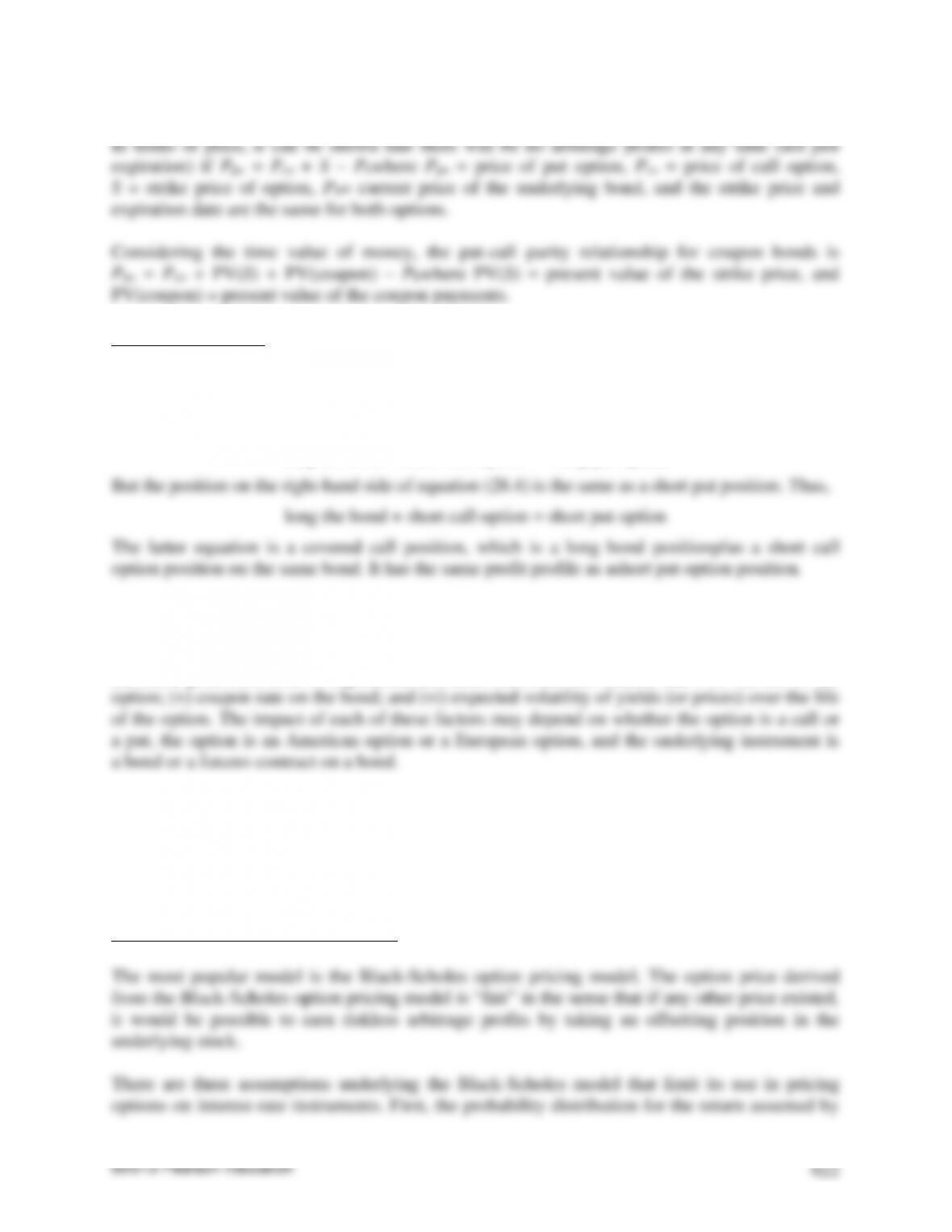
The put-call parity relationship is the relationship between the price of a call option and the
price of a put option on the same underlying instrument, with the same strike price and the same
Equivalent Positions
Working with equation oflong the bond + short call option + long put option = 0,we can identify
equivalent positions; that is, positions thatwill provide the same profit profile. For example,
subtracting the long put position fromboth sides of the above equation, we have
long the bond + short call option = –long put option
OPTION PRICE
Six factors will influence the option price: (i) current price of the underlying instrument;
(ii) strike price; (iii) time to expiration; (iv) short-term risk-free interest rate over the life of the
MODELS FOR PRICING OPTIONS
Several models have been developed for determining the theoretical value of an option. These
models are referred to as option pricing models. There are models for valuing options on bonds
and options on bond futures.
Models for Valuing Options on Bonds
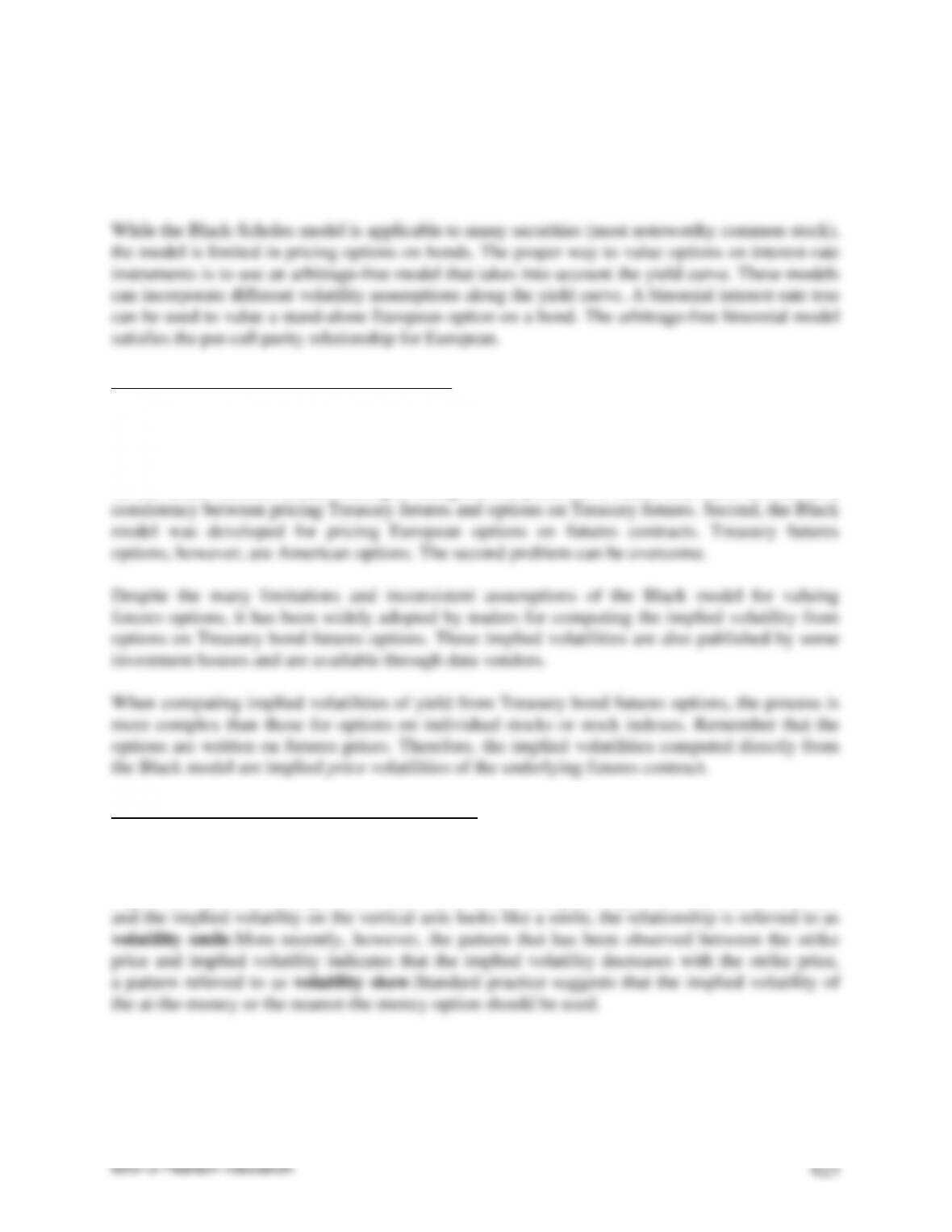
the Black-Scholes option pricing model permits some probability—no matter how small—that
the return can take on any positive value. The second assumption of the Black-Scholes option
pricing model is that the short-term interest rate is constant over the life of the option. The third
assumption is that the variance of prices is constant over the life of the option.
Models for Valuing Options on Bond Futures
The most commonly used model for futures options was developed by Fischer Black. The model
was initially developed for valuing European options on forward contracts. There are two
problems with this model. First, the Black model does not overcome the problems cited earlier
for the Black-Scholes model. Failing to recognize the yield curve means that there will not be a
Selection and Interpretation of Implied Volatility
The implied volatility for both in-the-money and out-of-the money options with the same
expiration date are higher than the implied volatility for at-the-money options with the same
expiration date. The U-shaped curve that exists if the strike price is plotted on the horizontal axis
SENSITIVITY OF OPTION PRICE TO CHANGE IN FACTORS
In employing options in an investment strategy, a portfolio manager would like to know how
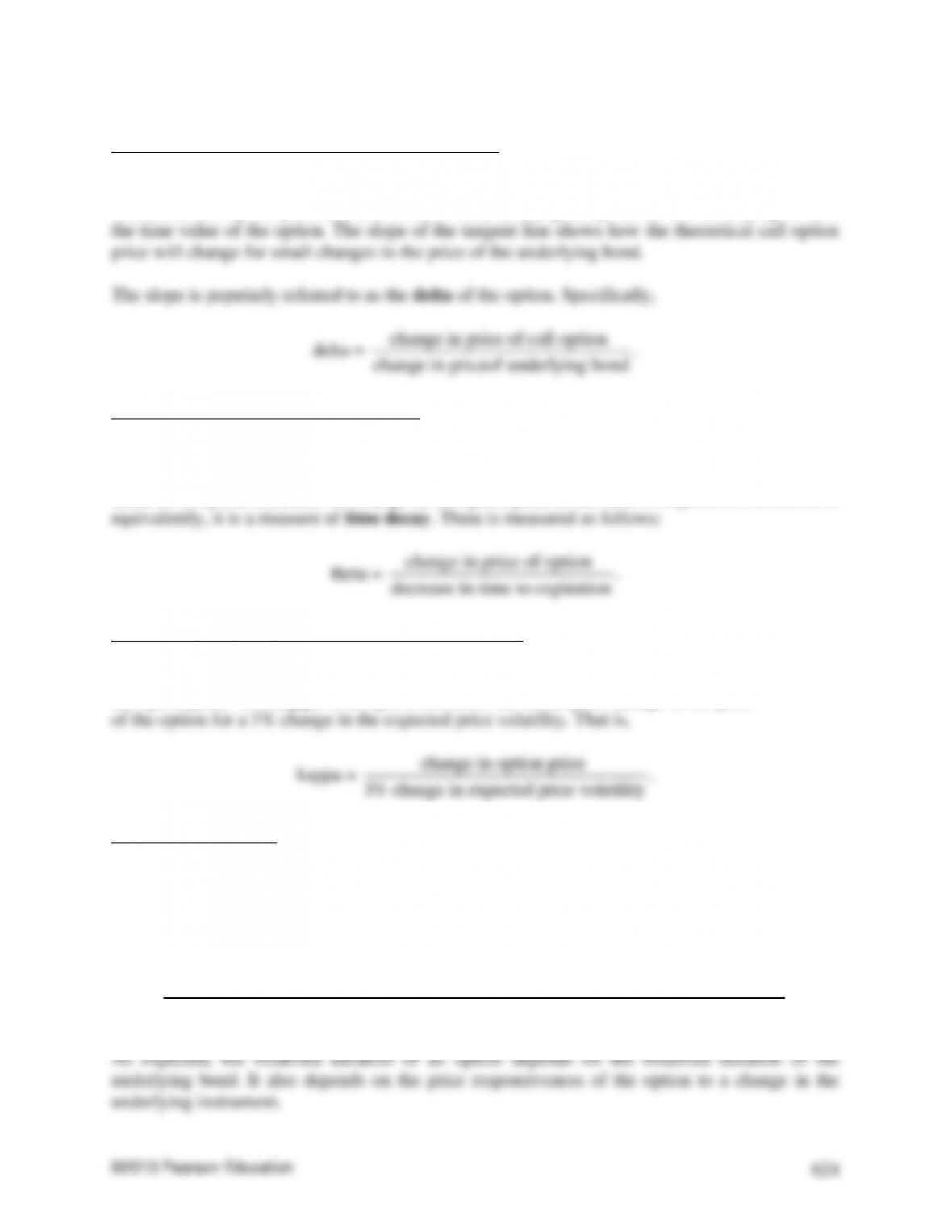
sensitive the price of an option is to a change in any one of the factors that affect its price.
Call Option Price and Price of the Underlying Bond
Because the theoretical call option price is shown by the convex line, the difference between the
theoretical call option price and the intrinsic value at any given price for the underlying bond is
change in priceof underlying bond
Call Option Price and Time to Expiration
All other factors constant, the longer the time to expiration, the greater the option price. Because
each day the option moves closer to the expiration date, the time to expiration decreases. The
theta of an option measures the change in the option price as the time to expiration decreases, or
decrease in time to expiration
Call Option Price and Expected Interest Rate Volatility
All other factors constant, a change in the expected interest rate volatility will change
the option price. The kappa of an option measures the dollar price change in the price
1% change in expected price volatility
Duration of an Option
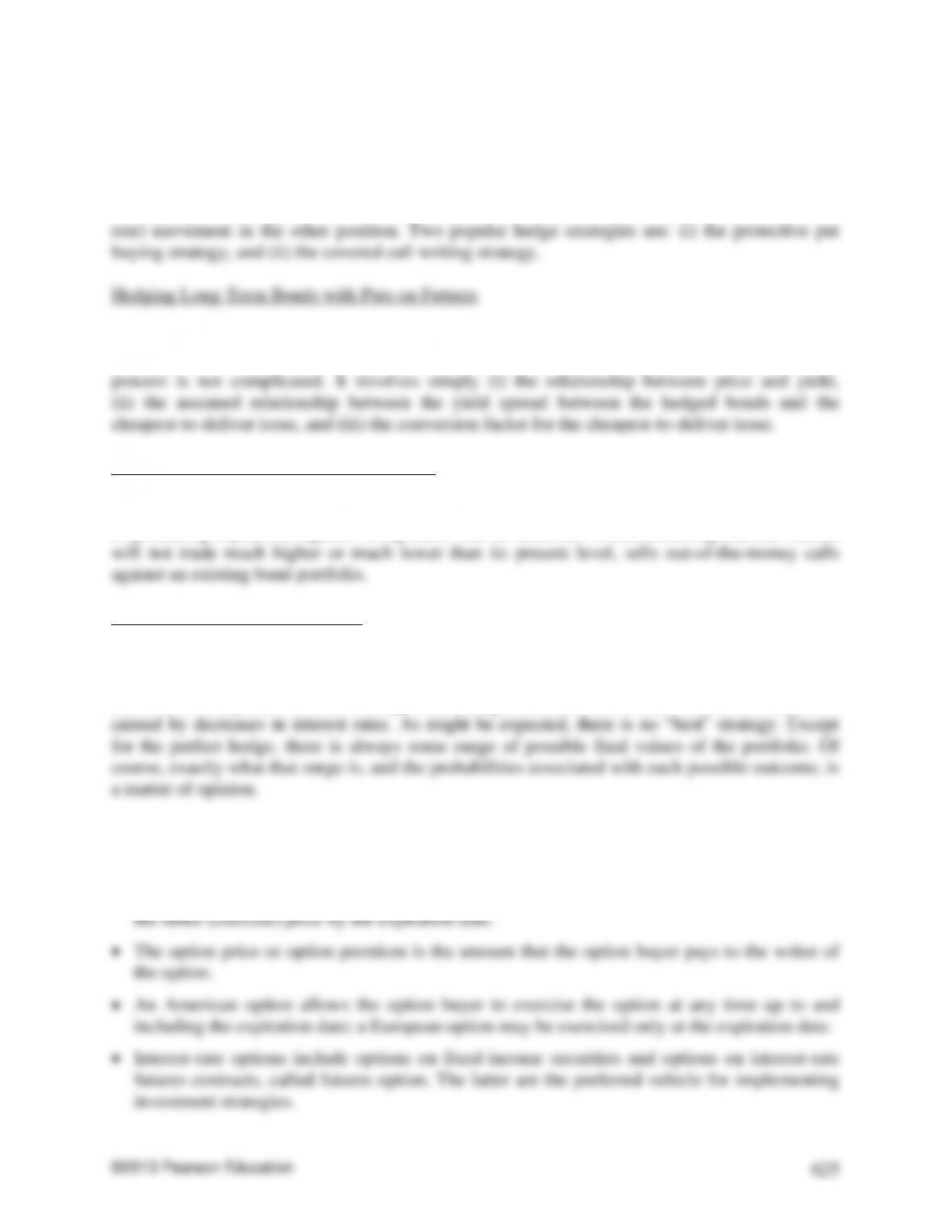
The modified duration of an option measures the price sensitivity of the option to changes
in interest rates. The modified duration of an option can be shown to be equal to
modified duration for an option =
(modified duration of underlying instrument)(delta)(price of underlying instrument)
price of option
HEDGE STRATEGIES
Hedge strategies involve taking a position in an option and a position in the underlying bond in
such a way that changes in the value of one position will offset any unfavorable price (interest
Investors often want to hedge their bond positions against a possible increase in interest rates.
Buying puts on futures is one of the easiest ways to purchase protection against rising rates. The
Covered Call Writing with Futures Options
Unlike the protective put strategy, covered call writing is not entered into with the sole purpose
of protecting a portfolio against rising rates. The covered call writer, believing that the market
Comparing Alternative Strategies
Three basic hedging strategies for hedging a bond position are: (i) hedging with futures,
(ii) hedging with out-of-the-money protective puts, and (iii) covered call writing with
out-of-the-money calls. Similar but opposite strategies exist for those who want to avoid the risk
KEY POINTS
• An option grants the buyer of the option the right either to buy (in the case of a call option) or
to sell (in the case of a put option) the underlying asset to the seller (writer) of the option at
©2013 Pearson Education
626
• Because of the difficulties of hedging particular bond issues or pass-through securities, many
institutions find over-the-counter options more useful; these contracts can be customized to
meet specific investment goals.
• The buyer of an option cannot realize a loss greater than the option price and has all the
upside potential. By contrast, the maximum gain that the writer (seller) of an option can
• Six factors influence the option price: (1) the current price of the underlying bond, (2) the
strike price of the option, (3) the time remaining to the expiration of the option, (4) the
expected price volatility of the underlying bond (i.e., expected interest-rate volatility),
(5) the short-term risk-free interest rate over the life of the option, and (6) coupon payments.
• An option pricing model determines the theoretical or fair value of an option. There are option
pricing models for options on bonds (i.e., options on physicals) and options on bond futures.
ANSWERS TO QUESTIONS FOR CHAPTER 27
(Questions are in bold print followed by answers.)
1. An investor owns a call option on bond × with a strike price of 100. The coupon rate on
bond × is 9% and has 10 years to maturity. The call option expires today at a time when
bond × is selling to yield 8%. Should the investor exercise the call option?
To exercise this call option it must be in-the-money, i.e., the current price (Pb) must be greater
than the strike price (S) of $100. We use the bond valuation formula as given below to find the
current price:
r
( )
1n
r+
whereC = semiannual payment of 0.045(100) = $4.5, r is the current yield of 8% / 2 = 4% or
0.04, n is the number of periods which is 2(10) = 20, and M is the par value of $100. Inserting in
our values, we have:
Pb = $4.5
( )
20
1
11 04
0 04
.
.
−
+
( )
20
100
1 04.
= $4.5
1 0.4563869
0.04
−
+
100
2.1911231
2. When the buyer of a put option on a futures contract exercises, explain the resulting
position for the buyer and the writer.
The buyer of a put option has a long position on a futures contract exercises when the strike price
is greater than the current price of the futures contract (this is the opposite found for a call
writer has collected the contract price for selling the option. The writer may even make a profit if
the exercise value is less than the contract price in which case the exercise value does not
overcome the original purchase price of the option contract.
As the parties to the futures option will realize a position in a futures contract when the option is
exercised, the question is: What will the futures price be? That is, at what price will the long be
3. An investor wants to protect against a rise in the market yield on a Treasury bond.
Should the investor purchase a put option or a call option to obtain protection?
An investor wanting to protect against a rise in the market yield of a Treasury bond is worried
that its current claim to an asset will fall in value as yields increase. Thus, the investor should
4. What is the intrinsic value and time value of a call option on bond W given the following
information?
strike price of call option = 97
5. “There’s no real difference between options and futures. Both are hedging tools, and both
are derivative products. It’s just that with options you have to pay an option premium, whereas
futures require no upfront payment except for a ‘good faith’ margin. I can’t understand why
anyone would use options.” Do you agree with this statement?