From the buyer’s point of view, the only cost with an option is the price of the option and that is
the maximum amount that can be lost. With a futures contract much more can be lost plus the
additional costs related to maintaining a margin account. With a futures contract, we have
a contract that is marked to market, which means money can be spent even before the contract’s
6. What arguments would be given by those who feel that the Black-Scholes model does not
apply in pricing interest-rate options?
The arguments lie in its underlying assumptions. There are three assumptions underlying the
Black-Scholes model that limit its use in pricing options on interest-rate instruments.
First, the probability distribution for the return assumed by the Black-Scholes option pricing
model permits some probability—no matter how small—that the return can take on any positive
value. But in the case of a zero-coupon bond, the price cannot take on a value above $100 and
therefore the return is capped. In the case of a coupon bond, we know that the price cannot
exceed the sum of the coupon payments plus the maturity value. For example, for a five-year
10% coupon bond with a maturity value of $100, the price cannot be greater than $150 (five
©2013 Pearson Education
630
The third assumption is that the variance of prices is constant over the life of the option.
However, as a bond moves closer to maturity its price volatility declines. Therefore, the
assumption that price variance is constant over the life of the option is inappropriate.
7. Below are some excerpts from an article titled “It’s Boom Time for Bond Options as
Interest-Rate Hedges Bloom,” published in the November 8, 1990, issue of The Wall Street
Journal.
Answer each question given after the below quotes.
(a) “The threat of a large interest-rate swing in either direction is driving people to options to
hedge their portfolios of long-term Treasury bonds and medium-term Treasury notes,” said
Steven Northern, who manages fixed-income mutual funds for Massachusetts Financial
Services Co. in Boston. Why would a large interest rate swing in either direction encourage
people to hedge?
A large interest rate swing in either direction (compared to one direction) could double the
demand for derivatives such as options. This is because regardless of one’s long or short position
in one’s assets (i.e., portfolio of long-term Treasury bonds and medium-term Treasury notes),
one would be concerned about a loss in value. In the case of Mr. Northern whose firm owns
(b) “If the market moves against an option purchaser, the option expires worthless, and all the
investor has lost is the relatively low purchase price, or ‘premium,’ of the option.” Comment
on the accuracy of this statement.
This statement is essentially true because with an option one has the right but not the obligation
to exercise and also the costs are much less than acquiring the underlying asset. However, there
is also the opportunity cost involved because the option price could have been reinvested in less
(c) “Futures contracts also can be used to hedge portfolios, but they cost more, and there isn’t
any limit on the amount of losses they could produce before an investor bails out.” Comment
on the accuracy of this statement.
Futures contracts, in terms of dealer fees, are a relatively cheap form of hedging and do not cost
much. Most investors in futures contract are not worried about losing on the futures because they
have the opposite position in the underlying asset. In brief, futures contracts are often used as
(d) “Mr. Northern said Massachusetts Financial has been trading actively in bond and note
put options. ‘The concept is simple,’ he said. ‘If you’re concerned about interest rates but don’t
want to alter the nature of what you own in a fixed-income portfolio, you can just buy puts.’ ”
Why might put options be a preferable means of altering the nature of a fixed-income
portfolio?
When managing a fixed-income portfolio, an alternative to buying put options is to short sale an
asset. This will be more expensive because one would have to (i) eventually invest an amount
8. What are the differences between an option on a bond and an option on a bond futures
contract?
A major difference concerns the underlying asset. A bond is usually part of a portfolio whose
value you want to protect. A bond futures is usually acquired to hedge the underlying asset that
one owns.
There would also likely be a difference in terms of the current price. The option on a bond
entitles the purchaser to cash in when the market price of the bond relative to strike value is
9. What is the motivation for the purchase of an over-the-counter option?
Over-the-counter (or dealer) options typically are purchased by institutional investors who are
motivated to hedge the risk associated with a specific security. For example, a thrift may be
interested in hedging its position in a specific mortgage pass-through security. Typically, the
©2013 Pearson Education
632
maturity of the option coincides with the time period over which the buyer of the option wants to
hedge, so the buyer is usually not concerned with the option’s liquidity.
Interest-rate options include options on fixed-income securities and options on interest-rate
futures contracts. The latter, more commonly called futures options, are the preferred vehicle for
implementing investment strategies. However, because of the difficulties of hedging particular
bond issues or pass-through securities, many institutions are motivated to use over-the-counter
options because they are more useful in that they can be customized to meet specific interest-rate
futures contracts.
Finally, there are over-the-counter options on the shape of the yield curve or the yield spread
between two securities that investors may find desirable and useful. These options include those
on the spread between mortgage pass-through securities and Treasuries, or between double
A corporates and Treasuries.
10. Does it make sense for an investor who wants to speculate on interest–rate movements
to purchase an over-the-counter option?
It doesn’t always make sense for an investor who wants to simply speculate on interest-rate
movements to purchase an over-the-counter option. This is especially true if the tailor-made
option costs more. In brief, there are plenty of standard contracts that are less expensive and can
11. “I don’t understand how portfolio managers can calculate the duration of an interest-rate
option. Don’t they mean the amount of time remaining to the expiration date?” Respond to
this question.
Duration is not designed to measure the time remaining to expiration but to measure the price
sensitivity to changes in interest rates. The length of time to the expiration date of the option is
positively related to the option value but is not the same. More details are given below.
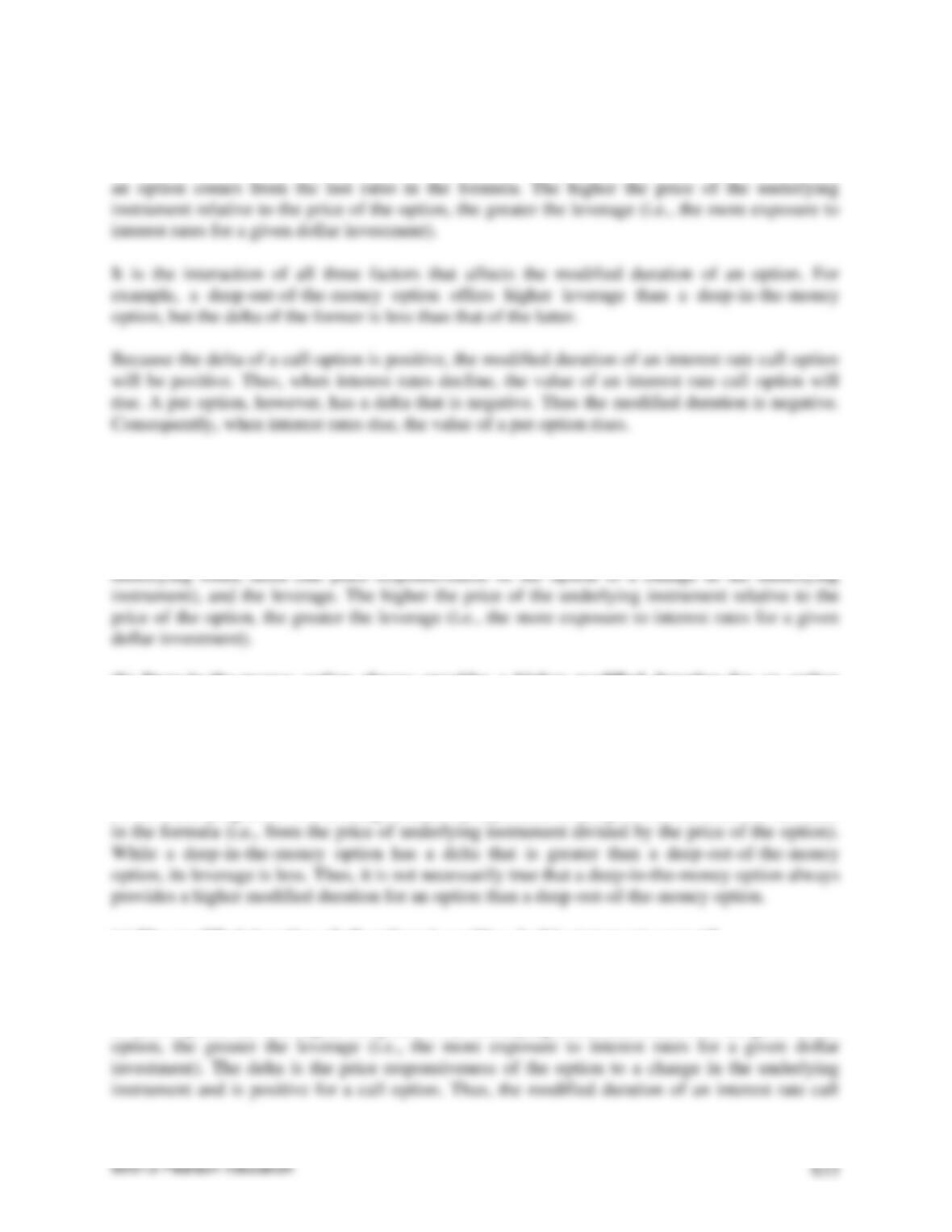
As expected, the modified duration of an option depends on the modified duration of the
underlying bond. It also depends on the price responsiveness of the option to a change in the
underlying instrument, as measured by the option’s delta. The leverage created by a position in
12. Answer the below questions.
(a) What factors affect the modified duration of an interest-rate option?
The modified duration of an interest-rate option is influenced by the modified duration of the
(b) Deep-in-the-money option always provides a higher modified duration for an option
than a deep-out-of-the-money option. Comment.
The modified duration of an option can be shown to be equal to the modified duration of
underlying instrument times delta times the price of underlying instrument divided by the price
of the option. Delta is the change in the price of a call option divided by the change in the price
of the underlying asset. The leverage created by a position in an option comes from the last ratio
(c) The modified duration of all options is positive. Is this statement correct?
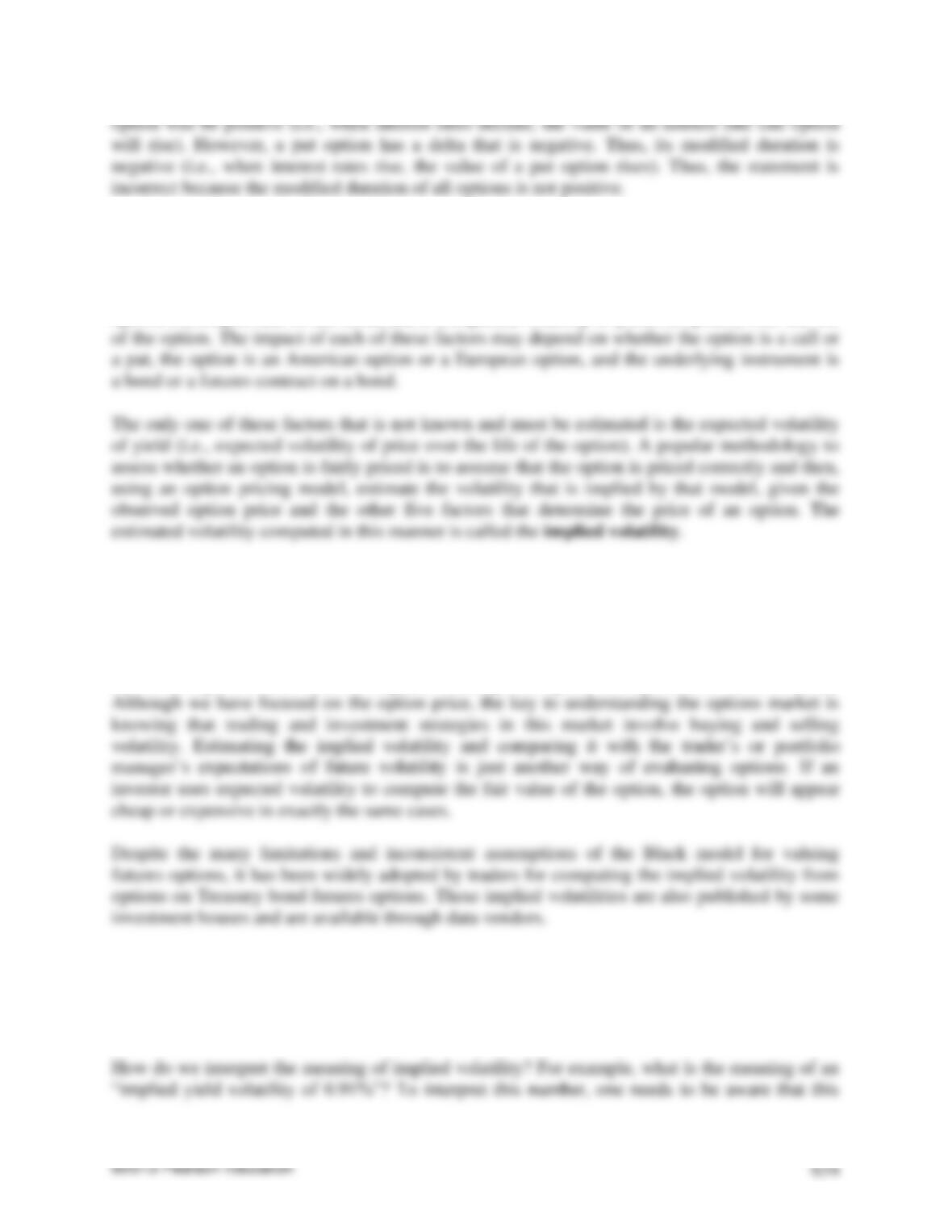
The modified duration of an interest-rate option is influenced by the modified duration of the
underlying bond (which is positive), delta (which can be positive or negative), and the leverage
(which is positive). The higher the price of the underlying instrument relative to the price of the
©2013 Pearson Education
634
option will be positive (i.e., when interest rates decline, the value of an interest rate call option
will rise). However, a put option has a delta that is negative. Thus, its modified duration is
negative (i.e., when interest rates rise, the value of a put option rises). Thus, the statement is
incorrect because the modified duration of all options is not positive.
13. How is the implied volatility of an option determined?
Six factors will influence the option price: (i) current price of the underlying instrument;
(ii) strike price; (iii) time to expiration; (iv) short-term risk-free interest rate over the life of the
option; (v) coupon rate on the bond; and (vi) expected volatility of yields (or prices) over the life
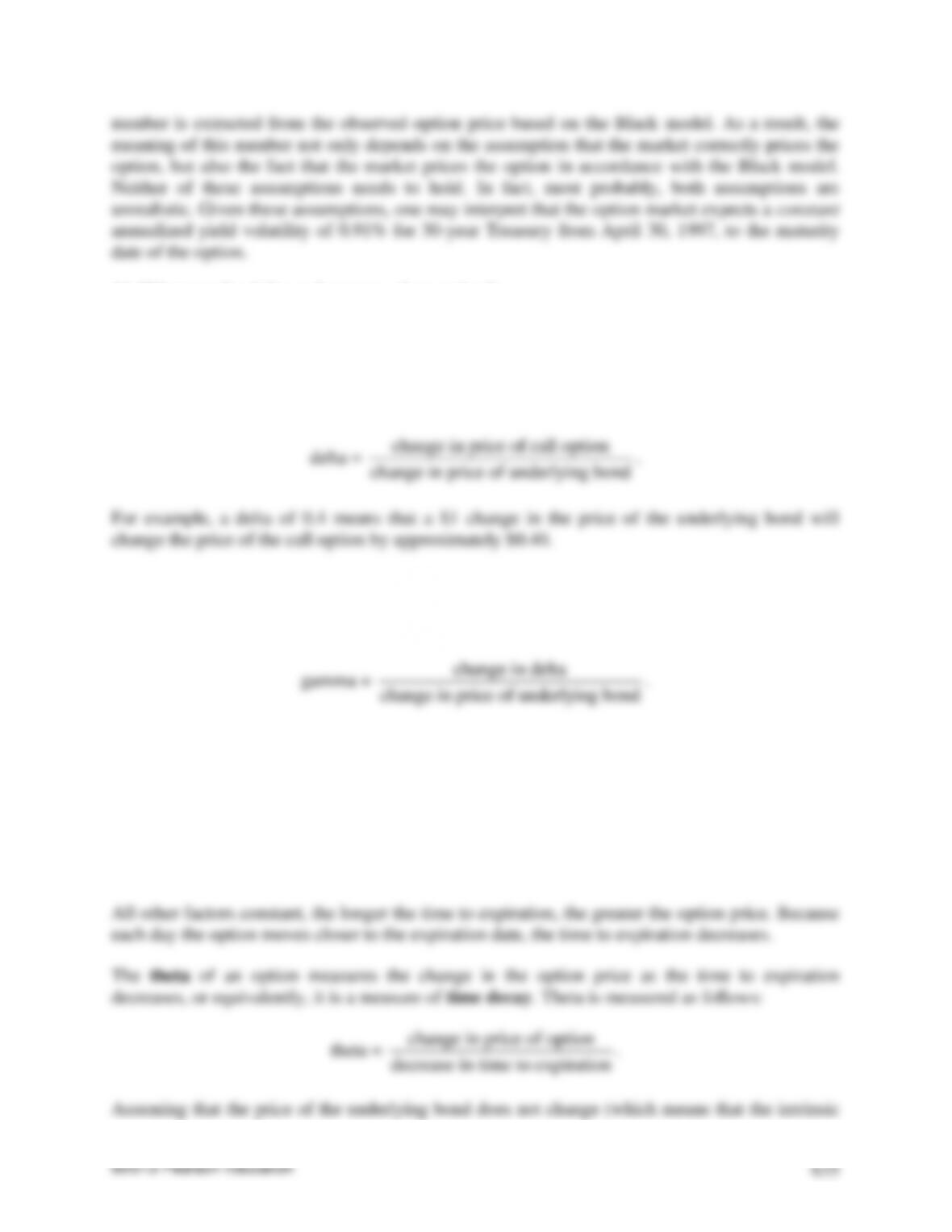
For example, suppose that a portfolio manager using some option pricing model, the current
price of the option, and the five other factors that determine the price of an option computes an
implied yield volatility of 12%. If the portfolio manager expects that the volatility of yields over
the life of the option will be greater than the implied volatility of 12%, the option is considered
to be undervalued. In contrast, if the portfolio manager’s expected volatility of yields over the
life of the option is less than the implied volatility, the option is considered to be overvalued.
When computing implied volatilities of yield from Treasury bond futures options, the process is
more complex than those for options on individual stocks or stock indexes. Remember that the
options are written on futures prices. Therefore, the implied volatilities computed directly from
the Black model are implied price volatilities of the underlying futures contract.
©2013 Pearson Education
635
number is extracted from the observed option price based on the Black model. As a result, the
meaning of this number not only depends on the assumption that the market correctly prices the
option, but also the fact that the market prices the option in accordance with the Black model.
Neither of these assumptions needs to hold. In fact, most probably, both assumptions are
unrealistic. Given these assumptions, one may interpret that the option market expects a constant
annualized yield volatility of 0.91% for 30-year Treasury from April 30, 1997, to the maturity
date of the option.
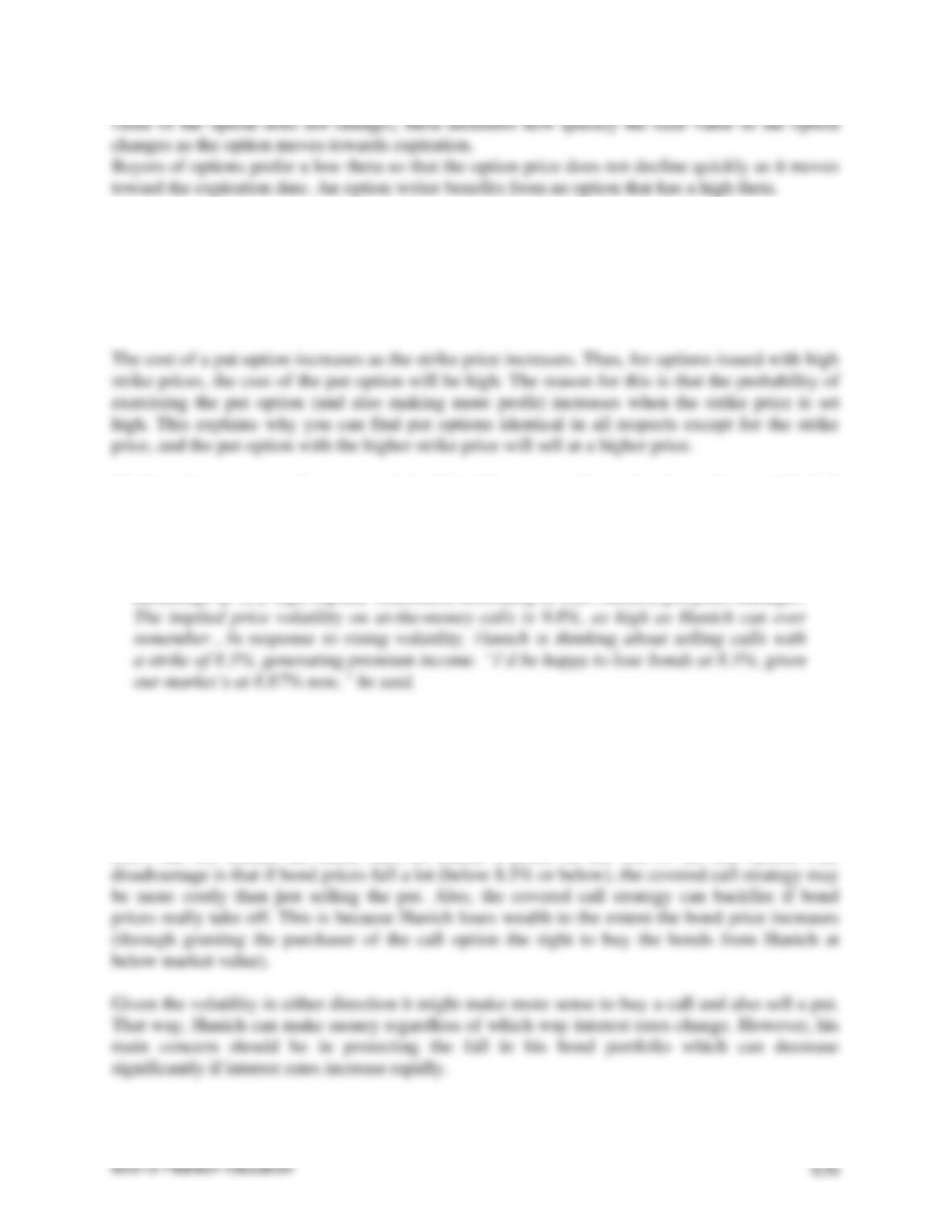
14. What are the delta and gamma of an option?
Suppose we are considering how the price of the call option changes when the price of the
underlying bond changes. In graphing this relationship, the slope of the tangent line shows how
the theoretical call option price will change for small changes in the price of the underlying
bond. The slope is popularly referred to as the delta of the option. Specifically,
The curvature of the convex relationship can also be approximated. This is the rate of change of
delta as the price of the underlying bond changes. The measure is commonly referred to as
gamma and is defined as follows:
change in price of underlying bond
15. Explain why the writer of an option would prefer an option with a high theta (all other
factors equal).
The loss to the writer decreases to the extent the option price declines. Thus, the writer of an
option would prefer a high theta (all other factors equal) because a high theta means that the
option price declines quickly as it moves toward the expiration date. More details are given
below.
change in price of underlying bond
©2013 Pearson Education
636
value of the option does not change), theta measures how quickly the time value of the option
changes as the option moves towards expiration.
Buyers of options prefer a low theta so that the option price does not decline quickly as it moves
toward the expiration date. An option writer benefits from an option that has a high theta.
16. In implementing a protective put buying strategy, explain the trade-off between the cost
of the strategy and the strike price selected.
The trade-off is that the cost of the strategy increases as a higher strike price is selected. More
details are given below.
17. Here is an excerpt from an article titled “Dominguez Barry Looks at Covered Calls,”
appearing in the July 20, 1992, issue of Derivatives Week, p. 7:
SBC Dominguez Barry Funds Management in Sydney, with A$5.5 billion under
management, is considering writing covered calls on its Australian bond portfolio to take
advantage of very high implied volatilities, according to Carl Hanich, portfolio manager.
Explain the strategy that Mr. Hanich is considering.
A covered call position, which is a long bond position plus a short call option position on the
same bond, has the same profit profile as a short put option position. Thus, when Hanich states
he is willing to lose (or sell) bonds at 8.5%, he is suggesting that he would use a put option strike
price consistent with an 8.5% bond. One advantage (of Hanich’s strategy) is that if bond prices
don’t fall but remain the same, then he makes a profit on the sell of the call option. One
18. Determine the price of a European call option on a 6.5% four-year Treasury bond with
a strike price of 100.25 and two years to expiration assuming: (1) the arbitrage-free
binomial interest-rate tree shown in Exhibit 27-10 (based on a 10% volatility
assumption),and (2) the price of the Treasury bond two years from now shown at each
node.
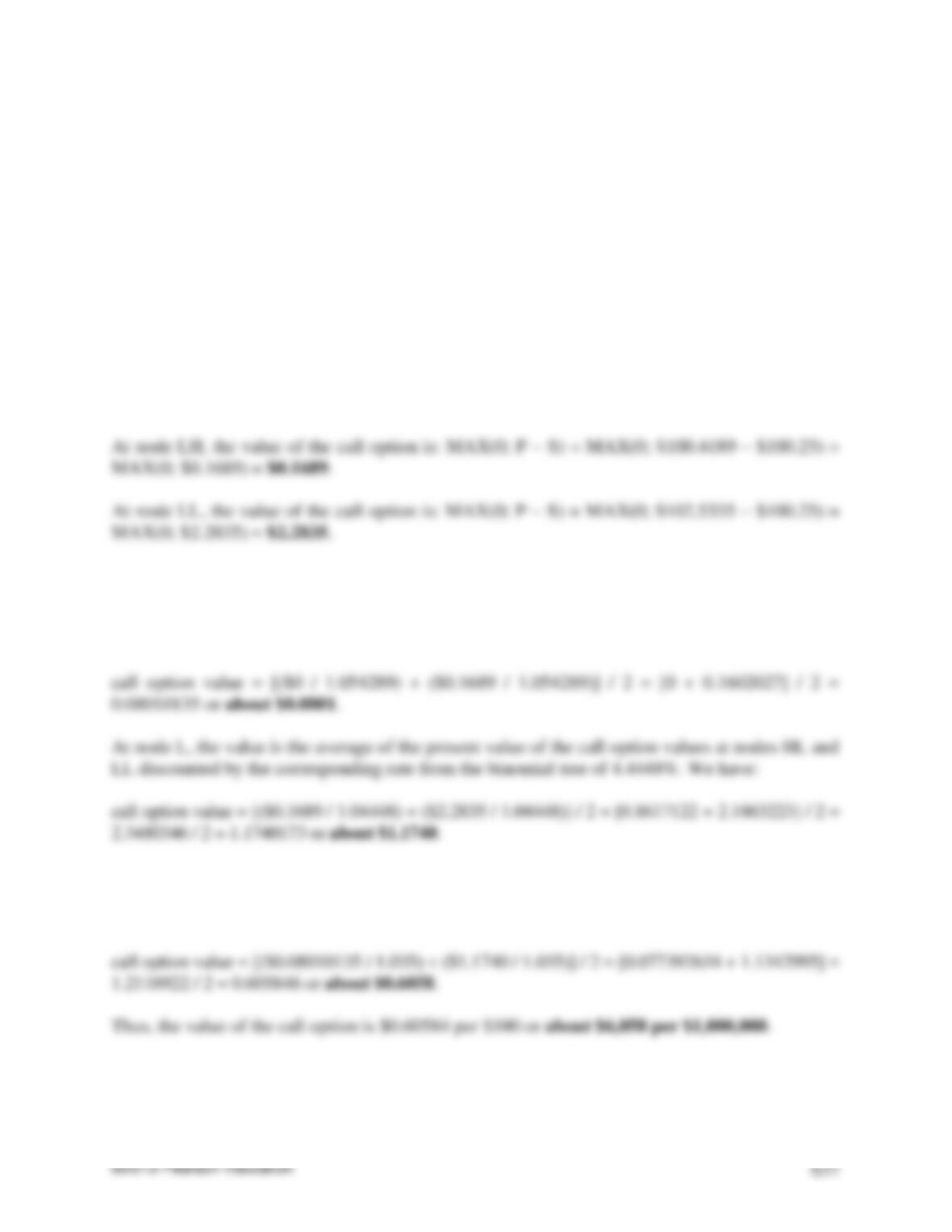
For each node, the value of the call option is the maximum of zero and the current price (P)
minus the strike price (S), i.e., MAX(0; P – S). The current prices are given in Exhibit 27-11 as
$97.9249, $100.4189, and $102.5335 for year two at three nodes which (from Chapter 17) we
call HH, LH (or HL), and LL, respectively.
At node HH, the value of the call option is: MAX(0; P – S) = MAX(0; $97.9249 – $100.25) =
MAX(0; −$2.3251) = $0.
For year two we have two nodes that we will refer to as nodes H and L.
At node H, the value is the average of the present value of the call option values at nodes HH and
HL discounted by the corresponding rate from the binomial tree of 5.4289%. We have:
At the initial node (year zero), the value is the average of the present value of the call option
values at nodes H and L discounted by the corresponding rate from the binomial tree of 3.500%.
We have:
19. Determine the price of a European put option on a 6.5% four-year Treasury bond with
a strike price of 100.25 and two years to expiration assuming the same information as in
Exhibit 27-10.
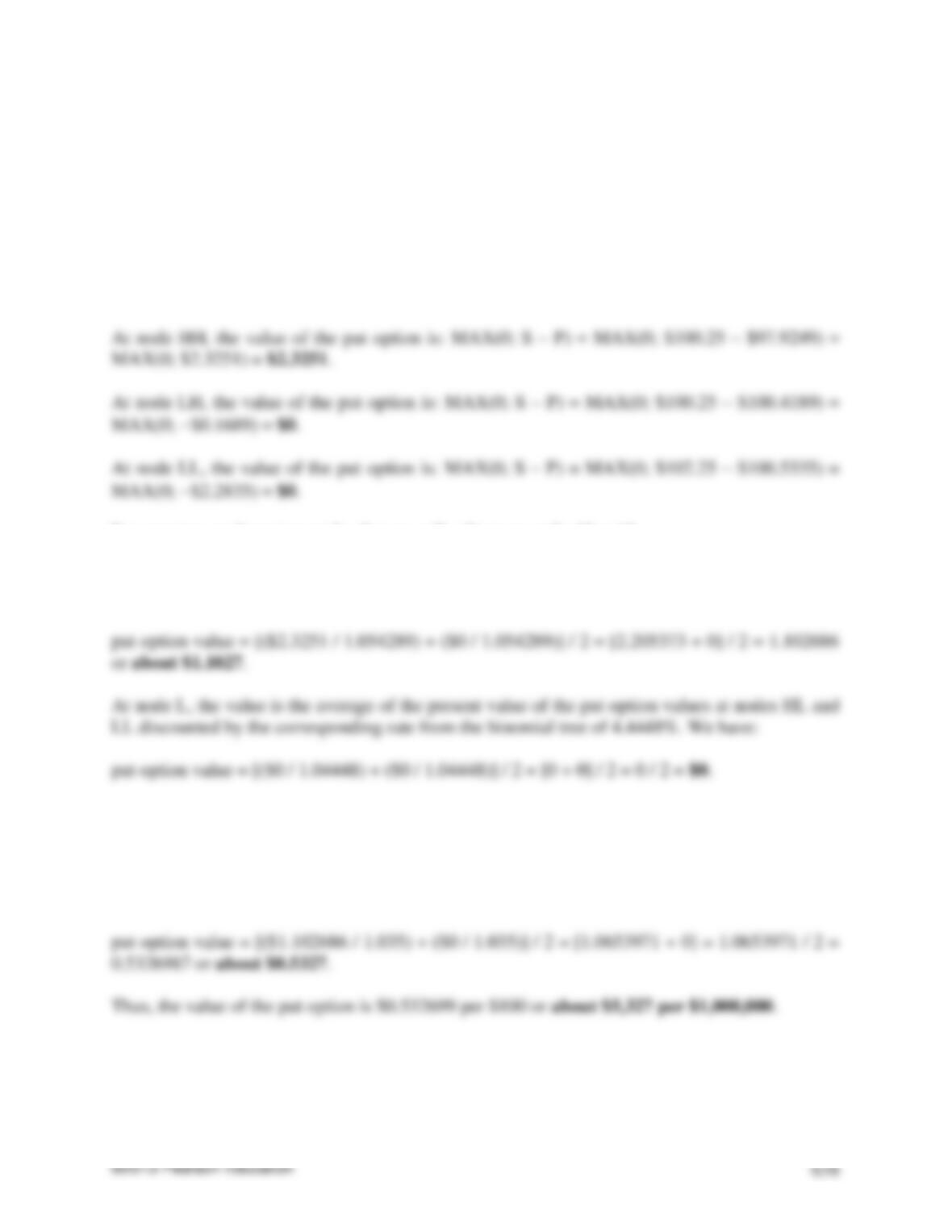
For each node the value of the put option is the maximum of zero and the strike price (S) minus
the current price (P), i.e., MAX(0; S – P). The current prices are given in Exhibit 27-11 as
$97.9249, $100.4189, and $101.5335 for year two at three nodes which (from Chapter 16) we
call HH, LH (or HL), and LL, respectively.
For year two we have two nodes that we will refer to as nodes H and L.
At node H, the value is the average of the present value of the put option values at nodes HH and
HL discounted by the corresponding rate from the binomial tree of 5.4289%. We have:
[NOTE. We already knew it was zero because both values were zero.]
At the initial node (year zero), the value is the average of the present value of the put option
values at nodes H and L discounted by the corresponding rate from the binomial tree of 3.500%.
We have: