The theoretical Treasury bond futures price may be at a premium to the cash market price (higher
than the cash market price) or at a discount from the cash market price (lower than the cash
4. If the Eurodollar CD futures contract is quoted at 91.75, what is the annualized futures
three-month LIBOR?
5. Suppose that an investor purchased a Eurodollar futures contract at an index price of
95.00. At the settlement date, suppose that the settlement price is 95.40. Explain whether
the buyer or the seller of the futures contract receives a payment at the settlement date.
The seller of the futures contract receives a payment from the buyer because interest rates have
(100.00% – 95.00%) = 5.00%. At the settlement date, the index price is 95.40. This means
a three-month LIBOR of 4.60% interest rate is available in the market. The compensation of
$1,000 of the seller from the buyer is for the lower prevailing three-month LIBOR of 4.60%
rather than the contracted amount of 5.00%.
1.00 or 100 ticks. The buyer must pay the seller 100 × $25 = $2,500. The gain from the short
6. Explain how a market participant concerned with a decline in three-month LIBOR can
hedge that risk using the Eurodollar futures contract.
A Eurodollar CD is a dollar-denominated CD issued outside of the United States, typically by
a European bank. The interest rate paid on Eurodollar CDs is the London Interbank Offered Rate
95.00 and purchased it for 96.00, realizing a loss of 1.00 or 100 ticks. The seller must pay the
buyer 100 × $25 = $2,500 per contract bought. The gain from the short futures position is then
7. Answer the below questions.
(a) What is Euribor?
LIBOR is the most commonly used reference rate for floating-rate bank loans and derivative
instruments denominated in U.S. dollars and British pounds. For euro-denominated loans and
derivatives, when a reference rate is used, it is typically the Euro Interbank Offered Rate
(Euribor). Euribor is the rate on deposits denominated in euros. The Euribor futures contract,
traded on the NYSE Euronext, and the Eurodollar futures contract are the most actively traded
futures contracts in the world.
(b) What is Euribor futures contract?
©2013 Pearson Education
606
The underlying is 30-day Euribor. More specifically, it is based on the European Banking
Federations’ Euribor for three-month deposits. The index price is 100 minus Euribor. The
delivery months are March, June, September, December, and four serial months, such that 25
delivery months are available for trading, with the nearest six delivery months being consecutive
calendar months. The minimum price movement (tick size) is 0.005, which is equal to €12.50.
8. For a Treasury futures contract, how do you think the cost of carry will affect the decision
of the short as to when in the delivery month the short will elect to deliver?
9. Explain the asymmetric effect on the variation margin and cash flow for the short and
long in an interest-rate futures contract when interest rates change.
10. What are the delivery options granted to the seller of the Treasury bond futures contract?
11. How is the theoretical futures price of a Treasury bond futures contract affected by the
delivery options granted to the short?
©2013 Pearson Education
607
In addition to the choice of which acceptable Treasury issue to deliver—sometimes referred to as
the quality option or swap option—the short position has two more options granted under CBT
delivery guidelines. The short position is permitted to decide when in the delivery month
delivery actually will take place. This is called the timing option. The other option is the right of
the short position to give notice of intent to deliver up to 8:00 P.M. Chicago time after the
closing of the exchange (3:15 P.M. Chicago time) on the date when the futures settlement price
has been fixed. This option is referred to as the wild card option. The quality option, the timing
option, and the wild card option (in sum referred to as the delivery options) mean that the long
position can never be sure of which Treasury bond will be delivered or when it will be delivered.
12. Explain how the shape of the yield curve influences the theoretical price of a Treasury
bond futures contract.
The theoretical price of a futures contract is equal to the cash or spot price plus the cost of carry.
13. Suppose that the conversion factor for a particular Treasury bond that is acceptable for
delivery in a Treasury bond futures contract is 0.85 and that the futures price settles at 105.
Assume also that the accrued interest for this Treasury bond is 4. What is the invoice price
if the seller delivers this Treasury bond at the settlement date?

14. Suppose that bond ABC is the underlying asset for a futures contract with settlement
six months from now. You know the following about bond ABC and the futures contract:
(1) In the cash market ABC is selling for $80 (par value is $100); (2) ABC pays $8 in
coupon interest per year in two semiannual payments of $4, and the next semiannual
payment is due exactly six months from now; and (3) the current six-month interest rate at
which funds can be loaned or borrowed is 6%.
Answer the below questions.
(a) What is the theoretical futures price?
The theoretical futures price (F) is given by:
F = P[1 + t(r – c)]
where P = cash market price, t = time, in years, to the futures delivery date, r = financing rate,
and c = current yield (coupon rate divided by the cash market price).
Inserting in our values, we have:
F = P[1 + t(r – c)] = $80[1 + 0.5(0.06 – 0.08)] = $80[0.99] = $79.20.
(b) What action would you take if the futures price is $83?
You would sell the futures contract at 83, purchase the bond at 80, and borrow 80 for six months
at 6% per year.
(c) What action would you take if the futures price is $76?
You would buy the futures contract at 76, sell (short) the bond for 80, and invest (lend) 80 for six
months at 6% per year.
(d) Suppose that bond ABC pays interest quarterly instead of semiannually. If you know
that you can reinvest any funds you receive three months from now at 1% for three
months, what would the theoretical futures price for six-month settlement be?
The theoretical futures price (F) is given by:
F = P[1 + t(r – c)]
where P = cash market price, t = time, in years, to the futures delivery date, r = financing rate,
and c = current yield (coupon rate divided by the cash market price).
The coupon rate was 4% semiannually or 8% annually. Now it is 2% quarterly and reinvested at
1%. This means we now have 2%(1.01) = 2.02% quarterly or 4(2.02%) = 8.08% annually.
Inserting in our new value for c gives:
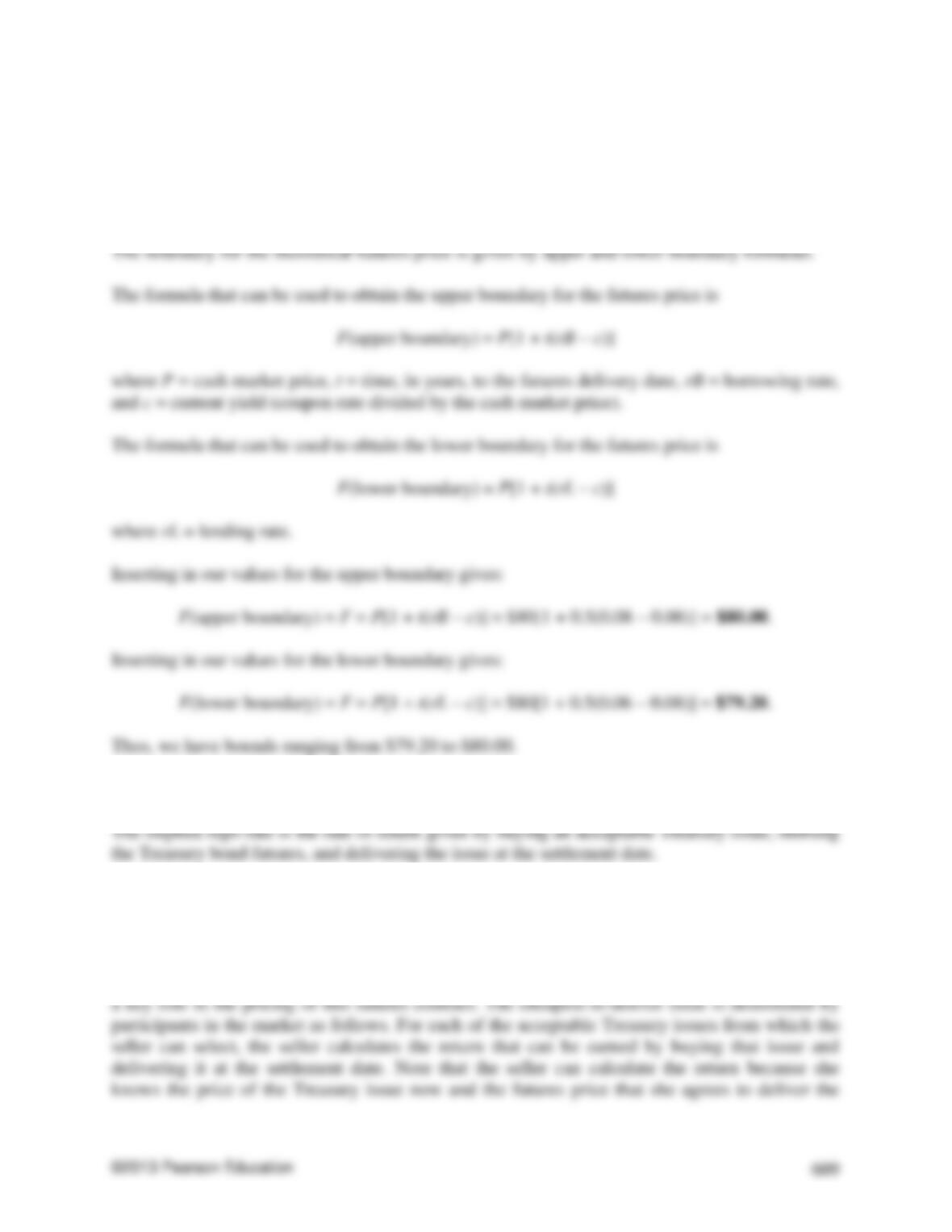
F = P[1 + t(r – c)] = $80[1 + 0.5(0.06 – 0.0808)] = $80[0.9898] = $79.168.
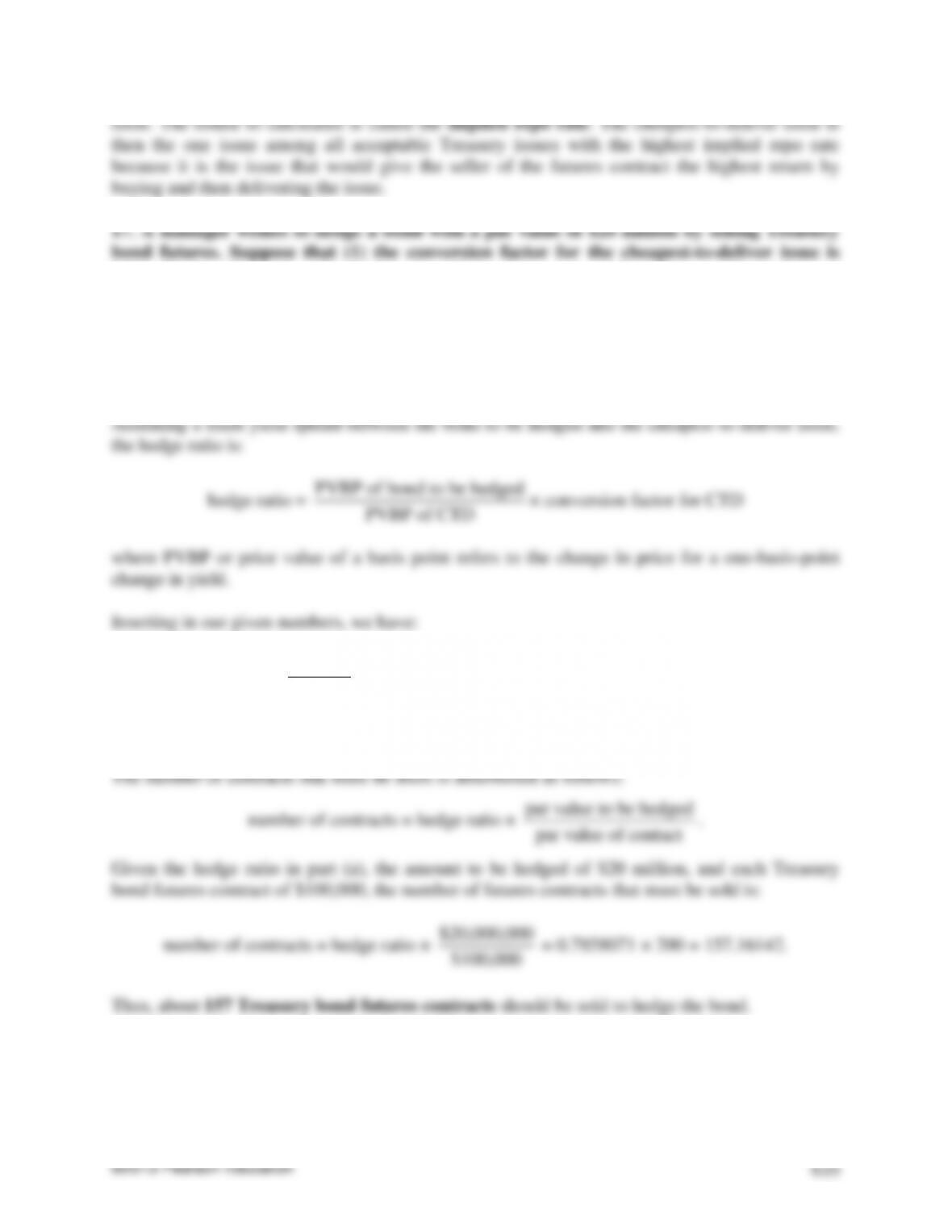
(e) Suppose that the borrowing rate and lending rate are not equal. Instead, suppose that
the current six-month borrowing rate is 8% and the six-month lending rate is 6%. What is
the boundary for the theoretical futures price?
15. What is the implied repo rate?
16. Explain why the implied repo rate is important in determining the cheapest–to-deliver
issue.
In selecting the issue to be delivered, the short will select from all the deliverable issues the one
that is cheapest to deliver. This issue is referred to as the cheapest-to-deliver issue; it plays
©2013 Pearson Education
610
issue. The return so calculated is called the implied repo rate. The cheapest-to-deliver issue is
then the one issue among all acceptable Treasury issues with the highest implied repo rate
because it is the issue that would give the seller of the futures contract the highest return by
buying and then delivering the issue.
0.91, (2) the price value of a basis point of the cheapest–to-deliver issue at the settlement
date is 0.06895, and (3) the price value of a basis point of the bond to be hedged is 0.05954.
Answer the below questions.
(a) What is the hedge ratio?
hedge ratio =
0.05954
0.06895
× 0.91 = 0.8635242 × 0.91 = 0.7858071 or about 0.79.
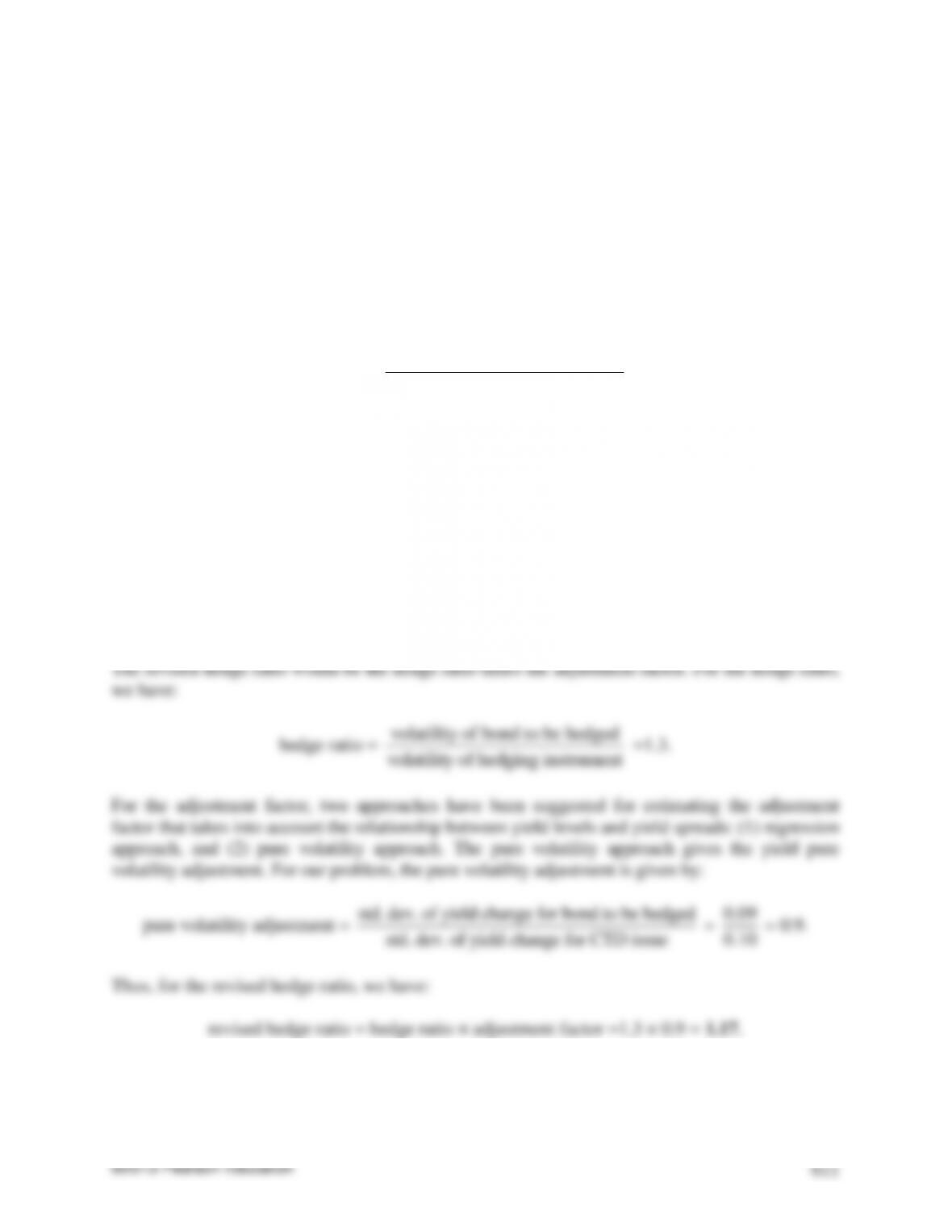
(b) How many Treasury bond futures contracts should be sold to hedge the bond?
18. Suppose that without an adjustment for the relationship between the yield on a bond to
be hedged and the yield on the hedging instrument the hedge ratio is 1.30.
Answer the below questions.
(a) Suppose that a yield beta of 0.8 is computed. What would the revised hedge ratio be?
The revised hedge ratio would be the hedge ratio times the adjustment factor. For the hedge ratio,
we have:
hedge ratio =
volatility of bond to be hedged
volatility of hedging instrument
=1.3.
For the adjustment factor, two approaches have been suggested for estimating the adjustment
factor that takes into account the relationship between yield levels and yield spreads: (1) regression
approach, and (2) pure volatility approach. The regression approach gives the yield beta. For our
problem, the yield beta is 0.8. Thus, for the revised hedge ratio, we have:
revised hedge ratio = hedge ratio × adjustment factor =1.3 × 0.8 = 1.04.
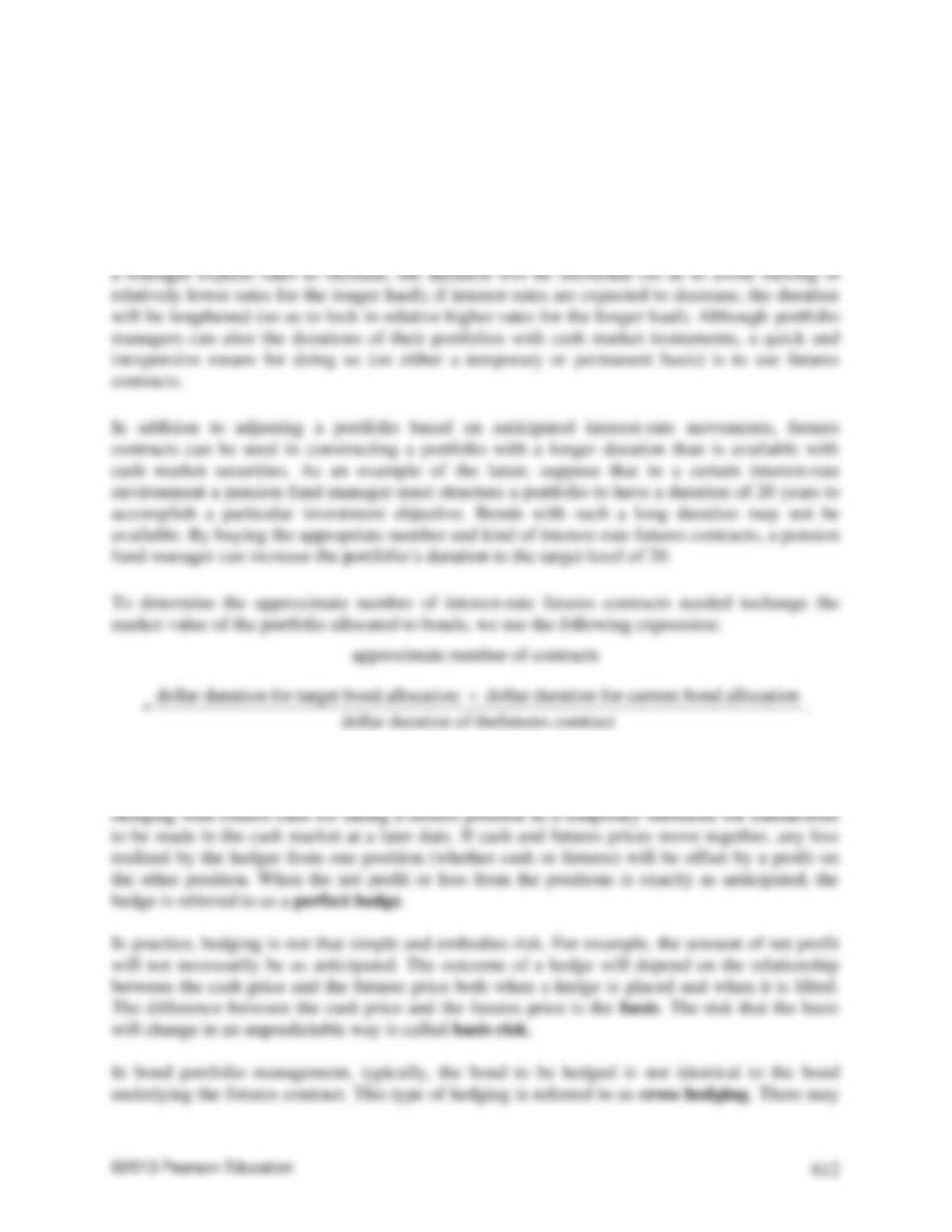
(b) Suppose that the standard deviation for the bond to be hedged and the hedging
instrument are 0.09 and 0.10, respectively. What is the pure volatility adjustment, and what
would be the revised hedge ratio?
volatility of bond to be hedged
volatility of hedging instrument
19. Suppose that a manager wants to reduce the duration of a portfolio. Explain how this
can be done using Treasury bond futures contracts.
Interest-rate futures can be used to alter the interest-rate sensitivity of a portfolio. Portfolio
managers with strong expectations about the direction of the future course of interest rates will
adjust the durations of their portfolios so as to capitalize on their expectations. Specifically, if
dollar duration of thefutures contract
20. What risks are associated with hedging?
©2013 Pearson Education
613
be substantial basis risk in cross hedging. An unhedged position is exposed to price risk, the risk
that the cash market price will move adversely. A hedged position substitutes basis risk for price
risk.
Another aspect of risk involved with a cross hedge is choosing the right hedge ratio. The hedge
ratio depends on volatility weighting, or weighting by relative changes in value. The purpose of
a hedge is to use gains or losses from a futures position to offset any difference between the
target sale price and the actual sale price of the asset. Accordingly, the hedge ratio is chosen with
the intention of matching the volatility (i.e., the dollar change) of the futures contract to the
volatility of the asset.
Another adjustment in the hedging strategy is usually necessary for dealing with the risk of
hedging nondeliverable securities. This adjustment concerns the assumption about the relative
yield spread between the cheapest-to-deliver bond and the bond to be hedged. In the prior
discussion, we assumed that the yield spread was constant over time. Yield spreads, however, are
not constant over time. They vary with the maturity of the instruments in question and the level
of rates, as well as with many unpredictable and nonsystematic factors.
21. How could a portfolio manager use a Treasury bond futures contract to hedge against
increased interest rates over the next quarter?
22. Consider the portfolio in Exhibit 26-3. Suppose that the dollar duration of the 5-year
Treasury note futures contract is $5,022.
a. What position would a portfolio manager have to take in the contract to hedge the portfolio?
The portfolio manager would take a long position by buying futures contracts. More details are
given below.
The market value of the portfolio in Exhibit 26-3 is $48,109,810 on March 31, 2011 and its
effective duration is 2.97. It is assumed that the manager is managing a portfolio whose
benchmark is theBarclays Capital Intermediate Aggregate Index and has a duration of 3.68.
Because the portfolio duration of 2.97 is less than that of the benchmark duration, the portfolio
hasless interest rate exposure (for a parallel shift in the yield curve) than the benchmark.
The manager wants to restructure the portfolio so that its duration matches that of the
benchmark. That is, the portfolio manager seeks to follow a duration-matched strategy and

therefore the portfolio’s target duration is 3.68. For a 100 basis change in interest rates, the
portfolio’s target dollar duration is then the product of 3.68% times the current market value of
the portfolio. Therefore,
portfolio target dollar duration = 3.68% × $48,109,810 = $1,770,110
The current portfolio duration is 2.97, so for a 100 basis point change in interest rates,
portfolio current dollar duration = 2.97% × $48,109,810 = $1,428,594
The difference between the target and the current dollar duration for the portfolio is $341,516.
This means that to get to the target portfolio duration of 3.68, the portfolio manager must
increase the dollar duration of the current portfolio by $341,516.
One way to do this is by taking a position in a futures contract. Buying futures contracts
increases the dollar duration. The question is what is the dollar duration of the futures contract?
For our problem,the portfolio manager will use the 5-Treasury note futures contract. The futures
price on March 31, 2011 was 116.79. Based on an analysis of this contract, the portfolio manager
determines that for a 100 basis point change in interest rates, the 5-year Treasury note futures
contract will change by roughly $5,022. If the portfolio manager buys C contracts, then the dollar
duration of the futures position for a 100 basis point change in interest rates is the product of the
number futures contract; that is,
dollar duration of futures contract = $5,022 × C
The portfolio manager wants the above equation to be equal $341,516. Thus,
$5,022 × C = $341,516
Solving we get
C = 68 contracts
Thus, by buying 68 5-year Treasury note futures contracts, the portfolio manager will increase
the dollar duration of the portfolio by $341,516 for a 100 basis point change in interest rates.
b. What is the market value of the position that the portfolio manager must take?
(116.79/100) × $100,000 × 68 = $7,941,720
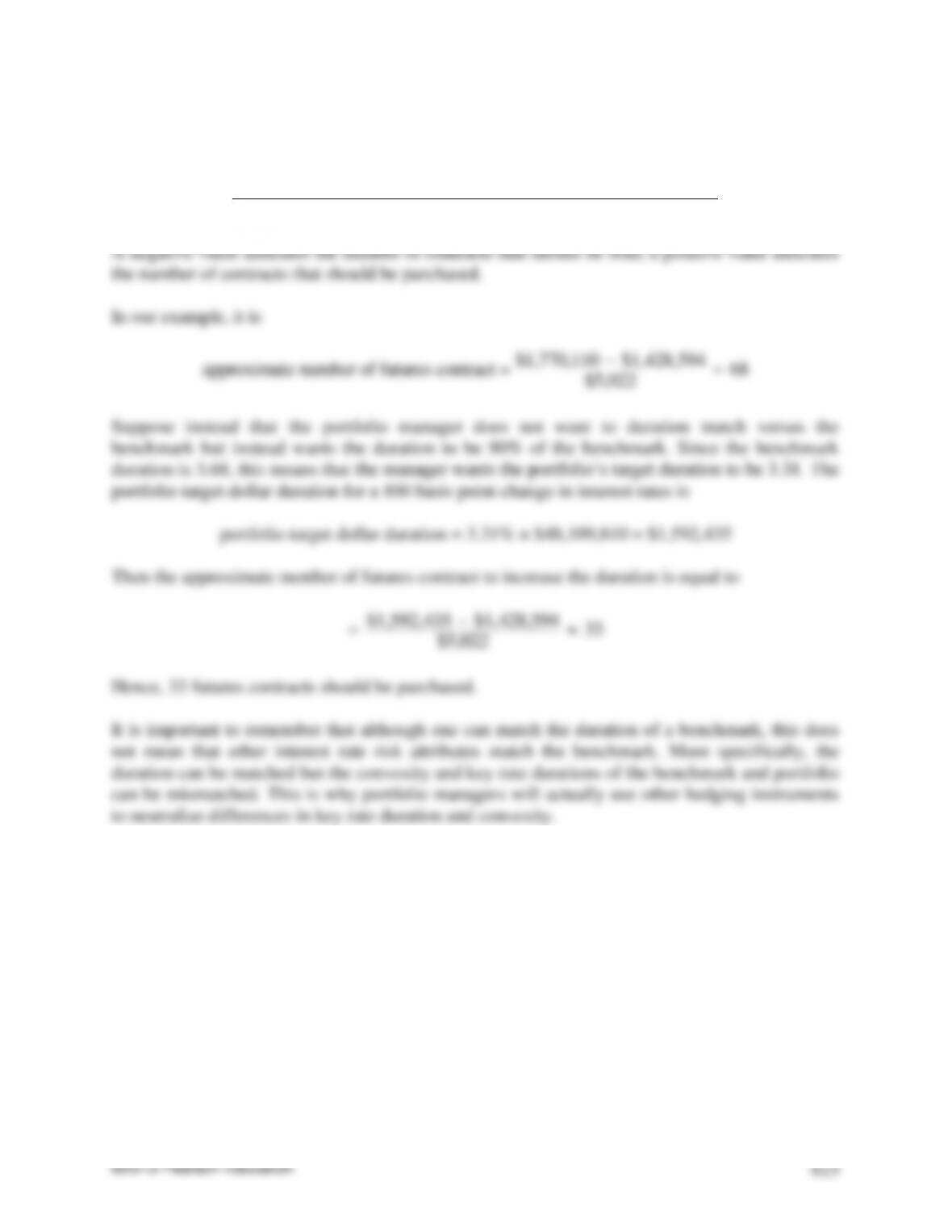
A formula to approximate the number of futures contracts necessary to adjust the portfolio
duration to a target level is
portfolio target dollar duration portfolio current dollar duration
dollar duration of futures contract
−
23. Consider the portfolio in Exhibit 26-3. Suppose that the dollar duration of the 5-year
Treasury note futures contract is $5,022.
a. What position would a portfolio manager have to take in the contract to obtain a portfolio
of 4?
The manager would take a long position by buying about 99 future contracts. More details are
given below.
Using the information found from the previous problem and Exhibit 23-6, we now want to know
what position will be taken if the portfolio manager does not want the portfolio duration to match
thebenchmark. With a portfolio target duration of 4, the manager wants the duration to be greater
than the benchmark by about (4 – 3.68) / 3.68 = 0.086957 or about 8.7%. Given a portfolio
market value of $48,109,810, the portfolio target dollar duration for a 100 basis point change in
interest rates is
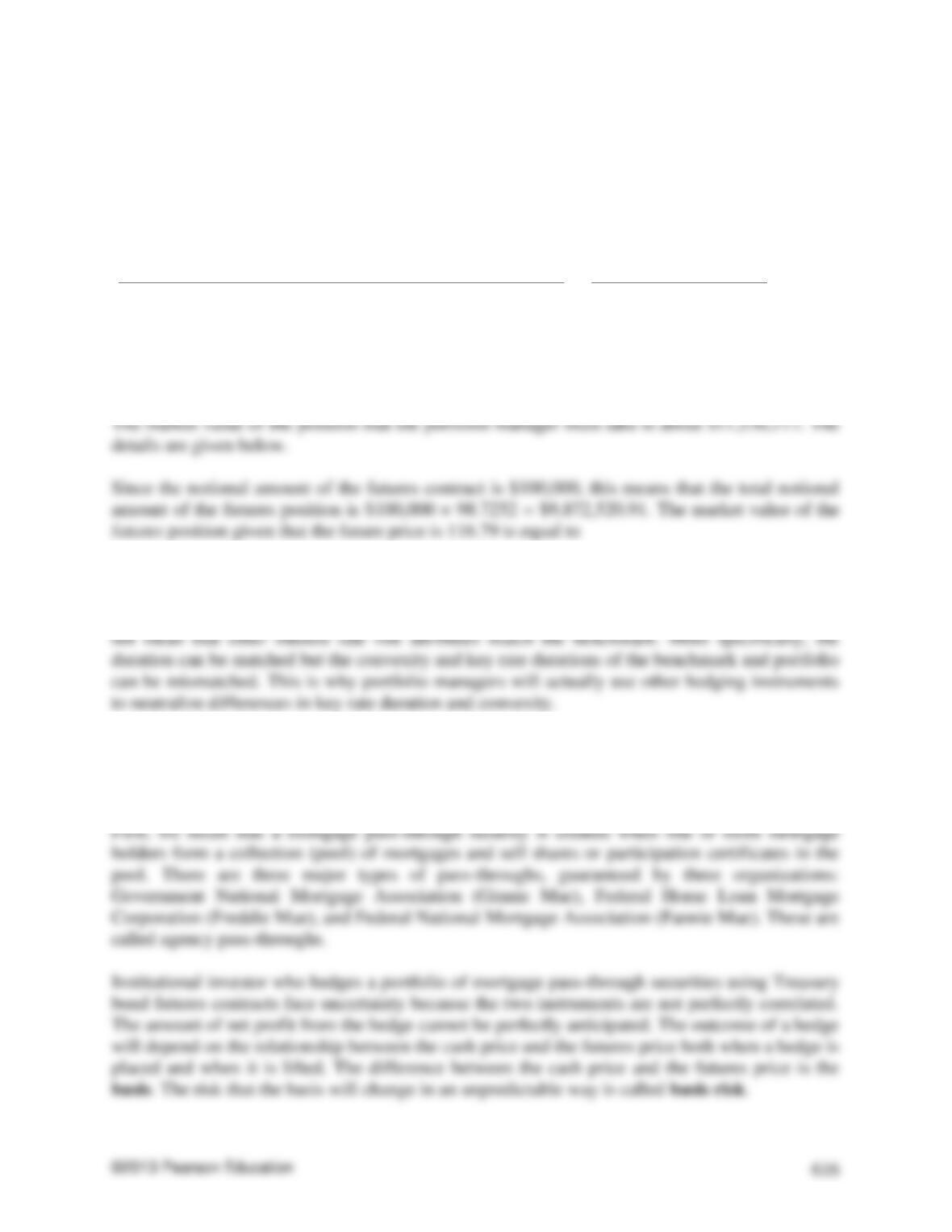
portfolio target dollar duration = 4.00% × $48,109,810 = $1,924,392.40.
The number of futures contract to increase the duration is given as:
portfolio target dollar duration portfolio current dollar duration
dollar duration of futures contract
−
=
$1,924,392 $1,428,594 98.73.
$5,022
−=
Thus, about 99 futures contracts should be purchased.
b. What is the market value of the position that the portfolio manager must take?
(116.79/100) × $100,000 × 98.7252 = $11,530,117.17.
It is important to remember that although one can match the duration of a benchmark, this does
24. Suppose that an institutional investor wants to hedge a portfolio of mortgage
pass-through securities using Treasury bond futures contracts. What are the risks associated
with such a hedge?

©2013 Pearson Education
617
The hedge between mortgage pass-through securities and Treasury bond futures contracts is
referred to as cross hedging. There is risk involved with a cross hedge. The key to minimizing
this is to choose the right hedge ratio. The hedge ratio depends on volatility weighting, or
weighting by relative changes in value. The purpose of a hedge is to use gains or losses from
a futures position to offset any difference between the target sale price and the actual sale price
of the asset. Accordingly, the hedge ratio is chosen with the intention of matching the volatility
(i.e., the dollar change) of the futures contract to the volatility of the asset.
25. The following excerpt appeared in the following article, “Duration,” in the November 16,
1992, issue of Derivatives Week, p. 9:
“TSA Capital Management in Los Angeles must determine duration of the futures contract it
uses in order to match it with the dollar duration of the underlying, explains David Depew,
principal and head of trading at the firm. Futures duration will be based on the duration of
the underlying bond most likely to be delivered against the contract …”
Answer the below questions.
(a) Explain why it is necessary to know the dollar duration of the underlying in order to
hedge.
Knowing the dollar duration of the underlying is necessary to hedging if the hedging instrument
is to offset any loss through ownership of the asset. For example, consider hedging with futures
where the bond to be hedged is not identical to the bond underlying the futures contract. This
type of hedge is a cross hedge. The key to minimizing risk in a cross hedge is to choose the right
hedge ratio. The hedge ratio depends on volatility weighting, or weighting by relative changes in
value. The purpose of a hedge is to use gains or losses from a futures position to offset any
difference between the target sale price and the actual sale price of the asset. Accordingly, the
hedge ratio is chosen with the intention of matching the volatility (i.e., the dollar change) of the
futures contract to the volatility of the asset.
If the two bonds have the same dollar duration then their percentage change in price is the same.
This implies they will have the same dollar price volatility. By having the same dollar duration,
the bonds will have the same price change for a given change in yield and thus achieving the
hedging purpose of offsetting any loss or gain.
(b) Why can the price value of basis point be used instead of the dollar duration?

26. You work for a conservative investment management firm. You recently asked one of
the senior partners for permission to open up a futures account so that you could trade
interest-rate futures as well as cash instruments. He replied,
“Are you crazy? I might as well write you a check, wish you good luck, and put you on
a bus to Las Vegas. The futures markets are nothing more than a respectable game of
craps. Don’t you think you’re taking enough risk trading bonds?”
How would you try to persuade the senior partner to allow you to use futures?
for $100. If the exchange where the futures contract for bond XYZ is traded requires an initial
margin of $5, however, Bob can purchase 20 contracts with his $100 investment. (This example