CHAPTER 26
INTEREST-RATE FUTURES CONTRACTS
CHAPTER SUMMARY
A futures contract is an agreement that requires a party to the agreement either to buy or sell
something at a designated future date at a predetermined price. In this chapter we describe
MECHANICS OF FUTURES TRADING
A futures contract is a firm legal agreement between a buyer (seller) and an established
exchange or its clearinghouse in which the buyer (seller) agrees to take (make) delivery of
something at a specified price at the end of a designated period of time.
Opening Position
Liquidating a Position
Role of the Clearinghouse
Associated with every futures exchange is a clearinghouse, which performs several functions.
One of these functions is guaranteeing that the two parties to the transaction willperform. When
an investor takes a position inthe futures market, the clearinghouse takes the opposite position
Margin Requirements
When a position is first taken in a futures contract, the investor must deposit a minimum dollar
amount per contract as specified by the exchange. This amount, called the initial margin, is
required as deposit for the contract. At the end of each trading day, the exchange determines the
settlement price for the futures contract. This price is used to mark to market the investor’s
position, so that any gain or loss from the position is reflected in the investor’s equity account.
FUTURES VERSUS FORWARD CONTRACTS
Just like a futures contract, a forward contract is an agreement for the future delivery of the
underlying at a specified price at the end of a designated period of time. Futures contracts are
traded on organized exchanges and are standardized agreements as to the delivery date (or
RISK AND RETURN CHARACTERISTICS OF FUTURES CONTRACTS
The buyer of a futures contract will realize a profit if the futures price increases; the seller of
a futures contract will realize a profit if the futures price decreases. If the futures price decreases,
the buyer of a futures contract realizes a loss while the seller of a futures contract realizes a profit.
Leveraging Aspect of Futures
INTEREST-RATE FUTURES CONTRACTS
Below we describe two of the major contracts used for risk control by institutional investors:
Eurodollar futures and U.S. Treasury futures.
Eurodollar Futures
Eurodollar futures contracts are traded on both the International Monetary Market of the Chicago
Mercantile Exchange and the London International Financial Futures Exchange. The Eurodollar
time deposit with a principal value of U.S. $1 million and three months to maturity is the
underlying for this contract.
To see how a Eurodollar futures contract is used for hedging, suppose that a market participant is
concerned that its borrowing costs six months from now are going to be higher. To protect itself,
it takes a short (selling) position in the Eurodollar futures contract such that a rise in short-term
interest rates will benefit. To see this, consider our previous illustration in the Eurodollar futures
Treasury Futures
The most active bond derivatives contracts are the Treasury futures contracts. These contractsare
classified by maturity. The underlying for the Treasury bond futures contract arecertain
Treasury coupon securities that were originally issued as Treasury bonds. Treasurynote futures
contracts include the two-year, five-year, and 10-year Treasury futures.
Treasury Bond Futures
The underlying instrument for a Treasury bond futures contract is $100,000 par value of
a hypothetical 20-year 8% coupon bond. The futures price is quoted in terms of par being 100.
Quotes are in 32nds of 1%. The seller of a Treasury bond futures who decides to make delivery
rather than liquidate his position by buying back the contract prior to the settlement date must
The price that the buyer must pay the seller when a Treasury bond is delivered is called the
invoice price, which is given as:
invoice price =
(contract size × futures contract settlement price × conversion factor) + accrued interest.
In selecting the issue to be delivered, the short will select from all the deliverable issues the one
that is cheapest to deliver. This issue is referred to as the cheapest-to-deliver issue; it plays
a key role in the pricing of this futures contract. Knowing the price of the Treasury issue, the
Treasury Note Futures
There are three Treasury note futures contracts: 10-year, five-year, and two-year. All
threecontracts are modeled after the Treasury bond futures contract and are traded on theCME
Group. The underlying instrument for the 10-year Treasury note futures contract is$100,000 par
PRICING AND ARBITRAGE IN THE INTEREST-RATE FUTURES MARKET
There are several different ways to price futures contracts. Each approach relies on the “law of
one price.” This law states that a given financial asset (or liability) must have the same price
regardless of the means by which it is created.
Pricing of Futures Contracts
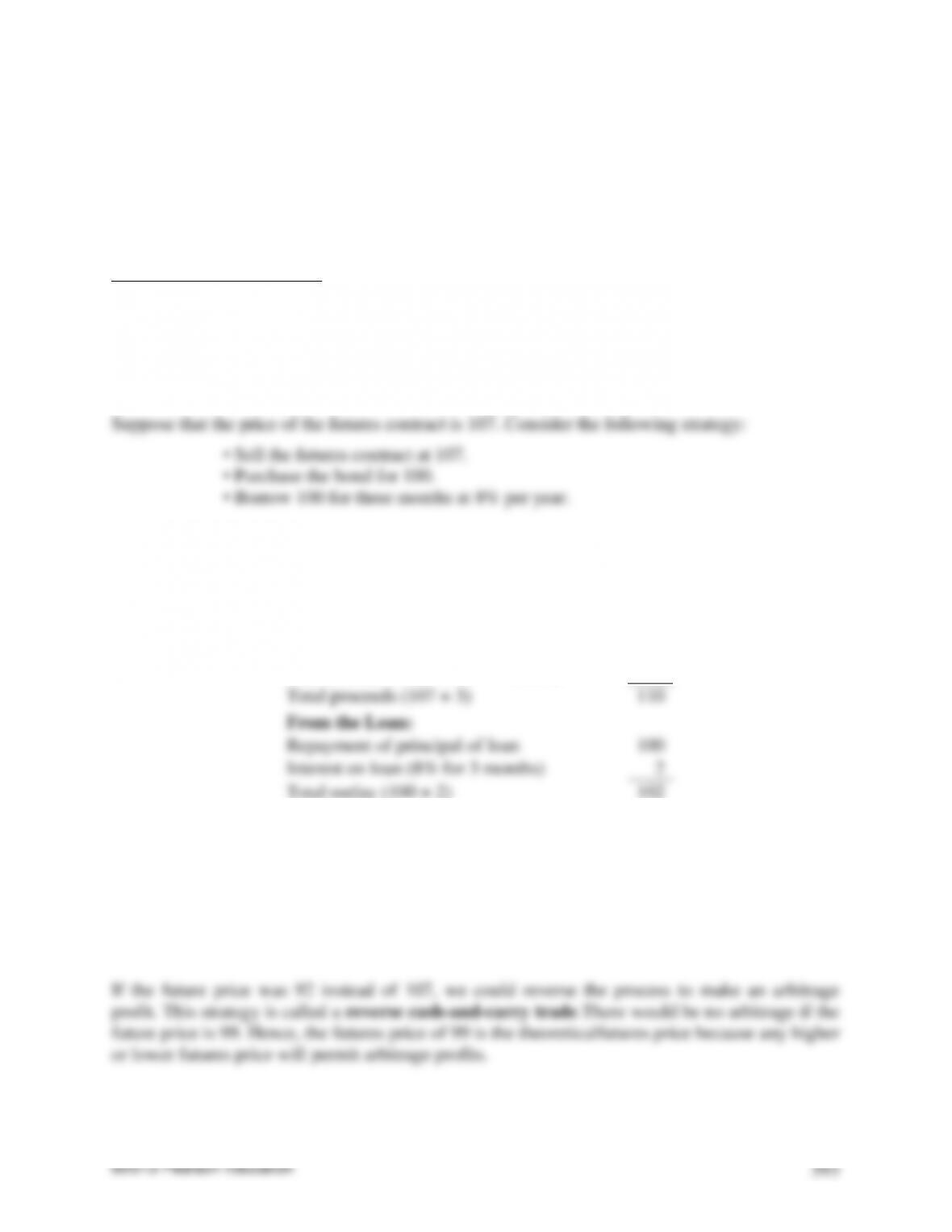
Suppose that a 20-year 100-par-value bond with a coupon rate of 12% is selling at par.
Alsosuppose that this bond is the deliverable for a futures contract that settles in three months.If
the current three-month interest rate at which funds can be loaned or borrowed is 8%per year,
what should be the price of this futures contract?
The borrowed funds are used to purchase the bond, resulting in no initial cash outlayfor this
strategy. Three months from now, the bond must be delivered to settle the futurescontract, and
the loan must be repaid. These trades will produce the following cash flows:
From Settlement of the Futures Contract:
Flat price of bond
107
Accrued interest (12% for 3 months)
3
Total proceeds (107 + 3)
110
From the Loan:
Repayment of principal of loan
100
Interest on loan (8% for 3 months)
2
Total outlay (100 + 2)
102
Profit (110 – 102)
8
This strategy will guarantee a profit of 8. Moreover, the profit is generated with no initial outlay
because the funds used to purchase the bond are borrowed. The profit will be realized regardless
of the futures price at the settlement date. Obviously, in a well-functioning market, arbitrageurs
would buy the bond and sell the futures, forcing the futures price down and bidding up the bond
price so as to eliminate this profit. This strategy is called a cash-and-carry trade.
Theoretical Futures Price Based on Arbitrage Model
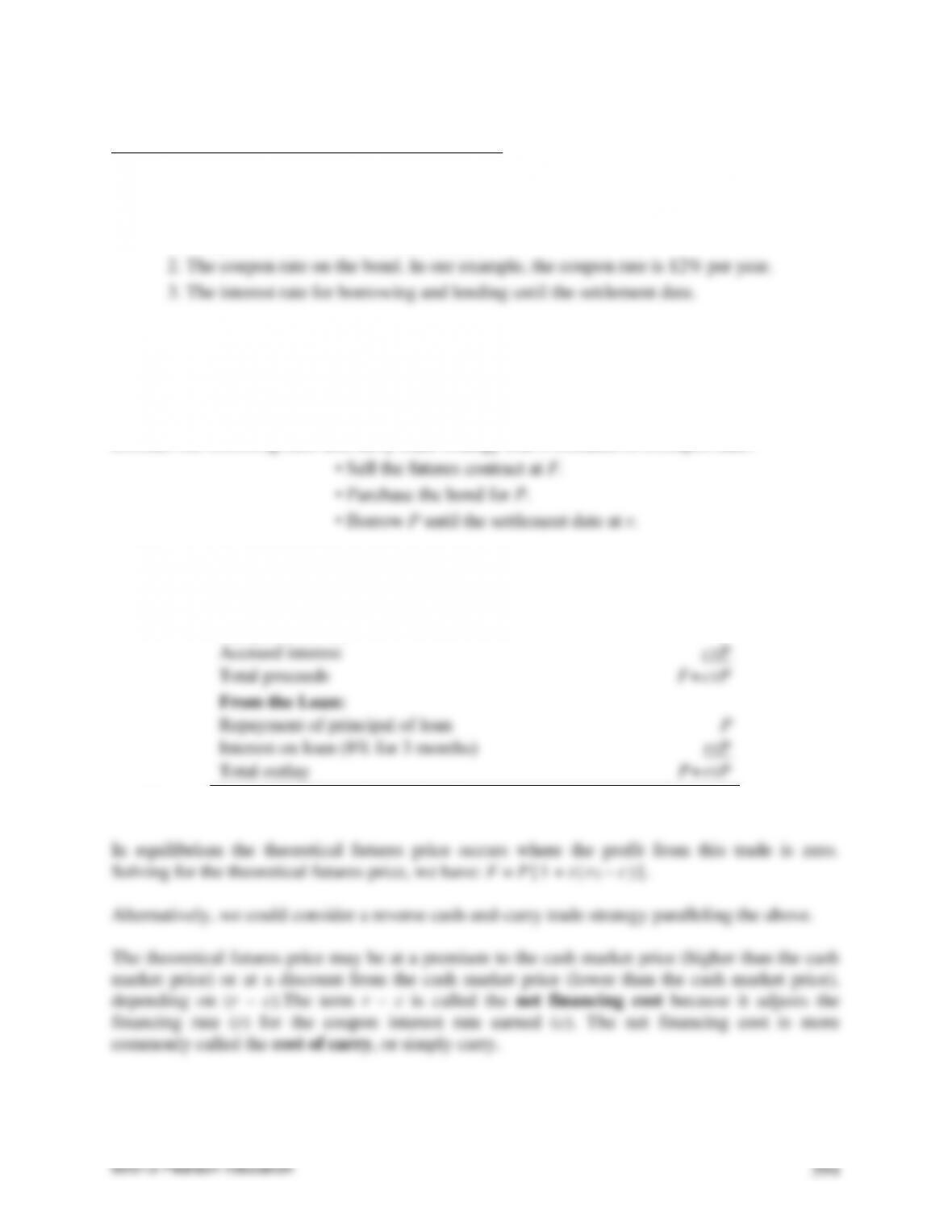
Considering the arbitrage arguments just presented, the theoretical futures price can bedetermined
on the basis of the following information:
1. The price of the bond in the cash market.
The borrowing and lending rate is referred to as the financing rate. In ourexample, the financing
rate is 8% per year.
We will let: r = financing rate; c = current yield or coupon rate divided by the cash market price;
P = cash market price; F = futures price; t = time, in years, to the futures delivery date. Now
consider the following cash-and-carry trade strategy that is initiated on a coupon date:
The outcome at the settlement date is
From Settlement of the Futures Contract:
Flat price of bond
F
Accrued interest
ctP
Total proceeds
F+ctP
From the Loan:
Repayment of principal of loan
P
Interest on loan (8% for 3 months)
rtP
Total outlay
P+r t P
Profit (total proceeds – total outlay)
(F+c tP ) – (P+r t P )
Positive carry means that the current yield earned is greater than the financing cost. Negative
carrymeans that the financing cost exceeds the current yield.
To derive the theoretical futures price using the arbitrage argument, we made
severalassumptions, which have certain implications.
Interim Cash Flows
No interim cash flows due to variation margin or coupon interest payments were assumedin the
model. Incorporating interim coupon payments into the pricing model is not difficult.However,
Short-Term Interest Rate (Financing Rate)
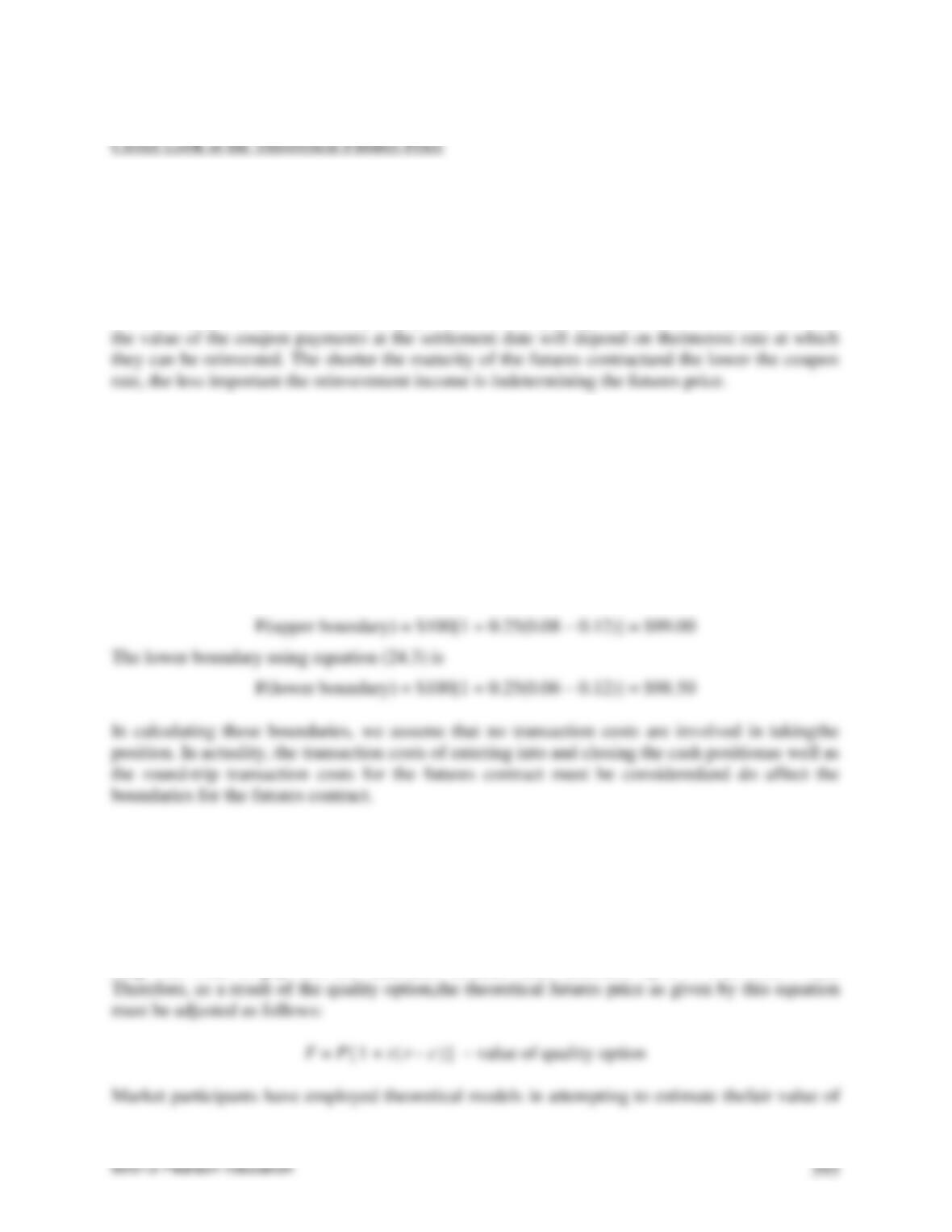
In deriving the theoretical futures price, it is assumed that the borrowing and lending ratesare
equal. Typically, however, the borrowing rate (rB) is higher than the lending rate (rL). The futures
price that would produce no arbitrage profit isF = P[1+t(rB– c)]. The futures price that would
produce no profit isF = P[1+t(rL– c)]. These latter two equations together provide boundaries
for the theoretical futuresprice.
The upper boundary is
Deliverable Bond Is Not Known
The arbitrage arguments used to derive equation F = P[1+t(r– c) ] assumed that only one
instrumentis deliverable. But the futures contracts on Treasury bonds and Treasury notes are
designedto allow the short the choice of delivering one of a number of deliverable issues (the
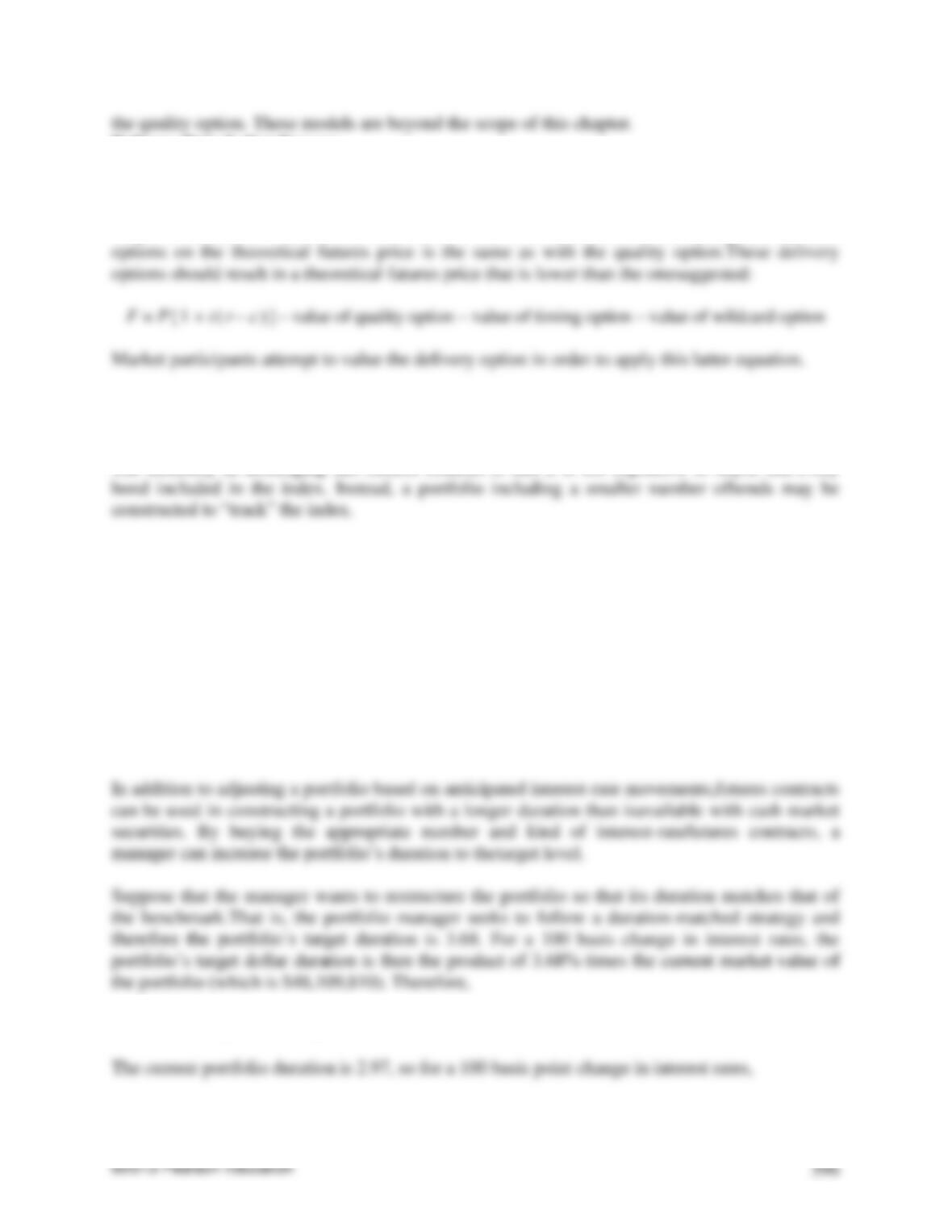
qualityor swap option). Because theswap option is an option granted by the long to the short, the
long will want to pay less for thefutures contract than indicated by F = P[1+t(r– c)].
©2013 Pearson Education
596
the quality option. These models are beyond the scope of this chapter.
Delivery Date Is Not Known
In the pricing model based on arbitrage arguments, a known delivery date is assumed.
ForTreasury bond and note futures contracts, the short has a timing and wild card option, sothe
long does not know when the securities will be delivered. The effect of the timing andwild card
Deliverable Is Not a Basket of Securities
The municipal index futures contract is a cash settlement contract based on a basket ofsecurities.
The difficulty in arbitraging this futures contract is that it is too expensive to buyor sell every
BOND PORTFOLIO MANAGEMENT APPLICATIONS
As described next, there are various ways in which a portfolio manager can use interest-rate
futures contracts.
Controlling the Duration of a Portfolio
Interest-rate futures can be used to alter the interest-rate sensitivity of a portfolio.
Portfoliomanagers with strong expectations about the direction of the future course of interest
rates will adjust the durations of their portfolios so as to capitalize on their expectations.
portfolio target dollar duration =3.68% × $48,109,810= $1,770,110
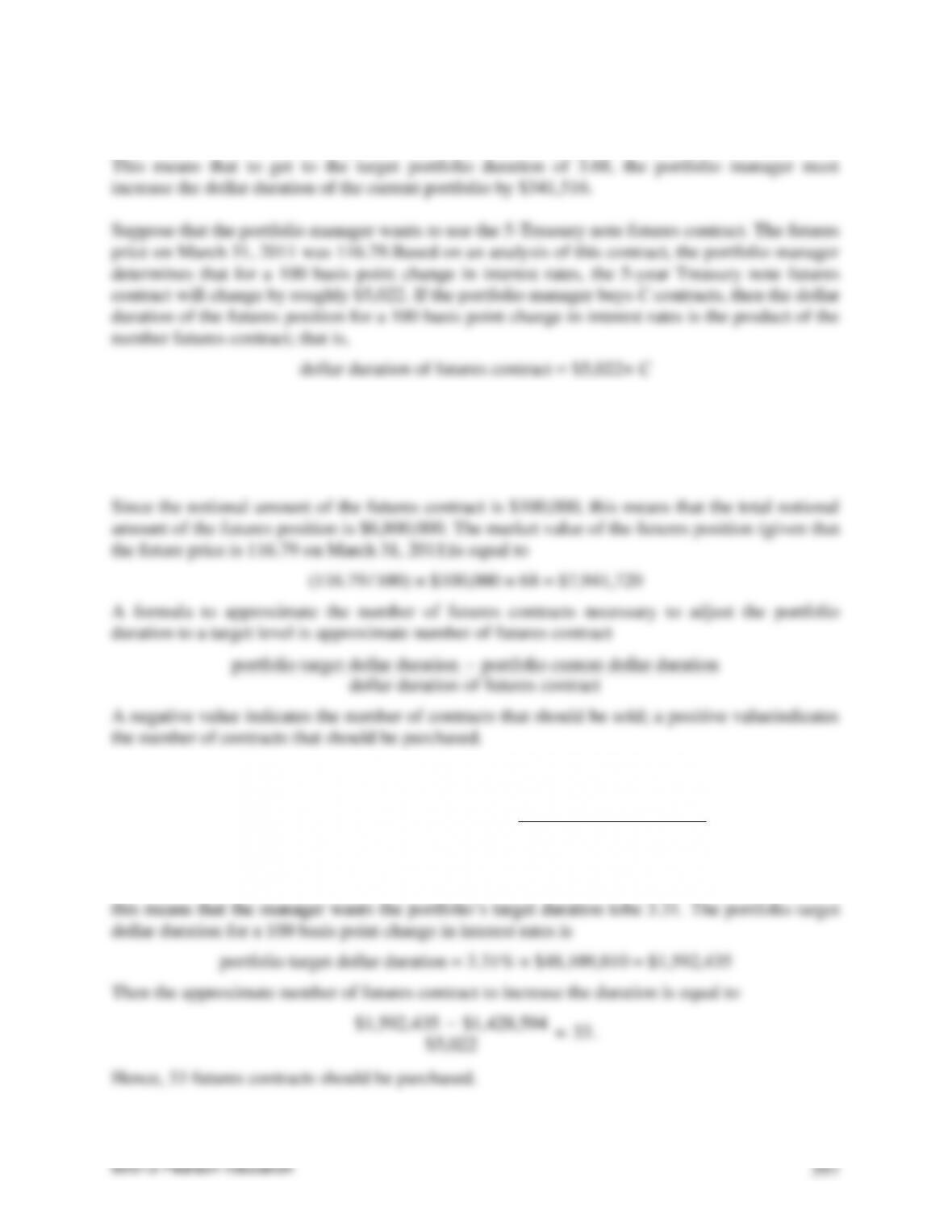
portfolio current dollar duration = 2.97% × $48,109,810= $1,428,594
The difference between the target and the current dollar duration for the portfolio is $341,516.
The portfolio manager wants the above equation to be equal $341,516. Thus,$5,022× C =
$341,516. Solving we getC = 68 contracts. Thus, by buying 68 5-year Treasury note futures
contracts, the portfolio manager will increase the dollar duration of the portfolio by $341,516 for
a 100 basis point change in interest rates.
In our example, it is
$1,770,110 $1,428,594 68
approximate number of futures contract =
$5,022
−=
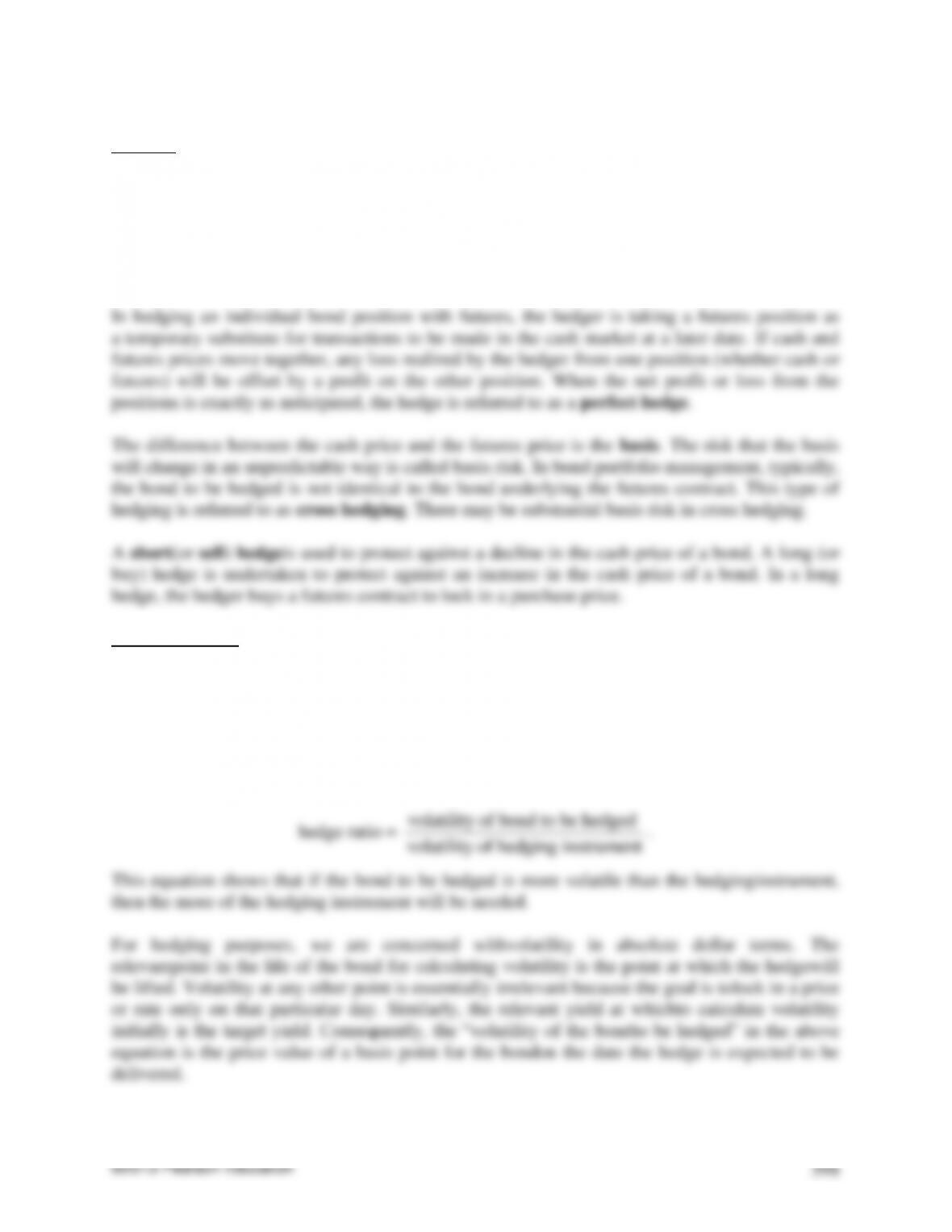
Suppose instead that the portfolio manager does not want the duration to match thebenchmark
but instead wants the duration to be 90% of the benchmark. Since the benchmarkduration is 3.68,
Hedging
Hedging is nothing more than a special case of interest rate risk management where the target
duration is zero. In the case of hedging a portfolio, a simple way to determine the number of
futures contract to short is to use. The number of futures contract to short is found by dividing
the current portfolio dollar duration by the dollar duration of the futures contract that is used as
the hedging vehicle.
The Hedge Ratio
The key to minimizing risk in a cross hedge is to choose the right hedge ratio. The hedgeratio
depends on volatility weighting, or weighting by relative changes in value. The purposeof
a hedge is to use gains or losses from a futures position to offset any differencebetween the target
sale price and the actual sale price of the asset. Accordingly, the hedgeratio is chosen with the
intention of matching the volatility (i.e., the dollar change) ofthe futures contract to the volatility
of the asset. Consequently, the hedge ratio is given by
volatility of bond to be hedged
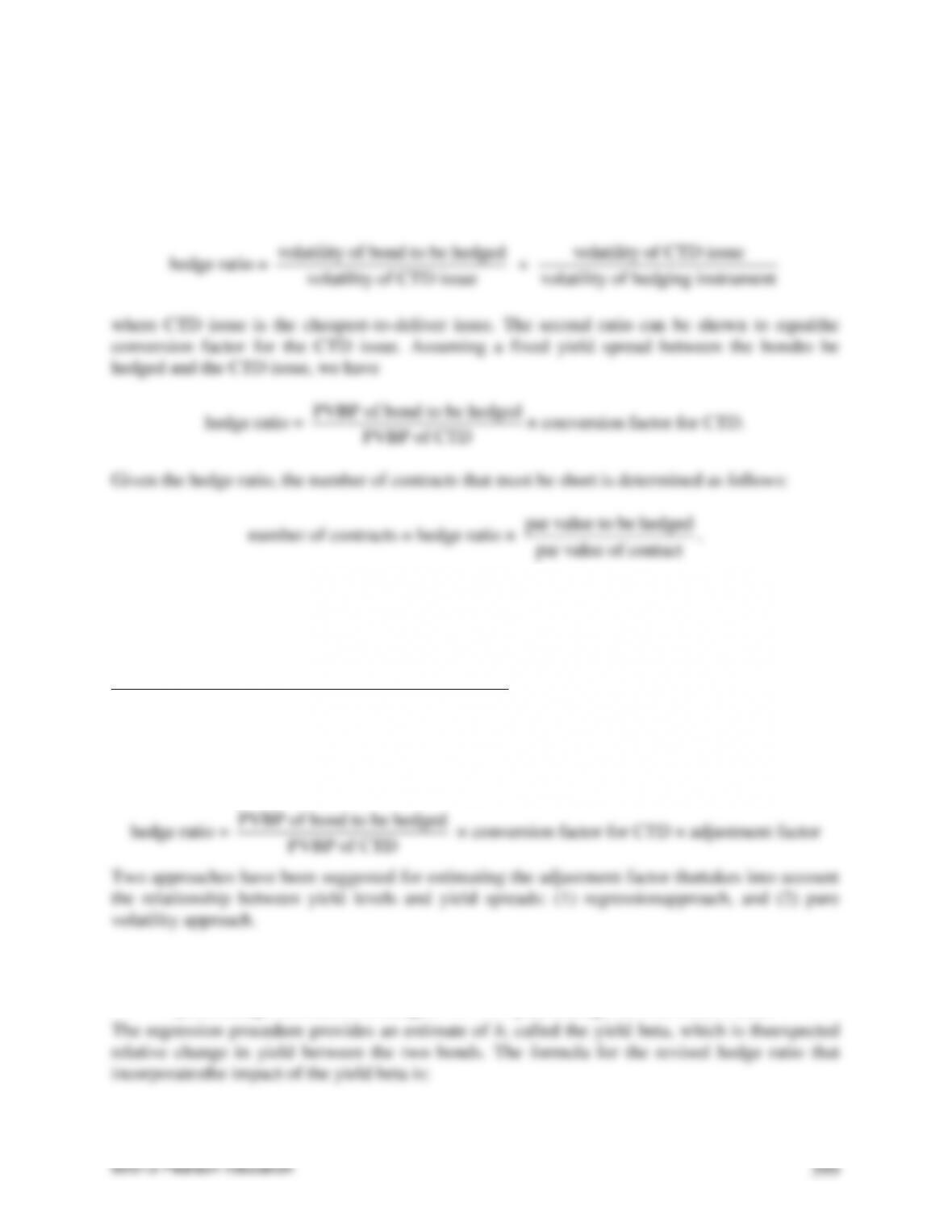
To calculate the hedge ratio, we need the volatility not ofthe cheapest-to-deliver issue, but of the
hedging instrument (i.e. of the futures contract).Fortunately, knowing the volatility of the bond to
be hedged relative to the cheapest-to-deliver issue and the volatility of the cheapest–to-deliver
bond relative to the futurescontract, we can easily obtain the relative volatilities that define the
hedge ratio:
par value of contact
Exhibit 26-4 shows that if the simplifying assumptions hold, a futures hedge using
therecommended hedge ratio very nearly locks in the target forward amount of $9,678,000 for
$10 million par value of the P&G bond.
Adjusting the Hedge Ratio for Yield Spread Changes
Yield spreads are not constant over time. They varywith the maturity of the instruments in
question and the level of rates, as well as with manyunpredictable and nonsystematic factors.
Because of this, the hedge ratio has to be adjusted.The formula for the revised hedge ratio that
incorporatesthe impact of the yield beta is:
PVBP of bond to be hedged
First, the regression approach involves estimating from historical data the following
regressionmodel:
yield change on bond to be hedged = a + b × yield change on CTD issue + error
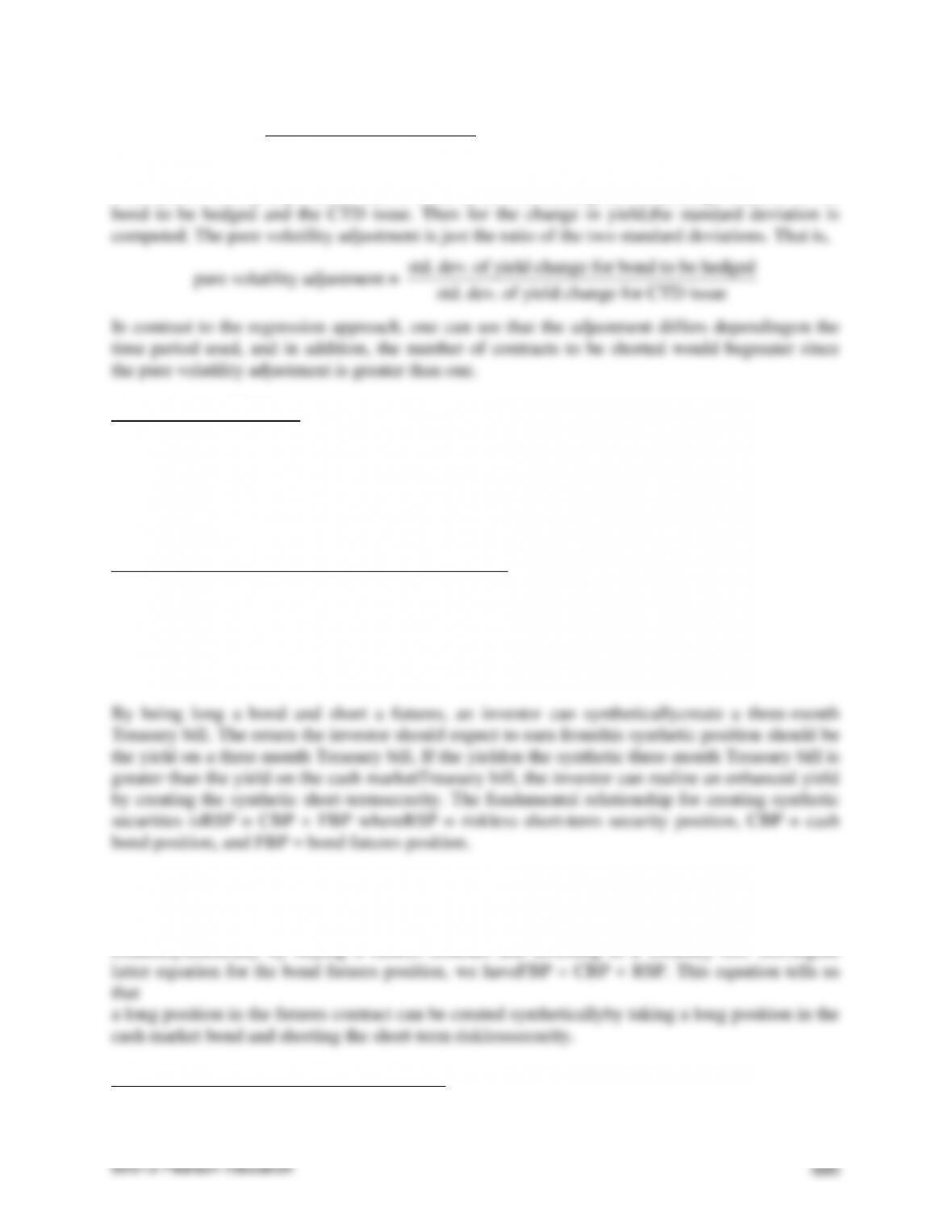
hedge ratio =
PVBP of bond to be hedged
PVBP of CTD
× conversion factor for CTD × yield beta
The second approach for capturing the relative movement in yields and estimatingthe adjustment
is the pure volatility adjustment. This is done by first calculating the dailychange in yield for the
Change in the CTD Issue
The effect of a change in the cheapest-to-deliver issue and the yield spread can be assesseda
priori. For example, at different yield levels at the date the hedge is to be lifted, a different yield
spread may be appropriate and a differentacceptable issue will be the CTD. The portfolio
manager can determine what this will do tothe outcome of the hedge.
Creating Synthetic Securities for Yield Enhancement
A cash market security can be created synthetically by taking a position in the futures
contracttogether with the deliverable instrument. If the yield on the synthetic security is thesame
as the yield on the cash market security, there will be no arbitrage opportunity. Anydifference
between the two yields can be exploited so as to enhance the yield on the portfolio.
A negative sign before a position means a short position. For the long bondposition, we have:
CBP = RSP + FBP. This equation states that a cash bond position equals a short-term riskless
securityposition plus a long bond futures position. Thus, a cash market bond can be
createdsynthetically by buying a futures contract and investing in a Treasury bill. Solvingthe
Allocating Funds between Stocks and Bonds
A pension sponsor may wish to alter the composition of its assets by increasing bonds and
decreasing stocks. A manager could undertake costly process of buying bonds and selling stocks.
However, an alternative course of action is to use interest-rate futures and stock index
futures.Buyingan appropriate number of interest-rate futures and selling an appropriate number
To determine the approximate number of interest-rate futures contracts needed tochange the
market value of the portfolio allocated to bonds, we use the following expression:
approximate number of contracts =
dollar duration for target bond allocation dollar duration for current bond allocation
dollar duration of thefutures contract
+
.
KEY POINTS
• A futures contract is an agreement between a buyer (seller) and an established exchange or its
clearinghouse in which the buyer (seller) agrees to take (make) delivery of something at a the
futures price at the settlement or delivery date.
• Associated with every futures exchange is a clearinghouse, which guarantees that the two
parties to the transaction will perform and allows parties to unwind their position without the
need to deal with the counterparty to the initial transaction.

©2013 Pearson Education
602
• Interest-rate futures contracts can be used by portfolio managers to control a portfolio’s
duration, to hedge a portfolio or bond position, to enhance returns when futures are mispriced,
and to efficient allocate funds between stocks and bonds.
ANSWERS TO QUESTIONS FOR CHAPTER 26
(Questions are in bold print followed by answers.)
1. Explain the differences between a futures contract and a forward contract.
Just like a futures contract, a forward contract is an agreement for the future delivery of the
underlying at a specified price at the end of a designated period of time.
Futures contracts are traded on organized exchanges and are standardized agreements as to the
delivery date (or month) and quality of the deliverable. However, a forward contract differs in
2. Answer the below questions.
(a) What is counterparty risk?
(b) Why do both the buyer and seller of a forward contract face counterparty risk?
3. What does it mean if the cost of carry is positive for a Treasury bond futures contract?