Chapter 26 – Hedge Funds
26-1
CHAPTER 26: HEDGE FUNDS
PROBLEM SETS
1. No, a market-neutral hedge fund would not be a good candidate for an investor’s entire
retirement portfolio because such a fund is not a diversified portfolio. The term ‘market–
2. The incentive fee of a hedge fund is part of the hedge fund compensation structure; the
incentive fee is typically equal to 20% of the hedge fund’s profits beyond a particular
3. There are a number of factors that make it harder to assess the performance of a hedge
fund portfolio manager than a typical mutual fund manager. Some of these factors are:
• Hedge funds tend to invest in more illiquid assets so that an apparent alpha may be in
4. No, statistical arbitrage is not true arbitrage because it does not involve establishing risk–
free positions based on security mispricing. Statistical arbitrage is essentially a portfolio
Chapter 26 – Hedge Funds
26-2
5. Management fee = 0.02 × $1 billion = $20 million
Portfolio rate
of return (%)
Incentive fee
(%)
Incentive fee
($ million)
Total fee
($ million)
Total fee
(%)
a.
-5
0
0
20
2
b.
0
0
0
20
2
c.
5
0
0
20
2
d.
10
20
10
30
3
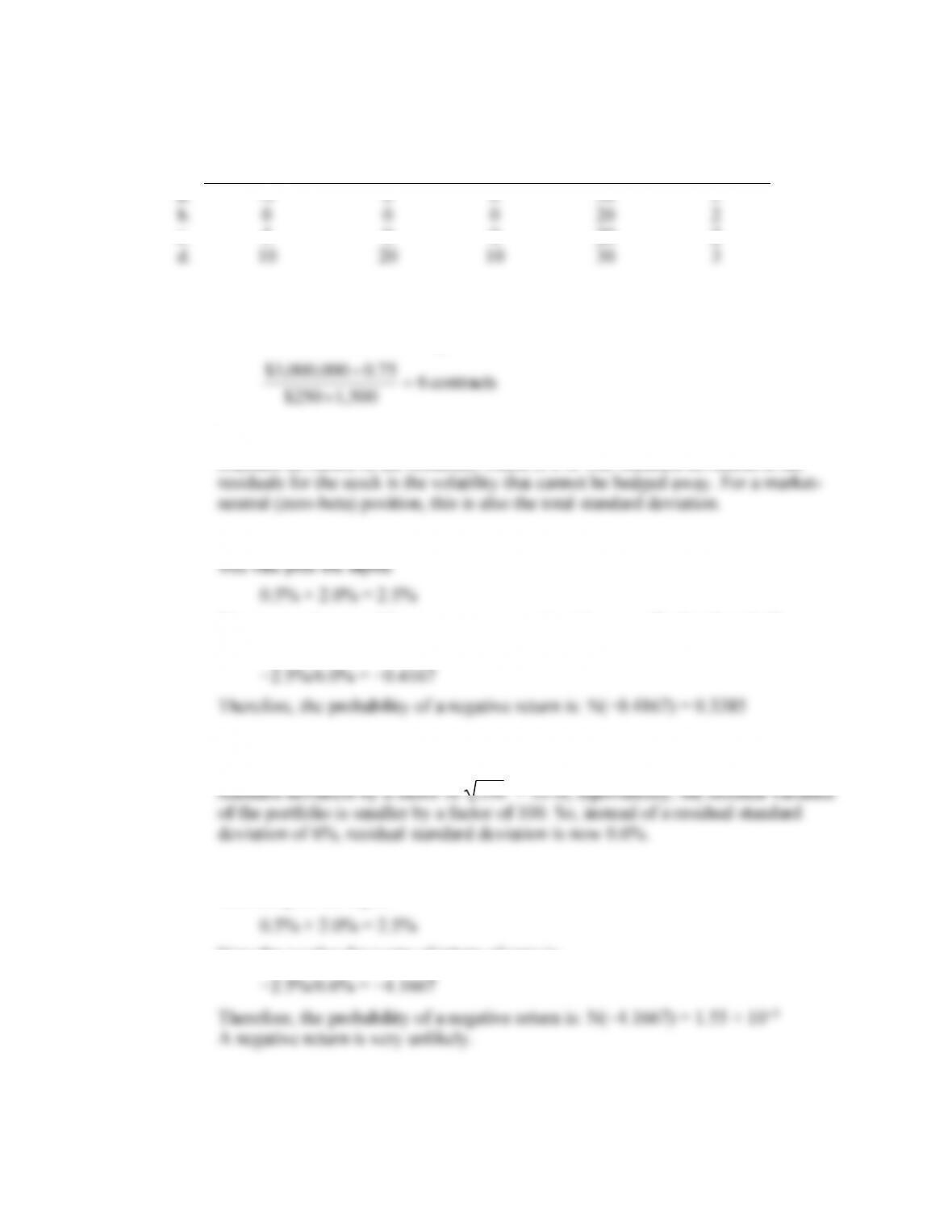
6. a. Since the hedge fund manager has a long position in the Waterworks stock, he
should sell six contracts, computed as follows:
6
1,500$250
0.75$3,000,000 =
contracts
b. The standard deviation of the monthly return of the hedged portfolio is equal to the
standard deviation of the residuals, which is 6%. The standard deviation of the
c. The expected rate of return of the market-neutral position is equal to the risk-
We assume that monthly returns are approximately normally distributed. The z-
value for a rate of return of zero is:
7. a. The residual standard deviation of the portfolio is smaller than each stock’s
b. The expected return of the market-neutral position is still equal to the risk-
free rate plus the alpha:
Now the z-value for a rate of return of zero is:
Chapter 26 – Hedge Funds
26-3
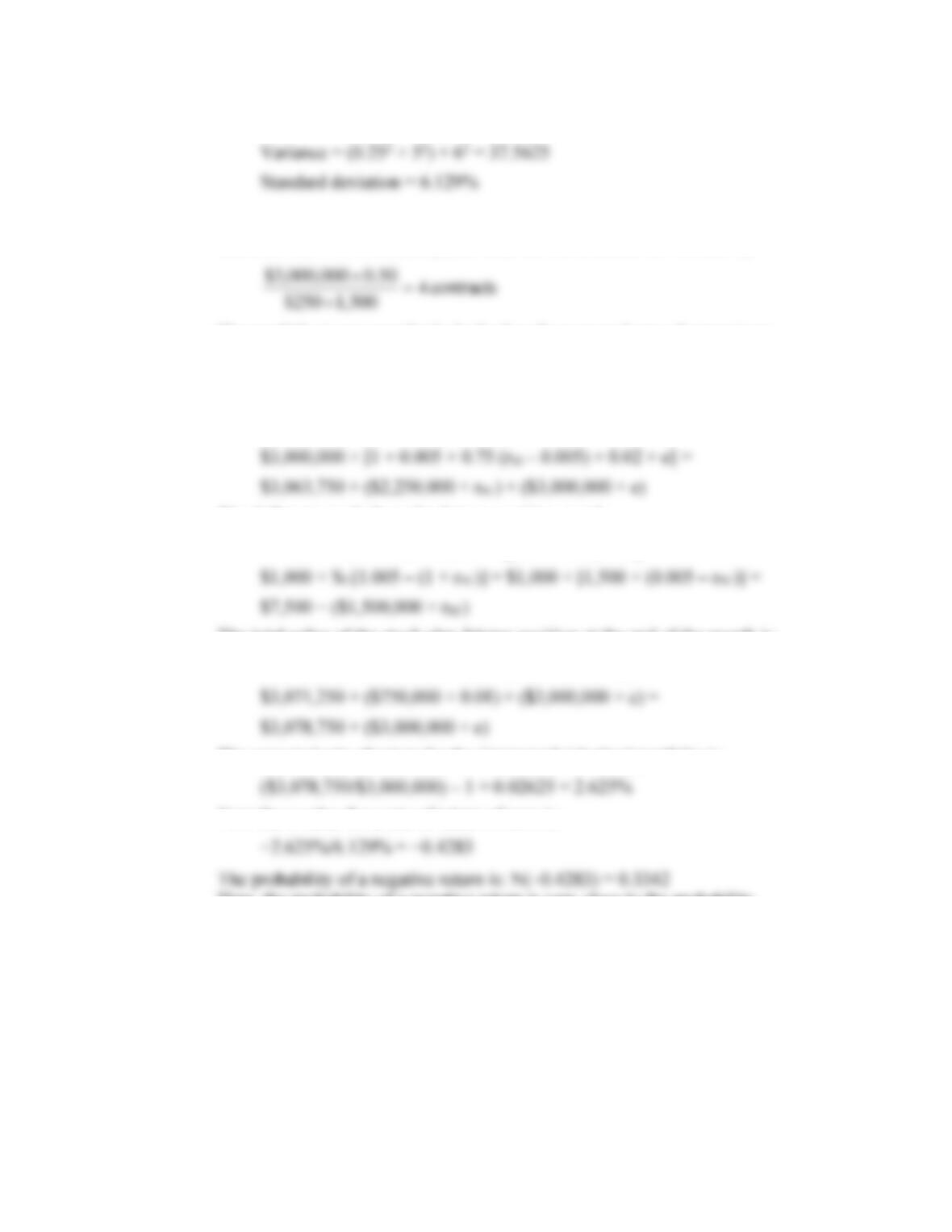
8. a. For the (now improperly) hedged portfolio:
b. Since the manager has misestimated the beta of Waterworks, the manager will
sell four S&P 500 contracts (rather than the six contracts in Problem 6):
4
1,500$250
0.50$3,000,000 =
contracts
The portfolio is not completely hedged so the expected rate of return is no
longer 2.5%. We can determine the expected rate of return by first computing
the total dollar value of the stock plus futures position. The dollar value of
the stock portfolio is:
$3,000,000 × (1 + rportfolio) =
The dollar proceeds from the futures position equal:
4 × $250 × (F0 − F1) = $1,000 × [(S0 × 1.005) – S1] =
The total value of the stock plus futures position at the end of the month is:
$3,071,250 + ($750,000 × rM ) + ($3,000,000 × e) =
The expected rate of return for the (improperly) hedged portfolio is:
Now the z-value for a rate of return of zero is:
Here, the probability of a negative return is very close to the probability
computed in Problem 6.
Chapter 26 – Hedge Funds
26-4
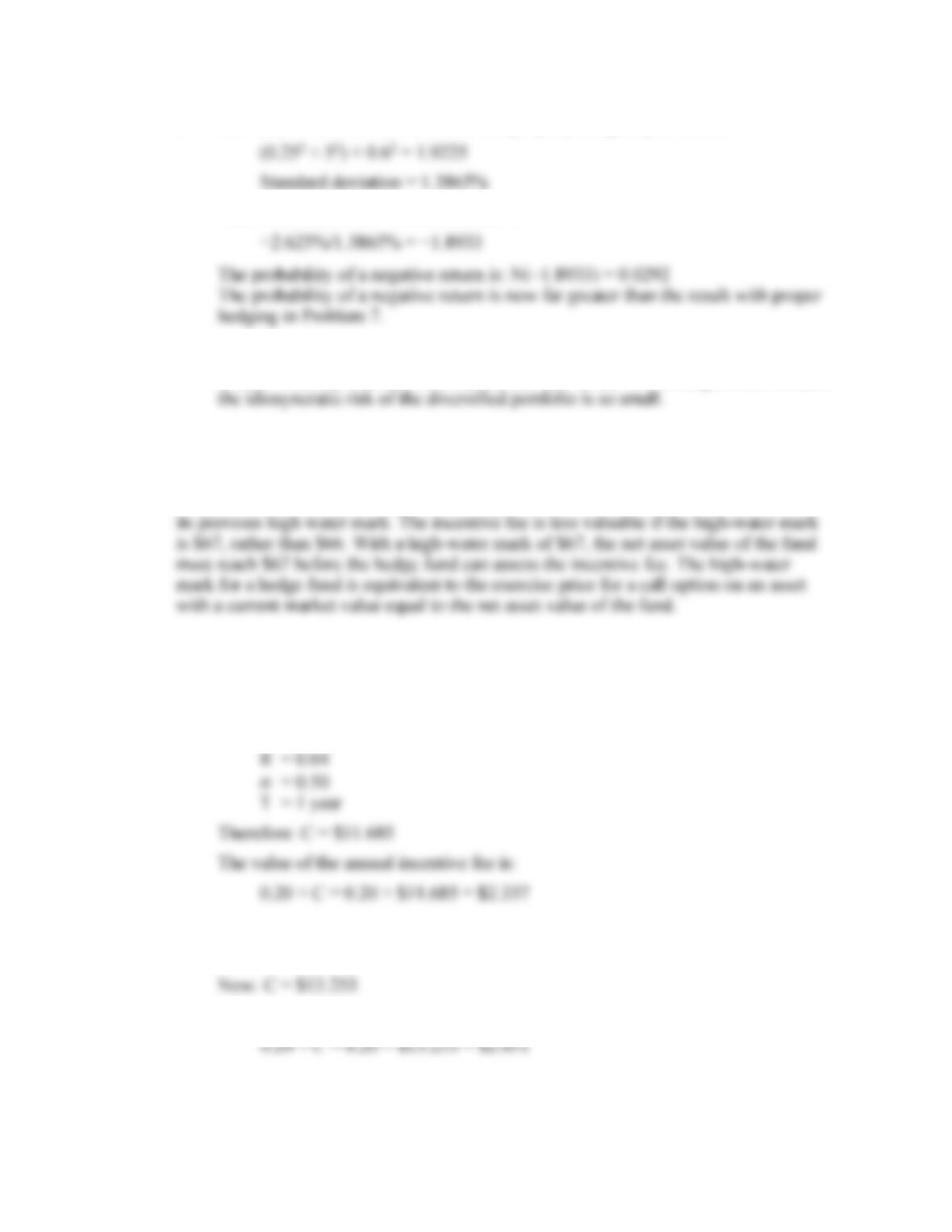
c. The variance for the diversified (but improperly hedged) portfolio is:
The z-value for a rate of return of zero is:
d. The market exposure from improper hedging is far more important in contributing
to total volatility (and risk of losses) in the case of the 100-stock portfolio because
9. The incentive fee is typically equal to 20% of the hedge fund’s profits beyond a
particular benchmark rate of return. However, if a fund has experienced losses in the
past, then the fund may not be able to charge the incentive fee unless the fund exceeds
10. a. First, compute the Black Scholes value of a call option with the following
parameters:
S0 = 62
X = 66
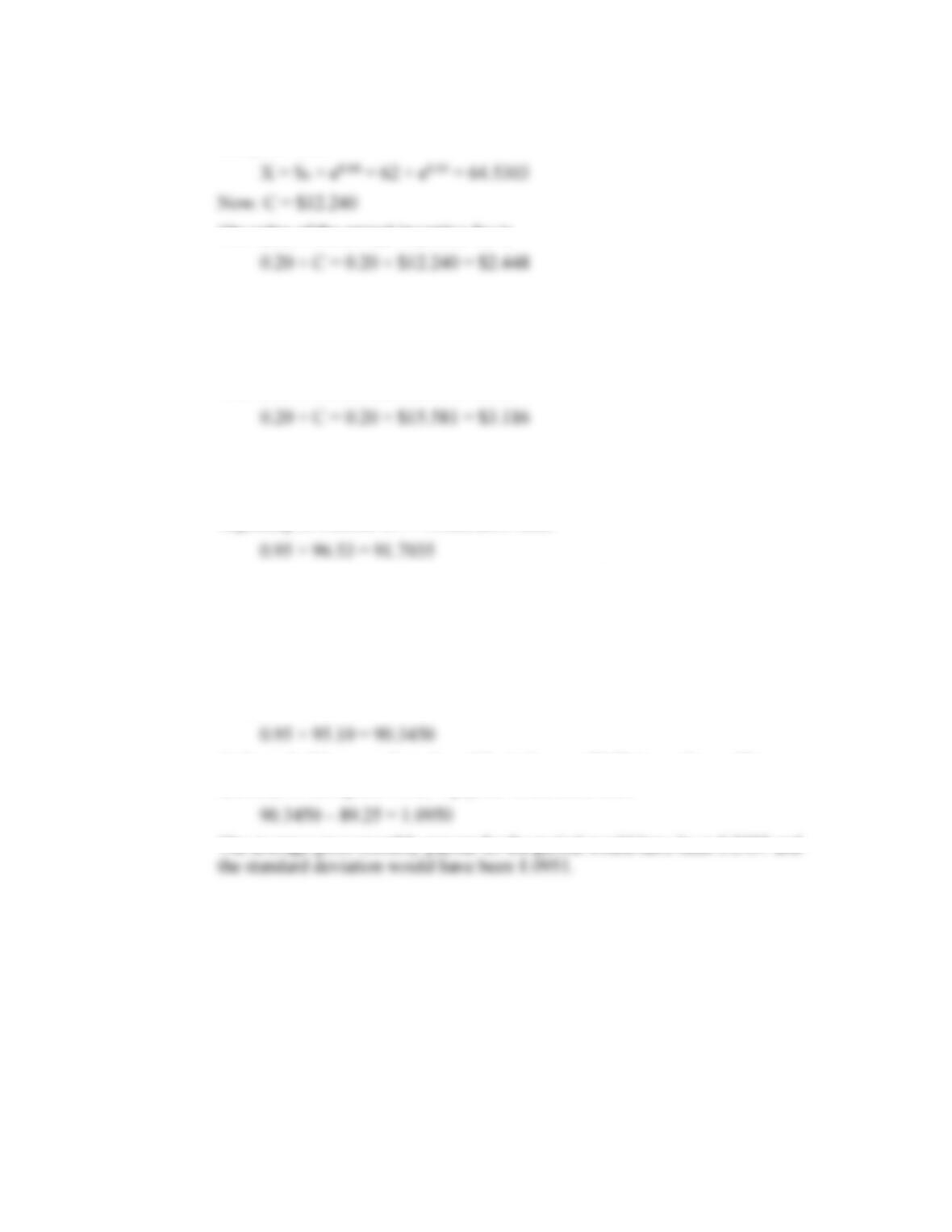
b. Here we use the same parameters used in the Black-Scholes model in part (a) with
the exception that: X = 62
The value of the annual incentive fee is
Chapter 26 – Hedge Funds
26-5
c. Here we use the same parameters used in the Black-Scholes model in part (a) with the
exception that:
The value of the annual incentive fee is
d. Here we use the same parameters used in the Black-Scholes model in part (a) with
the exception that: X = 62 and = 0.60
Now: C = $15.581
The value of the annual incentive fee is
11. a. The spreadsheet indicates that the end-of-month value for the S&P 500 in
September 1977 was 96.53, so the exercise price of the put written at the
beginning of October 1977 would have been:
At the end of October, the value of the index was 92.34, so the put would have
expired out of the money and the put writer’s payout was zero. Since it is unusual
for the S&P 500 to fall by more than 5 percent in one month, all but ten of the
120 months between October 1977 and September 1987 would have a payout of
zero. The first month with a positive payout would have been January 1978. The
exercise price of the put written at the beginning of January 1978 would have
been:
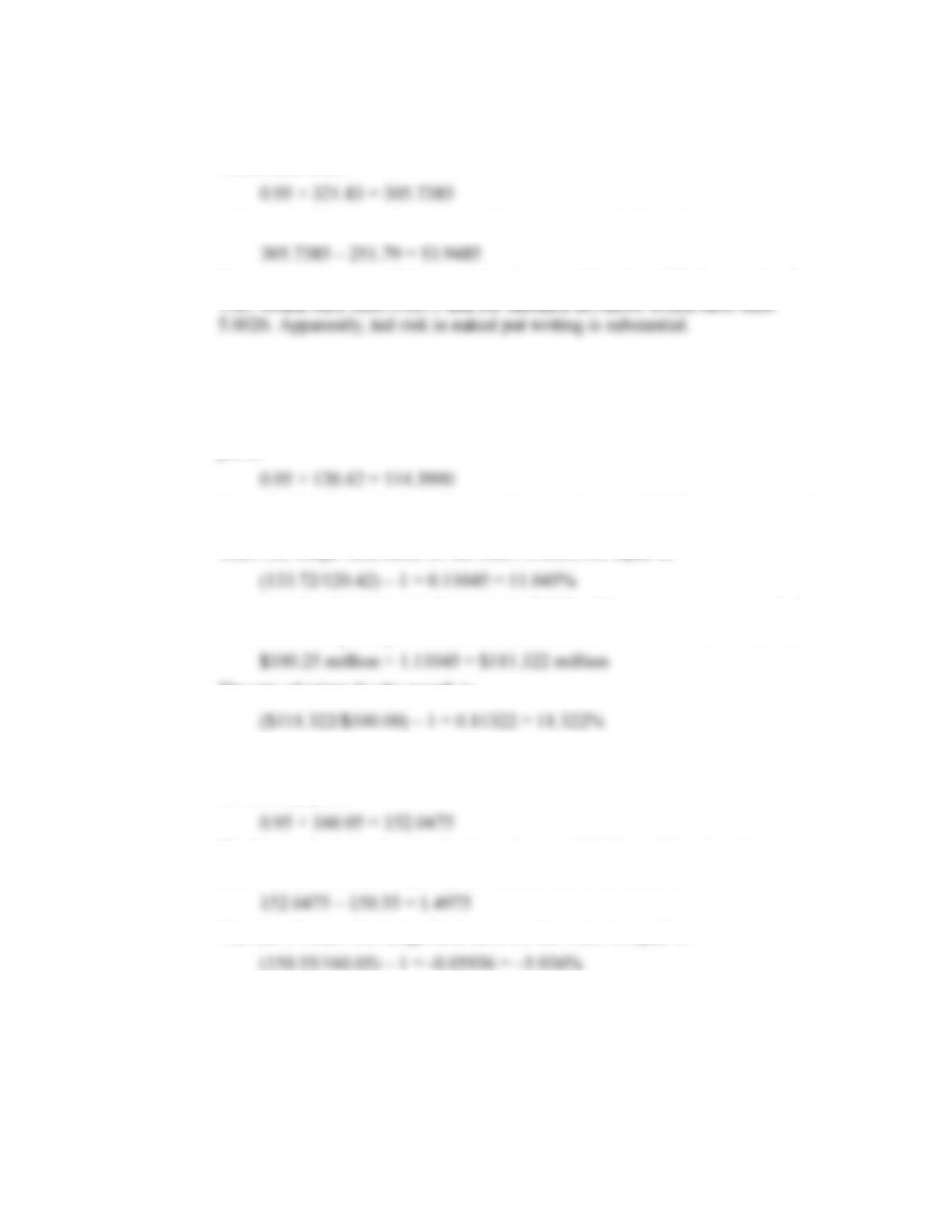
At the end of January, the value of the index was 89.25 (more than a 6%
decline), so the option writer’s payout would have been:
The average gross monthly payout for the period would have been 0.2437 and
Chapter 26 – Hedge Funds
26-6
b. In October 1987, the S&P 500 decreased by more than 21%, from 321.83 to
251.79. The exercise price of the put written at the beginning of October 1987
would have been:
At the end of October, the option writer’s payout would have been:
The average gross monthly payout for the period October 1977 through October
12. a. In order to calculate the Sharpe ratio, we first calculate the rate of return for each
month in the period October 1982-September 1987. The end of month value for
the S&P 500 in September 1982 was 120.42, so the exercise price for the October
put is:
Since the October end of month value for the index was 133.72, the put expired
out of the money so that there is no payout for the writer of the option. The rate of
return the hedge fund earns on the index is therefore equal to:
Assuming that the hedge fund invests the $0.25 million premium along with the
$100 million beginning of month value, then the end of month value of the fund is:
The rate of return for the month is:
The first month that the put expires in the money is May 1984. The end of
month value for the S&P 500 in April 1984 was 160.05, so the exercise price
for the May put is:
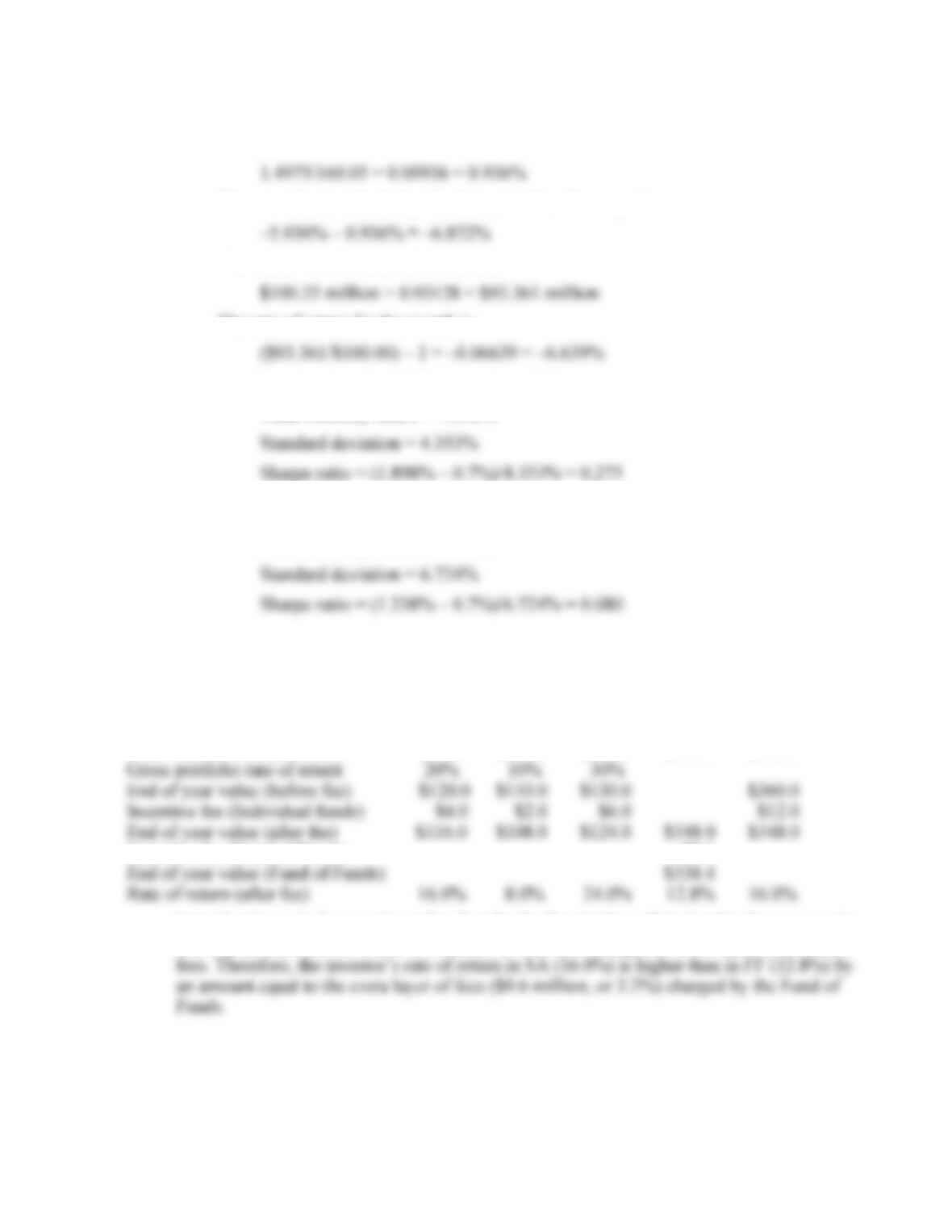
The May end of month value for the index was 150.55, and therefore the
payout for the writer of a put option on one unit of the index is:
The rate of return the hedge fund earns on the index is equal to:
Chapter 26 – Hedge Funds
26-7
The payout of 1.4975 per unit of the index reduces the hedge fund’s rate of
return by:
The rate of return the hedge fund earns is therefore equal to:
The end of month value of the fund is:
The rate of return for the month is:
For the period October 1982-September 1987:
Mean monthly return = 1.898%
b. For the period October 1982-October 1987:
Mean monthly return = 1.238%
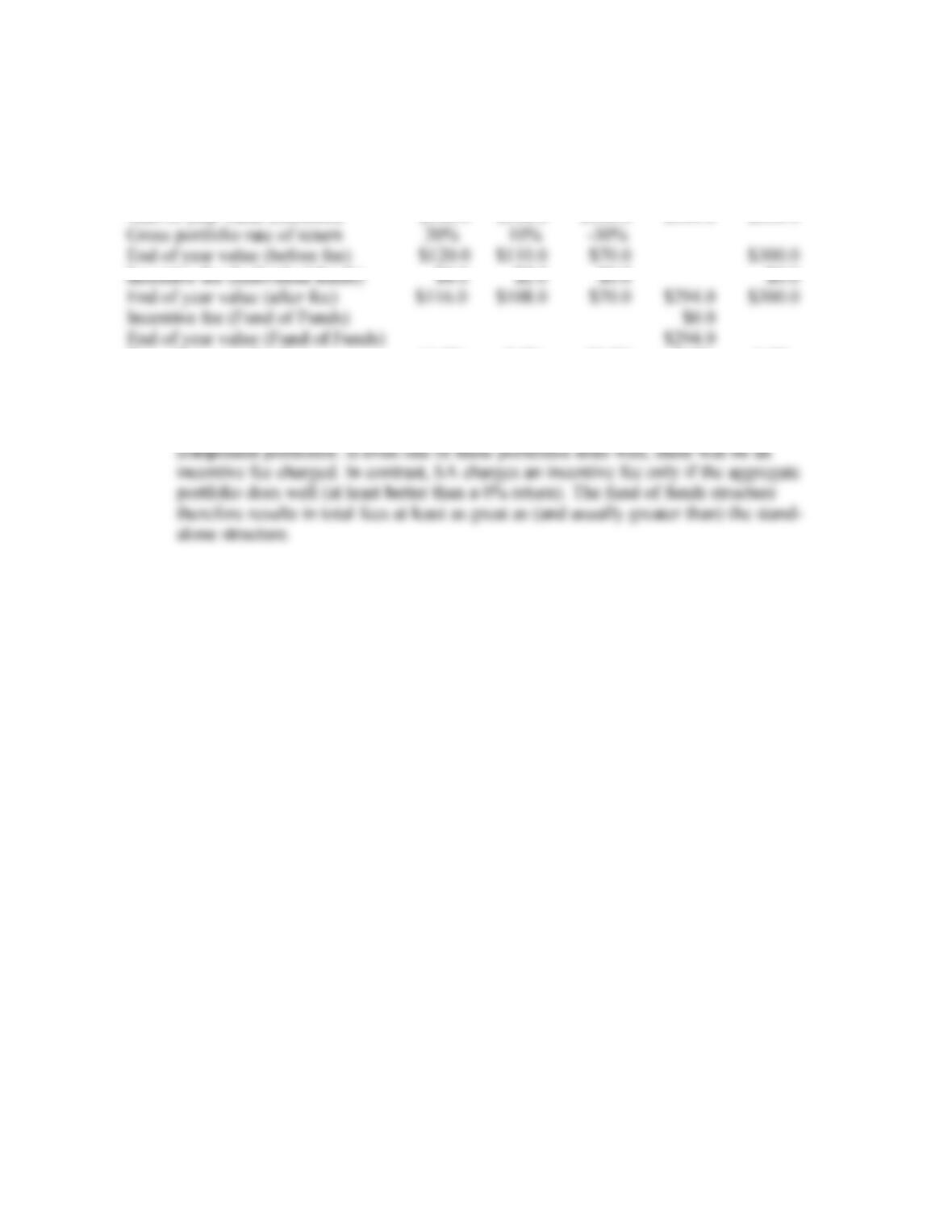
13. a., b., c.
Hedge
Fund 1
Hedge
Fund 2
Hedge
Fund 3
Fund
of Funds
Stand-
Alone
Fund
Start of year value (millions)
$100.0
$100.0
$100.0
$300.0
$300.0
Gross portfolio rate of return
20%
10%
30%
End of year value (before fee)
$120.0
$110.0
$130.0
$360.0
Incentive fee (Individual funds)
$4.0
$2.0
$6.0
$12.0
End of year value (after fee)
$116.0
$108.0
$124.0
$348.0
$348.0
Incentive fee (Fund of Funds)
$9.6
End of year value (Fund of Funds)
$338.4
Rate of return (after fee)
16.0%
8.0%
24.0%
12.8%
16.0%
Note that the end of year value (after-fee) for the Stand-Alone (SA) Fund is the same as the
end of year value for the Fund of Funds (FF) before FF charges its extra layer of incentive
Chapter 26 – Hedge Funds
26-8
d.
Hedge
Fund 1
Hedge
Fund 2
Hedge
Fund 3
Fund
of Funds
Stand-
Alone
Fund
Start of year value (millions)
$100.0
$100.0
$100.0
$300.0
$300.0
Gross portfolio rate of return
20%
10%
-30%
End of year value (before fee)
$120.0
$110.0
$70.0
$300.0
Incentive fee (Individual funds)
$4.0
$2.0
$0.0
$0.0
End of year value (after fee)
$116.0
$108.0
$70.0
$294.0
$300.0
Incentive fee (Fund of Funds)
$0.0
End of year value (Fund of Funds)
$294.0
Rate of return (after fee)
16.0%
8.0%
-30.0%
-2.0%
0.0%
Now, the end of year value (after fee) for SA is $300, while the end of year value for FF
is only $294, despite the fact that neither SA nor FF charge an incentive fee. The reason
for the difference is the fact that the Fund of Funds pays an incentive fee to each of the