Chapter 25 – International Diversification
CHAPTER 25: INTERNATIONAL DIVERSIFICATION
PROBLEM SETS
1. “International Investing Raises Questions” was published in The Wall Street
Journal in 1997. Some of the arguments presented in the article may no longer be
compelling more than a decade later. For example, the following statement from the
article is no longer true for many U.S. multinationals: “When you look at these
2. Which of the returns is more relevant to an investor depends on whether the
investor hedges the local currency. If the foreign exchange risk has been hedged,
3. a. $10,000/2 = £5,000
£5,000/£40 = 125 shares
b. To fill in the table, we use the relation:
Price per
Pound-Denominated
Dollar-Denominated Return (%)
for Year-End Exchange Rate
Share (£)
Return (%)
$1.80/£
$2.00/£
$2.20/£
4. The standard deviation of the pound-denominated return (using 3 degrees of
freedom) is 10.21%. The dollar-denominated return has a standard deviation of
Chapter 25 – International Diversification
25-2
5. a. First we calculate the dollar value of the 125 shares of stock in each scenario.
Then we add the profits from the forward contract in each scenario.
Price per
Dollar Value of Stock
at Given Exchange Rate
Share (£)
Exchange Rate:
$1.80/£
$2.00/£
$2.20/£
£35
7,875
8,750
9,625
£40
9,000
£45
Price per
Total Dollar Proceeds
at Given Exchange Rate
Share (£)
Exchange Rate:
$1.80/£
$2.00/£
$2.20/£
£35
9,375
10,500
10,500
10,500
11,625
11,750
11,875
Finally, calculate the dollar-denominated rate of return, recalling that the initial
investment was $10,000:
Price per
Rate of return (%)
at Given Exchange Rate
Share (£)
Exchange Rate:
$1.80/£
$2.00/£
$2.20/£
£35
-6.25%
-7.50%
-8.75%
0
5.00
5.00
16.25
17.50
6. Currency Selection
EAFE: [0.30 × (–10%)] + (0.10 × 0%) + (0.60 × 10%) = 3.0%
Manager: [0.35 × (–10%)] + (0.15 × 0%) + (0.50 × 10%) = 1.5%
Chapter 25 – International Diversification
25-3
7. 1 + r(US) = [1 + rf (UK)] (F0/E0) = 1.08 × (1.85/1.75) = 1.1417 r(US) = 14.17%
8. You can now purchase: $10,000/$1.75 = £5,714.29
9. A naïve investment by an investor who resides in Foreign Country A might include
only a small fraction of the portfolio invested in the home country, and a relatively
greater weight invested in U.S. securities. This might not be an appropriate
approach for a foreign investor who is likely to be comfortable with a home bias,
CFA PROBLEMS
1. Initial investment = 2,000 $1.50 = $3,000
2. a.
Chapter 25 – International Diversification
25-4
i. Availability of information, including insufficient data on which to base
investment decisions. Interpreting and evaluating data that is different in form
and/or content than the routinely available and widely understood U.S. data is
difficult. Also, much foreign data is reported with a considerable lag.
ii. Liquidity, in terms of the ability to buy or sell, in size and in a timely manner,
c. The asset-class performance data for this particular period reveal that non-U.S.
dollar bonds provided a small incremental return advantage over U.S. dollar
bonds, but at a considerably higher level of risk. Each category of fixed income
assets outperformed the S&P 500 Index measure of U.S. equity results with
regard to both risk and return, which is certainly an unexpected outcome. Within
the equity area, non-U.S. stocks, represented by the EAFE Index, outperformed
U.S. stocks by a considerable margin with only slightly more risk. In contrast to
securities clearly worked to the advantage of this fund over this time period.
5. The return on the Canadian bond is equal to the sum of
Coupon income +
Over the six-month period, the return is
Coupon + Forward premium/Discount + Capital gain =
Chapter 25 – International Diversification
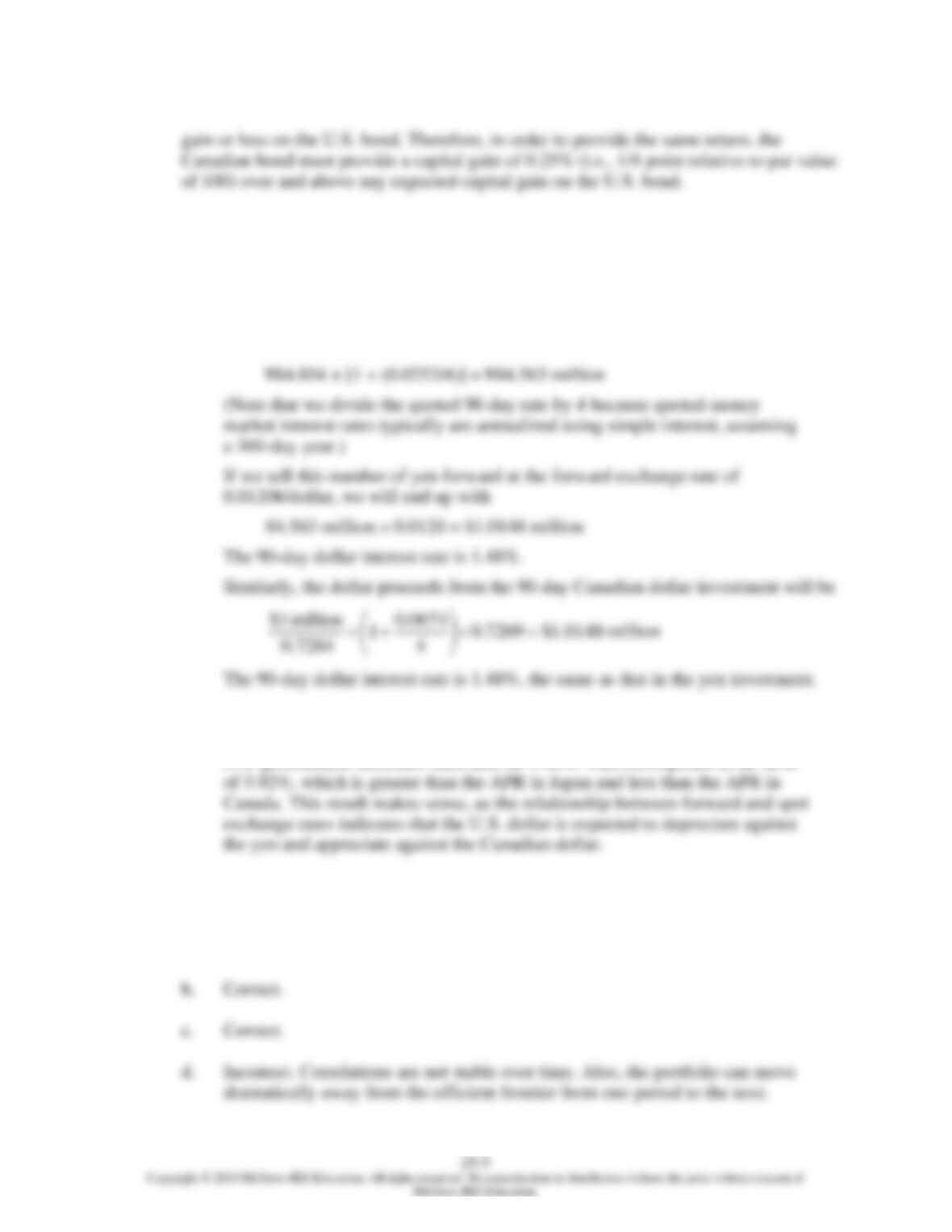
6. a. We exchange $1 million for foreign currency at the current exchange rate and sell
forward the amount of foreign currency we will accumulate 90 days from now. For
the yen investment, we initially receive:
1 million/0.0119 = ¥84.034 million
Invest for 90 days to accumulate:
b. The dollar-hedged rate of return on default-free government securities in both
Japan and Canada is 1.48%. Therefore, the 90-day interest rate available on
U.S. government securities must also be 1.48%. This corresponds to an APR
7. a. Incorrect. There have been periods of strong performance despite weak
currencies. It is also possible that an appreciating currency could enhance
performance.
Chapter 25 – International Diversification
25-6
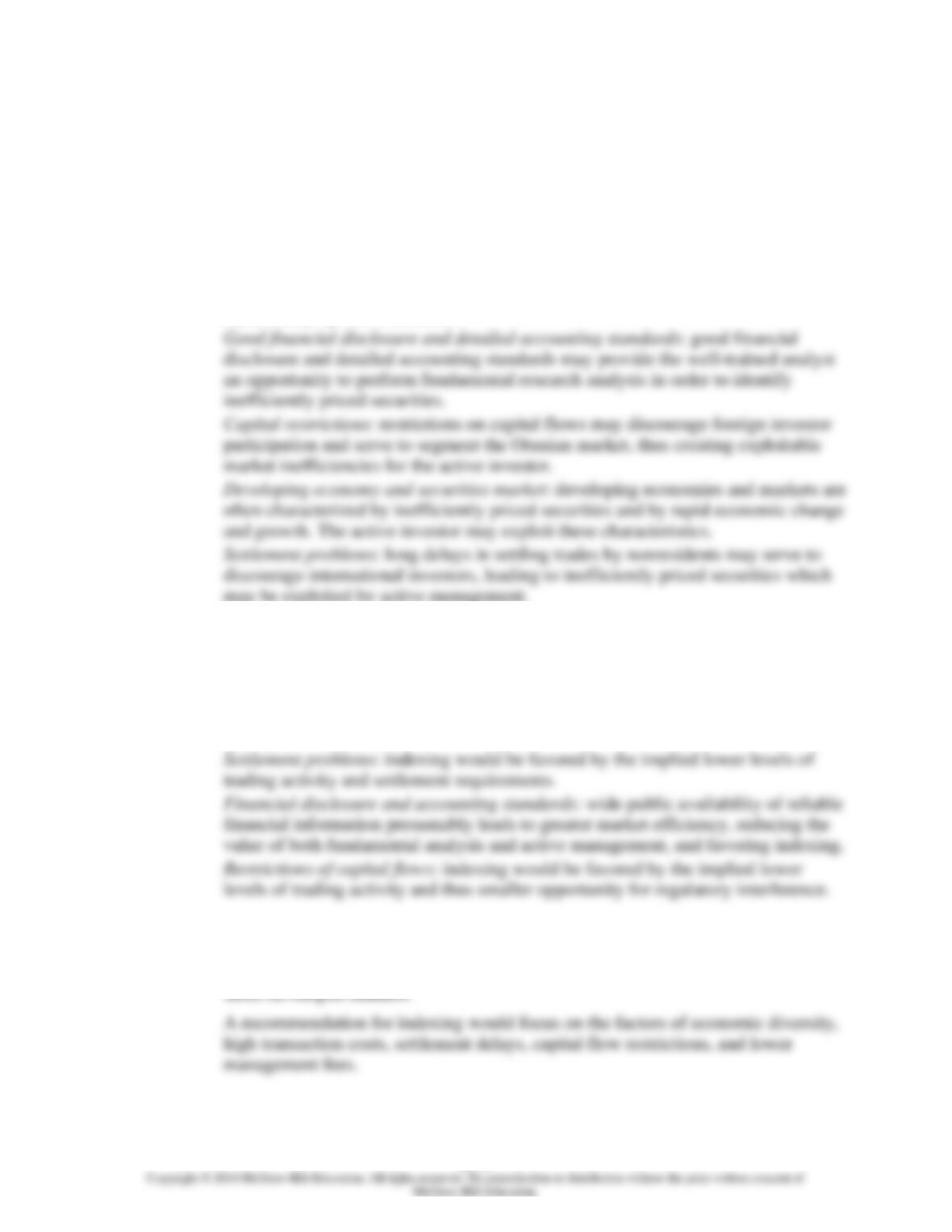
8. a. The following arguments could be made in favor of active management:
Economic diversity: the diversity of the Otunian economy across various sectors
may offer the opportunity for the active investor to employ “top-down” sector
timing strategies.
High transaction costs: very high transaction costs may discourage trading activity
by international investors and lead to inefficiencies that may be exploited
successfully by active investors.
may be exploited by active management.
The following arguments could be made in favor of indexing:
Economic diversity: economic diversity across a broad sector of industries implies
that indexing may provide a diverse representative portfolio that is not subject to the
risks associated with concentrated sectors.
High transaction costs: indexing would be favored by the implied lower levels of
trading activity and costs.
b. A recommendation for active management would focus on short-term
inefficiencies in, and long-term prospects for, the developing Otunian markets
and economy, inefficiencies and prospects which would not generally be found in