CHAPTER 25
BOND PERFORMANCE
MEASUREMENT AND EVALUATION
CHAPTER SUMMARY
In this chapter we will see how to measure and evaluate the investment performance of
a fixed-income portfolio manager. Performance measurement involves the calculation of the
return realized by a portfolio manager over some time interval, which we call the evaluation
REQUIREMENTS FOR A BOND PERFORMANCE AND
ATTRIBUTION ANALYSIS PROCESS
There are three desired requirements of a bond performance and attribution analysis process. The
PERFORMANCE MEASUREMENT
The starting point for evaluating the performance of a manager is measuring return. Because
different methodologies are available and these methodologies can lead to quite disparate results,
it is difficult to compare the performances of managers.
Alternative Return Measures
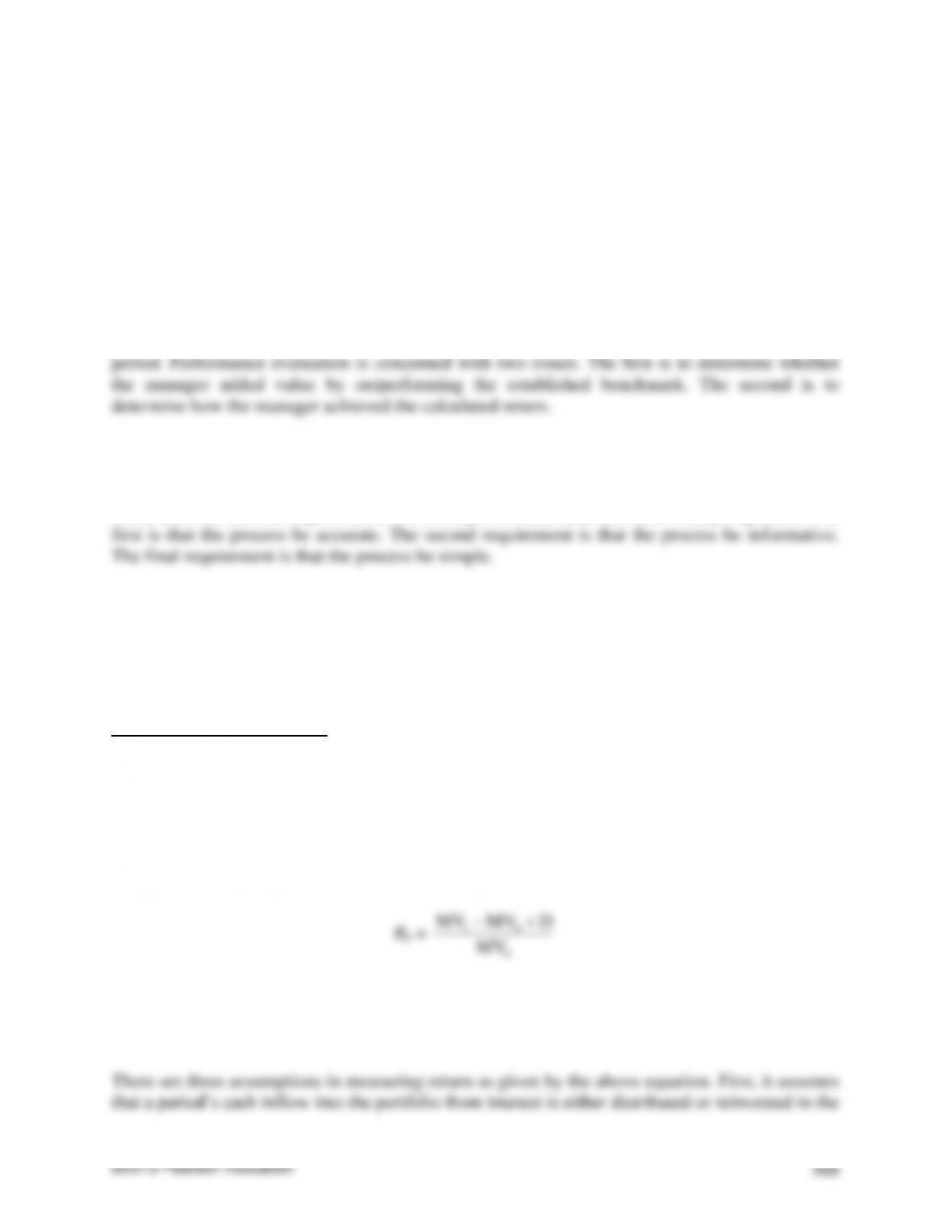
Let’s begin with the basic concept. The dollar return realized on a portfolio for any evaluation
period (i.e., a year, month, or week) is equal to the sum of (i) the difference between the market
value of the portfolio at the end of the evaluation period and the market value at the beginning of
the evaluation period, and (ii) any distributions made from the portfolio.
In equation form, the portfolio’s return can be expressed as follows:
0
MV
whereRp= return on the portfolio, MV1 = portfolio market value at the end of the evaluation
period; MV0 = portfolio market value at the beginning of the evaluation period; and, D= cash
distributions from the portfolio to the client during the evaluation period.
portfolio. Second, if there are distributions from the portfolio, they occur at the end of the
evaluation period or are held in the form of cash until the end of the evaluation period. Third, no
cash is paid into the portfolio by the client.
There are three methodologies that have been used in practice to calculate the average of the
subperiod returns: (1) the arithmetic average rate of return, (2) the time-weighted rate of return
(also called the geometric rate of return), and (3) the dollar-weighted rate of return.
Arithmetic Average Rate of Return
The arithmetic average rate of return is an unweighted average of the subperiod returns. The
general formula is
RA=
N
RRR PNPP +++
21
Time-Weighted Rate of Return
The time-weighted rate of return measures the compounded rate of growth of the initial
portfolio market value during the evaluation period, assuming that all cash distributions are
reinvested in the portfolio. It is also commonly referred to as the geometric rate of return
In general, the arithmetic and time-weighted average returns will give different values for the
portfolio return over some evaluation period. This is because in computing the arithmetic
average rate of return, the amount invested is assumed to be maintained (through additions or
Dollar-Weighted Rate of Return
The dollar-weighted rate of return is computed by finding the interest rate that will make the
present value of the cash flows from all the subperiods in the evaluation period plus the terminal
market value of the portfolio equal to the initial market value of the portfolio. Cash flows are
defined as follows:
The dollar-weighted rate of return is simply an internal rate-of-return calculation and hence it is
also called the internal rate of return. The general formula for the dollar-weighted return is
V0 =
( ) ( )
11
2
111
NN
N
DDD
CV
CC
RRR
+
+ + +
+++
The dollar-weighted rate of return and the time-weighted rate of return will produce the same
result if no withdrawals or contributions occur over the evaluation period and all investment
income is reinvested. The problem with the dollar-weighted rate of return is that it is affected by
©2013 Pearson Education
571
factors that are beyond the control of the manager. Specifically, any contributions made by the
client or withdrawals that the client requires will affect the calculated return. This makes it
difficult to compare the performance of two managers.
Annualizing Returns
The evaluation period may be less than or greater than one year. Typically, return measures are
reported as an average annual return. This requires the annualization of the subperiod returns.
The subperiod returns are typically calculated for a period of less than one year.
PERFORMANCE ATTRIBUTION ANALYSIS
Bond attribution models seek to identify the active management decisions that contributed to the
portfolio’s performance and give a quantitative assessment of the contribution of these decisions.
The performance of a portfolio can be decomposed in terms of four active strategies in managing
Benchmark Portfolios
To evaluate the performance of a manager, a client must specify a benchmark against which the
manager will be measured.
Plan sponsors work with pension consultants to develop normal portfolios for a manager. The
consultants use vendor systems that have been developed for performing the needed statistical
analysis and the necessary optimization program to create a portfolio displaying similar factor
positions to replicate the “normal” position of a manager. A plan sponsor must recognize that
there is a cost to developing and updating the normal portfolio.
©2013 Pearson Education
572
A more appropriate benchmark for institutional investors such as defined benefit pension plans is
one that reflects its liability structure. It has been argued that the major reason for the failure of
both public and private defined benefit plans is the wrong benchmarks have been used. Instead of
using a bond index as is commonly used, the appropriate benchmark should be one that is
customized liability index based on a specific pension plan’s actuarially determined liability
structure.
Performance Attribution Analysis Models
Clients of asset management firms need to have more information than merely if a portfolio
manager outperformed a benchmark and by how much. They need to know the reasons why
a portfolio manager realized the performance relative to the benchmark. It is possible that the
There are several performance attribution models that are available from third-party entities. In
selecting a third-party model, there are requirements that a good attribution model should possess
in order to evaluate the decision-making ability of the members of the portfolio management
team: additivity, completeness, and fairness. Additivity means that contribution to performance
Types of Performance Attribution Models
Today, performance attribution models can be classified into three types: sector-based attribution
models, factor-based attribution models, and hybrid sector-based/factor-based attribution models.
Factor-based attribution models actually allow a decomposition of the yield curve risk into level
risk and changes in the shape of the yield curve. For example, suppose that the attribution due to
yield curve risk is determined to be as follows:
Risk Factor
Portfolio D
Portfolio E
Portfolio F
Yield curve risk
140
1
–60
Level risk
135
60
3
Shape risk
5
−59
−63
KEY POINTS
• Performance measurement involves calculation of the return realized by a portfolio manager
over some evaluation period.
• Performance evaluation is concerned with determining whether the portfolio manager added
value by outperforming the established benchmark and how the portfolio manager achieved
the calculated return.
• The dollar-weighted rate of return is computed by finding the interest rate that will make the
present value of the cash flows from all the sub-periods in the evaluation period plus the
terminal market value of the portfolio equal to the initial market value of the portfolio.
The dollar-weighted rate of return is an internal rate-of-return calculation and will produce
the same result as the time-weighted rate of return if (1) no withdrawals or contributions occur
over the evaluation period, and (2) all coupon interest payments are reinvested.
ANSWERS TO QUESTIONS FOR CHAPTER 25
(Questions are in bold print followed by answers.)
1. What is the difference between performance measurement and performance evaluation?
2. Suppose that the monthly return for two bond managers is as follows:
Month
Manager I
Manager II
1
9%
25%
2
13%
13%
3
22%
22%
4
–18%
–24%
What is the arithmetic average monthly rate of return for the two managers?
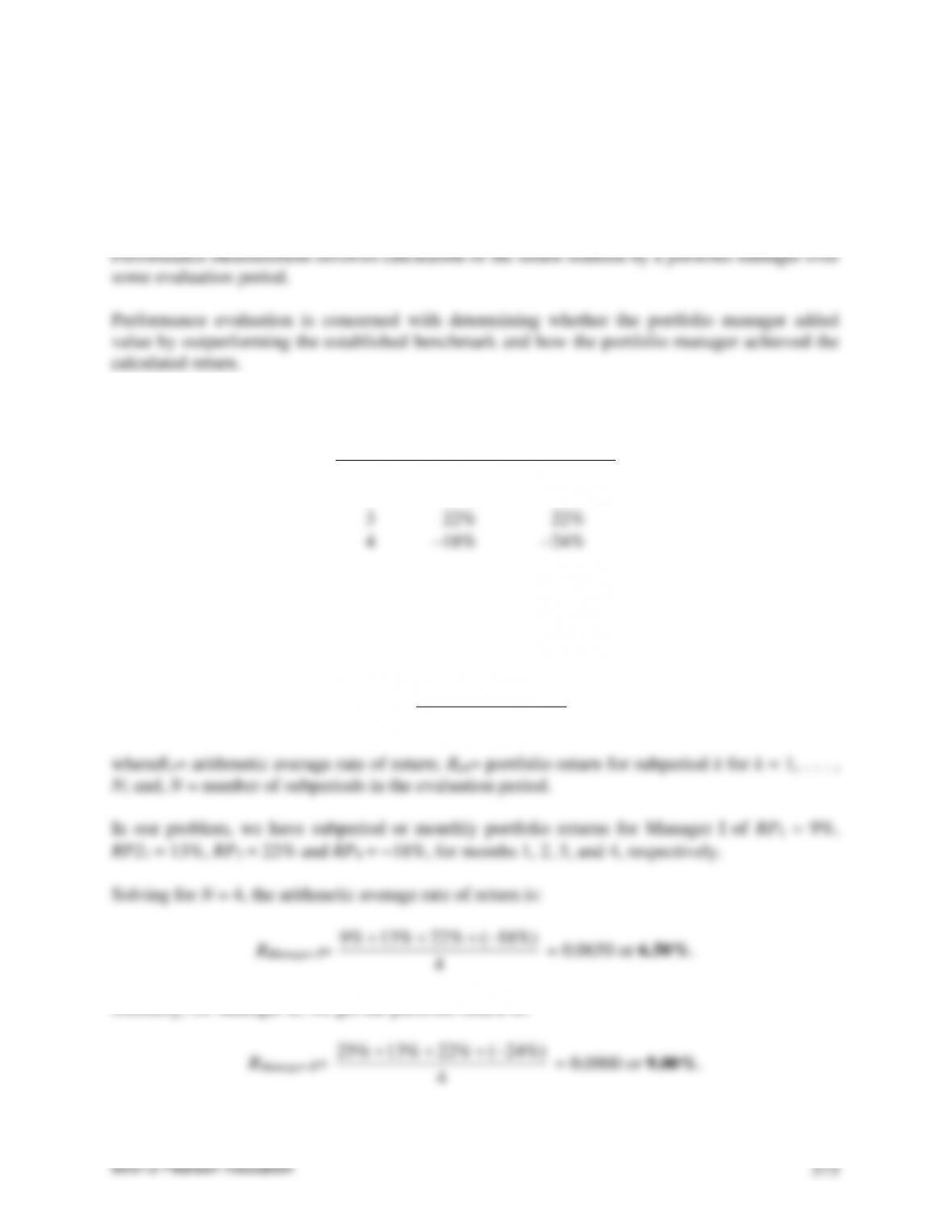
The arithmetic average rate of return is an unweighted average of the subperiod returns. The
general formula is
RA=
N
RRR PNPP +++
21
4
Similarly, for Manager II, we get the portfolio return of:
4
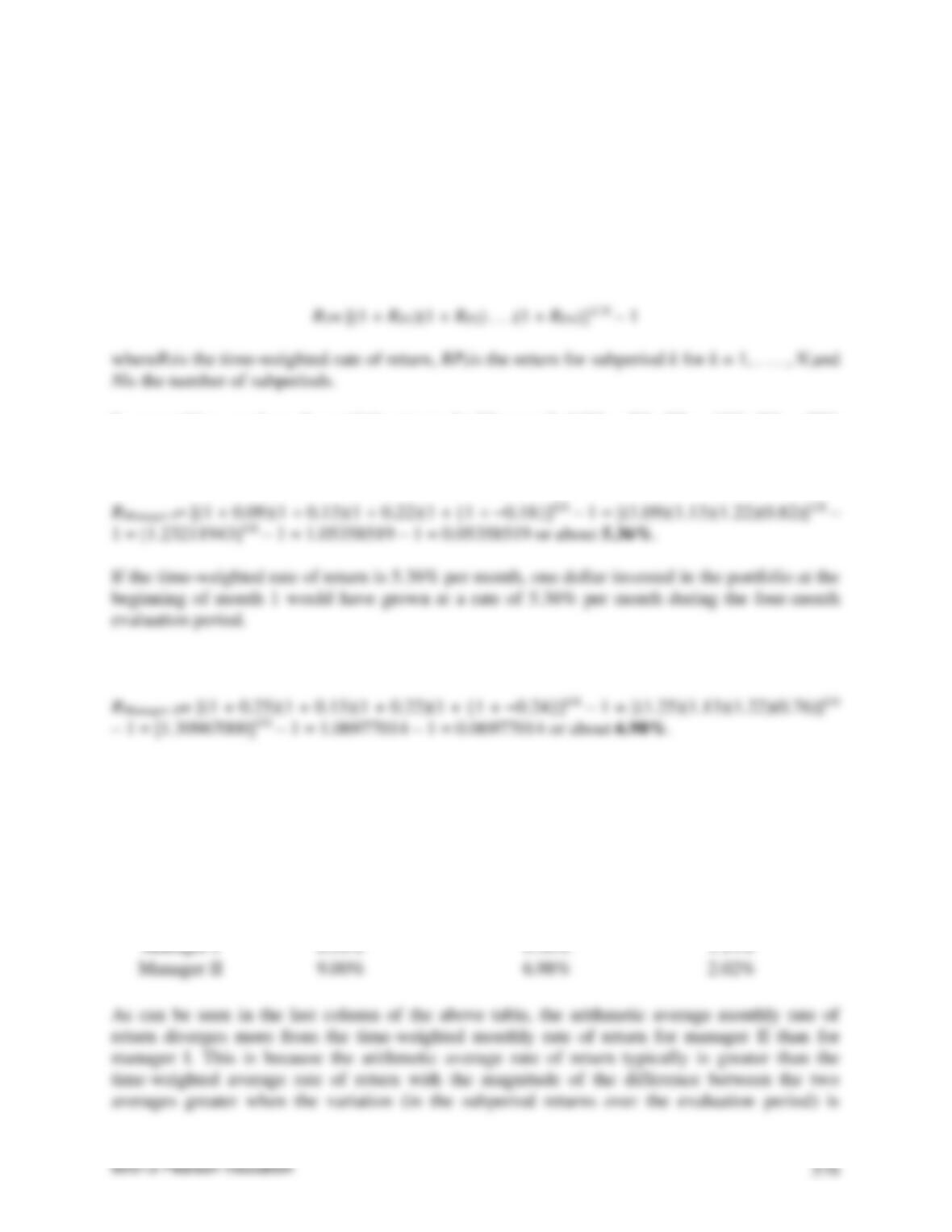
3. What is the time-weighted average monthly rate of return for the two managers in
Question 2?
The time-weighted rate of return measures the compounded rate of growth of the initial portfolio
market value during the evaluation period, assuming that all cash distributions are reinvested in
the portfolio. It is also commonly referred to as the geometric rate of return because it is
computed by taking the geometric average of the portfolio subperiod returns. The general
formula is
In our problem, we have the portfolio returns for Manager I of RP1 = 9%, RP2 = 13%, RP3 = 22%
and RP4 = −18%, for months 1, 2, 3, and 4, respectively. Solving for N = 4, the time-weighted rate
of return is:
Similarly, for Manager II, we get the portfolio return of:
4. Why does the arithmetic average monthly rate of return diverge more from the
time-weighted monthly rate of return for manager II than for manager I in Question 2?
The table below summarizes the managerial performances and differences between the two types
of monthly returns.
Two Types of Monthly Returns:
Arithmetic Average Return
Time-Weighted Return
Difference in Returns
Manager I
6.50%
5.36%
1.14%
Manager II
9.00%
6.98%
2.02%
As can be seen in the last column of the above table, the arithmetic average monthly rate of
return diverges more from the time-weighted monthly rate of return for manager II than for
manager I. This is because the arithmetic average rate of return typically is greater than the
time-weighted average rate of return with the magnitude of the difference between the two
averages greater when the variation (in the subperiod returns over the evaluation period) is
greater. Thus, because there is more variation in returns for Manager II, this causes a greater
difference between the arithmetic average monthly rate of return and the time-weighted monthly
rate of return. More details are given below.
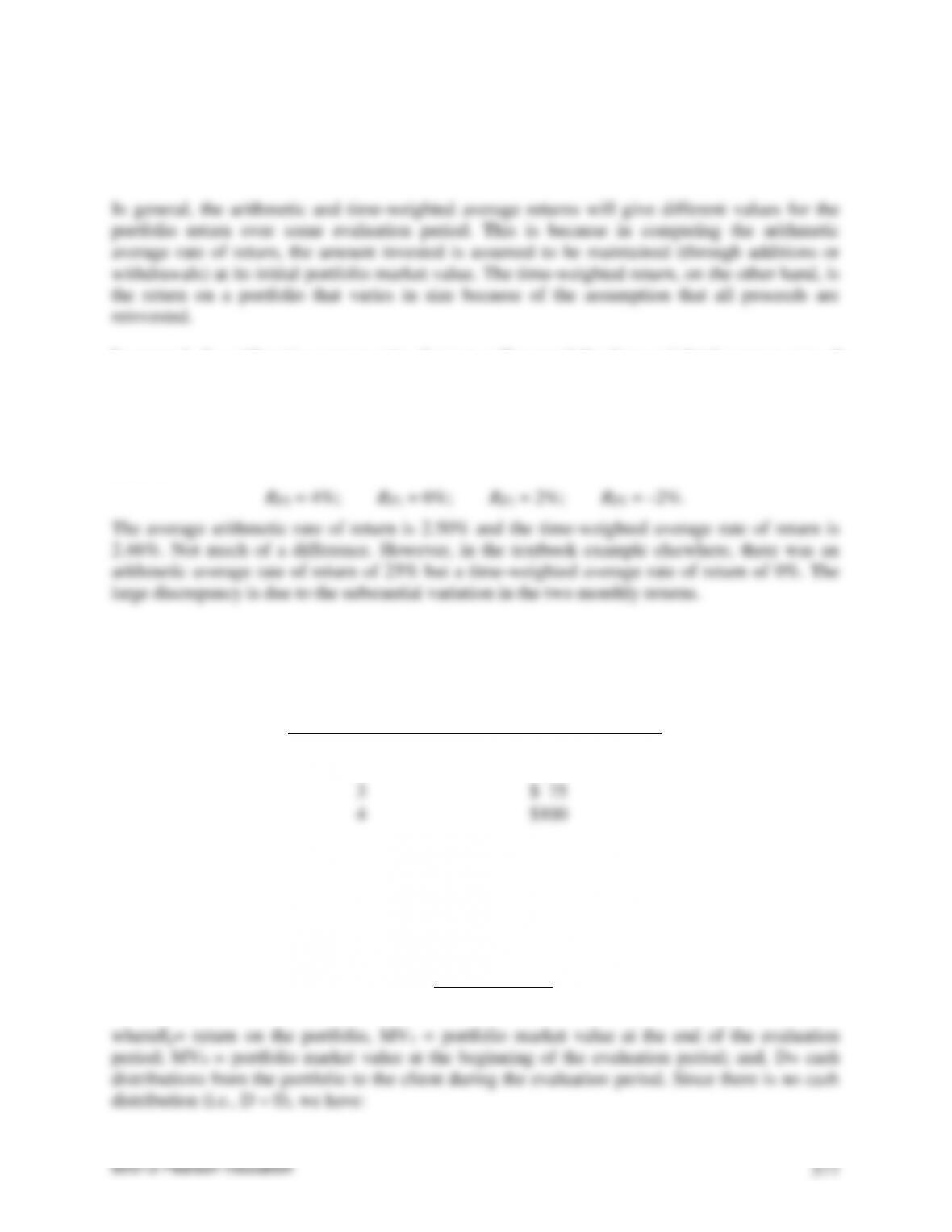
In general, the arithmetic average rate of return will exceed the time-weighted average rate of
return. The exception is in the special situation where all the subperiod returns are the same, in
which case the averages are identical. The magnitude of the difference between the two averages
is smaller the less the variation in the subperiod returns over the evaluation period. For example,
suppose that the evaluation period is four months and that the four monthly returns are as
follows:
5. Smith & Jones is a money management firm specializing in fixed-income securities. One
of its clients gave the firm $100 million to manage. The market value for the portfolio for
the four months after receiving the funds was as follows:
End of Month
Market Value (in millions)
1
$ 50
2
$150
3
$ 75
4
$100
Answer the below questions based on the above table.
(a) Calculate the rate of return for each month.
In equation form, the portfolio’s return can be expressed as follows:
Rp =
10
0
MV MV D
MV
−+
Rp=
10
0
MV MV
MV
−
.
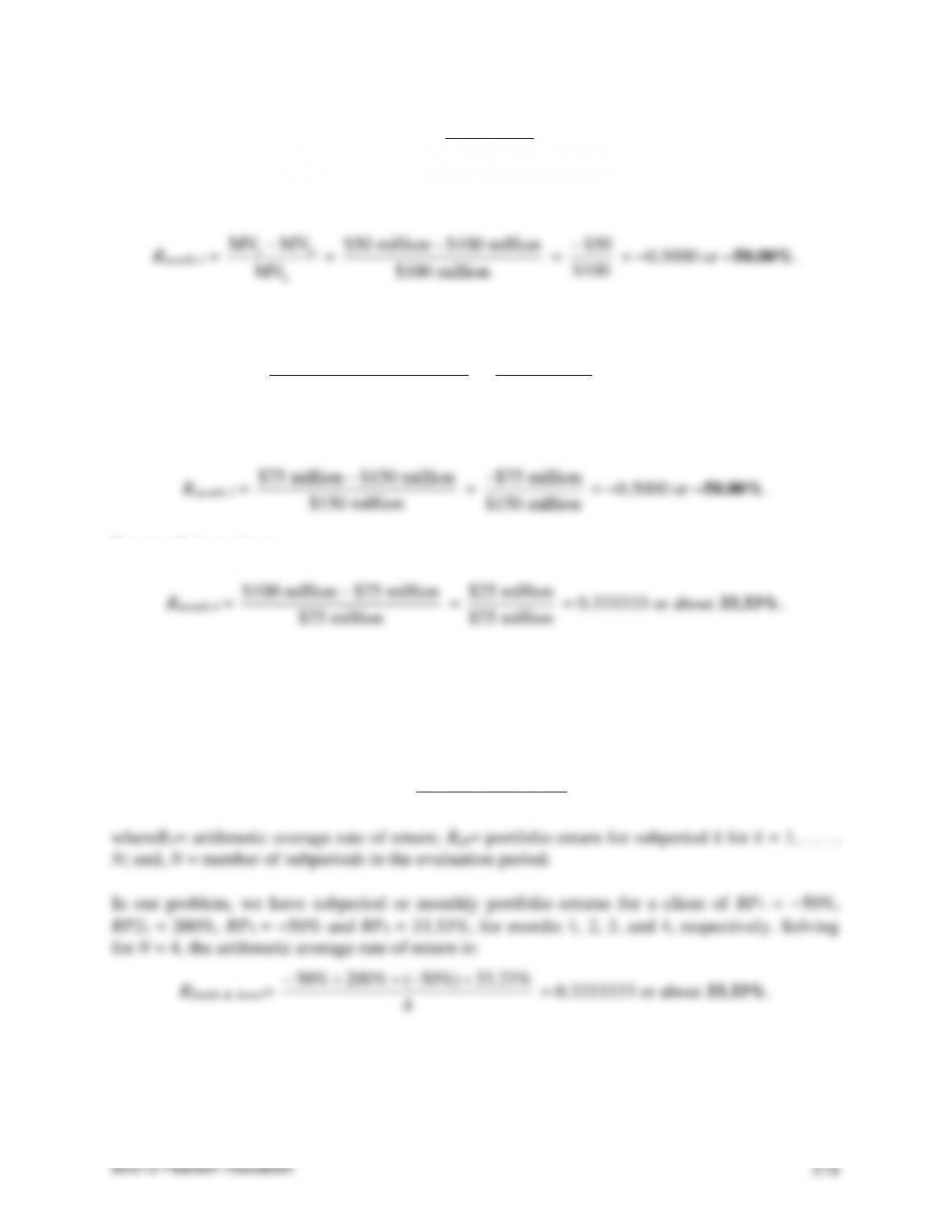
For period or month 1, we have:
10
−
0
MV
$100 million
100$
For month 2, we have:
Rmonth 2 =
$150 million $50 million
$50 million
−
=
$100 million
$50 million
= 2.000 or 200.00%.
For month 3, we have:
For month 4, we have:
$75 million
$75 million
(b) Smith & Jones reported to the client that over the four-month period the average
monthly rate of return was 33.33%. How was that value obtained?
The value was obtained by using arithmetic average rate of return, which is an unweighted
average of the subperiod returns. The general formula is
RA=
N
RRR PNPP +++
21
4